Maduro is Taking Venezuela Where Castro Tells Him

The rogue countries across the globe are Russia, Iran, North Korea, China and Cuba. What is in common here is they have each other and they work their foreign policy agendas in locations that threaten the West at every turn including militarily.

Iran, China and Russia are running the influence operations in North Korea. Russia is running the influence operation in Cuba, Nicaragua, Bolivia and Syria. China and Pakistan is the enabler to North Korea. China is in Africa, Russia is in Africa, Iran is in Iraq and Afghanistan….they are all policy, money and oil opportunists….crazy right?

The Star

A video showing more than a dozen men dressed in military fatigues, some carrying rifles, began circulating widely on social media around that time. In the recording, a man who identified himself as Capt. Juan Caguaripano said the men were members of the military who oppose Maduro’s socialist government and called on military units to declare themselves in open rebellion.

“This is not a coup d’etat,” the man said. “This is a civic and military action to re-establish the constitutional order.” More from the Associated Press.

So, while Venezuela is in a full blown tailspin….who owns the chaos there via Maduro? Cuba…

2004, the agreement was signed.

To further help, the University of Miami has an archived summary here.

So, it goes like this and the burden belongs to Obama and John Kerry for the plight of Venezuelans.

Photo

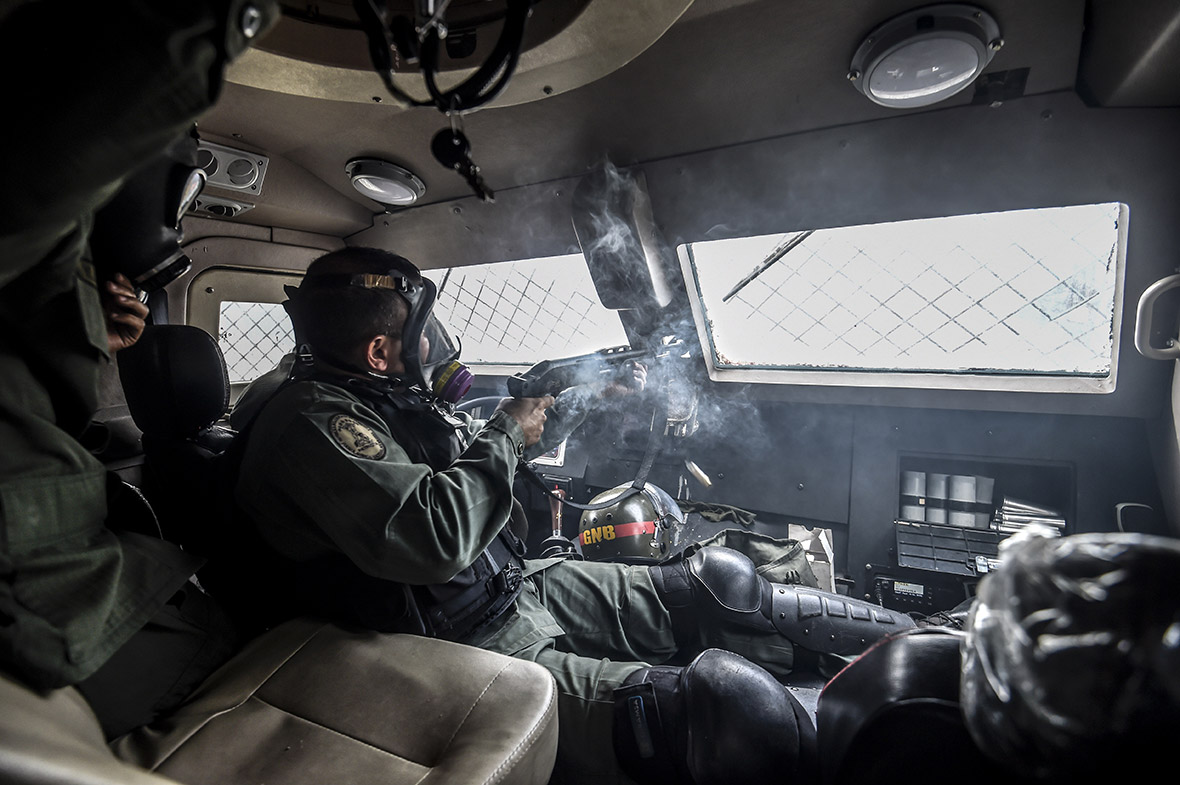
The Guns of Venezuela

Castro is calling the shots in Caracas. Sanctions have to be aimed at him.

WSJ: In a video posted on the internet Sunday morning, former Venezuelan National Guard captain Juan Caguaripano, along with some 20 others, announced an uprising against the government of Nicolás Maduro to restore constitutional order. The rebels reportedly appropriated some 120 rifles, ammunition and grenades from the armory at Fort Paramacay in Valencia, the capital of Carabobo state. There were unconfirmed claims of similar raids at several other military installations including in Táchira.

The Cuba-controlled military regime put tanks in the streets and unleashed a hunt for the fleeing soldiers. It claims it put down the rebellion and it instructed all television to broadcast only news of calm. But Venezuelans were stirred by the rebels’ message. There were reports of civilians gathering in the streets to sing the national anthem in support of the uprising.

Note to Secretary of State Rex Tillerson: Venezuelans want to throw off the yoke of Cuban repression. They need your help.

Unfortunately Mr. Tillerson so far seems to be taking the bad advice of his State Department “experts.”

The same bureaucrats, it should be noted, ran Barack Obama’s Latin America policy. Those years gave us a rapprochement with Havana that culminated with the 44th president doing “the wave” with Raúl Castro at a baseball game in 2016. Team Obama also pushed for Colombia’s surrender to the drug-trafficking terrorist group FARC in a so-called peace deal last year. And it supported “dialogue” last year to restore free, fair and transparent elections in Venezuela. The result, in every case, was disaster.

Any U.S.-led international strategy to liberate Venezuela must begin with the explicit recognition that Cuba is calling the shots in Caracas, and that Havana’s control of the oil nation is part of its wider regional strategy.

Slapping Mr. Maduro’s wrist with sanctions, as the Trump administration did last week, won’t change Castro’s behavior. He cares only about his cut-rate Venezuelan oil and his take of profits from drug trafficking. To affect things in Venezuela, the U.S. has to press Cuba.

Burning Cuban flags, when they can be had, is now practically a national pastime in Venezuela because Venezuelans understand the link between their suffering and Havana. The Castro infiltration began over a decade ago when Fidel sent thousands of Cuban agents, designated as teachers and medical personnel, to spread propaganda and establish communist cells in the barrios.

As I noted in this column last week, since 2005 Cuba has controlled Venezuela’s citizen-identification and passport offices, keeping files on every “enemy” of the state—a k a political opponents. The Venezuelan military and National Guard answer to Cuban generals. The Venezuelan armed forces are part of a giant drug-trafficking operation working with the FARC, which is the hemisphere’s largest cartel and also has longstanding ties to Cuba.

These are the tactical realities of the Cuba-Venezuela-Colombia nexus. The broader strategic threat to U.S. interests, including Cuba’s cozy relationship with Middle East terrorists, cannot be ignored.

Elisabeth Burgos is the Venezuelan ex-wife of the French Marxist Regis Debray. She was born in Valencia, joined the Castro cause as a young woman, and worked for its ideals on the South American continent.

Ms. Burgos eventually broke free of the intellectual bonds of communism and has lived in Paris for many years. In a recent telephone interview—posted on the Venezuelan website Prodavinci—she warned of the risks of the “Cuban project” for the region. “Wherever the Cubans have been, everything ends in tragedy,” she told Venezuelan journalist Hugo Prieto. “Surely we have no idea what forces we face,” Mr. Prieto observed—reflecting as a Venezuelan on the words of Ms. Burgos—because, as she said, there is “a lot of naiveté, a lot of ignorance, about the apparatus that has fallen on [Venezuelans]: Castroism.”

Cuban control of citizens is as important as control of the military. In Cuba this is the job of the Interior Ministry. For that level of control in Venezuela, Ms. Burgos said, Mr. Maduro must rely on an “elite of exceptional experts” Castro grooms at home.

Cuba, Ms. Burgos said, is not “simply a dictatorship.” For the regime it is a “historical political project” aiming for “the establishment of a Cuban-type regime throughout Latin America.” She noted that along with Venezuela the Cubans have taken Nicaragua, Bolivia, Ecuador, and are now going after Colombia. “The FARC, turned into a political party and with all the money of [the narcotics business], in an election can buy all the votes that it wants.”

Mr. Tillerson is forewarned. Castro won’t stop until someone stops him. To get results, any U.S.-led sanctions have to hit the resources that Havana relies on to maintain the repression.

Blame Obama and Brennan for Venezuela, Maduro

Some facts on Venezuela under Chavez and now Maduro. When it comes to blame on why the country is in a tailspin and on the way to be a failed state where people are suffering beyond measure, rogue foreign leaders flock together and Obama/Brennan knew this was coming.

VIR

Venezuela is part of SWIFT, the Society for Worldwide Interbank Financial Telecommunications. SWIFT knows precisely all the global transactions into and out of Venezuela including the country’s dealings with Syria, Iran, and Russia.

Related reading: Inside the Hell of Venezuelan Police Prisons

Venezuela has received at least $36 billion in loans from China that have helped finance two economic development funds focused largely on infrastructure projects. Five people in raids that we carried out in Caracas linked to the embezzlement of $84 million from the Chinese Fund and Bandes. Maduro pledged to stop the corruption. Right huh? What about $300 billion?

Oops, there is more: How about the loan for oil program?

Under Chavez, several global oil deals were signed that included India, China and Russia. Under Maduro, the production has failed to meet contractual agreements. Caracas needs the oil to pay debts to China and Russia, key political allies that have together lent Venezuela at least $50 billion in exchange for promised crude and fuel deliveries.

According to Reuters, former ministers Héctor Navarro and Jorge Giordani are accusing government workers of pocketing more than $300 billion in crude oil revenue over the past decade. They are demanding the government account for these funds and investigate into whose hands they went. Navarro has personally requested that “a state ethics council review the operations of the 13-year-old exchange control mechanism that opposition leaders have described as a ‘corruption machine.’”

Another former Chávez minister, Ana Elisa Osorio, petitioned the Republican National Council, a government watchdog group, to investigate the case. “In the last two years, we have found missing $20 billion from the Republic’s funds. This is why we resort here to calling for a meeting of regulators, the treasury, and the national attorney’s office,” Osorio said. More here.

Oh yeah, we cant leave out Goldman Sachs. In 2016, Goldman Sachs confirmed its asset management arm had bought $2.8 billion of another bond issued by Venezuela’s state oil company PDVSA at a steep discount.

SantiagoTimes

So on to some other facts that rogue leaders overlook, including the United States when it comes to heading off the tailspin and eventual failure of a state resulting in disgusting human rights violations.

2011: Iran began building intermediate-range missile launch pads on the Paraguaná Peninsula, and engineers from a construction firm – Khatam al-Anbia – owned by the Revolutionary Guards visited Paraguaná in February. Amir al-Hadschisadeh, the head of the Guard’s Air Force, approved the visit, according to the report. Die Welt cited information from “Western security insiders.”

In 2015: Drug smuggling is thought to be on the rise in Venezuela, with many public officials complicit. According to the BBC, the US has already sanctioned at least 50 whom it accuses of human rights abuses and drug trafficking.

Pressure on the drug trade in neighbouring Colombia appears to have forced many narco-traffickers over the border. While Venezuela does not grow the coca plant or manufacture cocaine, estimates in the US State Department’s annual International Narcotics Control Strategy Reports suggest that between 161 and 212 metric tons of cocaine are shipped from the country each year, although data is scarce.

In its most recent such report, published in March 2015, the US State Department reported that “public corruption is a major problem in Venezuela that makes it easier for drug-trafficking organizations to move and smuggle illegal drugs”. More here.

IBTimes

Related reading: Trump should muster an international rescue of Venezuela

2017: Maduro named Tareck El Aissami as the Vice President.

That means that, in a country of complete and utter chaos — where people are starving, healthcare is nonexistent, electricity is scarce, and vigilante justice is becoming a norm — a suspected terrorist is one heartbeat away from the highest office in the land.

El Aissami is a known entity in the world of US intelligence. He is allegedly a part of Venezuela’s state drug-trafficking network and has ties to Iran, Syria, and Lebanese terrorist group Hezbollah.

Joseph Humire, coauthor of “Iran’s Strategic Penetration in Latin America” and founder of the Center for a Secure Free Society (SFS) think tank, testified to the same effect before the House Committee on Foreign Affairs last year.

Over the years, El Aissami developed a sophisticated, multi-layered financial network that functions as a criminal-terrorist pipeline bringing militant Islamists into Venezuela and surrounding countries, and sending illicit funds and drugs from Latin America to the Middle East.

“His financial network consists of close to 40 front companies that own over 20 properties with cash, vehicles, real estate and other assets sitting in 36 bank accounts spread throughout Venezuela, Panama, Curacao, St. Lucia, Southern Florida and Lebanon. This network became integrated with the larger Ayman Joumaa moneylaundering network that used the Lebanese Canadian Bank to launder hundreds of million of dollars and move multi-ton shipments of cocaine on behalf of Colombian and Mexican drug cartels as well as Hezbollah.

“This immigration scheme is suspected to also be in place in Ecuador, Nicaragua and Bolivia, as well as some Caribbean countries.”

In 2016: A jury in New York found two relatives of Venezuelan President Nicolas Maduro guilty on Friday of attempting to import 800 kilograms of cocaine into the United States. Franqui Francisco Flores de Freitas and Efrain Antonio Campo Flores, both nephews of Maduro’s wife Cilia Flores, were arrested in November 2015 in Haiti in an investigation that saw Drug Enforcement Agency (DEA) informants pose as Mexican traffickers and meet with the nephews. More here.

Further on that case during trial it was revealed that Flores and Campo are the nephews of Cilia Flores, the wife of President Maduro and a politician in her own right. According to trial testimony, they were planning to move cocaine for the Revolutionary Armed Forces of Colombia (FARC) through Venezuela via the president’s private hangar at the Simon Bolivar International Airport in Caracas.

They expected the deal to bring them as much as $11 million, some of which was to be used to help fund Cilia Flores’ re-election campaign.

Largest Dark Web Hub for Illicit Drugs, Firearms, Malware Shutdown

Largest Dark Web Marketplace for Illicit Drugs, Firearms, Malware and More Shut Down

The largest criminal marketplace on the dark web for the illicit trade of drugs, firearms, computer hacking tools and more was shut down Thursday, the US Department of Justice (DOJ) announced.

The online marketplace, called AlphaBay, operated for more than two years, allowing buyers and sellers to anonymously exchange illegal goods and services like drugs, toxic chemicals, stolen and fraudulent identification documents and malware.

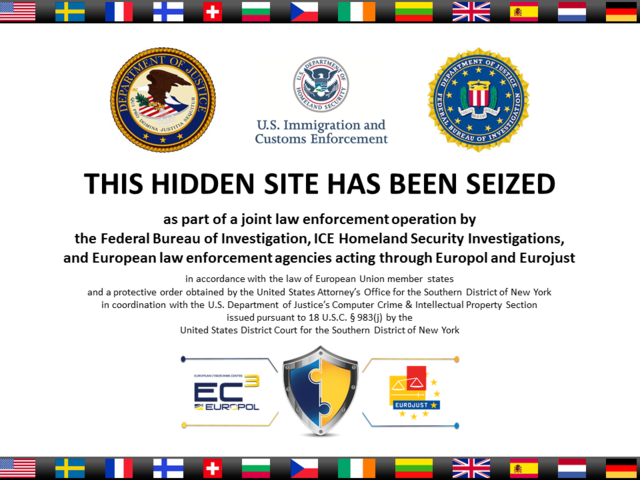
SilkRoad SeizureAlert placed on the Silk Road dark web criminal marketplace’s homepage after its seizure in 2013 (Photo: FBI, Public Domain Mark 1.0)

AlphaBay was hosted on the dark web, a hidden part of the internet that users require special software to access. One of the most common ways to access the dark web is by using a browser called Tor, which prevents network surveillance and essentially renders a user anonymous online.

Financial transactions between users on AlphaBay were conducted using cryptocurrencies, namely Bitcoin, Monero and Ethereum, according to the DOJ. Authorities believe the site was used to launder hundreds of millions of dollars from such illegal transactions.

AlphaBay was also linked to multiple overdose deaths in the US as a “major source” of fentanyl and heroin, The Independent reported.

The investigations that led to Thursday’s seizure of AlphaBay and Hansa, another major criminal market on the dark web, were led by the Federal Bureau of Investigation (FBI), the US Drug Enforcement Agency and the Dutch National Police, according to Europol, which also supported the operations.

Law enforcement agencies in Thailand, Lithuania, Canada, the UK and France also cooperated in the seizure of AlphaBay and Hansa’s digital infrastructure.

“Transnational organized crime poses a serious threat to our national and economic security,” said FBI Acting Director Andrew McCabe.

“Whether they operate in broad daylight or on the dark net, we will never stop working to find and stop these criminal syndicates.”

Authorities were able to take AlphaBay down in early July when they took the site’s alleged founder Alexandre Cazes into custody, The New York Times reported.

Cazes, 25, was a Canadian citizen living in Bangkok, Thailand. A few days after being arrested, on July 12, Cazes apparently committed suicide.

He was found to have possessed millions of dollars in cryptocurrency and luxury assets around the world, including expensive vehicles, residences and a hotel in Thailand.

At the time of its takedown, AlphaBay hosted more than 250,000 listings for illegal drugs and chemicals and more than 100,000 listings for stolen or fake documents, counterfeit goods, firearms and other illicit goods and services.

By comparison, the marketplace’s scope dwarfed the former largest illegal dark web exchange called the Silk Road, which was taken down in 2013 and had about 14,000 listings.

Europol Executive Director Rob Wainwright called AlphaBay’s demise a “massive blow to the underground criminal economy.”

However, the authorities’ fight against dark web markets is likely to continue.

In the wake of AlphaBay and Hansa’s seizure, NBC News reported a spike in traffic to a former competitor of the two marketplaces called DreamMarket, which might now enjoy a corner on the illegal market.

***

The U.S. Attorney’s Office for the Eastern District of California filed a civil forfeiture complaint against Alexandre Cazes and his wife’s assets located throughout the world, including in Thailand, Cyprus, Lichtenstein, and Antigua & Barbuda. Cazes and his wife amassed numerous high value assets, including luxury vehicles, residences and a hotel in Thailand. Cazes also possessed millions of dollars in cryptocurrency, which has been seized by the FBI and the Drug Enforcement Administration (DEA).

According to publicly available information on AlphaBay prior to its takedown, one AlphaBay staff member claimed that it serviced over 200,000 users and 40,000 vendors.  Around the time of takedown, there were over 250,000 listings for illegal drugs and toxic chemicals on AlphaBay, and over 100,000 listings for stolen and fraudulent identification documents and access devices, counterfeit goods, malware and other computer hacking tools, firearms and fraudulent services. Comparatively, the Silk Road dark web marketplace, which was seized by law enforcement in November 2013, had reportedly approximately 14,000 listings for illicit goods and services at the time of seizure and was the largest dark web marketplace at the time.

“This is likely one of the most important criminal investigations of the year – taking down the largest dark net marketplace in history,” said Attorney General Jeff Sessions. “Make no mistake, the forces of law and justice face a new challenge from the criminals and transnational criminal organizations who think they can commit their crimes with impunity using the dark net.  The dark net is not a place to hide. The Department will continue to find, arrest, prosecute, convict, and incarcerate criminals, drug traffickers and their enablers wherever they are. We will use every tool we have to stop criminals from exploiting vulnerable people and sending so many Americans to an early grave. I believe that because of this operation, the American people are safer – safer from the threat of identity fraud and malware, and safer from deadly drugs.”

“Transnational organized crime poses a serious threat to our national and economic security,” said Acting Director Andrew McCabe of the FBI. “Whether they operate in broad daylight or on the dark net, we will never stop working to find and stop these criminal syndicates.  We want to thank our international partners and those at the Department of Justice, the DEA and the IRS-CI for their hard work in demonstrating what we can do when we stand together.” More here.

Abuse of the Civil Asset Forfeiture Law

Related reading: The Myth of Judicial Activism

The Supreme Court struck down less than 1% of the federal laws passed over a 50-year period.

*** Questions must be asked why is the Justice Department re-applying this program and to what end?

Criminal forfeiture is an action brought as a part of the criminal prosecution of a defendant. It is an in personam (against the person) action and requires that the government indict (charge) the property used or derived from the crime along with the defendant. If the jury finds the property forfeitable, the court issues an order of forfeiture.

For forfeitures pursuant to the Controlled Substances Act (CSA), Racketeer Influenced and Corrupt Organizations (RICO), as well as money laundering and obscenity statutes, there is an ancillary hearing for third parties to assert their interest in the property. Once the interests of third parties are addressed, the court issues a final forfeiture order.

Civil judicial forfeiture is an in rem (against the property) action brought in court against the property. The property is the defendant and no criminal charge against the owner is necessary.

Administrative forfeiture is an in rem action that permits the federal seizing agency to forfeit the property without judicial involvement. The authority for a seizing agency to start an administrative forfeiture action is found in the Tariff Act of 1930, 19 U.S.C. § 1607. Property that can be administratively forfeited is: merchandise the importation of which is prohibited; a conveyance used to import, transport, or store a controlled substance; a monetary instrument; or other property that does not exceed $500,000 in value.

Source: A Guide to Equitable Sharing of Federally Forfeited Property for State and Local Law Enforcement Agencies, U.S. Department of Justice, March 1994.

Participants And Roles

The Justice Asset Forfeiture Program includes activity by DOJ components and several components outside the Department. Each component plays an important role in the Program.

Department of Justice Components

Money Laundering and Asset Recovery Section (MLARS) of the Criminal Division holds the responsibility of coordination, direction, and general oversight of the Program. AFMLS handles civil and criminal litigation, provides legal support to the U.S. Attorneys’ Offices, establishes policy and procedure, coordinates multi-district asset seizures, administers equitable sharing of assets, acts on petitions for remission, coordinates international forfeiture and sharing and develops training seminars for all levels of government.

Bureau of Alcohol, Tobacco, Firearms and Explosives (ATF) enforces the federal laws and regulations relating to alcohol, tobacco, firearms, explosives and arson by working directly and in cooperation with other federal, state and local law enforcement agencies. ATF has the authority to seize and forfeit firearms, ammunition, explosives, alcohol, tobacco, currency, conveyances and certain real property involved in violation of law.

Drug Enforcement Administration (DEA) implements major investigative strategies against drug networks and cartels. Enforcement operations have resulted in significant seizure and forfeiture activity. A significant portion of DEA cases are adopted from state and local law enforcement agencies.

Federal Bureau of Investigation The FBI investigates a broad range of criminal violations, integrating the use of asset forfeiture into its overall strategy to eliminate targeted criminal enterprises. The FBI has successfully used asset forfeiture in White Collar Crime, Organized Crime, Drug, Violent Crime and Terrorism investigations. See the FBI Investigative Programs Asset Forfeiture Home Page for more information.

United States Marshals Service as the primary custodian of seized property for the Program. USMS manages and disposes of the majority of the property seized for forfeiture. See their Seized Asset Information page and their National Sellers List for more information.

United States Attorneys’ Offices (USAOs) are responsible for the prosecution of both criminal and civil actions against property used or acquired during illegal activity.

Asset Forfeiture Management Staff (AFMS): Has responsibility for management of the Assets Forfeiture Fund, the Consolidated Asset Tracking System (CATS), program-wide contracts, oversight of program internal controls and property management, interpretation of the Assets Forfeiture Fund statute, approval of unusual Fund uses, and legislative liaison on matters affecting the financial integrity of the Program.

Components Outside the Department of Justice

There are several organizations outside the Department of Justice who participate in the DOJ Asset Forfeiture Program. This list may change as additional agencies and offices become part of the DOJ program. These agencies participate in Judicial forfeitures only.

United States Postal Inspection Service (USPIS) makes seizures under their authority to discourage profit-motivated crimes such as mail fraud, money laundering and drug trafficking using the mail.

Food and Drug Administration FDA’s Office of Criminal Investigations has made seizures involving health care fraud schemes, counterfeit pharmaceuticals, illegal distribution of adulterated foods, and product tampering.

United States Department of Agriculture, Office of the Inspector General USDA’s Office of Inspector General’s (OIG) mission is to promote effectiveness and integrity in the delivery of USDA agricultural programs. Forfeiture is integrated as an important law enforcement tool in combating criminal activity affecting USDA programs.

Department of State, Bureau of Diplomatic Security The Bureau of Diplomatic Security investigates passport and visa fraud and integrates asset forfeiture into our strategy to target the profits made by vendors who provide fraudulent documentation or others who utilize fraudulent visas and/or passports to further their criminal enterprises.

Defense Criminal Investigative Service (DCIS) is the criminal investigative arm of the Inspector General of the Department of Defense. The mission of DCIS is to protect America’s War fighters by conducting investigations and forfeitures in support of crucial National Defense priorities that include homeland security/terrorism, product substitution, contract fraud, public corruption, computer crimes, and illegal technology transfers. ”

The Comprehensive Crime Control Act of 1984 established the Department of Justice Assets Forfeiture Fund to receive the proceeds of forfeiture and to pay the costs associated with such forfeitures, including the costs of managing and disposing of property, satisfying valid liens, mortgages, and other innocent owner claims, and costs associated with accomplishing the legal forfeiture of the property.

The Attorney General is authorized to use the Assets Forfeiture Fund to pay any necessary expenses associated with forfeiture operations such as property seizure, detention, management, forfeiture, and disposal. The Fund may also be used to finance certain general investigative expenses. These authorized uses are enumerated in 28 U.S.C. §524(c). Read more here.

Hezbollah Terror Cells in Lebanon and Latin America

Kuwait expels Iranian diplomats over ‘terror’ cell: United Nations (United States) (AFP) – US Ambassador Nikki Haley on Wednesday accused Lebanon’s Hezbollah of amassing weapons and said the world must turn its attention to the actions of the powerful paramilitary organization.

  kataeb

Anyone ever ask or investigate the Hezbollah weapons inventory in Latin America?


No Latin American Country Has Branded Hezbollah a Terror Group Despite Ties to Major Attacks

WASHINGTON, D.C.—Latin American countries have failed to register Iranian proxy Hezbollah as a terrorist organization despite the threat it poses to the region, a Peruvian official revealed during a discussion on Capitol Hill.

The Shiite group is involved in various illicit activities in Latin America to generate money that some experts believe is used to fund terrorist activities in the Middle East.

During a discussion Wednesday on Capitol Hill hosted by the Center for a Secure Free Society (SFS), Moises Vega de la Cruz, a public prosecutor for the Peruvian government specializing in terrorism cases, revealed that “in Latin America, Hezbollah is not recognized as a terrorist organization.”

“I think Hezbollah is a threat to Latin America. Hezbollah is a terrorist organization that is advancing not only in Peru but in other Latin American countries as well,” he told Breitbart News.

Joseph Humire, an expert on Iranian activity in the Western Hemisphere and executive director of SFS, noted that no Latin American country has registered Hezbollah as a terrorist organization.

The United States and the European Union have deemed Lebanon’s Shiite group Hezbollah as a terrorist organization.

In the United States, Hezbollah’s main supporter Iran has been officially labeled a state sponsor of terror.

Peru recently adjudicated a case involving an alleged Hezbollah operative accused of explosives-related crimes in 2014. The individual avoided prosecution, but De La Cruz has appealed the decision.

“Most Latin Americans don’t view Islamist terrorism as a significant threat in their region and little public pressure has been placed on the establishment, reform, or improvement of weak or non-existent anti-terrorism laws across the region,” SFS pointed out in a statement. “Consequently, the Islamic State [ISIS/ISIL], Hezbollah, and other Jihadist networks and sympathizers are spreading throughout South America with impunity.”

The U.S. government has acknowledged the presence of both Shiite Hezbollah and Sunni ISIS in Latin America.

De la Cruz noted that Hezbollah maintains a presence in Peru, where it is reportedly converting people and trying to get involved politically.

The Peruvian Latina news agency reported last year that the Shiite group has registered as an official political party in Peru’s Abancay province, home to the largest concentration the country’s small Muslim community.

Hezbollah has established itself as an official political party in its main base of Lebanon.

Argentinian authorities have linked Hezbollah to fatal attacks against the South American country’s Jewish community, including the 1994 bombing of the Argentine-Israeli Mutual Association (AMIA)—the deadliest terrorist attack in the Western Hemisphere before September 11, 2001.

The U.S. military and the Department of State have expressed concern about the group’s presence in Latin America.

According to the U.S. State Department, Venezuela has provided a “permissive environment” that has allowed Hezbollah to thrive in the region.

Last year Michael Braun, a former DEA operations chief, told American lawmakers that Hezbollah is generating hundreds of millions from a “cocaine money laundering scheme” in Latin America that “provides a never-ending source of funding” for its terrorist operations in Syria and elsewhere.

Hezbollah is fighting on behalf of Iran on the side of the Russian-backed Syrian dictator Bashar al-Assad.

In an annual report to Congress issued earlier this year, U.S. Southern Command (SOUTHCOM) noted that “Hezbollah members, facilitators, and supporters engage in licit and illicit activities in support of the organization, moving weapons, cash, and other contraband to raise funds and build Hezbollah’s infrastructure in the region.”

SOUTHCOM is charged with overseeing American military activity in most of Latin America.

The group is believed to be operating throughout the Western Hemisphere.

Iran ‘foremost state sponsor of terrorism in 2016’: US state department

The department’s annual report on global terrorism accused the Iranian Revolutionary Guard’s Quds Force — which is responsible for operations outside the country — along with Iranian partners, allies, and proxies, of ‘playing a destabilising role in military conflicts in Iraq, Syria, and Yemen’

Iran was the “foremost state sponsor of terrorism in 2016”, the US state department said on Wednesday in its annual report on terrorism worldwide.

The 2016 Country Reports on Terrorism — the first released by the state department since US president Donald Trump assumed office — also highlighted Hizbollah’s increasing reach in Syria, Iraq and Yemen and an increase in “its long-term attack capabilities”.

Although the report said there had been a 9 per cent drop in global terror attacks last year from 2015, as well as a 13 per cent drop in terror-related fatalities, it stressed that “the Islamic State of Iraq and Syria (ISIS) remained the most potent terrorist threat to global security” in 2016.

Al Qaeda and its regional affiliates also “remained a threat to the US homeland and our interests abroad despite counter-terrorism pressure by US partners”, the report said.

On Iranian sponsorship of terrorism, the report accused the Revolutionary Guard’s Quds Force — which is responsible for operations outside the country — along with Iranian partners, allies, and proxies, of “playing a destabilising role in military conflicts in Iraq, Syria, and Yemen”. It also said “Iran continued to recruit fighters from across the region to join Iranian-affiliated Shia militia forces engaged in conflicts in Syria and Iraq, and has even offered a path to citizenship for those who heed this call”.

The 2016 report put more emphasis on the threat from Hizbollah than in previous years. It described the Lebanese political party and militia as “playing a major role in supporting the Syria government’s efforts to maintain control and territory, and providing training and a range of other support for Iranian-aligned fighters” in these conflict zones.

The state department said “there are reportedly about 7,000 Hizbollah fighters in Syria”, though it also highlighted that the group had lost “several senior military commanders and hundreds of fighters” in fighting there last year.

The report also highlighted Hizbollah’s continued efforts to “develop its long-term attack capabilities and infrastructure around the world”.

Justin Siberell, the state department’s acting coordinator for counter-terrorism, told The National on Wednesday that “Hizbollah maintains a sophisticated operation with [a] broad network group around the world”.

Mr Siberllel said it was unclear, however, if the Syrian conflict had boosted Hizbollah’s standing. On the one hand, the group had gained military expertise in Syria, he said, while on the other, it had suffered large number of casualties.

“It’s a mixed picture,” he said.

On Bahrain, the report said that “during 2016 the Bahraini government continued to make gains in detecting, neutralising, and containing terrorist threats from violent Shia militants and ISIS sympathisers”. It also referenced improved counter-terror co-operation with the UAE, Egypt, Saudi Arabia and other Arab countries.

The report voiced concerns over Al Qaeda exploiting the ongoing war in Yemen to make gains. It said that “despite leadership losses, Al Qaeda in the Arabian Peninsula (AQAP) remained a significant threat to Yemen, the region, and the United States, as ongoing conflict in Yemen hindered US efforts to counter the group”. It was a similar situation with Al Qaeda’s former affiliate in Syria, the report said.

“Al Nusra Front continued to exploit ongoing armed conflict to maintain a territorial safe haven in select parts of northwestern Syria,” the report said, referring to the group that now calls itself Jabhat Fatah Al Sham.

When it came to the Emirates, the report said that in 2016 “the UAE government maintained a robust counter-terrorism and countering violent extremism (CVE) partnership with the United States through its collaboration with US law enforcement; support of the Global Coalition to Defeat ISIS; and counter‑messaging initiatives, such as the Sawab and Hedayah Centers.”

The report made reference to the UAE’s deployment of forces to Yemen “to counter the spread of AQAP and ISIS” there, highlighting that, “along with its Yemeni partners, the UAE military successfully ejected AQAP from the port city of Mukalla in April — depriving AQAP from millions [of dollars] in monthly income — and from the coastal towns of Balhaf and Bir Ali in December”.

The report also highlighted wins for UAE border security.

“UAE government security apparatus continued monitoring suspected terrorists in the UAE, and successfully foiled terrorist attacks within its borders,” it said, adding: “UAE customs, police, and other security agencies improved border security and worked together with financial authorities to counter terrorist finance.”