An affordable price is probably the major benefit persuading people to buy drugs at www.americanbestpills.com. The cost of medications in Canadian drugstores is considerably lower than anywhere else simply because the medications here are oriented on international customers. In many cases, you will be able to cut your costs to a great extent and probably even save up a big fortune on your prescription drugs. What's more, pharmacies of Canada offer free-of-charge shipping, which is a convenient addition to all other benefits on offer. Cheap price is especially appealing to those users who are tight on a budget
Service Quality and Reputation
Although some believe that buying online is buying a pig in the poke, it is not. Canadian online pharmacies are excellent sources of information and are open for discussions. There one can read tons of users' feedback, where they share their experience of using a particular pharmacy, say what they like or do not like about the drugs and/or service. Reputable online pharmacy canadianrxon.com take this feedback into consideration and rely on it as a kind of expert advice, which helps them constantly improve they service and ensure that their clients buy safe and effective drugs. Last, but not least is their striving to attract professional doctors. As a result, users can directly contact a qualified doctor and ask whatever questions they have about a particular drug. Most likely, a doctor will ask several questions about the condition, for which the drug is going to be used. Based on this information, he or she will advise to use or not to use this medication.
Senator Grassley who was at the core of the original investigation delivered prepared remarks for the hearing. Find that document here.
The full 263 page report is here and it proves that Eric Holder not only lied more than once in written and in oral testimony, but worse he continued to lie to the family. This final report was published for full release on June 7, 2017. Will there be a consequence for Holder? Likely no, but he at least should be brought before the Bar Association and sanction, perhaps including suspending his law license.
FNC: Members of a congressional committee at a public hearing Wednesday blasted former President Barack Obama and his attorney general for allegedly covering up an investigation into the death of a Border Patrol agent killed as a result of a botched government gun-running project known as Operation Fast and Furious.
The House Oversight Committee also Wednesday released a scathing, nearly 300-page report that found Holder’s Justice Department tried to hide the facts from the loved ones of slain Border Patrol Brian Terry – seeing his family as more of a “nuisance” than one deserving straight answers – and slamming Obama’s assertion of executive privilege to deny Congress access to records pertaining to Fast and Furious.
“[Terry’s death] happened on Dec. 14, 2010, and we still don’t have all the answers,” Rep. Jason Chaffetz, R-Utah, committee chairman, said of Terry’s death. “Brian Terry’s family should not have to wait six years for answers.”
Terry died in a gunfight between Border Patrol agents and members of a six-man cartel “rip crew,” which regularly patrolled the desert along the U.S.-Mexico border looking for drug dealers to rob. The cartel member suspected of slaying the Border Patrol agent, Heraclio Osorio-Arellanes, was apprehended in April of this year by a joint U.S.-Mexico law enforcement task force.
Terry’s death exposed Operation Fast and Furious, a Bureau of Alcohol, Tobacco, Firearms and Explosives (ATF) operation in which the federal government allowed criminals to buy guns in Phoenix-area shops with the intention of tracking them as they were transported into Mexico. But the agency lost track of more than 1,400 of the 2,000 guns they allowed smugglers to buy. Two of those guns were found at the scene of Terry’s killing.
This undated photo provided by U.S. Customs and Border Protection shows U.S. Border Patrol agent Brian A. Terry. Terry was fatally shot north of the Arizona-Mexico border while trying to catch bandits who target illegal immigrants, the leader of a union representing agents said Wednesday, Dec. 15, 2010. (AP Photo/U.S. Customs and Border Protection, File) (AP Photo/U.S. Customs and Border Protection, File)
“More than five years after Brian’s murder, the Terry family still wonders about key details of Operation Fast and Furious,” the committee’s report states. “The Justice Department’s obstruction of Congress’s investigation contributed to the Terry family’s inability to find answers.”
Sen. Charles Grassley, R-Iowa, testified Wednesday in front of the committee, accusing DOJ and ATF officials of obstructing the investigation and working to silence ATF agents who informed the Senate of Fast and Furious.
“The Department of Justice and ATF had no intention of looking for honest answers and being transparent,” said Grassley, now chairman of the Senate Judiciary Committee and a staunch supporter of whistleblowers.
“In fact, from the onset, bureaucrats employed shameless delay tactics to obstruct the investigation.”
One of those silenced ATF agents, John Dodson, testified Wednesday that he remains “in a state of purgatory” since objecting to Fast and Furious and has been the subject of reprisals and ridicule at the agency.
“That decision, the single act of standing up and saying, ‘What we are doing is wrong’… instantly took my standing from being that of an agent of the government – to an enemy of the state,” Dodson said. “ATF and DOJ officials implemented an all-out campaign to silence and discredit me… Suffice to say, the last six to seven years at ATF have not been the best for me or my career.”
Grassley’s and Dodson’s testimony reinforced findings of the report, which states that the Justice Department knew before Terry’s death that the ATF was “walking” firearms to Mexico and knew the day after the agent’s death that Fast and Furious guns were involved in the shootout — despite denying these facts to the media. It goes on to state that the Justice Department’s internal investigation focused more on spinning the story to avoid negative media coverage than looking into lapses by either the DOJ or ATF.
Several emails revealed in the report appear to indicate that some Justice Department staffers were working to keep information from political appointees at the department.
“I don’t want to jinx it but it really is astounding that the plan worked — so far,” former Deputy Attorney General James Cole wrote in an email to Holder, according to the report.
The report also says that Holder’s Justice Department stonewalled inquiries from Sen. Chuck Grassley, R-Iowa, and deceptively told him that the “ATF makes every effort to interdict” firearms purchased by straw buyers. The controversial act of straw purchases – where a person who is prohibited from buying firearms uses another person to buy a gun on his or her behalf – has been a popular method that Mexico’s drug cartels use to obtain guns.
“There are important reasons for not giving Grassley everything he is asking for: it would embolden him in future fights and would ‘use up’ a lot of the material that we will eventually need to release to (California Rep. Darrell) Issa . . . as the oversight struggle continues,” the Office of Legislative Affairs Assistant Attorney General Ron Welch said in an email to DOJ colleagues.
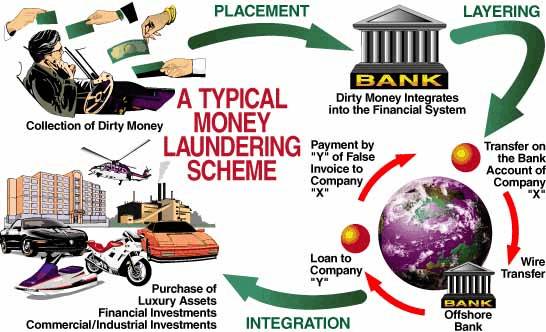
Federal money laundering cases generally take place within the context of a larger racketeering case governed by the RICO Act. Money laundering is typically only one aspect of a pattern of organized crime which may be nationwide or international. That being the case, money laundering is often the lesser offense in a pattern of crimes that can result in lifetime imprisonment.
How politicians and their friends get rich off insider stock tips, land deals, and cronyism that would send the rest of us to prison.
(If you have not read the book, try it out. It lays the ground work not only for politicians but international civilians also use the same model by gaining diplomatic status of obscure countries with bribes)
Now for the rest of the story.
Federal money laundering laws are guided by the RICO Act and there are a handful of countries with criminals operating under shadow corporations that clean money via real estate investments. London, New York and Miami are the prime cities where billions are spent on luxury real estate and the actual owner is never known.
Money laundering has a wide range of criminals that include Mafia, drug cartel leaders, Russians, Cypriots, business owners and even Kazakhstanis.
Some investigative journalists have done a remarkable job at tracking this phenomenon and there was even a documentary produced in 2015. This condition is actually a global shadow economy that has an estimated value in the range of billions of dollars. The New York Times has somewhat of a collection of related cases that you may find interesting where even Malaysia is included.
The Miami Herald did a story in 2015 on how Miami is but one crown jewel for offshore dollars fueling the real estate boom there. Ever heard of Isaias 21 Property or Mateus 5 International Holding? No? You’re not supposed to know.
Miami has a long history of money laundering. Its financial institutions report more suspicious activity than any other major U.S. city besides New York City and Los Angeles, according to FinCen data. And a recent case of money laundering involving fancy condos and the violent Spanish drug gang Los Miami drew further scrutiny to South Florida.
Jack McCabe, an analyst who studies the booming local housing market, said it’s impossible to know how many homes are purchased with dirty money.
“But I think many people believe it could be a sizable portion of the new condominium market in Miami,” McCabe said. “Even though developers and real-estate professionals suspect many of these units are bought with illegal funds, they realize their projects may not be successful without that support.”
Much has been in the news recently about the Trump team and companies being involved with Russian officials and oligarchs. There is hard evidence and some cases have already been through the legal system. We certainly cannot dismiss Hillary and Bill Clinton when it comes to collusion with those inside the Kremlin either much less a handful of other countries through their foundations. It appears there is no ‘statute of limitations’ with regard to US Code law on RICO.
The Russians have been dirty for years and those inside the Russian Federation and oligarchs have been moving illicit millions to billions out of the home country. For example how about a certain prominent Russian as one of the named depositors is billionaire oligarch (and personal friend of Vladimir Putin) Gennady Timchenko, who was sanctioned by the United States in March 2014 for his role in providing “material or other support to” Russian government officials. (There’s a rumor that sometime in the 1990s, Putin and Timchenko, who holds Finnish citizenship, were arrested in Helsinki for drunk and disorderly conduct; a rap sheet is said to exist with the two men’s mug shots.)
Timchenko’s designation carried the blockbuster revelation that Gunvor, the Swiss commodities trader he co-founded, was itself a vehicle for Putin’s personal self-enrichment: “Putin has investments in Gunvor,” the U.S. Treasury notice stated, “and may have access to Gunvor funds.” Not long before the sanctions were announced, Timchenko, who is worth an estimated $14.1 billion, was said to have divested his stake in Gunvor. Then, in November 2014, it was announced that the U.S. Attorney’s Office for the Eastern District of New York, helped by the Justice Department, was investigating Timchenko for money laundering. In 2013, Reuters disclosed that Timchenko had hired lobby firm Patton Boggs to persuade the U.S. Export-Import Bank, the export credit agency of the U.S. government, to finance his purchase of up to 11 Gulfstream luxury jets—a deal that was eyebrow-raising at the time and is now rendered illegal by sanctions. The rest of the story is here regarding one well known bank HSBC.
Considering the work of the FBI, the DoJ and State’s Attorneys General, the work appears to have a beginning but no end for both Trump and Clinton. As an aside, we need to ask officials where the Clinton investigation is, it at all. But moving on. This summary is not meant to take any anti-Trump position at all, in fact, we need him to succeed for the sake of America’s future. This is meant to be somewhat of a public service with all the chatter and investigations.
If you want to know what members of congress know and what the FBI is doing, here is but one clue:
The net is closing around a duo of fugitive oligarchs and their kin accused of laundering Kazakh money in posh U.S. real estate — including Trump Organization properties.
In a complicated case with potential implications for President Donald Trump’s business empire and associates of the real-estate-developer-turned-president, Switzerland has revealed it is considering an extradition request from Ukraine to hand over the son of a former Kazakh energy minister — and both men are facing money-laundering allegations in the United States and charges in Kazakhstan.
It’s the latest development in a saga that is reaching into Bayrock Group, an international real estate and investment company that paid the Trump Organization a license fee for the use of its name and an 18 percent ownership stake in the New York hotel and condo project.
The Khrapunov family is accused in U.S. lawsuits of “cleaning” illicit money through the purchase and quick resale of U.S. luxury properties, including daughter Elvira Kudryashova’s purchase of three Trump-branded condos in New York and a 9,000-square-foot Studio City mansion flipped in months to pop singer Bruno Mars for $6.5 million.
An investigation by McClatchy and reporting partners, involving interviews with officials representing legal matters against the accused in four countries, reveals:
▪ Ukraine has recently asked Switzerland to extradite Ilyas Khrapunov, son of former Kazakh Energy Minister Viktor Khrapunov, for alleged computer hacking.
▪ Ilyas Khrapunov and his wife secured unusual diplomatic posts representing the Central African Republic in Geneva, a move that helped provide them with a means of travel.
▪ Court documents tie Felix Sater — a Trump associate, Bayrock partner and twice-convicted Russian émigré — to some of the Khrapunovs’ transactions.
▪ Kazakh authorities asked the United States for information on Bayrock as part of the ongoing attempt to recover funds.
▪ A New York court decision may further reveal details about the Kazakh family’s financial flows into condos in the Trump SoHo building, developed and sold by Bayrock. Bank records include large transfers from a now-sanctioned Cyprus lender.
Federal lawsuits brought in Los Angeles by the city of Almaty and former business partners in New York are advancing against Ilyas and Viktor, who is also a former mayor of Almaty, Kazakhstan’s largest city. Both Khrapunovs and Ilyas’ father-in-law, Mukhtar Ablyazov — an uber-wealthy fugitive banker who owned BTA Bank until it was seized by regulators in 2009 — face criminal charges in Kazakhstan. Authorities allege $10 billion went missing from the bank, Kazakhstan’s third largest, and that Ablyazov moved out at least $4 billion.
The trio say they are the victims of political persecution by President Nursultan Nazarbayev, who has ruled oil-rich Kazakhstan since 1990. The country ranks in the bottom quarter on transparency measures, and Nazarbayev’s family is accused of stashing money in offshore companies.
The gathering legal drama is shining light on Trump business associate Bayrock Group, which involves Kazakh partners who helped develop the Trump SoHo building in New York and projects in Arizona and South Florida. This at a time when Donald Trump’s Russian and foreign ties are under greater scrutiny.
Crucial to Trump and his businesses — and the ability of lawyers to establish whether the Trump Organization had any knowledge of or benefit from any illegal money flows — is whether the United States or Switzerland hears the lawsuits against the Khrapunovs. If prosecutors convince a California court to hear the case, lawyers will have much greater ability to dig for evidence through a process known as discovery; Switzerland’s rules are far more restrictive.
This New York City Department of Finance document shows Elvira Kudryashova as the manager of SoHo 3311 LLC, which bought a unit in the Trump SoHo building. She is the daughter of Viktor Khrapunov, a fugitive Kazakh politician facing money laundering charges abroad and two civil lawsuits in the United States.
TheUkrainian extradition request from March shows that Ilyas Khrapunov is sought there for allegedly orchestrating a computer hack of a law firm representing BTA Bank.
“The allegations against me are preposterous,” Ilyas Khrapunov said in an interview, dismissing as “political” the accusations that he used malware in an email to gain access to and publish contents from a hard drive.
The Swiss are weighing the matter.
“In the Khrapunov case, an international assistance procedure and a national procedure for money laundering are currently underway at the Geneva Public Prosecutor’s Office,” said Henri Della Casa, a spokesman, confirming two Swiss probes. “We are making no further comments.”
Ablyazov, who uses his Facebook page as a protest site, was arrested by French police disguised as gardeners outside his home in Cannes in 2013. He was freed last December after France dropped an extradition order, determining he could not receive a fair trial, and he remains there.
California connection
The net tightening began here. According to allegations in the California lawsuit, Viktor Khrapunov arranged for rigged auctions of state property during his term as mayor of Almaty from 1997 to 2004. He and his wife, Leila, allegedly purchased property at substantially below-market rates using shell companies they controlled, then sold off the properties for a profit estimated at $300 million.
“Many observers are puzzled as to how Khrapunov, who is known to be quite corrupt . . . has managed to stay in government,” Kevin Milas, the U.S. embassy’s second in command, wrote back to agency headquarters in a Jan. 17, 2007, confidential memo about a political reshuffling.
The internal note cited an industrialist who had complained of being hit up for a bribe by Khrapunov.
The family fled to Switzerland in early 2008, where Ilyas already lived, seeking political asylum a few years later.
Viktor Khrapunov faced an Interpol detention request beginning in 2012, yet the family was able to buy the property in Los Angeles and the three Trump SoHo condos in New York. Ilyas Khrapunov was put under the same request in 2014.
“Switzerland has refused twice to extradite Viktor Khrapunov on the grounds that he would not have an equitable trial in Kazakhstan,” said Ilyas Khrapunov. “Switzerland proposed instead to have the trial delegated to them but Kazakhstan refused, fearing that the truth would come out.”
Friends in low places
The investigation by McClatchy and partners also found that Ilyas Khrapunov and his wife, Madina, Ablyazov’s daughter, were appointed to unusual diplomatic posts representing the Central African Republic at the U.N. Mission in Geneva.
A source tied to the Central African Republic, granted anonymity, said the couple had been appointed by former ruler Francois Bozizé before he was toppled and fled his troubled nation in 2013. Through a land acquisition the couple obtained dual citizenship in the Caribbean haven of St. Vincent and the Grenadines.
“Due to refusal of Kazakhstan to renew passports of the family, we were forced to apply through legal process to obtain secondary citizenships in order to exercise our rights to travel,” said Ilyas Khrapunov.
The diplomatic appointments and the recent extradition request are just chapters what’s been a complex, decade-long legal battle that is slowly providing more detail on Trump Organization associate Bayrock Group.
Trump’s associate
Bayrock is an international real estate and investment firm that worked with Trump on at least three known joint projects, and involves Kazakh businessmen.
Trump personally dealt with Bayrock, giving the developer a one-year exclusive right to build a Trump International Hotel and Tower in Moscow. In exchange he’d get a 20-25 percent stake in it.
“I am delighted at having the opportunity to partner with Bayrock Group LLC on yet another world-class development,” Trump wrote in a Jan. 1, 2005, letter to Tevfik Arif, a Kazakh partner of Bayrock, that was entered into evidence in a New Jersey lawsuit. “Moscow is one of the fastest growing cities in the world and offers the best location for a Signature Donald J. Trump development.”
At the time it entered the condo-branding deal with Trump, Bayrock was co-run by a twice-convicted Russian émigré and Trump associate named Felix Sater.
Court documents in New York involving the Khrapunovs tie Sater to multiple transactions by an investment firm in Luxembourg called Triadou SPV S.A., which invested in the United States and elsewhere. People close to the transactions, speaking privately because of ongoing businesses, say Sater had access to Trump and bragged about his Trump connections, even calling him “Mr T.”
“If he were sitting in the room right now, I really wouldn’t know what he looked like,” Trump said under oath as witness in a Florida lawsuit against Bayrock Group.
A prospectus shows Triadou was fully owned by SDG Capital S.A., a company on Lake Geneva that operates as Swiss Development Group, founded at the time the Khrapunovs fled to Switzerland. They say, in court documents, that it was sold in March 2013 to a Swiss businessman, who retained Ilyas Khrapunov through 2015.
Former Triadou Director Nicolas Bourg testified under oath last year that his company belonged to the Khrapunovs, who ordered him to sell assets and move money out of the United States after the California lawsuit was filed in 2014. The Khrapunovs say that is not true and that they’ve kept Swiss authorities informed of their purchases.
Bourg further testified that the Khrapunovs and Ablyazov co-mingled investments and used offshore shell companies to camouflage the purchase and sale of properties in the United States and elsewhere.
Another Triadou associate, New York developer Joseph Chetrit, settled with lawyers for the city of Almaty in 2015 and pledged to support their effort to recover what the city calls more than $300 million in stolen funds.
Sater was named in a lawsuit against a Triadou-owned company that was settled in December 2013. He is also being sued by one former Bayrock partner, Jody Kriss. And according to a recent story by The Wall Street Journal, Sater has issued veiled threats to dish on other Kazakhs because of a dispute he has over legal fees with another Bayrock partner of Kazakh origin, Tevfik Arif.
Arif gained international notoriety when he was arrested in 2010 while throwing what Turkish authorities called a lavish sex party on a luxury yacht involving teenage girls. The charges were later dropped.
Leila Khrapunov briefly did business with Arif and Bayrock in a joint venture called KazBay, which was going to invest in Kazakh natural resources but never got off the ground, in part because of revelations in a New York Times story in late 2007 that Bayrock’s Sater had a checkered past.
Kazakh authorities have alleged in their criminal case that Viktor Khrapunov’s stolen money was deposited at Eurasian Bank in Almaty and then transferred to Switzerland. That bank is owned by Alexander Mashkevich, a strategic partner in Bayrock and someone who, according to a report by McClatchy last month, is linked in sealed British court documents to organized crime groups. Mashkevich is not named in the U.S. lawsuits against Khrapunov, and the Khrapunovs banked with several lenders.
U.S. vs. Switzerland
The battle over which court should hear the high-stakes California lawsuit could determine whether the plaintiff’s lawyers establish any involvement in alleged money laundering by Trump associates.
I am convinced that Switzerland could become a model for countries that have recently embarked on the path of democracy.
Viktor Khrapunov on his website
“Switzerland is a perfectly adequate venue for my client,” said John Kenney, Khrapunov’s legal counsel in New York with the firm Hoguet Newman Regal & Kenney.
A federal court in California agreed in July 2015, but that decision was overturned this past March 30 on appeal by lawyers for the city of Almaty, allowing the case in Los Angeles to proceed.
“The city of Almaty is confident that when the court reviews the evidence, it will find that Viktor Khrapunov unjustly enriched himself to the tune of hundreds of millions of dollars by abusing his position as mayor, and with the assistance of his son Ilyas and others, laundered it throughout the world,” said Matthew L. Schwartz, a lawyer with Boies, Schiller & Flexner, which is representing Almaty in the New York case.
The Khrapunovs have until later in June to decide whether to appeal, but for more than two years they’ve avoided sitting for depositions in the U.S. cases.
“The defendants have sought to delay the case at every turn,” said David Schindler, a lawyer who represents Almaty in the California case. “Nevertheless our client remains committed to holding the Khrapunovs accountable for the money they stole from the people of Almaty.”
Trump’s licensing deals on properties typically involved payment of a fee for the use of his name and a Trump property management firm on-site, and Trump often got a small percentage from the first-time sales of condos too.
Depositions could shed light on whether and how the Trump Organization, through Bayrock Group and its Kazakh investors, benefited in any flow of illicit money.
One court document in a related British case shows Kazakh authorities filed a legal assistance request in 2013 to the U.S. government seeking details on the corporate structure of 15 companies it said were tied to the Khrapunovs, including Bayrock Group Inc. and Bayrock Group LLC.
Thus far, Ilyas Khrapunov has resisted providing evidence, but we look forward to the opportunity to question him about his role in his family’s crimes.
Matthew Schwartz, lawyer for the city of Almaty
The Financial Times reported last October that it had seen documents showing Sater had worked closely with Elvira Kudryashova in 2012, a year before she signed the documents for the three Trump SoHo condos. Kudryashova and Ilyas Khrapunov bought the condos so they could vacation in New York, with the properties offered as hotel rooms when they were not there.
Condos in the Trump SoHo building were developed and sold by Bayrock, which also vetted buyers.
Alan Garten, executive vice president and chief legal officer of the Trump Organization said it “was not responsible for the sale of units at Trump SoHo.”
The condos were bought by three companies that were registered in April 2013 within days of each other with the New York Division of Corporations: Soho 3310 LLC, Soho 3311 LLC and Soho 3203 LLC. They were dissolved the following year after the properties sold.
Court records show Kudryashova transferred a total of $3.1 million from a Wells Fargo account for the condo purchases. Bank documents also show her receiving large sums from an offshore company that used the Cyprus lender Federal Bank of the Middle East, which was headquartered in Tanzania. The Treasury Department blacklisted that bank as a “Primary Money Laundering Concern” on July 22, 2014.
A New York court decision in early May granted Almaty access to certain Khrapunovs-related bank transfers from abroad, and that could provide more details about the flow of their money into luxury properties that were held for short periods.
Sen. Ron Wyden of Oregon, the top Democrat on the Senate Finance Committee, cautioned that “these efforts have a long way to go before the federal government has the tools it needs to stop money laundering through shady real estate deals and anonymous shell companies.”
CORRECTION: An earlier version of this article gave the wrong law firm for John Kenney, who is with Hoguet Newman Regal & Kenney.
This story involved collaboration between McClatchy and the Organized Crime and Corruption Reporting Project, a global journalism network that investigates transnational corruption.
Tuesday, April 18, 8:15 a.m.: Along the 5100 block of Halsted Street on the South Side of Chicago, a quiet spring morning is interrupted by gunfire. Police respond to a gas station and discover a drive-by double homicide. As they secure the crime scene and work to identify the bodies and recover evidence, distraught family members of the victims begin to arrive, their faces full of anguish and disbelief. They will not be alone in their grief. By the end of the day in a city reeling from violent crime, there will be 13 more shootings and another murder.
Chicago’s extreme gun violence—762 homicides last year and more than 4,000 people wounded—has been described as an epidemic. Primarily gang-related, the shootings are often spontaneous and unpredictable, and the toll on victims, families, and entire communities cannot be overstated. That’s why the FBI’s Chicago Division, working with the Chicago Police Department (CPD) and other agencies, has undertaken significant measures to address the problem.
***
“The FBI sometimes battles a perception that we are only interested in terrorism or public corruption or large drug-trafficking organizations,” said Michael Anderson, special agent in charge of the Chicago Division. “The fact is, we are interested in those things, but in Chicago we are also getting down to the street level to address violent crime, and we are specifically going after the trigger-pullers and shot-callers.”
That street-level focus is in response to a city homicide rate that has “increased exponentially,” Anderson said. “The number of shootings is at a level that hasn’t been seen here since the early 1990s.” As a result, he explained, “what you are seeing and will continue to see in Chicago is a sustained FBI effort to support and supplement our local partners.”
That effort involves three major areas:
The creation in 2016 of a homicide task force—in addition to the FBI’s existing violent crimes squad—in which agents work alongside CPD detectives and other law enforcement officers to assist in solving the city’s murder cases;
Increased intelligence-gathering efforts to identify shooters and “directors of violence,” which includes embedding FBI analysts at CPD headquarters; and
Stepping up community outreach efforts to gain the public’s trust and enlist their help in solving crimes and making communities safer.
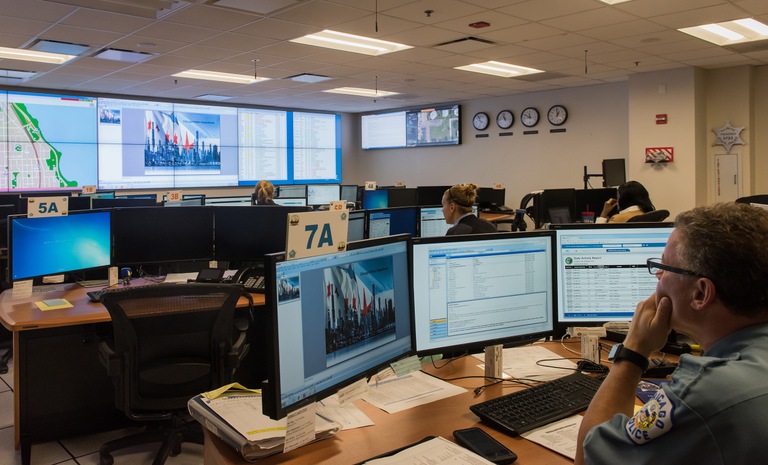
At Chicago Police Department headquarters, personnel in the Crime Prevention and Information Center monitor violent crimes throughout the city using surveillance video and other sophisticated tools. FBI analysts assigned to the center offer additional real-time intelligence that helps police officials deploy resources as efficiently as possible.
“Simply put,” said CPD Superintendent Eddie Johnson, “the FBI has more resources than we do. We combine the resources we have with the ones they have to fight these crimes.”
FBI and CPD personnel working together in the city’s most violent neighborhoods “has helped quite a bit,” Johnson said. “And we get real-time intelligence from the FBI that we didn’t get before. They can look at our crime picture and help us figure out where to best deploy our resources.”
Johnson, a Chicago native and 29-year veteran of the police force who spent many years as a patrol officer, believes a key reason for the city’s current violence is inadequate gun laws.
“The flow of guns into Chicago is just insane,” he said. “You will find that gang members would rather be caught with a gun by law enforcement than caught without one by their rivals. What we have to do through legislation is create a mentality where gang members won’t want to pick up a gun,” he explained. “You create that by holding them accountable for their actions. We simply don’t do a good job of that right now.”
Johnson recalled that when he joined CPD in 1988, he and fellow officers responded daily to calls of gang fights in progress. “We rarely hear that call anymore,” he said. “What we hear now is a person with a gun or a person shot. They just go straight to a firearm and they resolve their disputes with a weapon.”
“What you are seeing and will continue to see in Chicago is a sustained FBI effort to support and supplement our local partners.”
Michael Anderson, special agent in charge, FBI Chicago
“Communities are being hijacked by a relatively small percentage of people,” Anderson said. “The overwhelming majority of residents are hard-working citizens going to work, going to school, trying to go about their daily lives. These communities are under siege, and they are desperately looking for help.”
Of Chicago’s 22 police districts, the majority of violent crimes are taking places in a cluster of neighborhoods on the South and West Sides. “A handful of districts—probably five or six—are responsible for the disproportionate number of homicides and shootings,” Anderson said.
FBI and CPD investigators have focused considerable effort on two of the city’s most historically violent areas—the 11th District on the West Side and the 7th District on the South Side. “Since we put the task force in place,” Johnson said, “we’ve seen significant drops in gun violence in these two districts. We are making some real positive gains,” he said. “By no means are we declaring success, but we have seen some really encouraging results.”
Driving through the city’s most violent neighborhoods—Austin, Englewood, North Lawndale, Auburn Gresham—the streets and parks appear peaceful, and often they are. But when the violence comes, it is sudden and usually without warning. One gang member might have disrespected a rival gang member—increasingly through social media (see sidebar)—and they go looking for each other to settle matters with their guns.
“When I started as a cop,” Johnson said, “if you had a gang of 10 guys, maybe two of them at most would be armed. Now if you have a gang of 10 guys, probably nine of them are armed. And we’ve seen kids as young as 10 and 11 with firearms.”
Investigators agree that gang members are arming themselves at younger ages. “Based on what I’ve seen over the last year,” one FBI agent said, “these guys are carrying around guns as if it’s a symbol of their pride or who they are—and the bigger the gun, the better. We are seeing handguns with extended magazines and ammunition drums attached. It’s like guns are a part of them, a part of their culture. And they are not afraid to use them.”
“We get real-time intelligence from the FBI that we didn’t get before. They can look at our crime picture and help us figure out where to best deploy our resources.”
Eddie Johnson, superintendent, Chicago Police Department
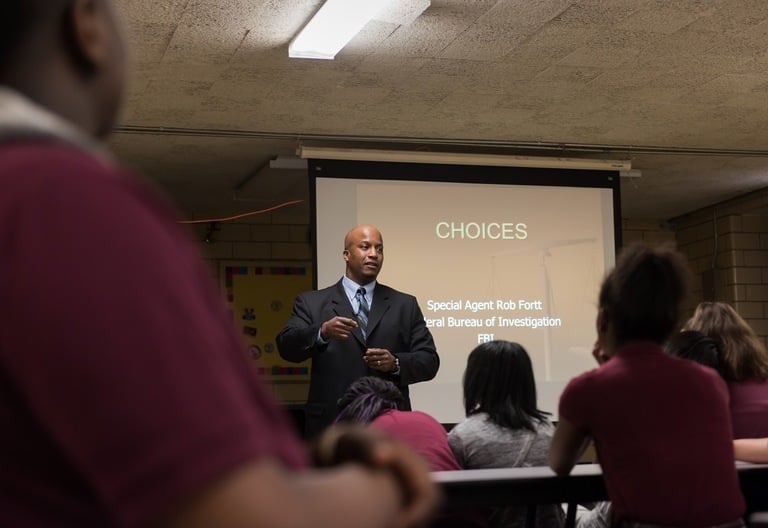
In addition to working closely with the Chicago Police Department to stop gun violence, the FBI has a strong community outreach program. At the Plato Learning Academy middle school in the Austin community, Special Agent Rob Fortt speaks to students about the dangers of joining gangs.
The FBI is working to reach some of these youngsters before they get involved with gangs—it’s one part of the Bureau’s larger community outreach effort in the campaign to stop gun violence. At the Plato Learning Academy middle school in the Austin community recently, Special Agent Rob Fortt spoke to sixth-, seventh-, and eighth-graders about the choices they make and the consequences of those choices.
The school’s principal, Charles Williams, welcomed the opportunity for the FBI to give students a fresh perspective on law enforcement and a positive message about making good decisions. Describing the neighborhood’s reputation for violence, Williams said he has heard gunshots in the middle of the day from his office, and violent crime is a fact of life. “Our students are surrounded by it, unfortunately. It’s just something that permeates the neighborhood.”
Gang-related homicides in Chicago are most easily solved when witnesses come forward. But in the city’s violent neighborhoods, many who witness shootings or have information don’t cooperate with law enforcement, either because they distrust the police or they want to engage in “frontier justice” and seek their own retaliation, the FBI’s Anderson said. “So we are putting a lot of resources into community outreach. We are really focusing on going out in the community and building trust. If folks trust law enforcement, they are more likely to report crimes.”
***
“We have to acknowledge that we have a fractured relationship with the community,” the CPD superintendent said. “But we’re working hard to rebuild that, and the FBI is helping us do that.” Johnson added, “I haven’t been to a community meeting yet where people have said they want less police. What they want is the police to be fair, respectful, and to get the bad guys out of their communities. That’s what they want. And you start that by having a constant dialogue with them, which we are doing.”
Community activist Andrew Holmes represents another important part of law enforcement’s outreach efforts. Holmes, who has experienced the tragedy of gun violence firsthand, has been working with the FBI since 2013 on issues involving gun crimes and the human trafficking of children. He is known to law enforcement and residents of violent neighborhoods as a rapid responder when a homicide occurs. He arrives on the streets at all hours of the day and night to counsel and comfort the families of victims. And he encourages witnesses to come forward.
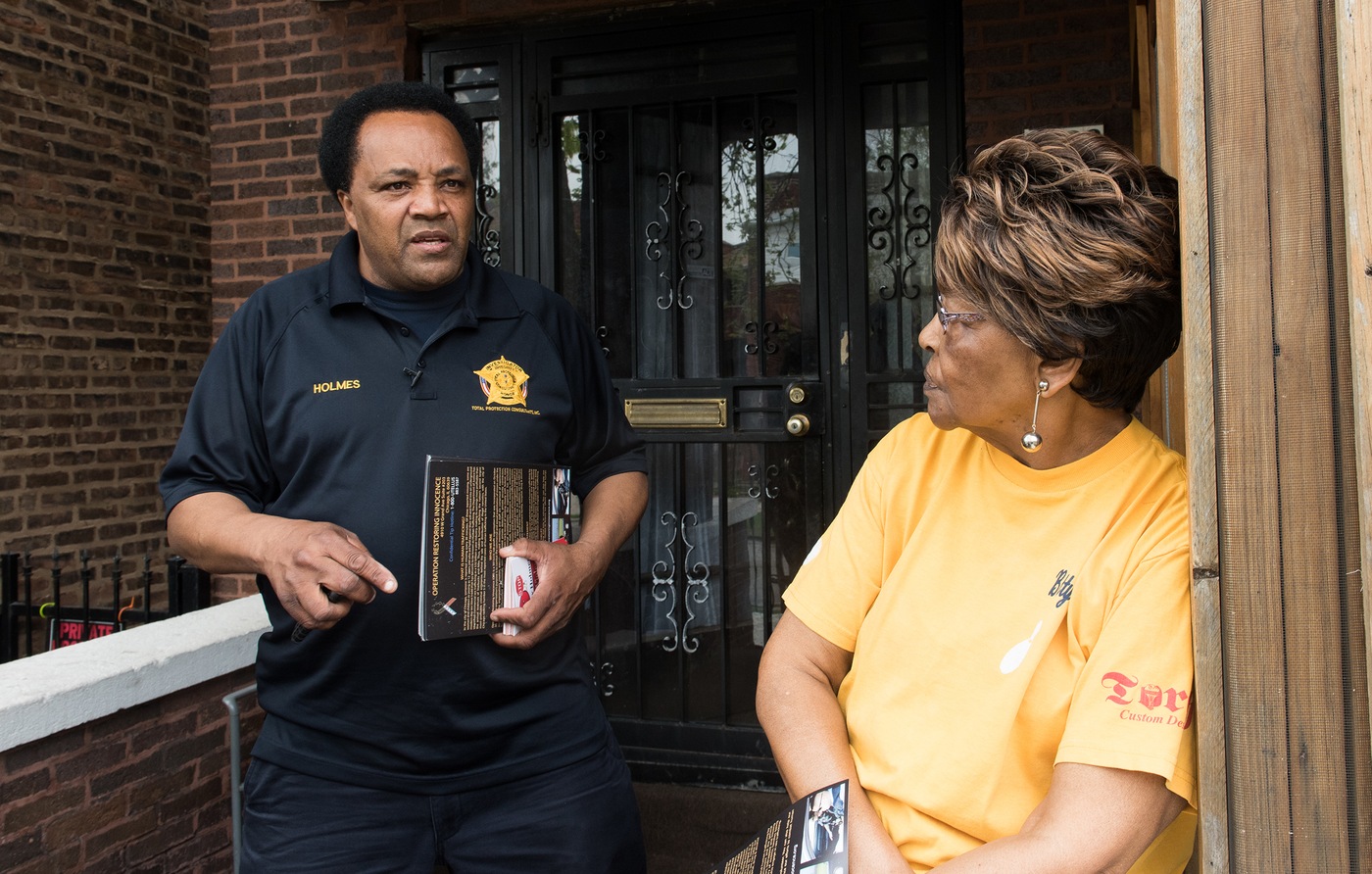
The work is meaningful to Holmes because his daughter was killed in Indiana when she was innocently caught in the crossfire of a gang shooting. And he recently lost an 11-year-old cousin in Chicago who was killed by a stray bullet meant for a gang member. Holmes also visits high-crime neighborhoods, going street to street to hand out pamphlets urging residents to report gun crimes. In the troubled Auburn Gresham community recently, he spoke to Betty Swanson, block captain of her neighborhood watch group.
Community activist Andrew Holmes has been working with the FBI since 2013 on issues involving gun violence. He regularly visits high-crime neighborhoods to urge residents to cooperate with law enforcement. In the Auburn Gresham community recently, he spoke to Betty Swanson, block captain of her neighborhood watch group.
On the porch of her tree-lined street, Swanson told Holmes that one of her grandsons had been murdered a few months ago. “He was going to visit his mom … after he got off work. Somebody walked up to the car and shot him. He was 28 years old.”
Although her street is largely violence-free now because so many of the residents are senior citizens, Swanson said her block group works hard to keep the area safe, and—like Holmes advocates—that means speaking up when necessary.
“One thing we try to do is to let witnesses know that it’s okay to talk,” Holmes said. “We ask people to engage with law enforcement. You’ve got to work with law enforcement. I don’t care who it is—FBI, state police, U.S. Marshals, Chicago Police—you have to.” Otherwise, the help needed to save a loved one might come too late. “You’ve got to reach over and get that phone, call the FBI,” he said. “Show these criminals—not this block, it’s not happening.”
Murder and Social Media
For those unfamiliar with Chicago’s rampant gun violence, it would be easy to think that shootings happen because of traditional turf battles—one gang trying to muscle in on a rival’s street-corner drug business. But that reality occurred in a time before social media. The new reality is increasingly virtual, and social media is playing a prominent role in the murder rate.
Violence can indeed result from “gang-on-gang and some narcotics territory disputes,” said Chicago Police Department Superintendent Eddie Johnson, “but a lot of our gun violence now is precipitated by social media.”
One gang member disrespects a rival on social media, and the rival responds in kind. The virtual argument escalates, and the gang members look to settle things with weapons. Using their electronic devices, gang members can often pinpoint their rivals’ location.
“Gun in one hand, smartphone in the other,” said Special Agent in Charge of the FBI’s Chicago Division Michael Anderson. Too often, that makes for a deadly mix. And in many cases, the time between the online dispute and actual shots being fired, Anderson said, “is very short.”
Primer: Body found in Queens park identified as teen member of MS-13 gang; victim was stabbed 34 times
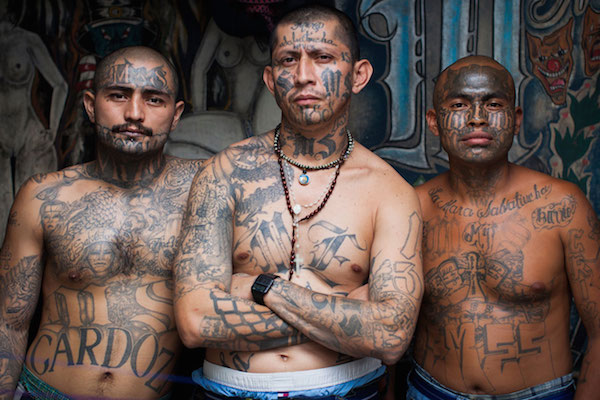
The decomposed body of a teen stabbed 34 times and dumped in a Queens park was identified as a member of the ruthless MS-13 street gang, police sources said Tuesday.
Fingerprints from prior arrests and a distinctive tattoo across the victim’s chest helped cops come up with a name for the butchered 16-year-old, according to sources.
“He seemed like a good kid, alright to me,” said a Queens neighbor of the boy’s family. “They were a nice family … It’s sad to hear. That gang is pretty brutal.”
The family was tossed from their home about two weeks ago for non-payment of rent, the neighbors said. A one-page eviction notice was stuck to the front door, and there was a spray-painted “MS13” on a nearby concrete and brick pillar.
The youth was discovered by a bird watcher in Alley Pond Park on Sunday afternoon, officials said. The body had a half-dozen stab wounds in the chest — and 28 more in the back.
The city Medical Examiner ruled his death a homicide and determined that he died about a week ago.
The MS-13 gang made headlines recently for a series of Long Island killings, including the machete murders of two teenage girls last year and the slaughter of four youths just last month. More here from NYDailyNews.
MS-13 extorting businesses in DC suburb: Police chief
Examiner: One of the most infamous gangs in the world is extorting Latino-owned businesses in a county on the outskirts of Washington D.C., a local law enforcement official warned federal lawmakers Wednesday.
Members of MS-13, a transnational gang based in El Salvador, have long demanded payments from illegal businesses that otherwise faced the threat of violence. A sheriff in Montgomery County, Md., believes they’re expanding the list of extortion targets to legitimate businesses.
“We have heard from community members that the gangs, which historically extorted money solely from illicit businesses such as ‘bordellos’ and unlicensed ‘cantinas,’ are now collecting ‘rent’ from legitimate Latino business owners and residents in certain apartment complexes,” Thomas Manger, the county’s chief of police, told the Senate Homeland Security and Government Affairs Committee. “In some instances, if the victims of this extortion refuse to pay the fee demanded by the gang, the gang members return with detailed information on the intended victims’ family members still living in Central America.”
The Trump administration has stepped up efforts to deport the gang members, to the chagrin of El Salvadoran leaders. “This clearly affects El Salvador. We already have a climate of violence in the country that we are combating,” Hector Antonio Rodriguez, the director of the country’s immigration agency, told the Washington Post. “If gang members return, of course this worries us.”
Violence in El Salvador contributes to the influx of Central Americans on the southern border, a human crisis that provides profit for gangs and taxes the border security capabilities of the United States. That’s why lawmakers such as Sen. James Lankford are interested in foreign aid to countries such as El Salvador.
“How we’re spending money in our foreign aid, and how we need to be able to target this, specifically dealing with violence in those areas, has an exact connection to what’s happening here,” the Oklahoma Republican said following an exchange with Manger.
In the meantime, threats of violence against Central American family members have also helped MS-13 gather new recruits in the United States, according to Manger. “The victims here in the United States know that the threat of violence to their extended family in their native countries is a true possibility and the perpetrators are out of the reach of U.S. law enforcement,” Manger said.
***
Were MS-13 gang members released into US communities? Senator demands answers
At least 16 self-proclaimed MS-13 gang members were transferred out of federal custody and into community placement centers across the country during the border surge in unaccompanied children from Central America in 2014, according to a new letter from the Chairman of the Committee on Homeland Security and Governmental Affairs.
It was unclear what happened to the members of Mara Salvatrucha, one of the most brutal transnational gangs in the world, and that’s why Senator Ron Johnson, R-Wis., wrote the Office of Refugee Resettlement on Tuesday demanding answers.
In 2014, the Obama Administration declared a humanitarian crisis after tens of thousands of immigrants flooded across the United States border.The dramatic increase in immigrants from El Salvador, Guatemala and Honduras overwhelmed border authorities at the time.
Fox News has now learned that more than a dozen teenage gang members were captured during the surge. According to Johnson’s letter and documents obtained by Fox News, the gang members “freely admitted” that they were “active MS-13 gang members” and marked bathrooms inside a placement center in Nogales, Arizona with MS-13 associated graffiti.
One teenage gang member stated he “was a drug dealer” and “would continue to do the same in the United States with his family.” Another admitted he was a member of the Surenos gang and had been “involved in multiple robberies, assaults and drug dealing” since he was 15 years old.
“These documents appear to show that the federal government knowingly moved self-identified gang members from Nogales, Arizona to placement centers in communities across the country. As you know, it is common for UACs (unaccompanied children) to be released from their placement center while awaiting a court date. It is unclear from these July 2014 documents whether any of these self-identified UAC gang members were released,” Johnson wrote in his letter to the Office of Refugee Resettlement.
Johnson is now asking for a complete accounting of all UACs captured at the border who have self-identified as gang members since 2010.
He also wants to know if any of the gang members were released into communities in Virginia, Washington, Texas, New York and Oklahoma. The questions come as the Committee on Homeland Security and Governmental Affairs holds hearings this week on the “The Rise of MS-13 and Other Transnational Criminal Organizations”.
Fox News reached out to Customs and Border Protection and the Office of Refugee Resettlement for a response to Johnson’s letter. So far, they have not responded.
Philippines: Martial law declared as Islamic State jihadis storm city and battle national army
In Mindanao. This is a global war, and of the most curious type imaginable: no one in authority wants to admit that it is actually going on, and Western governments generally treat each enemy attack in this war as a separate and discrete criminal incident.
“Philippines soldiers battle Isis-linked gunmen on Marawi city streets,” by Gabriel Samuels, Independent, May 23, 2017:
A group of heavily-armed militants from a group linked to Isis have reportedly stormed a city in the Philippines and engaged in firefights with the national army.
Residents of Marawi City, in the south of the country, were urged to remain indoors as at least 15 gunmen from a Muslim rebel group called Maute stormed the streets brandishing assault rifles.
The group, which is also known as the Islamic State of Lanao, have reportedly received support from Isis.
Troops and a special police force were deployed to the city after residents in a nearby village raised the alarm and appealed for help.
President Rodrigo Duterte then declared martial law and a state of emergency in the province of Mindano [sic]. General Eduardo Ano, the military chief of staff, said at least one police officer was killed and eight soldiers were wounded in the fighting. More here.
***
It was enormously controversial that President Trump placed a friendly call to Philippine strongman Duterte on April 29. Now, we can read what they said. In short, Duterte has been on a killing rampage and frankly has called the United States all kinds of nasty names. Humm…. Then there was the part of the phone call that included North Korea’s nuclear program.
Duterte Lands in Russia for Visit Cut Short After Martial Law Declaration
Philippines President Rodrigo Duterte has landed in Russia for what was planned as an extensive visit including one-on-one talks with President Vladimir Putin, but the trip has been cut short following a jihadist attack in the Philippine’s south.
Breitbart: Duterte alluded to this trip as the month began, following a personal invitation to the White House, saying he could not confirm travel to America because he is “supposed to go to Russia.”
Duterte arrived in Moscow Monday night for a four-day visit, accompanied by a large Filipino business delegation. While Duterte will seek more Russian business investment in his country, a key objective of his visit will be signing a defense cooperation agreement expected to provide the Philippines with more weapons to use in the ongoing war against drug traffickers that has become a staple of the Duterte presidency.
Duterte had previously claimed Putin had offered him a “buy one, get one free” deal on firearms.
The Philippines is also facing jihadist attacks by Abu Sayyaf, the Islamic State affiliate in the country, which has become increasingly aggressive in the Muslim-majority south of the country, where Duterte is from.
Abu Sayyaf ultimately led to Duterte’s decision to leave Russia early to address the jihadist threat. Duterte declared a 60-day period of martial law in his native Mindanao island and will return home. According to the Philippine Star:
Foreign Affairs Secretary Alan Peter Cayetano said at the same press conference that the president will be cutting his visit to Russia short because his presence is needed in the country.
The signing of bilateral agreements with Russia will push through but the meetings with Russia President Vladimir Putin and Prime Minister Dmitry Medvedev were postponed. Cayetano said Duterte may just speak with the two leaders via phone.
“The agreement on military technical cooperation will pave the way for the Philippines to explore a possibility of military procurement from Russia,” Foreign Assistant Secretary Maria Cleofe Natividad told reporters before Duterte left to Russia. The agreements would also reportedly create an extradition agreement, which the two countries had not previously had, and allow for “information sharing, training, and technical cooperation,” according to the regional news outlet Rappler.
Officials have also expressed a hope that Duterte’s visit will help end the propagation of negative Russia stereotypes in the country. “There’s been a lot of stereotypes in the Philippines and I don’t really blame it. I mean, growing up watching James Bond movies, the villains were either an evil Russian scientist or some beautiful nubile Russian assassin,” Philippine Ambassador to Russia Carlos Sorreta said on Monday. “The reality is we have not had a deeper exchange with Russia even though we’ve had good relations, so we’re 40 years. And that’s going to change.”
Sorreta hoped the Russian visit would expand the “kind of independent foreign policy [they are] trying to achieve.”
Before his departure, Duterte emphasized the need to expand cooperation with Russia. “Russia must cease to be at the margins of Philippine diplomacy,” he said. “Overdependence on traditional partners has limited our room to maneuver in a very dynamic international arena. This is a strategic oversight that has led to many missed opportunities for our country. I am determined to correct this.”
Duterte has repeatedly stated that he would like to diminish the role of the United States in Philippine foreign relations, at one point declaring, ” You know, if China and Russia would decide to create a new order, I would be the first to join.”
Prior to Duterte, the government of Benigno Aquino kept close ties to the United States and maintained a distance from Russia. The Philippine Star notes that a head of state from that country has not visited Russia since President Gloria Arroyo did in 2009, and prior to that, no visit is on the record since 1997.
Duterte has eagerly expressed his fondness for Putin. “I like Putin. … We have similarities. When it comes to girls,” Duterte said in August 2016, in anticipation of their first meeting. Following that meeting, Duterte gushed that Putin had a “wide laugh” and had reserved a gun as a present for him in Russia. Neither country has confirmed whether Putin will hand over the present during this visit.



 UNODC
UNODC
 Interfima