1000+ Officers Raid, 44 Arrests

Image result for ms-13 raid los angeles NY Daily News

Primer: The LATimes reports:

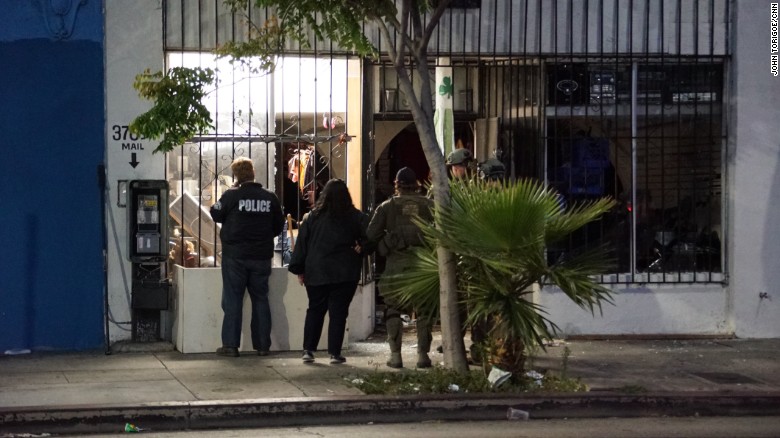
Shortly after 4 a.m. Wednesday, heavily-armed ATF agents — wearing helmets and bulletproof gear and carrying rifles — forced their way into a storefront and a back building near Exposition Boulevard and Western Avenue in Exposition Park. Agents approached in an armored vehicle down a narrow alleyway behind the small business.

Once inside, federal agents and police detectives found what they described as gang members involved in human trafficking, as well as possible victims. The storefront, which appeared to be locked from the outside, was full of garbage.

A few of the people detained were handcuffed and lined up facing a metal fence in the alleyway next to the armored vehicle.

The indictment names the former leader of the gang and a dozen people who acted as a joint council of leaders, Brown said.

The lead defendant in the indictment is 43-year-old Jose Balmore Romero, known as “Porky.” Romero called the shots for the gang in Los Angeles in 2013 and 2014 and oversaw the gang’s drug-trafficking activities and coordinated the collection of extortion money, some of which was distributed to the Mexican Mafia, according to the U.S. attorney’s office in Los Angeles. Romero has been in custody since 2015, charged with ordering a gang-related slaying.

Three men were charged with murder in connection with the gang’s activities, authorities said. Carlos Alfredo Cardoza Lopez, 23, known as “Little Boy,” faces a violent crime in aid of racketeering murder charge in the fatal shooting of a innocent bystander inside the gang-controlled Little San Salvador Nightclub and Restaurant on Western Avenue, federal prosecutors said in a statement. A friend of the victim also was stabbed. More here.

Associated Press

Indictment document is here.

Dozens of MS-13 gang members nabbed in 50 Los Angeles raids

Los Angeles (CNN)Hundreds of federal and local authorities stormed homes and storefronts across Los Angeles early Wednesday, targeting dozens of high-ranking members of the notorious MS-13 street gang.

The 50 pre-dawn raids, aimed at catching suspects asleep or off guard, also focused on nabbing members of MS-13’s core leadership, the Bureau of Alcohol, Tobacco, Firearms and Explosives (ATF) said.
“Today we disrupted this gang’s command and control,” said Eric Harden, special agent in charge of the ATF’s Los Angeles field division.
Los Angeles is the US base for MS-13, which has tens of thousands of members worldwide. Authorities count the gang among the largest criminal organizations in the US.
More than half of the 44 people arrested Wednesday are undocumented immigrants, acting US Attorney Sandra Brown said.
But the raids aimed to curb violent crime — not immigration violations, Los Angeles Police Chief Charlie Beck said. He said MS-13 often “preys on” undocumented immigrants.
The suspects face a wide range of charges, including federal racketeering and narcotics conspiracy. If convicted, Brown said, most of those arrested Wednesday could face decades in federal prison — and three could face the death penalty.
About 1,000 officers from the ATF, the FBI, the Drug Enforcement Administration, US Immigration and Customs Enforcement, the Los Angeles Police Department and the Los Angeles County Sheriff’s Department took part worked on the massive effort.
And they had to execute their plan in the dark of night.

An inside look into a raid

Authorities conduct one of 50 simultaneous raids targeting MS-13 gang members.

CNN’s was the only TV crew that accompanied authorities during the raids.
At 4 a.m., a dozen ATF agents poured out of an armored vehicle, preparing to break open the front and back doors of an inconspicuous store just outside downtown. The storefront they hit was a suspected hub for MS-13.
Rifle-wielding officers suited in body armor and helmets appeared ready for combat. With the element of surprise on their side, agents peacefully took half a dozen people into custody.
One by one, they came out in handcuffs. Some were suspected gang members; some may be victims of human trafficking, authorities said.
A storefront might seem like an odd place to find notorious gang suspects. But MS-13 members have been known to live in storefronts and have been suspected of using them as a cover for drug activity, prostitution and human trafficking.

Investigation goes deep

Federal agents say the probe, which began in June 2014, targeted the leadership and the most violent members of MS-13 in Los Angeles and the gang’s links to the Mexican mafia.
“We believe the most impact is made by targeting the mid- to upper-level hierarchy of the gang and removing them,” Harden said.
“Once removed, it causes a disorganization of the gang, where it suppresses their activity for an extensive amount of time until another leader is developed or steps up.”
MS-13 makes money from extortions, kidnappings, drug and weapons trafficking and human trafficking, the ATF said. Killings for the protection of the gang are common, federal authorities say, and sometimes are carried out with machetes.
Harden has faced off with MS-13 for decades, dating back to his days as a street agent.
“They’ve been here since the ’80s and have thrived to this date,” said Harden. “They’re a transnational or international gang. Their level of brutality is extreme and high, similar to what we read about and hear with the drug-trafficking cartels in Mexico.” More here from CNN.
With GPS, Drug Cartels Move Shipments to Europe Until

Drug cartels heavily rely on GPS devices to track shipments, feds say

The GPS has increasingly become a drug dealer’s new partner in crime.

Drug-smuggling groups are relying on the device to keep tabs on drug packages as they wind their way through Central America to the United States, according to published reports.

The criminals attach the drug shipments to buoys, send them off in the Pacific Ocean, and use signals they give off to track a package’s location by using special codes, InSight Crimes reports.

The GPS gives dealers the advantage of having drug shipments picked up by others monitoring their movements without being detected by authorities.

GPS devices are also allowing drug cartels to keep track of lower-level smugglers to ensure they are doing what they were told, say U.S. officials.

Barbara L. Carreno, public affairs officer for the U.S. Drug Enforcement Administration, said drug dealers have been using the tracking device for years. But recently, as the once bulky devices have become smaller and cheaper, their use has increased, she said.

“Traffickers need to know that their mules are doing what they are supposed to do and delivering their very valuable shipments where they are supposed to go,” Carreno said. “We often find GPS devices in shipments we seize.”

Traffickers won’t use a computerized system that would lead law enforcement back to them or create records that would implicate them.

– Barbara L. Carreno, spokeswoman, U.S. Drug Enforcement Administration

The GPS is simple enough, the DEA says, that it actually eludes more sophisticated tools used for drug interdictions by government agencies of various countries.

“Traffickers wouldn’t use a computerized system that would lead law enforcement back to them or create records that would implicate them,” Carreno said. “They want something cheap, unsophisticated and untraceable.”

Salvadoran officials say that Ecuadorean boatmen have become a core part of the criminal activity. They move the shipments to places off coasts of El Salvador, Guatemala and Costa Rica.

Once the shipments are left at certain locations in the Pacific, traffickers use the GPS to alert those waiting for them by sending information to mobile telephones and computers, the website said, citing the Salvadoran national police’s anti-narcotics division.

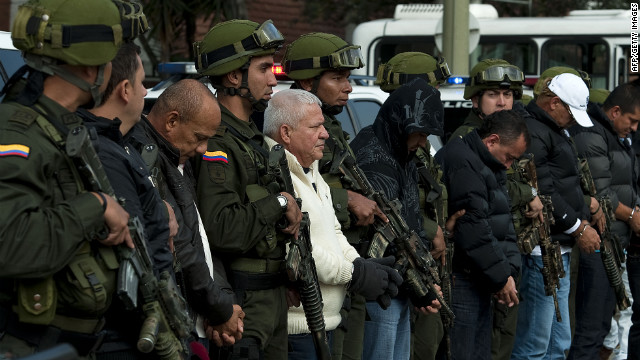
One of the most notorious drug kingpins, Ecuador’s Washington Prado Alava, was said by Colombian authorities to have run a highly sophisticated trafficking operation. But his operation, which moved 250 metric tons of cocaine to the United States over a four-year span, was dependent on GPS locators, Insight Crime reported. More here from FNC.

***

Anti-drug forces from several European and American countries intercepted a total of eight tons of cocaine in a double bust that is being dubbed as one of the largest in history.

In the larger one, Spanish authorities cooperated with Ecuadorean police to intercept a ship off that Latin American country bringing more than 5.5 metric tons of cocaine to Spain.

The ship was loaded with Colombian cocaine in the Pacific and planned to travel through the Panama Canal and across the Atlantic to Europe, officials said in a statement.

Una operación de la junto a la de Ecuador ha permitido interceptar un buque con 5.529 kilos de cocaína y detener a 24 personas.


In a separate drug seizure, Spanish police stopped a Venezuela-flagged fishing vessel carrying 2.5 metric tons of cocaine near Martinica.

The ship was intercepted on May 4 and was towed to Las Palmas in Spain’s Canary Islands.

The U.S. Drug Enforcement Agency and Britain’s National Crime Agency also took part in the joint operation.

The cargo seized off the coast of Ecuador has an estimated value of $250 million. Ecuadorean agents boarded it when it was almost three nautical miles off Santa Elena province.

Spain’s Interior Minister Juan Ignocio Zoido said to El Pais that the first operation resulted in the capture of 24 suspected drug traffickers.

“It is one of the largest cocaine seizures in history and it takes apart a large drug-trafficking organization between South America and Spain,” he said.

The massive operation began after Spain found out in January that a South American ring with links in Spain was organizing a large shipment.

That information was corroborated by intelligence also gathered by the U.S., Britain and Portugal, the statement said.

Since the beginning of 2017, Ecuador has confiscated about 30 tons of cocaine.

Large seizures of cocaine and cannabis aren’t uncommon in the Iberian Peninsula, which is seen as a drug gateway to Europe.

Spanish police captured almost eight metric tons of cocaine from four vessels in 2015 and 2016 and arrested 80 people, the police statement said.


DHS Project New Dawn 1,378 Arrests

Image result for homeland security investigations

U.S. Immigration and Customs Enforcement Officials are revealing details of a massive anti-gang operation that’s resulted in 1,378 arrests nationwide.

The six week long operation, which began March 26th, targeted violent criminal street gangs in the DC metro area, San Antonio, San Diego, and Newark.

“The primary purpose of the operation was to identify, arrest, and prosecute gang members and associates who threaten our communities,” Thomas Homan, ICE’s Acting Director told reporters.

The operation, called “Project New Dawn” was led by ICE’s Homeland Security Investigations section, known as HCI.

In the DC area alone, agents arrested 52 people, including 29 members of the El Salvador-controlled MS-13 gang.

“Nearly 1100 were arrested on federal or state criminal charges, including murder, assault and other crimes of violence,” says DHS Deputy Executive Associate Director Derek Benner.

Authorities arrested 21 people on murder related charges, and seven for rape and sexual assault charges.

Others face drug trafficking, weapons smuggling, human smuggling, sex trafficking, and racketeering charges.

Police say more than 1000 of those arrested had gang affiliations: connections to MS-13, and the Crips, Bloods, and the Surenos street gangs.

“Let me be clear that these violent criminal street gangs are the biggest threat facing our communities,” Homan says.

DC-based HSI agents arrested eleven MS-13 gang members in April at a home in Falls Church, police say.

Ten of those actions were ‘administrative arrests’, for immigation violations, the eleventh was a criminal arrest.

Investigators say federal agents and Fairfax County Police were keeping the home under surveillance because of reports about alleged sex trafficking.

“Our goal at the end of the day is to arrest, prosecute, imprison, deport and remove trans-national gang members as well as to supress violence, and prosecute crimial enterprises,” Benner says.

ICE says during the operation, officers seized 238 guns and $492,000 in cash.

But the agency also revealed a troubling trend.

Investigators in the San Diego area found street gangs are bucking the idea of turf or territory, and instead, are acting in concert, with different groups using each other’s expertise to maximize illegal profits.

“One gang, they specialize in narcotics smuggling, one may specialize in weapons trafficking,” Benner explains. “They’re using each other in this particular case, to further their own enterprises.”

Authorities say of those arrested, 933 are U.S. citizens, and 445 are foreign nationals from Central America, South America, Asia, Africa, Europe, and the Caribbean.

ICE’s Acting Director says the notion of sanctuary cities, where local authorities don’t cooperate with, or take part in ICE operations, is making these investigations more difficult.

“One officer can make (an) arrest inside the jail, turn him over to us, we can remove that person from the country,” Homan says. “When they get released without our attention, they’re back on the streets.”

He says after an initial arrest, 30 to 40 percent of gang-related suspects are repeat offenders.

Some of those in custody face federal re-entry charges, for returning to the U.S. after they were kicked out of the country for immigration or criminal violations.

ICE officials say this is not over, that there will be more operations like this in the future.

“We are not done,” Homan says. “We have a laser focus on these groups, and we will continue to actively pursue them, wherever they are in the United States.”

*** In 2016, ICE had a similar success. Image result for homeland security investigations

WASHINGTON — A five-week operation, dubbed Project Shadowfire, netted 1,133 arrests, including more than 900 transnational criminal gang members and others associated with transnational criminal activity, like drug trafficking, human smuggling and sex trafficking, murder and racketeering. The operation was led by U.S. Immigration and Customs Enforcement’s (ICE) Homeland Security Investigations (HSI) and concluded March 21.

“This operation is the latest example of ICE’s ongoing efforts, begun more than a decade ago under Operation Community Shield, to target violent gang members and their associates, to eradicate the violence they inflict upon our communities and to stop the cash flow to transnational organized crime groups operating overseas,” said ICE Director Sarah R. Saldaña.

Since the inception of Operation Community Shield in February 2005, HSI special agents, working in conjunction with federal, state and local law enforcement agencies, have made more than 40,000 gang-related arrests and seized more than 8,000 firearms.

Project Shadowfire was a surge operation conducted under Operation Community Shield, and led by the HSI National Gang Unit. Between Feb. 15 and March 21, HSI special agents worked with numerous state, local and federal law enforcement partners, including ICE’s Enforcement and Removal Operations (ERO), to apprehend individuals from various gangs.

Most of the individuals arrested during Project Shadowfire were U.S. citizens, but 239 foreign nationals from 13 countries in Central America, Asia, Europe and the Caribbean were also arrested. Of the 1,133 arrests, 915 were gang members and associates, 1,001 were charged with criminal offenses and 132 were arrested administratively for immigration violations.

The majority of arrestees were affiliated with gangs like MS-13, Sureños, Norteños, Bloods and several prison-based gangs. Enforcement actions occurred around the country, with the greatest activity taking place in the Los Angeles, San Juan, Atlanta, San Francisco, Houston, and El Paso areas.

The National Gang Unit oversees HSI’s expansive transnational gang portfolio and enables special agents to bring the fight to these criminal enterprises through the development of uniform enforcement and intelligence-sharing strategies.

Recent National Gang Unit-led operations include: Southern Tempest in 2011, targeting gangs affiliated with drug trafficking; Project Nefarious in 2012, targeting gangs involved in human smuggling and trafficking; Project Southbound in 2014, targeting the Sureños, the fasting growing transnational gang in the U.S., and Project Wildfire in 2015, the largest gang surge conducted by HSI to date.

Additionally, for the past three years, ICE has held an anti-gang conference with the U.S. Department of State in Mexico City to provide training and capacity building for international law enforcement officers to combat and prevent gang activities.

Mexico’s Cartel Kids and a Deadly State

Reuters: The Mexican army says its fight against surging opium production that feeds U.S demand is increasingly complicated by the rise of smaller gangs disputing wild, ungoverned lands planted with ever-stronger poppy strains.

The gangs have engulfed the state of Guerrero in a war to control poppy fields, turning inaccessible mountain valleys of endemic poverty and famous beach resorts into Mexico’s bloodiest spots.

Colonel Isaac Aaron Jesus Garcia, who runs a base in one of the state’s most unruly cities, Ciudad Altamirano, told Reuters on an operation to chop down poppies high in the Guerrero mountains that violence increased two years ago when a third gang, Los Viagra, began a grab for territory.

Bodies are discovered almost daily across the state, tossed by roads, some buried in mass graves. In Ciudad Altamirano, the mayor was killed last year and a journalist gunned down in March at a car wash.

“These fractures (in the gangs) started two years ago, and that caused this violence that is all about monopolizing the production of the drug,” Jesus Garcia said.

From this frontline of the fight against heroin, Jesus Garcia sees a direct link between a record U.S. heroin epidemic that killed nearly 13,000 people in 2015 and violence on his patch.

“The increase of consumers for this type of drug in the United States has been exponential and the collateral effect is seen here,” Jesus Garcia said.

REUTERS/Henry Romero

Heroin use in the United States has risen five-fold in the past decade and addiction has more than tripled, with the biggest jumps among whites and men with low incomes.

Jesus Garcia said the task of seeking out poppy fields in one of Mexico’s poorest and least accessible regions, rising above the beach resorts of Acapulco and Ixtapa, was practically endless.

His 34th Battalion and others send platoons of troops on foot for month-long expeditions every season. They set up camps and fan through treacherous terrain, part of a campaign that destroys tens of thousands of fields a year.

One such field visited by Reuters was deep in a lawless region six hours from Ciudad Altamirano through winding dirt roads thick with dust that rose into the mountains.

It was irrigated by a lawn sprinkler mounted on a pole that spritzed water over less than a hectare of poppies and fertilizer bags were piled nearby, basic farming techniques the soldiers nevertheless said were a sign of growers’ new sophistication.

A dozen troops fanned out, chopping down the flowers with machetes.

HIGHER YIELDS

Army officials said gangs use poppy varieties that produce higher yields and more potent opium from smaller plots, and that its higher value is driving violent competition between gangs.

“Now we see more production of poppy in less terrain, and it has to do with the quantity of bulbs each plant has,” said Lieutenant Colonel Jose Urzua as he showed bulbs oozing valuable gum from slits. He explained opium is often harvested by families.

In these tiny mountain hamlets opium has grown for decades, officials said, but a coffee plague and the U.S. opiate epidemic has led farmers to plant much more.

The harvest has become central to Guerrero’s economy, also dependent on cash sent home by immigrants.

One army official said the field seen by Reuters could produce around 3 kilos (6.6 lb) of opium, fetching up to $950 per kilo from traffickers who sell it for up to $8,000.

“There aren’t many alternatives here,” said a woman selling soft drinks and snacks from a pine shack by a dirt road. Her husband grows poppies, and she said anyone who runs a business faces extortion by gangs.

***   Image result for cnn no way out cartel kids CNN

(CNN)It was the second deadliest conflict in the world last year, but it hardly registered in the international headlines.

As Syria, Iraq and Afghanistan dominated the news agenda, Mexico’s drug wars claimed 23,000 lives during 2016 — second only to Syria, where 50,000 people died as a result of the civil war.
“This is all the more surprising, considering that the conflict deaths [in Mexico] are nearly all attributable to small arms,” said John Chipman, chief executive and director-general of the International Institute for Strategic Studies (IISS), which issued its annual survey of armed conflict on Tuesday.
“The wars in Iraq and Afghanistan claimed 17,000 and 16,000 lives respectively in 2016, although in lethality they were surpassed by conflicts in Mexico and Central America, which have received much less attention from the media and the international community,” said Anastasia Voronkova, the editor of the survey.   
In comparison, there were 17,000 conflict deaths in Mexico in 2015 and 15,000 in 2014 according to the IISS.

Rising death toll

Voronkova said the number of homicides rose in 22 of Mexico’s 32 states during 2016 and the rivalries between cartels increased in violence.
“It is noteworthy that the largest rises in fatalities were registered in states that were key battlegrounds for control between competing, increasingly fragmented cartels,” she said.
“The violence grew worse as the cartels expanded the territorial reach of their campaigns, seeking to ‘cleanse’ areas of rivals in their efforts to secure a monopoly on drug-trafficking routes and other criminal assets.”
Mexican drug cartels take in between $19 billion and $29 billion annually from US drug sales, according to the Department of Homeland Security.
Rivalries between the cartels wreak havoc on the lives of civilians who have nothing to do with narcotics. Bystanders, people who refused to join cartels, migrants, journalists and government officials have all been killed.

Not on news agenda

Jacob Parakilas, assistant head of the US and the Americas Programme at London-based think tank Chatham House, said part of the reason for the relative lack of attention paid to Mexico in the international media is “it’s not a war in the political sense of the word. The participants largely don’t have a political objective. They’re not trying to create a breakaway state. It doesn’t come with the same visuals. There are no air strikes.
“Also this has been going on since the beginning of the modern drug trade in the Americas. It’s not news in that sense. And Mexico is one of the most dangerous countries in the world to be a journalist. They are intentionally targeted in Mexico, which puts a dampener on the ability to report on this.”
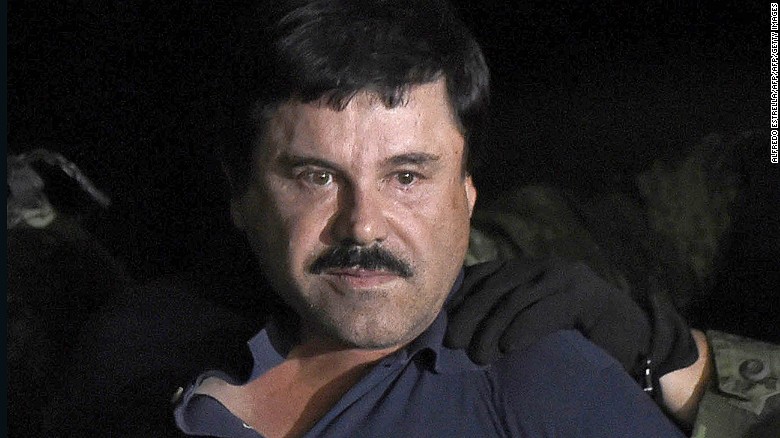
Drug kingpin Joaquin "El Chapo" Guzman is facing trial in New York.

There have, however, been significant arrests in relation to the Mexican drug trade in recent times.
Damaso Lopez Nunez, a high-ranking leader of Mexico’s Sinaloa drug cartel, was arrested on May 2 in Mexico City and could face charges in the US, authorities said.
His arrest follows January’s extradition of Joaquin “El Chapo” Guzman, who is accused of running the Sinaloa cartel — one of the world’s largest drug-trafficking organizations.
He awaits trial in New York on 17 counts accusing him of running a criminal enterprise responsible for importing and distributing massive amounts of narcotics and conspiring to murder rivals.

World conflict deaths fall

The number of conflict fatalities globally edged down last year, from 167,000 to 157,000, according to the IISS.
This was the second successive annual drop — 180,000 people were killed in 2014.
The number of deaths in Syria fell from 55,000 in 2015. But there were 1,000 more deaths in Afghanistan last year than 2015 and 4,000 more in Iraq.
Voronkova from the IISS said: “Civilians caught amid conflict arguably suffered more than in the preceding years. Between January and August, 900,000 people were internally displaced in Syria alone.”
The internal displacement figures were 234,000 for Iraq and 260,000 for Afghanistan.


Less than 1% of Visa Overstays are Captured

Note: Former DHS Secretary Jeh Johnson signed his name to a report dated January 2016 on the matter of ‘visa-overstays’. Nowhere in the report does it state all the systems and databases are not connected or using old technology and software. Click on the link above if you want to see the tables published by country. In the summary this paragraph was included:

Due to continuing departures by individuals in this population, by January 4, 2016, the number of Suspected In-Country Overstays for FY 2015 had dropped to 416,500, rendering the Suspected In-Country Overstay rate as 0.9 percent. In other words, as of January 4, 2016, DHS has been able to confirm the departures of more than 99 percent of nonimmigrant visitors scheduled to depart in FY 2015 via air and sea POEs, and that number continues to grow.

Image result for visa overstay report  NBCBoston

Homeland Security can’t keep up with more than 1 million immigrants who have overstayed visas

Homeland Security has built up a backlog of more than 1.2 million illegal immigrants who it believes have overstayed visas but managed to arrest only about 3,400 of them, according to the most recent data, which works out to a rate of about 1 in every 350 lawbreakers.
That is far worse than the rate for those who crossed the border illegally, and it means criminals, people engaged in narcoterrorism and other national security risks are left to run free in the U.S., the Homeland Security inspector general said in a report Thursday.
Federal agents have trouble tracking down the criminals because the government still doesn’t monitor departures, meaning it can’t be certain whether those who came on tourist, business or student visas leave when they are supposed to.
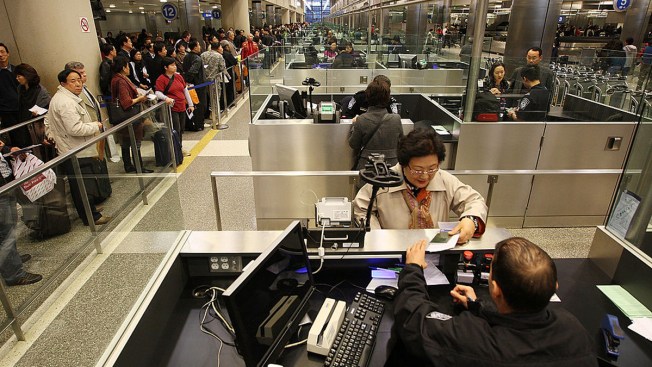
Officers have to check as many as 27 in-house systems, in addition to state databases, to try to guess whether someone has left. Even then, they can make catastrophic mistakes when it wrongly appears that a visitor has left the country.

“Such false departure information resulted in [deportation] officers closing visa overstay investigations of dangerous individuals, such as suspected criminals, who were actually still in the United States and could pose a threat to national security,” the investigators said in the report. “For example, an ERO officer stated that a suspect under investigation was listed as having left the country, but had given his ticket to a family member and was still residing in the United States.”
Visa overstays, as they are called, have become an increasing focus of the immigration debate. As the flow of illegal border crossings declines, an increasing percentage of those in the country illegally are travelers who came on business, tourist or student visas but didn’t leave when their time was up.
Several of the Sept. 11, 2001, hijackers were overstays.
Homeland Security has struggled to get a handle on the situation, or even to figure out how bad it is.
A report last year looking at just a portion of visas calculated that more than 500,000 visitors overstayed in 2015. The total backlog grew to more than 1.2 million, the inspector general said.
Meanwhile, U.S. Immigration and Customs Enforcement officers arrested only 3,402 potential overstays in 2015.

(Advance this video to the 18:40 minute mark and listen to the statistics on inbound travelers under the Visa Waiver Program) What could go wrong on this program?


In its official response, ICE said it is trying to do a better job of calculating the number of visa overstays.
President Trump has pushed the Homeland Security Department to finish the system that would track departures, and tests are being run at Hartsfield-Jackson International Airport in Atlanta.
The department also plans to release its next overstay report soon. That report will cover almost all visa categories, so the government will have a better sense for how bad the problem is.
But Rep. Bob Goodlatte, chairman of the House Judiciary Committee, said that until the government tracks all departures, it won’t know what’s going on.
“Visa security is a matter of national security, and it is imperative that we know who is coming to our country and when they leave so that we protect American citizens and our interests,” the Virginia Republican said.
Congress demanded a biometric entry-exit system more than 20 years ago, but administrations in both parties have failed to deliver, saying that airports aren’t configured to check departures and that the land ports of entry are an even bigger logistical hurdle.
Mr. Goodlatte said he expects Mr. Trump’s focus on immigration to finally push Homeland Security to finish the job.

Until then, officers will waste time on bogus leads, the inspector general’s report said. The data are so unreliable that officers and agents often end up finding an overstay still in the country who the systems said already had left, or spend time trying to track down someone who did leave the country or obtained legal status.
“An ICE officer estimated that he spent more than 50 hours on a single suspect, only to find the individual had applied for [an immigration] benefit and should not have been categorized as an overstay,” the audit said.