DoJ’s Bruce Ohr Demoted Again, Project Cassandra?

Image result for Hezbollah Business Affairs Component

That’s it? On second thought, keep him employed to cough up the goods on Project Cassandra. More on that below. As an aside, in late December, Jeff Sessions ordered a complete review of Project Cassandra.

FNC: A Justice Department official demoted late last year for concealing his meetings with the men behind the anti-Trump “dossier” has been stripped of yet another title, Fox News has learned.

Bruce Ohr is no longer head of the Organized Crime Drug Enforcement Task Force.

Separately, sources familiar with the discussions tell Fox News that the Justice Department is expected to comply with demands from the House Intelligence Committee to provide Ohr for an interview. He is scheduled to visit the committee on Jan. 17, sources said.

Fox News first reported in December that Ohr had been demoted from the position of associate deputy attorney general, after it was revealed he had conducted undisclosed meetings with dossier author Christopher Steele and Glenn Simpson of Fusion GPS, the opposition research firm that produced the salacious document.

Fox News also reported that his wife Nellie Ohr worked for Fusion GPS, specifically on research related to the dossier.

At the time of his demotion, DOJ officials told Fox News that Bruce Ohr had been “wearing two hats,” and would fall back to his other title and portfolio – as head of OCDETF.

Now, Ohr has been stripped of that role as well; former deputy director Thomas Padden is now acting director.  It is unclear where Ohr has landed, only that he is still an employee with the Department of Justice.

One DOJ insider joked that Ohr might end up in “one of those offices without a phone.”

Fox News has also confirmed that Bruce Ohr, as the head of OCDETF, was directly involved with Project Cassandra, the interagency investigation spearheaded by the DEA that tracked a massive international drug and money laundering scheme allegedly run by Hezbollah.

The project recently was the subject of a critical and lengthy Politico report looking at how the Obama administration may have hampered the investigation. Those closest to Project Cassandra, including Derek Maltz, the now-retired supervisory DEA agent who was a major player in the operation, claim the project and its potential prosecutions were sidelined by senior Obama administration officials who didn’t want to upset Iran in the lead-up to the historic nuclear deal with Tehran in 2015.

Attorney General Jeff Sessions has promised to look into what happened with the investigation.

He said in a statement last month: “While I am hopeful that there were no barriers constructed by the last admission to allowing DEA agents to fully bring all appropriate cases under Project Cassandra, this is a significant issue for the protection of Americans. We will review these matters and give full support to investigations of violent drug trafficking organizations.”

Sources close to the attorney general told Fox News that he was recently made aware of Ohr’s role in Project Cassandra and that Sessions is personally involved in the review and frequently asks for updates.

Image result for Hezbollah Business Affairs Component photo

The 76 page criminal complaint for Project Cassandra is here.

Hezbollah Business Affairs Component 85 tons of cocaine was sold to Los Zetas one of the most violent Mexican cartels. Bruce Ohr was head of the teams assigned to Project Cassandra.

The United States Drug Enforcement Administration (DEA) (2016) announced significant enforcement activity including arrests targeting Lebanese Hizballah’s External Security Organization Business Affairs Component (BAC), which is involved in international criminal activities such as drug trafficking and drug proceed money laundering. These proceeds are used to purchase weapons for Hizballah for its activities in Syria. This ongoing investigation spans the globe and involves numerous international law enforcement agencies in seven countries, and once again highlights the dangerous global nexus between drug trafficking and terrorism.

This effort is part of DEA’s Project Cassandra, which targets a global Hizballah network responsible for the movement of large quantities of cocaine in the United States and Europe. This global network, referred to by law enforcement as the Lebanese Hizballah External Security Organization Business Affairs Component (BAC), was founded by deceased Hizballah Senior Leader Imad Mughniyah and currently operates under the control of Abdallah Safieddine and recent U.S.-designated Specially Designated Global Terrorist (SDGT) Adham Tabaja. Members of the Hizballah BAC have established business relationships with South American drug cartels, such as La Oficina de Envigado, responsible for supplying large quantities of cocaine to the European and United States drug markets. Further, the Hizballah BAC continues to launder significant drug proceeds as part of a trade based money laundering scheme known as the Black Market Peso Exchange.

“These drug trafficking and money laundering schemes utilized by the Business Affairs Component provide a revenue and weapons stream for an international terrorist organization responsible for devastating terror attacks around the world,” said DEA Acting Deputy Administrator Jack Riley.  “DEA and our international partners are relentless in our commitment to disrupt any attempt by terrorists and terrorist organizations to leverage the drug trade against our nations. DEA and our partners will continue to dismantle networks who exploit the nexus between drugs and terror using all available law enforcement mechanisms.”

Beginning in February 2015, based on DEA investigative leads, European authorities initiated an operation targeting the network’s criminal activities in that region. Since then, law enforcement authorities, closely supported by DEA, have uncovered an intricate network of money couriers who collect and transport millions of euros in drug proceeds from Europe to the Middle East. The currency is then paid in Colombia to drug traffickers using the Hawala disbursement system. A large portion of the drug proceeds was found to transit through Lebanon, and a significant percentage of these proceeds are benefitting terrorist organizations, namely Hizballah.

This investigation is a result of leads developed during the investigation into the Lebanese Canadian Bank.

The combination of aggressive international law enforcement investigations and Treasury’s ongoing sanctions (see below) pressure shows the scope of the global commitment to diminish the ability of Hizballah and its financial supporters to move funds worldwide.

Enforcement Action

With DEA and Customs and Border Protection (CBP) working closely with foreign counterparts in France, Germany, Italy and Belgium, authorities arrested top leaders of the European cell of this Lebanese Hizballah External Security Organization BAC last week. The most significant arrest was of the U.S.-designated SDGT Mohamad Noureddine, a Lebanese money launderer who has worked directly with Hizballah’s financial apparatus to transfer Hizballah funds via his Lebanon-based company Trade Point International S.A.R.L. and maintained direct ties to Hizballah commercial and terrorist elements in both Lebanon and Iraq.

The CPB National Targeting Center partnered with DEA and international counterparts such as Europol in this investigation. CBP’s continued cooperation with the DEA , and European law enforcement counterparts is a vital component in dismantling complex global drug trafficking and money laundering networks as well as enhancing the security of the United States border.

U.S. Treasury Sanctions

Separately, the U.S. Department of the Treasury announced sanctions last week targeted Hizballah’s financial support network by designating Hizballah-affiliated money launderers Noureddine and Hamdi Zaher El Dine, as well as Trade Point International S.A.R.L, a company owned or controlled by Noureddine, pursuant to Executive Order 13224. This order targets terrorists and those providing support to terrorists or acts of terrorism.  Noureddine and El Dine were designated for providing financial services to or in support of Hizballah, a Specially Designated Global Terrorist.  Trade Point International S.A.R.L. was designated for being owned or controlled by Noureddine. As a result of Treasury’s action, all assets of the designated individuals or entities that are located in the United States or in the possession or control of U.S. persons are frozen, and U.S. persons are generally prohibited from engaging in transactions with them.

As part of its designation, Adam J. Szubin, Acting Under Secretary for Terrorism and Financial Intelligence, stated that, “Hizballah needs individuals like Mohamad Noureddine and Hamdi Zaher El Dine to launder criminal proceeds for use in terrorism and political destabilization.  We will continue to target this vulnerability, and expose and disrupt such enablers of terrorism wherever we find them.”

Participating offices and agencies:

DEA Philadelphia, DEA Miami, DEA Newark, DEA New York, DEA Special Operations Division, DEA Bilateral Investigative Unit, DEA country offices in Europe, as well as Bogota and Cartagena
U.S. Customs and Border Protection
U.S. Treasury Financial Crimes Enforcement Network (FinCEN)
U.S. Treasury Office of Foreign Assets Control (OFAC)
EUROPOL
EUROJUST

Obama/Democrats DID vote for the Wall and an Immigration Proposal

June, 1995: The White House today welcomed a Federal advisory panel’s recommendation to cut legal immigration by one-third. But the proposals met fierce opposition from Hispanic, Asian-American, Roman Catholic and Jewish groups, as well as from the National Association of Manufacturers.

Barbara Jordan, chairwoman of the panel, the Commission on Immigration Reform, delivered the plan to President Clinton, and he congratulated the panel. “Consistent with my own views, the commission’s recommendations are pro-family, pro-work, pro-naturalization,” he said.

Mr. Clinton said the panel had “laid out a road map for Congress to consider.” His press secretary, Michael D. McCurry, said that “the President indicated to Barbara Jordan today that he will support such reductions,” which would represent the biggest change in immigration policy in more than 40 years.

In addition, Mr. Clinton said the proposal “appears to reflect a balanced immigration policy that makes the most of our diversity while protecting the American work force so that we can better compete in the emerging global economy.” More here.

Image result for democrats vote for immigration plan photo


*** For an 8 minute video clip of then Senator Barack Obama on the matter of immigration and the border wall, go here.   In a separate speech on April 3, 2006, Barack Obama included these concepts:

The American people are a welcoming and generous people. But those who enter our country illegally, and those who employ them, disrespect the rule of law. And because we live in an age where terrorists are challenging our borders, we simply cannot allow people to pour into the United States undetected, undocumented, and unchecked. Americans are right to demand better border security and better enforcement of the immigration laws.

To begin with, the agencies charged with border security would receive new technology, new facilities, and more people to stop, process, and deport illegal immigrants. But while security might start at our borders, it doesn’t end there. Millions of undocumented immigrants live and work here without our knowing their identity or their background. We need to strike a workable bargain with them. They have to acknowledge that breaking our immigration laws was wrong. They must pay a penalty, and abide by all of our laws going forward. They must earn the right to stay over a 6-year period, and then they must wait another 5 years as legal permanent residents before they become citizens.

But in exchange for accepting those penalties, we must allow undocumented immigrants to come out of the shadows and step on a path toward full participation in our society. In fact, I will not support any bill that does not provide this earned path to citizenship for the undocumented population–not just for humanitarian reasons; not just because these people, having broken the law, did so for the best of motives, to try and provide a better life for their children and their grandchildren; but also because this is the only practical way we can get a handle on the population that is within our borders right now.

And before any guestworker is hired, the job must be made available to Americans at a decent wage with benefits. Employers then need to show that there are no Americans to take these jobs. I am not willing to take it on faith that there are jobs that Americans will not take. There has to be a showing. If this guestworker program is to succeed, it must be properly calibrated to make certain that these are jobs that cannot be filled by Americans, or that the guestworkers provide particular skills we can’t find in this country. The full text is here.

Image result for senator obama 2006

In part from Politifact:

The Secure Fence Act of 2006, which was passed by a Republican Congress and signed by President George W. Bush, authorized about 700 miles of fencing along certain stretches of land between the border of the United States and Mexico.

The act also authorized the use of more vehicle barriers, checkpoints and lighting to curb illegal immigration, and the use of advanced technology such as satellites and unmanned aerial vehicles.

At the time the act was being considered, Barack Obama, Hillary Clinton and Chuck Schumer were all members of the Senate. (Schumer of New York is now the Senate minority leader.)

Obama, Clinton, Schumer and 23 other Democratic senators voted in favor of the act when it passed in the Senate by a vote of 80 to 19.

In Defiance, Governors Issues Pardons to Deportees

It is argued that the Democrats want the illegals to stay in country due in part to gaining their vote. There is truth to that for sure, yet advocacy organizations raise a LOT of money which is in the end more important to the Democrat base for campaign contributions.

For a list of pro-amnesty groups covering all industry and social classifications, go here.

Perhaps as a reminder it is prudent to mention that Obama led the charge for clemency and pardons as noted here.

President Obama offered clemency to seven Iranians charged with violating U.S. trade sanctions against Iran as part of a historic prisoner agreement with Iran that freed four Americans Saturday, including Washington Post reporter Jason Rezaian.

The Iranians, six of whom are dual U.S.-Iranian citizens, were imprisoned or were pending trial in the United States. The U.S. government dismissed charges against 14 other Iranians, all outside the United States, after assessing that extradition requests were unlikely to be successful, according to a U.S. official. More here.

***

New York Gov. Andrew Cuomo mimicked California Gov. Jerry Brown’s approach to immigration, pardoning 18 convicted illegal immigrants who faced deportation.

Cuomo, a Democrat, praised himself on Twitter for his compassion Thursday before linking to a New York Times article supporting the move.

Related reading: In hopes of getting around federal law, immigrants seek governors’ pardons to block deportation

Defying Trump again, Jerry Brown pardons immigrants about to be deported

Escalating the state’s showdown with the Trump administration over illegal immigration, California Gov. Jerry Brown used a Christmas holiday tradition to grant pardons Saturday to two men who were on the verge of being deported for committing crimes while in the U.S.

Brown, pairing his state’s combative approach to federal immigration authorities with his belief in the power of redemption, characterized the pardons as acts of mercy.

The Democratic governor moved as federal officials in recent months have detained and deported immigrants with felony convictions that resulted in the loss of their legal residency status, including many with nonviolent offenses that occurred years ago.

With the pardons, the reason for applicants’ deportations may be eliminated, said attorney Kevin Lo of Asian Americans Advancing Justice-Asian Law Caucus, which represented some of the men in a recent class-action lawsuit.
The pardoned immigrants will still need to ask immigration courts to reopen their cases, he said.The detentions of felons has focused on specific ethnic groups in past months, including Cambodians and Vietnamese, according to immigration lawyers handling the cases. Cambodia has been reluctant to repatriate former felons, but acquiesced to accepting more after the State Department stopped issuing visas in September to a small group of top Cambodian officials and their families.

Two of Brown’s pardons are Northern California Cambodian men picked up in October in those immigration sweeps, Mony Neth of Modesto and Rottanak Kong of Davis.

Kong was convicted on felony joyriding in 2003 in Stanislaus County at age 25 and sentenced to a year in jail. Neth was convicted on a felony weapons charge with a gang enhancement and a misdemeanor charge of receiving stolen property with a value of $400 or less in 1995 in Stanislaus County.

Both men came to the United States as children after their families fled the Khmer Rouge regime, and neither has engaged in criminal activity since being released from prison.

Kong and Neth were scheduled to be deported Monday, but a federal judge issued a temporary restraining order last week in the lawsuit filed by Lo’s team, delaying their departure.

Neth, 42, was unexpectedly released from Rio Cosumnes Correctional Center on Friday, said his wife, Cat Khamvongsa, and is back home with his family – albeit with an ankle monitor.

“We gave him a big hug,” she said of herself and her 16-year-old daughter. “We’re so happy.”

In a phone interview Friday night while on his way to Costco, Neth said he was asleep Friday morning when a guard at the detention facility near Elk Grove called his name.

“I knew right then I was coming home,” Neth said. “It’s the best Christmas gift ever. … I don’t want to be anywhere else in the world.”

Despite the governor’s pardon, Neth still faces legal hurdles, Lo said.

AG Sessions Unwinds Obama’s Marijuana Policy

Oregon, one of the first states to push back:

SALEM, Ore. — An Oregon congressman who is one of a chief backer of legalized marijuana is urging a fight against U.S. Attorney General Jeff Session’s plan to open the gates to federal enforcement of laws against marijuana.

Rep. Earl Blumenauer, a Democrat who co-sponsored an amendment that prevents the Justice Department from interfering with states’ medical marijuana programs, called the move outrageous. He said anyone who cares about this issue should mobilize and push back strongly.

“One wonders if Trump was consulted—it is Jeff Sessions after all—because this would violate his campaign promise not to interfere with state marijuana laws,” he said in a prepared statement.

Oregon Gov. Kate Brown said rolling back federal marijuana policy, which has been largely non-interventionist, will disrupt the state’s economy. She said over 19,000 jobs have been created by the marijuana market in Oregon, which was the first state to decriminalize personal possession in 1973, legalized medical marijuana in 1998, and recreational use in 2014.

“The federal government must keep its promise to states that relied on its guidance,” she said in a statement. “My staff and state agencies … will fight to continue Oregon’s commitment to a safe and prosperous recreational marijuana market.”

More here.

WASHINGTON (Reuters) – The U.S. Justice Department on Thursday rescinded a policy begun under Democratic former President Barack Obama that had eased enforcement of federal marijuana laws, saying it would be up to federal prosecutors across the country to prioritize any such drug cases.

The Obama administration’s guidelines had “created a safe harbor for the marijuana industry to operate in these states and … there is a belief that that is inconsistent with what the federal law says,” a Justice Department official told reporters, referring to states that have legalized the drug.

***

Department of Justice
Office of Public Affairs

Thursday, January 4, 2018

Justice Department Issues Memo on Marijuana Enforcement

The Department of Justice today issued a memo on federal marijuana enforcement policy announcing a return to the rule of law and the rescission of previous guidance documents. Since the passage of the Controlled Substances Act (CSA) in 1970, Congress has generally prohibited the cultivation, distribution, and possession of marijuana.


In the memorandum, Attorney General Jeff Sessions directs all U.S. Attorneys to enforce the laws enacted by Congress and to follow well-established principles when pursuing prosecutions related to marijuana activities. This return to the rule of law is also a return of trust and local control to federal prosecutors who know where and how to deploy Justice Department resources most effectively to reduce violent crime, stem the tide of the drug crisis, and dismantle criminal gangs.


“It is the mission of the Department of Justice to enforce the laws of the United States, and the previous issuance of guidance undermines the rule of law and the ability of our local, state, tribal, and federal law enforcement partners to carry out this mission,” said Attorney General Jeff Sessions. “Therefore, today’s memo on federal marijuana enforcement simply directs all U.S. Attorneys to use previously established prosecutorial principles that provide them all the necessary tools to disrupt criminal organizations, tackle the growing drug crisis, and thwart violent crime across our country.”

What Goes on in Sanctuary California Wont Stay in California

Image result for sanctuary california photo

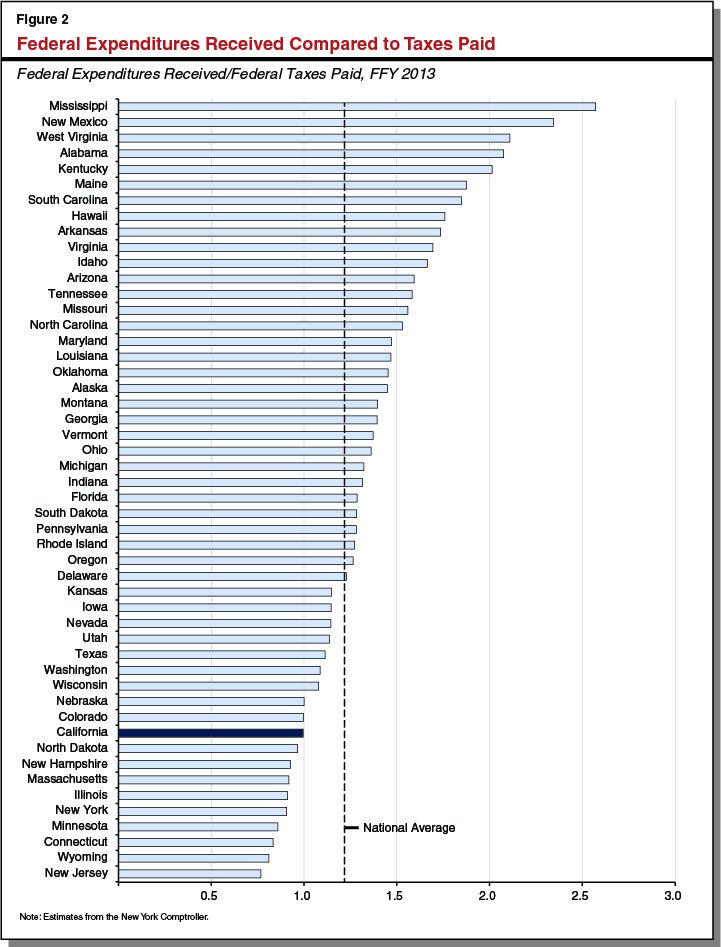
Federal dollars going to California could or should be considered foreign aid. Why? Read on…

The federal government spends some $367.8 billion a year on California. That’s an average of about $9,500 for every woman, man and child in the state.

In truth, the money isn’t spread out evenly. About 56 cents of every federal dollar spent in California, according to the analysis, goes to health or retirement benefits — Social Security, Medicare and money for low-income residents’ health care through the Medi-Cal program.

Defense contracts are the next biggest slice of the pie, followed by paychecks to military and civilian government employees. From there, federal spending gets sprinkled among a number of programs run by the state government. Gov. Jerry Brown’s recent budget plan pegged those funds at a total of $105 billion, equivalent to about 58% of state taxpayer dollars to be spent in the fiscal year that begins on July 1.

A detailed report is here.

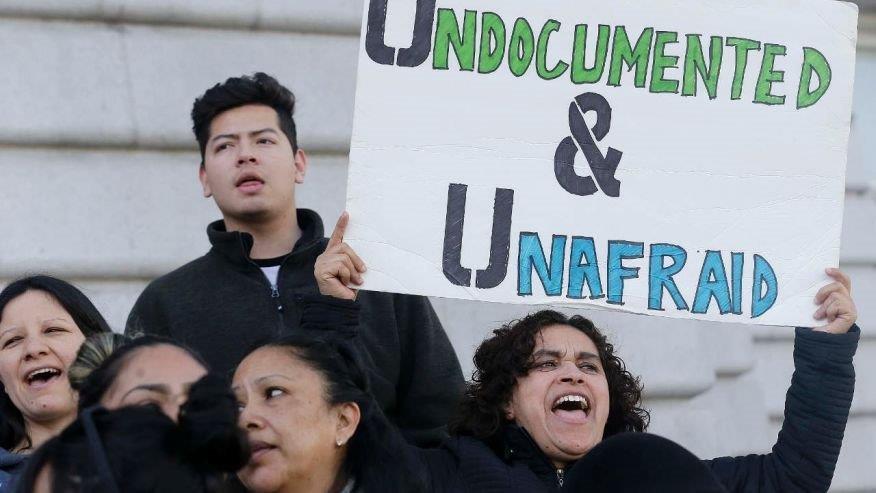
So, now that California is officially a sanctuary state under SB54, effective January1, 2018, those illegals, felons and those plotting threats with regard to national security can freely travel anywhere, this is not just a California problem.

Last year, when President Donald Trump issued an executive order to cut funding from counties that limit cooperation with U.S. immigration authorities, Santa Clara County stood to lose $1.7 billion in federal funding. After fighting the order, a federal judge ruled in favor of the county. Now that the entire state is following the same guidelines, some leaders argue it could strengthen their position in future legal battles.

Not everyone is onboard, however. Some California sheriff’s departments have criticized the new sanctuary state law, saying it will lead to broad roundups that could lead to collateral arrests. More here.

Image result for sanctuary california photo

There is a key word in this new law, it is ‘prohibits’.

BILL SUMMARY

  • Prohibits state and local law enforcement from holding illegal aliens on the basis of federal immigration detainers, or transferring them into federal custody, unless they’ve been convicted in the last 15 years for one of a list of 31 crimes, or are a registered sex offender: if not, they may only be held with a warrant from a federal judge.
  • Prohibits state and local law enforcement from asking anyone about their immigration status.
  • Prohibits state and local law enforcement from sharing any information with federal immigration authorities that is not available to the general public.
  • Prohibits state and local law enforcement from using any of their money or personnel to “investigate, interrogate, detain, detect, or arrest persons for immigration enforcement purposes”.
  • Prohibits state and local law enforcement from allowing federal immigration authorities to use space in their facilities.
  • Limits how and when state and local law enforcement can contract with federal immigration authorities.
  • Grants discretion to state and local law enforcement to cooperate even less with federal immigration authorities than the bill authorizes them to, but not more
  • Is near-universally recognized and described by both its supporters and opponents as a sanctuary state bill: protects illegal aliens at the expense of citizens, will increase illegal immigration to California, and sends the message that illegal aliens are welcome everywhere in the state.

***

State Senate Leader Kevin de Leon, the author of the bill, has argued that public safety will be undermined if the law isn’t passed. It is estimated that more than 2 million undocumented people live in California — with hundreds of thousands from Asia as well as Latin America — and advocates say many will be scared to interact with official institutions if they fear that will put them on federal immigration agents’ radar. They say individuals might not report violent crimes to police, might not send their kids to school or might not seek medical care at the local hospital. And there is some evidence to back that up: Earlier this year, the Los Angeles Police Department said that Latino communities were reporting fewer instances of sexual assault and domestic violence because of concerns about deportation under Trump. More here.

***

California Democratic state Senate president Kevin de León intends to enter California’s 2018 Senate race against Sen. Dianne Feinstein, three sources with knowledge of his plans say.

De León has begun calling labor leaders and elected officials to inform them of his plans, the sources said, and is expected to soon announce his campaign against Feinstein, a giant of California Democratic politics who has held the office since 1992.
The 50-year-old de León, who represents Los Angeles and is seen as a leading Latino voice in Democratic politics, is likely to campaign aggressively against President Donald Trump. He began signaling he could oppose Feinstein in late August, after she said Trump could “be a good president” and that he “can learn and change.” Feinstein later clarified that she is “under no illusion that it’s likely to happen and will continue to oppose his policies.” More here.
So who is this de Leon character? That is a challenge to determine and he has not been fully forthcoming on his own history. Check it out here. 
We also had this sexual harassment case, where de Leon was the roommate. Hummm. He was also a college dropout.

De León was the first and only person in his family to graduate from high school and attend college. He started out at the University of California Santa Barbara, but it was a challenge. He had moxie but no organizational skills, no practice at taking notes or studying for a test. He didn’t last long.

He couldn’t go back home and tell his mother of his failure. Instead, he went to work for One Stop Immigration Center, a nonprofit in Los Angeles that helps undocumented immigrants fill out paperwork and teaches them English, history and organizing.

Then, the Attorney General for California is Javier Beccera.  He is a loyal and dedicated supported of the Dream Act and will defend all cases against California becoming a sanctuary state. Meanwhile, remember that whole Pakistani IT case in Congress under Debbie Wasserman Schultz?

Enter again Javier Beccera.

Now-indicted former congressional IT aide Imran Awan allegedly routed data from numerous House Democrats to a secret server. Police grew suspicious and requested a copy of the server early this year, but they were provided with an elaborate falsified image designed to hide the massive violations. The falsified image is what ultimately triggered their ban from the House network Feb. 2, according to a senior House official with direct knowledge of the investigation.

The secret server was connected to the House Democratic Caucus, an organization chaired by then-Rep. Xavier Becerra. Police informed Becerra that the server was the subject of an investigation and requested a copy of it. Authorities considered the false image they received to be interference in a criminal investigation, the senior official said.

On Jan. 24, 2017, Becerra vacated his congressional seat to become California’s attorney general. “He wanted to wipe his server, and we brought to his attention it was under investigation. The light-off was we asked for an image of the server, and they deliberately turned over a fake server,” the senior official said.

“They were using the House Democratic Caucus as their central service warehouse … It was a breach. The data was completely out of [the members’] possession. Does it mean it was sold to the Russians? I don’t know,” the senior official said.

Capitol Police considered the image a sign that the Awans knew exactly what they were doing and were going to great lengths to try to cover it up, the senior official said. The House Sergeant-at-Arms banned them from the network as a result.

The senior official said the data was also funneled offsite via a Dropbox account, from which copies could easily be downloaded. Authorities could not immediately shut down the account when the Awans were banned from the network because it was not an official account. More here.

One last item…don’t forget to keep Eric Holder in the whole mix regarding California.

The California Senate is throwing its support behind Chicago in a lawsuit against the Justice Department over its plan to withhold federal money from “sanctuary cities,” which limit collaboration between state and local authorities with federal immigration agents.

Former U.S. Atty. Gen. Eric H. Holder Jr. and his firm, Covington & Burling, on Thursday filed a friend-of the-court brief on behalf of the state Senate in the federal case, saying sanctuary jurisdictions have policies consistent with federal law.

U.S. Atty. Gen. Jeff Sessions, Holder says, does not have the constitutional authority to mandate that cities, counties or states participate in federal immigration efforts as a condition to receive their federal public safety awards.

The lawsuit, filed last month by Chicago Mayor Rahm Emanuel and city officials, asks a judge to block the Trump administration from enforcing three new conditions it included in petitions for Edward Byrne Memorial Justice Assistance Grant money. The city uses the grant to buy police cars and other equipment, and to fund an anti-violence program.

Holder, who was said to have filed the brief pro-bono, was temporarily hired by the Senate and Assembly to serve as outside counsel to offer advice on the state’s legal strategy against the incoming administration. On Friday, a Covington & Burling spokeswoman said the firm remains “engaged with the California Senate on an ongoing basis.”

In the brief, Holder said the California Legislature has a particular interest in the Chicago case as it weighs Senate Bill 54, which seeks to limit state and local law enforcement agencies from using resources to question, detain and provide information on immigrants illegally in the country.

Covington & Burling analyzed the legislation this year and concluded that “states have the power over the health and safety of their residents and allocation of state resources.”