Sanctuary Cities Don’t Comply Face Loss of Federal Dollars/Clawback

AG: Sanctuary Cities Face Ineligibility for Future Federal Funds, ‘Clawback’ of Funds Already Awarded

(CNSNews.com) – Attorney General Jeff Sessions said Monday that states and localities that refuse to comply with federal immigration laws will be deemed ineligible for federal grants.

“Today, I’m urging  states and local jurisdictions to comply with these federal laws, including 8 U.S.C. Section 1373. Moreover, the Department of Justice will require that jurisdictions seeking or applying for Department of Justice grants to certify compliance with 1373 as a condition of receiving those awards,” he said, adding that the policy “is entirely consistent with the Department of Justice’s Office of Justice Program’s guidance that was issued just last summer under the previous administration.

“This guidance requires state and local jurisdictions to comply and certify compliance with Section 1373 in order to be eligible for OJP grants. It also made clear that failure to remedy violations could result in withholding grants, termination of grants, and disbarment or ineligibility for future grants,” Sessions added.

“The Department of Justice will also take all lawful steps to clawback any funds awarded to a jurisdiction that willfully violates 1373. In the current fiscal year, the Department of Justice’s Office of Justice Program and Community Oriented Policing services anticipates awarding more than $4.1 billion in grants,” he said.

The attorney general said that in one week alone, “there were more than 200 instances of jurisdictions refusing to honor ICE detainer requests with respect to individuals charged or convicted of a serious crime,” according to a report released recently by the Department of Homeland Security.

“The charges and convictions against these aliens included drug-trafficking, hit-and-run, rape, sex offenses against a child, and even murder. Such policies cannot continue. They make our nation less safe by putting dangerous criminals back on the streets,” Sessions said.

He pointed to the murder of 32-year-old Kate Steinle who was killed two years ago in San Francisco as an example.

“The shooter, Francisco Sanchez, was an illegal immigrant who had already been deported five times and had seven felony convictions,” Sessions pointed out.

“Just 11 weeks before the shooting, San Francisco had released Sanchez from its custody, even though Immigration and Customs Enforcement officers had filed a detainer requesting that he be held in custody until immigration authorities could pick him up for removal. Even worse, Sanchez admitted the only reason he came to San Francisco was because it was a sanctuary city,” the attorney general said.

“A similar story unfolded just last week, when Ever Valles, an illegal immigrant and a Mexican national was charged with murder and robbery of a man at a light rail station. Valles was released from a Denver jail in late December, despite the fact that ICE has lodged a detainer for his removal,” he said.

“The American people are not happy with these results. They know that when cities and states refuse to help enforce immigration laws, our nation is less safe. Failure to deport aliens who are convicted of criminal offenses puts whole communities at risk, especially immigrant communities in the very sanctuary jurisdictions that seek to protect the perpetrators,” Sessions said.

Sessions said recent polling shows that 80 percent of Americans “believe that cities that arrest illegal immigrants for crime should be required to turn them over to immigration authorities.”

“DUIs, assaults, burglaries, drug crimes, gang rapes, crimes against children, and murderers — countless Americans would be alive today and countless loved ones would not be grieving today if these policies of sanctuary cities were ended. Not only do these policies endanger lives of every American — just last May, the Department of Justice inspector general found that these policies also violate federal law,” he said.

***

Nine Bipartisan Homeland Security-Related Bills Passed by House

What the House Committee on Homeland security described as an “unprecedented number of bipartisan [bills] aimed at keeping Americans safe,” were passed this last week by the House which deal with a variety of aspects of homeland Security.

The nine pieces of legislation, the committee said, are designed “to … also save taxpayer dollars by improving the acquisition process at the Department of Homeland Security [DHS] and make important reforms to the operations of the Transportation Security Administration [TSA].”

“It is critical that we continue to re-examine our strategy, technology and the infrastructure we currently have in place to strengthen the Department of Homeland Security and stop terrorists from reaching our shores,” said committee chairman Michael McCaul (R-TX). “The evolving threats we face demand action to address vulnerabilities in our defenses. I commend the work of my Committee—particularly the bipartisan nature in which these bills were advanced—to make our country safer.”

The nine bills out the Homeland Security Committee passed by the House included a key counterterrorism bill, the Terrorist and Foreign Fighter Travel Exercise Act of 2017 (HR 1302), which expands on the work of last Congress.

The other key pieces of legislation passed this past week include the:

DHS Multiyear Acquisition Strategy Act of 2017 (HR 1249), introduced by Rep. Brian Fitzpatrick (R-PA), and amends the Homeland Security Act of 2002 to require a multiyear acquisition strategy of DHS.

DHS Acquisition Authorities Act of 2017 (HR 1252), introduced by Rep. Clay Higgins (R-LA), amends the Homeland Security Act of 2002 to provide for certain acquisition authorities for the Under Secretary of Management of DHS.

Reducing DHS Acquisition Cost Growth Act (HR 1294), introduced by Rep. John Rutherford (R-FL), amends the Homeland Security Act of 2002 to provide for congressional notification regarding major acquisition program breaches.

TSA Administrator Modernization Act of 2017 (HR 1309), introduced by Rep. John Katko (R-NY), streamlines the office and term of the administrator of TSA.

Quadrennial Homeland Security Review Technical Corrections Act of 2017 (HR 1297), introduced by Rep. Bonnie Watson Coleman (D-NJ), amends the Homeland Security Act of 2002 to make technical corrections to the requirement that the Secretary of Homeland Security submit quadrennial homeland security reviews.

Transparency in Technological Acquisitions Act of 2017 (HR 1353), introduced by Rep. Kathleen Rice (D-NY), amends the Homeland Security Act of 2002 to require certain additional information to be submitted to Congress regarding the strategic 5-year technology investment plan of the TSA.

Read Homeland Security Today’s report on the bill here.

Securing our Agriculture and Food Act (HR 1238), introduced by Rep. David Young (R-IA), amends the Homeland Security Act of 2002 to make the Assistant Secretary of Homeland Security for Health Affairs responsible for coordinating the efforts of DHS related to food, agriculture and veterinary defense against terrorism.

Read Homeland Security Today’s report on the legislation here.

Terrorist and Foreign Fighter Travel Exercise Act of 2017 (HR 1302), introduced by Rep. Martha McSally (R-AZ), requires an exercise related to terrorist and foreign fighter travel, and for other purposes.

Department of Homeland Security Acquisition Innovation Act (HR 1365), introduced by Rep. Lou Correa (D-CA), amends the Homeland Security Act of 2002 to require certain acquisition innovation.

What you Should Know About “Las Moicas” and Why

Is there any reason why the Trump administration has not called for all drug cartels to be listed as terror organizations?

Ten Cartels are fighting for control of Guerrero with more brutality and violence

Subject Matter: Organized crime in Guerrero
Recommendation: No prior subject matter knowledge requiredGuerrero occupies the third place in terms of most poverty at 62% of the population and first place for homicides at 2884 in 2016 at the national level. It is the state most disputed among organized crime groups. There is a presence of 10 cartels, five of them top level. Its central zone has converted into a battlefield between two organizations Los Rojos and Los Ardillos and possibly others that authorities have not completely identified yet. The presence of 500 military and state police has not contained the disappearances and executions and the criminals come back each time more brutal.

In the last decade, Guerrero has converted in the land of cartels and death; the dispute between the Sinaloa cartel, CJNG, the Beltran Leyva Organization, the Knights Templar, La Familia Michoacana and no less than five local organizations have converted the state into the most violent with 18,000 executions since 2006, when the call to war against the narco was initiated.

In Guerrero, 12 of the 81 towns are considered neutral zones. The geographic location of Chilapa has converted it into a demarcation most fought over since 2012 by Los Ardillos and Los Rojos, and not only because it is an essential corridor for the transit of drugs, also its land is utilized for the growing of poppys, “that has just finished its first harvest of the year”, according to the Guerrero Coordination Group.

What has happened this year, in Chilapa, there have been 48 executions related to the war between Los Rojos and Los Ardillos, Rojos and a third group of civil organizations known as “Los Jefes” or “Gente Nueva”, different to the Gente Nueva of the Sinaloa cartel, only have a presence int he communities,  and with a population of 129,867 only has 500 soldiers and 100 Municipals to police it.

This last weekend was a violent one in the State with no less that 23 deaths, 10 of them in Chilapa, two women and three men were killed by gunfire in different events and five bodies were incinerated in the interior of a taxi.

At the Start of the month, on Tuesday the 7th, 6 dismembered bodies in a state of decomposition appeared inside 13 plastic bags. On Thursday the 9th, they found another five bodies charred inside a vehicle. The brutality with which they perpetrate the executions in the indigenous town, “is very strong” assured the Governor Hector Astudillo Flores.

The growing wave of violence in the town led to the implementation of Operation Chilapa, in January of 2016. One year after the security strategy was put in place, the Mayor Jesus Parra Garcia blamed social networks and media for “inventing facts that affect the image of the town”. With recent executions of PRI members he had to admit that the violence was aggravated during his administration.

These are times of crisis, of adversity, and are very complex. I have had to govern in the most difficult times for Chilapa, he told reporters.

Who are Los Rojos and Los Ardillos

In the period of 2012 – 2015, when the municipality was governed by PRI Francisco Javier Garcia Gonzalez, Los Rojos settled in Chilapa under the command of Zenen Nava Sanchez “El Chaparro”, alleged family of Jesus Nava Romero ” El Rojo”.

He was a Lieutenant of Arturo Beltran Leyva and who was slaughtered in June of 2013 in Puebla. During this administration, the population lived through the first mass kidnappings, huge extortion of transport and businesses and brutal executions.

Jesus Nava Romero dead in the street (Borderland Beat archive)

Los Ardillos, a gang that comes from the Quechultenango region, whose leaders Celso and Antonio Hernandez Ortega are brothers of ex PRD deputy Bernardo Ortega Jiminez, have extended into the regions of Chilapa, Zitlala, Tixtla, Totoloapan and Acapulco in only one year, 2014, during the transition of the governorships of Angel Aguirre Rivero and Rogelio Ortega Martinez bot of the PRD.

The battle for the central zone of Guerreo tainted at this moment Aguirre Rivero as well as Garcia Gonzalez and also the ex PRI Mario Moreno Arcos of Chilpancingo, and Ignacio Bacilio and Eduardo Nero all accused publicly of ties to Los Rojos.

In 2015, with the change of State Government and municipal, things had begun to escalate. The President of the organization Siempre Vivos, Jose Diaz Navarro, assured that a reduction in the violence would be felt because Zenen Nava, who in January of 2016 escaped after a two hour confrontation with the armed forces, had returned. According to the PGR, El Chaparro in one of the 13 priority objectives of Guerrero and Morelos.

In the last three years, Los Ardillos and Los Rojos, in their dispute for territory, have committed executions of extreme cruelty, torturing, decapitating, and incinerating corpses that were left in public places.

They have also been responsible for the disappearance of 130 persons, according to the Centre for Human Rights. The mass kidnappings in the towns of Zitlata and Chilapa, where the criminal groups kidnap the inhabitants, all in the presence of Military and State Police, denounce the ONG.

The confrontations between various cartels, as well as the kidnappings and executions against the inhabitants, have caused fear in Chilapa. Families prefer not to leave their houses aftern 7 at night , the schools are secured with padlocks and checkpoints that are reinforced.

Nevertheless, the organization Siempre Vivos considers that part of the violence that affects the towns of Tixtla and Zitlala, is a strategy of terror of the State and Federal Governments so that the population calls for the law of Homeland Security, that is pending for discussion at the Congress of the Union.

Totoloapan and the Tequileros

Located in the region of the Tierra Caliente, Totoloapan is, along with Ajuchitlan, Arcelio and Coyuca, the Municipality most threatened by Los Tequileros, a group that separated from La Famila Michoacana and since 2013 have occasioned the displacement of families from no less than 16 communities.

According to reports of the newspaper El Sur, Raibel Jacobo de Almonte, El Tequilero, was a plaza jefe for La Familia Michoacana. Once he had formed his own organization, he began controlling the San Miguel Totolapan and some rural populations in the border area of Rio Balsas. In 2016 his epower extended to populations of the municipalities of Ajuchitlan, Tlapehuala and Arcelia.

In the Tierra Caliente, six out of every ten homicides are attributed to Los Tequileros, who are also linked to a politician, PRI deputy Saul Beltran Orozco. Before the omission, complicity and participation of the local authorities, the local population had chosen to arm itself to the face this criminal organization.

The violence in Guerrero is generalized by the number of cartels that are disputing the third poorest State of the country, but also by the failed security strategy implemented by the Federal and State Governments, that while advising of “big changes” and advances in security the State remains the number one in the list for malicious homicides.  Translated by Otis B Fly-Wheel for Borderland Beat from a Sinembargo article

***
Not finished yet:
Image result for Las Moicas
Meet the Little-Known Mexican Cartel Operating in California

A little-known drug trafficking group in Mexico called “Las Moicas” has not only successfully defended its foothold in the US heroin market for years against Mexico‘s most powerful cartels, but recent reports suggest that it might be expanding.

In an interview with BBC Mundo published on March 15, a spokesperson for the US Drug Enforcement Administration (DEA) said that the Moicas had been expanding their territory in Mexico and that the little-known group had come into conflict with some of Mexico‘s biggest criminal organizations, including the Sinaloa Cartel and the Jalisco Cartel – New Generation (CJNG).

According to a July 2015 report from the DEA, eight major Mexican transnational criminal groups were known to be operating in the United States. Alongside prominent players like the Sinaloa Cartel and CJNG, appeared a trafficking organization called Las Moicas.

According to the report, the Moicas are based in the Mexican state of Michoacán and have ties to the Familia Michoacána, an organization largely displaced by its splinter group, the Knights Templar. Despite the decline of the Familia Michoacána after the death of its top leader in 2014, the Moicas group “remains a regional supplier in California and operate[s] on a smaller scale relative to other major Mexican” criminal organizations.

The Moicas’ first reported run-in with the DEA dates back to 2009, when US authorities seized 50 kilograms of heroin and $250,000 in cash, in addition to arresting several of the 21 suspects from the group later charged in connection with the seizure.

The DEA’s press release concerning the operation asserts that a total of 200 kilograms of heroin, with an estimated retail value of $17.5 million, were smuggled during the run. The group allegedly hid both drugs heading north and drug profits heading south “in elaborate vehicle engine compartments” that allowed them to cross the border undetected.

At the time, the Moicas operated solely in California, but the group has since reportedly expanded to Reno, Nevada, and it operates in some areas of California dominated by the Sinaloa Cartel, according to the DEA’s 2015 report.

As of March 2016, VICE News reported, Mexican authorities had no record of Las Moicas.

InSight Crime Analysis

Mexico’s criminal landscape has become increasingly fragmented as larger cartels continue to rely heavily on smaller groups for specialized criminal tasks and as the government continues to take down top leaders of major criminal organization. In an illustration of this dynamic, Mexican authorities stated that nine cartels — not including the Moicas — operated throughout the country as of July 2016, relying on a total of 37 criminal cells.

Within this context, it appears that the Moicas may have succeeded in quietly growing by maintaining a low profile, as suggested by the absence of official acknowledgement of the group by the Mexican government as well as the scant public information available about the organization. According to the DEA spokesperson contacted by BBC Mundo, the US anti-drug agency does not even know the composition of the Moicas’ hierarchy.

It is possible that the Moicas have followed the blueprint of earlier Mexican drug trafficking organizations, such as the Xalisco Boys who achieved a striking expansion across the United States in the 1990s by investing in the heroin market while maintaining a low profile.

And it is likely that the Moicas’ rise and reported expansion has been fueled by the booming US demand for heroin. The US consumption market for this particularly addictive drug is believed to have tripled over the past decade, boosted by over-prescription of legal opioid drugs and even allegedly criminal activity by executives of some companies in the US pharmaceutical industry.

Visa Overstays are a Bigger Issue then the Border Wall

Primer: If you overstay your visa for 180 days or more (but less than one year), when you depart the U.S. you will be barred from reentering the U.S. for three years. If you overstay your visa for one year or more, when you depart the U.S. you will be barred from reentering the U.S. for ten years.

Image result for visa overstay

Related reading: Rep. Henry Cuellar (D-TX), reports on 30 countries that refuse to take back their criminals. He appeared on CSpan and Full Measure explaining the issue. The Washington Times reports under federal law, the U.S. government can refuse to issue visas to nationals of countries that refuse to take back their citizens who have been ordered deported from the United States. But according to Cuellar, the government is not enforcing the law.
***

TruthRevolt reports in part: The Center for Migration Studies reports that “two-thirds of those who arrived in 2014 did not illegally cross a border, but were admitted (after screening) on non-immigrant (temporary) visas, and then overstayed their period of admission or otherwise violated the terms of their visas.” This is a trend, far above illegal crossings, which is anticipated to continue climbing from now on.

“That’s because, incredibly, the U.S. doesn’t have an adequate system to assure the foreigners leave when they’re supposed to,” Judical Watch reports. “This has been a serious problem for years and in fact some of the 9/11 hijackers overstayed their visa to plan the worst terrorist attack on U.S. soil. More than a decade and a half later little has changed. Securing the famously porous southern border is essential to national security but so is a reliable system that cracks down on visa overstays.”

According to the CMS study, there have been 600,000 more overstays than illegal border crossings since 2007. Mexico leads in both overstays and EWIs, or entries without inspection. Here are the breakdowns:

  • California has the largest number of overstays (890,000), followed by New York (520,000), Texas (475,000), and Florida (435,000).
  • Two states had 47 percent of the 6.4 million EWIs in 2014: California (1.7 million) and Texas (1.3 million).
  • The percentage of overstays varies widely by state: more than two-thirds of the undocumented who live in Hawaii, Massachusetts, Connecticut, and Pennsylvania are overstays. By contrast, the undocumented population in Kansas, Arkansas, and New Mexico consists of fewer than 25 percent overstays. More here.

*** So who is responsible for control of this? ICE holds all accountability, which reports to the Department of Homeland Security. What about Congress you ask?

Check this out…

Well, there was a bill introduced in 2013, 2015 and again in January of 2017. Yup. The current bill was only introduced and has a 1% chance of passing. It is only a 2 page bill to amend current law noted as H.R. 643. This bill would make it a crime for visa overstays with defined penalties. It is the U.S. State Department, Bureau of Consular Affairs that is responsible for issuing visas and waivers in the case of denials. If you can stand reading the steps and caveats to this process, go here.

Related reading: DHS Releases Entry/Exit Overstay Report For Fiscal Year 2015

For context on how DHS under Secretary Jeh Johnson at the time packaged the report, here is a sample:

DHS conducts the overstay identification process by examining arrival, departure and immigration status information, which is consolidated to generate a complete picture of an individual’s travel to the United States.  The Department identifies two types of overstays – those individuals for whom no departure has been recorded (Suspected In-Country Overstay) and those individuals whose departure was recorded after their lawful admission period expired (Out-of-Country Overstay).

This report focuses on foreign nationals who entered the United States as nonimmigrant visitors for business (i.e., B1 and WB visas) or pleasure (i.e., B2 and WT visas) through an air or sea port of entry, which represents the vast majority of annual nonimmigrant admissions.  In FY 2015, of the nearly 45 million nonimmigrant visitor admissions through air or sea ports of entry that were expected to depart in FY 2015, DHS determined that 527,127 individuals overstayed their admission, for a total overstay rate of 1.17 percent.  In other words, 98.83 percent had left the United States on time and abided by the terms of their admission.

The report breaks the overstay rates down further to provide a better picture of those overstays that remain in the United States beyond their period of admission and for whom CBP has no evidence of a departure or transition to another  immigration status. At the end of FY 2015, the overall Suspected In-Country Overstay number was 482,781 individuals, or 1.07 percent.

Due to further continuing departures by individuals in this population, by January 4, 2016, the number of Suspected In-Country overstays for FY 2015 had dropped to 416,500, rendering the Suspected In-Country Overstay rate as 0.9 percent.  In other words, as of January 4, DHS was able to confirm the departures of over 99 percent of nonimmigrant visitors scheduled to depart in FY 2015 via air and sea POEs, and that number continues to grow.

This report separates Visa Waiver Program (VWP) country overstay numbers from non-VWP country numbers.  For VWP countries, the FY 2015 Suspected In-Country overstay rate is 0.65 percent of the 20,974,390 expected departures. For non-VWP countries, the FY 2015 Suspected In-Country Overstay rate is 1.60 percent of the 13,182,807 expected departures. DHS is in the process of evaluating whether and to what extent the data presented in this report will be used to make decisions on the VWP country designations.

Overall, CBP has improved the collection of data on all admissions to the United States by foreign nationals, biometric data on most foreign travelers to the United States, and processes to check data against criminal and terrorist watchlists.  CBP has also made tremendous progress in accurately reporting data on overstays to better centralize the overall mission in identifying overstays.  CBP will continue to roll out additional pilot programs during FY 2016 that will further improve the ability of CBP to accurately report this data.

U.S. Immigration and Customs Enforcement’s (ICE) Counterterrorism and Criminal Exploitation Unit (CTCEU) is the program dedicated to the enforcement of nonimmigrant visa violations.  Each year, ICE analyzes records of hundreds of thousands of potential status violators from various investigative databases and DHS entry/exit registration systems. The goal is to identify, locate, prosecute when appropriate, and remove overstays consistent with DHS’s immigration enforcement priorities, which prioritize those who pose a risk to national security or public safety.

Read more here.

The Counterterrorism and Criminal Exploitation Unit prevents terrorists and other criminals from exploiting the nation’s immigration system. Really? Yup, that is what the website reads. In a hearing from 2012, you may be interested in reading the testimony on the matter of visa overstays delivered by DHS Deputy Counterterrorism Coordinator John Cohen and ICE Homeland Security Investigations Deputy Executive Associate Director Peter Edge.

$2900.00 per Acre or Condemned, Border Wall Order

 Image result for southern border wall

Primer: This notice did not come from the new Trump administration, it was generated by the Loretta Lynch Department of Justice on behalf of the Department of Homeland Security. This is known as a ‘Declaration of Taking Notice.

The nearly 2,000-mile southern border is composed of federal, state, tribal and private lands. There are 632 miles of federal or tribal land — 33 percent — and the other 67 percent, most of which is in Texas, is private or state-owned, according to the Government Accountability Office (GAO). The Washington Post points out that the president would need Congress to pass a bill to acquire the tribal lands for his wall. More here.

Texans Receive First Notices of Land Condemnation for Trump’s Border Wall

The government offered $2,900 for 1.2 acres near the Rio Grande. If Flores chooses not to accept the offer, the land could be seized through eminent domain.

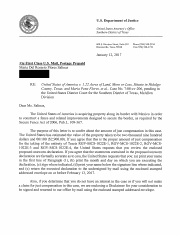
Observer: The week before Donald Trump’s inauguration, Yvette Salinas received a letter she had been dreading for years: legal notice that the U.S. Department of Homeland Security (DHS) wants to build a border wall on her family’s land in Los Ebanos. The 21-page document, entitled a “Declaration of Taking,” is addressed to her ailing mother, Maria Flores, who owns the property with her siblings. The letter offers Flores $2,900 for 1.2 acres near the Rio Grande. If she chooses not to accept the offer, the land could be seized through eminent domain. “It’s scary when you read it,” Salinas says. “You feel like you have to sign.”

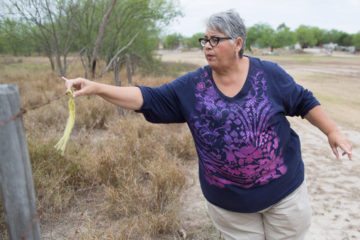
Jen Reel  The ribbon left by the DHS in 2008 to note where the border wall would enter on Aleida Flores’ land still remains.

The 16-acre property has been in the family for so long that none of them can remember the year it was acquired. Salinas only knows they’ve had it for five generations. Her uncle runs a few head of cattle on the property, which lies not far from Los Ebanos’ most famous attraction, a hand-drawn ferry that shuttles cars and their passengers across the river to Mexico.

This is not the first time the federal government has wanted to seize the land for a border wall. In the wake of the Secure Fence Act of 2006, the Bush administration put up 110 miles of border fencing, much of it on private land in Texas. In 2008, Salinas’ family received a condemnation notice offering them the same low, low price of $2,900. Others in Los Ebanos were mailed similar notices.

***  

But nature and time were on their side. Los Ebanos is squeezed into a bend in the Rio Grande, and lies entirely in the river’s floodplain. A treaty between the United States and Mexico forbids building any structures in the floodplain that could push floodwaters into surrounding communities.

***

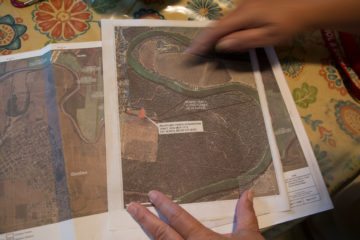
Jen Reel  The map given to Flores in 2008 by the DHS showing their proposed fence acquisition tract on Flores’ land.

Salinas’ family held off on signing the condemnation letter. As time passed, building a wall in Los Ebanos seemed less likely, because of the treaty and because the Obama administration made wall-building less of a priority. In the meantime, Aleida Garcia, Salinas’ cousin, said the government has increased security in the area by adding more surveillance, which she prefers to Trump’s proposed 30-foot wall. “Even if they build a wall, people will still come,” said Garcia. “What’s helped us tremendously and is less expensive is the technology — the aerostat balloons, the ground sensors and even boots on the ground.”

But Los Ebanos appears to be a prime target for the Trump administration. The surveying and planning work has already been done, and the Secure Fence Act authorizes more border fencing to be built. And in 2012, the United States half of the International Boundary and Water Commission, a binational organization tasked with managing the U.S.-Mexico water treaty, capitulated to lobbying by DHS and agreed to a wall in the floodplain.

Salinas says her family doesn’t want to give up their land, and they are consulting with lawyers to decide what to do next. But fighting the federal government could mean spending years in court. If they lose, DHS could take their land. Salinas, who is 29, says it makes her sad that the family’s legacy could be divided by an ugly wall that will cause problems for Los Ebanos. “We don’t want this wall — the town is pretty much united on that,” says Salinas. “But we don’t want to get sued by the U.S. government either.”

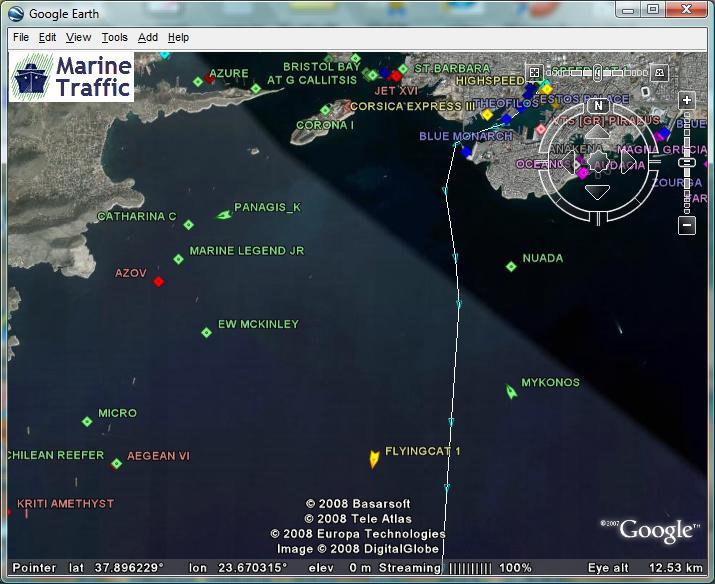
Maritime Traffic, Pirates, Smuggling and Dark Beacons

Maritime traffic is hardly considered a top priority and it should be. For illicit activities on the high seas, there is major intelligence value when it comes to smuggling and pirates.

Image result for gps maritime pirates cargo

— Israeli navy veteran Ami Daniel points at his computer screen and explains why the ship he was tracking should have been stopped and searched. It sailed near the Libyan port of Tobruk and waited four days more than a mile off the coast without ever docking, then moved west to Misrata, which it had never visited before.

Next came Greece, where it waited another four days offshore.

Whatever was on the ship — possibly drugs, weapons or people — likely eventually made its way to Europe’s shores, he said.

At a time of deep concern over migrant smuggling, Daniel said his company Windward has the ability to pick up such suspicious maritime behavior that would otherwise go unnoticed.

Ninety percent of the world’s trade is via the oceans, and ports simply cannot check even a fraction of all the containers. For that reason, they try to narrow it down with watch lists of ships.

But with turbulence in northern Africa and the collapse of Libya, smuggling networks have taken advantage of the situation while also becoming more sophisticated, Silvia Ciotti, head of the EuroCrime research body, explained.

And with the influx of hundreds of thousands of refugees across the seas, resources in Europe have been stretched threadbare.

The same smugglers taking desperate migrants and refugees into Europe also take contraband goods, Ciotti said.

“One day it is drugs. One day it is weapons. They do not care,” she said. If a ship’s activities are unusual — turning off its radar or visiting an at-risk port — it will be flagged. More here for ToI.

Image result for gps maritime traffic

The company is Windward, a rather new company that did get an interesting investor, former CIA director, General David Petraeus.

Using what it calls activity-based intelligence, Windward, a five-year-old maritime data and analytics firm here, probes beyond the ship-tracking services available on today’s market to validate identities of ocean-going vessels.

It compares their patterns of behavior and past associations with other ships —even where they loaded or didn’t load in specific ports of call.

“Nobody knows who’s the real owner of 75 percent of the world’s vessels,” said Daniel. “The reason is, for business reasons, they are registered under various flags of convenience by a lawyer who has one share and nobody knows who’s on top of him.

“So the tools of looking at data bases or registries are great in theory, but not in practice.”

The same holds true, company executives here say, for the Automated Information System (AIS), satellite-supported tracking system initiated in recent years by the US Coast Guard and now required by ocean-going vessels and passenger ships. Specific findings from the report showed an increase in GPS manipulation of 59 percent over the past two years; that 55 percent of ships misreport their actual port of call for the majority of their voyage; that large cargo ships shut off AIS transmissions 24 percent longer than others; and that 19 percent of the ships that “go dark” are repeat offenders.

To illustrate this point, Windward conducted an analysis specifically for Defense News, in which the company employed “reverse engineering” of a known arms smuggling incident to highlight similarly suspicious behavior by a ship that managed to evade detection by law enforcement authorities.

Its baseline case was the Haddad, a 39-year-old, Bolivian-flagged cargo vessel that embarked from Iskenderun, Turkey, in early September. It was ultimately seized by Greek authorities south of Crete with a cache of some 5,000 shotguns and a half million rounds of undocumented ammunition.

Using the route plied by the 66-meter Haddad, which sailed along the Turkish coast en route to Libya before being stopped, Windward came up with a similar profile of another ship which, for a variety of legal and proprietary reasons, it preferred to call Vessel X.

Like the Haddad, Vessel X was more than 30 years old and around the same size, about 75 meters. It left the same Turkish port on Aug. 19 — less than a month prior to Haddad — bearing a flag of convenience, this one from the South Pacific island of Vanuatu.

A day later, Vessel X stopped in an area near the Turkish shore where there was no other port in the area or any other reason to stop at that location, company analysts found. More here from DefenseNews.

Meanwhile, pirating is back in the news.

Somali pirates just hijacked a commercial ship for the first time in five years

WaPo: In 2010 and 2011, groups of armed Somali men were hijacking merchant vessels off Somalia’s coast at an almost daily pace. Thousands of hostages of myriad nationalities were taken, and billions of dollars were lost on ransoms, damages and delayed shipments.

The crisis was so severe that a naval task force with more than two dozen vessels from European Union countries, the United States, China, Russia, India and Japan banded together to restore order to one of the world’s busiest shipping routes. They largely succeeded. In 2015, there were 17 pirate attacks near Somalia, down from 151 in 2011. Many of those attacks were on smaller fishing boats from nearby countries, mostly by disgruntled Somali fishermen, but not commercial ships.

Until Tuesday.

Somali officials acknowledged that the Aris 13, an oil tanker, had been escorted to the Somali coast by at least eight and perhaps as many as dozens of armed men on two small skiffs. Reports from organizations that monitor piracy could not conclusively identify which flag the ship was flying or where it was owned, but Sri Lanka’s Foreign Ministry confirmed that eight of its nationals were on board as crew. The ship was on its way south to Mogadishu, Somalia’s capital.

The attack originated in the Puntland region, which is semiautonomous. “The vessel’s captain reported to the company they were approached by two skiffs and that one of them could see armed personnel on board,” an unidentified Middle East-based official told the Associated Press. “The ship changed course quite soon after that report and is now anchored.”

The U.S. Navy’s 5th Fleet oversees anti-piracy efforts along Somalia’s coast. Concerns about piracy’s reemergence in the region have been growing in concurrence with greater exploitation of Somalia’s waters by foreigners engaged in illegal fishing. Deprived of a livelihood, some Somali fishermen have turned back to hijacking to get by.

Salad Nur, described as a “local elder” by the Associated Press, said that the men involved in Tuesday’s hijacking had been searching for a commercial vessel for days on the open water. “Foreign fishermen destroyed their livelihoods and deprived them of proper fishing,” Nur said.

Piracy is also on the rise on the other side of Africa. Armed groups based along Nigeria’s coast have made that region the most dangerous for seafarers. That coast is also a major oil shipping route. Now that oil prices have dropped, pirates there have taken to kidnapping crew members for ransom rather than siphoning off oil, as the abductions have proved more lucrative.