Thanksgiving Day Terror. Black Swan Exercise

Related reading: Predicting Future Military Threats: Implications of the Black Swan

Donald Trump’s transition team is getting a helping hand from the Obama administration on national security matters.

The administration is giving the president-elect and a select few of his top advisers sensitive intelligence briefings.

And, in addition, Trump and his team will take part in two so-called ‘black swan’ exercises that simulate a domestic or national security emergency.

The exercises are intended to help an incoming administration learn how to manage a crisis in real time in case there is some kind of global or domestic emergency in the first days of a Trump presidency.

A black swan exercise would, for example, ensure that a fledgling Trump administration knows how to activate the proper federal agencies to maintain stability.

According to a briefing book from the nonpartisan Center for Presidential Transition, in 2008 the Bush administration hosted two black swan exercises for then president-elect Obama’s national security team. More here from ABC.

Black Swan operations and exercises have been practiced also in the United Kingdom.

**** What is on the horizon regarding terror?

Islamic State is urging its followers to carry out acts of terrorism in New York City during the upcoming, Macy’s Thanksgiving Day Parade.  Jamie Schram writes in this morning’s (Nov. 14, 2016) New York Post, that “ISIS is offering a detailed how-to on using trucks as weapons of mass destruction — noting that the Macy’s Thanksgiving Parade would be an ‘excellent target.”

Rumiyah2(1).jpg

MEMRI: On November 11, 2016, Al-Hayat, one of the media centers of the Islamic State (ISIS), released the third issue of its monthly magazine Rumiyah featuring an article calling on lone wolves in the U.S. and Europe to use trucks to target large outdoor conventions, crowded streets, outdoor markets, festivals, parades, and political rallies. The article also emphasized the importance of using trucks in terrorist attacks, and provided suggestions on “ideal vehicles” to use and tactical tips for the preparation and planning of attacks.

Rumiyah3.jpg

The article, titled “Just Terror Tactics,” features images of rental trucks from companies such as Hertz and U-Haul, as well as a picture showing the Macy’s Thanksgiving Day Parade in New York City. It begins by highlighting the “destructive capability” of motor vehicles and referring to the Bastille Day attack in Nice, France on July 14, 2016. While praising the Nice attacker, the article states: “This was superbly demonstrated in the attack launched by the brother Mohamed Lahouaiej-Bouhlel who, while traveling at the speed of approximately 90 kilometers per hour, plowed his 19-ton load-bearing truck into crowds celebrating Bastille Day in Nice, France, harvesting through his attack the slaughter of 86 Crusader citizens and injuring 434 more.”

Rumiyah4(1).jpg

The article stresses the importance of using a vehicle that can inflict maximum damage, and describes the “ideal” vehicles for lone wolf attacks as “load-bearing trucks, large in size, reasonably fast in speed or rate of acceleration, heavy in weight, double-wheeled, possessing a slightly raised chassis.” The article continued: “If accessible, [vehicles] with a metal outer frame which are usually found in older cars [should be used], as the stronger outer frame allows for more damage to be caused when the vehicle is slammed into crowds, contrary to newer cars that are usually made of plastics and other weaker materials.”

Providing suggestions on how to acquire the vehicle, the article noted that buying it is the “easiest” option; however, it also mentioned renting, borrowing from relatives and acquaintances, hotwiring, and carjacking as additional options. Under “applicable targets” the article listed: “Large outdoor conventions and celebrations, pedestrian-congested streets, outdoor markets, festivals, parades and political rallies.”

The article further emphasized that in order to inflict maximum damage, attackers should consider targeting “any outdoor attraction that draws large crowds,” stating that “it is not conditional to target gatherings restricted to government or military personnel only. All so-called ‘civilian’ (and low-security) parades and gatherings are fair game and more devastating to Crusader nations.”

As for “preparation and planning,” the article recommended “assessing vehicle for roadworthiness, filling vehicle with a sufficient amount of fuel, mapping out the route of the attack, surveying the route for obstacles, such as posts, signs, barriers, humps, bus stops, dumpsters, and if accessible, a secondary weapon should be attained.”

The article also provided ideas for attackers to use in order to declare their affiliation to ISIS to “have their motives acknowledged” such as writing “ISIS will remain” or “I am a soldier of the Islamic State” on pieces of papers and throwing them out of the vehicle’s window during the attack.

The article concludes by instructing attackers to stay inside their vehicles until they are no longer movable and then to start shooting pedestrians, first responders and security forces until they are killed.

****

Black Swan exercises are those that prepare for the unexpected and several events worldwide have been part of these operations.

1. Electromagnetic Pulse (EMP) or Solar Burst

As The Heritage Foundation highlighted in the documentary 33 Minutes,[3] an EMP attack could throw America back to the pre-Industrial Revolution era. A powerful solar burst would have the same impact. Should either event occur, people would have little time to react, and the damage would be incalculable.

If the U.S. were to lose power for any prolonged period of time, given the sheer number of people located in the interior of the country, mass starvation and death would become a reality. Most experts consider these events as highly unlikely ones, so little investment or planning is done related to them.

2. Pandemic Virus

Although the U.S. has prepared for a pandemic influenza outbreak, little preparation has gone into other potential viruses. More importantly, it is the unknown virus or “super virus” that represents a Black Swan for America. Recall that it was less than 30 years ago that AIDS first began embedding itself in North America. If a far more deadly and communicable virus hits America, the U.S. would quickly expend its existing resources.

3. Nuclear or Radiological Event

The U.S. has extensive knowledge of what would happen if a nuclear or radiological explosion occurred in a major American city. Theory, however, is a poor replacement for the reality of large numbers of deaths, burn victims, and physical debris. As former Vice President Dick Cheney wisely concluded, because of the sheer consequences, even a 1 percent chance of such an event occurring requires the nation to expend the necessary resources to prevent it.

4. Super-Volcanic Eruption

Seismic activity around the Yellowstone caldera is monitored, but tectonic shifts miles below the surface could result in the buildup of pressure and a super-volcanic eruption. The volcano beneath Yellowstone previously erupted, causing destruction as far away as California, Iowa, and Louisiana. An eruption, though unlikely given current readings, could have truly catastrophic consequences.

5. Nor’Easter/Hurricane

Hurricanes strike America with a fair degree of frequency. A Black Swan event would be a Nor’easter combined with a powerful hurricane that strikes New York City in the same manner as Hurricane Katrina struck New Orleans. Between the massive flooding and wind damage, New York City could sustain casualties and physical destruction well in excess of Katrina.

How Prepared Is the U.S.?

The honest and unfortunate answer to that question is unknown and, despite attempts to ascertain that answer, will not be known if existing policy remains in place. A Black Swan by definition becomes a Black Swan because it results in catastrophic outcomes. This “delicate” balance between preparing for events and not being able to prepare adequately for all events represents the ultimate risk-based decision making.

From 2003 to 2011, the U.S. Department of Homeland Security (DHS) distributed roughly $40 billion in funding to states and localities across America. Despite years of reporting requirements, DHS is fundamentally unable to state with any degree of certainty which capabilities exist, where those capabilities exist, the level of those capabilities, and the remaining capability needs. DHS knows it has funded the acquisition of many things, but specifics beyond that are unquantifiable.

Specifically, to gain a full accounting, Congress should:

  • Be fiscally responsible. Rather than continue to spread federal funds using an “inch thick and a mile wide” mentality, Congress should target federal funds at the highest-risk states, cities, and counties where the funds could meaningfully increase the security of Americans, including reducing the number of high-risk cities that are eligible for special funding.
  • Examine cooperative agreements. The need for equality downplays the need for the grant structure and invites another approach—such as the use of cooperative agreements, where the federal government and the states can sit down as true and equal partners and negotiate outcomes at the beginning and then direct funds to achieve those desired outcomes without the need for yearly applications.
  • Appoint a Black Swan commission. Rather than wait until after a catastrophic event has occurred, Congress should appoint an independent commission for the express purpose of analyzing the threats of a potential Black Swan, identifying existing capabilities, and making recommendations on how best to correct errors made thus far and accelerate closing the gap between where the nation stands today and where it needs to be tomorrow. The commission must have the independence and resources to quickly do its job after a full review of the status quo.

Expect the Unexpected

If the catastrophe in Japan has taught any lessons, it is that America must prepare for the unexpected with as much vigor as it prepares for the expected. Because a Black Swan can be so catastrophic, in many ways the ideal role for the federal government is to lead an effort surrounding those events. With the nation’s current fiscal challenges, conserving resources for catastrophic events is more vital than ever. More here from Heritage.

Final Report: How Latinos have Reshaped the Electoral Map

Mexican-Americans Are Reshaping the Electoral Map In Arizona — And The U.S.

Irma Maldonado in her dorm room at Grand Canyon University in Phoenix.

All photographs by Caitlin O’Hara


PHOENIX — In an office suite not far from the airport, Irma Maldonado, 18, expertly role-played what she’d be doing on the city’s streets in half an hour: knocking on the doors of residents and exhorting them to vote. But not everything was a game. Before a group of young canvassers headed out for the day, a team leader at the community organizing group LUCHA mentioned that someone had earlier pulled a gun on two members of the team.

“Everything was OK,” the organizer said, but Maldonado and the 15 or so other teens and 20-somethings were given safety whistles before hitting the streets.

Maldonado has a personal stake in America’s immigration debate, which has been making headlines throughout the election, particularly because of Donald Trump’s description of Mexicans as rapists and his desire to have Mexico pay for a border wall.


chideya-electorate-mex-1b
chideya-electorate-mex-1b-mobile


“Before going into high school — it was the summer of 2012 — my mother decided to self-deport to Mexico” with her two youngest children, Maldonado said. Maldonado, who was born and grew up in New Mexico, had a hard time adjusting to life in Nayarit, Mexico, a small state on the Pacific coast north of Puerto Vallarta, especially given that she hadn’t known her family’s status. “I think it was right when we had to move when I actually realized that my mom wasn’t actually legal here in the United States, when I was 14 years old,” she said. Her father, who has a green card, continues to work in New Mexico; Maldonado now is a first-year nursing student and lives with her 23-year-old sister in Arizona. Her mother and brother remain in Mexico.

Mexican-Americans such as Maldonado may help determine the political future of Arizona — and the nation — in a landmark election year. In an August survey, respondents were asked if Trump and Clinton made their respective parties more welcoming or more hostile to Latinos. Nine percent of Mexican-Americans said Trump made the GOP more welcoming; 74 percent said he made it more hostile. By contrast, 59 percent said Clinton made the Democratic party more welcoming; 9 percent said more hostile. An October poll by Latino Decisions found that 17 percent of Latino voters nationwide said they support Trump or are leaning toward him; 70 percent supported Clinton.


chideya-electorate-mex-2
chideya-electorate-mex-2-mobile


In Arizona, a state long dominated by Republicans, Clinton and Trump are in a virtual tie, according to a Monmouth University Poll released last week. Latino voters, who make up a fifth of the state’s electorate, are supporting Clinton over Trump by 35 percentage points. And critical to the electoral vote, only 9 percent of Latino voters who support Trump are in battleground states. Overall, 13 percent of the eligible voters in battleground states are Latino.

Arizona “was this strong, powerful red,” said Pita Juarez, 29, the communications director for the One Arizona coalition, an umbrella group of 14 advocacy groups, including LUCHA, that is working to boost Latino voter turnout. “Just today, we saw on FiveThirtyEight … it’s a light blue. And that’s something that I thought, really, I would never see.” (Arizona has gone back and forth between light blue and light red in FiveThirtyEight’s forecast over the last few weeks. Currently, Trump has a slight edge in the state’s forecast.)

Gabriel Sanchez, a professor of political science at the University of New Mexico and a principal at the opinion research firm Latino Decisions, said Latinos are more enthusiastic about voting this year than in 2012, having been mobilized by Trump’s comments targeting Mexicans. He added that the Republican Party will have a hard time winning over Mexican-Americans in subsequent elections unless it supports comprehensive immigration reform.

Like black millennials, younger Latinos show much weaker enthusiasm for Clinton than their elders. According to the October GenForward survey, conducted over the first half of the month, 44 percent of Latinos ages 18-30 plan to vote for Clinton and 8 percent will vote for Trump, with 10 percent going to third-party candidates. Nineteen percent said they didn’t plan to vote, and 12 percent were undecided.1GenForward, a survey by the Black Youth Project at the University of Chicago and The Associated Press-NORC Center for Public Affairs Research, queries 18- to 30-year-olds and oversamples for Latino and nonwhite respondents, in this case with a total cohort of 1,832 respondents.


Irma Maldonado in math class and walking to her dorm room at Grand Canyon University.


Mark Hugo Lopez, director of Hispanic research at the Pew Research Center, said that much of the growth in the Latino electorate in coming years will be from U.S.-born Latinos entering adulthood. Like other cohorts of younger voters they tend to be more supportive of bigger government, in contrast to older Mexican-Americans, who are more likely to hold conservative views. “Mexican-Americans are more likely to be Catholic than other groups of Latinos,” he said. “They are also more likely to be third or higher generation than other U.S. Latino groups and as a result to have served in the military. Both of these characteristics correlate with conservative views on many issues.” He noted that George W. Bush won at least 40 percent of the Latino vote in 2004.

 Mexican-Americans constitute 63 percent of the 57 million U.S. Latinos. Some Mexican-Americans can trace their heritage in New Mexico and other regions later acquired as U.S. territory back to the 1600s and earlier, while others are recent immigrants. Of the 35.8 million people of Mexican descent in the U.S., 68 percent are native born, and more than a quarter of those born in Mexico have become U.S. citizens. Separate estimates from the Pew Research Center indicate there were 5.8 million unauthorized Mexican citizens in America in 2014, 52 percent of the total unauthorized immigrant population. The Census Bureau considers Latinos in the U.S. to be an ethnicity, not a race, and thus Latino respondents can also mark any or multiple races; about a quarter identify as Afro-Latino. But only 1 percent of the population of Mexico is Afro-Latino, according to a recent census in that nation, the first to count the category.2The Census surveys of the diverse Latino population continue to evolve. One experimental survey design for the 2020 Census avoids using the terms race and ethnicity in the phrasing of the question entirely.

Nationwide, 11 percent of eligible voters are Latino, but in Arizona, 22 percent of eligible voters are. The state is currently going through a fierce local battle involving Sheriff Joe Arpaio that is arguably fanning the fires of Latino voter turnout as much as the national election.

Arpaio is an outsize figure who has served as Maricopa County sheriff for 23 years; run jails where the men must wear pink underwear and striped uniforms; and organized citizen border patrols with actor Steven Seagal. Arpaio also has a December court date on a contempt charge for violating a 2011 injunction against stopping people on the suspicion that they were not in the country legally. (He alleges the prosecution is politically motivated because of his support for Trump.) And just one week from now, Arpaio faces perhaps an even bigger challenge: a re-election bid with polls showing him trailing his challenger by 15 points.

LUCHA’s canvassers are campaigning against Arpaio, and there are indications that his presence on the ballot is motivating new voters. In Maricopa County, Democratic voter rolls rose by 13 percent since 2012, according to figures released in August, compared to a 7.6 percent increase for Republicans. And many Latinos register as independents but lean Democratic.

Some of the young activists who are canvassing for LUCHA are undocumented, according to One Arizona’s Juarez, and in other areas around the country with significant Latino populations, immigrants who are not yet on a path to citizenship are playing a role in the political process. One of them is Yessica Vasquez Moctezuma, 25, a bank teller, who will graduate this fall with a bachelor’s degree in political science from the University of Texas at San Antonio. She has been in the United States for 19 years, which means she was undocumented until 2012, at which point an executive order qualified her for temporary but renewable DACA (Deferred Action for Childhood Arrivals) status.

Vasquez Moctezuma is frank in her assessment of her family’s legal status, since her parents are not eligible for DACA and continue to work without documentation.

“We are breaking some laws just by being here illegally, but we bind to the laws here,” she said. “We pay our taxes every year, like any other citizen would.” She worries that her parents, who have paid into the Social Security system — which receives an estimated $12 billion a year from undocumented immigrants and their employers — will never receive benefits and will never be able to truly retire. Still, she said, “This is why I studied political science, because I love the government here. I feel like in so many ways it’s so great.”

For her part, Irma Maldonado said she is excited about voting in her first presidential election. After remaining undecided until early October, she decided to vote for Clinton. But she added, “Honestly, this election, a lot of people are not that pumped to vote. It’s really kind of sad.” The number of Mexican-American and Latino voters who show up on Nov. 8 could determine the outcome in her state, and possibly in the nation.

Terrifying Immigration Numbers, and Court Decision

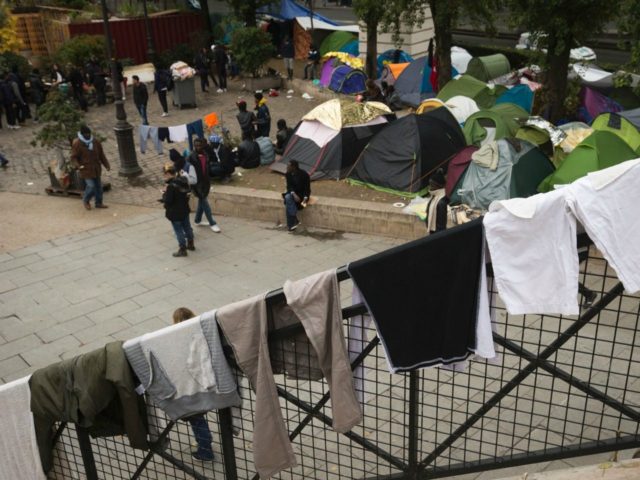
Hundreds of Migrants Pitch Tents on Paris Streets as Calais Camp Shuts

(REUTERS) – The number of migrants sleeping rough on the streets of Paris has risen by at least a third since the start of the week when the “Jungle” shanty town in Calais was evacuated, officials said on Friday.

Along the bustling boulevards and a canal in a northeastern corner of Paris, hundreds of tents have been pitched by migrants – mostly Africans who say they are from Sudan – with cardboard on the ground to try and insulate them from the autumn chill.

While the presence of migrants there is not new, it has grown substantially this week, Colombe Brossel, Paris deputy mayor in charge of security issues, told Reuters.

“We have seen a big increase since the start of the week. Last night, our teams counted 40 to 50 new tents there in two days,” Brossel said, adding there was now a total of 700 to 750.

This means there are some 2,000-2,500 sleeping in the area, up from around 1,500 a few days before, she said.

“It’s not a huge explosion in numbers but there is a clear increase,” she said. “Some of them come from Calais, others from other places.”

 migrants Paris JOEL SAGET/AFP/Getty

After years as serving as an illegal base camp for migrants trying to get to Britain, the “Jungle” at Calais was finally bulldozed this week and the more than 6,000 residents of the ramshackle camp near the English channel were relocated to shelters around France. More here.

Sessions: ‘Critical alert,’ 817,740 illegals crossed last year

In a bid to put the issue of illegal immigration back into the presidential debate, outspoken critic Sen. Jeff Sessions on Monday issued a “Critical Alert” warning of a potentially historic surge of over the border.

“We are simply overwhelmed,” his statement said. In it he estimated the Fiscal Year 2016 illegal crossings at 817,740.

“There is a crisis at our southwest border — one that in many ways exceeds the crisis we saw just two years ago, one that further undermines the integrity of our immigration system, but one that the most of the media has elected to ignore,” said Sessions, an advisor to Republican presidential nominee Donald Trump.

  • U.S. Immigration and Customs Enforcement is currently detaining more than 40,000 aliens, with internal predictions indicating that the number could reach 47,000 in the coming months.
  • In fiscal 2016, the U.S. Border Patrol apprehended 408,870 illegal aliens at the southern border; a number 23 percent higher than in fiscal 2015.
  • Brandon Judd, president of the National Border Patrol Council, was quoted as saying just half of illegals are caught crossing the border.
  • Calculating illegal entries based on that formula, 408,870 illegal aliens evaded detection in fiscal 2016, for a total of approximately 817,740 illegal entries into the United States last year.

Sessions said the border crisis demands a new president and approach to reforming immigration starting with a closed border.

*****

In part from Breitbart: Border Patrol Agent and NBPC President Brandon Judd spoke exclusively with Breitbart Texas and condemned the leadership of the Border Patrol’s parent agency, Customs and Border Protection (CBP), for allegedly “keeping this information secret” ahead of the 2016 U.S. presidential election.

“We are at breaking point. We have the highest number of illegal aliens in custody in history in Border Patrol’s RGV Sector and this information has been kept from the American public,” said Agent Judd. “The talk of amnesty has once again created pull factors and encouraged people from all over the world to cross Mexico and then cross our porous southern border to illegally enter the U.S. We are simply overwhelmed.” (See CBP’s response below.)

Agent Judd told Breitbart Texas that Americans should vote their conscience, but they should do so with all of the information available. “This is an issue of the federal government restricting crucial information from the public ahead of a presidential election and it is unacceptable. Americans deserve to know the truth. Our Border Patrol agents deserve for Americans to know what they are really facing. Too many Border Patrol agents have given their lives and left loved ones to grieve for CBP leadership to play these types of political games ahead of such an impactful election.”

Agent Cabrera said CBP were in fact concealing the gravity of the current border crisis. “One side in this coming election is downplaying illegal immigration and concealing this information only serves to help that agenda,” said Agent Cabrera.

Breitbart Texas reached out to the RGV Sector PIO for the Border Patrol and did not receive a response, though not much time was given to the agency. (See update below. A strong denial of the agents’ claims was issued by CBP to Breitbart Texas after publication.)

Historically, CBP, Border Patrol’s parent agency, has had to correct false assertions and denials. Perhaps the most glaring example occurred in June 2014 when an official CBP Twitter account directly accused this reporter of publishing a false report, only to later admit the report was accurate and true.

CBP has released numbers indicating near-record apprehensions; however, the assertions from the agents in the NBPC pertain to people who illegally entered the U.S. and are currently in custody in Border Patrol facilities. Agent Judd stated, “There is a significant difference between apprehension numbers and numbers in custody in our facilities. These record numbers in custody indicate that these are people who are not voluntarily returning. This indicates that these people will, under current policy, be released into our communities and given amnesty. This record number of people currently in detention is significant because the RGV Sector is dealing with the Gulf and Los Zetas cartels. This means our agents are busy babysitting record numbers in facilities instead of patrolling the border and stopping these murderers, kidnappers, and drug smugglers.” More here.

*****

Judge rebukes administration over few admissions for Syrian Christian refugees

FNC: A federal judge has rebuked the Obama administration over the lack of Syrian Christians being admitted from the war-zone, calling it a “perplexing discrepancy” that only 56 of 11,000 Syrian refugees to the U.S. in fiscal 2016 were Christian.

The rebuke came in a Seventh Circuit Court of Appeals opinion on a Freedom of Information Act lawsuit filed by The Heartland Alliance’s National Immigrant Justice Center – a liberal human rights group that advocates for immigrants and asylum-seekers — seeking information on certain terror groups.

As first reported by attorney and former FEC member Hans von Spakovsky for The Daily Signal, while the court found in favor of the government, Judge Daniel Manion addressed the refugee issue and took aim at the Obama administration over how few Christians had been admitted to the U.S.

“It is well‐documented that refugees to the United States are not representative of that war‐torn area of the world. Perhaps 10 percent of the population of Syria is Christian, and yet less than one‐half of one percent of Syrian refugees admitted to the United States this year are Christian,” he wrote.

According to government figures, of the almost 11,000 Syrian refugees admitted to the United States in fiscal 2016, only 56 were Christian.

RELATED: ‘GROSS INJUSTICE’: OF 10,000 SYRIAN REFUGEES TO THE US, 56 ARE CHRISTIAN

“To date, there has not been a good explanation for this perplexing discrepancy,” Manion noted.

The numbers are disproportionate to the Christian population in Syria, estimated last year by the U.S. government to make up roughly 10 percent of the population. Since the outbreak of civil war in 2011, it is estimated that between 500,000 and 1 million Christians have fled the country, while many have been targeted and slaughtered by the Islamic State.

Manion qualified his remarks by saying that his point “is not to suggest that any refugee group is more or less welcome: quite the contrary” but warned the Obama administration against failing to provide states with enough data on the people coming in.

In the case, the NIJC was requesting the identities of Tier III terrorist organizations, which are not publicly available. The administration argued that Tier III terrorist organizations “tend to be groups about which the U.S. government does not have good intelligence, making it essential that [DHS] be able to obtain information about them during screening interviews that are as focused and complete as possible.”

Manion noted that potential ties to a Tier III organization like a Christian militia may be why the government is not letting in as many Christians, but that it was impossible to tell since the information is not publicly available.

“It is at least possible that incidental affiliation with some Christian militia could lead an immigration officer to deny entry to Syrians on this basis. That would be a dubious consequence,” he wrote.

A State Department spokesperson told FoxNews.com in September that religion was only one of many factors used in determining a refugee’s eligibility to enter the United States.

The New Drug Cartel Generation and Weapons

Northwest Mexico Erupts in Violence in Next Generation Cartel Wars

InSight: A bloody cartel war raging in the state of Baja California Sur hints at the new strategies and alliances forming as Mexico‘s fragmented underworld reorganizes.

A Zeta magazine investigation into drug war violence in the city of La Paz, the capital of Baja California Sur, has revealed how a spate of macabre murders is connected to a campaign waged by a new alliance between the Jalisco Cartel– New Generation (CJNG) and the remnants of the Tijuana Cartel against Los Dámaso, a network connected to the Sinaloa Cartel.

According to Zeta, the CJNG and Tijuana Cartel factions are operating under the name the Tijuana Cartel– New Generation (CTNG) and have been kidnapping, torturing and murdering rivals in an attempt to seize control of local drug sales and distribution.

Their targets, according to a Zeta source from the local Public Security Coordination Group (Grupo de Coordinación de Seguridad Pública), are rival hitmen, operatives that have switched sides, plaza chiefs linked to the Sinaloa Cartel and local drug distributors. Their aim is not only to remove these people but also to obtain information on the large scale Sinaloa distributors that continue providing drugs to the region.

However, the source said, identifying the relationship between the local criminal cells and larger cartels is difficult due to the fragmented nature of the current underworld and the constantly shifting allegiences of local networks.

InSight Crime Analysis

The battle for La Paz reflects a new dynamic in the Mexican underworld, as fragmented remains of once all-powerful cartels confront or ally themselves with new players as they compete for control of local as well as transnational criminal markets.

The relatively new CJNG has been one of the most expansionist groups in Mexico in recent years, and it is little surprise that it has now moved into Bajo California Sur. It was once believed to be in alliance with the Sinaloa Cartel, but there are now growing signs the organization is looking to capitalize on what appears to be a fragmentation of the Sinaloa Cartel in the wake of the capture of the cartel’s most prominent leader, Joaquin “El Chapo” Guzman.

SEE ALSO: Jalisco Cartel – New Generation Profile

In contrast, the Tijuana Cartel has been in long term decline, and so an alliance with an up-and-coming group such as the CJNG represents the remaining cartel factions’ best chance of clinging on to some level of criminal power.

Los Dámaso, meanwhile, have long been operatives for the Sinaloa Cartel. However, there have been numerous reports suggesting the network has been in conflict with other Sinaloan factions.

As highlighted by Zeta’s source, these national actors are increasingly dependent on alliances with local criminal cells that have more autonomy and less loyalty to larger organizations than in the past. This makes for a much more complex and often chaotic dynamic in this latest generation of Mexico‘s cartel wars.

*** Improvised armored vehicle captured from the Zetas cartel.

Juan Cedillo : Improvised armored vehicle captured from the Zetas cartel.

Time Magazine has provided more information:

As Mexican gangsters shot it out with troops in the border city of Reynosa this month, residents posted warnings on social media of where not to drive. Not only was the gunfire itself a problem but cartel gunmen had covered some roads with perilous spikes that they call ponchallantas or “tire punchers.” The hazard can appear suddenly as the cartels have customized vans with tubes that eject the spikes. If a car drives into them too fast, it can spin into a lethal crash. Gangsters also set grounded vehicles on fire, creating more debris in the way of security forces.

The tire punchers used in the April 17 firefight, in which soldiers arrested an alleged kingpin called José Tiburcio Hernández, are the latest example of the homemade battle technology developed by Mexico’s cartels. Gangsters have also built fighting vehicles with four inch-thick armor, sometimes referred to as “monsters” or “narco tanks.” And in October, police in the western state of Jalisco even busted a clandestine factory where traffickers assembled their own assault rifles.

The development of this narco technology south of the Rio Grande has grabbed the attention of U.S. security thinkers such as Robert Bunker, an external researcher for the U.S. Army War College. He compares it to the homemade war tools used by insurgent forces round the world. “Each battle technology has been adapted to both the conflict environment and the ideological and illicit economic motivations of the irregular forces,” Bunker says. “Caltrops and spike traps have been a component of warfare going back to the ancient Greeks. In many ways, we can think of them as pre-modern landmines.”

While there is no declared war in Mexico, fighting between rival cartels and the security forces has claimed more than 83,000 lives since 2007, according to a count by Mexico’s federal intelligence agency. Gangsters use traditional weapons, including Kalashnikovs, which are often smuggled from the United Sates. The Bureau of Alcohol Tobacco and Firearms has traced 73,684 guns seized in Mexico to U.S. gun sellers since 2009. Cartels also have rocket-propelled grenades, which may be stolen from Central American military caches.

However, it is harder for them to buy actual military vehicles leading to them inventing their own. The Zetas cartel, which was led by former soldiers, first developed its own armored vehicles, both converting regular trucks and building others from scratch. Their “monsters” resemble machines from the fantasy road wars of Mad Max, with gun turrets, battering rams and walls of armor.

The Mexican army has taken many of these makeshift tanks off the road, holding more than 40 of them in its base in Reynosa. But some are still at large and causing havoc. Last year, a Zeta monster attacked a hotel in the border town of Ciudad Mier, where executives from the oil services multinational Weatherford were staying. (The executives were shaken but unscathed).

Furthermore, vigilante groups that formed to fight cartels also built their own armored vehicles. “We were going into heavy gunfire and we needed protection. So we made these monsters of our own, based on the vehicles that the Zetas had built,” said Francisco Espinosa, a cattle rancher turned vigilante. With the help of local metal workers, they also used thick layers of armor, and added some of their own features such as mobile sand trenches.

The gun factory busted in October belonged to rising gang called the Jalisco New Generation Cartel. The cartel has gained infamy for a series of attacks on Mexican officials, including an ambush on April 7 that killed 15 policemen. Hidden in two farm houses in the tequila-producing region, the factory used industrial metal cutters and blow torches to assemble AR15 rifles from components. “It’s highly sophisticated machinery with very precise software that allows them to make the cuts to finish the guns, which work perfectly,” Jalisco Attorney General Luis Carlos Najera said.

The factory likely uses gun parts that are sold on line, producing untraceable AR15’s, says Bunker, the security scholar. “I consider it conceptually sophisticated but not technologically sophisticated. The next step in this process will be the addition of a 3D metal printer. I’m sure this will come in time as more of these improvised arms factories spring up, metal printer technology matures, and prices for them drop.”

The cartels’ ability to make their own guns, customized vehicles and spike ejectors make them difficult for Mexico’s government to wipe out. Under President Enrique Pena Nieto, troops have arrested a string of cartel leaders, including the head of the Zetas and Sinaloan chief Joaquin “Chapo” Guzman. This has helped reduce the total number of homicides, which went down from a peak of more than 22,000 in 2011 to 15,649 last year, according to a police count. But incidents such as the chaos in Reynosa and ambushes in Jalisco continue to shake the nation.

Bunker warns that cartels may keep on developing their battle tech. They could use drones for surveillance in the near future, giving them a fighting edge. Mexican gangsters have also used small car bombs, and could potentially harness bigger improvised explosive devices like those in the Middle East. “One area that we should keep an eye on is car bomb and IED use potentials,” Bunker says. “I could envision IEDs being placed in a city or town under certain circumstances.”

Meet Monzer al Kassar: Jailed Arms Trafficker to Global Hot Spots

 Photo: NBC

Monzar al Kassar was accused of being a key player in the Iraq insurgency. Indeed, he barely raises his grey eyebrows at the latest charges by the Baghdad government, which says he was a key associate of the family of a brother of Saddam Hussein.

The Observer tracked him down to his lavish, 15-suite residence, designed like a Renaissance palazzo overlooking Puerto Banus. Guards swing the gates open to allow guests into the estate, where there is a swimming pool built like a four-leaf clover. Three Spanish mastiffs prowl during the night to deter uninvited guests.

Inside the palace, a grand piano is showcased at the bottom of a marble staircase under a domed skylight. In the grand salon, silk flowers are arranged in a giant Chinese vase in front of a marble fireplace. Statues of servants holding lamps stand before the massive drapes, and on the wall are murals of African servants in turbans, carrying platters of fruit.

Photographs furnish a stark reminder of just who Kassar is. One is of him shaking hands with Uday Hussain, Saddam’s brutal son, killed in the months after the invasion. Another photo shows the two men together with an Arab musician. Kassar says he met Uday when he was sponsoring the Iraqi football team.

In a cabinet nearby is a picture of him holding hands with Hassan Aideed, son of Farah Aideed, the now-deceased Somali warlord portrayed in the film Black Hawk Down. ‘A good man,’ says Kassar. (He has been implicated in shipping arms to Somalia, in violation of an international embargo.)

The warlord Aideed is just one of his eclectic group of acquaintances, and Kassar insists that, in fairness, there are many less controversial ones. On the mantelpiece is a photo of Kassar with a Spanish intelligence official and Mustafa Tlas, the former defence minister of Syria. Then there is the photo, taken at a gala fundraiser in Marbella, of him standing next to ageing country music singer Kenny Rogers. Yet on a massive coffee table is a photo of Kassar hugging Palestinian terrorist Abu Abbas, former leader of the Palestinian Liberation Front. The picture was taken about 15 years ago, in South Yemen, and shows the portly Abbas smiling and sitting on a chair with Kassar in a tight embrace. Abu Abbas was apprehended in Baghdad in 1993 and died after a year in US custody. For more details and a timeline, Guardian published this summary.

The Court’s decision in the case of the United States v. al Kassar is found here.

The background on how the takedown of Monzar al Kassar:

Known as the Prince of Marbella, al Kassar sits in a prison in South Carolina for the conviction of several international crimes, most of all arms trafficking.

Since in or about the early 1970s, MONZER AL KASSAR, a/k/a “Abu Munawar,” a/k/a “El Taous,” the defendant, has been an international weapons trafficker. During this time period, KASSAR has been a source of weapons and military equipment for armed factions engaged in violent conflicts around the world. Specifically, KASSAR has provided weapons and military equipment to such factions in Nicaragua, Brazil, Cyprus, Bosnia, Croatia, Somalia, Iran, and Iraq, among other countries. Some of these factions have included known terrorist organizations, such as the Palestinian Liberation Front (“PLF”), the goals of which included attacks on United States interests and United States nationals.

al Kassar was snared in a plot to sell weapons to FARC, a terror organization in Columbia with a 50 year history of Marxism and a global narcotics network.

**** In part from a site known as DeepCapture:

It is nice to know that Monzer al-Kassar has been arrested and that he is no longer described as the “Prince of Marbella,” but in charging him only with the one crime that he did not commit, the DOJ seems to be covering up (or at least neglecting to publicize, much less prosecute) the many crimes (from terrorist atrocities to narco-trafficking and destructive financial crime perpetrated against the American economy) that he did commit during his long and colorful career as one of the world’s most prominent oligarchs.

In addition, it is possible that Monzer al-Kassar was finally arrested in 2008 only because of his importance to the Syrian government (he was, indeed, one of Syrian President Assad’s most important associates), and because the U.S. government had decided at that point to lend its support to the jihadi guerrillas who were then already gearing up to overthrow the Syrian government. Those jihadis, of course, are now (with U.S. support) fighting the Syrian military under the banner of an “Arab Spring” campaign for freedom and democracy.

In any event, Monzer al-Kassar accomplished much over his career, and with few exceptions, the major U.S. news organizations have yet to give him any credit for these accomplishments. One exception, as I mentioned before, was Forbes Magazine. In 2004, Forbes (without otherwise providing the details of Monzer al-Kassar interesting biography) reported that Monzer al-Kassar not only had ties to Osama bin Laden, but was involved, along with two British citizens—Jared Brook and Lincoln Fraser—with a “high flying financial outfit” called Imperial Consolidated Group.

Imperial Consolidated was involved in multiple destructive financial crimes, most of them involving pump and dump schemes and the “bust-outs” of publicly listed companies in Europe and the United States. All told, Imperial Consolidated looted at least $300 million from the Western financial system. The British miscreants were charged for their involvement in this monumental criminal enterprise, and, meanwhile, they had sued Monzer al Kassar for slander, accusing him of telling people that Imperial Consolidated had fronted arms sales to Osama bin Laden. The merits of that lawsuit remain unclear, but it is clear that Monzer al-Kassar was himself involved with Imperial Consolidated (though he has never been charged on any count other then selling weapons to undercover DEA agents).

Meanwhile (to cite just one more accomplishment), Monzer al-Kassar had long been one of the world’s leading counterfeiters of American currency. His fake U.S. $100 bills were of such high quality that they were known as “Supernotes,” and he created such vast quantities of them that they had a negative impact on the value of the U.S. dollar. As early as 1996, Kenneth Timmerman, a reporter for Time magazine and The Wall Street Journal, prepared an official document for U.S. Congressman Spencer Bacchus outlining the details of Monzer al-Kassar’s counterfeiting operation. This report was promptly deposited in a trash can somewhere in Washington. (This site has quite a summary defined in chapters, where more information is in fact provided)

**** From PBS in part:

While building the case, Spain requested that Switzerland seize Al Kassar’s bank accounts. Swiss officials then opened their own preliminary inquiry into money laundering, lack of vigilance in financial operations, and fraudulent documents and foreign certificates. Following this inquiry, Swiss authorities began to investigate Al Kassar’s arms sales using Swiss banks.

Photo of Kassar's indoor poolQuestioned on December 9, 1993, by Swiss prosecutors, Al Kassar explained that he was a diplomatic representative of Yemen in Poland and therefore could not answer questions about government-to-government affairs. A search of Al Kassar’s Spanish address revealed documents confirming his relationship to the Croatian Zeljko Mikulic and containing the codes used for the ship’s contents: “Tea” meant TT pistols (Tula-Tokarev pistols, developed in the U.S.S.R. in the 1930s and subsequently manufactured by other Eastern Bloc countries), and “tea bags” meant bullets.

Bassam Abu Sharif was questioned by Swiss officials while passing through Geneva in 1994. He claimed that he had only met Al Kassar once in 1979 and twice thereafter. He explained that he had been asked by the Yemeni government to use his bank account to transfer money for an arms sale organized by the Yemeni ministry of defense to buy arms for Bosnia and Croatia. He said that he learned only later that Al Kassar had organized the sale.

A Determined Swiss Prosecutor Freezes Al Kassar’s Millions

Geneva Cantonal prosecutor Laurent Kasper-Answermet upheld his 1992 freeze on $6 million belonging to Al Kassar, arguing that his financial investigation found the funds to have come from criminal activities. The financial side of an arms deal leaves a paper trail, whereas arms hidden in shipping containers, guerilla armies and corrupt government officials leave none. In 1998, a Geneva appeals court upheld the seizure but released $3.7 million not directly linked to the arms deal.

Photo of Kassar sitting on couch“If Yemen does a deal with Bosnia and Croatia, how can I control it?” asked Al Kassar, dismissing accusations that he is an embargo-busting arms dealer. Under existing legal controls, his question is reasonable.

The case is the first of its kind in Switzerland and is expected to set a precedent. The arms did not touch Swiss territory and did not involve Swiss citizens or the country in any way other than through its banking system. Switzerland is not directly affected by the small-arms trade but has an interest in maintaining the respectability of its banking system. Such cases, as well as that of Leonid Minin ,an Israeli citizen arrested in Italy for selling Ukrainian weapons to Liberia and Sierra Leone, are pushing existing legislation in new directions in an attempt to discourage the illegal arms trade.

Al Kassar has lost successive court appeals and has one final chance to have his $2.3 million returned in an appeal to a Swiss federal court.

Matthew Brunwasser is a freelance journalist based in Bulgaria. He worked as field producer on FRONTLINE/World’sGunrunners” story.

NEXT – SARKIS SOGHANALIAN:
The Cold War’s Largest Arms Merchant

Links relevant to this article:

Monzer Al Kassar and the Iran-Contra Affair
In Chapter 8 of the Final Report of the Independent Counsel for Iran/Contra Matters, the authors allege that Monzer Al Kassar made $500,000 selling arms to supply the Contras.

Al Kassar in Argentina
This Middle East Intelligence Bulletin report describes the investigation into Al Kassar’s involvement in the Buenos Aires bombings of the Israeli Embassy and the Jewish Cultural Center, unsolved 10 years later. The report also describes Al Kassar’s possible connection to President Carlos Menem and the shipment of arms to Croatia.

Al Kassar and President Menem
This article from Argentina’s La Nacion describes the political price Carlos Menem paid for his alleged involvement with Al Kassar and the 6000-ton shipment of Argentine arms to Ecuador and Croatia. (La Nacion, April 15, 2001)

Al Kassar Fights Back
The Independent (U.K.) documents the public falling-out between Al Kassar and his former business partner, U.K. investment firm Imperial Consolidated Group. Al Kassar says the firm wanted him to sell arms to Osama bin Laden back in January 2001. The firm denies his accusation. (Independent, January 21, 2001)

Al Kassar’s Estranged Business Partner
Offshore Business News and Research offers a portrait of Imperial Consolidated’s questionable offshore business. A glance at the links under the heading “Regulatory Problems” shows that their deal with Al Kassar was only part of their portfolio.

U.S. Senate Investigation Into the Bank for Credit and Commerce International
This 1992 Senate committee report recommended further investigation into BCCI’s “relationships with convicted Iraqi arms dealer Sarkis Soghanalian, Syrian drug trafficker, terrorist and arms trafficker Monzer Al Kassar, and other major arms dealers.” This decade-old investigation sheds some light on the history and interconnectedness of illegal arms dealers.