Mexican Officials are Smuggling Haitians into the U.S.

Immigration Official Warns 40,000 Haitians On Their Way To U.S. Via California’s Mexico Border

SAN FRANCISCO (AP) — A top U.S. immigration official says 40,000 Haitians may be on their way to the United States amid what she calls an “emergency situation” on California’s border with Mexico.

Immigration and Customs Enforcement Director Sarah Saldana said Thursday in Washington that the estimate came from other governments during a recent trip she made to Central America.

Saldana told the House Judiciary Committee that word of the new arrivals contributed to the Homeland Security Department’s announcement on Thursday that it was lifting special protections shielding Haitians from deportation that were put in place after their country’s 2010 earthquake. She says changing conditions in Haiti also played a part.

***  

Mexican officials quietly helping thousands of Haitian illegal immigrants reach U.S.

WashingtonTimes: Mexican officials are quietly helping thousands of illegal immigrant Haitians make their way to the United States, according to an internal Homeland Security document that details the route taken by the migrants, the thousands of dollars paid to human smugglers along the way and the sometimes complicit role of the governments of America’s neighbors.

More than 6,000 Haitians arrived at the border in San Diego over the last year — a staggering 18-fold increase over fiscal year 2015. Some 2,600 more were waiting in northern Mexico as of last week, and 3,500 others were not far behind, waiting in Panama to make the trip north, according to the documents, obtained by Rep. Duncan Hunter, California Republican.

The migrants are paying at least $2,350 to be smuggled from South America to the doorstep of the U.S., where many present themselves at the border and many demand asylum, hoping to gain a foothold here.

Boat maker Audit Volmar walks inside the shell of a sail boat he's building on the beach of Leogane, Haiti. The 30-foot-long boats are purchased by smugglers for around $12,000 and then taken to northern Haiti to find passengers. (Associated Press)
Photo by: Dieu Nalio Chery
Boat maker Audit Volmar walks inside the shell of a sail boat he’s building on the beach of Leogane, Haiti. The 30-foot-long boats are purchased by smugglers for around $12,000 and then taken to northern Haiti to find passengers. (Associated Press)

“Haitians have forged a dangerous and clandestine new path to get to the United States,” says the document, which lays out in detail the route and the prices paid along the way for smugglers, bus tickets and, where they can be obtained legally, transit documents.

Their trek begins in Brazil and traces a 7,100-mile route up the west coast of South American and Central America, crossing 11 countries and taking as long as four months.

Some countries are more welcoming than others, according to the document, which was reviewed by The Washington Times. Nicaragua is listed as being particularly vigilant about deporting the Haitian migrants if they are caught — so smugglers charge $1,000 to get through that country.

When traveling through Central American countries the Haitians will claim instead to be from Congo, believing that authorities in Central America aren’t likely to go through the hassle of deporting them to West Africa if they are caught, Homeland Security said.

Being smuggled through Ecuador costs $200, while Guatemala and Colombia cost $300 apiece, the document says.

Mexico, though, is more accommodating to the migrants. It stops them at its southern border in Tapachula, processes them and — though they don’t have legal entry papers — “they receive a 20-day transit document” giving them enough time to get a bus across Mexico, arriving eventually in Tijuana, just south of San Diego.

Once in the United States, many of the Haitians claim asylum and fight deportation in cases that can drag on for years, guaranteeing the migrants a foothold in the country in the meantime. U.S. Citizenship and Immigration Services said it received referrals to conduct credible fear screenings, which is the first part of an affirmative asylum claim, for 523 Haitians over the last year.

Other Haitians who are apprehended are put on a slow deportation track, giving them a chance to blend into the shadows along with other illegal immigrants. Southern Florida is a particularly attractive destination for the Haitians once they are released into the U.S., the document said.

Haitians are the latest nationality to surge into the United States, along with Central Americans enticed by the belief that lax enforcement policies under President Obama will enable them to stay, even if it means living in the shadows.

“The exponential increase in Haitian migrants showing up at the southern border is truly astonishing, and it shows one of the many consequences of President Obama’s immigration policy, which invites illegal entry and exploitation of the system,” said Joe Kasper, chief of staff for Mr. Hunter.

He said he was struck by “Mexico’s complicity” in helping the Haitians by granting them legal passage just to reach the United States.

Mexico doesn’t want them, but it’s entirely content with putting migrants — in this case Haitians — right on America’s doorstep,” he said.

The Mexican Embassy in Washington has not responded to repeated inquiries from The Times, dating back to last month, on its role in the Haitian surge.

As many as 75,000 Haitians fled to Brazil after the 2010 earthquake. Some 50,000 still remain, but the rest have left — including a steady stream over the last year headed for the United States.

Haiti’s embassy in Washington promised to make someone available to discuss the situation, but didn’t follow through.

U.S. Customs and Border Protection, the agency that guards the borders and ports of entry, acknowledged “an uptick” in Haitians arriving without permission. In fact, the numbers leapt from 339 in fiscal year 2015 to 6,121 in 2016 — an increase of more than 1,800 percent.

“While CBP officials have made adjustments to port operations to accommodate this uptick in arriving individuals, CBP officials are used to dynamic changes at our local border crossings, including San Ysidro, the nation’s busiest border crossing, and are able to flex resources to accommodate those changes,” the agency said in a statement.

CBP says it processed the Haitians “on a case by case basis” and those that don’t have permission to be in the U.S. are sent to Immigration and Customs Enforcement (ICE), the deportation agency.

As of Sept. 24, ICE had 619 Haitians in detention.

ICE had been moving slowly on deportations of Haitians under a humanitarian policy in place since the 2010 earthquake. But on Sept. 21, Homeland Security Secretary Jeh Johnson announced a change, saying agents would again begin rapid deportations of Haitians caught at the border.

Jessica Vaughan, policy studies director at the Center for Immigration Studies, said the data shows just how much the smuggling operations control illegal immigration. She said there are faster routes through Mexico and into the United States, but the fact that 90 percent of them are coming to San Diego is evidence they have an arrangement, likely with the Sinaloa cartel.

She also that by issuing transit permits, Mexico was assisting not only the Haitians’ illegal migration, but also providing a financial boost to the very criminal cartels that Mexican officials say are a threat to their society.

“I understand how this collusion or ambivalence to a criminal phenomenon works in Mexico, but I don’t understand why the Obama administration is letting it happen,” she said. “We could shut this down in a hurry simply by telling asylum seekers that they need to apply in one of the eight or nine safe countries that they passed through on the way. Otherwise we are just asking to see another 160,000 or more applicants next year.”

Congressman Issa Still in Court Fighting on the Fast and Furious Case

Good for him !!

The Flash Memo from the House Oversight Committee, dated April 2016.

House GOP Presses Court on ‘Fast and Furious’ Documents Committee argues Justice lied about botched gun-tracking initiative

House Oversight Committee under Rep. Darrell Issa, R-Calif., probed failed gun-tracking program. (Bill Clark/CQ Roll Call File Photo) –

RollCall: House Republicans accused the Obama administration of “generally making a mockery” of the congressional oversight process, as they fight in a federal appeals court for documents related to a flawed gun-tracking initiative known as Operation Fast and Furious. The House Oversight and Government Reform Committee, in a brief filed Thursday at the U.S. Court of Appeals for the District of Columbia Circuit, argued that a lower court judge did not fully correct the Justice Department’s “executive abuses” as it responded to a congressional subpoena.

“DOJ responded by lying to Congress; engaging in concerted resistance, delay and gamesmanship; refusing to produce a privilege log for more than three years; belatedly raising new purported grounds for withholding documents long after the fact; and generally making a mockery of the process of negotiation and accommodation that is supposed to facilitate the exercise of Congress’s oversight and investigative powers,” the brief stated.

The lower courts allowed the Justice Department to benefit from that response, the committee argued, preventing the House from completing its obstruction of Congress investigation.

“This court should restore balance to the congressional oversight process by correcting the errors of the district court and compelling DOJ to produce in full, at long last, the entirety of the documents sought in the complaint,” the brief stated.

The appeal challenged rulings in the case, including U.S. District Court Judge Amy Berman Jackson’s order Jan. 19 for the administration to turn over internal documents related to the Justice Department’s response to the congressional inquiry. President Barack Obama had asserted executive privilege over those documents on the grounds that disclosure would reveal the agency’s deliberative process.

Jackson’s order applied to documents responsive to the committee’s subpoena in October 2011 as part of the investigation spearheaded by then-Chairman Darrell Issa.

The California Republican has said the records will show that the Justice Department covered up the Fast and Furious program launched in 2009 by the Bureau of Alcohol, Tobacco, Firearms and Explosives, in which the government lost track of guns it was trying to trace to Mexican drug cartels. The weapons have been traced to crimes such as the 2010 murder of Border Patrol agent Brian Terry. The program was halted in 2011.

The order also applied to nine documents for which no justification for the invocation of privilege had been provided, however the order denied all other requests from the committee for documents from the administration.

WASHINGTON – House Oversight and Government Reform Committee Chairman Darrell Issa (R-Calif.) today released the following statement regarding the decision of U.S. District Court Judge Amy Berman Jackson to deny the Justice Department’s motion to dismiss the House of Representatives’ lawsuit concerning administration documents related to the Operation Fast and Furious scandal.

The President asserted executive privilege over these subpoenaed documents on June 20th 2012.

“This ruling is a repudiation of the Obama Justice Department and Congressional Democrats who argued the courts should have no role in the dispute over President Obama’s improper assertion of executive privilege to protect an attempted Justice Department cover-up of Operation Fast and Furious,” said Chairman Issa. “I remain confident in the merits of the House’s decision to hold Attorney General Eric Holder in contempt; this ruling is an important step toward the transparency and accountability the Obama Administration has refused to provide.”


This is the premise of Congressman Issa’s argument, a hearing from 2014. Essentially a Constitutional crisis.

China’s Chemical Weapon for Sale and Killing Thousands

Chemical weapon for sale: China’s unregulated narcotic


SHANGHAI (AP) — For a few thousand dollars, Chinese companies offer to export a powerful chemical that has been killing unsuspecting drug users and is so lethal that it presents a potential terrorism threat, an Associated Press investigation has found.

The AP identified 12 Chinese businesses that said they would export the chemical — a synthetic opioid known as carfentanil — to the United States, Canada, the United Kingdom, France, Germany, Belgium and Australia for as little as $2,750 a kilogram (2.2 pounds), no questions asked.

Carfentanil burst into view this summer, the latest scourge in an epidemic of opioid abuse that has killed tens of thousands of people in the United States alone. Dealers have been cutting carfentanil and its weaker cousin, fentanyl, into heroin and other illicit drugs to boost profit margins.

Despite the dangers, carfentanil is not a controlled substance in China, where it is manufactured legally and sold openly online. The U.S. government is pressing China to blacklist carfentanil, but Beijing has yet to act, leaving a substance whose lethal qualities have been compared with nerve gas to flow into foreign markets unabated.

“We can supply carfentanil … for sure,” a saleswoman from Jilin Tely Import and Export Co. wrote in broken English in a September email. “And it’s one of our hot sales product.”

China’s Ministry of Public Security declined multiple requests for comment from the AP.

Before being discovered by drug dealers, carfentanil and substances like it were viewed as chemical weapons. One of the most powerful opioids in circulation, carfentanil is so deadly that an amount smaller than a poppy seed can kill a person. Fentanyl is up to 50 times stronger than heroin; carfentanil is chemically similar, but 100 times stronger than fentanyl itself.

“It’s a weapon,” said Andrew Weber, assistant secretary of defense for nuclear, chemical and biological defense programs from 2009 to 2014. “Companies shouldn’t be just sending it to anybody.”

The AP did not actually order any drugs so could not conduct tests to determine whether the products on offer were genuine. But a kilogram of carfentanil shipped from China was recently seized in Canada.

Carfentanil was first developed in the 1970s, and its only routine use is as an anesthetic for elephants and other large animals. Governments quickly targeted it as a potential chemical weapon. Forms of fentanyl are suspected in at least one known assassination attempt, and were used by Russian forces against Chechen separatists who took hundreds of hostages at a Moscow theater in 2002.

The chemicals are banned from the battlefield under the Chemical Weapons Convention.

In fiscal year 2014, U.S. authorities seized just 3.7 kilograms (8.1 pounds) of fentanyl. This fiscal year, through just mid-July, they have seized 134.1 kilograms (295 pounds), according to U.S. Customs and Border Protection data obtained by the AP. Fentanyl is the most frequently seized synthetic opioid, U.S. Customs reports.

Users are dying of accidental respiratory arrest, and overdose rates have soared. China has not been blind to the key role its chemists play in the global opioid supply chain. Most synthetic drugs that end up in the United In States come from China, either directly or by way of Mexico, according to the DEA. China already has placed controls on 19 fentanyl-related compounds. Adding carfentanil to that list is likely to only diminish, not eliminate, global supply.

Despite periodic crackdowns, people willing to skirt the law are easy to find in China’s vast, freewheeling chemicals industry, made up of an estimated 160,000 companies operating legally and illegally. Vendors said they lie on customs forms, guaranteed delivery to countries where carfentanil is banned and volunteered strategic advice on sneaking packages past law enforcement.

Speaking from a bright booth at a chemicals industry conference in Shanghai last month, Xu Liqun said her company, Hangzhou Reward Technology, could produce carfentanil to order.

“It’s dangerous, dangerous, but if we send 1kg, 2kg, it’s OK,” she said, adding that she wouldn’t do the synthesis herself because she’s pregnant. She said she knows carfentanil can kill and believes it should be a controlled substance in China.

“The government should impose very serious limits, but in reality in China it’s so difficult to control because if I produce one or two kilograms, how will anyone know?” she said. “They cannot control you, so many products, so many labs.”

Several vendors recommended sending the drugs via EMS, the express mail service of state-owned China Postal Express & Logistics Co., as a fail-safe option.

“EMS is a little slow than Fedex or DHL but very safe, more than 99% pass rate,” a Yuntu Chemical Co. representative wrote in an email. “If send to the USA, each package less than 250g is the best, small and unattractive, we will divide 1kg into 4-5 packages and send every other day or send to different addresses.”

EMS declined to comment.

A Yuntu representative hung up the phone when contacted by the AP and did not reply to emails seeking comment. Soon after, the company’s website vanished.

Not all of the websites used to sell the drugs are based in China. At least six Chinese companies offering versions of fentanyl, including carfentanil, had IP addresses in the United States, hosted at U.S. commercial web providers, the AP found.

___

“NOBODY WAS MOVING. THEY PUT THE PEOPLE THERE LIKE DOLLS”

In 2002, Russian special forces turned to carfentanil after a three-day standoff with Chechen separatists, who had taken more than 800 people hostage in a Moscow theater. They used an aerosol version of carfentanil, along with the less potent remifentanil, sending it through air vents, according to a paper by British scientists who tested clothing and urine samples from three survivors.

The strategy worked, but more than 120 hostages died from the effects of the chemicals.

Olga Dolotova, an engineer who survived the attack, remembers seeing white plumes descending before she lost consciousness. When she awoke, she found herself on a bus packed with bodies. “It was such a horror just to look at it,” she said. “Nobody was moving. They put the people there like dolls.”

The theater siege raised concerns about carfentanil as a tool of war or terrorism, and prompted the U.S. to develop strategies to counter its use, according to Weber, the former Defense Department chemical weapons expert.

The U.S., Russia, China, Israel, the Czech Republic, the United Kingdom and India are among the countries that have assessed carfentanil and related compounds for offensive or defensive applications, according to publicly available documents and academic studies.

“Countries that we are concerned about were interested in using it for offensive purposes,” Weber said. “We are also concerned that groups like ISIS could order it commercially.”

Weber considered a range of alarming scenarios, including the use of carfentanil to knock out and take troops hostage, or to kill civilians in a closed environment like a train station. He added that it is important to raise awareness about the threat from carfentanil trafficking.

“Shining sunlight on this black market activity should encourage Chinese authorities to shut it down,” he said.

Fentanyls also have been described as ideal tools for assassination — lethal and metabolized quickly so they leave little trace.

Agents from Israel’s secret intelligence service, Mossad, sprayed a substance believed to be a fentanyl analog into the ear of Hamas leader Khaled Mashaal as he walked down a street in Amman, Jordan, in a botched 1997 assassination attempt.

The U.S. began researching fentanyl as an incapacitating agent in the 1960s and, by the 1980s, government scientists were experimenting with aerosolized carfentanil on primates, according to Neil Davison, the author of “‘Non-Lethal’ Weapons” who now works at the International Committee of the Red Cross.

The U.S. says it is no longer developing such chemical agents. But two state-owned companies in China have marketed “narcosis” dart guns, according to Michael Crowley, project coordinator at the University of Bradford’s Non-Lethal Weapons Research Project. He said the ammunition “might very well be fentanyl or an analog of fentanyl,” adding that in the 1990s, the U.S. explored similar guns loaded with a form of fentanyl.

Among the problems with fentanyls is that the line between life and death is too thin.

“There is no incapacitating chemical agent that can be used in a tactical situation without extreme risk of injury or death to everybody in the room,” Crowley said.

___

“HURRY TO BUY”

DEA officials say they are getting unprecedented cooperation from China in the fight against fentanyls, noting unusually deep information sharing in what can be a fractious bilateral relationship.

The DEA has “shared intelligence and scientific data” with Chinese authorities about controlling carfentanil, according to Russell Baer, a DEA special agent in Washington.

“I know China is looking at it very closely,” he said. “That’s been the subject of discussion in some of these high-level meetings.”

Last October, China added 116 synthetic drugs to its controlled substances list, which had a profound impact on global narcotics supply chains. Acetylfentanyl, for example, is a weaker cousin of carfentanil that China included on last year’s list of restricted substances. Six months later, monthly seizures of acetylfentanyl in the U.S. had plummeted by 60 percent, DEA data obtained by the AP shows.

Several vendors contacted in September were willing to export carfentanil, but refused to ship the far less potent acetylfentanyl. A Jilin Tely Import & Export Co. saleswoman offered carfentanil for $3,800 a kilogram, but wrote, with an apologetic happy face, that she couldn’t ship acetylfentanyl because it “is regulated by the government now.”

Contacted by the AP, the company said it had never shipped carfentanil to North America and had offered to sell it just “to attract the customer.”

Seven companies offered to sell acetylfentanyl despite the ban, however. Five offered fentanyl and two offered alpha-PVP, commonly known as flakka, which also are controlled substances in China.

Liu Feng, deputy general manager of Zhejiang Haiqiang Chemical Co., said his company sent a large order of carfentanil to India last year and has sold smaller amounts to trading companies in Shanghai. He said they also had put false labels on packages for customers.

“Everyone in the industry knows it,” he said. “But we just do not say it.”

Another company went out of its way to recommend acetylfentanyl. “Our customer feedback that the effect is also very good,” Wonder Synthesis emailed in broken English. The company says it has warehouses in the United States, Europe, Russia and India.

Wonder Synthesis did not respond to emails seeking comment and the phone number provided did not work. The AP visited its published address in Beijing and found a beauty parlor.

The problem with carfentanil is not limited to the United States. In late June, Canadian authorities seized a kilogram of carfentanil shipped from China in a box labelled printer accessories.

The powder contained 50 million lethal doses, according to the Canada Border Services Agency — more than enough to wipe out the entire population of the country. It was hidden inside bright blue cartridges labelled as ink for HP LaserJet printers. “Keep out of reach of children,” read the labels, in Chinese.

Royal Canadian Mounted Police officers in Vancouver sealed themselves inside hazmat suits, binding their wrists, ankles, zippers, and face masks with fat yellow tape. With large oxygen containers on their backs and chunky respirators, it looked as if they were preparing for a trip to the moon.

“Cocaine or heroin, we know what the purpose is,” said Allan Lai, an officer-in-charge at the Royal Canadian Mounted Police in Calgary, who is helping oversee the criminal investigation. “With respect to carfentanil, we don’t know why a substance of that potency is coming into our country.”

In August and September, high-level delegations of Chinese and U.S. drug enforcement authorities met to discuss joint efforts on synthetic opioids, but neither meeting produced any substantive announcement on carfentanil.

Nonetheless, some Chinese vendors are already bracing for a new wave of controls. In an email, Wonder Synthesis wrote, “If you need any chems, just hurry to buy.”

Creative Methods Cartels use to Move Narcotics in America

Cannon used to launch Mexican marijuana into US

Cannon used to launch Mexican marijuana into the United States

InsightCrime: Every day, Mexico‘s cartels attempt to ship untold quantities of drugs across the US border. And every day, Mexican and US authorities try to stop them. The drugs are usually hidden in commercial or passenger vehicles transiting official checkpoints. But in recent years, crime groups have begun to experiment with a wide range of innovative methods for moving illicit cargo past one of the world’s most heavily guarded borders and into the most lucrative drug market. Below, InSight Crime looks at five of the most creative.

Tunnels

16-10-04-USMex-Border-Tunnel

The first “narco-tunnel” from Mexico to the US was discovered in 1990. According to the Los Angeles Times, the tunnel ran 273 feet from a luxury home in Agua Prieta, Mexico to a warehouse in Arizona, and it was equipped with electric lighting, a drainage system and a trolley for moving the drugs. US anti-drug officials described it to the newspaper as “something out of a James Bond movie,” perhaps because access to the tunnel on the Mexican side was provided by a “hidden switch inside the luxury home that, when activated, boosted a pool table and the concrete slab below it high into the air to open the way to a narrow shaft below.”

SEE ALSO: Coverage of US/Mexico Border

Since then, dozens of tunnels have been discovered along the border — many of them incomplete, and many of them linked to the powerful Sinaloa Cartel. Its top boss, Joaquin “El Chapo” Guzmán, famously escaped from a maximum-security prison by way of an elaborate mile-long tunnel in July 2015.

One of the biggest narco-tunnels ever discovered in the United States was found in April 2016. According to the San Diego Union-Tribune, it ran half a mile from a house in Tijuana, Mexico to an industrial property in the San Diego area, and it was equipped with lights, rails and a ventilation system. Authorities indicated the tunnel was likely used to move multiple tons of drugs that included marijuana and cocaine. By all indications, this method will remain a popular option for smuggling narcotics across the border.

Catapults

16-10-04-USMex-Border-Catapult

Another ancient technology adapted for modern use, drug trafficking groups do not seem to have adopted the catapult with the same zeal as the tunnel. There is, however, at least one documented case — captured on grainy surveillance camera footage — in which suspected smugglers appear to load packages of marijuana into a large contraption on the Mexican side of the border and launch them into the United States. A Mexican official told the Associated Press the catapult was capable of flinging more than four pounds of marijuana over the border at a time.

Mexican authorities have discovered several other catapults suspected of being used for drug trafficking in recent years. But the relative inefficiency and inaccuracy of these machines means that they are unlikely to attain widespread use as a method for transporting drugs across the border.

Cannon

16-10-04-USMex-Border-Cannon

The shortcomings of the catapult method do not appear to have deterred traffickers from seeking ways to shoot drugs from Mexico into the United States. Authorities in the Mexican state of Sonora recently discovered a vehicle modified to serve as a mobile air cannon capable of launching packages of drugs across the border. It is not clear whether the apparatus — described by the news outlet Fusion as something that looked like it “came out of the Mad Max movie” — was ever used, nor is it clear if it even functioned as intended.

There are other documented instances in which traffickers have used cannon to launch drugs across the border, including another truck-mounted device discovered by Mexican authorities in 2013. However, the conspicuous appearance of such contraptions, combined with the substantial amount of effort they likely take to build and operate, make it unlikely that machines like these will come into widespread use by trafficking groups.

Ultralight Aircraft

16-10-04-USMex-Border-Light

Using aircraft to fly drugs over the US border is nothing new for Mexico-based trafficking groups. Decades ago, the late Juarez Cartel kingpin Amado Carrillo Fuentes earned the nickname “Lord of the Skies” (“El Señor de los Cielos”) for the fleet of small airplanes his organization used to ferry drugs from Mexico to the United States. More recently, however, trafficking groups have begun to use “ultralight” aircraft in fly-by-night operations. These machines are much smaller and slower than their full-size counterparts, and due to their limited range they are typically used for recreation rather than transportation. But crime groups have begun outfitting ultralight aircraft with special equipment like all-terrain landing gear and extra cargo space to enhance their ability to stealthily carry illicit loads over the border.

SEE ALSO: Mexico News and Profiles

Ultralight aircraft typically fly relatively lower to the ground, which — along with their small size — makes them difficult to detect. And in addition to requiring relatively little training to operate, they are fairly cheap and easy to construct, increasing their appeal for traffickers. Moreover, these vehicles can carry hundreds of pounds of drugs at a time. These advantages make ultralights an economical option for enterprising smugglers, and authorities expect their use in drug trafficking to continue, or even increase, in the future.

Drones

16-10-04-USMex-Border-Drone

The rapid growth in the market for commercially produced unmanned aircraft systems, commonly referred to as “drones,” has been accompanied by a simultaneous increase in their use by drug smugglers. In August 2015, two men pleaded guilty in US court to receiving a package of 28 pounds of heroin that was flown across the border from Mexico using a drone. Federal authorities told the Los Angeles Times that the case was “the first cross-border seizure by US law enforcement involving the new smuggle-by-air tactic.” Earlier that year, a drone carrying six pounds of methamphetamine crashed in Mexico just south of the US border. And according to Popular Mechanics, there had reportedly been more than one hundred similar attempts during previous years to use drones to carry drugs over the border.

Still, officials say that drone-based drug trafficking has its limitations. US Drug Enforcement Administration (DEA) spokesperson Amy Roderick told the Los Angeles Times in 2015 that drones “will only allow a small amount of drugs to be flown at a time, and that coupled with the ease of detection, does not make this method very profitable to these drug trafficking organizations whose motivation is money.”

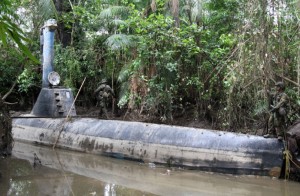
***** From the Center of International Maritime Security:

Drug cartels today are much more organized, adaptive, and strategic. Over time, they have acquired vast financial resources that allow them to invest in technologies geared towards providing them with a strategic edge. Drug cartels have learned to adapt to a changing environment where law enforcement authorities and militaries are also seeking to find their own effective ways of disrupting the flow of illicit drugs. Technology has become a source of competitive advantage and both drug cartels and militaries have been investing in engineering and technological tools that will allow them to counteract one another.

On one side, drug cartels attempt to optimize their operational efficiency while mitigating the risk of detection, seizure, and capture. On the other side, we have law enforcement and militaries’ efforts to improve their surveillance and detection capabilities. This race to out-flank and counteract one another has led to the development of narco-submarines.

During the past twenty years, Colombia’s various drug cartels have engaged in investing in and developing narco-submarine technology that will yield a competitive edge. Over time, their increasing need to evade capture and confiscation of narcotics led drug cartels to move away from using go-fast boats and planes, and instead turn towards developing in-house, homemade, custom built narco-submarines.

A narco-submarine (also called narco-sub) is a custom-made, self-propelled vessel built by drug traffickers to smuggle their goods. Over the years, their engineering, design and technology have improved, thus making them more difficult to detect and capture. Moreover, from a cost-benefit perspective, the yielded benefits are far superior to the associated costs of building these vessels.

Although militaries and law enforcement agencies have become progressively collaborative in their efforts to reduce the flows of narcotics, the use of narco-submarines enables narcotics to continue to reach their destinations while reducing the probability of detection. Albeit, there have been some confiscations of narco-submarine vessels over the last several years. These appropriations in turn have led to our understanding of how narco-submarines are designed, engineered, and used to deploy narcotics.

Cocaine smuggling from the Andean region of South America to the United States generates yearly revenues in the high tens of billions of dollars (e.g. 2008 UN estimate of USD $88 billion retail) and over the last thirty-five years has produced in the low trillions of dollars in retail sales. The use of narco-subs and related vessels represents one component of a broader illicit distribution strategy that also relies upon go-fast boats, airplanes, the hiding of narcotics inside bulk containers and smaller commodities, drug mules, and other techniques to covertly get this high value product into the U.S.

In fact, as of June 2012, maritime drug smuggling accounts for 80% of the total illicit flow from the Andean region into Honduras, Mexico and other mid-way transportation regions prior to entry into the U.S. About 30% of the maritime flow is estimated by the Drug Enforcement Administration (DEA) to utilize narco submarines. Overall, however, maritime interdiction rates are very low. In March 2014, the commander of the U.S. Southern Command testified to Congress that:

“Last year, we had to cancel more than 200 very effective engagement activities and numerous multilateral exercises, Marine Corps Gen. John F. Kelly told members of the Senate Armed Services Committee. And because of asset shortfalls, Southcom is unable to pursue 74 percent of suspected maritime drug trafficking, the general said.

“I simply sit and watch it go by,” he continued. “And because of service cuts, I don’t expect to get any immediate relief, in terms of assets, to work with in this region of the world.”

As a result, it can be seen that narco-submarines and related maritime drug trafficking methods are being carried out with relative impunity, with only about 1 in 4 craft presently being interdicted.

Per the testimony of Rear Admiral Charles Michel, JIATF-South Director, in June 2012, the following statistics pertaining maritime contact numbers and interdictions are provided:

JIATF-South detected an SPSS [Self-Propelled Semi-Submersibles] at sea for the first time in 2006. By 2009, the interagency detected as many as 60 SPSS events were moving as much as 330 metric tons per year. Prior to 2011, SPSS had only been employed by traffickers in the Eastern Pacific. However, since July 2011, JIATF-South has supported the disruption of five SPSS vessels in the Western Caribbean, each carrying more than 6.5 metric tons of cocaine.

There have been a total of 214 documented SPSS events, but only 45 were disrupted due largely to the difficulty of detecting such low-profile vessels.

The numbers of these vessels which now exist is also highly debatable with potentially dozens of them being produced every year by criminal organizations in Colombia such as the FARC (Fuerzas Armadas Revolucionarias de Colombia), Rastrojos, and Urabeños. One point greatly influencing the numbers of these vessels which exist at any specific time is if they are utilized once and then scuttled after their delivery (the traditional U.S. military viewpoint) or if they are utilized multiple times (the traditional Colombian military viewpoint). Depending on the perspective held, greater or lesser numbers of narco subs would be required to be produced each year to replenish the vessels lost due to capture, accidental sinking, intentional-scuttling to avoid capture, and, potentially most importantly, at the end of a delivery run.

What is known is that the capability of these vessels has grown over the last two decades with their evolution and, if the Colombian cartels’ dream of making the journey (using fully submersible narco-subs) to West Africa and Europe is realized, such subs would very well represent a valuable cross Atlantic trafficking resource that would not likely be scuttled at the end of such a profitable illicit trade route.

Given this context concerning the immense values associated with the cocaine trade to the U.S. and the large amount of these illicit drugs not being interdicted during the initial leg in their journey to the United States, we have written a paper, “Narco-Submarines – Specially Fabricated Vessels Used For Drug Smuggling Purposes”, soon to be released by the Foreign Military Studies Office (FMSO) and intended to be an initial primer on the subject of narco-submarines, that is, those specially fabricated vessels utilized principally by Colombian narco traffickers and developed to smuggle cocaine into the U.S. illicit drug market.

narco2This work is anticipated to appear in the Foreign Military Studies Office (FMSO) website as unclassified research conducted on defense and security issues that are understudied or under-considered. The work contains a preface written by Dr. James G. Stavridis, and a number of essays written by U.S. Navy Captain Mark F. Morris, Adam Elkus, Hannah Stone, Javier Guerrero Castro, and Byron Ramirez discussing and analyzing narco-submarines. The paper also comprises a comprehensive photo gallery, arranged in chronological order, which allows the reader to observe the evolution of narco-submarine technologies. It also contains a cost benefit analysis of using narco-submarines, as well as a map and a table that highlights where these distinct narco subs were interdicted. The data that we came across seems to propose that cartels have been using different types of narco-submarines concurrently; hence, they seem to be employing a mixed strategy.

This study is important and relevant to the present challenges faced by law enforcement authorities and militaries. This effort seeks to add value to the existing literature on the subject as it contains several essays which describe the complexity of the challenges that narco-submarines present. The document also provides the background and context behind the emergence of these vessels. Furthermore, the work illustrates the evolution of narco-submarine technology and the advances in their design, features, and technical capabilities.

Finally, it is important that we collectively consider the potential of these types of vessels to transport more than just narcotics: the movement of cash, weapons, violent extremists, or, at the darkest end of the spectrum, weapons of mass destruction.

While this is a volume that will be of general interest to anyone with an interest in global security, the intended readers are military, homeland security, and law enforcement personnel who wish to learn more about these vessels and their respective capabilities. Policymakers and analysts may also find the work useful for understanding the detection and interdiction challenges that these vessels generate. Increasing the area of knowledge about narco-submarines should enrich and deepen our understanding of the threat they pose to our domestic security, and indeed to the global commons.

DHS Allows Refugees into U.S. with only Testimony, no Documents

Europe, now then the United States…

Related reading: Presidential Determination Signed to Accept 85,000 Refugees

VIDEO: Obama Administration Official Admits to Allowing Refugees in to U.S. Based on Their Testimony Alone

Cruz questions administration officials on refugee program at Judiciary Committee hearing

WASHINGTON, D.C. – U.S. Sen. Ted Cruz (R-Texas), in today’s Judiciary immigration subcommittee hearing, highlighted serious problems with the Obama administration’s refugee resettlement efforts, including the federal government’s inadequate refugee vetting process. While questioning State Department Principal Deputy Assistant Secretary Simon Henshaw, Department of Homeland Security (DHS) Director León Rodríguez, and Department of Health and Human Services Director Robert Carey, Sen. Cruz specifically noted that the administration’s willful blindness to radical Islamic terrorism has prevented Christian refugees from the Middle East from escaping the genocide of ISIS and has also seriously undermined counterterrorism efforts in the United States.

Moreover, during an exchange with Sen. Cruz, Director Rodríguez acknowledged publicly that refugee applications can be approved based solely on the applicant’s testimony, without any documentation.

Sen. Cruz: Is it true or false that the testimony of the applicant alone can be sufficient for approval? 

Director Rodríguez: There are cases where the testimony is not necessarily corroborated by documents…I am acknowledging that, yes, testimony can be the basis for the grant of a refugee…

Watch Sen. Cruz’s full opening remarks and first line of questioning, where Director Rodríguez admits that refugee applications can be approved based on testimony alone, here. Sen. Cruz’s second line of questioning can be viewed here. Below is the full transcript of Sen. Cruz’s opening remarks:

“America has long shown an incredible generosity of spirit welcoming refugees and offering them safe haven. Indeed, I am the son of a refugee who fled prison and torture in Cuba and came to America seeking freedom. But our immigration laws are not a suicide pact. The refugee program should not become a vehicle for terrorists to come murder innocent Americans.

“I and, I think, a great many Americans are deeply concerned by the willful blindness of this administration to the threat of radical Islamic terrorism. That was characterized powerfully just a few minutes ago when our Democratic colleague Senator Al Franken said we should not even ask refugees if they are Muslims. If one is trying to prevent radical Islamic terrorists from coming in, the suggestion from my Democratic colleague that we shouldn’t even ask, to me, is nuts.

“As we look at what is happening in Syria and what is happening in the Middle East, ISIS is evil. They are waging a war of genocide against Christians. They are murdering Jews. They are murdering fellow Muslims, and yet, the refugee program as administered by this administration seems to have an enormous preference for Syrian Muslim refugees and seems to actively keep out Syrian Christian refugees.

“In 2014, the Obama administration admitted 249 refugees from Syria, 224 of those, 89.9 percent, were Muslim, only 13 were Christian – 5.2 percent. In 2015, the Obama administration admitted 2,192 refugees from Syria; 2,149 were Muslim – that’s 98 percent – and only 29, 1.3 percent, were Christian. In 2016 to date, the Obama administration has admitted 11,717 refugees from Syria, of those 11,624 were Muslim – that’s 99.2 percent – and 49 were Christian – that’s 0.41 percent. All told since 2011, 14,267 Syrian refugees have been admitted to the United States and more than 14,000 of them were Muslim. Fewer than 100 were Christian.

“Now, those numbers are not even close to the proportional population in Syria. Ten percent of the pre-war population in Syria was Christian, and yet, 0.68 percent of the refugees being admitted by the administration are Christian.”