State Dept: Country Reports on Terrorism 2015

Cuba, Mexico, Venezuela, all in our hemisphere get major passes from the State Department.

Related reading: The 50 most violent cities in the world

Related reading: The world’s most dangerous and safest countries revealed  Interactive map for rankings is found here.


Country Reports on Terrorism 2015 is submitted in compliance with Title 22 of the United States Code, Section 2656f (the “Act”), which requires the Department of State to provide to Congress a full and complete annual report on terrorism for those countries and groups meeting the criteria of the Act.

Beginning with the report for 2004, it replaced the previously published Patterns of Global Terrorism.


Chapters

Chapter 1. Strategic Assessment
Chapter 2. Country Reports: Africa Overview
Chapter 2. Country Reports: East Asia and Pacific Overview
Chapter 2. Country Reports: Europe Overview
Chapter 2. Country Reports: Middle East and North Africa Overview
Chapter 2. Country Reports: South and Central Asia Overview
Chapter 2. Country Reports: Western Hemisphere Overview
Chapter 3: State Sponsors of Terrorism Overview
Chapter 4: The Global Challenge of Chemical, Biological, Radiological, or Nuclear (CBRN) Terrorism
Chapter 5: Terrorist Safe Havens (Update to 7120 Report)
Chapter 6. Foreign Terrorist Organizations
Chapter 7. Legislative Requirements and Key Terms

Annexes

National Consortium for the Study of Terrorism and Responses to Terrorism: Annex of Statistical Information [Get Acrobat Reader PDF version   ]
Terrorism Deaths, Injuries and Kidnappings of Private U.S. Citizens Overseas in 2015

Full Report

Country Reports on Terrorism 2015 (PDF)

Related reading: SUMMARY: Wilayat Sinai, an organization identified with the Islamic State, has recently suffered a series of serious blows from the Egyptian army. 

Yup, He Commuted Another 111 Sentences

Obama Commutes Sentences Of 111 Federal Inmates Convicted Of Non-Violent Drug Charges


WASHINGTON (AP) — President Barack Obama has cut short the sentences of 111 federal inmates in another round of commutations for those convicted of nonviolent drug offenses

Obama has long called for phasing out strict sentences for drug offenses, arguing they lead to excessive punishment and incarceration rates unseen in other developed countries.

White House Counsel Neil Eggleston says the commutations underscore the president’s commitment to using his clemency authority to give deserving individuals a second chance.

He says that Obama has granted a total of 673 commutations, more than the previous 10 presidents combined. More than a third of the recipients were serving life sentences.

Eggleston says he expects Obama to continue granting commutations through the end of his administration, but only legislation can ensure the federal sentencing system operates more fairly.

Prisoner applications are being reviewed by more than 1,000 attorneys at 323 law firms and organizations nationwide, pro bono. In the meantime, more than 35,000 inmates — about 16 percent of the federal prison population — have applied to have their sentences shortened under the Justice Department-led initiative. More her from the WashingtonPost.

This the program began under Eric Holder.

Obama has enacted his own SAFE Act, legislation that has not advanced, so he is using his pen and phone instead. Note the title ‘SAFE’….safe for who exactly?

The Safe, Accountable, Fair, and Effective (SAFE) Justice Act Rep. Jim Sensenbrenner and Rep. Bobby Scott

States Lead the Way in Corrections Reform

Since 1980, Congress has steadily increased the size and scope of the federal criminal code and with it the federal prison population. In that period, the federal government has added an estimated 2,000 new crimes to the books, while the federal imprisonment rate has grown by an astounding 518 percent. During the same period, annual spending on the federal prison system rose 595 percent, from $970 million to more than $6.7 billion, after adjusting for inflation.

Like the federal government, states also recorded sharp increases in imprisonment and associated costs over the past 30 years. During the past decade, however, the states have responded by reducing their imprisonment rate by 4 percent while the federal imprisonment rate jumped 15 percent. The state drop was driven in large part by comprehensive reform efforts in more than two dozen states designed to protect public safety while containing costs and preventing further growth in government programs.

These state reforms have returned dividends to taxpayers many times over: from Texas and Wisconsin to Rhode Island, from Georgia and South Carolina to New York, 32 states have reduced both their crime and imprisonment rates over the past five years. Cumulative cost savings in a subset of these states exceed $4.6 billion, and millions have been reinvested in prison alternatives better at breaking the cycle of recidivism.

The Safe, Accountable, Fair, and Effective (SAFE) Justice Act

The SAFE Justice Act is bipartisan legislation that puts lessons learned in the states to work at the federal level. The legislation protects public safety and reins in escalating corrections costs by –

Curtailing overcriminalization – requires public disclosure of regulatory criminal offenses; allows victims of regulatory over-criminalization to contact the inspector general; restores discretion to judges to determine to what extent manipulated conduct that results from fictitious law enforcement “stings” may be considered in court; protects against wrongful convictions; creates procedures to simplify charging and safely reduce pre-trial detention; and eliminates federal criminal penalties for simple drug possession in state jurisdictions.

Increasing use of evidence-based sentencing alternatives – expands eligibility for pre-judgment probation; promotes greater use of probation for lower-level offenders; and encourages judicial districts to open drug, veteran, mental health and other problem solving courts.

Concentrating prison space on violent and career criminals – clarifies original Congressional intent by examining the role an offender plays in a drug offense and targeting higher-level traffickers for mandatory minimums and recidivist enhancements; applies life sentences for drug trafficking only in the most egregious cases; allows eligible offenders to petition for resentencing under new trafficking laws; modestly expands the drug trafficking safety valve; clarifies that mandatory minimum gun sentences can only run consecutively when the offender is a true recidivist; and expands compassionate release for lower-risk geriatric and terminally-ill offenders.

Reducing recidivism – expands earned time to encourage more inmates to participate in individualized case plans designed to reduce their likelihood of reoffending; seeks to boost success rates of offenders on probation and post-prison supervision by mandating swift, certain and graduated sanctions for violations and offering credits for those who are compliant; creates a performance-incentive funding program; creates mental health and de-escalation training programs for prison personnel; and mandates the use of performance-based contracting for half-way houses.

Increasing government transparency and accountability – requires fiscal impact statements for sentencing and corrections bills; requires sentencing cost analyses to be disclosed in pre-sentencing reports; adds a non-voting federal defender rep. on the U.S. Sentencing Commission; requires the calculation of good time as Congress intended; requires federal agencies to report on corrections populations and recidivism rates, among other indicators; reauthorizes the Innocence Protection Act and directs the Attorney General to develop best practices to reduce wrongful convictions; and encourages prison savings to be invested in strengthening safety measures for law enforcement.

The Research Foundation for the SAFE Justice Act

The SAFE Justice Act, like the comprehensive corrections reforms enacted in many states, draws from the large and growing body of research about what works to reduce recidivism, including the following principles:

To deter offending, use swift and certain responses – Research demonstrates that delayed, unpredictable, and severe responses are less effective than swift, certain, and fair sanctions. Swift and certain responses—both punishments and rewards—are more effective because they help offenders see the response as a direct consequence of their behavior and because offenders heavily discount uncertain and distant responses.

States that have implemented swift and certain responses include Washington, Georgia, and West Virginia.

Earned time policies can reduce recidivism – Research demonstrates that rewards and incentives can work to change offending behavior and reduce recidivism. The benefits of earned time policies for inmates and earned compliance credits for offenders under probation or post-release supervision include lower costs (through accelerated release) and lower recidivism (by shifting correctional resources to those offenders who continue to violate rules and break laws).

States that have built earned time into their prison systems include Kentucky, Maryland, and Louisiana. States that have built earned time into their supervision systems include South Dakota, Mississippi, and Arkansas.

For drug offenders, sentence strategically – The most vicious, predatory and high-level drug offenders warrant prison cells to avert the harm they cause to individuals and communities, but research shows that long terms of incarceration for the vast majority of mid-level couriers, distributors and dealers has little impact on public safety. While imprisonment may temporarily disrupt a drug market, the “replacement effect”—whereby new recruits quickly replace those imprisoned for mid-level roles—negates the impact of incarceration on drug price, availability, or related crime. Instead, prison time should be focused on violent or kingpin drug traffickers who are controlling the marketplace.

States that have recalibrated their drug sentencing systems to differentiate higher-level from lower-level offenders include South Dakota, Georgia, and South Carolina.

Focus on high-risk offenders – For many lower-level offenders, especially those whose criminal conduct is driven largely by substance abuse, alternatives like drug and mental health courts, treatment programs, and intensive supervision both hold offenders accountable and work better to reduce recidivism. In fact, research suggests that for many lower-risk and less serious offenders a prison sentence may actually be responsible for an increase in recidivism by encouraging anti-social ties and breaking bonds at home.

States that have encouraged diversion of lower-level offenders to prison alternatives include Mississippi, California, and Illinois.

Age matters – Research has long shown that age is one of the most significant predictors of criminality, with criminal or delinquent activity peaking in late adolescence and decreasing significantly with time. As a result, imprisonment of offenders into their 50s, 60s and 70s provides diminishing and often negligible public safety returns. Implementing smart, targeted geriatric release programs can ensure heinous offenders remain behind bars while cutting down on costs and maintaining public safety.

States that have implemented geriatric or compassionate release programs include Alabama, Colorado, and Montana.

 

DoJ: Enforcing the Law is Discrimination

Related reading: Report: U.S. Spent $1.87 Billion to Incarcerate Illegal-Immigrant Criminals in 2014 Read more at

Justice Dept.: Firing migrant workers with expired papers is discrimination

WashingtonExaminer: The Justice Department released a video this week encouraging companies not to terminate immigrants after their employment authorization expires, and indicated that doing so is a form of discrimination.

The video is shot in a dimly lit office, where two actors discuss whether their fictional company should let go of some Salvadoran employees who have failed to provide updated paperwork on their immigration status.

After a discussion about whether retaining the workers would violate the law, a woman says, “I think this is an exception to that rule,” and recommends that they contact the the Office of Special Counsel for Immigration Related Unfair Employment Practices before making any decisions.

“We want to follow the rules but we don’t want to lose these workers or discriminate against them,” she concludes. “They are too valuable.”

The video then tells viewers that the federal government has extended employment authorization by six months for people from El Salvador with Temporary Protected Status, a benefit designed to help foreign nationals who are considered unable to safely return to their home.

The Justice Department claims requesting additional work-authorization documents from these workers may violate a provision in the Immigration and Nationality Act (INA) designed to protect individuals from excessive employer demands based on their nationality.

“The Justice Department is firmly committed to protecting the rights of all work-authorized immigrants and ensuring that employers do not engage in unlawful discrimination,” said Principal Deputy Assistant Attorney General Vanita Gupta, head of the Justice Department’s Civil Rights Division in a statement upon the video’s release on Thursday.

Related reading: Read the report on Obama Executive Action Removals Executive Action-Removals-SCOMM

MigrationPolicy: While much of the attention to the Obama administration’s announcement of executive actions on immigration in November 2014 has focused on key deferred action programs, two changes that have not faced legal challenge are in the process of being implemented and may substantially affect the U.S. immigration enforcement system. These changes include the adoption by the Department of Homeland Security (DHS) of new policy guidance on which categories of unauthorized immigrants and other potentially removable noncitizens are priorities for enforcement, and the replacement of the controversial Secure Communities information-sharing program with a new, more tailored Priority Enforcement Program (PEP).

The new policy guidance, which builds on previous memoranda published by the Obama administration in 2010 and 2011, further targets enforcement to noncitizens who have been convicted of serious crimes, are threats to public safety, are recent illegal entrants, or have violated recent deportation orders. MPI estimates that about 13 percent of unauthorized immigrants in the United States would be considered enforcement priorities under these policies, compared to 27 percent under the 2010-11 enforcement guidelines. The net effect of this new guidance will likely be a reduction in deportations from within the interior of the United States as DHS detention and deportation resources are increasingly allocated to more explicitly defined priorities.

By comparing the new enforcement priorities to earlier DHS removal data, this report estimates that the 2014 policy guidance, if strictly adhered to, is likely to reduce deportations from within the United States by about 25,000 cases annually—bringing interior removals below the 100,000 mark. Removals at the U.S.-Mexico border remain a top priority under the 2014 guidelines, so falling interior removals may be offset to some extent by increases at the border.

Taking the enforcement focus off settled unauthorized immigrants who do not meet the November 2014 enforcement priorities would effectively offer a degree of protection to the vast majority—87 percent—of unauthorized immigrants now residing in the United States, thus affecting a substantially larger share of this population than the announced deferred action programs (9.6 million compared to as many as 5.2 million unauthorized immigrants).

This report analyzes how many unauthorized immigrants fall within each of the new priority categories and how implementation of these priorities could affect the number of deportations from the United States, as well as what the termination of Secure Communities and launch of PEP could mean for federal cooperation with state and local authorities on immigration.

The Clinton’s History with Iran and Cuba and Latin America

Posted earlier on this site, Iran’s Cuba and Latin American Tours and Trouble Ahead forced a deeper examination of the Iran, Cuba and Latin America relationship. As Iran is now at least $1.7 billion dollars richer, larger questions develop on Iran’s global expansion. Being in our hemisphere and right in the backyard of America some chilling conditions emerge.

Reported in 2010, Cuba has expressed support for Iran’s nuclear program and has defended Iran’s right to peaceful nuclear technology in the face of UN sanctions. Cuban President Raul Castro also serves as the Secretary-General of the Non-Aligned Movement, which released a statement in July 2008 declaring that its member states “welcomed the continuing cooperation being extended by the Islamic Republic of Iran to the IAEA” and “reaffirmed that states’ choices and decisions, including those of the Islamic Republic of Iran, in the field of peaceful uses of nuclear technology and its fuel cycle policies must be respected.”[1]

In late November 2009, the IAEA passed a rebuke of Iran for building a second enrichment plan in secret.[2] Cuba, along with Venezuela and Malaysia, opposed the resolution.[3] The resolution by the 35-member IAEA Board of Governors calls on Iran to halt uranium enrichment and immediately freeze the construction of its Fordo nuclear facility, located near Qom.[4]  Cuba and Iran cooperate bilaterally and multilaterally through the Non-Aligned Movement. In a June 2008 memorandum of understanding, Iranian President Ahmadinejad explained that the two countries expressed their continued support for “each other on the international scene.” [17]  In September 2008, Iran began funding medical students from the Solomon Islands to study in Cuba, including airfare and computers for medical students unable to finance their own way to Havana to study.[18]  More here.

Related reading: It’s time to start worrying about what Russia’s been up to in Latin America

There is a long and nefarious history between the United States and Cuba but we don’t have to go back much further than the Clinton administration. Seems with enough money to the Clinton’s or to the Democrat National Committee, lots of things can be overlooked.

****

THREAT TO THE HOMELAND

Iran’s Extending Influence in the Western Hemisphere

Iran not only continues to expand its presence in and bilateral relationships with countries like Cuba, Ecuador, Nicaragua, and Venezuela, but it also maintains a network of intelligence agents specifically tasked with sponsoring and executing terrorist attacks in the western hemisphere. True, the unclassified annex to a recent State Department report on Iranian activity in the western hemisphere downplayed Iran’s activities in the region; this material, however, appeared in an introductory section of the annex that listed the author’s self-described “assumptions.” While one assumption noted that “Iranian interest in Latin America is of concern,” another stated that as a result of U.S. and allied efforts “Iranian influence in Latin America and the Caribbean is waning.” More here from the Washington Institute.

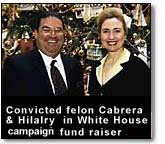
Back in 1996, seems the Clintons were doing then what they are doing today, hanging with criminals that donate.

WASHINGTON DESK – The Justice Department released on Wednesday photographs showing a convicted Miami cocaine trafficer who is seen standing next to and posing with vice president Al Gore. The two were attending a party in Florida last December.

Apparently, Cabrera was asked to make a large donation to the Clinton-Gore campaign in exchange for perks like hob-nobbing with Al Gore and the first lady, Hillary Rodham Clinton.

Jorge Cabrera’s cash contributions to the Clinton-Gore campaign were so generous, that Cabrera was also invited to the White House and gained entrance there without any FBI & Secret Service security clearance.

CNN reported Wednesday that Cabrera’s attorney, Stephen Bronis, said $20,000(given to the Clinton-Gore campaign) was not intended to buy protection for drug smuggling.

‘He had a lobster and stone crab fishery in the Keys and felt that contribution might promote that future course,’ Bronis said.

The Clinton-Gore campaign only returned the $20,000 last week after the full story had reached ABC News, and the Clinton administration had been asked for comment by the media.

Cabrera was arrested in January during a Miami drug bust of nearly three tons of cocaine. Cabrera was arrested and pleaded guilty to one drug count. He was also imprisoned in the 1980s on narcotics charges.

A report that the picture of Cabrera and Gore had been impounded by the Justice Department prompted an angry reaction from Republicans, including Bob Dole’s presidential campaign, House Speaker Newt Gingrich and Rep. Bob Livingston of Louisiana, chairman of the House Appropriations Committee.

Republicans sent letters to Attorney General Janet Reno and the directors of the FBI and the Secret Service seeking information about Cabrera and the campaign contribution.

Livingston asked the federal agencies for a complete accounting of the facts relating to the story within three days: whether Cabrera had dined at the White House, details of his relationship with Clinton and Gore and, if he did dine with them, how he passed FBI & Secret Service scrutiny to gain access to them.

The U.S. attorney’s office in Miami was contacted by reporters. Justice said it would not provide photographs of Cabrera and Gore in Florida and at the White House when reporters requested them on Monday. The Justice Department attempted to claim that Cabrera’s story is coverd by the Privacy Act law in turning down the media request for information on the arrest for cocaine possession of tons of the illegat drug and dealing.

Jant Reno put out information that the photo of Cabrera with Gore and Clinton could not be released without the consent of Cabrera. Later, the Justice Department did release the photographs after Cabrera submitted written authorization.

The delay by the Justice Department appeared to be an effort to distance itself from accusations that are mounting from the American public that the Justice Department is receiving guidance from the Clinton White House and the vice president’s office on the timing of Janet Reno’s investigation.

Justice says it is looking into the breach of National Security by Cabrera’s ready access to secured areas of the White House and its grounds when he entered as an invited quest of president Clinton for dinner and photo-ops.

Then much more recently, like February of 2016, Hillary was busy nurturing the pro-Iran lobby including a fund-raiser.

Clinton will participate in a Menlo Park fundraiser on Sunday hosted by Twitter executive Omid Kordestani and his wife Gisel Hiscock, as well as National Iranian American Council (NIAC) board member Lily Sarafan and Noosheen Hashemi, who serves on the board of the pro-Iran advocacy group Ploughshares, a major funder of pro-Iran efforts.

NIAC, an advocacy group formed by Iranian-Americans to work against the pro-Israel community, has long been accused of lobbying on Iran’s behalf against sanctions and other measures that could harm the Islamic Republic’s interest.

Ploughshares, which partners with NIAC, is joining the White House in efforts to pressure the Jewish community and others to back the recently implemented Iran nuclear agreement, the Free Beacon reported.

The organization has also spent millions to influence coverage of Iran and protect the Obama administration’s diplomatic relations with Iran.

NIAC has emerged a key pro-Iran player in the United States, working with the White House and liberal groups to spin the deal as a positive for U.S. national security.

The group is currently leading the charge to block recent counter-terrorism legislation that would require individuals who have travelled to Iran to obtain a visa before entering the United States. More from FreeBeacon.

Alright so we have established historical relationships with Cuba and Iran and the Clintons. Is there more that we should know? Yes.

  1. Cuban spies in America
  2. The DEA did it’s job but Bill Clinton remained loyal to the Castro brothers
  3. Hillary’s personal global spy, Sidney Blumenthal collaborated on Hezbollah’s new office in Cuba.
  4. In 2011, Hillary’s State Department sent their old friend Bill Richardson to Cuba to bring back an American, Alan Gross, who was an embedded spy working for USAID.
  5. In 2009, Obama and Hillary began the normalization process with Cuba.
  6. Bill Clinton’s old buddy Strobe Talbott collaborated on Cuba with Hillary’s State Department.
  7. Hillary announced that Iran would be invited to an upcoming  multinational conference on Afghanistan
  8. Documents reveal Bill Clinton’s secret contact with Iran
  9. Sid Blumenthal, Jake Sullivan and Hillary on Iran and Israel

Iran’s Cuba and Latin American Tours and Trouble Ahead

While the United States attempted to normalize relations with both Iran and Cuba, it appears the real result is a renewed friendliness between Iran and Cuba at the cost of the U.S. taxpayer, that $1.7 billion or more.

It also must be noted that Cuban refugees continue to appear on American shores but now we must question how many of them are terrorists and what are they bringing with them. Iceberg ahead.

It is also important to note that the Cuban military runs all tourism and the hospitality industry as the United States has opened those travel channels.

****

Related reading: Breaking Sanctions with Cuba?

Cuba is a state sponsor of terrorism, that is until the White House decided it was no longer.

Cuba supports Iran’s nuclear ambitions and opposed IAEA rebukes of secret Iranian enrichment sites. The two countries have banking agreements (Islamic Republic News Agency), economic cooperation and lines of credit ( FNA), and three-way energy-focused treaties with Bolivia (CSMonitor). Cuba and Iran hold regular ‘Joint Economic Commission’ meetings; the latest, in November 2009, further expanded bilateral trade and economic ties.

Related reading: The U.S. has had a Russian Problem of Espionage for Decades

One of Cuba’s largest and long-term industries is spying and selling intelligence and secrets globally.

**** Image result for javad zarif 

Iran says will open new chapter in relations with Cuba

Reuters: Kicking off a six-day tour of Latin America, Iranian Foreign Minister Mohammad Javad Zarif said on Monday in Havana his visit would open a new chapter in the Islamic Republic’s relations with Communist-ruled Cuba.

Iran, which has long been friendly with Cuba, is on a drive to improve foreign commerce after the removal in January of international sanctions against the Islamic Republic.

“We will start a new chapter in the bilateral relations with Cuba on the basis of a big (business) delegation accompanying me on this visit,” Zarif said at a meeting with his Cuban counterpart, Bruno Rodriguez.

The international community lifted sanctions on Iran as part of the deal under which Tehran curbed its nuclear program.

Rodriguez congratulated Iran on the “success of its foreign policy” while reiterating its longstanding support for “all countries to develop nuclear energy with pacific ends”.

Cuba and Iran have in common a long stand-off with the United States. They were both on the U.S. State Department’s list of terrorism sponsoring countries until Havana was removed last year as part of a detente with Washington.

“We have always been on the side of the great Cuban people in view of atrocities and unjust sanctions,” Zarif said.

“The government and Cuban people have also always shown us solidarity with regards to the atrocities committed by the empire.”

Zarif’s tour will also take him to Chile, Nicaragua, Bolivia and Venezuela.

Just last week, Cuba’s new Economy Minister Ricardo Cabrisas made a trip to Tehran where he met with President Hassan Rouhani.

German exports to Iran, mostly machines and equipment, jumped in the first half of the year following the removal of international sanctions against the Islamic Republic, official trade data showed on Monday