An affordable price is probably the major benefit persuading people to buy drugs at www.americanbestpills.com. The cost of medications in Canadian drugstores is considerably lower than anywhere else simply because the medications here are oriented on international customers. In many cases, you will be able to cut your costs to a great extent and probably even save up a big fortune on your prescription drugs. What's more, pharmacies of Canada offer free-of-charge shipping, which is a convenient addition to all other benefits on offer. Cheap price is especially appealing to those users who are tight on a budget
Service Quality and Reputation
Although some believe that buying online is buying a pig in the poke, it is not. Canadian online pharmacies are excellent sources of information and are open for discussions. There one can read tons of users' feedback, where they share their experience of using a particular pharmacy, say what they like or do not like about the drugs and/or service. Reputable online pharmacy canadianrxon.com take this feedback into consideration and rely on it as a kind of expert advice, which helps them constantly improve they service and ensure that their clients buy safe and effective drugs. Last, but not least is their striving to attract professional doctors. As a result, users can directly contact a qualified doctor and ask whatever questions they have about a particular drug. Most likely, a doctor will ask several questions about the condition, for which the drug is going to be used. Based on this information, he or she will advise to use or not to use this medication.
Report: Corruption Substantially Undermined US Mission in Afghanistan
VOA/WASHINGTON — Widespread corruption in Afghanistan has substantially undermined U.S. efforts to rebuild the county, according to a report released Wednesday
The U.S. government’s Special Inspector General for Afghanistan Reconstruction (SIGAR) John Sopko said corruption has fueled grievances against the Afghan government and channeled material support to the insurgency from the beginning of Operation Enduring Freedom.
Sopko’s report says corruption remains an enormous challenge to security, political stability, and development, and urges the U.S. mission to make anticorruption efforts a top priority.
The report offers a number of recommendations for implementing a U.S. interagency anticorruption strategy in Afghanistan.
Although the United States injected tens of billions of dollars into the Afghan economy, it contributed to the growth of corruption by being slow to recognize the magnitude of the problem, the role of corrupt patronage networks, and the ways in which corruption threatened core U.S. goals. It said certain U.S. policies and practices exacerbated the problem.
‘Endemic’ problem
The report titled, “Corruption in Conflict: Lessons from the U.S. Experience in Afghanistan,” quoted Ambassador Ryan Crocker, who re-opened the U.S. Embassy in Kabul soon after the September 11, 2001, attacks and served again as ambassador in 2011-2012 (and who is a member of Broadcasting Board of Governors which oversees U.S. international broadcasting, including the Voice of America) as saying that “the ultimate point of failure for our efforts … wasn’t an insurgency. It was the weight of endemic corruption.”
“The corruption lens has got to be in place at the outset, and even before the outset, in the formulation of reconstruction and development strategy, because once it gets to the level I saw, it’s somewhere between unbelievably hard and outright impossible to fix,” Crocker said.
****
The report is 164 pages, but here is some help with the conclusions:
Our study of the U.S. experience with corruption in Afghanistan finds:
1. Corruption undermined the U.S. mission in Afghanistan by fueling
grievances against the Afghan government and channeling material
support to the insurgency.
2. The United States contributed to the growth of corruption by injecting
tens of billions of dollars into the Afghan economy, using flawed oversight
and contracting practices, and partnering with malign powerbrokers.
3. The U.S. government was slow to recognize the magnitude of the problem,
the role of corrupt patronage networks, the ways in which corruption
threatened core U.S. goals, and that certain U.S. policies and practices
exacerbated the problem.
4. Even when the United States acknowledged corruption as a strategic
threat, security and political goals consistently trumped strong
anticorruption actions.
5. Where the United States sought to combat corruption, its efforts
saw only limited success in the absence of sustained Afghan and
Billions in US taxpayer money filled the pockets of Afghan warlords, bolstered the drug trade and fed corruption during effort to rebuild the country after the war
Federal watchdog released damning report into post-war efforts by US
Was based on the ‘lessons’ needed to be learned from military operations
They injected billions into economy without knowing extent of corruption
The money ended up in hands of criminals, some with ties to the Taliban
Multi-million dollar villas were built for the corrupt individuals
While programs meant to actually rebuild the country were undermined
A top diplomat Ryan Crocker said: ‘The ultimate point of failure for our efforts wasn’t an insurgency. It was the weight of endemic corruption’
He added that the failures in the system are ‘almost impossible to fix’
Iran, a known and proven state sponsor of terror has a history of stealing worldwide peace.
Below is the Congressional hearing of the money transfer transaction(s) to Iran, and the testimony reveals there are more coming and others not previously known.
There is an extensive al-Qaeda network feeding global branches based in the Islamic Republic.
Fifteen years on from the 11 September 2001 terror attacks on the US, al-Qaeda is better-positioned than ever before. Its leadership held, and it has rebuilt a presence in Afghanistan. More importantly, al-Qaeda has built powerful regional branches in India, North Africa, Somalia, Yemen and Syria.
Rebranding itself away from the savagery of Iraq, al-Qaeda has sought to embed itself in local populations by gaining popular legitimacy to shield itself from retribution if, or when, it launches terrorist strikes in the West. This is proceeding apace, above all because of a failure to assist the mainstream opposition in Syria, sections of which were forced into interdependency with al-Qaeda to resist the strategy of massacre and expulsion conducted by the Assad regime.
The 9/11 massacre had not come from nowhere. In February 1998, Osama bin Laden, then-leader of al-Qaeda, plus Ayman al-Zawahiri and three others signed a document that said “kill the Americans and their allies – civilians and military – is an individual duty for every Muslim”.
Al-Qaeda attempted to blow up US troops in Yemen in December 1992. Three months later, al-Qaeda attacked New York’s World Trade Center, murdering six people. In November 1995, a car bomb in Riyadh targeted the American training mission for the Saudi National Guard, killing six people. In June 1996, Iran blew up the US military living quarters at Khobar Towers in Saudi Arabia, murdering 19 people.
Al-Qaeda played “some role, as yet unknown” in the attack, according to the 9/11 Commission. The US Embassies in Kenya and Tanzania were levelled in August 1998, slaughtering 224 people and wounding 5,000, mostly Africans. And in October 2000, a skiff containing two suicide bombers struck an American Naval vessel, the USS Cole, in the port of Aden, killing seventeen sailors.
The conspiracy theories about 9/11 are now a feature of life today. Often proponents will hide behind the façade of “asking questions”. Instead of queries about jet fuel melting steel beams and nano-thermite, however, this inquisitiveness would be much better directed at the actual unanswered questions surrounding 9/11, which centre on the role of Iran.
In 1992, in Sudan, al-Qaeda and Iran came to an agreement to collaborate against the West “even if only training”, the 9/11 Commission records. Al-Qaeda members went to the Bekaa valley to be trained by Hezbollah, Iran’s Lebanese proxy. Hezbollah’s military leader at that time, Imad Mughniyeh, personally met Bin Laden in Sudan to work out the details of this arrangement.
There is no doubt that training provided by Iran made the 1998 East African Embassy bombings possible, and after the bombing numerous al-Qaeda operatives fled unhindered through Iran to Afghanistan. The 9/11 Commission documented that over-half of the death pilots “travelled into or out of Iran” and many were tracked into Lebanon.
Iran and Hezbollah wished to conceal any past evidence of cooperation with Sunni terrorists associated with al-Qaeda
Senior Hezbollah operatives were certainly tracking some of the hijackers, in at least one case travelling on the same plane. The operational planner of 9/11, Khalid Sheikh Mohammad, lived in Iran for long stretches of the 1990s. To this day there is an extensive al-Qaeda network that feeds the global branches based in Iran, sheltered from US counter-terrorism efforts.
“Iran and Hezbollah wished to conceal any past evidence of cooperation with Sunni terrorists associated with al-Qaeda,” the 9/11 Commission noted. But the connections were there, and “this topic requires further investigation”. Sadly, such investigation has never occurred. Instead, the Islamic Republic has been brought into the fold, with billions of dollars released to it through the nuclear deal and a curious belief that Tehran can, or will, help stabilise the Middle East has taken hold.
Bin Laden had intended to drive the US out of the region with the 9/11 attack. “Hit them and they will run,” he told his followers. This was a theme of his 1996 fatwa first declaring war on America. In this, he miscalculated.
The Taliban regime had sheltered Jihadi-Salafists from all over the Arab world. Some left over from the fight against the Soviet occupation; others on the run from the security services of their native lands or just wanting to live in a land of “pure Islam”. Though the training and planning for global terrorism occurred in Afghanistan, most of al-Qaeda’s resources were directed more locally, toward irregular wars, notably in Algeria, Bosnia, and Chechnya. Al-Qaeda trained up to 20,000 jihadist insurgents before 9/11. This sanctuary was lost in the aftermath of 9/11, something lamented by jihadi strategist Mustafa Setmariam Nasar (Abu Musab al-Suri).
Bin Laden had worked with Ahmad al-Khalayleh (Abu Musab al-Zarqawi), the Jordanian founder of what we now know as the Islamic State (Isis), to carve out a jihadi statelet in northern Iraq in the late 1990s led by a group called Ansar al-Islam.
Rice is thrown as Hezbollah members carry the coffin of top their commander Mustafa Badreddine on 13 May 2016Reuters/Aziz Taher
After the Taliban’s fall, al-Khalayleh moved into this area and into Baghdad in early 2002. After making preparations through Syria for the influx of foreign fighters, al-Khalayleh moved to the Ansar-held territory and waited for the US.led Coalition.
IS’s predecessor planned – with al-Qaeda’s blessing – to expel the Coalition forces and set up an Islamic state in Iraq that could then spread across the region, restoring the caliphate. But IS’s methods brought it into frequent conflict with al-Qaeda, and by 2008 IS had been strategically defeated after provoking a backlash among Sunnis in Iraq. The distinctions between IS and al-Qaeda hardened thereafter until their formal split in February 2014.
IS, post-2008, changed some tactical aspects so as to bring the tribes back on-board but remained remarkably consistent in its approach, including the celebration of violence, premised on the idea of building an Islamic state as quickly as possible, which would force the population into collaboration with it and ultimately acceptance over time. In contrast, al-Qaeda placed ever-more emphasis on building popular support that would culminate in a caliphate when it had a critical mass.
The discrediting of IS’s predecessor, operating under al-Qaeda’s banner, damaged al-Qaeda so much that Bin Laden considered changing the organization’s name. Events since then, above all allowing the Syria war to protract, allowed al-Qaeda to rebrand as “pragmatic”, using IS as a foil, and recover.
Al-Qaeda, vanguard-style, took on the local concerns, worked to solve them, and in turn claimed the protection of the local population. Al-Qaeda has tangled itself so deeply into local dynamics, in Yemen and Syria most notably, that it would require a substantial local effort to root them out.
Unfortunately, the Western approach is making the problem worse. A good example came on Thursday night (8 September 2016) when the US launched air strikes against some leaders of al-Qaeda in Syria, now calling itself Jabhat Fatah al-Sham (JFS), which ostensibly disaffiliated from al-Qaeda in July in order to further this process of entanglement.
JFS claims it has no external ambitions and is working to break the siege of 300,000 people in the rebel-held areas of Aleppo city, yet it is attacked. Meanwhile, the US has done nothing about the thousands of Iranian-controlled Shia jihadists, tied into Iran’s global terrorist network, who are the leading element in imposing the siege, and conducted these strikes likely in furtherance of a deal with Russia, which also helped impose the siege. JFS thus claimed that it is serving the Syrian people, while the US opposes the revolution and supports the pro-regime coalition.
“It is a highly unfortunate reality that many Syrians living in opposition areas of Syria perceive JFS as a more determined and effective protector of their lives and interests than the United States and its Western allies,” wrote Charles Lister. The West has been unwilling to do anything to complicate the ability of the Bashar al-Assad regime to commit mass-murder for fear of antagonizing the Iranians and collapsing a “legacy-setting nuclear accord“. While that remains the case, al-Qaeda will continue to gain power and acceptance as a necessary-evil in Syria, and the ramifications of Syria are generational and global.
It is true that there is far too much optimism in current assessments of IS’s impending doom. The group will outlast the loss of its cities, and the misguided way the Coalition has conducted the war will provide conditions for a potential revival. Still, it is al-Qaeda that has the long-term advantage.
IS claimed sole legitimacy to rule, gained visibility and therefore followers. But as strategists like Setmariam understood, this made them visible to their enemies too, a toll that is beginning to tell, especially abroad. In Syria, formal al-Qaeda branches were never the organisation’s only lever and al-Qaeda was much more interested in shaping the environment than ruling it. In essence, al-Qaeda will give up the name and the public credit for the sake of the thing – whether that’s the popular understanding of the religion or the foundations of an Islamic emirate.
“IS wants the world to believe that it is everywhere, and … al-Qaeda wants the world to believe that it is nowhere.” That quip from Daveed Gartenstein-Ross neatly summarizes the trajectory of the two organisations. What can’t be seen is harder to stop – al-Qaeda’s counting on it.
Kyle W. Orton is associate fellow at the Henry Jackson Society and a Middle East analyst and commentator.
Mexico issues transit visas to surge of African migrants
MEXICO CITY (AP)— Mexican immigration authorities say 424 migrants from African countries arrived at the southern state of Chiapas over two days last week.
The National Immigration Institute said Tuesday that it has issued them 20-day transit visas that will allow the migrants to reach the U.S.-Mexico border, where they plan to request asylum.
Officials call it an unusual surge and say most of the migrants first went to Brazil or Ecuador to start their journey through Latin America.
Most of the Africans presented themselves voluntarily to immigration officials in the Chiapas town of Tapachula. They did not specify their nationalities. Immigration support staff in Tijuana has been aiding migrants from the Congo, Somalia and Ghana to arrive at the U.S. port of entry at San Isidro.
Guatemala is facing an influx of African immigrants on their way to the United States, having caught 56 times more so far in 2016 than they did in all of 2015.
Only 13 African immigrants were caught in Africa in all of 2015, and by September 2, 2016 729 Africans had been caught by Guatemalan authorities, La Prensa reports. The majority of the African immigrants are from the Democratic Republic of Congo, Ghana, Senegal, and Somalia.
The country is facing an increase of immigrants in general. In 2015, the national police reported 1,131 immigrants caught from various countries. By August 29, 2016, they had intercepted 2,514 immigrants, an increase of 122.2 percent.
Jorge Pereza Breedy, head of the International Organization for Migration in El Salvador, Guatemala, and Hondoras, said that changes in the situation in Europe has led these immigrants to come to Central America. “The saturation of the transit route in Europe and the increase in border security is one of the principal factors in the increase of Asian and African emigrants in Central America,” Breedy told La Prensa.
The African immigrants aren’t in Guatemala to stay there and instead are making there way northward towards Mexico and the United States. “It’s not that they want to come to this country to stay, they want to get to the United States,” Danilo Rivera of the Central American Institute for Social and Development Studies said to La Prensa. (RELATED: Mexico Shipping Hundreds Of Illegal Africans To US Border)
Recently, El Salvadoran authorities busted a human smuggling ring which generated $150,000 a year bringing immigrants illegally to the United States from Brazil.
**** But there is still more:
The New Face of American Immigration
This year candidates have focused on migrants from Mexico, but nationally and in most states, India and China have become the top sources for new arrivals.
Going back to 2010, the matter of Africans fleeing to Latin America and then to the United States began for several reasons.
YaleGlobal: Latin America is becoming an increasingly common destination for African immigrants as Europe tightens its immigration controls and suffers from xenophobia and migration-related violence. Brazil, for example, which has the largest black population outside Africa, offers a more culturally receptive society. Though most of the population is white, Argentina receives a fair share of African migrants too. That country is attractive because immigrants can legalize their status and receive temporary work permits, even with the high level of unemployment, and have access to free healthcare and Spanish classes taught by Catholic church charities. While Europe shutters its borders, and the US tightens immigration, other countries that have historically grown through immigration are picking up the slack. – YaleGlobal
More African Immigrants Finding a Home in Latin America
As European countries tighten up border controls, a rising number of Africans fleeing trouble in their homelands are arriving at ports in Latin America
Mexico issuing transit visas to African migrants flocking to U.S.-Mexico border
MEXICO CITY (AP) – Mexican immigration authorities say 424 migrants from African countries arrived at the southern state of Chiapas over two days last week.
The National Immigration Institute said Tuesday that it has issued them 20-day transit visas that will allow the migrants to reach the U.S.-Mexico border, where they plan to request asylum.
Officials call it an unusual surge and say most of the migrants first went to Brazil or Ecuador to start their journey through Latin America.
Most of the Africans presented themselves voluntarily to immigration officials in the Chiapas town of Tapachula. They did not specify their nationalities.
Immigration support staff in Tijuana has been aiding migrants from the Congo, Somalia and Ghana to arrive at the U.S. port of entry at San Isidro.
Meanwhile:
Shootouts in Mexico border city kill 11, including bystander
ABCNews: Two highway shootouts between soldiers and suspected drug gang members in a northern border city resulted in 11 dead Saturday, including a bystander caught in the crossfire, Mexican authorities reported.
The violence in Nuevo Laredo, across from Laredo, Texas, prompted the temporary closure of the highway, which is a major artery for travel and commerce between the United States and Mexico.
The Tamaulipas state government said in a statement that the armed confrontations began early Saturday when troops killed eight suspected criminals on the highway. Soldiers seized a truck and high-caliber weapons, it said.
An hour later another shootout broke out nearby in which two suspects were killed, along with a woman who was traveling in her car, authorities said.
Nuevo Laredo Mayor Carlos Canturosas said Saturday night via Facebook that the highway, which handles nearly half of the export-import cargo between Mexico and the United States, had reopened.
Nuevo Laredo has experienced high violence rates as rival factions of the Zetas drug cartel fight for control of the area.
Every appropriations bill has included money to secure the border. So much so that funding increased from $1.5 billion in 2005 to $2.3 billion in 2007 — eventually increasing to $3.8 billion in the 2015 fiscal year.
In 2013, Congress again tried to pass immigration reform. Again the effort failed. The border security proposals of that so-called “Gang of Eight” bill would have increased dramatically, doubling the number of full-time border patrol agents to more than 38,400. It also would have added to the construction of a physical border, including double fencing. And it would have added to the amount of virtual security like drones and mobile surveillance.
That bill would have set aside a whopping $46.3 billion over ten years to move toward the more militarized border. But with the federal government now spending nearly $4 billion per year on border security, it’s not much less than what the Gang of Eight would have hoped. Read more here.
Protecting our borders from the illegal movement of weapons, drugs, contraband, and people, while promoting lawful entry and exit, is essential to homeland security, economic prosperity, and national sovereignty.
America shares 7,000 miles of land border with Canada and Mexico, as well as rivers, lakes and coastal waters around the country. These borders are vital economic gateways that account for trillions of dollars in trade and travel each year. They are also home to some of our nation’s largest – and safest – cities and communities. Protecting our borders from the illegal movement of weapons, drugs, contraband, and people, while promoting lawful entry and exit, is essential to homeland security, economic prosperity, and national sovereignty.
DHS works to secure our borders through the deployment of personnel, technology, and infrastructure; as well as working closely with our neighbors in Canada and Mexico, and our many federal, state, local, tribal, and territorial partners.
CBP Border Patrol agents, agriculture specialists, Air and Marine agents, and officers guard America’s front lines. These men and women prevent terrorists and their weapons from entering the United States while continuing their mission of seizing contraband and apprehending criminals and others who illegally attempt to enter the United States.
Through increases in Border Patrol staffing; construction of new infrastructure and fencing; use of advanced technology—including sensors, radar, and aerial assets –investments to modernize the ports of entry; and stronger partnerships and information sharing, we are creating a safer, more secure, and more efficient border environment.
Memo explains how Donald Trump plans to pay for border wall
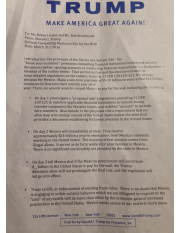
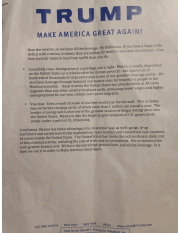
In a two-page memo to The Washington Post, Trump outlined for the first time how he would seek to force Mexico to pay for his 1,000-mile border fence, which Trump has made a cornerstone of his presidential campaign and which has been repeatedly scoffed at by current and former Mexican leaders. Read about Trump’s plan