Russia Weaponizing the Arctic

Russian Military Build-Up in Arctic Highlights Kremlin’s Militarized Mindset

Image result for russia arctic  Image result for russia arctic

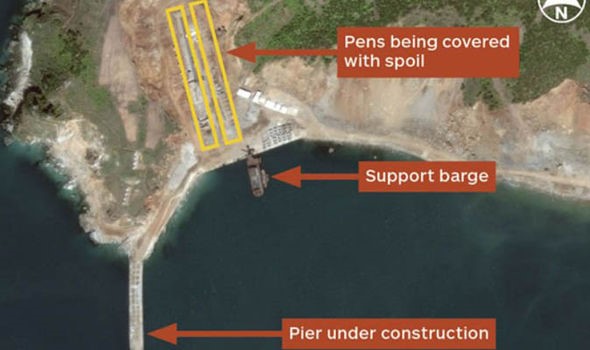
Jamestown: Despite Russia’s economic crisis, which has already imposed restrictions on military spending (see EDM, May 3), the Kremlin is trying to implement a questionable buildup in the Arctic, aimed at strengthening Russian military might. During a recent board session of the Russian Ministry of Defense, Minister Sergei Shoigu paid special attention to the implementation of the “2020 Activity Plan by the Northern Fleet.” He reminded participants that the Northern Fleet, an “inter-service strategic formation,” was formed over two years ago “in order to protect [the] northern borders of Russia” (Mil.ru, July 27). He mentioned in particular that the construction of “closed-loop” (self-sustaining) military towns will be finished on the Franz Josef Land archipelago and the Novosibirsk Islands in 2016. A joint situational awareness system is being created to support air defense.   The Russian defense ministry intends to build or reconstruct ten airfields in the Arctic. “Russia’s Federal Agency for Special Construction [Spetsstroy] is building military infrastructure facilities on six islands in the Arctic,” Izvestia quotes a ministry official. According to this source, over 100 tons of military equipment for more than 150 facilities are planned to be delivered to these remote military garrisons. In addition to the materiel supply, more than 190 tons of construction materials—including precast concrete, cement, metal, pipes, fittings and equipment—will be delivered to the Arctic for building the facilities (Izvestia, July 11). The construction and renovation of runways and other structures is ongoing at Severomorsk-1 airfield (Murmansk oblast) as well as Nagurskoye air base (Alexandra Land Island, in the Franz Josef Archipelago). The airfields at Rogachevo (Arkhangelsk oblast), Tiksi (Yakutia Republic) and Temp (Kotelny Island in the Arctic Ocean) are also under construction. It was announced that beginning next year, Tiksi is to become the permanent base for a formation of high-altitude MiG-31 interceptors (Rossiiskaya Gazeta, July 19).   Meanwhile, troops deployed in the Arctic are undergoing intensive training. Specifically, units of mobile rapid-reaction forces are being exposed to the conditions of the Far North. During several snap inspection exercises in the past year, the Russian General Staff has concentrated on the ability to reinforce three land-based brigades in Murmansk oblast—the 200th Motorized Rifle Brigade (Pechenga), the 80th Arctic Motorized Rifle Brigade (Alakurtti) and the 61st Marine Brigade (Sputnik)—with airborne units based in Ivanovo and Pskov (western-central Russia) (Mil.ru April 9, 2015).   Over the last decade, the Russian leadership has become obsessed with the notion that climate change will result in the imminent melting of the polar ice cap in the Arctic Ocean. At this point, these politicians argue, Russia will be able to tap a wealth of heretofore inaccessible natural resources, such as oil and natural gas from the seabed. In addition, the role of the Northern Sea Route (which hugs Russia’s Arctic coast) will increase dramatically, providing huge revenues to Moscow from cargo ships allowed to pass through this transit corridor connecting Europe, Asia and North America.   However, climate change is unlikely to bring only benefits for Russia. In addition to polar ice, the Arctic permafrost will also melt. Consequently, a belt of Russia’s northern coast is expected to turn into a swamp many kilometers deep, making it impossible to build the infrastructure necessary to serve the Northern Sea Route or the facilities required to extract the region’s oil and gas. Moreover, the United Nations Convention on the Law of the Sea (UNCLOS) prohibits parties to the agreement from placing restrictions on foreign ships passing along the Northern Sea Route. Thus, Russia (a party to UNCLOS) is obligated to provide passing foreign vessels with communications as well as meteorological, hydrological and rescue services at its own expense. This means that President Vladimir Putin’s dream of cashing in on the route is wishful thinking. Even now, his plans clearly diverge from reality. Transit traffic via the Northern Sea Route has dropped catastrophically: from 1.18 million tons in 2013, to 39,000 tons in 2015 (Regnum, December 8, 2015).   For almost 80 years of this route’s existence, no one had any reason to question its economic viability. Military bases and prison camps were the main destination and departure points along the Northern Sea Route. Now, with transcontinental cargo traffic having collapsed, Moscow’s main hope is that this route will be used for transporting offshore oil. However, all major Western oil companies have so far refused to develop the Arctic shelf: it is too dangerous and expensive. Furthermore, sections of the Northern Sea Route are inaccessible to larger ships. Vessels with a draught of over 12 meters cannot operate in the vicinity of the Novosibirsk Islands, for example (Fni.no, November 8, 1999).   Future prosperity in the Arctic looks highly doubtful, but the Kremlin lives according to a different logic. It believes that the possession of even hypothetical treasures in the Far North will inevitably encourage other countries to forcibly take them from Russia. Therefore, the Kremlin has demanded that the defense ministry “strengthen the battle capability” in the region.   In executing this order, the Russian military is bound to redevelop old Cold War–style scenarios, even though none of the other Arctic-region countries have shown any sign of militarization in recent years. Nearly Russia’s entire military potential in the Far North is currently concentrated on the Kola Peninsula—the extreme west of the Russian Arctic. This was no accident, and it stems from the Arctic region’s role as a zone of military confrontation between the Soviet Union and the United States throughout the Cold War. It was convenient to deliver nuclear strikes against the enemy from the depths of the ice-covered ocean. The main task of all Soviet Armed forces in the Arctic—the naval surface fleet, the air force and ground troops—was to ensure nuclear submarine combat patrols and the protection of their bases on the Kola Peninsula. No one at that time suggested the need to control and defend thousands of miles of ice desert. Surface vessels of the Northern Fleet, in fact, cannot operate east of Novaya Zemlya—beyond this point they lack ground support and air protection. To ensure wide-scale patrols, it is not enough to restore Soviet-era airfields and station there a few dozen jets. Thousands of tons of fuel will also be required. Deploying small garrisons in the Arctic makes no military sense either. Thus, Russia is spending massive resources simply for Shoigu to be able to report to Putin that the country’s unobtainable natural wealth is being protected.


–Aleksandr Golts
North Korea Goes to War Footing

North Korea is now developing BALLISTIC SUBMARINES to carry nuclear warheads

Madcap dictator Kim Jong-un has authorised a huge expansion of the country’s main military dockyards in preparation for the construction of a fleet on new submarines.

The move will raise fears that the mentally unstable dictator is attempting to construct an at sea nuclear deterrent to rival Britain’s Trident programme.

The mentally unstable dictator, who is attempting to develop viable nuclear missiles, has upped his rhetoric against the West in recent months and has persistently threatened to start World War Three.

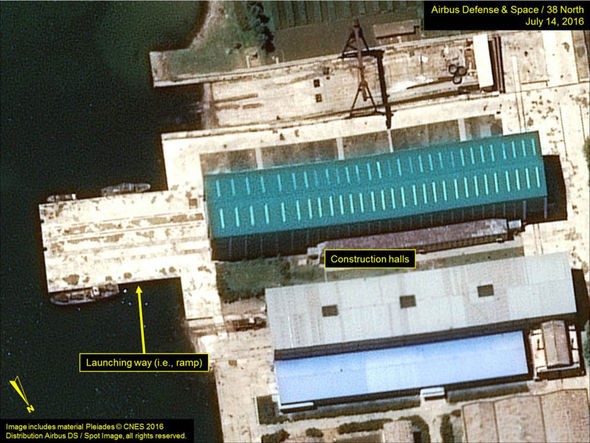
Now analysis of the Sinpo South Shipyard, on the country’s eastern coast, shows that the North Korean navy is clearing a huge harbour and has put up a massive new construction hall.

Experts at 38 North, a program at the US-Korea Institute, have examined satellite imagery which shows the true extent of the secretive country’s ambitious naval plans.


At the moment North Korea has a single small, outdated Gorae-class submarine which is neither large nor technologically advanced enough to launch nuclear missiles.

But the analysts warned: “The status of work inside the hall remains unclear, but when it is finished North Korea will be able

But the analysts warned: “The status of work inside the hall remains unclear, but when it is finished North Korea will be able to build and launch new submarines much larger than the existing Gorae-class, including a new class of ballistic missile submarines.” More here from ExpressUK.

NoKO sub base NoKo submarine base

North Korea: U.S. has crossed red line; relations on war footing

PYONGYANG, North Korea (AP) — North Korea’s top diplomat for U.S. affairs told The Associated Press on Thursday that Washington “crossed the red line” and effectively declared war by putting leader Kim Jong-un on its list of sanctioned individuals, and said a vicious showdown could erupt if the U.S. and South Korea hold annual war games as planned next month.

Han Song Ryol, director-general of the U.S. affairs department at the North’s Foreign Ministry, said in an interview that recent U.S. actions have put the situation on the Korean Peninsula on a war footing.

The United States and South Korea regularly conduct joint military exercises south of the Demilitarized Zone, and Pyongyang typically responds to them with tough talk and threats of retaliation.

Han said North Korea believes the nature of the maneuvers has become openly aggressive because they reportedly now include training designed to prepare troops for the invasion of the North’s capital and “decapitation strikes” aimed at killing its top leadership.

Han says designating Kim himself for sanctions was the final straw. “The Obama administration went so far to have the impudence to challenge the supreme dignity of the DPRK in order to get rid of its unfavorable position during the political and military showdown with the DPRK,” Han said, using the acronym for North Korea’s official name, the Democratic People’s Republic of Korea.

“The United States has crossed the red-line in our showdown”, he said. “We regard this thrice cursed crime as a declaration of war.” declaration of war.”

Although North Korea had already been heavily sanctioned internationally for its nuclear weapons and long-range missile development programs, Washington’s announcement on July 6 was the first time Kim Jong Un has been personally sanctioned.

Less than a week later, Pyongyang cut off its final official means of communications with Washington — known as the New York channel. Han said Pyongyang has made it clear that everything between the two must now be dealt with under “war law.” More here from the WashingtonTimes.

*****

WASHINGTON – A US policy institute said it may have located a secret facility used by North Korea in the early stages of building its program to enrich uranium for nuclear weapons, which if confirmed would be critical to the success of any future nuclear deal, according to a report seen by Reuters on Thursday.

The report by the Institute for Science and International Security said there has always been doubt about whether North Korea has disclosed all of its nuclear facilities. Confirming their location would be critical to the success of any future agreement to freeze and dismantle North Korea’s nuclear weapons program, it said.

The site, 27 miles (43 km) from the nuclear complex at Yongbyon, may have played a key role in development of centrifuges that refine uranium hexafluoride gas into low-enriched and highly enriched uranium, the report said.

“It is necessary to identify where North Korea enriches uranium and part of that is understanding where it has done it in the past,” said David Albright, the institute’s president.

What may once have been the early centrifuge research and development facility is believed to have been inside an aircraft parts factory inside a mountain next to Panghyon Air Base. It was located using commercial satellite imagery, the report said.

It was unclear whether the aircraft parts factory was still operational but information from defectors indicates there may be three production-scale centrifuge manufacturing plants operating in the country although their locations have not been confirmed, said Albright.

Tensions have been escalating between North Korea and South Korea, the United States and Japan over Pyongyang’s fourth underground nuclear test in January and a series of missile launches.

North Korea’s nuclear program is based on highly enriched uranium and plutonium separated from spent reactor fuel rods.

The reclusive government, which for more than a decade denied having a gas centrifuge program, in November 2010 revealed the existence of a production-scale gas centrifuge plant at Yongbyon but insisted it had no other such facilities.

In June 2000, a Japanese newspaper quoted Chinese sources as saying a facility was located inside Mount Chonma, the report said. Information recently obtained from “knowledgeable government officials” suggested the undeclared facility was associated with an underground aircraft parts factory, it said.

Working with Allsource Analysis, which interprets satellite imagery, the institute determined it most likely was Panghyon Aircraft Plant, which made parts for Soviet-supplied fighters.

The report quoted an unidentified official as saying the site could have held between 200 and 300 centrifuges. More details here.

Another Terror Attack in Germany, Risks in USA

Al Qaeda chief urges kidnappings of Westerners for prisoner swaps

Al Qaeda chief Ayman al-Zawahiri has appeared in an audio interview calling on fighters to take Western hostages and exchange them for jailed jihadists, the monitoring service SITE Intelligence Group said on Sunday.

In recording posted online, Al-Zawahiri called on the global militant network to kidnap Westerners “until they liberate the last Muslim male prisoner and last Muslim female prisoner in the prisons of the Crusaders, apostates, and enemies of Islam,” according to SITE. More here from Reuters.

******

A 21-year-old Syrian refugee was arrested on Sunday after killing a pregnant woman with a machete in Germany, the fourth violent assault on civilians in western Europe in 10 days, though police said it did not appear linked to terrorism.

The incident, however, may add to public unease surrounding Chancellor Angela Merkel’s open-door refugee policy that has seen over a million migrants enter Germany over the past year, many fleeing war in Afghanistan, Syria and Iraq.

German police said they arrested the machete-wielding Syrian asylum-seeker after he killed a woman and injured two other people in the southwestern city of Reutlingen near Stuttgart. Much more here from Newsweek.

*****

Related reading on NGO’s: UNHCR – Partnership in Resettlement

Related reading: UNHCR –NGO Toolkit for Practical Cooperation on …

Related reading: NGOs Call on US to Resettle More Syrian Refugees | Al …

So what about the real vetting process in the United States you ask…..it is a great question.

After the Paris attacks, the White House called in 34 governors to discuss the policy and vetting process of refugees into the United States. While we focus on ‘Syrian’ refugees, they hardly make up the majority and it is this fact that must be noted. Even so, the White House, 3 days later published a chart of the vetting program and it does have some gaps (questions) that too must be answered.

‎Refugees undergo more rigorous screening than anyone else we allow into the United States. Here’s what the screening process looks like for them:

The Screening Process for Refugees Entry Into the United States (full text of the graphic written below the image)

The full text is found here from the White House.

The admission of refugees to the United States and their resettlement here are authorized by the Immigration and Nationality Act (INA), as amended by the Refugee Act of 1980. The INA defines a refugee as a person who is outside his or her country and who is unable or unwilling to return because of persecution or a well-founded fear of persecution on account of race, religion, nationality, membership in a particular social group, or political opinion. In special circumstances, a refugee also may be a person who is within his or her country and who is persecuted or has a well-founded fear of persecution on account of race, religion, nationality, membership in a particular social group, or political opinion. The maximum annual number of refugee admissions (refugee ceiling) and the allocation of these numbers by region of the world are set by the President after consultation by Cabinet-level representatives with members of the House and the Senate Judiciary Committees.

The Department of State’s (DOS’s) Bureau of Population, Refugees, and Migration (PRM) is responsible for coordinating and managing the U.S. Refugee Admissions Program. Prospective refugees can be referred to the U.S. program by the United Nations High Commissioner for Refugees (UNHCR), a U.S. embassy, or a designated nongovernmental organization (NGO), or in some cases, they can access the U.S. refugee program directly. PRM generally arranges for an NGO, an international organization, or U.S. embassy contractors to manage a Resettlement Support Center (RSC) that assists in refugee processing.

Following the consultations, the President issues a Presidential Determination that sets the refugee ceiling and regional allocations for that fiscal year. Once the Presidential Determination for a fiscal year has been issued, INA Section 207 also allows for additional refugee admissions in response to an “emergency refugee situation.” In such a situation, the President may, after congressional consultation, issue an Emergency Presidential Determination providing for an increase in refugee admissions numbers.

For FY2016, the Obama Administration initially proposed a refugee ceiling of 75,000 and held consultations with Congress on that proposal. The proposal reportedly included an allocation of 33,000 for the Near East/South Asia, the region that includes Syria.5 The Administration subsequently announced that the United States would admit at least 10,000 Syrian refugees in FY2016. On September 29, 2015, the Obama Administration released the Presidential Determination on Refugee Admissions for Fiscal Year 2016.6 It sets the FY2016 refugee ceiling at 85,000, with 79,000 admissions numbers allocated among the regions of the world and 6,000 admissions numbers comprising an unallocated reserve.7 The allocation for the Near East/South Asia region is 34,000.

Actual Admissions

In FY2015, the United States admitted 69,933 refugees. The Near East/South Asia region accounted for 24,579 admissions, of which 1,682 were Syrian refugees. In the first month of FY2016 (October 2015), total refugee admissions were 5,348, Near East/South Asia region admissions were 1,979, and Syrian admissions were 187. From October 1, 2010, through October 31, 2015, the United States admitted a total of 2,070 Syrian refugees.

Role of the Department of Homeland Security

USCIS adjudicates refugee applications and makes decisions about eligibility for refugee status. USCIS officers in the Refugee Corps interview each applicant in person and consider other evidence and information to determine whether the individual is eligible for refugee status. More comprehensive reading here.


Hey Obama, Kerry, Rhodes, Explain this Secret on Iran Deal

Related reading: Flying Above the Radar, Sanctions Evasion in the Iranian Aviation Sector

Related reading: Banking & Money Laundering Risk

Iranian financial institutions remain locked out of the U.S. financial system, and therefore cut off from much of the global financial system. International banks have been hit with $14 billion in fines since 2009 for violating U.S. sanctions on Iran. The U.S. continues to designate the entire Iranian financial sector as a jurisdiction of primary money laundering concern under Section 311 of the USA PATRIOT Act and the 2012 National Defense Authorization Act.

****

Iran urged to avoid further ballistic missile launches, to preserve deal July 18, 2016

Iran has been urged not to carry out further ballistic missile tests, which might be deemed inconsistent with the “constructive spirit” of the nuclear deal struck with world powers a year ago.

The call came from UN Under Secretary-General Jeffrey Feltman, briefing the Security Council on the implementation of the resolution which endorsed the so-called Joint Comprehensive Plan of Action (JCPOA).

AP Exclusive: Confidential text eases Iran nuke constraints

VIENNA (AP) — Key restrictions on Iran’s nuclear program imposed under an internationally negotiated deal will start to ease years before the 15-year accord expires, advancing Tehran’s ability to build a bomb even before the end the pact, according to a document obtained Monday by The Associated Press.

The document is the only text linked to last year’s deal between Iran and six foreign powers that hasn’t been made public, although U.S. officials say members of Congress have been able to see it. It was given to the AP by a diplomat whose work has focused on Iran’s nuclear program for more than a decade, and its authenticity was confirmed by another diplomat who possesses the same document.

The diplomat who shared the document with the AP described it as an add-on agreement to the nuclear deal. But while formally separate from that accord, he said that it was in effect an integral part of the deal and had been approved both by Iran and the U.S., Russia, China, Britain, France and Germany, the six powers that negotiated the deal with Tehran.

Details published earlier outline most restraints on Iran’s nuclear program meant to reduce the threat that Tehran will turn nuclear activities it says are peaceful to making weapons.

But while some of the constraints extend for 15 years, documents in the public domain are short on details of what happens with Iran’s most proliferation-prone nuclear activity – its uranium enrichment – beyond the first 10 years of the agreement.

The document obtained by the AP fills in the gap. It says that as of January 2027 – 11 years after the deal was implemented – Iran can start replacing its mainstay centrifuges with thousands of advanced machines.

Centrifuges churn out uranium to levels that can range from use as reactor fuel and for medical and research purposes to much higher levels for the core of a nuclear warhead. From year 11 to 13, says the document, Iran can install centrifuges up to five times as efficient as the 5,060 machines it is now restricted to using.

Those new models will number less than those being used now, ranging between 2,500 and 3,500, depending on their efficiency, according to the document. But because they are more effective, they will allow Iran to enrich at more than twice the rate it is doing now.

The U.S. says the Iran nuclear agreement is tailored to ensure that Iran would need at least 12 months to “break out” and make enough weapons grade uranium for at least one weapon.

But based on a comparison of outputs between the old and newer machines, if the enrichment rate doubles, that breakout time would be reduced to six months, or even less if the efficiency is more than double, a possibility the document allows for.

The document also allows Iran to greatly expand its work with centrifuges that are even more advanced, including large-scale testing in preparation for the deal’s expiry 15 years after its implementation on Jan. 18.

A U.S. official noted, however, that the limit on the amount of enriched uranium Iran will be allowed to store will remain at 300 kilograms (660 pounds) for the full 15 years, significantly below the amount needed for a bomb. As well, it will remain restricted to a level used for reactor fuel that is well below weapons grade. Like the diplomats, the official demanded anonymity in exchange for discussing the document.

“We have ensured that Iran’s breakout time comes down gradually after year 10 in large part because of restrictions on its uranium stockpile until year 15,” the official said. “As for breakout times after the initial 10 years of the deal, the breakout time does not go off a cliff nor do we believe that it would be immediately cut in half, to six months.”

Still the easing of restrictions on the number and kind of centrifuges means that once the deal expires, Tehran will be positioned to quickly make enough highly enriched uranium to bring up its stockpile to a level that would allow it to make a bomb in half a year, should it choose to do so.

The document doesn’t say what happens with enrichment past year 13. That indicates a possible end to all restrictions on the number and kind of centrifuges even while constraints on other, less-proliferation prone nuclear activities remain until year 15.

Iran insists it is not interested in nuclear weapons, and the pact is being closely monitored by the International Atomic Energy Agency. The IAEA says Tehran has essentially kept to its commitments since the agreement was implemented, a little more than six months after Iran and the six powers finalized it on July 14, 2015.

Marking the agreement’s anniversary Thursday, President Barack Obama said it has succeeded in rolling back Iran’s nuclear program, “avoiding further conflict and making us safer.” But opposition from U.S. Republicans could increase with the revelation that Iran’s potential breakout time would be more than halved over the last few years of the pact.

Also opposed is Israel, which in the past has threatened to strike Iran if it deems that Tehran is close to making a nuclear weapon. Alluding to that possibility, David Albright, whose Washington-based Institute for Science and International Security is a U.S. government go-to resource on Iran’s nuclear program, said the plan outlined in the document “will create a great deal of instability and possibly even lead to war, if regional tensions have not subsided.”

The deal provides Iran with sanctions relief in exchange for its nuclear constraints. But before going into recess, U.S. Congress last week approved a bill to impose new sanctions for Tehran’s continuing development and testing of ballistic missiles, a program the White House says is meant to carry atomic warheads even if it is not part of the nuclear agreement.

It also approved a measure that calls for prohibiting the Obama administration from buying more of Iran’s heavy water, a key component in certain nuclear reactors.

The White House has said removing the country’s surplus heavy water denies Tehran access to a material that may be stored for potential nuclear weapons production. But critics note that the purchase was made only after Iran exceeded heavy water limits proscribed by the nuclear deal and assert it rewarded Tehran for violating the agreement.

U.S. Puts Former Gitmo Detainee on Terror List, Istanbul Attack

What has he been doing since his release 10 years ago? Planning and recruiting for the Istanbul airport terror attack? And Obama released 3 detainees in 2 days and more to come. What about those ‘forever’ detainees like Khalid Sheik Mohammed? Hummmm

Ex-Gitmo detainee, Islamic State’s leader in Chechnya designated by State Department

The State Department announced today that two jihadists have been added to the US government’s list of designated terrorists.

One of the two, Ayrat Nasimovich Vakhitov, was once detained at Guantanamo and was recently arrested by Turkish authorities. According to Voice of America, Vakhitov is “among 30 people Turkish authorities say they have arrested in connection with” the terrorist attack at Istanbul’s Ataturk airport late last month. No terrorist organization has claimed responsibility for the assault on the airport, which left more than 40 people dead. But it is widely suspected to be the work of the Islamic State.

The second newly-designated terrorist is Aslan Avgazarovich Byutukaev, who leads the jihadists in Chechnya who are loyal to the Islamic State’s so-called Caucasus province.

Former Guantanamo Detainee

Screen Shot 2016-07-13 at 12.26.28 PM

Vakhitov (pictured on the right) was held at Guantanamo for less than two years, from June 2002 until February 2004. He was then transferred to Russia. The State Department’s designation page does not say that Vakhitov was once detained at the American facility in Cuba, but The Long War Journal has confirmed that he is the same individual.

The details of his story, as recounted in a leaked Joint Task Force – Guantanamo (JTF-GTMO) threat assessment, are somewhat odd. Vakhitov was “arrested by the Taliban on suspicion of espionage, and incarcerated at the Sarpuza prison complex in Kandahar,” the leaked file reads. He was apparently transferred to Guantanamo because of “his possible knowledge of an American citizen killed” at that same prison “while he was there.”

JTF-GTMO ultimately concluded that Vakhitov was neither affiliated with al Qaeda, nor a Taliban leader. He was recommended for transfer. But JTF-GTMO also thought he would be remain imprisoned inside Russia.

“Because of the Russian government’s agreement to incarcerate this detainee upon his transfer, and provided that he remains incarcerated under the control of the Russian government, the detainee poses no future threat to the U.S. or its allies,” JTF-GTMO’s threat assessment reads.

The State Department says that Vakhitov “is associated with Jaysh al-Muhajirin Wal Ansar” (JMWA, or “the Army of the Emigrants and Helpers”). Part of the original JMWA organization joined the Islamic State, while the rest of the organization continued to operate independently before swearing allegiance to Al Nusrah Front in Sept. 2015. Al Nusrah is al Qaeda’s official branch in Syria and the Islamic State’s rival.

The State Department’s designation page does not mention Vakhitov’s reported arrest in Turkey, but does say he has “used the internet to recruit militants to travel to Syria.”

Islamic State leader in Chechnya

The State Department note Byutukaev was a “prominent leader” in the Islamic Caucasus Emirate (ICE). ICE is openly loyal to al Qaeda, but has suffered a string of defections to the Islamic State.

Russian security forces killed ICE’s top emir and his two successors in less than two years time, from late 2013 until mid-2015. The decapitation strikes likely helped the Islamic State win the loyalty of some of ICE’s most important remaining commanders, including Byutukaev.

Byutukaev, also known as Emir Khamzat, was a close confidant of Dokku Umarov and led ICE’s Riyad-us-Saliheen Martyr Brigade. But Umarov perished sometime in late 2013 or early 2014. His replacement, Aliaskhab Kebekov, more commonly known as Ali Abu Muhammad al Dagestani, was subsequently killed by Russian forces in April 2015.

Less than two months after Kebekov’s demise, Byutukaev officially broke with ICE, declaring himself to be one of Baghdadi’s men.

The pro-al Qaeda contingent in the Caucasus then suffered another blow when Abu Usman, Kebekov’s successor, was hunted down in August 2015. Both Kebekov and Abu Usman were vocal opponents of Abu Bakr al Baghdadi’s Islamic State, so much so that al Qaeda’s main propaganda arm continues to feature clips of their anti-Baghdadi lectures in its productions.

High value targeting, as it is commonly called, is an essential part of any government’s counterterrorism strategy. But it can lead to unintended consequences as well. In this instance, the deaths of ICE’s top leaders probably helped drive Byutukaev and his comrades into the Islamic State’s arms. The large contingent of fighters from the Caucasus region in the Islamic State’s ranks in Iraq and Syria most likely added to the pressure on the jihadists back home to flip as well.

The State Department notes that Byutukaev is “responsible for directing numerous deadly suicide bombing operations, including the January 2011 attack at the crowded international arrivals hall of Moscow’s Domodedovo Airport.” The bombing killed at least 35 people and wounded more than 100 others.

Umarov, who was ICE’s emir at the time, quickly claimed credit for the airport attack in a video released online.

Doku-Riyah-video-Kavkaz

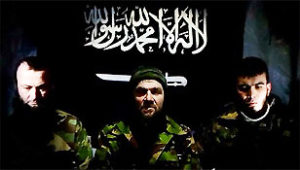
Umarov also appeared in another video alongside Byutukaev (seen on the left in the photo included here) and a suicide bomber identified only as “Saifullah.” Umarov said that he had visited the Riyad-us-Saliheen Martyr Brigade’s base before sending Saifullah on a “special operation,” meaning the bombing at Domodedovo.

At the end of video, both Umarov and Byutukaev were shown embracing Saifullah. [See LWJ report, Caucasus Emirate leader threatens Russia with ‘a year of blood and tears.’]

“Since becoming an ISIL [Islamic State in Iraq and the Levant] leader in June 2015,” State reports, “Byutukaev has planned attacks on behalf of the group.” One of these operations took place in November 2015, when “Russian Special Forces discovered a large bomb hidden on the side of the road in Kantyshevo, Ingushetiya, Russia.”

The Caucasus “province” was announced in June 2015, after Islamic State spokesman Abu Muhammad al Adnani publicly accepted the oaths of allegiance sworn by jihadists throughout the region. The Caucasus branch is reportedly led by Rustam Asilderov, a former ICE leader who defected to the Islamic State in late 2014. Asilderov’s defection set off a firestorm of controversy and bickering among the Caucasus jihadists.

In Sept. 2015, Foggy Bottom designated the Islamic State’s Caucasus “province” as a terrorist organization and also identified other ICE defectors who had joined its cause.

Thomas Joscelyn is a Senior Fellow at the Foundation for Defense of Democracies and the Senior Editor for The Long War Journal.

*****

Aiat Nasimovich Vahitov, also spelled Ayrat Wakhitov or Vahidov (Tatar Cyrillic: Айрат Вахитов, Latin: Ayrat Waxitov) is an ethnic Tatar citizen of Russia who was held in extrajudicial detention in the United States Guantanamo Bay detention camp, in Cuba.[1] He was repatriated with six other Russians in February 2004. Fluent in Arabic, Pashto, Persian, Urdu and Russian, he also spoke basic English.[2]

On May 15, 2006 the Department of Defense released its first full official list of all the Guantanamo detainees who were held in military custody.[3] Airat Vakhitov’s name is not on that list. The list includes an individual named Aiat Nasimovich Vahitov.who was born on March 27, 1977, on Naberezhnye Chelny, Tatarstan, Russia.

Russian authorities released the detainees after investigations into whether they had broken any Russian laws.

Vakhitov spoke publicly on June 28, 2005 about torture in Guantanamo when he announced he was planning to sue the United States for his mistreatment.[4] He was invited, by Amnesty International, to speak about Guantanamo torture, in London, on November 2, 2002.

Geydar Dzhemal, chairman of the Islamic Committee of Russia, reported that he was hosting Vakhitov, and another former Guantanamo detainee, Rustam Akhmyarov, following threats by security officials.[5] According to Dzhemal the security officials had visited Vakhitov, and warned him that he should only talk about torture in Guantanamo Bay, not Russian torture. Dzhemal reported that security officials subsequently seized Vakhitov and Akhmyarov from his apartment on August 29, 2005. He called their seizure a kidnapping because they refused to show their identification. He predicted that the pair would be arrested on trumped up charges, to curtail their human rights activities.

The pair were released from detention on September 2, 2005  More details here.