The Empire State Building a New Taliban Home?

Remember when Obama released the top 5 Taliban commanders from Gitmo in exchange for Bowe Bergdahl? Qatar became their new home where they were allowed to move freely.

Sure the headline is a stretch…or is it?

As recently as last year, Qatar was hosting peace talks with the Taliban while today, the Taliban holds more territory in Afghanistan than any other time in history. As a reminder, it was and is the Taliban that protects al Qaeda factions going back to the attacks on America on 9/11.


One more fact: How Qatar is funding the rise of Islamist extremists

The fabulously wealthy Gulf state, which owns an array of London landmarks and claims to be one of our best friends in the Middle East, is a prime sponsor of violent Islamists

So, American icons such as the Empire State Building is in the ownership of a terror state? Cary Grant and Deborah Kerr are rolling in their graves with disgust.

 <– His son graduated from West Point and Obama was there the same weekend that the Gitmo prisoner swap happened with Bergdahl.

VOA: Qatar’s sovereign wealth fund has made an iconic purchase in America — a stake in the company that owns New York’s Empire State Building.

The $622-million purchase by the Qatar Investment Authority comes as the Doha fund increases its investments in the U.S. as the small country on the Arabian Peninsula tries to cope with low global oil and gas prices.

The Empire State Realty Trust Inc., which manages the 102-story, 1,454-foot (443-meter) -tall building, announced the Qatari purchase late Tuesday, saying the fund would gain a 9.9-percent stake in the company. The trust owns a total of 14 office properties and six retail properties around the New York area.

The Qatar Investment Authority did not respond to a request for comment Wednesday.

The pointed top of the Art Deco-style Empire State Building, once the tallest structure in the world, still stands out in New York’s famed skyline. It remains a major tourist attraction and has been the centerpiece of major American films from “King Kong” to “Sleepless in Seattle.”

Tiny Qatar, an OPEC member, is a strong regional ally for Washington and hosts American bombers and the forward headquarters of the U.S. military’s Central Command at its vast al-Udeid air base. Aircraft and personnel there are involved in the ongoing U.S.-led campaign against the Islamic State group in Iraq and Syria.

Qatar will host the 2022 FIFA World Cup and has been on a building boom, mirroring on a smaller scale the one that gripped the United Arab Emirates’ city-state of Dubai. However, its government coffers have been hard hit by the drop of global oil prices, which have fallen from over $100 a barrel in the summer of 2014 to around $50 now.

The nation’s investment authority, estimated to be worth some $335 billion by the Las Vegas-based Sovereign Wealth Fund Institute, has been increasingly eyeing opportunities in the U.S. Last September, it announced plans to open an office in New York and committed to investing $35 billion in the U.S. over the next five years.

Related reading: Qatar Investment Authority allocates $2bn to Russian fund

The fund’s existing American holdings include a more than 10-percent stake in New York-based luxury jeweler Tiffany & Co. It sold its share of the American film studio Miramax to Qatar-based media group beIN in March for an undisclosed sum.

Government-backed Qatar Airways, meanwhile, has been rapidly expanding its operations in the U.S., provoking a backlash from American carriers.

Also among the Qatari fund’s interests in America is a 44-percent stake in the $8.6 billion redevelopment project in New York known as Manhattan West, which includes remodeling the building that’s now home to the global headquarters of The Associated Press. The AP announced in August 2015 it planned to move from that building to another near the World Trade Center.

AP’s Report on Access to Hillary After the Checks Cashed

Hillary’s top people are calling this comprehensive report by Associated Press cherry-picking. Given the vast list of names, organizations and timeline, it is hardly cherry-picking. Hat tip to AP.

We cant know at this point the wider implications when it comes to government money authorized and spent via the State Department and other agencies as a result of requests from donors and collusion stemming from the Clinton Foundation and policy coming out of the White House and the State Department. Another question is how much was known by the White House and approved?

Foreign governments, organizations and leaders knew and know what we have not, in order to get a meeting or a phone call, just write a check first. No wonder we are hated due to RICO and yet we fret over Davos and the Bilderbergers. Sheesh….We fret over the money that went into the Foundation(s) but not much if at all is reported about charity distributions.

WASHINGTON (AP) — More than half the people outside the government who met with Hillary Clinton while she was secretary of state gave money — either personally or through companies or groups — to the Clinton Foundation. It’s an extraordinary proportion indicating her possible ethics challenges if elected president.

At least 85 of 154 people from private interests who met or had phone conversations scheduled with Clinton while she led the State Department donated to her family charity or pledged commitments to its international programs, according to a review of State Department calendars released so far to The Associated Press. Combined, the 85 donors contributed as much as $156 million. At least 40 donated more than $100,000 each, and 20 gave more than $1 million.

Donors who were granted time with Clinton included an internationally known economist who asked for her help as the Bangladesh government pressured him to resign from a nonprofit bank he ran; a Wall Street executive who sought Clinton’s help with a visa problem; and Estee Lauder executives who were listed as meeting with Clinton while her department worked with the firm’s corporate charity to counter gender-based violence in South Africa.

The meetings between the Democratic presidential nominee and foundation donors do not appear to violate legal agreements Clinton and former president Bill Clinton signed before she joined the State Department in 2009. But the frequency of the overlaps shows the intermingling of access and donations, and fuels perceptions that giving the foundation money was a price of admission for face time with Clinton. Her calendars and emails released as recently as this week describe scores of contacts she and her top aides had with foundation donors.

The AP’s findings represent the first systematic effort to calculate the scope of the intersecting interests of Clinton Foundation donors and people who met personally with Clinton or spoke to her by phone about their needs.

The 154 did not include U.S. federal employees or foreign government representatives. Clinton met with representatives of at least 16 foreign governments that donated as much as $170 million to the Clinton charity, but they were not included in AP’s calculations because such meetings would presumably have been part of her diplomatic duties.

Clinton’s campaign said the AP analysis was flawed because it did not include in its calculations meetings with foreign diplomats or U.S. government officials, and the meetings AP examined covered only the first half of Clinton’s tenure as secretary of state.

“It is outrageous to misrepresent Secretary Clinton’s basis for meeting with these individuals,” spokesman Brian Fallon said. He called it “a distorted portrayal of how often she crossed paths with individuals connected to charitable donations to the Clinton Foundation.”

Republican presidential nominee Donald Trump fiercely criticized the links between the Clinton Foundation and the State Department, saying his general election opponent had delivered “lie after lie after lie.”

“Hillary Clinton is totally unfit to hold public office,” he said at a rally Tuesday night in Austin, Texas. “It is impossible to figure out where the Clinton Foundation ends and the State Department begins. It is now abundantly clear that the Clintons set up a business to profit from public office.”

Last week, the Clinton Foundation moved to head off ethics concerns about future donations by announcing changes planned if Clinton is elected.

On Monday, Bill Clinton said in a statement that if his wife were to win, he would step down from the foundation’s board and stop all fundraising for it. The foundation would also accept donations only from U.S. citizens and what it described as independent philanthropies, while no longer taking gifts from foreign groups, U.S. companies or corporate charities. Clinton said the foundation would no longer hold annual meetings of its international aid program, the Clinton Global Initiative, and it would spin off its foreign-based programs to other charities.

Those planned changes would not affect more than 6,000 donors who have already provided the Clinton charity with more than $2 billion in funding since its creation in 2000.

“There’s a lot of potential conflicts and a lot of potential problems,” said Douglas White, an expert on nonprofits who previously directed Columbia University’s graduate fundraising management program. “The point is, she can’t just walk away from these 6,000 donors.”

Former senior White House ethics officials said a Clinton administration would have to take careful steps to ensure that past foundation donors would not have the same access as she allowed at the State Department.

“If Secretary Clinton puts the right people in and she’s tough about it and has the right procedures in place and sends a message consistent with a strong commitment to ethics, it can be done,” said Norman L. Eisen, who was President Barack Obama’s top ethics counsel and later worked for Clinton as ambassador to the Czech Republic.

Eisen, now a governance studies fellow at the Brookings Institution, said that at a minimum, Clinton should retain the Obama administration’s current ethics commitments and oversight, which include lobbying restrictions and other rules. Richard Painter, a former ethics adviser to President George W. Bush and currently a University of Minnesota law school professor, said Bill, Hillary and Chelsea Clinton should remove themselves completely from foundation leadership roles, but he added that potential conflicts would shadow any policy decision affecting past donors.

Fallon did not respond to the AP’s questions about Clinton transition plans regarding ethics, but said in a statement the standard set by the Clinton Foundation’s ethics restrictions was “unprecedented, even if it may never satisfy some critics.”

State Department officials have said they are not aware of any agency actions influenced by the Clinton Foundation. State Department spokesman Mark Toner said Tuesday night that there are no prohibitions against agency contacts with “political campaigns, nonprofits or foundations — including the Clinton Foundation.” He added that “meeting requests, recommendations and proposals come to the department through a variety of channels, both formal and informal.”

Some of Clinton’s most influential visitors donated millions to the Clinton Foundation and to her and her husband’s political coffers. They are among scores of Clinton visitors and phone contacts in her official calendar turned over by the State Department to AP last year and in more-detailed planning schedules that so far have covered about half her four-year tenure. The AP sought Clinton’s calendar and schedules three years ago, but delays led the AP to sue the State Department last year in federal court for those materials and other records.

S. Daniel Abraham, whose name also was included in emails released by the State Department as part of another lawsuit, is a Clinton fundraising bundler who was listed in Clinton’s planners for eight meetings with her at various times. A billionaire behind the Slim-Fast diet and founder of the Center for Middle East Peace, Abraham told the AP last year his talks with Clinton concerned Mideast issues.

Big Clinton Foundation donors with no history of political giving to the Clintons also met or talked by phone with Hillary Clinton and top aides, AP’s review showed.

Muhammad Yunus, a Bangladeshi economist who won the 2006 Nobel Peace Prize for pioneering low-interest “microcredit” for poor business owners, met with Clinton three times and talked with her by phone during a period when Bangladeshi government authorities investigated his oversight of a nonprofit bank and ultimately pressured him to resign from the bank’s board. Throughout the process, he pleaded for help in messages routed to Clinton, and she ordered aides to find ways to assist him.

American affiliates of his nonprofit Grameen Bank had been working with the Clinton Foundation’s Clinton Global Initiative programs as early as 2005, pledging millions of dollars in microloans for the poor. Grameen America, the bank’s nonprofit U.S. flagship, which Yunus chairs, has given between $100,000 and $250,000 to the foundation — a figure that bank spokeswoman Becky Asch said reflects the institution’s annual fees to attend CGI meetings. Another Grameen arm chaired by Yunus, Grameen Research, has donated between $25,000 and $50,000.

As a U.S. senator from New York, Clinton, as well as then-Massachusetts Sen. John Kerry and two other senators in 2007 sponsored a bill to award a congressional gold medal to Yunus. He got one but not until 2010, a year after Obama awarded him a Presidential Medal of Freedom.

Yunus first met with Clinton in Washington in April 2009. That was followed six months later by an announcement by USAID, the State Department’s foreign aid arm, that it was partnering with the Grameen Foundation, a nonprofit charity run by Yunus, in a $162 million commitment to extend its microfinance concept abroad. USAID also began providing loans and grants to the Grameen Foundation, totaling $2.2 million over Clinton’s tenure.

By September 2009, Yunus began complaining to Clinton’s top aides about what he perceived as poor treatment by Bangladesh’s government. His bank was accused of financial mismanagement of Norwegian government aid money — a charge that Norway later dismissed as baseless. But Yunus told Melanne Verveer, a long-time Clinton aide who was an ambassador-at-large for global women’s issues, that Bangladesh officials refused to meet with him and asked the State Department for help in pressing his case.

“Please see if the issues of Grameen Bank can be raised in a friendly way,” he asked Verveer. Yunus sent “regards to H” and cited an upcoming Clinton Global Initiative event he planned to attend.

Clinton ordered an aide: “Give to EAP rep,” referring the problem to the agency’s top east Asia expert.

Yunus continued writing to Verveer as pressure mounted on his bank. In December 2010, responding to a news report that Bangladesh’s prime minister was urging an investigation of Grameen Bank, Clinton told Verveer that she wanted to discuss the matter with her East Asia expert “ASAP.”

Clinton called Yunus in March 2011 after the Bangladesh government opened an inquiry into his oversight of Grameen Bank. Yunus had told Verveer by email that “the situation does not allow me to leave the country.” By mid-May, the Bangladesh government had forced Yunus to step down from the bank’s board. Yunus sent Clinton a copy of his resignation letter. In a separate note to Verveer, Clinton wrote: “Sad indeed.”

Clinton met with Yunus a second time in Washington in August 2011 and again in the Bangladesh capital of Dhaka in May 2012. Clinton’s arrival in Bangladesh came after Bangladesh authorities moved to seize control of Grameen Bank’s effort to find new leaders. Speaking to a town hall audience, Clinton warned the Bangladesh government that “we do not want to see any action taken that would in any way undermine or interfere in the operations of the Grameen Bank.”

Grameen America’s Asch referred other questions about Yunus to his office, but he had not responded by Tuesday.

In another case, Clinton was host at a September 2009 breakfast meeting at the New York Stock Exchange that listed Blackstone Group chairman Stephen Schwarzman as one of the attendees. Schwarzman’s firm is a major Clinton Foundation donor, but he personally donates heavily to GOP candidates and causes. One day after the breakfast, according to Clinton emails, the State Department was working on a visa issue at Schwarzman’s request. In December that same year, Schwarzman’s wife, Christine, sat at Clinton’s table during the Kennedy Center Honors. Clinton also introduced Schwarzman, then chairman of the Kennedy Center, before he spoke.

Blackstone donated between $250,000 and $500,000 to the Clinton Foundation. Eight Blackstone executives also gave between $375,000 and $800,000 to the foundation. And Blackstone’s charitable arm has pledged millions of dollars in commitments to three Clinton Global aid projects ranging from the U.S. to the Mideast. Blackstone officials did not make Schwarzman available for comment.

Clinton also met in June 2011 with Nancy Mahon of the MAC AIDS, the charitable arm of MAC Cosmetics, which is owned by Estee Lauder. The meeting occurred before an announcement about a State Department partnership to raise money to finance AIDS education and prevention. The public-private partnership was formed to fight gender-based violence in South Africa, the State Department said at the time.

The MAC AIDS fund donated between $5 million and $10 million to the Clinton Foundation. In 2008, Mahon and the MAC AIDS fund made a three-year unspecified commitment to the Clinton Global Initiative. That same year, the fund partnered with two other organizations to beef up a USAID program in Malawi and Ghana. And in 2011, the fund was one of eight organizations to pledge a total of $2 million over a three-year period to help girls in southern Africa. The fund has not made a commitment to CGI since 2011.

Estee Lauder executive Fabrizio Freda also met with Clinton at the same Wall Street event attended by Schwarzman. Later that month, Freda was on a list of attendees for a meeting between Clinton and a U.S.-China trade group. Estee Lauder has given between $100,000 and $250,000 to the Clinton Foundation. The company made a commitment to CGI in 2013 with four other organizations to help survivors of sexual slavery in Cambodia.

MAC AIDS officials did not make Mahon available to AP for comment.

When Clinton appeared before the U.S. Senate in early 2009 for her confirmation hearing as secretary of state, then- Sen. Richard Lugar, a Republican from Indiana, questioned her at length about the foundation and potential conflicts of interest. His concerns were focused on foreign government donations, mostly to CGI. Lugar wanted more transparency than was ultimately agreed upon between the foundation and Obama’s transition team.

Now, Lugar hopes Hillary and Bill Clinton make a clean break from the foundation.

“The Clintons, as they approach the presidency, if they are successful, will have to work with their attorneys to make certain that rules of the road are drawn up to give confidence to them and the American public that there will not be favoritism,” Lugar said.

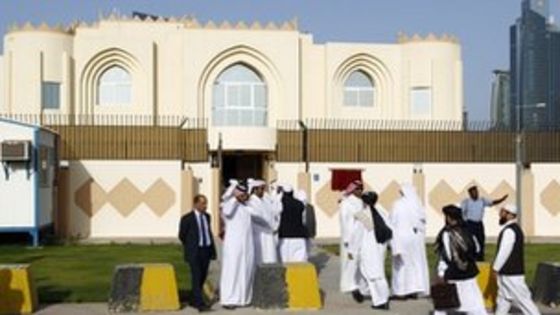
The Clinton’s History with Iran and Cuba and Latin America

Posted earlier on this site, Iran’s Cuba and Latin American Tours and Trouble Ahead forced a deeper examination of the Iran, Cuba and Latin America relationship. As Iran is now at least $1.7 billion dollars richer, larger questions develop on Iran’s global expansion. Being in our hemisphere and right in the backyard of America some chilling conditions emerge.

Reported in 2010, Cuba has expressed support for Iran’s nuclear program and has defended Iran’s right to peaceful nuclear technology in the face of UN sanctions. Cuban President Raul Castro also serves as the Secretary-General of the Non-Aligned Movement, which released a statement in July 2008 declaring that its member states “welcomed the continuing cooperation being extended by the Islamic Republic of Iran to the IAEA” and “reaffirmed that states’ choices and decisions, including those of the Islamic Republic of Iran, in the field of peaceful uses of nuclear technology and its fuel cycle policies must be respected.”[1]

In late November 2009, the IAEA passed a rebuke of Iran for building a second enrichment plan in secret.[2] Cuba, along with Venezuela and Malaysia, opposed the resolution.[3] The resolution by the 35-member IAEA Board of Governors calls on Iran to halt uranium enrichment and immediately freeze the construction of its Fordo nuclear facility, located near Qom.[4]  Cuba and Iran cooperate bilaterally and multilaterally through the Non-Aligned Movement. In a June 2008 memorandum of understanding, Iranian President Ahmadinejad explained that the two countries expressed their continued support for “each other on the international scene.” [17]  In September 2008, Iran began funding medical students from the Solomon Islands to study in Cuba, including airfare and computers for medical students unable to finance their own way to Havana to study.[18]  More here.

Related reading: It’s time to start worrying about what Russia’s been up to in Latin America

There is a long and nefarious history between the United States and Cuba but we don’t have to go back much further than the Clinton administration. Seems with enough money to the Clinton’s or to the Democrat National Committee, lots of things can be overlooked.

****

THREAT TO THE HOMELAND

Iran’s Extending Influence in the Western Hemisphere

Iran not only continues to expand its presence in and bilateral relationships with countries like Cuba, Ecuador, Nicaragua, and Venezuela, but it also maintains a network of intelligence agents specifically tasked with sponsoring and executing terrorist attacks in the western hemisphere. True, the unclassified annex to a recent State Department report on Iranian activity in the western hemisphere downplayed Iran’s activities in the region; this material, however, appeared in an introductory section of the annex that listed the author’s self-described “assumptions.” While one assumption noted that “Iranian interest in Latin America is of concern,” another stated that as a result of U.S. and allied efforts “Iranian influence in Latin America and the Caribbean is waning.” More here from the Washington Institute.

Back in 1996, seems the Clintons were doing then what they are doing today, hanging with criminals that donate.

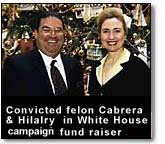
WASHINGTON DESK – The Justice Department released on Wednesday photographs showing a convicted Miami cocaine trafficer who is seen standing next to and posing with vice president Al Gore. The two were attending a party in Florida last December.

Apparently, Cabrera was asked to make a large donation to the Clinton-Gore campaign in exchange for perks like hob-nobbing with Al Gore and the first lady, Hillary Rodham Clinton.

Jorge Cabrera’s cash contributions to the Clinton-Gore campaign were so generous, that Cabrera was also invited to the White House and gained entrance there without any FBI & Secret Service security clearance.

CNN reported Wednesday that Cabrera’s attorney, Stephen Bronis, said $20,000(given to the Clinton-Gore campaign) was not intended to buy protection for drug smuggling.
‘He had a lobster and stone crab fishery in the Keys and felt that contribution might promote that future course,’ Bronis said.

The Clinton-Gore campaign only returned the $20,000 last week after the full story had reached ABC News, and the Clinton administration had been asked for comment by the media.

Cabrera was arrested in January during a Miami drug bust of nearly three tons of cocaine. Cabrera was arrested and pleaded guilty to one drug count. He was also imprisoned in the 1980s on narcotics charges.

A report that the picture of Cabrera and Gore had been impounded by the Justice Department prompted an angry reaction from Republicans, including Bob Dole’s presidential campaign, House Speaker Newt Gingrich and Rep. Bob Livingston of Louisiana, chairman of the House Appropriations Committee.

Republicans sent letters to Attorney General Janet Reno and the directors of the FBI and the Secret Service seeking information about Cabrera and the campaign contribution.

Livingston asked the federal agencies for a complete accounting of the facts relating to the story within three days: whether Cabrera had dined at the White House, details of his relationship with Clinton and Gore and, if he did dine with them, how he passed FBI & Secret Service scrutiny to gain access to them.

The U.S. attorney’s office in Miami was contacted by reporters. Justice said it would not provide photographs of Cabrera and Gore in Florida and at the White House when reporters requested them on Monday. The Justice Department attempted to claim that Cabrera’s story is coverd by the Privacy Act law in turning down the media request for information on the arrest for cocaine possession of tons of the illegat drug and dealing.

Jant Reno put out information that the photo of Cabrera with Gore and Clinton could not be released without the consent of Cabrera. Later, the Justice Department did release the photographs after Cabrera submitted written authorization.

The delay by the Justice Department appeared to be an effort to distance itself from accusations that are mounting from the American public that the Justice Department is receiving guidance from the Clinton White House and the vice president’s office on the timing of Janet Reno’s investigation.

Justice says it is looking into the breach of National Security by Cabrera’s ready access to secured areas of the White House and its grounds when he entered as an invited quest of president Clinton for dinner and photo-ops.

Then much more recently, like February of 2016, Hillary was busy nurturing the pro-Iran lobby including a fund-raiser.

Clinton will participate in a Menlo Park fundraiser on Sunday hosted by Twitter executive Omid Kordestani and his wife Gisel Hiscock, as well as National Iranian American Council (NIAC) board member Lily Sarafan and Noosheen Hashemi, who serves on the board of the pro-Iran advocacy group Ploughshares, a major funder of pro-Iran efforts.

NIAC, an advocacy group formed by Iranian-Americans to work against the pro-Israel community, has long been accused of lobbying on Iran’s behalf against sanctions and other measures that could harm the Islamic Republic’s interest.

Ploughshares, which partners with NIAC, is joining the White House in efforts to pressure the Jewish community and others to back the recently implemented Iran nuclear agreement, the Free Beacon reported.

The organization has also spent millions to influence coverage of Iran and protect the Obama administration’s diplomatic relations with Iran.

NIAC has emerged a key pro-Iran player in the United States, working with the White House and liberal groups to spin the deal as a positive for U.S. national security.

The group is currently leading the charge to block recent counter-terrorism legislation that would require individuals who have travelled to Iran to obtain a visa before entering the United States. More from FreeBeacon.

Alright so we have established historical relationships with Cuba and Iran and the Clintons. Is there more that we should know? Yes.

  1. Cuban spies in America
  2. The DEA did it’s job but Bill Clinton remained loyal to the Castro brothers
  3. Hillary’s personal global spy, Sidney Blumenthal collaborated on Hezbollah’s new office in Cuba.
  4. In 2011, Hillary’s State Department sent their old friend Bill Richardson to Cuba to bring back an American, Alan Gross, who was an embedded spy working for USAID.
  5. In 2009, Obama and Hillary began the normalization process with Cuba.
  6. Bill Clinton’s old buddy Strobe Talbott collaborated on Cuba with Hillary’s State Department.
  7. Hillary announced that Iran would be invited to an upcoming  multinational conference on Afghanistan
  8. Documents reveal Bill Clinton’s secret contact with Iran
  9. Sid Blumenthal, Jake Sullivan and Hillary on Iran and Israel

How and When the $1.7 Billion was Paid to Iran, Database Item

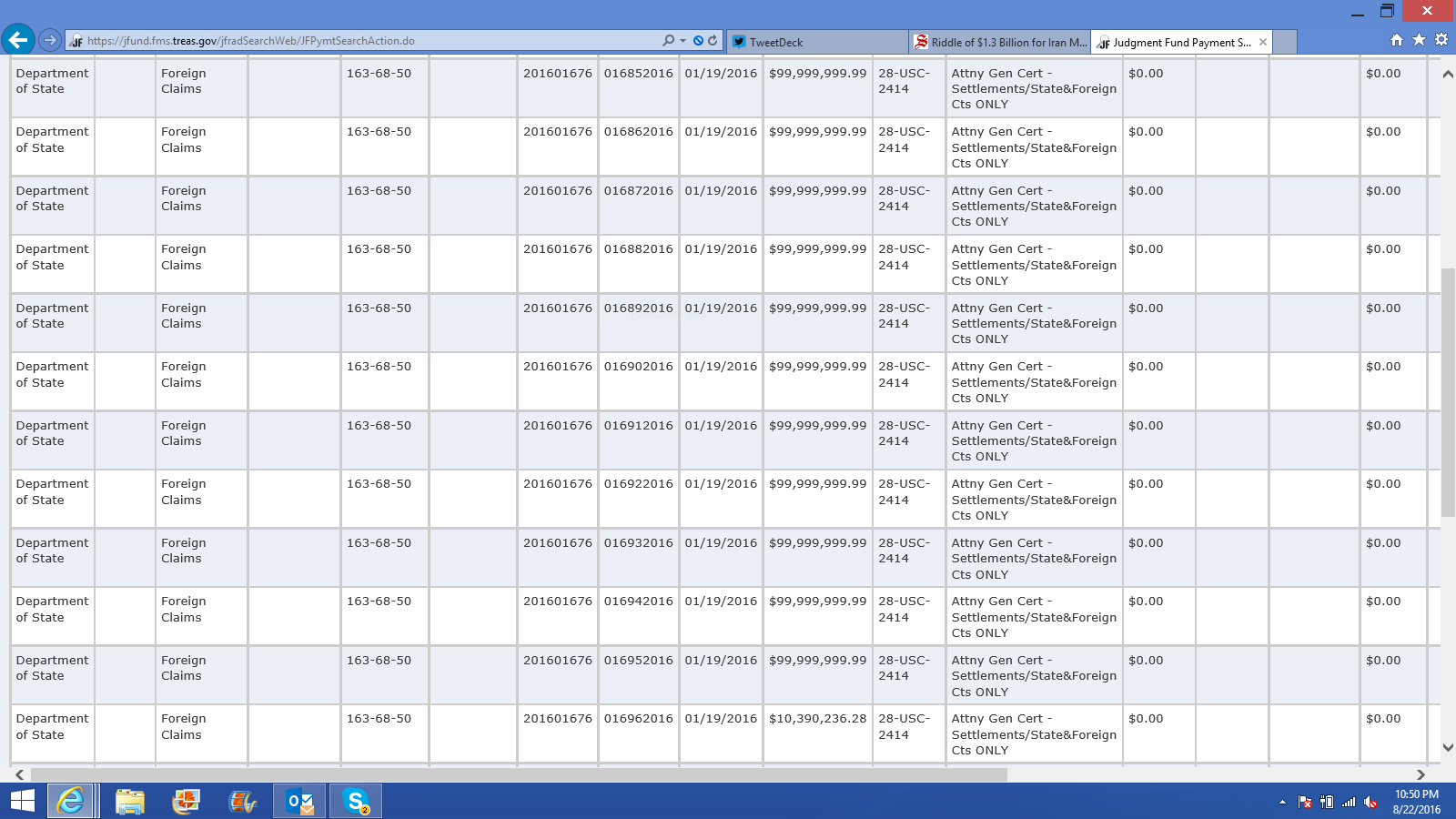
Note the date and this money was assigned to the State Department Account in the graphic (screen-shot below the text)

Riddle of $1.3 Billion for Iran Might Relate to 13 Outlays Of Exactly $99,999,999.99

NYSun: Congressional investigators trying to uncover the trail of $1.3 billion in payments to Iran might want to focus on 13 large, identical sums that Treasury paid to the State Department under the generic heading of settling “Foreign Claims.”

The 13 payments when added to the $400 million that the administration now concedes it shipped to the Iranian regime in foreign cash would bring the payout to the $1.7 billion that President Obama and Secretary Kerry announced on January 17. That total was to settle a dispute pending for decades before the Iran-U.S. Claims Tribunal in at The Hague.

Related reading: $400M is but One Payment to Iran, from a 1996 Legal Case

Mr. Kerry told the press at the time that the settlement included $400 million that Iran under the Shah had paid into a U.S. trust fund for an arms deal that collapsed after Iran’s 1979 Islamic revolution. Plus, said Kerry, the U.S. had agreed to pay “a roughly $1.3 billion compromise on the interest.”

The Wall Street Journal’s Jay Solomon and Carole E. Lee broke earlier this month the news that on the same day that Mr. Obama announced the settlement, his administration secretly sent Iran the $400 million payment in cash. Last week, the State Department finally confirmed that the January 17 cash shipment was used as “leverage” to ensure Iran’s release that same day of four American prisoners — fueling questions about whether the Obama administration, despite its denials, had paid ransom.

Yet more questions surround the administration’s handling of the remaining $1.3 billion. Could this have been drawn from a fund bankrolled by American taxpayers and housed at Treasury, called the Judgment Fund? And why were the 13 payments in amounts of one cent less than $100,000,000?

The Judgment Fund has long been a controversial vehicle for federal agencies to detour past one of the most pointed prohibitions in the Constitution: “No Money shall be drawn from the Treasury, but in Consequence of Appropriations made by Law.”

The Judgment Fund, according to a Treasury Department Web site, is “a permanent, indefinite appropriation” used to pay monetary awards against U.S. government agencies in cases “where funds are not legally available to pay the award from the agency’s own appropriations.”

In March, in letters responding to questions about the Iran settlement sent weeks earlier by Representatives Edward Royce and Mike Pompeo, the State Department confirmed that the $1.3 billion “interest” portion of the Iran settlement had been paid out of the Judgment Fund. But State gave no information on the logistics.

The 13 payments that may explain what happened are found in an online database maintained by the Judgment Fund. A search for “Iran” since the beginning of this year turns up nothing. But a search for claims in which the defendant is the State Department turns up 13 payments for $99,999,999.99.

Description: https://ssl.gstatic.com/ui/v1/icons/mail/images/cleardot.gif

They were all made on the same day, all sharing the same file and control reference numbers, all certified by the U.S. Attorney General, but each assigned a different identification number. They add up to $1,299,999,999.87, or 13 cents less than the $1.3 billion Messrs. Clinton and Kerry announced in January.

Together with a 14th payment of just over $10 million, the grand total paid out by Treasury from the Judgment Fund on that single day, January 19, for claims pertaining to the State Department, comes to roughly $1.31 billion.

Treasury has provided no answers to my queries about whether these specific payments were for the Iran settlement. Nor why these transfers comprised 13 payments, each of which was a cent under $100,000,000. Nor whether the $10 million related to the same matter.

The Judgment Fund database contains over the past year no other payouts pertaining to State that come anywhere near the scale of $1.3 billion of the announced with Iran. And it contains no details on what the State Department might have done with the $1.3 billion.

It does say, as a general matter, that “Defendant Agency Name is the same as the Responsible Agency Name.” It leaves open the question of whether it was State rather than Treasury that determined by what route and in what form the funds would reach their final destination.

State has refused to disclose even such basic information as the date on which Iran took receipt of the $1.3 billion. As recently as August 4, a State spokesman told the press: “I don’t have a date of when that took place.”

Nor has the administration answered whether the $1.3 billion was transferred to Iran via the banking system, or, like the $400 million, in cash. According to the Judgment Fund web site, the “preferred method” for payments is “by electronic fund transfer,” approved by the relevant government agency, to the party receiving the award.

But, the Weekly Standard noted last week, President Obama recently defended his $400 million cash shipment to Iran on the grounds that “We don’t have a banking relationship with Iran… We could not wire the money.”

The Judgment Fund’s public database provides no information about where precisely the $1.31 billion in January payments went, or how. The Fund’s web site does provide blank “Voucher for Payment” forms, requiring administration officials to provide such details, and sign off on them.

These payouts from the Judgment Fund were made within days of the announcement of the Iran settlement. The Judgment Fund’s web site states that while its bureaucracy has recently become more efficient, “processing times” for payments still take “6 to 8 weeks.”

If the multiple 10-digit payments of January 19 do turn out to be connected to the Iran settlement announced January 17, that would suggest that the Judgment Fund completed its processing for Iran in a mere two days one of which — Monday, January 18 — was a federal holiday.

Ms. Rosett, a Foreign Policy Fellow with the Independent Women’s Forum, a columnist of Forbes and a blogger for PJMedia, is a contributing editor of The New York Sun.

Ransom to Iran

Yup, Even More on Hillary EmailGate

Oh…a housekeeping matter, check this out also:

“It’s time for the U.S. to start thinking of Iraq as a business opportunity.” – Hillary Clinton

Hillary Clinton has been outed by her right-hand lady, Huma Abedin. Emails from the assistant have revealed Clinton Foundation donors received special access to the State Department. Judicial Watch has published the documents. Check out just how bad this is.

Judicial Watch today released 725 pages of new State Department documents, including previously unreleased email exchanges in which former Hillary Clinton’s top aide Huma Abedin provided influential Clinton Foundation donors special, expedited access to the secretary of state. In many instances, the preferential treatment provided to donors was at the specific request of Clinton Foundation executive Douglas Band.

The new documents included 20 Hillary Clinton email exchanges not previously turned over to the State Department, bringing the known total to date to 191 of new Clinton emails (not part of the 55,000 pages of emails that Clinton turned over to the State Department).  These records further appear to contradict statements by Clinton that, “as far as she knew,” all of her government emails were turned over to the State Department.

The Abedin emails reveal that the longtime Clinton aide apparently served as a conduit between Clinton Foundation donors and Hillary Clinton while Clinton served as secretary of state. In more than a dozen email exchanges, Abedin provided expedited, direct access to Clinton for donors who had contributed from $25,000 to $10 million to the Clinton Foundation. In many instances, Clinton Foundation top executive Doug Band, who worked with the Foundation throughout Hillary Clinton’s tenure at State, coordinated closely with Abedin. In Abedin’s June deposition to Judicial Watch, she conceded that part of her job at the State Department was taking care of “Clinton family matters.”

Included among the Abedin-Band emails is an exchange revealing that when Crown Prince Salman of Bahrain requested a meeting with Secretary of State Clinton, he was forced to go through the Clinton Foundation for an appointment. Abedin advised Band that when she went through “normal channels” at State, Clinton declined to meet. After Band intervened, however, the meeting was set up within forty-eight hours. According to the Clinton Foundation website, in 2005, Salman committed to establishing the Crown Prince’s International Scholarship Program (CPISP) for the Clinton Global Initiative. And by 2010, it had contributed $32 million to CGI. The Kingdom of Bahrain reportedly gave between $50,000 and $100,000 to the Clinton Foundation. And Bahrain Petroleum also gave an additional $25,000 to $50,000.

From: Doug Band

To: Huma Abedin

Sent: Tue Jun 23 1:29:42 2009

Subject:

Cp of Bahrain in tomorrow to Friday

Asking to see her

Good friend of ours

From: Huma Abedin

To: Doug Band

Sent: Tue Jun 23 4:12:46 2009

Subject: Re:

He asked to see hrc thurs and fri thru normal channels. I asked and she said she doesn’t want to commit to anything for thurs or fri until she knows how she will feel. Also she says that she may want to go to ny and doesn’t want to be committed to stuff in ny…

From: Huma Abedin [Huma@clintonemail.com]

Sent: Thursday, June 25, 2009 10:35:15 AM

To: Doug Band

Subject:

Offering Bahrain cp 10 tomorrow for meeting woith [sic] hrc

If u see him, let him know

We have reached out thru official channels

Also included among the Abedin-Band emails is an exchange in which Band urged Abedin to get the Clinton State Department to intervene in order to obtain a visa for members of the Wolverhampton (UK) Football Club, one of whose members was apparently having difficulty because of a “criminal charge.” Band was acting at the behest of millionaire Hollywood sports entertainment executive and President of the Wasserman Foundation Casey Wasserman. Wasserman has donated between $5 million and $10 million to the Clinton Foundation through the Wasserman Foundation.

From: Tim Hoy [VP Wasserman Media Group]

Date: Tue. 5 May 2009 10:45:55 – 0700

To: Casey Wasserman

Subject: [Redacted] Wolverhampton FC/visa matter

Casey: Paul Martin’s [popular English footballer] client [Redacted] needs to get an expedited appointment at the US Embassy in London this week and we have hit some road blocks. I am writing to ask for your help.

The Wolverhampton FC is coming to Las Vegas this Thursday for a “celebration break.” [Redacted] so he cannot get a visa to the US without first being “interviewed” in the visa section of the US Embassy in London …

I contacted Senator Boxer’s office in SF for help … They balked at the criminal charge and said they “couldn’t help.”

I’m now trying to get help from Sherrod Brown’s office but that’s not going well either. So do you have any ideas/contacts that could contact the US Embassy in London and ask that they see [Redacted] tomorrow?

From: Casey Wasserman

To: Doug Band; Trista Schroeder [Wasserman Media Group executive]

Sent: Tue May 05 2:23:50 2009 [PT]

Subject: FW [Redacted] Wolverhampton FC/visa matter

Can you help with the below [Hoy email], or maybe Huma??? I am copying trista as I am on the plane in case I lose connection … thx.

From: Doug Band

Sent: Tue May 05 7:08:21 2009 [ET]

To: Casey Wasserman; Trista Schroeder

Subject: Re: [Redacted] Wolverhampton FC/visa matter

Will email her.

From: Doug Band

To: Huma Abedin

Sent: Tue May 5 7:26:49 2009

Subject: Fw: [Redacted] Wolverhampton FC/visa matter

[As per subject line, Band apparently forwarded Abedin material sent to him by Casey.]

From: Huma Abedin [Huma@clintonemail.com]

Sent: Tuesday, May 05, 2009 7:39:38 PM

To: Doug Band

Subject: Re: [Redacted] Wolverhampton FC/visa matter

I doubt we can do anything but maybe we can help with an interview. I’ll ask.

From: Huma Abedin

To: Doug Band

Sent: Tue May 05 5:50:09 2009

Subject: Re: [Redacted] Wolverhampton FC/visa matter

I got this now, makes me nervous to get involved but I’ll ask.

From: Doug Band

To: Huma Abedin

Sent: Tuesday, May 05, 2009 7:43:30 PM

Subject:  Re: [Redacted] Wolverhampton FC/visa matter

Then don’t

The Abedin emails also reveal that Slimfast tycoon S. Daniel Abraham was granted almost immediate access to then-Secretary of State Clinton, with Abedin serving as the facilitator. According to the Clinton Foundation website, Abraham, like the Wasserman Foundation, has given between $5 million and $10 million to the Clinton Foundation. The emails indicate that Abraham was granted almost immediate access to Clinton upon request:

From: Huma Abedin

To: H

Sent: Mon May 04 4:40:34 2009

Subject: Danny

Danny abraham called this morning. He is in dc today and tomorrow and asked for 15 min with you. Do u want me to try and fit him in tomorrow?

From: H

To Huma Abedin

Sent: Mon May 04 5:14:00 2009

Subject: Re: Danny

Will the plane wait if I can’t get there before 7-8?

From: Huma Abedin

Sent: Monday, May 04, 2009 5:15:30 PM

Subject: Re: Danny

Yes of course

Additional Abedin emails in which the top Clinton aide intervenes with the State Department on behalf of Clinton Foundation donors include the following:

  • On Friday, June 26, 2009, Clinton confidant Kevin O’Keefe wrote to Clinton saying that “Kevin Conlon is trying to set up a meeting with you and a major client.” Clinton wrote to Abedin, “Can you help deliver these for Kevin?” Abedin responded, “I’ll look into it asap” Kevin O’Keefe donated between $10,000 and $25,000 to the Clinton Foundation. Kevin Conlon is a Clinton presidential campaign “Hillblazer”who has raised more than $100,000 for the candidate.
  • On Tuesday, June 16, 2009, Ben Ringel wrote to Abedin, “I’m on shuttle w Avigdor Liberman. I called u back yesterday. I want to stop by to see hrc tonite for 10 mins.” Ringel donated between $10,000 and $25,000 to the Clinton Foundation.
  • On Monday, July 6, 2009, Maureen White wrote to Abedin, “I am going to be in DC on Thursday. Would she have any time to spare?” Abedin responded, “Yes I’ll make it work.” White donated $75,000 to the Clinton Foundation.
  • In June 2009, prominent St. Louis political power broker Joyce Aboussie exchanged a series of insistent emails with Abedin concerning Aboussie’s efforts to set up a meeting between Clinton and Peabody Energy VP Cartan Sumner. Aboussie wrote, “Huma, I need your help now to intervene please. We need this meeting with Secretary Clinton, who has been there now for nearly six months. This is, by the way, my first request. I really would appreciate your help on this. It should go without saying that the Peabody folks came to Dick [Gephardt] and I because of our relationship with the Clinton’s.” After further notes from Aboussie, Abedin responded, “We are working on it and I hope we can make something work… we have to work through the beauracracy [sic] here.” Aboussie donated between $100,000 and $250,000 to the Clinton Foundation.
  • On Saturday, May 16, 2009, mobile communications executive and political activist Jill Iscol wrote to Clinton, “Please advise to whom I should forward Jacqueline Novogratz’s request [for a meeting with the secretary of state]. I know you know her, but honestly, she is so far ahead of the curve and brilliant I believe she could be enormously helpful to your work.” Clinton subsequently sent an email to Abedin saying, “Pls print.” Jill and husband Ken Iscol donated between $500,000 and $1 million to the Clinton Foundation. Clinton subsequently appointed Novogratz to the State Department’s Foreign Affairs Policy Board.

So who is Doug Band? Per his own website:

Douglas J. Band Douglas J. Band

President, Teneo Holdings

Douglas J. Band is a co-founder and President of Teneo.

Mr. Band began working in the White House in 1995, serving in the White House Counsel’s office for four years and later in the Oval Office as the President’s Aide. In 1999, he was appointed by President Clinton as a Special Assistant to the President before he was made one of the youngest Deputy Assistants ever to serve a President.

Mr. Band served as President Clinton’s chief advisor from 2002 until 2012, advising him as the Counselor to the President, and was the key architect of Clinton’s post-Presidency. He created and built the Clinton Global Initiative, which to date, has raised $69 billion for 2,100 philanthropic initiatives around the world and impacted over 400 million people in 180 countries. On March 1, 2012, President Clinton said of Doug: “I couldn’t have achieved half of what I have in my post-presidency without Doug Band. Doug is my Counselor and a board member of the Clinton Global Initiative, which was created at his suggestion. He tirelessly works to support the expansion of CGI’s activities and my other foundation work around the world. In our first ten years, Doug’s strategic vision and fund-raising made it possible for the foundation to survive and thrive. I hope and believe he will continue to advise me and build CGI for another decade.”

Mr. Band has traveled to 125 countries and to over 2,000 cities. In the Summer of 2009, he traveled to North Korea with President Clinton to orchestrate and secure the release of two American journalists.

Additionally, he has been involved in other negotiations to free and help Americans held around the world. He has assisted in the rebuilding of nations and regions after some of the worst natural disasters in the past two decades, including New Orleans, Haiti, Southeast Asia, and Gujarat, India.

Mr. Band has advised several heads of state, governors and mayors transition out of public office into private life. He was part of the negotiation team that handled all aspects of Hillary Clinton’s becoming Secretary of State. He continues to serve his country in assisting various domestic agencies and advising foreign governments on nation-building, infrastructure creation and democratic governance structure.

Doug Band graduated from the University of Florida in 1995 and while working at the White House for six years, he simultaneously obtained a masters and a law degree from Georgetown University by attending both programs in the evenings.

Doug lives in New York City with his wife Lily and their three children, Max (5), Sophie (4) and Elle (2).