The Larger Covert Actions by Soros, Access, Policy, Chaos

Go here for communications regarding the United StatesGo here for global actions by Soros.
The manipulation is epic as is his influence on policy, money and mandates. His access to powerbrokers can never fully be known or understood. Bottom-line is chaos. Below should help.


Russia v. Ukraine Real Conflict Coming?

For Putin, it is all financial and likely to flush out NATO operations if possible.

**** 

BusinessInsider: Ukraine says it thinks Vladimir Putin is planning a new invasion, and it’s not hard to see why: the Russian leader has built up troops on its border and resumed the hostile rhetoric that preceded his annexation of Crimea two years ago.

But despite appearances, some experts say Putin is more likely seeking advantage through diplomacy than on the battlefield, at least this time around.

“It’s about sanctions,” Andrey Kortunov, director general of the Russian International Affairs Council, a Moscow-based foreign policy think tank close to the Russian Foreign Ministry, told Reuters.

“It looks like a way of increasing pressure on Western participants of the Minsk peace process,” he said of a peace deal set up for eastern Ukraine, where pro-Russian separatists have battled against government forces.

For two years, Russia has been under U.S. and EU sanctions over its annexation of Crimea and support for the separatists in eastern Ukraine. European leaders say the sanctions cannot be lifted unless the Minsk peace deal is implemented, but for now it looks moribund, with fighting occasionally flaring and both sides blaming each other for failing to implement truce terms. More here.

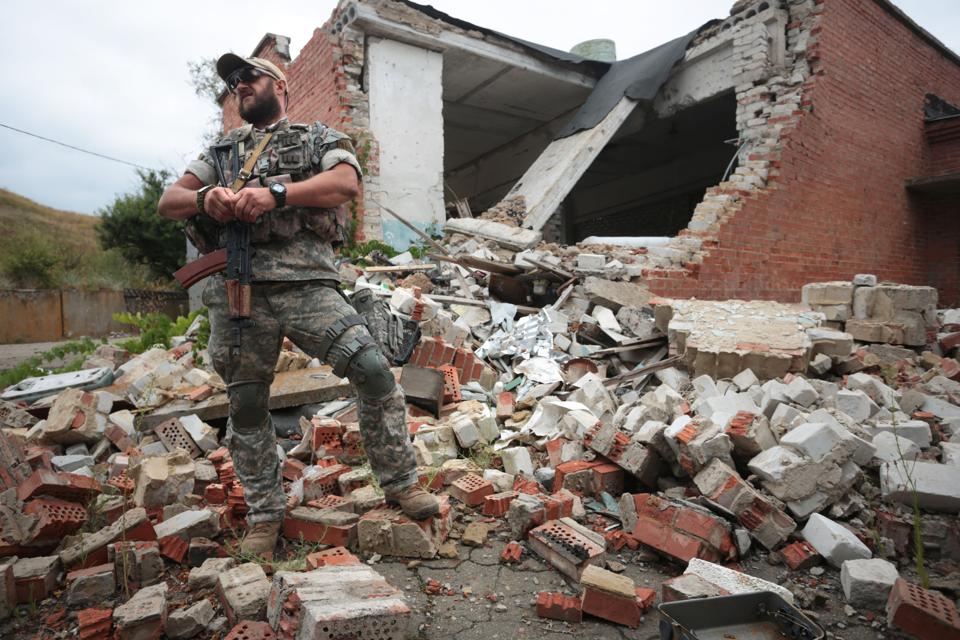
A Ukrainian paratrooper walks among the ruins of building destroyed by pro-Russian separatists shelling on August 14, 2016. Pro-Russian rebels allegedly have ramped up their shelling of one key village: the once quiet coastal resort village of Shyrokyne in Donetsk has turned into one of the bloodiest battlefields of the 27-month separatist revolt. (Photo by ALEKSEY FILIPPOV/AFP/Getty Images)

Forbes: The fog of war has become a Russian specialty.  Did they invade Ukraine? Did they not? Did Crimeans vote for secession on their own volition? Did they not? In any event, the market seems to be ignoring the recent escalation of tensions between Ukraine and Russia. Tensions do not bode well for sanctions removal, even though it seems pretty certain to everyone that a Hillary Clinton presidency will keep sanctions in place come January.

The latest fiasco: a border skirmish in Crimea with Ukrainian forces led to the death of two Russian soldiers.

Nevertheless, the skirmish may not have even happened. The New York Times reported Monday from Moscow that Ukraine denied the killing of two soldiers. The official word from Kiev is that the Kremlin invented the story to escalate tensions in order to whip up nationalist passions ahead of parliamentary elections in September. A Russian television report documenting the arrest of a couple of Ukrainian commandos in Crimea included shots of a full moon at dusk, though the moon was waning on the date of the alleged incident, the Times reported. The shot may have been stock footage, however.

And while all this tit-for-tat was going on, the Market Vectors Russia (RSX) fund rose 2.27%, two times more than the MSCI Emerging Markets Index.

The jury is out as to why this is happening in Crimea. One theory is that Ukraine was the instigator. Ukraine has a strong, even existential, interest in ensuring that the U.S. continues to provide support. To this end, it is advantageous for Ukraine to paint Putin and Russia as bad guys, an increasingly easy task.

Pro-Russia political analyst Sergei Markov even says U.S. intelligence agencies and the Hillary Clinton campaign itself were behind it in order to make pro-Russia Republican Donald Trump look to be supportive of a rogue nation.

“An escalation of tensions between Russia and Ukraine would be highly expedient for Hillary Clinton, who has repeatedly issued sharp-worded, aggressive statements against Putin and Russia,” he was quoted as saying by the Khodorkovsky Center’s editorial writers on Monday.

RSX sold off only a tad late after market hours on Monday.

Why would Vladimir Putin want to cause more trouble in Ukraine than he already has? His United Russia party has very little opposition. His approval rating remains high. But a little bit of Russian firepower, especially where Russia is looked at as being picked on by Western back forces, plays well with United Russia fans.

Putin has state Duma elections coming up and he may take the view that both Europe and the U.S. are too weak to seriously punish him beyond extending sanctions, which is a given if in a Clinton presidency.

Putin may also take the view that a foreign policy distraction is a good pretext for a bit of political housecleaning at

home, explaining the exit of long-standing supporter, Chief of Staff Sergei Ivanov, notes Jan Dehn, head of research for emerging market investment firm Ashmore in London.

As for the investment implications, Russia’s ability and willingness to pay its debts to foreign banks remain solid. If bond spreads should blow out materially, buyers are likely to outweigh sellers in a rather short period of time. This happened back in November of 2014 when the central bank changed its currency trading band and raised interest rates three times in less than a month. Spreads were over 900 basis points over Treasurys. The Russian bond lords were the first to pile in.

That made Russia one of the best bond trades in the world and stood as evidence that the market has faith in Russia debt, at least. It will get paid. It actually yields. Holy lord…

Meanwhile, the Russian economy is turning a corner and investors are hoping to see GDP crack zero this year. Year on year growth rates were -0.6% in the second quarter from -1.2% in the first. Inflation is stabilizing but not enough yet for a rate cut. So long as inflation doesn’t go the other way, the central bank will cut rates and that will be supportive of equities.

The only thing to pull the rug out of Russia would be oil heading to the $30s again. It’s not unlikely. But it’s definitely not consensus.

What is Life in Aleppo After Siege is Broken?

Aleppo is an ancient metropolis, and one of the oldest continuously inhabited cities in the world; it has been inhabited since perhaps as early as the 6th millennium BC. The city’s significance in history has been its location at one end of the Silk Road, which passed through central Asia and Mesopotamia. When the Suez Canal was inaugurated in 1869, trade was diverted to sea and Aleppo began its slow decline. At the fall of the Ottoman Empire after World War I, Aleppo ceded its northern hinterland to modern Turkey, as well as the important railway connecting it to Mosul.


Rebel fighters break siege in southern Aleppo, sources say

But little has changed for the besieged residents of rebel-held eastern Aleppo neighborhoods, who have been enduring acute shortages of food and medicine, as the fighting remains too fierce for aid to be delivered, the UK-based Syrian Observatory for Human Rights and humanitarian workers operating in the area say.
 
Syrian state news agency SANA says that the rebels have not broken the siege of the city’s eastern neighborhoods. The agency reports that government troops had inflicted “heavy losses” on rebel groups in the fighting raging in the south and southwest of the city. More here from CNN.

Video here.

Aleppo Siege Broken 

A coalition of Rebel Forces Has broken the siege of Aleppo according to reports Rebels say they have breached the siege imposed by the Syrian government on opposition neighbourhoods in the northern city of Aleppo, in a major military breakthrough after intense fighting.

The Syrian Regime seized the only route into rebel-held areas in northern Aleppo last month, prompting a rebel counteroffensive from the city’s south.

Who in Govt is Whistleblowing on Immigration/Asylum Detention?

This event was hosted by Jones Day Law firm in Washington DC. The policies currently being applied by DHS, ICE and Customs and Border Patrol have officially been challenged as noted in this video of the The U.S. Commission on International Religious Freedom and Human Rights First hosted a discussion on removal and detention of refugees seeking asylum in the U.S.

See the video here. While the session was almost 4 hours, please take the time to listen to the first two panelists…that will explain their mission and the links below. Moving forward, you will be able to better understand Barack Obama’s presentation next month at the United Nations, Jeh Johnson’s position and that of presidential candidate Hillary Clinton. Note that at no time is there a discussion about creating conditions by which globally migrants, refugees, asylum seekers would not have to leave their home countries in the first place.

Note also that the real human rights violations are happening in home countries yet no country leadership be it Mexico, El Salvador, Honduras, Syria, Iraq or Sudan has been brought before any tribunal for violations or war crimes.

2015 Annual Report

The Office of International Religious Freedom has the mission of promoting religious freedom as a core objective of U.S. foreign policy. The office is headed by the Ambassador-at-Large for International Religious Freedom, David N. Saperstein. We monitor religious persecution and discrimination worldwide, recommend and implement policies in respective regions or countries, and develop programs to promote religious freedom.

Given the U.S. commitment to religious freedom, and to the international covenants that guarantee it as the inalienable right of every human being, the United States seeks to:

  • Promote freedom of religion and conscience throughout the world as a fundamental human right and as a source of stability for all countries;
  • Assist emerging democracies in implementing freedom of religion and conscience;
  • Assist religious and human rights NGOs in promoting religious freedom;
  • Identify and denounce regimes that are severe persecutors on the basis of religious belief.

The office carries out its mission through:

  • The Annual Report on International Religious Freedom. The report contains an introduction, executive summary, and a chapter describing the status of religious freedom in each of 195 countries throughout the world. Mandated by, and presented to, the U.S. Congress, the report is a public document available online and in book form from the U.S. Government Printing Office.
  • The designation by the Secretary of State (under authority delegated by the President) of nations guilty of particularly severe violations of religious freedom as “Countries of Particular Concern” under the International Religious Freedom Act of 1998 (H.R. 2431) and its amendment of 1999 (Public Law 106-55). Nations so designated are subject to further actions, including economic sanctions, by the United States.
  • Meetings with foreign government officials at all levels, as well as religious and human rights groups in the United States and abroad, to address problems of religious freedom.
  • Testimony before the United States Congress on issues of international religious freedom.
  • Close cooperation with the independent United States Commission on International Religious Freedom.
  • Sponsorship of reconciliation programs in disputes which divide groups along lines of religious identity. The office seeks to support NGOs that are promoting reconciliation in such disputes.
  • Programs of outreach to American religious communities.

Refugees Have Temporary Status in U.S. but not under DHS

The United States has been taking in refugees, migrants and asylees from Latin America and several dozen countries for decades. This is supposed to be a temporary condition but the truth is it has never been temporary.
Image result for manbij

Now with 45 million people from just 2015 displaced from their home countries around the world, there is a crisis that is hard to define much less solve. The United Nations is the lead organization that is under pressure to find solutions and world leaders are not in any kind of collective agreement. Meanwhile, there are people, mostly innocent that are suffering. This is a historical time, one that was in fact not only predictable but solvable if civil war, conflicts and terrorism was addressed long before it manifested.

At issue is the total cost of war where there is no end in sight but more, the cost of creating a viable and living long term solution for migrants to include education, healthcare, law enforcement, jobs, entitlements to list a few. No country is monetarily prepared for the future costs many yet to be known, studied or funded.

Related reading: Bodies found off coast of Libya as migrant toll climbs

The United States had every opportunity in 2011 to launch humanitarian action missions to offset refugee conditions especially as Islamic State was born, and predicted to become a global terror operation directly after Abu Musab al-Zarqawi was killed. He is the original father of Islamic State…al Qaeda in Iraq.

Image result for zarqawi

As a result of the long war in Iraq, Syria and Afghanistan, the complete damage to cities and towns where normal infrastructure has been destroyed, there is no viable location to go back to. There are no schools, hospitals, roads, buildings and commerce has stopped except for black markets and smuggling. Further, no countries are stepping up with funds to help rebuild or as many call it, nation building.

In summary, refugees are in fact a new permanent status for wherever they are located, including the United States.

Consequently, the United Nations is chartered with drafting a global solution with world leaders.

The first cut a the draft is found here.

In part from the NewYorkTimes: Refugees and migrants will be the biggest issue at the gathering of world leaders at the United Nations next month. President Obama plans to lead a meeting at the General Assembly in an effort to nudge countries to take in more refugees and contribute to countries that have taken them in for years.

The United Nations secretary general, Ban Ki-moon, also plans to hold a meeting on the plight of refugees and migrants. The document under negotiation will be the centerpiece of his meeting.

While the draft text has no force of international law, every sentence has been argued and negotiated. The resulting language is sometimes so vague that it is likely to bring little comfort to the millions of men, women and children who are seeking safety and opportunity abroad.

Eritrea, for instance, recently complained that the many references to human rights in the document were “redundant.” (A United Nations committee earlier this year accused Eritrea of atrocities against its own citizens.)

Russia resisted a sentence that called for countries to share in the “burden” of taking in refugees. (Russia takes in very few, except lately, from parts of Ukraine.)

The United States suggested a phrase asserting that detention is “seldom” good for children. Activists for immigrants and refugees found that suggestion so appalling that they fired off a letter on Friday to President Obama. They argued that any international agreement should make clear that detention is “never in the best interests of children” and should commit to ending the practice. (The United States detains children who arrive from Mexico without legal papers.)

Amnesty International said in a statement over the weekend that “with some states trying to dilute the agreement to suit their own political agendas, we may end up with tentative half-measures that merely reinforce the status quo or even weaken existing protection.”

This draft agreement sets out a long list of principles, most already enshrined in existing laws. It says refugees deserve protection and should not be sent back to places where they could face war or persecution. It urges countries to allow refugees to work and to let their children attend school, though it stops short of saying refugees have a right to either jobs or schools.

It asserts that migration can be good for the world, which is wording that migrant-sending countries wanted. It also calls for countries to take back their citizens if they travel illegally and fail to get asylum, which is what migrant-receiving countries, especially in Europe, wanted.

An early draft had proposed a global compact to allocate where refugees could be permanently resettled, but that proposal failed. African and Latin American countries wanted to know why the compact was on refugees alone, according to diplomats involved in the negotiations. Why not also have a compact on the rights of migrants, they asked.

The latest draft sets a 2018 deadline for two compacts — one for refugees, a second for migrants.

The draft text also says nothing about the rights of the 40 million people who are displaced in their own countries, or about those who are leaving their homes because of climate change.