
But John Kerry, Iran Does Support al Qaeda

Primer:

The State Department confirmed that Iran continues to work with Al-Qaeda elements, despite
their expressed hostility towards one another. It stated: “Iran remained unwilling to bring to
justice senior Al-Qaeda (AQ) members it continued to detain, and refused to publicly identify
those senior members in its custody.
Iran allowed AQ facilitators Muhsin al-Fadhli and Adel Radi Saq al-Wahabi al-Harbi to operate a
core facilitation pipeline through Iran, enabling AQ to move funds and fighters to South Asia and
also to Syria.

Al-Fadhli is a veteran AQ operative who has been active for years. Al-Fadhli began working with the Iran-based AQ facilitation network in 2009 and was later arrested by Iranian authorities. He was released in 2011 and assumed leadership of the Iran-based AQ facilitation network.” Clarion Project

Related reading: Al Qaeda’s Global Reach – State Dept Foreign Terror Org. List

Related reading: Usama bin Ladin’s sons thought to be in Iran

Related reading: Osama bin Laden’s Son Threatens Revenge Against U.S. For Father’s Assassination

Top Intel Official: Al Qaeda Worked on WMD in Iran

New evidence of the bin Laden-Iran connection.

WeeklyStandard: Al Qaeda operatives based in Iran worked on  and biological weapons, according to a letter written to Osama bin Laden that is described in a new book by a top former U.S. intelligence official.

The letter was captured by a U.S. military sensitive site exploitation team during the raid on bin Laden’s Abbottabad headquarters in May 2011. It is described in Field of Fight, out Tuesday from Lieutenant General Michael Flynn, the former head of the Defense Intelligence Agency, and Michael Ledeen of the Foundation for Defense of Democracies.

“One letter to bin Laden reveals that al Qaeda was working on chemical and biological weapons in Iran,” Flynn writes.

Flynn’s claim, if true, significantly advances what we know about al Qaeda’s activity in Iran. The book was cleared by the intelligence community’s classification review process. And U.S. intelligence sources familiar with the bin Laden documents tell us the disclosure on al Qaeda’s WMD work is accurate.

Flynn notes that only a small subset of bin Laden’s files have been released to the public. The “Defense Intelligence Agency’s numerous summaries and analyses of the files remain classified,” too, Flynn writes. “But even the public peek gives us considerable insight into the capabilities of this very dangerous global organization.”

It’s not just al Qaeda.


“There’s a lot of information on Iran in the files and computer discs captured at the Pakistan hideout of Osama bin Laden,” Flynn writes in the introduction. The authors note that the relationship between Iran and al Qaeda “has always been strained” and “[s]ometimes bin Laden himself would erupt angrily at the Iranians.” Previously released documents and other evidence show that al Qaeda kidnapped an Iranian diplomat in order to force a hostage exchange and bin Laden was very concerned about the Iranians’ ability to track his family members.

And yet the book makes clear that Flynn believes there is much more to the al Qaeda-Iran relationship than the public has been told. And that’s not an accident. Obama administration “censors have been busy,” Flynn writes, blocking the release of the bin Laden documents to the public and, in some cases, to analysts inside the U.S. intelligence community. “Some of it—a tiny fraction—has been declassified and released, but the bulk of it is still under official seal. Those of us who have read bin Laden’s material know how important it is…”

Not surprisingly, Obama administration officials bristle at Flynn’s characterization of their lack of transparency and lack of urgency on jihadists and their state sponsors. “Mike Flynn, in true Kremlin form, has been peddling these baseless conspiracy theories for years. Anyone who thinks Iran was or is in bed with al Qaeda doesn’t know much about either,” an Obama administration official told THE WEEKLY STANDARD.

It’s an odd line of attack, given the fact that the Obama administration has repeatedly accused Iran of directly aiding al Qaeda. The Treasury and State Departments publicly accused the Iranian regime of allowing al Qaeda to operate inside Iran in: July 2011, December 2011, February 2012,July 2012, October 2012, May 2013, January 2014, February 2014, April 2014, and August 2014. In addition, in congressional testimony in February 2012, Director of National Intelligence James Clapper described the relationship as a “marriage of convenience.”

Asked about the administration’s own repeated statements pointing to the Iranian regime’s deal with al Qaeda, the administration official who dismissed Flynn’s claim as a “baseless conspiracy” theory declined to comment further.

The Flynn/Ledeen claim about al Qaeda’s WMD work in Iran comes with an interesting wrinkle. The authors preface their disclosure of al Qaeda’s work on “chemical and biological weapons in Iran” by suggesting that the revelation was included in documents already public.

But the only document released to date that seems to touch on the subject is a March 28, 2007, letter to an al Qaeda operative known as “Hafiz Sultan.” The letter, which discussed the possibility of Iran-based al Qaeda operatives using chlorine gas on Kurdish leaders and includes a likely reference to Atiyah ‘Abd-al-Rahman, was released by the administration via the Combating Terrorism Center at West Point in May 2012. President Obama’s Treasury Department has claimed that Rahman was appointed by Osama bin Laden “to serve as al Qaeda’s emissary in Iran, a position which allowed him to travel in and out of Iran with the permission of Iranian officials.” It is not, however, addressed to bin Laden and it does not include a reference to biological weapons.

And while the U.S. Treasury and State Department have repeatedly sanctioned al Qaeda’s operatives inside Iran and offered rewards for information on their activities, as noted, statements from Treasury and the State Department do not mention al Qaeda’s “chemical and biological weapons” work inside Iran.

The takeaway: It does not appear that the al Qaeda document referenced by Flynn has been released by the U.S. government.

Flynn and others who have seen the documents say there are more explosive revelations in the bin Laden files kept from the public. Those already released give us a hint. One document, released in 2015, is a letter presumably written by Osama bin Laden to the “Honorable brother Karim.” The recipient of the October 18, 2007, missive, “Karim,” was likely an al Qaeda veteran known Abu Ayyub al Masri, who led al Qaeda in the Iraq (AQI) at the time.

Bin Laden chastised the AQI leader for threatening to attack Iran. The al Qaeda master offered a number of reasons why this didn’t make sense. “You did not consult with us on that serious issue that affects the general welfare of all of us,” bin Laden wrote. “We expected you would consult with us for these important matters, for as you are aware, Iran is our main artery for funds, personnel, and communication, as well as the matter of hostages.”

That language from bin Laden sounds a lot like the language the Obama administration used in July 2011, when a statement from the U.S. Treasury noted that the network in Iran “serves as the core pipeline through which Al Qaeda moves money, facilitators and operatives from across the Middle East to South Asia.”

David Cohen, who was then a top Treasury official and is now the number two official at the CIA, told us back then: “There is an agreement between the Iranian government and al Qaeda to allow this network to operate. There’s no dispute in the intelligence community on this.”

Why, then, is the Obama administration attempting to dismiss the cooperative relationship between Iran and al Qaeda as a “baseless conspiracy?” Good question.

And it’s one that releasing the rest of the documents could help answer.

Note: Flynn’s co-author Michael Ledeen is a colleague of Thomas Joscelyn at the Foundation for Defense of Democracies.

****

Most recently, in September, the Obama administration launched missile strikes against al Qaeda’s so-called Khorasan Group in Syria. The administration pointed to  indicating that this cadre of “core” al Qaeda operatives was planning mass killings in the West, and possibly even in the United States. Two of the terrorists who lead the Khorasan Group formerly headed al Qaeda’s operations in Iran. Tellingly, Iran allowed this pair to continue their fight against the West, even as they have battled Iran’s chief allies in Syria.

Obama’s Treasury Department first publicly recognized the relationship between the Iranian regime and al Qaeda on July 28, 2011. Treasury added six al Qaeda operatives to the U.S. government’s list of designated terrorists. The principal terrorist among them is known as Yasin al-Suri, “a prominent Iran-based al Qaeda facilitator” who operates “under an agreement between al Qaeda and the Iranian government.” Treasury described al Qaeda’s presence in Iran as a “core pipeline” and “a critical transit point for funding to support al Qaeda’s activities in Afghanistan and Pakistan.” Treasury made it clear that other high-level al Qaeda members were actively involved in shuttling cash and recruits across Iran.
John Kerry, Iran is Cheating on JPOA, Germany Report

Paging Mr. Kerry, paging Mr. Obama, paging Ben Rhodes..paging anyone, pick up on line 4.

Do we have to rely on Angela Merkel of Germany to get the truth?

In 2015: The number two man at the CIA said today he has a “high degree of confidence” that if Iran cheats on the newly-signed, controversial nuclear deal, the U.S. intelligence community would catch them in the act.

“Our assessment of the provisions that are in the JCPOA (Joint Comprehensive Plan of Action) that provide the real-time, persistent access to the cleared sites, as well as a mechanism for getting scheduled access to suspicious sites, combined with other capabilities and information that we have available to us, gives us a reasonably high degree of confidence that we would be able to detect Iran if it were trying to deviate from the requirements that they’ve signed up to in the JCPOA,” David Cohen, Deputy Director of the Central Intelligence Agency said at the Aspen Security Forum today. “So I think our assessment is that the JCPOA gives us a good ability to detect Iranian deviation from the limitations on enrichment and the other specific elements in the JCPOA.”

When referring to access to Iranian sites, Cohen was presumably referring to the access provided to International Atomic Energy Agency inspectors, as stipulated in the agreement, not access by the CIA. More here from ABC.

***** So….under Obama and Kerry, is the CIA allowed to track Iranian actions and report cheating and violations?

*****

Iran cheats on nuclear deal

Elliott Abrams is a senior fellow for Middle East Studies at the Council on Foreign Relations. This piece is reprinted with permission and can be found on Abrams’ blog “Pressure Points.”

Hayom: The greatest imminent danger in last year’s nuclear deal, the Joint Comprehensive Plan of Action, was always that Iran would cheat — taking all the advantages of the deal, but then seeking to move forward more quickly toward a nuclear weapon — and that the Obama administration would be silent in the face of that cheating.

This was always a reasonable prospect, given the history of arms control agreements. Those who negotiate such agreements wish to defend them. They do not wish to say, six or 12 months and even years later, that they were duped and that the deals must be considered null and void.

Last week, Germany’s intelligence agency produced a report detailing Iranian cheating. Here is an excerpt from the news story:

“Germany’s domestic intelligence agency said in its annual report that Iran has a ‘clandestine’ effort to seek illicit nuclear technology and equipment from German companies ‘at what is, even by international standards, a quantitatively high level.’ The findings by the Federal Office for the Protection of the Constitution, Germany’s equivalent of the FBI, were issued in a 317-page report last week.

“German Chancellor Angela Merkel underscored the findings in a statement to parliament, saying Iran violated the United Nations Security Council’s anti-missile development regulations. ‘Iran continued unabated to develop its rocket program in conflict with the relevant provisions of the U.N. Security Council,’ Merkel told the Bundestag. … The German report also stated, ‘It is safe to expect that Iran will continue its intensive procurement activities in Germany using clandestine methods to achieve its objectives.’

“According to an Institute for Science and International Security July 7 report by David Albright and Andrea Stricker, Iran is required to get permission from a UN Security Council panel for ‘purchases of nuclear direct-use goods.’

“While the German intelligence report did not say what specifically Iran had obtained or attempted to obtain, the more recent report said dual use goods such as carbon fiber must be reported. Iran did not seek permission from the U.N.-affiliated panel for its proliferation attempts and purchases in Germany, officials said.”

Here is a summary of that report by the Institute for Science and International Security:

“The Institute for Science and International Security has learned that Iran’s Atomic Energy Organization recently made an attempt to purchase tons of controlled carbon fiber from a country. This attempt occurred after Implementation Day of the Joint Comprehensive Plan of Action. The attempt to acquire carbon fiber was denied by the supplier and its government. Nonetheless, the AEOI had enough carbon fiber to replace existing advanced centrifuge rotors and had no need for additional quantities over the next several years, let alone for tons of carbon fiber. This attempt thus raises concerns over whether Iran intends to abide by its JCPOA commitments. In particular, Iran may seek to stockpile the carbon fiber so as to be able to build advanced centrifuge rotors far beyond its current needs under the JCPOA, providing an advantage that would allow it to quickly build an advanced centrifuge enrichment plant if it chose to leave or disregard the JCPOA during the next few years. The carbon fiber procurement attempt is also another example of efforts by the P5+1 to keep secret problematic Iranian actions.”

So Iran isn’t only being more aggressive since the signing of the JCPOA — in Iraq and Syria, for example, or in cyber attacks on the United States — but is also cheating on the deal. And what is the reaction from the Obama administration, and other cheerleaders for the JCPOA? Nothing.

John Kerry famously said, “Iran deserves the benefits of the agreement they struck.” They do not deserve to be allowed to cheat. Kerry said in April when asked if Iran would “stick to the key terms of this deal for the next 20 years” that “I have faith and confidence that we will know exactly what they’re doing during that period of time. And if they decide to try to cheat, we will know it, and there are plenty of options available to us. That I have complete faith and confidence in.”

That’s nice. But now we know they are cheating, and the option the administration appears to have chosen is silence: just ignore the problem. When asked about the German intel report and the Institute for Science and International Security report, the State Department spokesman replied, “We have absolutely no indication that Iran has procured any materials in violation of the JCPOA.”

Needless to say this kind of response will only encourage Iran to cheat more, secure in the knowledge that Obama administration officials will not call them out on it, nor choose any serious one of the “plenty of options” it says it has. This means that Iran’s breakout time will diminish, and the danger to its neighbors and to the United States will grow and grow.

From “Pressure Points” by Elliott Abrams. Reprinted with permission from the Council on Foreign Relations.

Venezuela, Chaos in our Hemisphere, Inflation Skyrockets

Venezuelans flee to Mexico to escape economic crisis


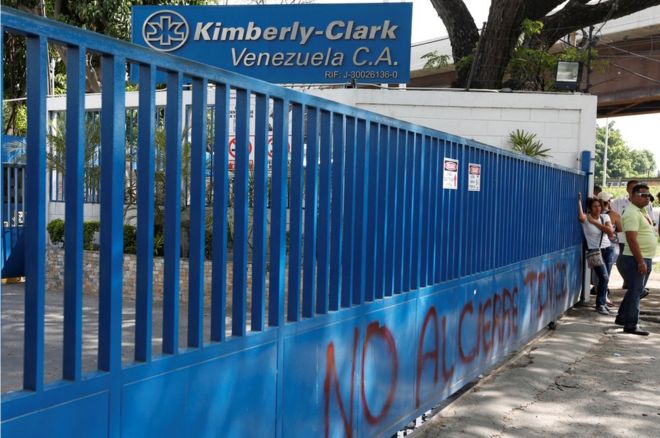
Kimberly-Clark: Venezuela seizes and re-opens US-owned factory

BBC: The government of Venezuela has said it has seized a factory owned by the US firm Kimberly-Clark.

The firm had said it was halting operations in Venezuela as it was unable to obtain raw materials.

But the labour minister said on Monday that the factory closure was illegal and it had re-opened “in the hands of the workers”.

Kimberly-Clark, which makes hygiene products including tissues and nappies, said it had acted appropriately.

Over the weekend it became the latest multinational to close or scale back operations in the country, citing strict currency controls, a lack of raw materials and soaring inflation.

 Employees outside closed Kimberly-Clark gates in Maracay on 10 July 2016 Reuters: No to the closure” read graffiti on the firm’s gates over the weekend
General Mills, Procter & Gamble and other corporations have reduced operations in Venezuela as the country is gripped by economic crisis and widespread shortages of basic household goods.

What has gone wrong in Venezuela?

Labour Minister Oswaldo Vera, from the ruling Socialist Party (PSUV), visited the factory in Maracay and said it was illegal.

Almost 1,000 workers had asked him to re-start production, he said.

Mr Vera said: “Kimberly-Clark will continue producing, now in the hands of the workers.

“We’ve just turned on the first engine.”

The Texas-based company said in a statement: “If the Venezuelan government takes control of Kimberly-Clark facilities and operations, it will be responsible for the well-being of the workers and the physical asset, equipment and machinery in the facilities going forward.”

In just 12 hours, more than 35K Venezuelans cross Colombian border to buy food, medicine

In just 12 hours, more than 35,000 Venezuelans crossed the border into Colombia on Sunday to buy food and medicines in the city of Cucuta, when the Venezuelan government agreed to opened border crossings for one day only.

People began crossing the Simon Bolivar international bridge at 5:00 a.m. to purchase products that are scarce in Venezuela.

“We’re from here in San Antonio (and), honestly, we don’t have any food to give our children, so I don’t think it’s fair that the border is still closed,” a Venezuelan woman told EFE in Cucuta.

The woman, who preferred to not give her name, crossed the international bridge with her husband and children ages 5 and 2.

The border crossings between Tachira state and Norte de Santander province were closed on Aug. 19, 2015, by Venezuelan President Nicolas Maduro, who said he took the measure to fight smuggling and prevent members of paramilitary groups from entering Venezuela.

Maduro later ordered all crossings along the 1,378-mile border closed.

Tachira Gov. Jose Gregorio Vielma Mora said Saturday that the border would be opened on Maduro’s orders.

After the announcement, hundreds of Venezuelans began lining up to cross the Simon Bolivar international bridge.

“A second entry by Venezuelans into Colombia was planned by the Venezuelan right, with the pretext of buying food and medicines,” Vielma Mora said.

The governor was apparently referring to an incident last Tuesday, when about 500 Venezuelans from the city of Ureña crossed the closed Francisco de Paula Santander international bridge and went into Cucuta to buy food.

Norte de Santander Gov. William Villamizar, for his part, said in a Twitter post after visiting the border crossings that the humanitarian corridor “has benefited 25,000 people” who were able to buy “food and medicines.”

Villamizar spoke with some of the people streaming across the border and posed for photos with a family carrying a poster that read, “Colombia, gracias por su solidaridad con Venezuela” (Colombia, Thanks for Your Solidarity with Venezuela).

“This is super nice on Colombia’s part, very good,” Rosalba Jaimes, a San Antonio resident, told EFE.

Betty Rojas, a Venezuelan already heading home, said she and others planned to cross whenever the border was open.

“We bought rice, pasta, sugar, toilet paper, butter, everything we could bring back. We had enough for lots of stuff,” Rojas told EFE, adding that she wanted to tell the Colombian government “thank you.”

Cucuta police chief Col. Jaime Barrera said officers would “guarantee security in Cucuta’s business districts for the thousands of people coming from Venezuela.

Officers have been posted at the border crossings and at businesses across the border city, the provincial police chief said.

Colombian President Juan Manuel Santos and Foreign Minister Maria Angela Holguin visited Cucuta on Wednesday.

The president said he would try to negotiate with Maduro in an effort to reopen the border crossings.

Venezuela: Decree Grants New Powers To President, Defense Minister

Stratfor: Venezuelan President Nicolas Maduro issued a presidential decree July 11 granting new, sweeping powers to himself and Defense Minister Vladimir Padrino Lopez, Sumarium reported. Maduro said the decree establishes a new program that concentrates economic and political power at the very top of government, which will enable the country to correct its economic woes and get production back on track. Moreover, all government institutions and ministries in the country will now fall under the direct control of the president and the defense minister. The president said that he will provide more information about the decree, which effectively makes Padrino Lopez a second head of state in Venezuela, within the coming days.


U.S. Evacuates Embassy Over Violence/Unrest

UN: 36,000 civilians seek shelter in South Sudan capital

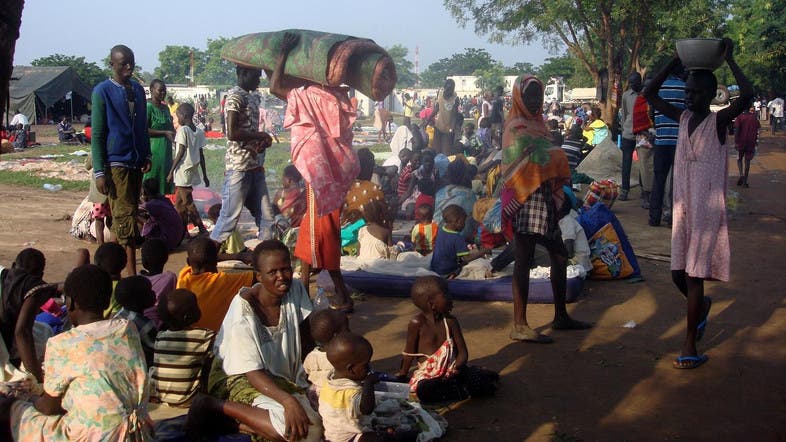
Displaced South Sudanese families are seen in a camp for internally displaced people in the United Nations Mission in South Sudan (UNMISS) compound in Tomping, Juba, South Sudan, July 11, 2016. (Reuters)
al-Arabiya: he United Nations called on Tuesday for free movement and protection of civilians fleeing fighting in the South Sudanese capital of Juba, where it said at least 36,000 displaced people are seeking shelter in UN sites and other locations.

“Access to those in need is limited by the ongoing fighting and insecurity,” UN spokeswoman Alessandra Vellucci told a news briefing in Geneva.

Access to the UN compound is being blocked for civilians, who are trapped in churches and schools without access to water and sanitation, the World Health Organization (WHO) said, adding that it was sending trauma kits.

Meanwhile the UN refugee agency called on neighboring countries to keep their borders open to people seeking asylum and said it was gearing up for possible refugee outflows.

Related reading: U.S. Ambassador to the United Nations has been there but she is currently ignoring South Sudan for Chile and Uruguay. No worries though, she issued this statement:

FOR IMMEDIATE RELEASE

Tonight, the Security Council expressed its readiness to enhance UNMISS’ role in responding to this crisis and its role in providing security on the ground. The Security Council has also called upon states in the region to begin preparing additional troops for possible deployment.

Violent fighting between rival factions in South Sudan forces U.S. to evacuate embassy

• Five SPLA soldiers were killed and at least two SPLM-IO troops were injured on Sunday

• Clashes occurred on the fifth anniversary of the country’s independence

• Koro Bessho, Japan’s ambassador to the U.N., confirmed the death of the Chinese soldier

JUBA, South Sudan – United States is set to evacuate its embassy in South Sudan following the recent surge in violent clashes in the region.

The State Department spoke of the “sudden and serious deterioration,” of the situation in the new country which had blown the rivalry between the President and Vice President into an everyday “general fighting.”

There were also reports of a U.S. embassy vehicle being attacked in clashes on July 7.

The rival factions pledging loyalties to President Salva Kiir and Vice President Riek Machar engaged in a violent fight on Sunday, involving gunfire outside a UN building. Allegations that Machar’s residence in Juba was attacked by Kiir’s men had triggered the fight.

Local reports claimed that five SPLA soldiers were killed and at least two SPLM-IO troops were injured, besides a few civilian casualties.

Clashes occurred on the fifth anniversary of the country’s independence. UNMISS, the UN mission in South Sudan, said that the violence occured so close that it drove away 1,000 internally displaced people under its protection. It said, “Both UNMISS compounds in Juba have sustained impacts from small arms and heavy weapons fire.”

UN Secretary-General Ban Ki-moon condemned the incident as “senseless violence” and reports stated that he plans to hold an emergency session to discuss the situation in South Sudan.

While Chinese and Rwandan peacekeepers sustained injuries, Japan’s ambassador to the UN Koro Bessho confirmed the death of a Chinese soldier.

On July 7, a shootout between the bodyguards of both the leaders led to a full blown fight in Juba that killed at least 150 people.

Kiir and Machar met at the Presidential Palace the next day to issue a call for calm, following the severe damage and loss of lives.

By July 10, local radio station Radio Tamazuj reported that the death toll from those clashes may be as high as 271.

Kenya Airways informed the suspension of all flights to the city because of an “uncertain security situation.”

Meanwhile, Britain’s Foreign Office also advised against all travel to South Sudan, saying “the security situation in Juba has deteriorated” since Friday.

In July 2011, South Sudan declared itself as an independent country following more than 20 years of guerrilla warfare. The states of war had claimed the lives of at least 1.5 million people and displaced more than four million and the declaration of independence raised hopes for stable conditions.

However, after President Salva Kiir sacked the cabinet and accused Vice-President Riek Machar of planning a coup, civil war broke out between both camps in December 2013 which involved ethnic groups – the Dinka, led by Kiir, and the Nuer, under Machar, turning the clashes more violent.

A peace agreement was signed in South Sudan in August 2015, but many issues remain unresolved.

Tehran Lives in John Kerry’s Head, Aggressions Approved

It is Iran stupid…yet both the National Security Council, led by Susan Rice, Barack Obama and John Kerry are declared honorary citizens of Iran with gold keys to the city of Tehran.

Check it…

U.S. Confirms Purchase of Iranian Nuke Materials for $8.6 Million

FreeBeacon: U.S. and Iranian officials confirmed on Monday that the United States had completed a $8.6 million taxpayer-funded purchase of Iranian nuclear materials, a deal undertaken by the Obama administration to keep Iran in compliance with last summer’s nuclear agreement.

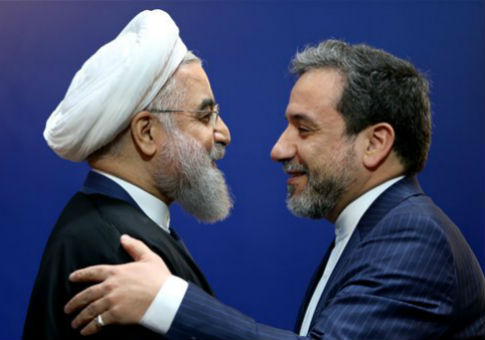
Iran’s Deputy Foreign  Minister Abbas Araghchi, right, embraces President Hassan Rouhani / AP Iran’s Deputy Foreign Minister Abbas Araghchi, right, embraces President Hassan Rouhani / AP

Abbas Araghchi, a top Iranian diplomat and negotiator of the deal, announced on Iranian television that the United States had moved forward with the purchase of 32 tons of heavy water for a price of $8.6 million. That money is said to have been successfully transferred to Iran, according to Persian language reports in the country’s state-run media.

An Energy Department spokesperson, speaking on background to the Free Beacon, confirmed the purchase.

“I can confirm reports that the DOE Isotope Program has completed the acquisition of 32 metric tons of heavy water from Iran,” the spokesperson said.

One U.S. official told the Free Beacon that while the deal is being announced officially now, it was actually concluded in April, when the administration first announced it.

“The heavy water deal was really concluded in April and it just took a few months to make all the necessary arrangements you would expect from such a deal,” the official said.

The disclosure could complicate matters on Capitol Hill with lawmakers who have been rebuffed by the administration in their attempts to learn more about the deal, sources said.

An Energy Department spokesperson told the Free Beacon in late April: “We cannot discuss details of the payment until after the purchase is complete.”

The timeline for the deal is raising new questions from congressional sources.

“The confirmation of this late April date is likely to anger lawmakers who were denied details of the deal because the Energy Department told them several months ago that key details surrounding the deal had not yet been firmed up,” said one congressional adviser familiar with attempts to compel further details about the deal.

The source pointed to a a letter presented to Rep. Mike Pompeo (R., Kansas). The Free Beacon was the first outlet to obtain that letter.

“The Obama administration’s deal with the Mullahs in Tehran to purchase heavy water demonstrates a disturbing, potentially illegal, willingness of the administration to subsidize Iran’s nuclear program,” Pompeo told the Free Beacon at the time. “This purchase allows the Iranians to offload previously unsellable product and it destigmatizes the act of doing business in Iran.”

The purchase has sparked opposition on Capitol Hill among lawmakers who say that the United States should not engage in nuclear-related business with Iran. The purchase was made outside of the nuclear accord and was touted by the administration as a way to keep Iran within the limits set under the deal.

Lawmakers have been critical of the sale due to their inability to get specific details from the administration about how the deal would be completed and how U.S. taxpayer funds would be awarded to Iran.

“One of the most important achievements of the JCPOA was that we are now recognized as a seller of heavy water by America, which did not accept heavy water production by Iran,” Araghchi was quoted as saying, according to an independent translation provided to the Free Beacon.

“Heavy water production has reached 25 tons per year and storing heavy water in Oman was the decision of the Atomic Energy Organization [of Iran]. … The need of Arak [heavy water reactor] was between 80 to 90 tons,” Araghchi added. “We considered 130 tons for caution. We have this amount inside the country and send some to storage facilities in Oman.”

Lawmakers are expected to vote Thursday on legislation that would ban the administration from carrying out similar purchases in the future.

Update, 5:30 p.m. The headline and body of this post have been revised to reflect confirmation of the purchase by an Energy Department official.

Oh wait….there is more…..beyond the IRGC, Iranian Revolutionary Guard Corps hijacking our sailors, naval aggression is a very common occurrence and threat.

Votel sees cause for concern as U.S., Iranian ships share tight space

TampaBayTimes: ABOARD THE USS NEW ORLEANS — The Iranian vessel with its antiship cruise missiles did what ships from Iran often do — cruise within 500 yards of a U.S. Navy vessel.


Only this time, the USS New Orleans had a special guest — Army Gen. Joseph Votel, head of U.S. Central Command. Votel was visiting the ship in the Strait of Hormuz as part of his tour of the 20-nation CentCom region, which began last week when he flew out of headquarters at MacDill Air Force Base.

Two days after visiting Afghanistan, Votel arrived aboard the New Orleans on a tilt-rotor V-22 Osprey, landing on a flight deck in sweltering heat. He landed just in time to see a Houdong-class warship, belonging to the Iranian Revolutionary Guards Corps navy, cruise close by.

It would happen five times during the hours Votel spent passing through the Strait of Hormuz aboard the New Orleans, an amphibious transport dock ship. The experience gave Votel a front-row seat to the complex challenges Iran poses to the U.S. and its allies in the region — challenges that fall on Votel’s shoulders as officer in charge of U.S. military operations in the Middle East and Southwest Asia. More here.

**** Given the constant aggression by the IRGC with the knowledge and approval of Tehran, these events are likely a leak by Navy officials due to anger and rightly so. Since the Obama administration is pro Iran due to overwhelming protections of the deals with Iran including the Joint Plan of Action, the National Security Council and the State Department stop at nothing to ensure Iran’s actions are acceptable at the cost of law regarding international sea traffic and the major threat to our Navy.

In part from Reuters:  The five Iranian vessels consisted of four speedboats, three with mounted machine guns, as well as a guided missile patrol ship.

One of the four speedboats that approached the New Orleans and its escort, a Navy guided missile destroyer, the USS Stout, cut its engines and watched as the U.S. warships passed. An hour before, a larger Iranian guided-missile patrol craft came by.

U.S. officials stressed that such approaches fell within the category of professional interactions, the kind they see during 90 percent of the U.S. Navy’s roughly 250 transits through the Strait of Hormuz each year. But the Navy says some 10 percent are classified as unsafe, abnormal or unprofessional.  More here.