Real Refugee Numbers, UN Report, Solution


Global forced displacement hits record high

UNHCR Global Trends report finds 65.3 million people, or one person in 113, were displaced from their homes by conflict and persecution in 2015.

GENEVA, June 20 (UNHCR) – Wars and persecution have driven more people from their homes than at any time since UNHCR records began, according to a new report released today by the UN Refugee Agency.

The report, entitled Global Trends, noted that on average 24 people were forced to flee each minute in 2015, four times more than a decade earlier, when six people fled every 60 seconds.

The detailed study, which tracks forced displacement worldwide based on data from governments, partner agencies and UNHCR’s own reporting, found a total 65.3 million people were displaced at the end of 2015, compared to 59.5 million just 12 months earlier.

“At sea, a frightening number of refugees and migrants are dying each year. On land, people fleeing war are finding their way blocked by closed borders.”

UN High Commissioner for Refugees Filippo Grandi

It is the first time in the organization’s history that the threshold of 60 million has been crossed.

“More people are being displaced by war and persecution and that’s worrying in itself, but the factors that endanger refugees are multiplying too,” said UN High Commissioner for Refugees Filippo Grandi.

“At sea, a frightening number of refugees and migrants are dying each year; on land, people fleeing war are finding their way blocked by closed borders. Closing borders does not solve the problem.”

Forced displacement has been on the rise since at least the mid-1990s in most regions, but over the past five years the rate has increased.

The reasons are threefold:

  • conflicts that cause large refugee outflows, like Somalia and Afghanistan – now in their third and fourth decade respectively – are lasting longer;
  • dramatic new or reignited conflicts and situations of insecurity are occurring more frequently. While today’s largest is Syria, wars have broken out in the past five years in South Sudan, Yemen, Burundi, Ukraine and Central African Republic, while thousands more people have fled raging gang and other violence in Central America;
  • the rate at which solutions are being found for refugees and internally displaced people has been on a falling trend since the end of the Cold War, leaving a growing number in limbo.

“We’re stuck here. We can’t go on and we can’t go back,” said Hikmat, a Syrian farmer driven from his land by war, now living in tent outside a shopping centre in Lebanon with his wife and young children. “My children need to go to school, they need a future,” he added.

The study found that three countries produce half the world’s refugees. Syria at 4.9 million, Afghanistan at 2.7 million and Somalia at 1.1 million together accounted for more than half the refugees under UNHCR’s mandate worldwide. Colombia at 6.9 million, Syria at 6.6 million and Iraq at 4.4 million had the largest numbers of internally displaced people. Read the full report here.

****  Related reading: Record 65.3 million people displaced, often face barriers: UNHCR

Related reading: More than 80,000 civilians have escaped Fallujah in anti-ISIS fight, UN reports

Part of a solution is offered and viable.

The United States and its closest partner in Syria, the Kurdish Democratic Union Party (PYD), have worked closely together to take territory from the Islamic State. The PYD’s militia—the People’s Protection Units (YPG)—is the most dominant group in the Syrian Democratic Forces (SDF). This partnership relies on a small number of American special operations forces (SOF) to embed with the SDF to leverage the benefits of airpower to take territory. This approach is based on the United States’ recent experiences in Afghanistan, Iraq, and Libya, where a small number of ground forces allowed for local militias to rapidly take territory.

As the anti-ISIL coalition and its Kurdish majority partner begins the campaign to force ISIL from Raqqa, its capital, concurrent efforts to defeat the group in the Manbij pocket – the stretch of Islamic State controlled territory between the cities of Marea and Manbij near the Turkish-Syrian border – will gain in importance. The taking of Raqqa city will ultimately require four interlinked efforts. First, the continued SDF-led efforts to take territory in northern Raqqa province, beginning with a southward push from strongholds near Ain Issa and just north of Raqqa city. Second, the American and Jordanian supported “New Syrian Army” continue its move north towards the town of Al Bukamal, an ISIL controlled town in the Euphrates River Valley on the Iraqi-Syrian border. The SDF continues to push south from Markadah, outside of Ash Shaddadi. Finally, a force will also have to close the Manbij pocket to deny ISIL freedom of movement from strongholds on the western flank to reinforce positions in and around its capital city.

The strategy to clear the Manbij pocket, however, remains hampered by Turkish concerns about the YPG and the United States’ decision not to embed special operators with the Arab and Turkmen groups active in the area. ISIL has taken advantage of this disagreement, attacking villages between Azaz and Marea, cutting the last remaining Arab majority opposition territory in two. To increase the effectiveness of operations in the Manbij pocket, the United States should consider restarting a train-and-equip program, designed to fit a narrow mission set: relaying coordinates to the coalition for more effective targeting in the area to take Raqqa. This program would have to first focus on defeating ISIL positions near Azaz and Marea, before beginning to push the group further east.

Revising a Failed Train-and-Equip Program

The first iteration of the train-and-equip program sought to create an entirely new rebel brigade, Division 30, trained in Turkey to fight the Islamic State exclusively. Washington insistence that this force refrain from fighting the Assad regime was incongruent with the military goals of the opposition. At the same time, Syria’s Al Qaeda affiliate, Jabhat al-Nusra, was present in the area and viewed the introduction of U.S. trained fighters as a threat to its power. While the program was cancelled following al-Nusra’s seizure of Division 30 equipment, in an overlooked success, Division 30 was able to call in U.S. airstrikes when it came under attack from al-Nusra. An updated program should build upon this limited success.

Since the failure of the program, the YPG has remained the closest U.S. partner in Syria’s civil war. This relationship, however, is complicated by the YPG’s direct links to the Kurdistan Workers’ Party (PKK), a U.S.-designated terrorist group that has waged an insurgency against the Turkish government for close to three decades, first with the aim of carving out an independent Kurdistan and now to achieve so-called democratic autonomy. The YPG-PKK linkage ultimately poses longer-term problems for the American relationship with Turkey, a NATO ally since 1952, as they fight a renewed bloody counterinsurgency campaign in their southeastern provinces. Read more here from WotR.

ManbijPocket

1.0 Million Green Cards to be Issues by DHS

1M Immigrants From Muslim Countries Admitted During Obama’s Presidency

The Obama Administration is on track to issue 1 million green cards to immigrants from countries where Muslims are in the majority, according to an analysis of Department of Homeland Security data released Friday.

According to the DHS Yearbook of Immigration Statistics, green cards were issued to 832,014 people from Muslim-majority countries in the first six fiscal years of the Obama administration, from fiscal years 2009-2014, the Senate Subcommittee on Immigration and the National Interest report shows.

In addition, the numbers of green cards increased dramatically in the last two fiscal years of the report, for 2013 and 2014. The records show that 117,423 green cards were issued in fiscal year 2013, compared to 148,810 in fiscal year 2014, for an increase of nearly 27 percent.

The reports show that in the first six fiscal years President Barack has held office, the United States issued green cards to an average of 138,669 migrants from Muslim-majority countries every year, and if the trends continue, the United States will have issued green cards to at least 1.1 million migrants from such countries by the time Obama leaves office in January.  Read more here from NewsMax.


The vetting for migrants and refugees is performed by the UN High Commission for Refugees. The UNHCR operates in panic mode, simply rubber-stamping approval due to volume. So, let’s make a movie.

Stars ask you to stand #WithRefugees

More than 60 stars of film, TV and music have joined refugees, faith leaders and UNHCR to back a petition highlighting the plight of forcibly displaced people.


GENEVA, June 16 (UNHCR) – More than 60 stars from the worlds of film, TV and music joined refugees, faith leaders and UN Refugee Agency staff today to urge you to stand #WithRefugees and sign a petition on behalf of the world’s forcibly displaced.

The petition aims to gather public support for the growing number of families forced to flee conflict and persecution worldwide, who currently face heightened anti-refugee rhetoric coupled with greater restrictions to asylum.

It calls on governments to ensure every refugee child gets an education; that every refugee family has somewhere safe to live, and can work or learn skills to make a positive contribution to their community.

Despite the fact that the FBI and CIA director have said that Syrian refugees cannot be screened properly, Barack Obama has put the program to resettle Syrian refugees in the country on the fast track.

The AP reported that so far only about 1,000 Syrian families have been brought to the US but that was because the process took 18 to 24 months.  The US now has a speeded up “surge operation” in place.

“The 10,000 (figure) is a floor and not a ceiling, and it is possible to increase the number,” Kassem told reporters. High-risk groups are given priority to include unaccompanied minor, victims of torture and gender-based violence. The UNHCR insists that the US resettle 65,000 Syrian refugees. 

In part from FNC: The danger posed by people coming from terrorism-infested regions has been a hotly contested issue, as is the potentially outsized impact on the small American communities often called upon to receive them. What does not appear in doubt is the hefty price tag, which is projected to total some $644 million over those refugees’ first five years in the United States.

Unlike other classes of immigrants, refugees are immediately eligible for a full range of welfare benefits.

The figure comes from an analysis performed by the Center for Immigration Studies, which looked at processing and administrative costs of the federal agencies, money for assistance provided to refugees directly or through federally funded nonprofit organizations and consumption of government-assistance programs. Unlike other classes of immigrants, refugees are immediately eligible for a full range of welfare benefits.

Camarota, director of research for the Washington-based think tank, estimated costs of the federal welfare programs by examining five-year usage rates contained in a report by the Office of Refugee Resettlement. The most recent figures, show usage rates for welfare programs by refugees from the Middle East that are even higher for most programs than when Camarota first wrote the report.

Refugees from the Middle East use those programs at rates that far exceed participation by refugees from any other region. In five of seven programs, the percentage of Middle Eastern refugees participating are higher than those of refugees from Africa, the region with the next-highest usage rates. In some cases, the rates are substantially higher. Nearly nine in 10 were on food stamps, for instance, compared with 80 percent of African refugees.

“The Middle East really stands out,” said Camarota, who speculated that the disparity might be due to deficiencies in eduction, English proficiency or job skills. “There’s something special about Middle Easterners in the cost of these programs.”

The Office of Refugee Resettlement Report, however, indicates that Middle Easterners arrived with better English skills and more education than those from other parts of the world.

If the latest participation figures hold up for the Syrians admitted between Oct. 1 last year and Sept. 30 this year, Camarota’s five-year cost projection — $64,370 per person and $257,481 per household — may be low-ball estimates.

Ira Mehlman, a spokesman for the Federation of American Immigration Reform, said it would be more cost-effective for the United States to provide financial assistance to Jordan and Turkey, which are housing the bulk of refugees who fled war-torn Syria. Those refugees also would have an easier time returning home after the fighting ends.

“In terms of helping people, you get far more for your money helping people close to where they live,” he said. Read more details here.


Global Human Trafficking, Here at Home

Pigs Fly, the UN Finally Admitted Global Sex Violence/Trafficking

Even CNBC is Sounding Alarm on Smuggling at Southern Border


Reps. Cohen, Kinzinger, Cárdenas and Wagner Introduce Bipartisan Human Trafficking Bill

June 9, 2016
Press Release

[WASHINGTON, DC] – Congressman Steve Cohen (D-TN), Congressman Adam Kinzinger (R-IL), Congressman Tony Cárdenas (D-CA) and Congresswoman Ann Wagner (R-MO) yesterday introduced H.R. 5405, the Stop, Observe, Ask and Respond (SOAR) to Health and Wellness Act. This bipartisan legislation would provide health care professionals at all levels training on how to identify and appropriately treat human trafficking victims. It is a companion bill to S. 1446, which was introduced by Senators Heidi Heitkamp (D-ND) and Susan Collins (R-ME).

“Human trafficking is a hidden crime that impacts hundreds of thousands of people across the U.S., and many of these victims end up in a health care setting while being exploited,” said Congressman Cohen. “Our bill aims to ensure health care professionals are trained to identify victims of human trafficking and provide them with critical, victim-centered health care.  Our bill also enables health care providers to implement protocols and procedures to work with victims, service organizations, and law enforcement so that victims can get proper support and perpetrators of human trafficking are brought to justice. I would like to thank Reps. Kinzinger, Cárdenas and Wagner for joining me in introducing this bill.”  

“It is critical that our health care providers are trained to recognize cases of human trafficking and have the proper procedures to best help those most vulnerable,” said Rep. Kinzinger. “I’m proud to be an original cosponsor of the SOAR Act and I believe this pilot program will have a significant impact towards identifying cases of human trafficking and helping more victims across the country from this disgusting crime.”  

“Human trafficking has grown into a large scale industry that is disproportionately geared towards women,” said Rep. Cárdenas. “This is just one of the many reasons why I did not hesitate to become an original cosponsor of the SOAR bill. Victims of trafficking suffer long-term effects, and with the introduction of new research, it is evident that the people who seek help can be identified and properly cared for by trained professionals. It is time to use this information in order to help stop the growth of the trafficking industry and facilitate the well-being of both survivors and victims.”   

“Education and awareness are critical in the fight to end human trafficking. This legislation will provide health care providers on all levels with the appropriate training and tools necessary to identify and report potential cases of human trafficking,” said Congresswoman Wagner. “With tens of thousands of victims being trafficked in the United States each year, I am happy to work with my colleagues across the aisle to introduce and quickly pass this legislation.”   

“Victims of human trafficking are hidden in plain sight – making those in captivity unrecognizable even to our most trusted professionals like doctors and nurses,” said Senator Heitkamp. “By implementing across the country the successes of health worker pilot training programs in North Dakota, my bipartisan bill with Sen. Collins would help provide the critical tools medical professionals need to recognize and protect victims of human trafficking. Today’s introduction of our bill in the U.S. House of Representatives is a critical step toward putting an end to human trafficking by identifying victims and getting them the support they need.” 

“Sex trafficking is a heinous crime that tragically affects every corner of America.  Human traffickers prey upon the most vulnerable, often homeless or runaway children,” said Senator Collins.  “Identification is a crucial, and frequently missed, step in helping victims and stopping these atrocities.  This bipartisan legislation would expand a successful pilot program at the U.S. Department of Health and Human Services to ensure that more health care providers have the training to identify, report, and treat these cases, which will help us shine a light on some of the darkest stories imaginable and protect victims of these detestable crimes.” 

The Stop, Observe, Ask and Respond (SOAR) to Health and Wellness Act supports efforts underway at the Department of Health and Human Services (HHS) to combat human trafficking by directing the Secretary to establish a pilot program to be known as ‘Stop, Observe, Ask and Respond to Health and Wellness Training.’ While human trafficking victims are often difficult to identify, a reported 68 percent of trafficking victims end up in a health care setting at some point while being exploited, including in clinics, emergency rooms and doctor’s offices.  Despite this, out of more than 5,680 hospitals in the country, only 60 have been identified as having a plan for treating patients who are victims of trafficking and 95 percent of emergency room personnel are not trained to treat trafficking victims. The SOAR Act will help close the gap in health care settings without plans for treating human trafficking victims.

**** How bad is it?

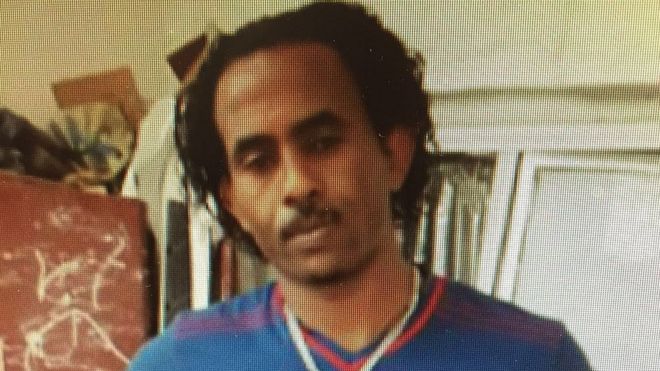
BBC: Dubbed “the General”, Mered Medhanie is alleged to have led a multi-billion dollar empire which specialised in people-smuggling.

Undated handout photo, issued by the Kk'S National Crime Agency, of Mered Medhanie, dubbed "The General", one of the world's most wanted people smugglers, who has been arrested Mered Medhanie styled himself on the late Libyan leader Col Muammar Gaddafi 

A 35-year-old Eritrean, he came to public attention after being linked to the worst migrant disaster at sea – the deaths of 359 migrants in October 2013 after their boat sank near the Italian island of Lampedusa.

Canada-based barrister Christine Duhaime, who specialises in money-laundering legislation, said Mr Mered was suspected to be a ringleader of the people-smuggling network which stretched across Africa and Europe.

“He is notorious just for the fact that he controlled a lot of money and a lot of people,” she told the BBC’s Newsday programme.

“As kingpin, the amount of money that went through him is apparently in the billions.” More to the story here.

Report: Mexican Security Forces, Crimes Against Humanity

The report is titled “Undeniable Atrocities: Confronting Crimes against Humanity in Mexico”. The report’s analysis relies on legal standards of the Rome Statute, which established the International Criminal Court, and which Mexico ratified in 2005.

The Open Society Slide Presentation is found here. Someone(s) at this George Soros organization really cares? Huh?

Mexican security forces committed crimes against humanity-report

Mexico’s drug war has resulted in the most violent period in the country’s modern history, with over 150,000 people killed since 2006

ThomsonReuters MEXICO CITY, June 6 (Reuters) – Mexican security forces have committed crimes against humanity, with mass disappearances and extrajudicial killings rife during the country’s decade-long drug war, according to a report released by rights groups on Monday.

The 232-page report, published by the Open Society Justice Initiative and five other human rights organizations, warned that the International Criminal Court could eventually take up a case against Mexico’s security forces unless crimes were prosecuted domestically.

“We have concluded that there are reasonable grounds to believe there are both state and non-state actors who have committed crimes against humanity in Mexico,” the report said.

Mexico’s drug war has resulted in the most violent period in the country’s modern history, with more than 150,000 people killed since 2006.

Consistent human rights abuses – including those committed by members of the Zetas drug cartel- satisfied the definition of crimes against humanity, the report said.

The authors recommended that Mexico accept an international commission to investigate human rights abuses.

A series of shootings of suspected drug cartel members by security forces, with unusually high and one-sided casualty rates, have tarnished Mexico’s human rights record.

“Resorting to criminal actions in the fight against crime continues to be a contradiction, one that tragically undermines the rule of law,” the report stated.

The unresolved 2014 kidnapping and apparent killing of 43 students from the Ayotzinapa teacher-training college was one of the most high-profile cases to have damaged Mexico’s reputation.

The report was based on documents and interviews over a nine-year period from 2006 to 2015.

It cited mass graves and thousands of disappearances, in addition to killings such as the shooting by the army of 22 suspected gang members in Tlatlaya in central Mexico, and similar incidents, as evidence of criminality in the government’s war against the country’s drug cartels.

Eric Witte, one of the report’s authors, recommended that the government look at the U.N. Commission against Impunity in Guatemala (CICIG) as an example for inviting an international investigative commission to bring cases in Mexican courts.

Evidence gathered by CICIG against former Guatemalan President Otto Perez played a key role in his resignation and eventual arrest last year.

The report criticised Mexico’s weak justice system. If atrocities continued without measures being taken to end impunity, the International Criminal Court could step in, said Witte, a former advisor at the Hague-based court.

“Unfortunately, Mexico might be one atrocity away from an international commission becoming politically viable,” Witte, who leads national trials of grave crimes for the Open Society Justice Initiative, told Reuters.

The Silent Heroes in Iraq, Saving the Girls


(CNN)The bidding opens at $9,000. For sale? A Yazidi girl.

She is said to be beautiful, hardworking, and a virgin. She’s also just 11 years old.
 
This advertisement — a screengrab from an online marketplace used by ISIS fighters to barter for sex slaves — is one of many Abdullah Shrem keeps in his phone.
Each offers vital clues — photographs, locations — that he hopes will help him save Yazidi girls and young women like this girl from the militants holding them captive.

Shrem was a successful businessman with trade connections to Aleppo in Syria when ISIS came and kidnapped more than 50 members of his family from Iraq’s Sinjar province, a handful of the thousands of Yazidis seized there in 2014.

Tens of thousands of Yazidis fled their homes and clambered up Mount Sinjar in an attempt to escape the fighters; hundreds were massacred, while thousands of women and girls were abducted and sold into slavery.

Sold into sex slavery

Desperate — and angered at what he saw as a lack of support from the international community — he began plotting to save them himself, recruiting cigarette smugglers used to sneaking illicit produce in and out of ISIS territory to help his efforts.

“No government or experts trained us,” he explains when we meet in the Kurdish region of northern Iraq. “We learned by just doing it, over the last year and a half, we gained the experience.”
 The Shariya camp opened six months ago and now 4,000 tents line the dusty ground, providing shelter to thousands of refugees.

 Shariya camp with 4000 tents
 
So far, he says, his network has freed 240 Yazidis; it hasn’t been easy, or cheap — he’s almost broke, having spent his savings paying smuggling fees.
For those who venture into ISIS territory, the stakes are even higher — a number of the smugglers have been captured and executed by ISIS while trying to track down Yazidi slaves.
But Shrem insists the risks are worth it: “Whenever I save someone, it gives me strength and it gives me faith to keep going until I have been able to save them all.”
In some cases, the smugglers follow clues in the adverts or other tidbits of information they’re able to gather to find the Yazidis. In others, the hostages themselves reach out and plead for help, offering key details as to their location; a province or town they’ve overheard mentioned, or a local landmark they’ve been able to spot.
Once they manage to make contact, the prisoners are told when and where to go to meet the smugglers who wait for them in a nearby car. Depending on the circumstances of the rescue, it can take days or even weeks to get safely out of ISIS territory, switching from vehicle to vehicle, and waiting in safe houses.

Children as bomb-makers

Dileen (not her real name) is one of those rescued by Shrem and his team of smugglers.
She was separated from her husband when ISIS militants overran Sinjar province. The last time she saw him he was being marched away, hands up, with the other men from their village.
She and her children were taken to Mosul with the women and girls. “They separated the ones who were really pretty, and made us remove our headscarves to see the prettiest ones,” she says.


They were moved from place to place within ISIS territory: Mosul, Tal Afar, Raqqa, and finally to Tishrin where, she says, she was sold to an ISIS fighter, who raped her repeatedly.
“They forced me, and they threatened my children,” she says, recalling the five months she spent trapped in his home.
ISIS claims the Quran justifies taking non-Muslim women and girls captive, and permits their rape — a claim vociferously denied by Islamic scholars.
While Dileen was used as a sex slave, her daughter Aisha (not her real name), who is just seven years old, was forced to work late into the night, in the basement of their apartment building, assembling IEDs for ISIS.
“I used to make bombs,” says Aisha, quietly, playing with her hair. “There was a girl my age and her mother. They threatened to kill [the girl] if I wouldn’t go and work with them,” she told CNN.
“They would dress us in all black and there was a yellow material and sugar and a powder, and we would weigh them on a scale and then we would heat them and pack the artillery.”
An ISIS militant, she says, would then add the detonation wires.

Escapees ‘can’t forget’