Prison Uprising Planned for August/ BGF

Warning issued for prison guards, officers about possible attacks from ‘Black Guerilla Family’

A previous version of this story incorrectly identified Jerry Elster as a former member of BGF. We regret the error. He currently works as the Healing Justice Coordinator for American Friends, a Quaker organization devoted to service, development and peace programs throughout the world.

An urgent bulletin is going out to law enforcement Wednesday, warning of a new threat of attacks against officers on the street and in prisons.
It has to do with what’s called Black August.
I-Team Reporter Dan Noyes has a source in law enforcement that leaked the bulletin to him. He wants you to understand the potential dangers officers are facing. In his words, when it hits the fan, you’ll know the reason why.

The Federal Bureau of Prisons, Sacramento Intelligence Unit and the FBI’s National Gang Intelligence Center have issued a bulletin to law enforcement, warning of increased risk for violence during Black August.

The prison gang Black Guerilla Family or BGF started Black August in the 1970’s as a month to honor fallen members.

One of the biggest, Hugo Pinell served 46 years in solitary confinement after a San Francisco rape conviction, after killing a prison guard, and slashing the throats of two other guards who survived during an escape attempt in 1971.

Former San Quentin inmate Jerry Elster remembers Pinell as a freedom fighter. “When I went to prison at 20 years old, there was somebody there to remind me not to compromise my integrity,” Elster said.

Last summer, just 12 days after corrections finally released Pinell from solitary, he was stabbed to death in a riot at state prison Sacramento.

The bulletin says the Black Guerilla Family believes state prisons worked with the Aryan Brotherhood to Kill Pinell.

 Picture

At the very least, Elster believes the state had a duty to protect Pinell. “I mean, it’s only those who are charged with authority and protection, of protecting and housing of Hugo Pinell who have to bear that responsibility,” Elster said.

The bulletin warns an inmate source: “Claims the BGF has a 2-for-1 kill policy.” That the BGF is “going to kill correctional officers and Aryan Brotherhood gang members to send a firm message. And the attacks will occur across the country, not just in California, and will likely occur during the BGF’s memorial celebration of Black August.

The Bureau of Prisons and the FBI declined to comment for this report, so I showed the bulletin to retired FBI special agent Rick Smith. “I think it’s serious. They put that bulletin out, they don’t want to be caught with something happening with the information they have and not disseminating it,” he said.

Also included in the bulletin is the FBI’s Baltimore office reports, “BGF members reportedly discussed how they could ambush law enforcement officers who were parked in alleys or side streets.”

 Related reading: The Black Book in .pdf

It also mentions the San Francisco Bay View newspaper for publishing articles, “suggesting California Department of Corrections and Rehabilitation responsibility for Pinell’s murder, and promoting Black August celebrations as a platform for action.”

Bay View editor Mary Ratcliff is surprised her newspaper is named in the bulletin, but is worried about the message. “This statement from the department of justice puts black people in danger,” Ratcliff said. “Because it is promoting the idea that there is a war going on between black people and law enforcement.”

The bulletin also includes a drawing from the newspaper by a BGF member, showing the logo and a gorilla eating a pig.

Ratcliff downplays the reference to violence against police officers. “A depiction like that is a release, it’s yeah, go for it, that’s how I feel. Now, I don’t have to do it,” she said.

Smith from the FBI tells me this bulletin does not come as news to officers, in prison or on the streets. They know how dangerous their jobs have become. This is yet another heads up.

*****

Gang Profile

Picture

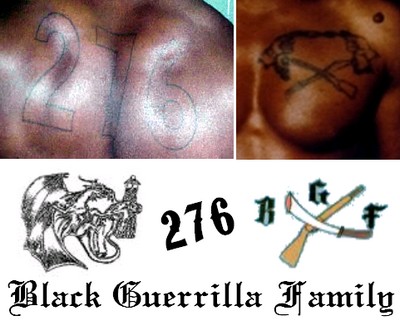
Symbols: Crossed sabers, machetes, rifles with the letters BGF, 276, a horned dragon wrapped around a prison tower
Ranking structure: Paramilitary
Territory: California and selected areas around the United States
Alliances: Nuestra Familia, Crips and Bloods
Members: 9,000
Racial make up: Black
Threat: High

The Black Guerrilla Family (BGF)  prison gang, founded in 1966 in the San Quieten State Prison in California. The BGF was founded by George Lester Jackson, W.L. Nolen, David Johnson, James Carr, and other black convicts in the state prison at the time. This gang has become not only active in California but Maryland as well. BGF members are very influential within the prison system and are known to recruit correction facility staff to aid them in their illegal activities.

Black Guerrilla Family Oath

If I should ever break my stride, or falter at my comrade’s side, this oath will kill me
If my word should ever prove untrue, should I betray the chosen few, this oath will kill me
If I submit to greed or lust or misuse the people’s trust, this oath will kill me
Should I be slow to take a stand or show fear of an man, this oath will kill me
If I grow lax in discipline, in time of strife refuse my hand, this oath will kill me
Long live the spirit of George Jackson, long live the spirit of the Black Guerrilla Family

The Pen and Phone Just Commuted Another 214 Criminals

Obama Commutes Sentences For 214 Federal Prisoners

President Obama on Wednesday cut short the sentences of 214 federal inmates, including 67 life sentences, in what the White House called the largest batch of commutations on a single day in more than a century.

Almost all the prisoners were serving time for nonviolent crimes related to cocaine, methamphetamine or other drugs, although a few were charged with firearms violations related to their drug activities. Almost all are men, though they represent a diverse cross-section of America geographically.

Obama’s push to lessen the burden on nonviolent drug offenders reflects his long-stated view that the U.S. needs to remedy the consequences of decades of onerous sentencing requirements that put tens of thousands behind bars for far too long. Obama has used the aggressive pace of his commutations to increase pressure on Congress to pass a broader fix and to call more attention to the issue.

All told, Obama has commuted 562 sentences during his presidency — more than the past nine presidents combined, the White House said. Almost 200 of those who have benefited were serving life sentences.

*****

FNC: “We are not done yet,” Deputy Attorney General Sally Yates said. “We expect that many more men and women will be given a second chance through the clemency initiative.”

Most of those receiving commutations Wednesday will be released December 1.

Though there’s broad bipartisan support for a criminal justice overhaul, what had looked like a promising legislative opportunity for Obama’s final year has mostly fizzled. As with Obama’s other priorities, the intensely political climate of the presidential election year has confounded efforts by Republicans and Democratic in Congress to find consensus.

Obama has long called for phasing out strict sentences for drug offenses, arguing they lead to excessive punishment and incarceration rates unseen in other developed countries. With Obama’s support, the Justice Department in recent years has directed prosecutors to rein in the use of harsh mandatory minimums.

The Obama administration has also expanded criteria for inmates applying for clemency, prioritizing nonviolent offenders who have behaved well in prison, aren’t closely tied to gangs and would have received shorter sentences if they had been convicted a few years later.

Civil liberties groups praised that policy change but have pushed the Obama administration to grant commutations at a faster pace. The Clemency Resource Center, part of NYU School of Law, said more than 11,000 petitions are pending at the Justice Department and that the group believes 1,500 of them meet the administration’s criteria to be granted.

But the calls for greater clemency have sometimes sparked accusations from Obama’s opponents that he’s too soft on crime, an argument that is particularly resonant this year as presidential candidates Donald Trump and Hillary Clinton trade claims about who is best positioned to keep the country safe.

“Many people will use words today like leniency and mercy,” said Kevin Ring of the group Families Against Mandatory Minimums. “But what really happened is that a group of fellow citizens finally got the punishment they deserved. Not less, but at long last, not more.”

Border Patrol Website Promotes Lawlessness = Insurgency

Border Patrol docTemporary Protected Status Designated Country: Syria Through 2018, which means forever.


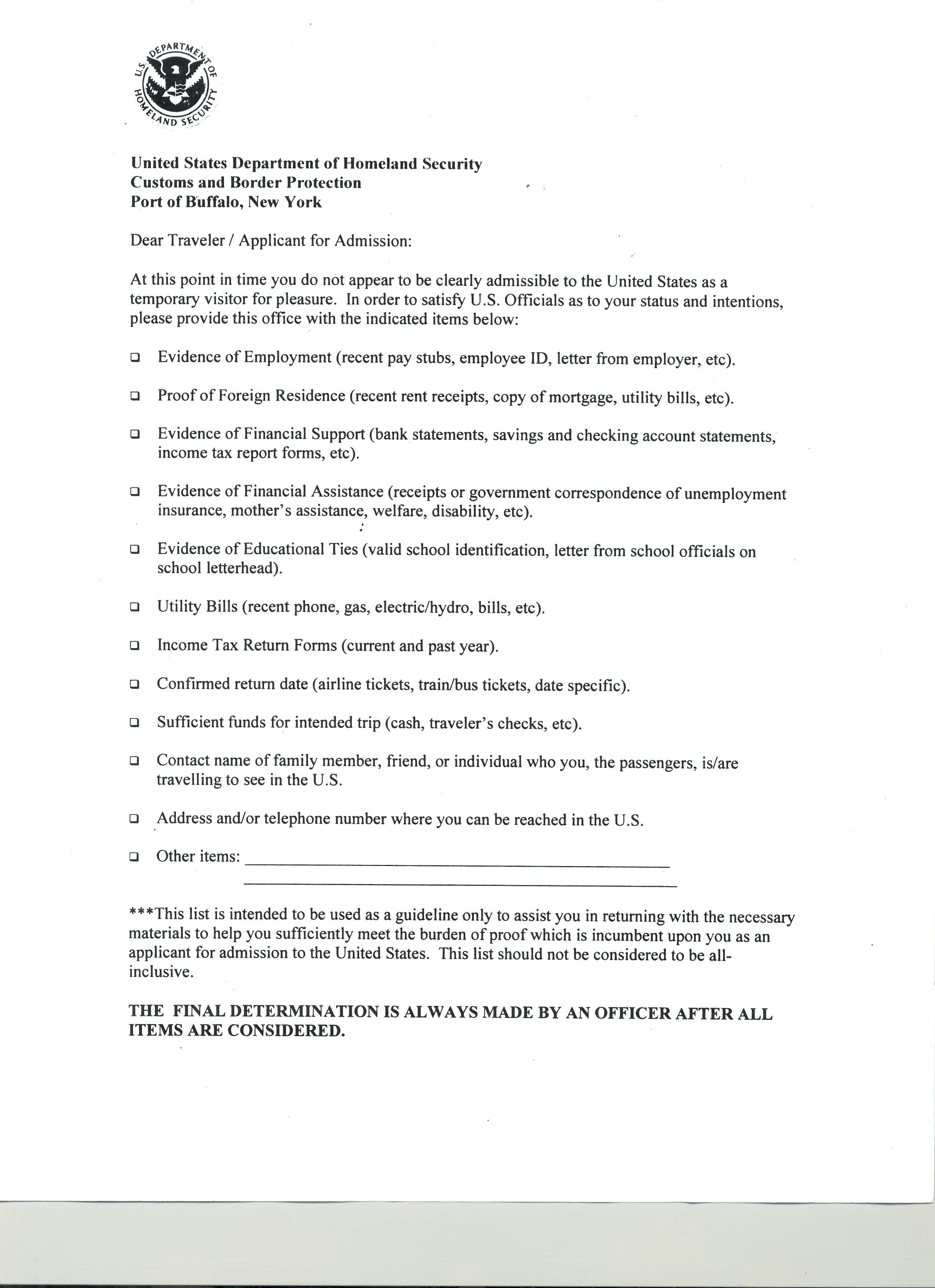
The document above is just a suggestion. Always explained as compassion –>> A visa and passport are not required of a Mexican national who is in possession of a Form DSP-150, B-1/B-2 Visa and *Border Crossing Card, containing a machine-readable biometric identifier, issued by the Department of State and is applying for admission as a temporary visitor for business or pleasure from contiguous territory by land or sea. 

Mexican citizens using the Border Crossing Card may travel 55 miles into the U.S. – except in the Nogales/Tucson area, where travel to Tucson is authorized.

The Border Crossing Card (BCC) is acceptable as a stand-alone document (by itself) only for travel from Mexico by land, or by pleasure vessel or ferry. Together with a valid passport, though, it meets the documentary requirements for entry at all land, air, and sea ports of entry (to include travel from Canada).  Note: You must be a Mexican citizen and a resident of Mexico to have a BCC.

Border Patrol’s website offers advice on eluding … Border Patrol

FNC: Immigrants who want to enter the U.S. illegally can learn how and where to avoid the Border Patrol from an advisory on the agency’s own website, which critics say is evidence of the Obama administration’s “schizophrenic” approach to enforcement.

Safety and sanctuary can generally be found at schools, churches, hospitals and protests, where Customs and Border Protection agents are barred under a “sensitive locations policy” from carrying out their duty of enforcing border security. In fact, the agency’s website states that actions at such locations can only be undertaken in an emergency or with a supervisor’s approval.

“The policies are meant to ensure that ICE and CBP officers and agents exercise sound judgment when enforcing federal law at or focused on sensitive locations, to enhance the public understanding and trust, and to ensure that people seeking to participate in activities or utilize services provided at any sensitive location are free to do so, without fear or hesitation,” the government website states in both English and Spanish.

While the explanation is apparently meant to show the deference Customs and Border Protection agents show to sensitive societal institutions, critics, including the Media Research Center, say it also tells illegal border crossers where to go if they are being pursued. Agents are barred from interviewing, searching or arresting suspected illegal immigrants in such locations.

“So, almost any illegal alien can escape arrest by either walking with a second person (a march), attending some type of class, or finding a nearby church, medical facility or school bus stop,” the Center wrote in a post bringing the advisory to light.

A “Frequently Asked Questions” section explains in detail what the Customs and Border Patrol’s parent agency, the Department of Homeland Security, considers safe zones for illegal immigrants.

  • Schools, such as known and licensed day cares, pre-schools and other early learning programs; primary schools; secondary schools; post-secondary schools up to and including colleges and universities; as well as scholastic or education-related activities or events, and school bus stops that are marked and/or known to the officer, during periods when school children are present at the stop;
  • Medical treatment and health care facilities, such as hospitals, doctors’ offices, accredited health clinics, and emergent or urgent care facilities;
  • Places of worship, such as churches, synagogues, mosques, and temples;
  • Religious or civil ceremonies or observances, such as funerals and weddings;
  • During public demonstration, such as a march, rally, or parade.

Critics of the Obama administration’s immigration policies have long complained that it undermines the mission of border enforcement by imposing rules on agents that they say leave them unable to do their jobs.

“This administration has systematically and maliciously attacked and deconstructed all phases of border enforcement,” said Dan Stein, president of Federation for American Immigration Reform. “It’s to the point now where virtually nobody has to go home. ICE is no longer carrying out its core mission, of finding, identifying and removing illegal aliens from the country.

“Agents are in a state of despair,” Stein added. “They are being turned into nursemaids, chaperones and bus drivers.”

Telling people suspected of breaking the law where they can seek refuge makes no sense, said Jessica Vaughan, director of policy studies for the Center for Immigration Studies.

“It’s schizophrenic,” Vaughan said. “What the Obama administration has done is to create sanctuaries for illegal aliens and to publicize them. That is fine for a social welfare agency, but not for a law enforcement agency. No law enforcement agency would ever want to broadcast where lawbreakers can go to be shielded from the consequences of their actions.”

The site does say the “sensitive locations policy” does not apply to places directly along the border, but warns its own agents that if they plan to move on a suspect in such a location near the border they “are expected to exercise sound judgment and common sense while taking appropriate action, consistent with the goals of this policy.”

The CBP website also provides a toll-free number and email address to allow illegal immigrants to report possible violations of the “sensitive locations” policy.


Refugees Have Temporary Status in U.S. but not under DHS

The United States has been taking in refugees, migrants and asylees from Latin America and several dozen countries for decades. This is supposed to be a temporary condition but the truth is it has never been temporary.

Image result for manbij

Now with 45 million people from just 2015 displaced from their home countries around the world, there is a crisis that is hard to define much less solve. The United Nations is the lead organization that is under pressure to find solutions and world leaders are not in any kind of collective agreement. Meanwhile, there are people, mostly innocent that are suffering. This is a historical time, one that was in fact not only predictable but solvable if civil war, conflicts and terrorism was addressed long before it manifested.

At issue is the total cost of war where there is no end in sight but more, the cost of creating a viable and living long term solution for migrants to include education, healthcare, law enforcement, jobs, entitlements to list a few. No country is monetarily prepared for the future costs many yet to be known, studied or funded.

Related reading: Bodies found off coast of Libya as migrant toll climbs

The United States had every opportunity in 2011 to launch humanitarian action missions to offset refugee conditions especially as Islamic State was born, and predicted to become a global terror operation directly after Abu Musab al-Zarqawi was killed. He is the original father of Islamic State…al Qaeda in Iraq.

Image result for zarqawi

As a result of the long war in Iraq, Syria and Afghanistan, the complete damage to cities and towns where normal infrastructure has been destroyed, there is no viable location to go back to. There are no schools, hospitals, roads, buildings and commerce has stopped except for black markets and smuggling. Further, no countries are stepping up with funds to help rebuild or as many call it, nation building.

In summary, refugees are in fact a new permanent status for wherever they are located, including the United States.

Consequently, the United Nations is chartered with drafting a global solution with world leaders.

The first cut a the draft is found here.

In part from the NewYorkTimes: Refugees and migrants will be the biggest issue at the gathering of world leaders at the United Nations next month. President Obama plans to lead a meeting at the General Assembly in an effort to nudge countries to take in more refugees and contribute to countries that have taken them in for years.

The United Nations secretary general, Ban Ki-moon, also plans to hold a meeting on the plight of refugees and migrants. The document under negotiation will be the centerpiece of his meeting.

While the draft text has no force of international law, every sentence has been argued and negotiated. The resulting language is sometimes so vague that it is likely to bring little comfort to the millions of men, women and children who are seeking safety and opportunity abroad.

Eritrea, for instance, recently complained that the many references to human rights in the document were “redundant.” (A United Nations committee earlier this year accused Eritrea of atrocities against its own citizens.)

Russia resisted a sentence that called for countries to share in the “burden” of taking in refugees. (Russia takes in very few, except lately, from parts of Ukraine.)

The United States suggested a phrase asserting that detention is “seldom” good for children. Activists for immigrants and refugees found that suggestion so appalling that they fired off a letter on Friday to President Obama. They argued that any international agreement should make clear that detention is “never in the best interests of children” and should commit to ending the practice. (The United States detains children who arrive from Mexico without legal papers.)

Amnesty International said in a statement over the weekend that “with some states trying to dilute the agreement to suit their own political agendas, we may end up with tentative half-measures that merely reinforce the status quo or even weaken existing protection.”

This draft agreement sets out a long list of principles, most already enshrined in existing laws. It says refugees deserve protection and should not be sent back to places where they could face war or persecution. It urges countries to allow refugees to work and to let their children attend school, though it stops short of saying refugees have a right to either jobs or schools.

It asserts that migration can be good for the world, which is wording that migrant-sending countries wanted. It also calls for countries to take back their citizens if they travel illegally and fail to get asylum, which is what migrant-receiving countries, especially in Europe, wanted.

An early draft had proposed a global compact to allocate where refugees could be permanently resettled, but that proposal failed. African and Latin American countries wanted to know why the compact was on refugees alone, according to diplomats involved in the negotiations. Why not also have a compact on the rights of migrants, they asked.

The latest draft sets a 2018 deadline for two compacts — one for refugees, a second for migrants.

The draft text also says nothing about the rights of the 40 million people who are displaced in their own countries, or about those who are leaving their homes because of climate change.


Another Terror Attack in Germany, Risks in USA

Al Qaeda chief urges kidnappings of Westerners for prisoner swaps

Al Qaeda chief Ayman al-Zawahiri has appeared in an audio interview calling on fighters to take Western hostages and exchange them for jailed jihadists, the monitoring service SITE Intelligence Group said on Sunday.

In recording posted online, Al-Zawahiri called on the global militant network to kidnap Westerners “until they liberate the last Muslim male prisoner and last Muslim female prisoner in the prisons of the Crusaders, apostates, and enemies of Islam,” according to SITE. More here from Reuters.

******

A 21-year-old Syrian refugee was arrested on Sunday after killing a pregnant woman with a machete in Germany, the fourth violent assault on civilians in western Europe in 10 days, though police said it did not appear linked to terrorism.

The incident, however, may add to public unease surrounding Chancellor Angela Merkel’s open-door refugee policy that has seen over a million migrants enter Germany over the past year, many fleeing war in Afghanistan, Syria and Iraq.

German police said they arrested the machete-wielding Syrian asylum-seeker after he killed a woman and injured two other people in the southwestern city of Reutlingen near Stuttgart. Much more here from Newsweek.

*****

Related reading on NGO’s: UNHCR – Partnership in Resettlement

Related reading: UNHCR –NGO Toolkit for Practical Cooperation on …

Related reading: NGOs Call on US to Resettle More Syrian Refugees | Al …

So what about the real vetting process in the United States you ask…..it is a great question.

After the Paris attacks, the White House called in 34 governors to discuss the policy and vetting process of refugees into the United States. While we focus on ‘Syrian’ refugees, they hardly make up the majority and it is this fact that must be noted. Even so, the White House, 3 days later published a chart of the vetting program and it does have some gaps (questions) that too must be answered.

‎Refugees undergo more rigorous screening than anyone else we allow into the United States. Here’s what the screening process looks like for them:

The Screening Process for Refugees Entry Into the United States (full text of the graphic written below the image)

The full text is found here from the White House.

The admission of refugees to the United States and their resettlement here are authorized by the Immigration and Nationality Act (INA), as amended by the Refugee Act of 1980. The INA defines a refugee as a person who is outside his or her country and who is unable or unwilling to return because of persecution or a well-founded fear of persecution on account of race, religion, nationality, membership in a particular social group, or political opinion. In special circumstances, a refugee also may be a person who is within his or her country and who is persecuted or has a well-founded fear of persecution on account of race, religion, nationality, membership in a particular social group, or political opinion. The maximum annual number of refugee admissions (refugee ceiling) and the allocation of these numbers by region of the world are set by the President after consultation by Cabinet-level representatives with members of the House and the Senate Judiciary Committees.

The Department of State’s (DOS’s) Bureau of Population, Refugees, and Migration (PRM) is responsible for coordinating and managing the U.S. Refugee Admissions Program. Prospective refugees can be referred to the U.S. program by the United Nations High Commissioner for Refugees (UNHCR), a U.S. embassy, or a designated nongovernmental organization (NGO), or in some cases, they can access the U.S. refugee program directly. PRM generally arranges for an NGO, an international organization, or U.S. embassy contractors to manage a Resettlement Support Center (RSC) that assists in refugee processing.

Following the consultations, the President issues a Presidential Determination that sets the refugee ceiling and regional allocations for that fiscal year. Once the Presidential Determination for a fiscal year has been issued, INA Section 207 also allows for additional refugee admissions in response to an “emergency refugee situation.” In such a situation, the President may, after congressional consultation, issue an Emergency Presidential Determination providing for an increase in refugee admissions numbers.

For FY2016, the Obama Administration initially proposed a refugee ceiling of 75,000 and held consultations with Congress on that proposal. The proposal reportedly included an allocation of 33,000 for the Near East/South Asia, the region that includes Syria.5 The Administration subsequently announced that the United States would admit at least 10,000 Syrian refugees in FY2016. On September 29, 2015, the Obama Administration released the Presidential Determination on Refugee Admissions for Fiscal Year 2016.6 It sets the FY2016 refugee ceiling at 85,000, with 79,000 admissions numbers allocated among the regions of the world and 6,000 admissions numbers comprising an unallocated reserve.7 The allocation for the Near East/South Asia region is 34,000.

Actual Admissions

In FY2015, the United States admitted 69,933 refugees. The Near East/South Asia region accounted for 24,579 admissions, of which 1,682 were Syrian refugees. In the first month of FY2016 (October 2015), total refugee admissions were 5,348, Near East/South Asia region admissions were 1,979, and Syrian admissions were 187. From October 1, 2010, through October 31, 2015, the United States admitted a total of 2,070 Syrian refugees.

Role of the Department of Homeland Security

USCIS adjudicates refugee applications and makes decisions about eligibility for refugee status. USCIS officers in the Refugee Corps interview each applicant in person and consider other evidence and information to determine whether the individual is eligible for refugee status. More comprehensive reading here.