Smuggling Network, Terror Hotbeds, Southern Border

Smuggling network guided illegals from Middle East terror hotbeds to U.S. border

WashingtonTimes: A smuggling network has managed to sneak illegal immigrants from Middle East terrorism hotbeds straight to the doorstep of the U.S., including helping one Afghan man authorities say was part of an attack plot in North America.

Immigration officials have identified at least a dozen Middle Eastern men smuggled into the Western Hemisphere by a Brazilian-based network that connected them with Mexicans who guided them up to the U.S. border, according to internal government documents reviewed by The Washington Times.

Those smuggled included Palestinians, Pakistanis and the Afghan man who Homeland Security officials said had family ties to the Taliban and was “involved in a plot to conduct an attack in the U.S. and/or Canada.” He is in custody but the Times is withholding his name at the request of law enforcement to protect ongoing investigations.

Some of the men handled by the smuggling network were nabbed before they got to the U.S., but others actually made it into the country, including the Afghan man who was part of a group of six from so-called “special interest countries.”

The group, guided by two Mexicans employed by the smuggling network, crawled under the border fence in Arizona late last year and made it about 15 miles north before being detected by border surveillance, according to the documents, which were obtained by Rep. Duncan Hunter, California Republican.

Law enforcement asked The Times to withhold the name of the smuggling network.

It’s unclear whether the network succeeded in sneaking other “special interest” illegal immigrants by border officials, but the documents obtained by Mr. Hunter confirm fears of a pipeline that can get would-be illegal immigrants from terrorist hotbeds to the threshold of the U.S.

Just as troubling, the Border Patrol didn’t immediately spot the Afghan man’s terrorist ties because the database agents first checked didn’t list him. It wasn’t until they also checked an FBI database that they learned he may be a danger, the documents say.

“It’s disturbing, in so many ways,” said Joe Kasper, Mr. Hunter’s chief of staff. “The interdiction of this group validates once again that the southern border is wide open to more than people looking to enter the U.S. illegally strictly for purposes of looking for work, as the administration wants us to believe. What’s worse, federal databases weren’t even synched and Border Patrol had no idea who they were arresting and the group was not considered a problem because none of them were considered a priority under the president’s enforcement protocol. That’s a major problem on its own, and it calls for DHS to figure out the problem — and fast.”

Mr. Hunter wrote a letter to to Homeland Security Secretary Jeh Johnson this week demanding answers about the breakdowns in the process.

Both U.S. Immigration and Customs Enforcement, which is the chief agency charged with sniffing out smuggling networks, and Customs and Border Protection, which oversees the Border Patrol and which initially failed to sniff out the terrorist connections, declined to comment. Homeland Security, which oversees both agencies, didn’t provide an answer either.

The group of six men nabbed after they already got into the U.S. — the Afghan and five men identified as Pakistanis — all made asylum claims when they were eventually caught by the Border Patrol. Mr. Hunter said his understanding is that the five men from Pakistan were released based on those claims, and have disappeared.

The government documents reviewed by The Times didn’t say how much the smugglers charged, but did detail some of their operation.

Would-be illegal immigrants were first identified by a contact in the Middle East, who reported them to the smuggling network in Brazil. That network then arranged their travel up South America and through Central America, where some of them were nabbed by U.S. allies.

In the case of the Afghan man with terrorist ties, he was smuggled from Brazil through Peru, then Ecuador, Colombia, Panama, Costa Rica, Nicaragua, Honduras, Guatemala and finally Mexico.

He was caught near a ranch 15 miles into the U.S., after his group’s movements were detected by one of the Border Patrol’s mobile detection trucks. He told agents his group had crawled under the border fence near Nogales.

In the documents obtained by Mr. Hunter, Homeland Security officials said they considered the case a victory because it showed how they can use apprehensions on the southwest border to trace smuggling networks back to their source.

But the documents had worrying signs as well. When agents first ran the man through the Terrorist Screening Data Base, he didn’t show up as a danger. Indeed, a November report from KNXV-TV in Arizona said authorities said “records checks revealed no derogatory information about the individuals.”

That turns out not to be true, according to the documents. The Afghan man was listed in the FBI’s Terrorist Identities Datamart Environment (TIDE) database as having suspect relations.

Mr. Hunter told Mr. Johnson the discrepancy between the databases was troubling.

The government documents also said some of the special interest aliens caught at the border were previously identified by authorities in other Latin American countries — but had different sets of biometric identifiers associated with them. That raised questions of whether those countries are sharing accurate information with the U.S.

Networks capable of smuggling potential terrorists has long been a concern, but the Obama administration had tamped down those worries, arguing that the southwest border wasn’t a likely route for operatives.

Still, evidence has mounted over the last couple of years, including a smuggling ring that snuck four Turkish men with ties to a U.S.-designated terrorist group into the U.S. in 2014. they paid $8,000 apiece to be smuggled from Istanbul through Paris to Mexico City, where they were stashed in safe houses before being smuggled to the border.

At the time, Mr. Johnson said the men were actually part of a group that was fighting against the Islamic State, and questioned whether they should have even been designated as part of a terrorist group.

But behind the scenes Mr. Johnson’s agents were already at work trying to roll up smuggling rings under an action dubbed Operation Citadel.

Lev Kubiak, assistant director at ICE Homeland Security Investigations’ international operations branch, testified to Congress earlier this year that Operation Citadel resulted in 210 criminal arrests in 2015. One part of the effort, known as Operation Lucero, dismantled 14 human smuggling routes, including some operations designed to move people from the Eastern Hemisphere to Latin America and then into the U.S., he said.

Next up is the U.S. State Department Report by Country on Terrorism

Country Reports on Terrorism 2015

Chapters –Chapter 1. Strategic Assessment
Chapter 2. Country Reports: Africa Overview
Chapter 2. Country Reports: East Asia and Pacific Overview
Chapter 2. Country Reports: Europe Overview
Chapter 2. Country Reports: Middle East and North Africa Overview
Chapter 2. Country Reports: South and Central Asia Overview
Chapter 2. Country Reports: Western Hemisphere Overview
Chapter 3: State Sponsors of Terrorism Overview
Chapter 4: The Global Challenge of Chemical, Biological, Radiological, or Nuclear (CBRN) Terrorism
Chapter 5: Terrorist Safe Havens (Update to 7120 Report)
Chapter 6. Foreign Terrorist Organizations
Chapter 7. Legislative Requirements and Key Terms

Annexes

National Consortium for the Study of Terrorism and Responses to Terrorism: Annex of Statistical Information [Get Acrobat Reader PDF version   ]
Terrorism Deaths, Injuries and Kidnappings of Private U.S. Citizens Overseas in 2015

Full Report

Country Reports on Terrorism 2015 (PDF)

Fast and Furious Weapons and Mass Killings

Documents: Mexican Cartels Used Fast and Furious Guns For Mass Killings

TownHall: New documents obtained by the government watchdog Judicial Watch prove, again, that guns sold through the Obama Justice Department’s Fast and Furious Operation have been used by Mexican cartels for mass murder south of the border.

“According to the new records, over the past three years, a total of 94 Fast and Furious firearms have been recovered in Mexico City and 12 Mexican states, with the majority being seized in Sonora, Chihuahua and Sinaloa.  Of the weapons recovered, 82 were rifles and 12 were pistols identified as having been part of the Fast and Furious program.  Reports suggest the Fast and Furious guns are tied to at least 69 killings,” Judicial Watch reports. “The documents show 94 Fast and Furious firearms were seized, 20 were identified as being involved in ‘violent recoveries.’  The ‘violent recoveries’ involved several mass killings.”

The documents include locations, type of gun recovered and number of people killed:

June 30, 2014 — One 7.62mm rifle recovered in Tlatlaya, Estado de Mexico.  This is the reported date and location of a shootout in which 22 people were killed.

May 22, 2015 — Two 7.62mm rifles recovered from the site of a massive shootout in Rancho el Sol, Michoacán, that left one Mexican Federal Police officer and 42 suspected cartel members dead.

August 7, 2015 — One 7.62mm rifle was among five firearms reported as recovered from an abandoned stolen vehicle in which three dead shooting victims were found in Parral, Chihuahua.

January 29, 2013 — One 7.62mm rifle seized in Hostotipaquillo, Jalisco is reportedly related to the assassination of the town police chief, Luis Lucio Astorga and his bodyguard.

January 11, 2016 — One .50 caliber rifle seized from the Joaquin “Chapo” Guzman’s hideout in Los Mochis, Sinaloa, where he was (re)arrested.

Keep in mind these stats only relate to 94 Fast and Furious guns, most of them being AK-47s and .50 caliber rifles, that have been recovered. The Department of Justice, with help from ATF, trafficked more than 2500 of them right into the hands of violent Mexican cartels members. Fast and Furious guns are only recoverable and traceable when they are left at crime scenes, which doesn’t account for the number of times they were used in previous crimes.

Former Attorney General Eric Holder admitted during congressional testimony years ago that guns trafficked by the DOJ would be used to carry out violent crimes. In 2011, former House Oversight Committee Chairman Darrell Issa told reporters, citing Mexican Attorney General Marisela Morales, hundreds of Mexican citizens had been murdered as a result of the operation. Since then, a number of guns from the operation have been found at crime scenes in the U.S.

“These documents show President Obama’s legacy includes one of gunrunning and violence in Fast and Furious,” Judicial Watch President Tom Fitton said in a statement.  “As the production of documents from the ATF continues, we expect to see even further confirmation of Obama’s disgraced former Attorney General Eric Holder’s prediction that Fast and Furious guns will be used in crimes for years to come.”

Last month a federal judge struck down an executive privilege claim made by President Obama in June 2012 over thousands of Fast and Furious documents. Those documents show the lengths Holder and his closest aides at DOJ went to cover-up the Operation and the scandal that followed, which became public when Border Patrol Agent Brian Terry was murdered by Mexican bandits in December 2010. They were carrying guns from Operation Fast and Furious.

DHS: Border Patrol/Coast Guard Drone Conflict

But in 2015, the Office of Inspector General says the CBP drone program has essentially been grounded.

The IG report, the second audit of the program since 2012, found there is no reliable method of measuring the program’s performance and determined that its impact in stemming illegal
immigration has been minimal.

According to the CBP Fiscal Year Report, the drones flew about 10 percent fewer hours in 2014 than the previous year and 20 percent fewer than in 2013. The missions were credited with contributing to the seizure of just under 1,000 pounds of cocaine in 2014, compared to 2,645 in 2013 and 3,900 in 2012. But apprehensions of illegal immigrants between 2014 and 2013 fell despite the flood of more than 60,000 unaccompanied children coming across the border from Central America.

Combined with the decrease in productivity, the OIG report disclosed the staggering costs to run the program, more than $12,000 per hour when figuring fuel, salaries for operators, equipment and overhead. More from FNC.

Related: Coast Guard UAV System

Related: CBP and Coast Guard even share buildings


Bungling border agency can’t find drone records

WashingtonTimes: Homeland Security can’t find a single record of a request to fly drones to help the Coast Guard, the agency said this week in a letter to a top member of Congress — an admission that’s likely to add fuel to the guard’s request for its own fleet of unmanned aerial vehicles.

R. Gil Kerlikowske, commissioner of Customs and Border Protection, said his agency’s Air and Marine office records all requests, but for some reason it “could not locate any prior requests from the USCG” for unmanned aerial surveillance flights.

For Rep. Duncan Hunter, California Republican and chairman of a subcommittee that oversees the Coast Guard, the admission was the latest signal that the border agency isn’t treating its colleagues in the guard fairly.

“It’s baffling, really. This response goes to show just how disadvantaged the Coast Guard truly is under the DHS umbrella,” said Joe Kasper, Mr. Hunter’s chief of staff. “It’s impossible to excuse the terrible record keeping, but that aside — we know for a fact that the Coast Guard has made numerous requests for UAS support.”

Both the Coast Guard and CBP are part of the Homeland Security Department, and under the current arrangement the guard has to use CBP’s drones. That leaves the maritime mission hostage to the whims of border officials, who have their own missions, and who already struggle with logistics and maintenance problems that keep their fleet of drones grounded far too often.

Mr. Hunter is pressing for the Coast Guard to get its own ground-based drones, which it can assign on its own.

“The Coast Guard shouldn’t have to rely on CBP and vice versa. We know CBP is well intentioned, and it has its own mission, but that doesn’t help the Coast Guard beyond the joint operational space,” Mr. Kasper said.

Neither CBP nor the Coast Guard had substantive replies to requests for comment Tuesday afternoon, but in his letter, dated Monday, Mr. Kerlikowske insisted the two agencies “work side-by-side.”

He said even if Coast Guard requests aren’t recorded, there are clear instances when CBP was assisting the guard’s operations. He pointed to a Guardian drone that aided the Coast Guard Cutter Boutwell in making three interdictions over the last year.

“CBO and USCG are close partners and have been highly successful performing joint operations in support of DHS’s primary mission to protect the American people from terrorist threats,” Mr. Kerlikowske said.

He said they will try to improve operations.

But his agency has been promising better drone use for years, and has consistently fallen short, according to watchdog reports.

Just 5 percent of Drone flights were conducted in the southeast, meaning off the coast of Florida, according to a new report Tuesday by the Government Accountability Office. The rest of the time the drones were operating on the border with Canada or the landlocked southwest border with Mexico.

Homeland Security Inspector General John Roth last year called CBP’s drone program “dubious achievers,” saying hundreds of millions of dollars have been wasted to stock a fleet that often can’t even get into the air.

He put the cost of flying each drone at more than $12,000 an hour — five times the figure CBP had given.

“Notwithstanding the significant investment, we see no evidence that the drones contribute to a more secure border, and there is no reason to invest additional taxpayer funds at this time,” Mr. Roth said in releasing his report last year. “Securing our borders is a crucial mission for CBP and DHS. CBP’s drone program has so far fallen far short of being an asset to that effort.”

Declining Deportations and Increasing Criminal Alien Releases

Declining Deportations and Increasing Criminal Alien Releases –

The Lawless Immigration Policies of the Obama Administration

Subcommittee on Immigration and the National Interest

May 19, 2016

Statement of Mark Krikorian

Executive Director, Center for Immigration Studies

Hearing May 19, 2016

Deportation is crucial. Credibility in immigration policy can be summed up in one sentence: Those who should get in, get in; those who should be kept out, are kept out; and those who should not be here will be required to leave.

– Barbara Jordan

CIS: The Obama administration has embraced a radical new approach to immigration law. It has, without the consent of Congress, transformed violation of immigration law into a “secondary offense.” That is to say, the goal is to ensure that an alien faces consequences for breaking immigration law only if he also breaks some other, “real,” law involving, say, violence or drug dealing. And even then, the primary violation has to be quite severe to warrant deportation for the (secondary) immigration offense.

This is comparable to the seat belt laws in many states; in places where failing to wear a seat belt is a secondary offense, a police officer cannot pull you over just for that, but if he pulls you over for speeding or some other primary offense, he can then also write a seat belt citation.

The administration’s November 2014 deportation priorities memo pretends this is not so; it includes ordinary violations of immigration law, but only as the lowest priority for deportation. And the collapse in interior removals of immigration violators shows that this third priority category is just for show.

John Sandweg, former acting director of ICE, stated the Obama administration position succinctly: “If you are a run-of-the-mill immigrant here illegally, your odds of getting deported are close to zero.”

This extra-legal shift in the conception of the immigration statute has been misleadingly packaged as “prosecutorial discretion.” True prosecutorial discretion is exercised by individual law enforcement officers in ways that do not undermine the agency’s mission. For instance, if a state trooper stops you for speeding and your documents are in order, you’ve interacted with him in a respectful manner, and your toddler in the back seat is crying because she needs her diaper changed — and he lets you off with a warning rather than a fine, that is prosecutorial discretion.

What the Obama administration has done is use discretion as a pretext for simply exempting the vast majority of immigration violators from any possibility of legal consequences.

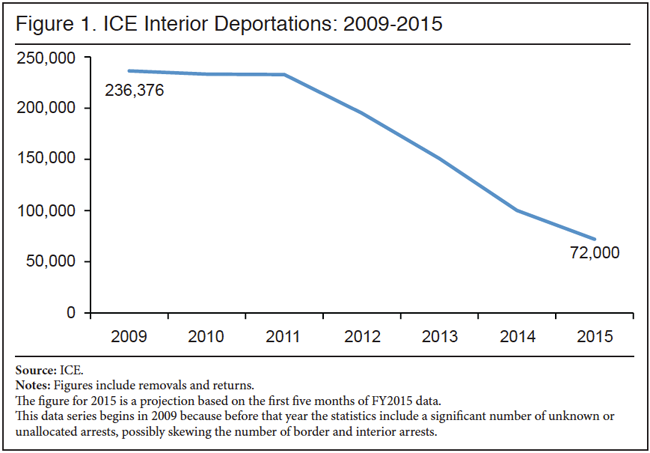
The results of this transformation of immigration law are clear in the data. ICE statistics show that deportations from the interior (aliens arrested by ICE deportation officers and special agents, as opposed to the Border Patrol) have collapsed, from 236,000 in President Obama’s first year in office to 72,000 last year, a decline of 70 percent over the course of this administration:

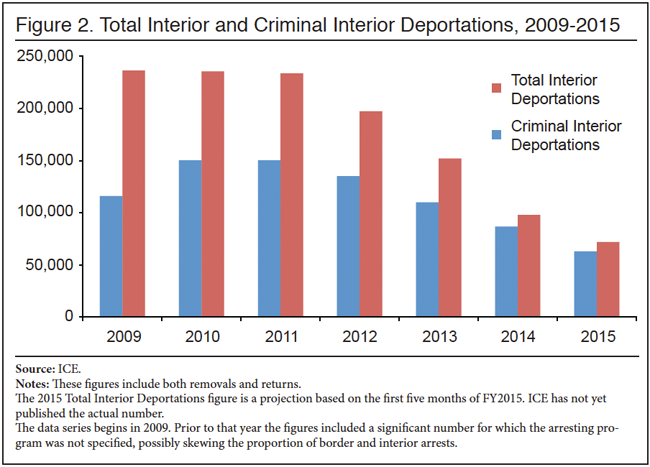
Not only have total interior deportations collapsed, but even the removal of criminals has declined by more than half, from about 150,000 in 2010 and 2011 to about 63,000 last year — this despite the Obama administration’s claim of prioritizing such removals:

This decline has occurred despite increases in the number of criminal aliens identified by ICE, largely from the nationwide implementation of the Secure Communities program, which screened the fingerprints of aliens arrested by local law enforcement agencies. This successful program, which was tremendously popular with local law enforcement agencies, was dismantled by the president’s November 2014 executive actions, and replaced by the Priority Enforcement Program (PEP). ICE removal officers are still alerted to the arrest of criminal aliens by local police, but are prohibited by the White House and subservient ICE political leadership from acting on that information.

This collapse in deportations is not because we’ve run out of illegal aliens. After declining in 2007-2009 because of new enforcement efforts at the end of the Bush administration, followed by the recession, the number of illegal aliens has remained essentially constant at between 11 and 12 million. Many of these are new illegal arrivals — we estimate that some 2.5 million new illegal immigrants settled here during the first six years of the Obama administration, offset mainly by departures and legalizations.

Nor is the steep drop in deportations due to a lack of resources. Last year the Obama administration re-programmed $113 million that Congress had provided to ICE/ERO for enforcement and gave it to other agencies within DHS. The White House 2017 budget request actually seeks a decrease in funding for immigration enforcement, most notably a decrease of $100 million in funding for detention beds — from 34,000 beds to 30,900 — and a 15 percent decrease in funding for fugitive operations (i.e., the effort to locate the roughly 900,000 people ordered deported who simply ran off).

Rather, the collapse in enforcement is a policy choice of the Obama administration. Its strategic vision is, as I described above, to downgrade the immigration law to a secondary status. Among the tactics that serve this strategy, especially with regard to criminals, is the termination of the successful Secure Communities program and its replacement with the Priority Enforcement Program (PEP). There are three ways PEP suppresses enforcement:

  1. The new, more restrictive PEP prioritization scheme exempts a larger number of criminal aliens from deportation. Essentially, under PEP the only aliens ICE officers can target for deportation are people convicted of felonies, multiple “serious” misdemeanors, certain gang members, terrorists, and recent deportees. This exempts large numbers of criminal aliens from deportation.
  2. PEP imposes new logistical hurdles for ICE, most notably the requirement that an alien be convicted before ICE takes custody — which can enable a criminal alien to abscond from facing charges, or in some cases walk out of a courthouse or jail before ICE is aware that the offender is being released; and
  3. PEP explicitly allows local governments to impose non-cooperation or sanctuary policies on local law enforcement agencies. In 2014, local sanctuary jurisdictions released more than 10,000 aliens that local ICE field officers were seeking to deport.

As a result of these policies, fewer deportable aliens (and criminal aliens) are being removed from the country and criminal aliens who formerly would have been removed are now being released back to our communities only to commit new crimes.

There is an enormous public safety cost to these enforcement suppression policies. Since 2013 ICE has released approximately 85,000 criminal aliens from its custody. Many of these aliens have gone on to commit additional crimes. More than 125 have since been charged with homicide.

Here are some of the most egregious examples of crimes committed by illegal aliens released from ICE custody because of the president’s prioritization rules:

Sarah Root. In Omaha, Nebraska, on January 31, 2016, an illegal alien named Eswin Mejia, age 19, who had entered illegally as an “unaccompanied minor” but was allowed to stay with his brother, was drag racing while drunk and crashed his pick-up truck into the back of a car driven by Sarah Root, age 21. She died in the hospital soon after, just a day after her graduation from college. Mejia was arrested several days later for felony motor vehicle homicide. He had prior infractions as well. Bail was set at $50,000. Knowing Mejia was an illegal alien, local police contacted ICE five times to urgently request a detainer, fearing he would flee after making bail. ICE refused, saying that Mejia “did not meet ICE’s enforcement priorities.” As the local police feared, Mejia disappeared after posting bail.

Grant Ronnebeck. A 21-year-old man who was murdered while working at a convenience store in Mesa, Arizona. Ronnebeck’s killer was an illegal alien who was released by ICE in 2013 after conviction for a burglary and kidnapping involving drug dealing, to await an immigration hearing years in the future.

Katerin Gomez. This 35-year-old mother of three children under age 13 was killed in Chelsea, Massachusetts, on October 18, 2014, by a stray bullet through her window. The gun was fired during a street brawl allegedly by Hector Ramires, a 21-year old illegal alien member of the notoriously violent MS-13 gang, who was at large awaiting trial for two prior arrests for armed robbery (one with a gun, one with a knife), in which his illegal status and gang membership were noted. The police report also includes mention of prior criminal involvement in his home country of Honduras. ICE did not issue a detainer or initiate deportation proceedings after either prior arrest, nor did it make an effort to charge Ramires as an illegal alien in possession of a firearm, which is a felony punishable by up to 10 years in prison.

Greg Morton. This Frederick County (Maryland) sheriff’s deputy was attacked last November while sitting in his vehicle by Jose Misael Reyes-Reyes, an 18-year-old illegal alien who had entered as an unaccompanied minor. The attacker was a member of the notoriously violent MS-13 gang and had prior arrests, including one for carrying a dangerous weapon. ICE declined to take him into custody after the prior arrests because he was already awaiting an immigration court hearing.

* * *
Prioritizing enforcement resources is not, in itself, the problem we face in immigration. Applying any body of law requires trade-offs and choices. The Treasury Department, for instance, devotes significant resources to the detection of money-laundering by organized crime or funding for terrorists. But it also has parallel initiatives of routine enforcement, to serve as a deterrent for ordinary taxpayers who might be tempted to cheat. Likewise in traffic enforcement; a driver doing 100 miles per hour through a school zone, firing a gun out the window, will obviously be top priority — but at the same time, there are parallel, routine enforcement efforts — speed traps and the like — to deter ordinary people from endangering others with unsafe driving.

If the IRS were to issue memos exempting anyone who’s not a mobster or terrorist from paying taxes, Congress would be aghast. Yet that is precisely what ICE has been ordered to do in the immigration context.

Some might object that the anticipated “raids” to take Central American illegal aliens into custody prove that the administration has not relegated immigration law to secondary status. Unfortunately, the opposite is true. The first round of “raids,” in January, netted a whopping 121 people — out of thousands of recent Central American illegal aliens — and only 70 of them were actually deported. Even if this next round of apprehensions is several times larger, it still amounts to nothing more than “enforcement theater.” It’s not even good enforcement theater. These Kabuki raids are too small — microscopic would be more accurate — to change the perception in Central America that if you get into the United States it’s unlikely you’ll ever be required to leave.

Despite staged disagreements with the administration over immigration enforcement, Congresswoman Pelosi concisely articulated the view she shares with the White House when she said in 2013 that “Our view of the law is that … if somebody is here without sufficient documentation, that is not reason for deportation.”

This is very different from an earlier Democratic congresswoman, Barbara Jordan, a civil rights pioneer and champion of the rule of law. As head of the bipartisan U.S. Commission on Immigration Reform, Jordan testified before Congress that “Credibility in immigration policy can be summed up in one sentence: Those who should get in, get in; those who should be kept out, are kept out; and those who should not be here will be required to leave.”

Hizbollah is Out of Control

By New Jersey DHS

Hizballah

Hizballah is an Islamic militant group based in Lebanon and allied with Iran. Its primary goal is the destruction of Israel.

  • Since 2013, Hizballah has plotted attacks against Israeli citizens and institutions in Europe, South America, Southeast Asia, the Middle East, and Africa. In January, five Palestinians were arrested on suspicion of joining a Hizballah cell and planning a suicide bombing and shooting in the West Bank. In June 2015, a Hizballah member pled guilty to acquiring nine tons of ammonium nitrate in Cyprus, which was intended for attacks against Israelis.
  • Although Hizballah possesses the capability to attack the United States and Western interests, the group is focused on supporting Bashar al-Assad’s regime in Syria. Hizballah receives training, weaponry, and about $200 million per year from Iran.
  • In 2013, Hizballah’s involvement in the Syrian conflict shifted from an advisory to a combat role. The group’s commitment is demonstrated by the number of personnel it has dispatched to Syria—Western media estimate 6,000 to 8,000 fighters, or roughly one-quarter of its assessed fighting force.

Threat to New Jersey: Low

The terror threat from Hizballah to New Jersey is low because the group’s resources and efforts are focused on supporting the Assad regime in Syria. Nonetheless, group supporters and sympathizers are active in the New Jersey region, primarily in fundraising. 

  • In February, the Drug Enforcement Administration (DEA)—to include its Newark office—and international agencies across seven countries uncovered a global Hizballah drug and money-laundering scheme. In October 2015, federal authorities in New York—acting in concert with the Newark DEA office—arrested two Hizballah associates for conspiring to launder narcotics proceeds and international arms trafficking.
  • In July 2013, Moussa Ali Hamdan, a former New Jersey resident, was sentenced in Philadelphia for providing proceeds from counterfeit goods sales to Hizballah.

US Nexus

  • Since 2005, approximately 20 Hizballah-related cases have been prosecuted in the United States. Half of the cases were along the East Coast, including in New York and Pennsylvania. None were in New Jersey.
  • Hizballah has never conducted an attack on US soil, but it has targeted the US military in Lebanon, including the bombing of a US Marine compound in 1983 in Beirut, which killed 241 US personnel.

DEA: Hizballah Drug Trafficking and Money Laundering Arrests

In January, the Drug Enforcement Administration (DEA), along with its European counterparts, arrested members of Hizballah’s External Security Organization Business Affairs Component in Europe for drug trafficking and money laundering, the proceeds of which transited through Lebanon to support Hizballah operations in Syria. The DEA operation, known as Project Cassandra, involved law enforcement agencies from seven countries and targeted Hizballah’s cocaine trafficking in the United States and Europe.

  • Hizballah developed business relationships with South American drug cartels supplying cocaine to the US and European markets. According to the DEA, Hizballah laundered the drug revenue through the acquisition and sale of high-valued vehicles, sometimes concealing money inside vehicles shipped internationally.
  • In February 2015, European authorities launched an investigation based on DEA leads and discovered a network of couriers collecting and transporting drug proceeds—in the form of euros—from Europe to the Middle East. The revenue was then transferred to Colombian cartels using the hawala disbursement system, a payment network based on trust and the use of family and regional connections.
  • US agencies participating in Project Cassandra include the Newark DEA office, US Customs and Border Protection, the US Treasury’s Financial Crimes Enforcement Network, and the US Treasury Office of Foreign Assets Control. Officials did not specify the number of individuals arrested nor the location of arrests in Europe. The investigation is ongoing.

Exploiting Outbound Cargo Vulnerabilities

Hizballah continues to launder narcotics proceeds through US maritime ports by leveraging the inundated outbound cargo shipment process and concealing contraband in otherwise legal outbound vehicle shipments. Since October 2015, Customs and Border Protection (CBP) in the Port of New York and New Jersey has processed more than 25,000 export vehicle titles per month in accordance with current regulations and performed, on average, more than 500 physical vehicle examinations per month.

  • This year, the Drug Enforcement Administration’s Project Cassandra targeted a Hizballah network selling narcotics in the United States and Europe and laundering the proceeds through the acquisition and sale of high-end vehicles, sometimes concealing money inside vehicles shipped internationally.
  • In 2011, US authorities filed a civil money-laundering suit against three Lebanese financial organizations and two Beirut-based money exchange houses, accusing them of wiring at least $329 million in drug proceeds to 30 used car dealerships in the United States—one located in North Arlington (Bergen County).
  • In 2010, the FBI disrupted two Hizballah-linked schemes—one in Virginia where money was hidden in tires of used vehicles being shipped via maritime vessels to Lebanon, and another in Ohio where authorities arrested a couple for attempting to conceal $200,000 in a vehicle they planned to ship to Lebanon.

The Port of New York and New Jersey has implemented mitigation strategies to stop the movement of contraband through outbound cargo in New Jersey. For example, in 2005, CBP, US Immigration and Customs Enforcement, Homeland Security Investigations, and other federal, state, local, and international law enforcement agencies created the Border Enforcement Security Task Force—more commonly known as BEST—to coordinate information sharing between agencies. In addition, CBP’s Customs Trade Partnership Against Terrorism encourages private-sector companies to provide information about suspicious activity related to cargo shipments.

Interwoven Money Laundering and Smuggling Systems

Hizballah’s profits from narcotics and other criminal activity are transferred via multiple forms of money laundering and illicit enterprises, including hawala money exchanges, the Black Market Peso Exchange (BMPE), and bulk cash smuggling. In March, the Director of the Stein Program on Counterterrorism and Intelligence at the Washington Institute for Near East Policy reported to Congress that despite receiving up to $200 million from Iran each year, Hizballah uses various criminal methods to generate additional revenue and fund its involvement in Syria.

  • Hizballah operatives can transfer cash quickly and without an audit trail by using the hawala remittance system, an informal currency transfer system operating outside or parallel to traditional banking and financial channels.
  • In February, the Drug Enforcement Administration revealed—as part of its Project Cassandra investigation—Hizballah leverages the BMPE, which uses trade-based money laundering to disguise proceeds from illegal activity.
  • Hizballah smuggles large sums of money from the United States, South America, and Europe via couriers and airport employees. The arrest of a ground services coordinator at Chicago’s O’Hare International Airport in 2007 demonstrates Hizballah supporters have bypassed airport security to transport packages of cash—in this case up to $100,000—intended to finance Hizballah operations in Lebanon.