Obama/Kerry Cant Modify Iran, Cyber Army

Iran’s cyber army – the latest in a series of maleficence

TheHill: In July, when the P5+1 struck a nuclear deal with Iran dubbed as “historic,” administration officials spun it as a first step on a path toward improving Tehran’s behavior. That path hit yet another bump in recent weeks, when Iran launched nuclear-capable missiles in defiance of a United Nations Security Council resolution that endorsed the nuclear deal.

In a letter to the U.N., the U.S., France, Great Britain and Germany decried the missile tests. Secretary of State John Kerry speaking on a visit to Bahrain on April 7, 2016, condemned “the destabilising actions of Iran.”

Iran’s Minister of Defense Brig. Gen. Hossein Dehghan shot back: “If John Kerry actually thought about these subjects, he would no longer utter nonsense and foolish words.” The U.S., he said, should “leave the region and stop supporting terrorists.”

The Iranian regime, in contrast, clearly has no plans to curtail its regional meddling. According to reports from inside the Iranian regime, Supreme Leader Ali Khamenei has dispatched hordes of Islamic Revolutionary Guard Corps (IRGC), mercenary militias, as well as groups of regular army forces to Syria in anticipation of new attacks against the opposition and Free Syrian Army (FSA).

In a move unparalleled since the Iran-Iraq war, Khamenei has deployed his military on a large scale abroad.

The missile launches, coupled with the Iranian regime’s expanding role in wreaking havoc in Syria, naturally grabbed the headlines, overshadowing a no less disturbing report by the U.S. Justice Department that Iran was behind a series of cyber attacks against the U.S., targeting at least 46 companies and a dam by 2013. Now, new and stunning intelligence about the scope and depth of the Iranian regime’s investment in a cyber war against the U.S. are widening the anti-terror focus.

According to the U.S. indictment, between 2011 and 2013, hackers linked to the IRGC attacked U.S. financial institutions as well as a flood-control dam 25 miles north of New York City. Other targets included the New York Stock Exchange, Bank of America, and AT&T.

The hackers broke into the command and control system of the dam in 2013, according to Washington, and may have been able to release water from behind the dam if not for the fact that the sluice gate had been manually disconnected at the time of intrusion.

This is an unequivocal warning that the Iranian regime is preparing to mount a larger cyber attack against American infrastructure.

According to new reports from inside the Iranian regime, IRGC commander Mohammad-Ali Jafari has thrown his weight behind designating a “Cyber Force” to act as the IRGC’s “sixth force” – alongside its ground forces, navy, aerospace, extraterritorial Qods (Jerusalem) Force, and domestic Bassij militia.

The IRGC has been deeply involved in cyber warfare aimed at domestic suppression and supporting terrorists abroad since 2007. IRGC Brigadier General Hossein Hamedani (killed in late 2015 leading the charge in Syria) announced in 2010, “The Bassij cyber council has trained over 1,500 active ‘cyber jihadis,’” promising that their activities would increase in the near future.

When the IRGC’s Intelligence Organization was formed following the 2009 nationwide uprisings against the theocracy, the Cyber Army was placed under it. In November 2010, the Cyber Army claimed that it had hacked 500 sites simultaneously, while disrupting the intelligence networks and private websites of other counties.

Tehran has no intention of getting “right with the world,” as President Obama once suggested. The Iranian regime is committed to pursuing a strategic war against the U.S. and its allies. Any hopes of change in behavior are illusory at best.

Washington needs to develop a more comprehensive strategy to confront this threat before it’s too late. Since the regime’s cyber force, now targeting U.S. sites was formed to counter social protests and political activism inside Iran, America’s natural allies in this war are the Iranian people and the organized opposition.

Related: 2013: The Iranian Cyber Threat, Revisited

Statement before the U.S. House of Representatives Committee on Homeland Security/Subcommittee on Cybersecurity, Infrastructure Protection, and Security Technologies

******

In 2014: As international scrutiny remains focused on the Islamic Republic of Iran’s nuclear program, a capability is developing in the shadows inside Iran that could pose an even greater threat to the United States. The 2010 National Security Strategy discusses Iran in the context of its nuclear program, support of terrorism, its influence in regional activities, and its internal problems. There was no mention of Iran’s cyber capability or of that ability to pose a threat to U.S. interests. This is understandable, considering Iran has not been a major concern in the cyber realm. Furthermore, Russia and China’s cyber activities have justifiably garnered a majority of attention and been widely reported in the media over the past decade. Iran’s cyber capabilities have been considered third-tier at best. That is rapidly changing. This report discusses the growing cyber capability of Iran and why it poses a new threat to U.S. national interests.

Iran in a Cyber Context.
      Just as computing power grows exponentially each year, so can an adversary’s cyber capabilities. When one considers the origins of world-class cyber threats to the United States, two countries immediately come to mind—Russia and China. Yet with its growing cyber capabilities and intent to use them, Iran is rapidly striving to earn a position among the ranks of this nefariously elite group. For decades, the U.S. Government has publicly acknowledged concern over Iran’s efforts to develop a nuclear program to counter U.S. military capabilities. Recently, the 2014 Quadrennial Defense Review stated that, “Over the past 5 years, a top Administration priority in the Middle East has been preventing Iran from acquiring a nuclear weapon.”2 This focus on Iran’s nuclear ambitions has distracted many from Iran’s other developing capability. In the last few years, Iran’s cyber proficiency has garnered the attention of a select few government officials and private industry leaders. In late-2011, the executive chairman of Google stated, “The Iranians are unusually talented in cyber war for some reason we don’t fully understand.”3 Stopping a cyber adversary from disrupting activity or stealing intellectual property has been the primary concern of government and private sector organizations, but in the military and intelligence communities, there are other concerns about Iran. More here.

$600 Billion, Failing Classrooms

US Spends $600 Billion/Year on Education, But Large Majority of H.S. Seniors Not College-Ready

Hollingsworth/(CNSNews.com) – Despite the fact that the U.S. spends more than $600 billion per year on public education, a large majority of high school seniors are not ready for college-level work in math and reading, according to the latest results of the 2015 National Assessment of Educational Progress (NAEP), also known as “the nation’s report card”.

Demonstrating proficiency in a core subject like math or reading is considered proof of being academically prepared for college-level courses.

However, just 25 percent of 12th graders tested “Proficient” or above in math on the 2015 NAEP, down slightly from the 26 percent reported in 2013.

That means that three-quarters of the nation’s soon-to-be-graduating high school seniors are not prepared to succeed in college math courses.

Although more 12th graders (37 percent) tested “Proficient” or above in reading, that figure was also down one percent from the 2013 results.

According to NAEP, nearly two-thirds of high seniors do not have the written language skills they will need in college.

The average score of the 31,900 12th graders who took the 2015 NAEP math test was 152, which was down in all four content areas and one point lower than the average score (153) in 2013, Peggy Carr, acting commissioner of the National Center for Education Statistics (NCES), told reporters during a webinar on Wednesday announcing the latest NAEP results.

Only three percent of those taking the math assessment tested “Advanced.” Another 22 percent tested “Proficient”, with 37 percent of test-takers demonstrating a “Basic” mastery of mathematics.

However, the largest contingent – 38 percent – tested at the lowest “Below Basic” level. “There is a larger proportion of students at the bottom of the distribution” than in 2013, Carr acknowledged.

English Language Learners, who posted a six-point gain, were the only student sub-group to significantly increase their math scores over 2013 levels, she pointed out.

The average score in reading (287) was not significantly different from the average score reported in 2013 (288), Carr said.

Six percent of high school seniors scored in the “Advanced” reading category, with 31 percent testing “Proficient”, and 35 percent scoring in the “Basic” range.

However, 28 percent failed to demonstrate even basic mastery of the written word – three percent more than in 2013.

Carr noted that the 2015 NAEP results remained virtually unchanged for various racial and ethnic sub-groups compared to 2013. In general, white and Hispanic males tended to do better on the math tests, while females overall did better on the reading assessments, she pointed out.

Education experts also noted that average math scores were higher for students who took more challenging pre-calculus and calculus classes, and average reading scores were the highest for students who reported reading more than 20 pages of text a day in school or while doing their homework assignments.

When CNSNews.com asked how the latest reading and math NAEP scores compared to student test scores worldwide, Carr replied that “we will wait to see” when the next international results are released in November and December.

According to the latest available figures from NCES, “the 50 states and D.C. reported $603.7 billion in funding collected for public elementary and secondary education in 2013.”

State and local governments provided 91 percent of all education funding, while the federal government paid the remaining 9 percent.

*****

Don’t go away yet, there is more and it is worse.

Obama budgets $17,613 for every new illegal minor, more than Social Security retirees get

Paul Bedard, the Washington Examiner: President Obama has budgeted $17,613 for each of the estimated 75,000 Central American teens expected to illegally cross into the United States this year, $2,841 more than the average annual Social Security retirement benefit, according to a new report.

The total bill to taxpayers: $1.3 billion in benefits to “unaccompanied children,” more than double what the federal government spent in 2010, according to an analysis of the administration’s programs for illegal minors from the Center for Immigration Studies. The average Social Security retirement benefit is $14,772.

The report notes that the president’s budget, facing congressional approval, includes another $2.1 billion for refugees, which can include the illegals from Central America, mostly Honduras, Guatemala and El Salvador.

What’s more, the administration is also spending heavily on a program with the United Nations to help the illegal minors avoid the dangerous trip by declaring them refugees and handing them a plane ticket to the U.S. where, once here, they get special legal status.

The report, titled “Welcoming Unaccompanied Alien Children to the United States,” is a deep dive into the administration’s evolving efforts to let hundreds of thousands of mostly 16- and 17-year-old males settle in the country.

It said that most of the undocumented minors do not qualify for refugee status or are even in any danger in their native countries. Instead, they are seeking to unify with their family members, commonly parents in the United States illegally.

The report cited Department of Health and Human Services data showing the trend. “New data,” said CIS, “shows that 80 percent of the 71,000 Central American children placed between February 2014 and September 2015 were released to sponsors who are in the United States illegally.”

Go here for charts and full report.

Author Nayla Rush suggested that the administration’s Central American Refugee/Parole Program with the United Nations that declares minors refugees could have the effect of giving legal status to their illegal parents once in the U.S.

“Children will be able to qualify for refugee status and then be flown to the United States. As a reminder, refugees receive automatic legal status and are required to apply for a green card within their first year following arrival. They can apply for citizenship five years from the date of entry.

“Since parents from Central America illegally present in the United States could not benefit from the CAM program and sponsor their children, perhaps the reverse can take place with children admitted under this new version of the refugee program. Children, acquiring legal status followed by naturalization by the time they reach adulthood, could indeed sponsor their parents,” wrote Rush.


Bashir al Assad’s Alawite Sect Fissures, Talks Fail

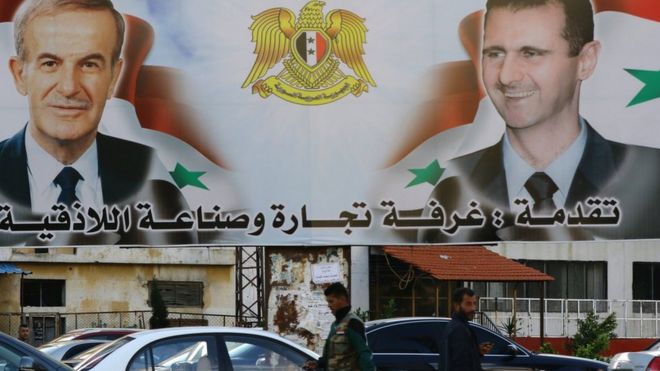
A billboard sponsored by the chamber of commerce and industry shows pictures of Syrian President Bashar al-Assad (R) and his late father former president Hafez al-Assad in the coastal city of Latakia (17 March 2016) AFP, Syria’s Alawites are closely associated with Bashar al-Assad (R) and his late father Hafez (L) 
‘Muslim quality’

In part from BBC: The Alawites emerged in the 10th Century in neighbouring Iraq.

Little has been confirmed about their beliefs and practices since then because, according to the leaders, they had to be hidden to avoid persecution.

However, most sources say the name “Alawite” refers to their veneration of the first Shia imam, Ali, the son-in-law and cousin of the Prophet Muhammad.

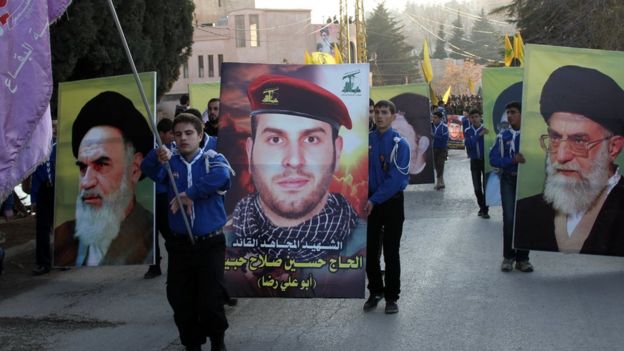
Banners showing the founder of the Islamic Republic of Iran, Ayatollah Ruhollah Khomeini (L), and the current Supreme Leader of Iran, Ayatollah Ali Khamenei (R), are held up beside one of a Lebanese Hezbollah commander killed in Syria (C) at a funeral in Baalbek (1 January 2014) AFP: Shia power Iran and Lebanon’s Shia Hezbollah movement are assisting the Assad regime

For full comprehensive summary by the BBC, go here.

****

al-Arabiya: The most significant development coming from Syria in the last few days is not the killing of Al-Qaeda spokesperson in Idlib or the US-Russian chatter denying a plan to oust Bashar Al-Assad. It was a document leaked to the Western media and dubbed as the “declaration of identity reform” signaling signs of discontent from elders in the Alawite community towards the Syrian regime.

The news of the document is the most concrete evidence we have from Assad’s religious community since the beginning of the uprising in 2011, indicating that their patience is running out with the status-quo and they are openly seeking a third alternative. For such alternative to materialize, however, and for the Alawites to publicly start abandoning Assad, a political and security umbrella has to be extended from Russia and regional countries, guaranteeing their protection and role in a pluralistic future in a post-Assad Syria.

Alawite discontent

Syria’s Alawites have been both, the cornerstone for the regime’s survival and its Achilles’ heel. A 15% of Syria’s population (estimate of 3 million), the minority enjoys the lion’s share in the regime political and security hierarchy. Assad, the Chief of Staff of the Syrian Army, heads of the intelligence services are all from the powerful sect. When the state security proved not enough, a new militia was formed and allied with the regime and Iran to protect the Alawites along the coastline and in the mountain region over Latakia.

“The declaration from the Alawite leaders is a watershed moment in how the minority is publicly untying itself from Assad family, and attempting to pursue a pact of coexistence in Syria”, Joyce Karam.

The new declaration as leaked by European media, exposes fissures between the Alawites and the regime, and efforts to pursue a third option, instead of prolonging Assad’s military campaign, or getting overridden by extremist groups. According to the The Telegraph, the document authors “had been forced to act because of the extreme danger the sect was now facing” amid reports of enormous losses for the Alawites (a third of their young) in the 5-year-long war. In a political departure from the regime narrative, the declaration speaks of “a new relationship with Syria’s Sunni majority” while calling the regime as “totalitarian”, and the uprising “an initiative of noble anger”. The document also promotes a vision for secular, pluralist and democratic state of Syria.

By distancing themselves from the regime, the Alawite signatories are seeking a path that is not hostage to Assad’s strategy of war and outright military victories that could take years or lead to disintegration of Syria. From the beginning of the conflict, there were shy attempts from the Alawite community showing discontent with the Assad family and the war realities. In the last year the community has demonstrated in Latakia calling to execute Assad’s cousin, Suleiman, now serving a 20-year sentence in prison. In 2014, protests from members of the community broke out in Tartous and in Homs over the bombing of elementary schools and the failure of the security to protect their children.

Assurances from Region and Russia

The declaration from the Alawite leaders is a watershed moment in how the minority is publicly untying itself from Assad family, and attempting to pursue a pact of coexistence in Syria. However, and unless it’s met by political and security assurances from the West, the region and Russia, this momentum will not hold against a status quo of fear from extremism that forces Alawites to be more dependent on Assad and local militias.

For a minority whose roots are entrenched in the Levant and has survived the Mamluks, the Crusaders, and the Ottomans, it is only natural that its fate won’t be parallel and decided by the Assad family. It is the regime and not the family that holds higher priority for the Alawites, and even then, negotiating a new pact of governance is the most pragmatic and secure approach for the community’s future in Syria. The heavy toll of the war and the strong presence of Al-Qaeda’s Jabhat Nusra in Northern of the country are ominous signs of what could yet come if no political solution is achieved.

In that context, Russia’s intervention and establishing a presence in Khmeimim airbase in Latakia could make Moscow a key guarantor for the Alawites in a post-Assad Syria. Regional countries such as Saudi Arabia who helped assure the Lebanese Christians at the end of the civil war by brokering the Taif agreement, or Turkey who holds influence in Northern Syria could help in mediating between the Alawites and the opposition.

There is already plenty of buzz regionally of backchannel diplomacy to resolve the Syrian conflict, supervised by John Kerry and Sergei Lavrov, before U.S. President Barack Obama leaves office. There are also questions on recent reports of relieving Maher al-Assad of his duties in the Republican Guard, and what that could mean for the negotiations, for the Alawites and Moscow’s role.

The Alawite declaration this week from Syria, is a critical opportunity to start a conversation about the status of the minority in a post-Assad structure. Absent of guarantees in form of protection and political assurances, this paper will be shelved along a thick bundle of documents and goodwill gestures to resolve the conflict.

 USAToday

*****

WSJ: GENEVA—Talks aimed at ending the five-year war in Syria ground to a halt with the government and opposition divided over fundamental issues, including whether President Bashar al-Assad’s political fate even belongs on the agenda.

The regime insists that Mr. Assad remain in power, and the opposition demands that he step down. With an August United Nations deadline looming to form a new government and the peace process floundering, participants in the talks have floated alternatives aimed at breaking the deadlock that appease some parties but anger others.

Among the ideas are to transfer Mr. Assad’s powers to a handful of deputies; to form a new ruling council comprised of Syrian military officials and moderate rebel leaders; and to coalesce around a new Syrian leader who feuding camps could support.

None of the alternatives has gained traction, and each would face serious, possibly insurmountable, obstacles even if they garnered support in the Geneva talks. The discussions around them are a sign of the lengths to which negotiators are going in an effort to maintain some form of dialogue.

“Geneva is a process without content,” a senior Western diplomat said. Much more here.

Trump: America First, Foreign Policy Presentation

Good for Donald Trump, America should be first when it comes to policy and diplomacy. Applause to the Donald for that standard. Well said.

Tell us again how to pronounce Tanzania or San Bernardino.

What was not said however is disturbing for those who have a keen interest in foreign policy. Of particular note, the Ambassador of Russia was sitting on the front row. Perhaps this is but one reason, Trump never mentioned Russia or Vladimir Putin.

Remember it was only recently that Russia has been more than provocative in reckless actions against a U.S. destroyer and U.S. military aircraft. This is a violation of the IncSea Treaty. This is not the first time either, noting Russian bombers off the West Coast and the same with our European allies. What about the Baltic States, Crimea or Ukraine? Anything?

What about the constant war in the cyber realm? Trump did mention artificial intelligence, does he know what that is? What about electronic or economic warfare?

al Qaeda, Boko Harem, Haqqani, Jabhat al-Nusra, Houthis? Nah….the plight of Jews and Christians, Yazidis, Peshmerga? Standing with France on their recent attacks? Nothing about China’s aggression with the new islands and fighter jets there?

Well said Donald on the destruction of Islamic State, high marks for that. Additional high marks for the IRGC and kidnapping our sailors.

Trump made a mere simple reference to Iran and their nuclear program, stating they will never have a nuclear weapon and the Joint Plan of Action was a bad deal. How come no reference to Iran being a violator of conventions, a rogue state sponsor of terror? Nothing about the Iranian Revolutionary Guard Corp or Hezbollah or IED’s made by Iran that killed and maimed our soldiers? What about Iran’s collusion with North Korea? Anything on that? No…

Does Trump approve of John Kerry’s work as the current Secretary of State? Humm, perhaps as Trump never mentioned Kerry.

Syria unleashed Islamic State? Really? Trump blames China for North Korea. Does Donald think that China is fully, exclusively responsible and accountable for Kim Jung Un?

Why no mention of foreign aid? There is likely a bailout coming for Puerto Rico. Does Trump have a clue on that? When it comes to NATO, Trump backed off and merely mentioned that only four member countries pay the 2% of GDP. Never a mention that countries do pay the United States for bases and protection like Philippines and Japan. Did Trump slight Israel by not stating nurturing and restoring the relationship or is he still in a neutral position when it comes to the Palestinians? Hamas? Anything on human rights violations? What about the corruption of the United Nations?

When referencing Cuba, Trump correctly stated that Obama was slighted at the airport with no Cuban official being on the formal reception. Is Trump cool with normalizing relations with Cuba considering the treatment of dissidents or U.S. criminals that have receive safe haven on the island or the debt Cuba owes to U.S. domestic corporations for nationalizing them? What about Guantanamo as a whole?

Forgotten is a war we are currently fighting against the Taliban in Afghanistan…not a word at all by Trump.

Trump did layout his policy on foreign matters stating diplomacy, caution and restraint. That is always the standard. Did Trump mention he was going to revisit or retool those approaches? No….

Most disturbing, included in Trump’s foreign policy speech was the feeble condition of our own nuclear program and the military as a whole. Why explain any weakness at all where adversaries are listening with a keen ear? The U.S. military is still today the most advanced power on the globe while new technologies and weapons systems are in the future pipelines. Hey Donald, how about making a positive declaration about the military condition and the work of the Pentagon and the military collaboration with allies that does demonstrate strength?

Well, here is the text of his speech for your reference.

For additional reference, those included on Trump’s foreign policy team are:

Zalmay Khalilzad, the former Ambassador to Iraq and Afghanistan. He is under investigation. Trump only met Khalilzad earlier in the day. Further, the Ambassador stated that if Hillary had asked him to be part of her team, he would gladly do so.

Walid Phares, a Lebanese Christian and commentator on Middle East Affairs.

George Papadopoulos, energy consultant

Carter Page, energy consultant and lobbyist for Gazprom, a Russian energy company

Joe Schmitz, fired as former Inspector General, Department of Defense, formerly of Blackwater and his sister is Mary Kay Letourneau gained infamy after having a sexual relationship with her 12-year-old student, to whom she is now married.

LTG Keith Kellogg (ret), Chief Operating Officer of the Coalition Provisional Authority in Baghdad, Iraq


A New Scheme for Syrian Refugees?

Related: Obama pledge to welcome 10,000 Syrian refugees far behind schedule

Read more from the White House directly:

Refugees Welcome graphicInfographic: The screening process for refugee entry into the U.S.
Download graphic

Refugees Welcome graphic
By the numbers: What you need to know about Syrian refugees in the U.S.
Download graphic
******

“Alternative Safe Pathways” for Syrian Refugees – Resettlement in Disguise? 

By Nayla Rush

CIS.org: With the Syrian crisis entering its sixth year, the United Nations High Commissioner for Refugees (UNHCR) is thinking of “innovative approaches” to organize Syrian admissions, alongside the refugee resettlement program, to countries willing to welcome them. UNHCR’s target for resettlement is 480,000 places over the next three years; it is not sure how many additional admissions into the U.S. and elsewhere these new “alternative safe pathways” will ensure. Refugees who are not resettled could be “legally admitted” using various routes described below.

The legitimacy and transparency of these new “alternative pathways,” aimed at admitting increasing numbers of Syrian refugees into the United States without calling them “refugees,” remain to be seen. They might even amount to convenient admissions detours at a time when the U.S. refugee resettlement program is under tight scrutiny.

In a panel discussion on The Global Refugee Crisis: Moral Dimensions and Practical Solutions organized by the Brookings Institution earlier this year, Beth Ferris, Research Professor at Georgetown University and adviser to the United Nations Secretary General on humanitarian refugee policy, talked about the need to find different solutions to the ongoing humanitarian Syrian crisis. The refugee resettlement program was no longer sufficient to admit Syrian refugees she said; “alternative safe pathways” are needed:

Refugees and government officials are expecting this crisis to last 10 or 15 years. It’s time that we no longer work as business as usual … UNHCR next month [March 2016] is convening a meeting to look at what are being called “alternative safe pathways” for Syrian refugees. Maybe it’s hard for the U.S. to go from 2,000 to 200,000 refugees resettled in a year, but maybe there are ways we can ask our universities to offer scholarships to Syrian students. Maybe we can tweak some of our immigration policies to enable Syrian-Americans who have lived here to bring not only their kids and spouses but their uncles and their grandmothers. There may be ways that we could encourage Syrians to come to the U.S. without going through this laborious, time-consuming process of refugee resettlement.” (Emphasis added.)

The UNHCR conference Ferris was referring to took place in Geneva this March 30. It is one of a series of initiatives aimed at comprehensively addressing the Syrian crisis in 2016. The Geneva “High-level meeting on global responsibility sharing through pathways for admission of Syrian refugees” focused on the need for a substantial increase in resettlement numbers and for “innovative approaches” to admit Syrian refugees. It followed February’s London Conference on Syria, which stressed the financial aspect of this humanitarian crisis ($12 billion pledged in humanitarian aid) and precedes a September 2016 high-level plenary meeting of the United Nations General Assembly in New York. Worthy of note here, President Obama will host a global refugee summit this September 20 on the margins of this upcoming General Assembly meeting.

The focus of the Geneva meeting was to introduce “other forms of humanitarian admissions” since “[r]esettlement is not the only aim”, explained UNHCR’s spokesperson. UN High Commissioner for Refugees Filippo Grandi appealed to the international community in his opening statement, calling for “alternative avenues” for the admission of Syrian refugees:

These pathways can take many forms: not only resettlement, but also more flexible mechanisms for family reunification, including extended family members, labour mobility schemes, student visa and scholarships, as well as visa for medical reasons. Resettlement needs vastly outstrip the places that have been made available so far… But humanitarian and student visa, job permits and family reunification would represent safe avenues of admission for many other refugees as well.

At the end of the meeting, Grandi highlighted several commitments made by a number of participants in his closing remarks. Promises were made to:

  • Increase the number of resettlement and humanitarian admission places.
  • Ease family reunification and increase possibilities for family reunion.
  • Give scholarships and student visas for Syrian refugees.
  • Remove administrative barriers and simplify processes to facilitate and expedite the admission of Syrian refugees.
  • Use resources provided by the private sector in order to create labor mobility schemes for Syrian refugees.

The Geneva meeting was attended by representatives of 92 countries, including the United States. Heather Higginbottom, Deputy Secretary of State for Management and Resources, reiterated in her remarks the U.S. commitment to refugees: “President Obama has made assisting displaced people a top priority for the U.S. government.” Last year alone the U.S. contributed more than $6 billion to humanitarian causes. So far this year, the United States has provided nearly $2.3 billion in humanitarian assistance worldwide. She also announced additional measures: “We are further increasing our support of Syrian refugees, and we will make additional contributions to the global displacement effort through September, and beyond”, while reminding the participants of President Obama’s role in hosting a high-level refugee summit this September.

The U.S. State Department released a Media Note following the Geneva meeting. It confirmed the goal of resettling at least 10,000 Syrians in FY 2016 and of 100,000 refugees from around the world by the end of FY 2017 – an increase of more that 40 percent since FY 2015. It also announced the following:

  • “The United States pledged an additional $10 million to UNHCR to strengthen its efforts to identify and refer vulnerable refugees, including Syrians, for resettlement.”
  • The United States joins UNHCR in calling for new ways nations, civil society, the private sector, and individuals can together address the global refugee challenge.”
  • “Additionally, the United States has created a program to allow U.S. citizens and permanent residents to file refugee applications for their Syrian family member.” [Emphasis added.]

On this last note, why create a family reunification program for Syrian refugees when refugees in the U.S. are already entitled to ask for their spouse and unmarried children under 21 to join them? Unless of course, the aim is to widen family circles to include aunts and uncles, brothers and sisters, grandmothers and grandfathers.

Let’s see if we got this right: More Syrian refugees are to be resettled in the United States; administrative barriers (including security checks?) are to be removed to expedite admissions. Come to think of it, this is exactly what we witnessed with the “Surge Operation” in Jordan, where refugee resettlement processes were reduced from 18-24 months to three months in order to meet the target of 10,000 Syrian refugees this year.

Moreover, the United States government, by its own admission, “joins UNHCR in calling for new ways” to move more Syrians to other countries. With the U.S. Refugee Resettlement program under close scrutiny, other routes for “legal admissions” (not “resettlement”) of Syrian refugees into the United States seem more appropriate. Those routes may vary from private sponsorships, labor schemes, expanded family reunification programs, humanitarian visas, medical evacuation, to academic scholarships and apprenticeships, etc.

What remains to be determined is how transparent these “alternative pathways” will be. Will we be given details about numbers, profiles, locations, screening, or costs? Also, what additional measures are we to expect from this administration as it prepares to host a Global Refugee Summit this September 20?

Meanwhile, we are left to wonder: aren’t these “pathways” for refugees nothing more than disguised resettlement routes? Akin to “pathways to citizenship” in lieu of amnesty…