Venezuela, There She Blows

Statement of Secretary Lew on the Venezuela Executive Order
3/9/2015

U.S.Treasury: We are committed to defending human rights and advancing democratic governance in Venezuela through the use of financial sanctions.

We will use these tools to target those persons involved in violence against anti-government protesters, serious human rights abuses, and those involved in the arrest or prosecution of individuals for their legitimate exercise of free speech.

Corrupt actions by Venezuelan government officials deprive Venezuela of needed economic resources that could be invested in the Venezuelan people and used to spur economic growth.  These actions also undermine the public trust in democratic institutions and the human rights to which Venezuelan citizens are entitled.  This Executive Order will be used to protect the U.S. financial system from the illicit financial flows from public corruption in Venezuela.

Beginning in 2013, perhaps earlier:

Venezuela is running out of money fast and has started selling its gold

CNN: The cash-strapped country could default by next year when lots of debt payments are due. Venezuela’s reserves, which are mostly made up of gold, have fallen sharply this year as the country needs cash to pay off debt and tries to maintain its social welfare programs.

Venezuela owes about $15.8 billion in debt payments between now and the end of 2016.

But it doesn’t have enough to make good on its payments. Venezuela only has $15.2 billion in foreign reserves — the lowest amount since 2003. A lot of those reserves are in gold.

Less than $1 billion of Venezuela’s reserves are in cash, and it has a couple billion in reserves at the IMF.


Venezuela risks a descent into chaos 
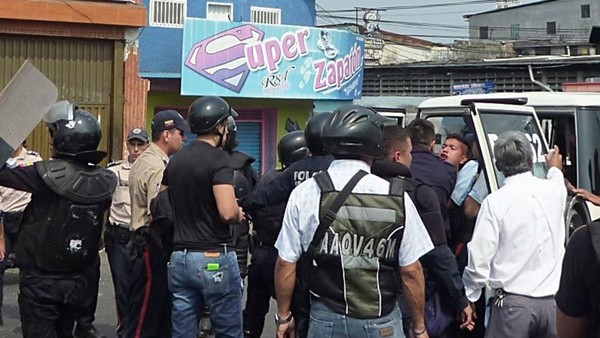
Riot police arrest students during a protest against Venezuelan President Nicolas Maduro, in San Cristobal, Venezuela on March 29, 2016. Two police officers died and four more were severely injured after being ran over by a car presumably driven by students during an anti-government protest against the rise in the public transport fares, in San Cristobal. AFP PHOTO/ARNALDO CESARETTIARNALDO CESARETTI/AFP/Getty Images©AFP

Police arrest students during a protest against Venezuelan President Nicolas Maduro in San Cristobal. Two officers died and four more were hurt

FT: At the main morgue of central Caracas, the stench forces everyone to cover their nostrils. “Now things are worse than ever,” says Yuli Sánchez. “They kill people and no one is punished while families have to keep their pain to themselves.”

Ms Sánchez’s 14-year-old nephew, Oliver, was shot five times by malandros, or thugs, while riding on the back of a friend’s motorcycle. His uncle, Luis Mejía, remarked that in a fortnight three members of their family had been shot, including two youths who were shot by police.


An economic, social and political crisis facing Nicolás Maduro, Venezuela’s unpopular president, is being aggravated by a rise in violence which is prompting fears that this oil-rich country risks becoming a failed state.

“What can we do?” Mr Mejía asks. “Give up.” The morgue employee in charge of handling the corpses notes that a decade ago he received seven or eight bodies every weekend. These days, he says, that number has risen to between 40 and 50: “This is now wilder than the wild west.”

Critics say that the Venezuelan government is increasingly unable to provide citizens with water, electricity, health or a functioning economy which can supply basic food staples or indispensable medicines, let alone personal safety.

Last month alone, Venezuelans learned of the summary execution of at least 17 gold miners supposedly by a mining Mafia, the killing of two police officers allegedly by a group of students who drove a bus into a barricade, and a hostage drama inside a prison at the hands of a grenade-wielding criminal gang. On Wednesday, three policemen were killed when an armed gang busted a member out of a lock-up in the capital.

At least 10 were killed in a Caracas shanty town after a confrontation between local thugs armed with assault rifles, while a local mayor was gunned down outside his home in Trujillo state last month. There are widespread reports of lynchings.

All this is creating a broad unease that Mr Maduro is unable to maintain order. Venezuela has the world’s fastest inflation and its dire recession is worsening. Mr Maduro last week declared every Friday a holiday for the next two months to save electricity as a prolonged drought has exacerbated chronic power shortages. There is a lack of basic goods. Analysts warn that the economic crisis risks turning in to a humanitarian one.

The evidence of state failure is very concrete in the country that sits on top of the world’s largest oil reserves– Moisés Naím, Carnegie Endowment for International Peace

“Failed state is a nebulous concept often used too lightly. That’s not the case with today’s Venezuela,” says Moisés Naím a Venezuelan distinguished fellow at the Carnegie Endowment for International Peace. “The evidence of state failure is very concrete in the country that sits on top of the world’s largest oil reserves.”

Venezuela is already one of the world’s deadliest countries. The Venezuelan Observatory of Violence, a local think-tank, says the murder rate rose last year to 92 killings per 100,000 residents. The attorney-general cites a lower figure of 58 homicides per 100,000.

In 1998, a year before former leader Hugo Chávez took office, the rate was 19 per 100,000, says the think-tank’s director Roberto Briceño León, adding that after 17 years of socialist “revolution”, it is the poor who make up most of the victims.

“I think it is evident that the Venezuelan state cannot act as a state in many areas of the country, so it could be considered failed,” says Mr Briceño, adding that the state now “lacks a monopoly on violence”.

But the state is indeed to blame for some of that violence, according to a report by advocacy groups Human Rights Watch and the Venezuelan Human Rights Education-Action Programme presented to the Inter-American Commission on Human Rights.

“Venezuelans are facing one of the highest murder rates in the hemisphere and urgently need effective protection from violent crime,” said José Miguel Vivanco HRW’s Americas director. “But in multiple raids throughout the country, the security forces themselves have allegedly committed serious abuses.”

Their findings show that police and military raids in low-income and immigrant communities in Venezuela have led to widespread allegations of abuse, including extrajudicial killings, mass arbitrary detentions, maltreatment of detainees, forced evictions, the destruction of homes, and arbitrary deportations.


Country’s bitter power struggle reflects institutional weakness across the region

The government usually blames violence within its borders on Colombian rightwing paramilitaries engaged in a war against its revolution. But as David Smilde and Hugo Pérez Hernáiz of the Washington Office on Latin America, a think-tank, recently wrote: “Attributing violence in Venezuela to paramilitary activity has been a common rhetorical move used by the government over the past year, effectively making a citizen security problem into a national security problem.”

For many Venezuelans it no longer matters who is to blame. “It is a state policy of letting anarchy sink in,” says a former policeman outside the gates of a compound in Caracas.

That former police station now houses the Frente 5 de Marzo, one of the political groups that consider themselves the keepers of socialism’s sacred flame. The gates bear the colours of the Venezuelan flag and are marked with bullet holes. The man believes there is something akin to a civil war going on.

“Venezuela is pure chaos now. It seems to me there is no way back,” he says.

**** 

Iran has been outsourcing for many years and that includes to Iran:

Iran’s ambassador to Venezuela said Tuesday that a check worth about $70 million, found by German authorities in the luggage of Iran’s former central bank chief, was going to be used by an Iranian company for its expenses while building public housing in Venezuela.

Iranian Ambassador Hojattolah Soltani made the remarks in an interview with the Venezuelan television channel Globovision, saying the check for 300 million Venezuelan bolivars was to be used for the expenses of the Kayson Company, a Tehran-based construction business that is building thousands of homes for the Venezuelan government.

The Iranian ambassador noted that the man with the check whom German authorities stopped last month is not currently a government official. Soltani said that Tahmasb Mazaheri, a former chief of Iran’s central bank and former economy minister, has been working as an adviser to the Iranian company.

Venezuelan authorities had to comment on the issue, and stressed that everything was above board (link is external). The Iranian Ambassador to Caracas would later recant his opinion, as cited by AP above, saying about the caught check-courier (link is external) “[he] is by no means an official of the Government (of Iran); neither has his name been affixed to the confiscated check”, and adding that the check “was signed in Iran and Mr. Mazaheri was on his way to Venezuela to bring the check to cash it in Banco Venezuela.”

So Mazaheri, who is not an official of the Government of Iran as per Iran’s Ambassador to Venezuela claims, was entrusted to carry a check worth $70 million, just like that? Mazaheri was a director of Banco Internacional de Desarrollo (link is external), an OFAC-designated entity targeted by the U.S. Treasury Department “for providing or attempting to provide financial services to Iran’s Ministry of Defense and Armed Forces Logistics (MODAFL). (link is external)” The European Union also included the bank in its list of sanctioned entities involved in “nuclear or ballistic missiles activities

– See more at: http://infodio.com/250414/venezuela/corruption/kayson/tahmasb/mazaheri#sthash.8z4z99bY.dpuf

North Korea Threat Real or Sorta Real?

Analysts remain sceptical of North Korea’s nuclear strike claims

Janes: Photos released by North Korean official news outlet Rodong Sinmun on 9 March showed the country’s leader, Kim Jong-un, meeting the country’s nuclear technicians at what could be a KN-08 (Hwasong-13) intercontinental ballistic missile production facility near Jonchon in the country’s northern Chaggang province.

The accompanying article said Kim was congratulating his nuclear weapon scientists for having developed a miniaturised nuclear warhead: a claim being met with scepticism by various Western analysts.

The photos and article came two days after Pyongyang threatened its South Korean neighbours with a pre-emptive nuclear strike for the 7 March initiation of joint exercises ‘Foal Eagle’ and ‘Key Resolve’: the largest set of manoeuvres ever conducted with US forces in the region, in which around 17,000 US troops are exercising alongside some 300,000 South Korean military personnel.

In the week prior to the beginning of the exercises, Pyongyang’s KCNA state news agency quoted Kim as saying that North Korea’s “nuclear warheads need to be ready for use at any time”.

Various security policy think-tanks have accused Washington and its South Korean allies of raising tensions on the Korean peninsula, calling the exercises ill-advised. Stephan Haggard from the School of Global Policy and Strategy at University of California, San Diego, who authors a blog on North Korea, told news sites like CNN, “I didn’t see the logic of expanding the exercises. I personally think that upping the sizes of the exercises didn’t serve any material function. It’s not clear that the size will bring North Korea back to the diplomatic table, so there’s no real purpose to do that. All you’ve done is stir the viper’s nest.”

Specialists on North Korea’s defence capabilities and internal politics dismiss these criticisms of the US-South Korean manoeuvres, arguing that such condemnation ignores the realities of the immediate objectives of North Korea’s nuclear programme and the nature of the regime’s internal political intrigue.

(CNN)The North Korea monitoring project 38 North says that satellite imagery shows “suspicious activity” at a nuclear enrichment site in North Korea.

Plumes of exhaust steam, a byproduct of heating the main plant at the Yongbyon Radiochemical Laboratory complex, have been seen in commercial satellite images taken March 12 and over the preceding five weeks, the group says.
This activity is unusual, the report by the Washington-based project says.
“Exhaust plumes have rarely been seen there and none have been observed on any examined imagery this past winter,” the report says.

Weeks away?

The plumes of steam do not necessarily indicate that the process for refining plutonium for nuclear weapons is underway or will be soon, the report says.

It does, however, note that U.S. Director of National Intelligence James Clapper recently testified that Pyongyang had “announced its intention to ‘refurbish and restart’ its nuclear facilities,” including the uranium enrichment facility at Yongbyon, and that it could be able to recover plutonium from the reactor’s spent fuel “within a matter of weeks to months.”
Separate images appear to show further work on the site’s Experimental Light Water Reactor, a key facility for the enrichment of nuclear fuel, is ongoing, with a new transformer yard and road built, and the installation of electrical cables completed. More here.

Historical Monastery in Syria Destroyed by ISIS

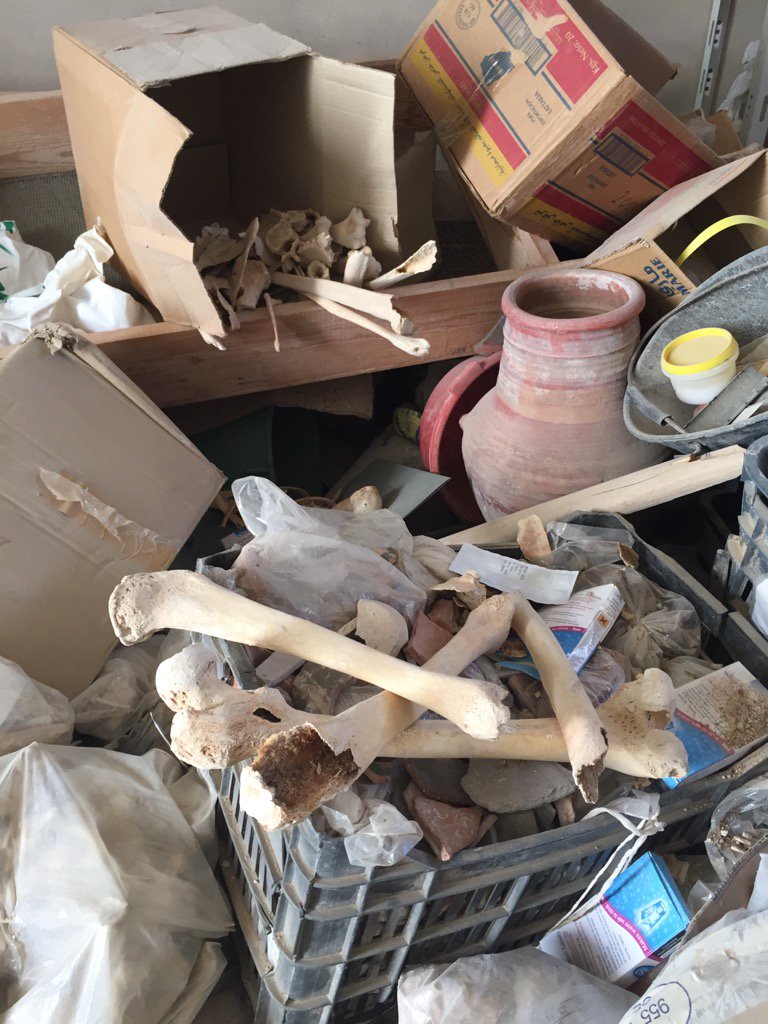
Christian saint’s bones unearthed in monastery destroyed by ISIS

FNC: A Christian saint’s bones have reportedly been unearthed amid the rubble of an ancient Syrian monastery destroyed by Islamic State.

Mar Elian monastery appears ravaged after heavy fighting between Syrian Army and the Islamic State group in Qaryatain, Syria, Monday, April 4, 2016. (AP Photo/Natalia Sancha)

Mar Elian monastery appears ravaged after heavy fighting between Syrian Army and the Islamic State group in Qaryatain, Syria, Monday, April 4, 2016. (AP Photo/Natalia Sancha)

Much of the fifth-century St. Elian, or Mar Elian, monastery in the town of Qaryatain has been reduced to stones by ISIS. Qaryatain was recaptured by Syrian government forces Sunday.

Channel Four News journalist Lindsey Hilsum reports that the bones of saints were clearly visible among the wreckage of the monastery, a once-cherished pilgrimage site.

The bones of Christian saints in the rubble of St Eliane monastery in . blew it up last August.

The bones are thought to be those of St. Elian, also known as St. Julian of Emesa, which is the ancient name for the Syrian city of Homs. St. Elian was martyred in 284 A.D.  after his refusal to renounce Christianity.

The U.K.-based Syrian Observatory of Human Rights reported that ISIS destroyed the monastery in August 2015. “They pulled it down using bulldozers claiming that ‘the monastery is worshiped beside Allah,’ SOHR said in a statement released Aug. 20 2015.

Militants also trashed an ancient church next to the Assyrian Christian monastery, and desecrated a nearby cemetery, breaking the crosses and smashing name plates.

Bones of saints, chucked into a room, after destroyed their resting place at St Eliane monastery

Related: Syria works to save Palmyra’s treasures as ISIS advances on ancient city

Midway between the ancient city of Palmyra and the Syrian capital, Damascus, Qaryatain  was once home to a sizeable Christian population. Before IS took it over last August, it had a mixed population of around 40,000 Sunni Muslims and Christians, as well as thousands of internally displaced people who had fled from the nearby city of Homs.

As it came under militant attack, many of the Christians fled. More than 200 residents, mostly Christians, were abducted by the extremists, including a Syrian priest, the Rev. Jack Murad, who was held by the extremists for three months.

During the eight months that Qaryatain was under IS control, some Christians were released and others were made to sign pledges to pay a tax imposed on non-Muslims. Some have simply vanished.

Syrian forces recaptured Palmyra from ISIS last month, ending their reign of terror at the UNESCO World Heritage site. Palmyra, located about 150 miles northeast of Damascus, dates back to the second millennium B.C. The city was one of the most important cultural centers of the ancient world and has been home to Arabic, Aramaic, and Greco-Roman culture.

ISIS took control of Palmyra last year and subsequently demolished some of its best-known monuments, such as the Temple of Ba’al. The jihadists, who beheaded the city’s former antiquities chief, also used Palmyra’s ancient amphitheater for public executions.

The Associated Press contributed to this report.


Any Americans in the Panama Papers?

Headlines coming soon courtesy of media as noted by McClatchy
Mossack Fonseca worked with oil firms owned by Iranian state despite sanctions

Documents show law firm at centre of Panama Papers leak carried on doing business with companies after learning of their real owners

Guardian: The law firm at the centre of the Panama Papers leak acted for an Iranian oil company that had been blacklisted by the US, the documents reveal.

Mossack Fonseca realised it was working for Petropars Ltd in 2010 only when another client accidentally fell foul of the US sanctions that had been imposed on the energy firm.

Petropars and the other client had been assigned the same PO box in the British Virgin Islands by Mossack Fonseca, and the address had been flagged by banks as linked to a blacklisted company.

The episode highlights the perils of giving the same address to thousands of shelf-companies – and the lack of rigour in Mossack Fonseca’s due diligence procedures.

This was acknowledged by the firm’s managing partner, Jürgen Mossack, who sent an angry email complaining about the lack of background checks, the documents show. “Everybody knows that there are United Nations sanctions against Iran, and we certainly want no business with regimes and individuals from such places! Not because of OFAC [the Office of Foreign Assets Control, the US Treasury department that deals with sanctions] but out of principle.”

Mossack Fonseca discovered it had been acting for the Iranian firm when the head of its Geneva office requested that a client be given a new mailing address in the British Virgin Islands (BVI).

PO box 3136 in Road Town, Tortola, was shared by a multitude of other shelf companies on the law firm’s books, including Petropars.

Petropars had been designated by the US Treasury in June that year as an oil company ultimately owned by the Iranian state. With offices in Dubai and London, it played a key role in securing foreign investment for the South Pars natural gas field. The largest in the world, the field lies in the Persian gulf and is shared with Qatar.

Putting Petropars on the official OFAC sanctions list was intended to sap financial support for Iran’s nuclear and missile programmes.

After a flurry of checks, Mossack Fonseca discovered it was acting for Petropars and two other companies in which it held stakes: Drilling Company International Limited and Venirogc Limited, a joint venture with Venezuela’s state-owned oil company PDVSA, which would itself be blacklisted by the US the following year.

Three months after the blacklisting, Mossack Fonseca’s compliance team recommended resigning from Petropars and “all its associated companies”. By then, not only OFAC but the United Nations had issued sanctions against the Middle Eastern state.

Mossack Fonseca duly stood down and Petropars was recorded as inactive from May 2011, as were its two subsidiaries. But another Iranian company remained on the books.

Despite resolving to cut ties with Iran, Mossack Fonseca continued servicing an outfit called Petrocom. It shared the same London accountant as Petropars, and gave its address as Sepahbod Gharani Avenue in Tehran.

The relationship was managed through London, where a separately owned business holds the exclusive UK rights to market Mossack Fonseca’s services.

Mossack Fonseca in the BVI produced a certificate of good standing (often requested by banks or trading partners), stamped by the office of the Virgin Islands deputy governor on 14 September 2010; papers approving the appointment of a new chairman and managing director; and others for the creation of a joint venture.

Mossack Fonseca’s BVI office did carry out checks on the company. A request for the name of the ultimate beneficial owner of Petrocom elicited the following reply from Mossack Fonseca’s UK franchise: “I think we could assume that would be Mahmoud Ahmadinejad unless I’m mistaken.”

While Iran’s then-president was unlikely to have actually held shares in these offshore entities, the comment makes it clear Mossack Fonseca’s UK office knew it was continuing to act for state-owned companies.

In June 2013, the US imposed sanctions on Petrocom’s parent OIIC, describing it as part of a network of 37 front companies set up to manage the Iranian leadership’s commercial holdings. OIIC was allegedly controlled by a holding company called Eiko, which stands for The Execution of Imam Khomeini’s Order.

“The purpose of this network is to generate and control massive, off-the-books investments, shielded from the view of the Iranian people and international regulators,” a US Treasury press release stated.

The most recent data, from December 2015, shows Petrocom remains on the firm’s books. A certificate of good standing was issued as recently as April 2015.

Mossack Fonseca said: “We have never knowingly allowed the use of our companies by individuals having any relationship with North Korea, Zimbabwe, Syria and other countries or individuals sanctioned by the United States or European Union. We routinely resign from client engagements when ongoing due diligence and/or updates to sanctions lists reveals that a party to a company for which we provide services has been either convicted or listed by a sanctioning body.”

Emmanuel Cohen, who runs Mossack Fonseca’s UK franchise, said in a letter from his lawyer that he had been “in the forefront of undertaking due diligence checks over the years”, and that “he takes the obligations of reporting extremely seriously and files any suspicious activity” with the National Crime Agency. Regarding Petropars, Mossack Fonseca UK “was working through a professional client in the UK and was not responsible for any due diligence”. He added that the UK business was under no obligation to follow US sanctions.

Petrocom and Petropars did not respond to requests for comment.

In January 2016, the US removed Petropars and OIIC from its blacklist, following the nuclear deal with Iran.

Panama Papers reporting team: Juliette Garside, Luke Harding, Holly Watt, David Pegg, Helena Bengtsson, Simon Bowers, Owen Gibson and Nick Hopkins

Who are Those Wearing Blue Helmets?

I have been saying for years that those that make up the U.N. Peacekeepers are the worst of the worst that member nations offer up and finally, The New York Times figured it out. I bet that Donald Trump actually meant the United Nations rather than NATO when he spoke about breaking it up or did he?

Armies Used by U.N. Fail Watchdog Group’s Test

NYT: The militaries of the 30 countries that provide the most soldiers and police officers to United Nations peacekeeping operations also are among those most susceptible to corruption, according to a study released Sunday by an anti-corruption monitoring organization.

The organization, Transparency International, known for its annual corruption rankings of governments around the world, said that in its A-to-F grading for the armed forces of the top troop-contributing countries, only Italy scored higher than a D.

Six of the countries — Burkina Faso, Cameroon, Chad, Egypt, Morocco and Togo — received F grades, Transparency International said.

The three countries that contribute the most troops, Bangladesh, Ethiopia and India — which together provide about 25,200 uniformed personnel, roughly a quarter of the total in United Nations peacekeeping operations — also scored poorly in the study’s rankings. Bangladesh and India each received a D, and Ethiopia an E.

The organization cited poor anti-corruption practices and inadequate training as factors in assessing the rankings.

The study comes against a backdrop of new allegations against some peacekeepers. The most recent catalyst for concern has been a growing sex-abuse scandal that has implicated peacekeepers deployed to the Central African Republic, in episodes dating to 2013, many involving children.

Transparency International did not cite any examples of peacekeeper corruption in the study.

United Nations officials did not dispute the findings but said the study did not reflect steps the organization had taken to prevent corruption by peacekeepers.

“There are a full range of audit and independent oversight systems that are in place to protect against such risks once individual units deploy to peacekeeping operations,” Nick Birnback, a spokesman for United Nations peacekeeping, said.

A few years ago there was the genesis of the Syrian civil war, Somalia, Libya and more. This speaks to not only the peacekeepers being criminals and corrupt but the leadership of the United Nations as well. Neither Kofi Annan or Ban Ki Moon have taken the UN up to levels where it becomes meaningful. It is not for lack of intelligence, the UN building in New York is full of international spies and well connected to world leaders, it becomes a lack of will and management.

2012, Ignatius of WaPo in part: The Somalia mess made the United Nations so nervous about intervention that it ignored an appeal a few months later from its own representative in Rwanda that a genocidal massacre was about to begin there.

In January 1994, Gen. Romeo Dallaire, the French Canadian commander of a small force called UNAMIR, cabled New York that the Hutu-led government in Kigali was planning the “extermination” of Tutsis. He concluded his message, “Allons-y.” Let’s go. The United Nations did nothing. Three months later, 800,000 Rwandans were dead.

Annan was running peacekeeping operations at the time, and his deputy cabled the brave Dallaire insisting on “the need to avoid entering into a course of action that might lead to the use of force and unanticipated consequences.” That’s a sorry U.N. chapter, and it’s to Annan’s credit that he tells this and other stories so honestly.

The third debacle was Bosnia. In April 1993, the Security Council demanded that the town of Srebenica, filled with 60,000 Muslim refugees and encircled by Bosnian Serb forces, become a “safe area . . . free from armed attacks.” The refugees waited more than two years for the United Nations to deliver. In July 1995, Gen. Ratko Mladic committed his infamous massacre. A month later, UNPROFOR finally intervened.

When Annan became secretary-general, the United Nations tried to bolster its peacekeeping efforts. It did better in East Timor, Kosovo and Libya in putting some teeth in the concept of a “responsibility to protect.” But the abiding story has been the United Nations’ limitations — in dealing with Iraq, the Palestinian issue, Iran and now Syria.
What to do? Albright and 15 other former foreign ministers just sent a letter to President Vladimir Putin saying they were “gravely disappointed” by Russia’s failure to support the U.N. mission and pleading for action to stop the war in Syria. Albright’s office says that the Russians responded negatively. As the whole of this revealing book demonstrates, there’s got to be a better way to prevent ruinous conflicts.