
Heinz and John Kerry Deep Tax Havens in Panama Papers


EXCLUSIVE: Kerry, Heinz Family Have Millions Invested In Offshore Tax Havens

Pollock/DailyCaller: Secretary of State John Kerry and his wife Teresa Heinz have invested millions of U.S. dollars through family trusts in at least 11 offshore tax havens, according to The Daily Caller News Foundation’s Investigative Group.

The revelation comes on the heels of the release of the Panama Papers, a treasure trove of 11.5 million legal and financial records documenting how some of the world’s richest and most powerful people have used offshore bank accounts to conceal their wealth and avoid taxes.

Since the release of the papers, no American politician has been identified as using the secretive offshore accounts.

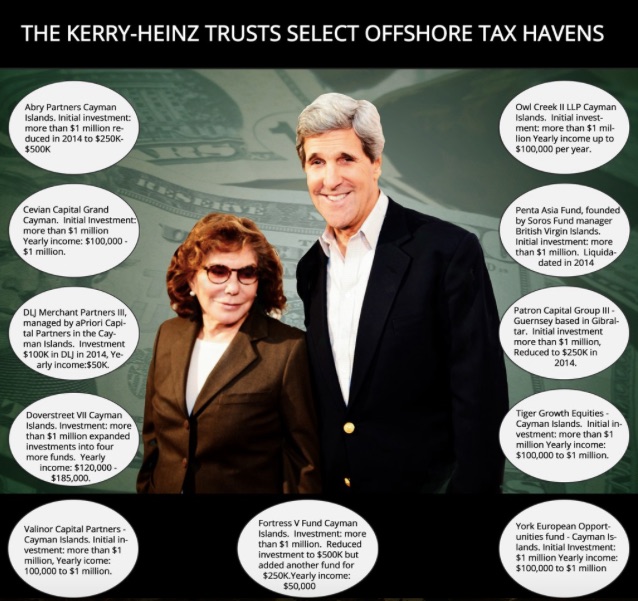
But a DCNF investigation has confirmed that the former Massachusetts Democratic senator and his billionaire wife, using an elaborate set of Heinz family trusts, have invested “more than $1 million” each into 11 separate offshore accounts — mainly hedge funds in the Cayman Islands.

Source: The Daily Caller News Foundation

The investments were made during both Kerry’s tenure in the Senate and in his present position as the nation’s chief diplomat.

The trusts funneled millions of dollars over the years into various offshore investment vehicles through a Heinz trust called the “Heinz Family Commingled Alternative Investment Fund.”

Two other trusts appear to have been set up by the Heinz family since Kerry was appointed by President Barack Obama in 2013 to succeed Hillary Clinton as secretary of state. One is called “HFI Intermediate Fund II” and other the “HFI Dividend Investments.” HFI stands for the Heinz Family Investments.

Another Heinz trust, called “HP Imperial,” invests in companies throughout Asia, including state-run companies within the People’s Republic of China. It is an interesting decision by the Heinz family, given Kerry’s present duties.

When Kerry joined the Obama administration in February 2013, he was considered the second wealthiest member of the Senate, with personal assets totaling nearly $200 million.

Teresa Heinz inherited hundreds of millions of dollars when her former husband, Republican Sen. John Heinz of Pennsylvania, died in 1991 in an airplane crash. Forbes estimates Heinz’s net worth today is $1 billion.

Even after his ascension as secretary of state, the Heinz family continues to make sizable investments in tax havens, a fact that doesn’t sit well with some who would normally be supportive of Kerry.

“Well I say it doesn’t look good by any means,” said Susan Harley, deputy director of Congress Watch, a progressive lobby organization founded by Ralph Nader.

“There’s always a question of whether it’s tax avoidance or tax evasion,” she told TheDCNF.  “We would expect our government servants to uphold the law. Those folks need to be held to the same standards as everyone else.”

Obama recently lashed out at U.S. citizens who use tax havens.

On April 5, a few days after the Panama Papers were released, the president said the rich “have enough lawyers and enough accountants to wiggle out of responsibilities that ordinary citizens are having to abide by.” He said they were “gaming the system.”

Harley said the president might not be pleased with some of his cabinet members investing in tax havens: “Given what the president has said, it doesn’t sound like he would be in favor of that kind of behavior as far as people in his cabinet.”

For its part, State Department Spokesman Adm. John Kirby told TheDCNF Kerry is not a beneficiary of the investments and does not own them.

“Secretary Kerry has no offshore investments. He is not, nor has he ever been a beneficiary of Heinz Family and Marital Trusts and he has no decision-making power over them since they are entirely controlled by independent trustees,” said Kirby.

Heinz is a beneficiary, Kirby said, but he emphasized that the investments “are entirely controlled by independent trustees.” He declined to say who controls the trust and makes investment decisions.

The Kerry/Heinz family investments are so vast that Kerry’s federal financial disclosure form runs 169 pages in length, with about 10 investments per page.

Although Democrats are united in condemning offshore accounts, many Democrats, including Obama, have actually benefited from them.

The Fortress Fund, founded by James Dinan, is a tax shelter that is close to Democrats. The Heinz family invested “more than $1 million” in Fortress V when Kerry was a senator, according to his 2015 financial disclosure form.

Fortress is incorporated in the Cayman Islands, according to the company’s filing with the Securities and Exchange Commission.

In 2006, Fortress first came to public attention when it was disclosed that the hedge fund paid Democratic presidential candidate John Edwards $480,000 for a “part time job.” Edwards had invested $16 million into Fortress.

The New York Times described the Fortress Fund in 2007, saying it was comprised of “thinly regulated pools of often risky investments,” and linked it to the subprime mortgage meltdown of 2008.

Dinan also was a top Obama bundler who raised between $50,000 to $100,000 in 2008, according to OpenSecrets, a nonprofit campaign finance research group.

And Penta Asia Fund, based in the British Virgin Islands, was founded by former George Soros fund manager John Zwaanstra.

According to records from Kerry’s Senate filing and his federal disclosure filing, he and his family appear to have cut back on their  offshore investments after he joined the Department of State, but did not eliminate them. In some instances, they actually invested more in various offshore funds.

The Kerry family trust offshore investments are in:

Abry Partners – The company finalized $42 billion in “leveraged transactions” according to its website. Incorporation: Cayman Islands. Kerry family investment was worth “more than $1 million” while he was in the Senate, but was reduced in 2014 to between $250K to $500K.

Cevian Capital – Is an active ownership investment firm that seeks ownership in undervalued public companies. Incorporated: George Town, Grand Cayman. This is the only offshore investment organized by the new Kerry family “HFI Diversified Investment Fund.” While secretary of state, Kerry and family invested “more than $1 million” in the fund. It pays annual dividends, interest and capital gains of $100,000 to $1 million.

DLJ Merchant Partners III — is a Delaware registered company, but as of 2013, it was managed by APriori Capital Partners, a Cayman Island registered firm. Kerry only had $100K in DLJ in 2014, but the family still receives dividends, rentals and royalties, interest and capital gains. Annual income is $50,000.

Dover Street VII – Seeks to buy investments in venture capital or buyouts in the U.S. and U.K. Incorporated: Cayman Islands.  The family trust invested more than $1 million while Kerry was in the Senate. As secretary of state, the family expanded investments into four more funds. They get annual dividends, interest, rents royalties, and capital gains totaling $120,000 to $185,000.

Fortress V Fund – Specializes in buyouts and recapitalizations, according to Bloomberg. Incorporation: Cayman Islands. The trust investment: more than $1 million. After Kerry became secretary of state, the family reduced investment to $500,000 for Fortress V but added a new investment in “Fortress V Co-investment Fund” for $250,000. The family receive dividends, rents and royalties, interest and capital gains.

Owl Creek II – A hedge fund. Incorporation: Cayman Islands. Kerry family investment: More than $1 million in Senate filing; reduced to $100,000 from $1 million in 2014.  The family receives dividends, rent and royalties, and capital gains up to $100,000 per year.

Penta Asia Fund – An Asia-focused hedge fund founded by Soros Fund manager John Zwaanstra. Registration: British Virgin Islands. The trusts investment began while Kerry was in the Senate with an investment of more than $1 million.  It was liquidated in 2014.

Patron Capital Group III – The fund makes “opportunistic and value-oriented investments,” including “liquidity constrained property assets” predominantly in Western Europe. Registered in Guernsey and based in Gibraltar. While Kerry was in the Senate, the family invested more than $1 million, but that was reduced to $250,000 in 2014. They receive dividends, interest, and capital gains, now only $5,000 per year

Tiger Growth Equities – This fund primarily focuses investment in China, Southeast Asia, Latin America and Eastern Europe. Incorporation: Cayman Islands. More than $1 million in Kerry’s Senate filing. Kerry and family have continued their investment during his secretary of state years. They receive annual dividends, interest and capital gains estimated from $100,000 to $1 million.

Valinor Capital Partners –  Is a “pooled investment hedge fund.” Incorporated: Cayman Islands. Kerry and family invested more than $1 million, receiving annual income from dividends, interest and capital gains of $100,000 to $1 million.

York European Opportunities fund – a hedge fund, that invests in “restructures, spinoffs, split-ups and proxy contests.” Incorporation: Cayman Islands. Kerry Family Investment: $1 million during the Senate term. Dividends: $100,000 to $1 million annually. Subsidiary York Capital Management’s number one investment is in the HJ Heinz Company.

“HP Imperial,” another Heinz trust invests in Malaysia, Hong Kong, Thailand and South Korea. Its biggest investments are in communist China, including the Alibaba Group; Boer Holdings, a Chinese electrical distribution company in Wuxi, Yixing and Shanghai; Hubao International Holdings, a tobacco company; Labixiaoxin Snacks Group, a Chinese snack food provider; Sands China, with six casinos in Macau; and Tibet 5100 Water Holdings, a Chinese-owned company trying to sell Tibetan premium water like Evian.


Need to Know Facts on EB-5 Visa Program

In 1999, yes under President Bill Clinton and selling out sovereignty under a globalist agenda:


FAS: The immigrant investor visa was created in 1990 to benefit the U.S. economy through employment creation and an influx of foreign capital into the United States. The visa is also referred to as the EB-5 visa because it is the fifth employment preference immigrant visa category. The EB-5 visa provides lawful permanent residence (i.e., LPR status) to foreign nationals who invest a specified amount of capital in a new commercial enterprise in the United States and create at least 10 jobs. The foreign nationals must invest $1,000,000, or $500,000 if they invest in a rural area or an area with high unemployment (referred to as targeted employment areas or TEAs).

There are approximately 10,000 visas available annually for foreign national investors and their family members (7.1% of the worldwide employment-based visas are allotted to immigrant investors and their derivatives). In FY2015, there were 9,764 EB-5 visas used, with 93% going to investors from Asia. More specifically, 84% were granted to investors from China and 3% were granted to those from Vietnam.

In general, an individual receiving an EB-5 visa is granted conditional residence status. After approximately two years the foreign national must apply to remove the conditionality (i.e., convert to full-LPR status). If the foreign national has met the visa requirements (i.e., invested and sustained the required money and created the required jobs), the foreign national receives full LPR status. If the foreign national investor has not met the requirements or does not apply to have the conditional status removed, his or her conditional LPR status is terminated, and, generally, the foreign national is required to leave the United States, or will be placed in removal proceedings.

In 1992, Congress established the Regional Center (Pilot) Program, which created an additional pathway to LPR status through the EB-5 visa category. Regional centers are “any economic unit, public or private, which [are] involved with the promotion of economic growth, including increased export sales, improved regional productivity, job creation, and increased domestic capital investment.” The program allows foreign national investors to pool their investment in a regional center to fund a broad range of projects within a specific geographic area. The investment requirement for regional center investors is the same as for standard EB-5 investors. As the use of EB-5 visas has grown, so has the use of the Regional Center Program. In FY2014, 97% of all EB-5 visas were issued based on investments in regional centers. Unlike the standard EB-5 visa category, which does not expire, the Regional Center Program is set to expire on September 30, 2016.

Different policy issues surrounding the EB-5 visa have been debated. Proponents of the EB-5 visa contend that providing visas to foreign investors benefits the U.S. economy, in light of the potential economic growth and job creation it can create. Others argue that the EB-5 visa allows wealthy individuals to buy their way into the United States.

In addition, some EB-5 stakeholders have voiced concerns over the delays in processing EB-5 applications and possible effects on investors and time sensitive projects. Furthermore, some have questioned whether U.S. Citizen and Immigration Services (USCIS) has the expertise to administer the EB-5 program, given its embedded business components. The Department of Homeland Security’s Office of the Inspector General (DHS OIG) has recommended that USCIS work with other federal agencies that do have such expertise, while USCIS has reported that it has taken steps internally to address this issue. USCIS has also struggled to measure the efficacy of the EB-5 category (e.g., its economic impact). USCIS methodology for reporting investments and jobs created has been called into question by both the DHS OIG and the U.S. Government Accountability Office (GAO).


Furthermore, some have highlighted possible fraud and threats to national security that the visa category presents. In comparison to other immigrant visas, the EB-5 visa faces additional risks of fraud that stem from its investment components. Such risks are associated with the difficulty in verifying that investors’ funds are obtained lawfully and the visa’s potential for large monetary gains, which could motivate individuals to take advantage of investors and can make the visa susceptible to the appearance of favoritism. USCIS has reported improvements in its fraud detection but also feels certain statutory limitations have restricted what it can do. Additionally, GAO believes that improved data collection by USCIS could assist in detecting fraud and keeping visa holders and regional centers accountable.

Lastly, the authority of states to designate TEAs has raised concerns. Some have pointed to the inconsistency in TEA designation practices across states and how it could allow for possible gerrymandering (i.e., all development occurs in an area that by itself would not be considered a TEA). Others contend that the current regulations allow states to determine what area fits their economic needs and allow for the accommodation of commuting patterns.

In addition to the issues discussed above, Congress may consider whether the Regional Center Program should be allowed to expire, be reauthorized, or made permanent, given its expiration on September 30, 2016. In addition, Congress may consider whether any modifications should be made to the EB-5 visa category or the Regional Center Program. Legislation has been introduced in the 114th Congress that would, among other provisions, amend the program to try to address concerns about fraud, and change the manner in which TEAs are determined. Other bills would create an EB-5-like visa category for foreign national entrepreneurs who do not have their own capital but have received capital from qualified sources, such as venture capitalists. Read more here.


Obama’s Climate Change Treaty or Accord, Skirts Senate

Obama’s Violating the Constitution by Not Submitting Climate Treaty to Senate

DailySignal/Senator Mike Lee and Congressman Mike Kelly:

Today at United Nations Headquarters in New York City, Secretary of State John Kerry and representatives of over 130 nations will sign the Framework Convention on Climate Change agreement that was negotiated in Paris last December.

According to President Obama, this “historic agreement” will “hold every country accountable” if they fail to meet its carbon emission targets.

The White House has also acknowledged that the agreement contains “legally binding” provisions designed to create a “long-term framework” that will force the United States and signatory countries to reduce carbon emissions for decades to come.

Despite these facts, President Obama has already announced he will not submit the Paris Climate Agreement to the Senate for advice and consent. Instead, the White House claims the signature environmental achievement of the president’s tenure is just an “international agreement” not meriting Senate attention.

If the stakes weren’t so high, this claim would be laughable on its face.

Not only was this agreement’s predecessor, the United Nations Framework Convention on Climate Change, submitted to the Senate and approved as a treaty, but when the Senate ratified that treaty, the Foreign Relations Committee specifically reported that any future emissions targets agreed to through the Convention “would have to be submitted to the Senate for its advice and consent.”

President Obama has chosen to ignore this directive.

He has also chosen to ignore the State Department’s eight-factor test that is used to determine “whether any international agreement should be brought into force as a treaty or as an international agreement other than a treaty.”

Those eight factors are:

1) The extent to which the agreement involves commitments or risks affecting the nation as a whole (the agreement’s carbon reductions will inflict costs on every American who consumes energy)

2) Whether the agreement is intended to affect state laws (the agreement will force states to meet emission targets)

3) Whether the agreement can be given effect without the enactment of subsequent legislation by the Congress (Congress will have to appropriate money for the agreement’s Green Climate Fund)

4) Past U.S. practice as to similar agreements (the agreement’s predecessor was submitted as a treaty)

5) The preference of the Congress as to a particular type of agreement (Congress wants to vote on this agreement)

6) The degree of formality desired for an agreement (the agreement is a highly detailed 31-page document)

7) The proposed duration of the agreement, the need for prompt conclusion of an agreement, and the desirability of concluding a routine or short-term agreement (the agreement sets emissions targets decades in advance)

8) The general international practice as to similar agreements (there are many, but the 1985 Vienna Convention for the Protection of the Ozone Layer is just one example)

The only reason President Obama is not sending the Paris Climate Agreement to the Senate as a treaty is that he knows the Senate would handily reject it.

This is an unacceptable breach of Article II Section 2 of the Constitution, and Congress must do something about it.

That is why we have introduced a concurrent resolution in the House and Senate expressing the sense of Congress that the Paris Climate Agreement must be submitted to the Senate as a treaty for its advice and consent.

If President Obama fails to do so, then Congress must prevent its implementation by forbidding any payments to the agreement’s “Green Climate Fund,” an international slush fund included in the Paris agreement to induce developing nations to sign the agreement.

If Congress fails to specifically prohibit taxpayer money from being spent implementing the Paris Climate Agreement, then they will be complicit in President Obama’s subversion of the Constitution.


*****

More reading on the facts of the Accord, or whatever it is called that will not receive a Senate vote:

FAS: On April 22, 2016, as many as 155 countries intend to sign the new international Paris Agreement to address greenhouse-gas-induced climate change. No international agreement to date has attracted as many signatures on the opening day of the year-long signature period. Eight nations—all perceiving themselves as particularly vulnerable to the impacts of climate change—plan to deposit their instruments of ratification as well.

Delegations of 195 nations adopted the Paris Agreement on December 12, 2015. It creates a structure for nations to pledge every five years to abate their greenhouse gas (GHG) emissions, to adapt to climate change, and to cooperate to these ends, including financial and other support. A single framework to promote transparency and track progress of Parties’ efforts applies, for the first time, to all Parties—whether rich or poor. The Parties also adopted a Decision to

give effect to the Paris Agreement. Both the Decision and the Agreement (hereinafter capitalized) are intended to be legally binding on Parties to the United Nations Framework Convention on Climate Change (UNFCCC) and the new Agreement, respectively, though not all provisions within them are mandatory. Both are subsidiary to the UNFCCC, which the United States ratified with the advice and consent of the Senate (Treaty Document 102-38, October 7, 1992).

The UNFCCC entered into force in 1994.

Whether the new Paris Agreement or Decision would require Senate advice and consent depends on the content of the agreements. If either were to contain new legal obligations on the United States, it would favor requiring Senate consent to ratification. However, the United States and other Parties to the UNFCCC accepted many legally binding obligations when they ratified the Convention, including control of greenhouse gas (GHG) emissions, preparation to adapt to climate change, international cooperation and support, and regular reporting of emissions and actions with international review. Some have argued that the Paris Agreement does not require more of the United States than it is already obligated to do under the UNFCCC, while others have argued that it does.

Purpose and Post-2050 Balance of Emissions and Removals

The agreement states that it aims to hold the increase in the global average temperature to well below 2 °C above pre-industrial levels and to pursue efforts to limit the temperature increase to 1.5 °C above pre-industrial levels, recognizing that this would significantly reduce the risks and impacts of climate change.

This purpose is stated as enhancing the implementation of the UNFCCC, including its objective to stabilize GHG concentrations in the atmosphere at a level to avoid dangerous anthropogenic interference in the climate system. In order to achieve this “long-term temperature goal,” Parties aim to make their GHG emissions peak as soon as possible and then to reduce them rapidly “so as to achieve a balance between anthropogenic emissions by sources and removals by sinks of greenhouse gases in the second half of this century.” In other words, the Agreement envisions achieving net zero anthropogenic emissions. While this is arguably synonymous with the UNFCCC’s objective of stabilizing GHG atmospheric concentrations, the Agreement puts a timeframe on the objective for the first time. However, as a collective objective, the Agreement provides no means to hold an individual Party accountable if the objective were not met.

Mitigation and Adaptation

The Agreement and Decision establish a single framework under which all Parties would:

communicate every five years and undertake “ambitious” Nationally Determined Contributions (NDCs) to mitigating GHG emissions, participate in a single “transparency framework” that includes communicating their GHG inventories and implementation of their obligations, including financial support provided or received, not less than biennially (with exceptions to a few, least developed states), and be subject to international review of their implementation.

All Parties will eventually be subject to common procedures and guidelines. However, while developed country Parties (not defined) must provide NDCs stated as economy-wide, absolute GHG reduction targets, developing country Parties are exhorted to enhance their NDCs and move toward similar targets over time, in light of their national circumstances.

Further, flexibility in the transparency framework is allowed to developing countries, depending on their capacities, regarding the scope, frequency, and detail of their reporting. The administrative Secretariat of the Convention will record the NDCs and other key reports in a public registry.

The Agreement also requires “as appropriate” that Parties prepare and communicate their plans to adapt to climate change. Adaptation communications, too, will be recorded in a public registry.

A committee will, in a facilitative and non-punitive manner, address compliance issues under the Paris Agreement. The Paris Agreement contains provisions for voluntary withdrawal of Parties.

The Agreement permits Parties voluntarily to participate in cooperative approaches (implicitly, emissions markets) that “involve the use of internationally transferred mitigation outcomes.”

Finance

The Agreement reiterates the obligation in the UNFCCC to provide financial support to developing country Parties to implement their mitigation efforts, calling for it to be continuous and enhanced. It uses exhortatory language to restate the collective pledge in the 2009 Copenhagen Accord, of $100 billion annually by 2020, and calls for a “progression beyond previous efforts.” For the first time under the UNFCCC, the Agreement encourages all Parties to provide financial support. In addition, in the Decision, the Parties agreed to set, prior to their 2025 meeting, a new, collective, quantified goal for mobilizing financial resources of not less than $100 billion annually to assist developing country Parties. The Decision strongly urges developed country Parties to scale up their current financial support—in particular to significantly increase their support for adaptation. The Agreement recognizes that “enhanced support” will allow for “higher ambition” in the actions of developing country Parties.

Five-Year Assessments

In 2023 and every five years thereafter, the Parties are to perform a “global stocktake” to review implementation of the Paris Agreement and progress toward the purpose of the Agreement and the long-term net zero anthropogenic emissions goal.


Iran Forces Them to Fight for Assad

Fatimiyoun Brigade

A comprehensive summary is here.

The Islamic Republic of Iran now controls part–though not all–of Yemen, Iraq, Syria, and Lebanon, while Turkey is another contender.

***

The creation of an Afghan Shia division in the Iranian Revolutionary Guards structure is not new, and dates back to the Iran-Iraq war during the 1980s when an Afghan Shia force, the Abouzar Brigade, was formed to help fight Iraq.

So….while the White House, the National Security Council and the State Department want Assad removed from power and while the Obama regime is pro-Iran, how do they square this conundrum exactly? It should also be mentioned that those ‘Syrian’ refugees flooding into Europe are hardly all Syrian, in fact few are.

In part from BBC: Fatemioun Brigade, an all-Afghan unit commanded by Revolutionary Guards officers.

“The Iranian Revolutionary Guards Corps decided that the Syrian military could not succeed on their own,” he told the BBC. “The frontlines were too depleted and men were trying to avoid conscription.”

The Iranians decided to set up a 50,000-strong National Defence Force to fight alongside the Syrian army.

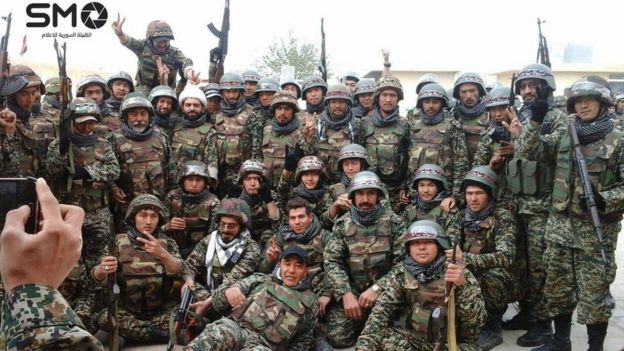
Photo obtained by opposition Syria Media Organization purportedly showing Afghan fighters in Syria

With a shortage of willing fighters inside Syria, they began looking elsewhere – signing up Iranian Afghans, Lebanese, Iraqi and Pakistani Shia recruits.

As the five-year conflict in Syria grinds on, BBC Persian has found evidence that Iran is sending thousands of Afghan men to fight alongside Syrian government forces.

The men, who are mainly ethnic Hazaras, are recruited from impoverished and vulnerable migrant communities in Iran, and sent to join a multi-national Shia Muslim militia – in effect a “Foreign Legion” – that Iran has mobilised to support Syrian President Bashar al-Assad.

Many have since fled the battlefield and joined the refugee trail to Europe.

In a small town in Germany, we meet “Amir”, an Afghan man in his early twenties.

He was born to refugee parents in Isfahan, Iran, and is now himself an asylum seeker in Europe.

Like most of the almost three million Afghans in Iran, he lived as a second-class citizen.

Without legal residency or identity documents, he found it hard to get an education or a job. Fear of arrest and deportation was a daily reality.

Human Rights Watch recently estimated as many as 10,000 Afghans may have been recruited by the Revolutionary Guards.

Iran’s foreign ministry has denied any Afghans are being sent in an official capacity. The official narrative from Tehran is that they are all volunteers, off to defend holy sites of their own volition.

But every week in Iran there are more military-style funerals for fallen Fatemioun fighters.

And with a major government spring offensive around Aleppo in the offing, it seems Iran’s Foreign Legion will be fighting – and dying – for President Assad for some time to come. Full article here.

****

AJ: “Iran is recruiting fighters from Shia communities across the world to fight in Syria,” continued al-Abdah, who is based in Turkey.

“Iran considers itself the one and only reference point for all Shia people in the whole world. It organises them into political, social, and military organisations, both in their local communities and abroad.

“This is part of the main mission of the Iranian regime in terms of exporting the revolution. Iran recruits, motivates, organises, finances, and trains Shias from all over the world to help support Bashar al-Assad’s regime from collapsing.” More here.

As for Iran and the Iranian Revolutionary Guard Corps, go here for the plotted objectives and study titled:

The Rise of the Pasdaran

Assessing the Domestic Roles of Iran’s

Islamic Revolutionary Guards Corps


Comrade Ayatollah, it Always Points Back to Russia/USSR


“Is Iran’s Supreme Leader Ayatollah Ali Khamenei a graduate of the Patrice Lumumba People’s Friendship University in Moscow? Did the KGB recruit Khamenei as a spy in the 1960’s? Is Soviet indoctrination and ideological training to blame for Khamenei’s hatred of the United States? The Persian blogosphere is boiling over with speculations about Khamenei’s alleged Soviet connections. The affair started Wednesday, as Iranian bloggers discovered Russia Today’s February 5, 2010 report on the 50th anniversary of the People’s Friendship University in Moscow, in which Khamenei is mentioned among the university’s “most notable graduates.” A claim also appears on Russia Today’s website, although the reference is made to “Iran’s Supreme Leader Ali Khomeini,” an obvious mistake. Subsequently, Iranian bloggers identified other Russian sources making the very same claim: The November 25, 2003 issue of Kommersant presents Khamenei as a People’s Friendship University graduate…………….”

Patrice Lumumba University was named after the murdered first Congolese prime minister after independence from Belgium. Lumumba was allegedly killed by Congolese rivals and Western intelligence services. I believe that to be true: Lumumba was perceived as a ‘communist’ by the West during the peak of the Cold War. The Soviet university attracted many third world students, and it is possible that a young Khamenei was among them, but it is highly unlikely. I doubt it very much: he must have started as a student of Islamic faith at a young age. Or maybe he was groomed as a communist mole inside Qom, a potential Manchurian Ayatollah. If true this would mean that Khamenei also speaks Russian in addition to Persian, Arabic, and Turkish. He is as much a communist as the Saudi Mufti is a secret Shi’a, as much as Bashar al-Assad is a Salafi.


Introduction:

For close to a century, destiny has played a bitter game with our ancient homeland. The winds of bizarre events have left us Iranians in a historical abeyance. Addicted to our shared agony and engrossed in our daily demise, we have even lost the ability to ponder the starting point of this common grief. Perhaps if our fathers sought out the root of this shared agony, a feasible solution would have emerged. What you are about to read is the result of two decades of chasing after questions that have perplexed me for half of my life. Finally when I started writing this book four years ago, I anticipated many possible outcomes. I expected this book to evolve into the biography of a ruthless dictator or the discovery of an old Soviet espionage network. But in my wildest dreams I could not have imagined that Comrade Ayatollah would turn into perhaps one of the largest research collections that sheds light on the darkest political and criminal dossiers in Iranian history. Today I declare with certainty that I have identified the root of the historical agony of our people and I have no doubt that all those who follow me on this journey to the conclusion of the book will acquire a new viewpoint on what has come to pass in our nation during the past century. The key to identifying the root cause of this shared agony lies not in our country but far away in the heart of Iran’s Northern neighbor — in the vast nation of Russia. The same place where in 1905 sparks of revolution were ignited in Tsarist Russia. Twelve years later, the flames of the Bolshevik Revolution at first engulfed the people of this expansive country and then spread to ancient Iran and other parts of the world to reduce their history, culture and identity to ashes.

Comrade Ayatollah investigates in ten chapters documents related to the pivotal role of the Soviet Union’s security agency in the planning and execution of the Islamic Revolution of 1979 and this terrifying organization’s subsequent covert facilitation of the ascent of Seyed Ali Khamenei to the position of Absolute Supreme Leader in Iran. In each of these ten chapters you will encounter one of the hidden secrets and terrifying mysteries in the history of the Islamic Revolution. While deciphering these enigmas, I also provide material for independent research and a suggested topic for case studies.

The first chapter is a review of the history of the Cold War the origins of which can be traced back to the rivalry between two victors of World War I — the Russians and the British — for the control of the partitioned Ottoman territory. The Ottomans were the big losers of the war and the most prized spoils of war left behind by their defeated army were the historic lands of the Middle East and North Africa. The Bolshevik Revolution that coincided with the end of World War I kept the Russians from controlling a part of this valuable territory and thus Great Britain and France remained the two powers that won control over the lion’s share of the Middle East. After the 1917 revolution and the establishment of the Soviet Union, the Russians once again began eyeing territories outside the boundaries of this newly established empire.

Their creeping influence accelerated in the former Ottoman territories, from Mesopotamia to Palestine and from Morocco to Egypt. With the advent of World War II, the Russian and the British armies entered Iran from the north and south, respectively, and occupied the entire country with the excuse that Iran was a supporter of Nazi Germany. The clandestine influx of the Soviet intelligence service’s spies and agents under the guise of the Red Army provided the opportunity for the Russians to penetrate all strata of society in the broad geographical expanse of Iran. At the end of World War II, the British army immediately began to withdraw. The Soviet Red Army months later under international pressure especially from the United States withdrew, but its intelligence service’s spies never left Iran. The result of their three-decade long operations in Iran to  recruit and train elements loyal to the Soviet Union was the December 1979 Islamic Revolution. What transpired during this bitter era in Iran, the Middle East and North Africa has been depicted in this chapter.

The second chapter details the names of some of the powerful political figures who were trained in Moscow by the Soviet intelligence service for the roles they would play during the days leading up to the revolution and the years that followed, along with their respective biographies highlighting the services they rendered to the Russians. All this information is based on secret documents that are published for the first time in this book. We will see that all three influential factions in the Islamic Republic’s closed political circle in the past three decades have been in the service of Soviet intelligence. Seyed Ali Khamenei who leads the conservative or hardliners’ faction, Seyed Mohammad Moussavi Khoeiniha who is the spiritual father of the Reformist faction, and some of Mahmoud Amadinejad’s closest advisors including Kamran Daneshjoo, Mahmoud Mollabashi and Arsalan Ghorbani who comprise the neo-conservative faction are all graduates of the Patrice Lumumba University in Moscow, the official international spy training center for the Russians since 1960.

Read more here if you have the courage for history.