
On Iran, Obama Unwound Carter’s Action

It all started with the Iranian hostages, then the Beirut bombings. President Jimmy Carter gave the order to freeze all accessible Iranian assets including military equipment. And so it was done, but Madeline Albright began to pull the threat on behalf of Iran, and Barack Obama continued to do the same in 2009.

There are countless moving parts here, so it is for sure convoluted so perhaps the bullet points here will help. A calculator may be good too.

  • The Supreme Court decided today in a 6-2 ruling on behalf of the victims to free up close to $2 billion in frozen Iranian assets—held in a New York bank for Iran’s central bank, Bank Markazi—to compensate more than 1,000 victims and family members harmed in terrorism incidents traceable to Iran, including the 1983 bombing of a U.S. Marines barracks in Lebanon.   
  • In 2000, in her speech on Friday, March 17, the U.S. Secretary of State, Mrs. Albright, made reference to the Iranian assets that the United States froze in the aftermath of the hostage crisis in 1979. It always had been that any normalization of relations between these two countries had to consider the unfreezing of the Iranian assets. What was never clear was the size and nature of the assets. In her speech, Mrs. Albright indicated that much of the frozen assets were turned over to Iran after 1981. Yet, she also intimated that there is more that was not turned over. The size of the remaining frozen assets has been one mystery. Their nature and location, too, are not clear. At the time of the freeze, reports indicated that the assets consisted of goods purchased by Iran and not delivered by the suppliers, including military supplies, cash and securities on deposit or in trust with various U.S. banks and financial institutions here and their branches and subsidiaries abroad, stock and bonds of United States issuers, real estate, right to interest, dividend, and distribution, contract rights, and other proprietary interests. Read the rest of the shocking summary here.
  • To dovetail the second bullet point above, today, Daily Beast published an item that explains why the legislation introduced to punish Saudi Arabia for any involvement in the 9/11 attacks on the United States should be avoided as noted by some key officials at the Pentagon. Why you ask, the historical house of the United States is not clean either, which too is further explained in the link of the second bullet item. This is for sure still up for debate, however, there are major indications that during Barack Obama’s trip to Saudi Arabia, he is likely reassuring the KSA he will veto any punishing legislation. 
  • We can fully know at all exactly where or how much Iranian money resides in banks around the world and how is brokering business on behalf of Iran, investing for the rogue country, much less skirting sanctions for them as well. You see even China had/has ownership of $22 billion of Iranian funds mostly due to sanctions and to pay for oil. 
  • In 2009, enter Barack Obama and $2 billion for Iran just to come to the table. WSJ:  ” More than $2 billion allegedly held on behalf of Iran in Citigroup Inc. C 2.43 % accounts were secretly ordered frozen last year by a federal court in Manhattan, in what appears to be the biggest seizure of Iranian assets abroad since the 1979 Islamic revolution.  The legal order, executed 18 months ago by the U.S. District Court for the Southern District of New York, is under seal and hasn’t been made public. The court acted in part because of information provided by the U.S. Treasury Department.President Barack Obama has pledged to enact new economic sanctions on Iran at year-end if Tehran doesn’t respond to international calls for negotiations over its nuclear-fuel program. The frozen $2 billion stands at the center of an intensifying legal struggle between Luxembourg’s Clearstream Banking S.A., the holder of the Citibank account, and the families of hundreds of U.S. Marines killed or injured in a 1983 terrorist attack on a Marine barracks in Beirut, Lebanon. Clearstream is primarily a clearing house for financial trades and is a wholly owned subsidiary of Germany’s Deutsche Börse AG. Luxembourg’s bank secrecy laws have helped it grow into a major European financial center.” More here from the WSJ.  
  • So what about this Clearstream Banking operation you say? Well they were a nefarious operation as well. In 2014, The U.S. Department of the Treasury’s Office of Foreign Assets Control (OFAC) today announced a $152 million agreement with Clearstream Banking, S.A. (Clearstream), of Luxembourg, to settle its potential civil liability for apparent violations surrounding Clearstream’s use of its omnibus account with a U.S. financial institution as a conduit to hold securities on behalf of the Central Bank of Iran (CBI). More here from Treasury.   
  • In January 2016, The U.S. State Department announced the government had agreed to pay Iran $1.7 billion to settle a case related to the sale of military equipment prior to the Iranian revolution, according to a statement issued on Sunday.
    Iran had set up a $400 million trust fund for such purchases, which was frozen along with diplomatic relations in 1979. In settling the claim, which had been tied up at the Hague Tribunal since 1981, the U.S. is returning the money in the fund along with “a roughly $1.3 billion compromise on the interest,” the statement said.
  • Wait, there is the other $100 billion: That’s roughly how much the U.S. Treasury Department says Iran stands to recover once sanctions are lifted under the new nuclear deal.

We cant know if there is more, yet no wonder Iran is dancing in the streets and maintains threatening behavior where Obama continues to tell the region, get along with Iran….they are legitimate. Oh….Obama is working on a personal meeting with Rouhani too.

Intense U.S.-Iran negotiations appear to be underway at this time, on various levels. They have included meetings this week in New York between Iranian Foreign Minister Zarif and U.S. Secretary of State Kerry, and an April 14 Washington meeting between Central Bank of Iran governor Valiollah Seif and U.S. Secretary of the Treasury Jack Lew.[1] According to an April 19 report on the Iranian website Sahamnews.org, which is affiliated with Iran’s Green Movement, President Obama asked to meet with Iranian President Hassan Rohani in two secret letters sent in late March to both Iranian Supreme Leader Ali Khamenei and President Rohani. According to the report, Obama wrote in the letters that Iran has a limited-time opportunity to cooperate with the U.S. in order to resolve the problems in Syria, Iraq, and Yemen, and promised that if Iran agreed to a meeting between him and Rohani, he would be willing to participate in any conference to this end. The Sahamnews report further stressed that Supreme Leader Khamenei discussed the request with President Rohani, that Rohani said that Iran should accept the request and meet with Obama, and that such a meeting could lead to an end to the crises in the region while increasing Iran’s influence in their resolution. Rohani promised Khamenei that any move would be coordinated with him and reported to him. According to the report, Khamenei agreed with Rohani. The Sahamnews report also emphasized that Khamenei’s recent aggressively anti-U.S. speeches were aimed at maintaining an anti-U.S. atmosphere among the Iranian public, whereas in private meetings he expresses a different position. Courtesy and more from MEMRI here.

 

Keeping America, America? Britain First Action

Does we have the same attitudes? Is this a call to action in America?

Example…is this happening here in America?

Say NO to Labour’s Muslim mayor!

At a funeral in South London, Sadiq Khan, the local Labour MP and now Labour candidate to be mayor of London, shook hands with convicted terrorist Babar Ahmad, a man who has been blamed for inspiring a generation of extremists, including the gang behind the London bombings of July 7, 2005.

The pair exchanged brief pleasantries before Khan moved on. This happened only a few months ago, around the time of Khan’s nomination as Labour’s mayoral candidate.

Sadiq Khan

Khan shared a platform with Yasser al-Siri, a convicted terrorist and associate of hate preacher Abu Qatada, and Sajeel Shahid, a militant who helped to train the ringleader of the London bombings.

Recently, it emerged that his parliamentary assistant posted a series of highly offensive Islamist, homophobic and misogynistic messages online. Shueb Salar also posed for photos with guns.

Khan was also exposed when it was revealed he ‘followed’ two Isis supporters on Twitter. One posted links to propaganda videos; the other is the brother of a man convicted of supporting insurgents in Afghanistan.

Khan’s former brother-in-law, Makbool Javaid, had links with the extremist group Al-Muhajiroun, an organisation that praised the 9/11 attacks and the 7/7 bombings. Javaid appeared at London events alongside some of the country’s most notorious hate preachers, including the now banned cleric Omar Bakri.

Both before and after Khan became an MP, he shared speaking platforms with Stop Political Terror, a group supported by a man dubbed the ‘Bin Laden of the internet’. Anwar al-Awlaki, an imam linked to Al Qaeda, preached to three of the 9/11 hijackers and became the first American to be targeted and killed in a U.S. drone strike.

Stop Political Terror later merged with Cage, a London campaign group that described the notorious ISIS executioner Jihadi John as “a beautiful young man”.

See Who Does Exploit Offshore Tax Havens

Offshore investment is among the murkiest sectors of the financial world. That’s by design — keeping money offshore can help shield money from tax authorities, obscure its origin and conceal the genuine owners. There are many legitimate reasons for opening an offshore banks account. Wealthy people do it to better manage their investment portfolios or protect their assets. Offshore accounts can also help the rich pay less tax — legally.

However, offshore accounts are also the lynchpin in many illegal tax avoidance schemes. Owners go to great lengths to conceal the existence of these accounts from their home governments, and they are often helped by lax disclosure rules in offshore tax havens.

Investors caught trying to hide their accounts can face steep penalties. More here from CNN.

US corporations have $1.4tn hidden in tax havens, claims Oxfam report

Charity analysis of the 50 biggest US businesses claims Apple have $181bn held offshore, while General Electric has $119bn and Microsoft $108bn

Guardian: US corporate giants such as Apple, Walmart and General Electric have stashed $1.4tn (£980bn) in tax havens, despite receiving trillions of dollars in taxpayer support, according to a report by anti-poverty charity Oxfam.

The sum, larger than the economic output of Russia, South Korea and Spain, is held in an “opaque and secretive network” of 1,608 subsidiaries based offshore, said Oxfam.

The charity’s analysis of the financial affairs of the 50 biggest US corporations comes amid intense scrutiny of tax havens following the leak of the Panama Papers.

And the charity said its report, entitled Broken at the Top was a further illustration of “massive systematic abuse” of the global tax system.

Technology giant Apple, the world’s second biggest company, topped Oxfam’s league table, with some $181bn held offshore in three subsidiaries.

Boston-based conglomerate General Electric, which Oxfam said has received $28bn in taxpayer backing, was second with $119bn stored in 118 tax haven subsidiaries.

Computing firm Microsoft was third with $108bn, in a top 10 that also included pharmaceuticals giant Pfizer, Google’s parent company Alphabet and Exxon Mobil, the largest oil company not owned by an oil-producing state.

Oxfam contrasted the $1.4tn held offshore with the $1tn paid in tax by the top 50 US firms between 2008 and 2014.

It pointed out that the companies had also enjoyed a combined $11.2tn in federal loans, bailouts and loan guarantees during the same period.

Overall, the use of tax havens allowed the US firms to reduce their effective tax rate on $4tn of profits from the US headline rate of 35% to an average of 26.5% between 2008 and 2014.

The charity said this had helped firms spend billions on an “army” of lobbyists calling for greater state support in the form of loans, bailouts and guarantees, funded by taxpayers.

The top 50 US firms spent $2.6bn between 2008 and 2014 on lobbying the US government, Oxfam said.

“For every $1 spent on lobbying, these 50 companies collectively received $130 in tax breaks and more than $4,000 in federal loans, loan guarantees and bailouts,” said Oxfam.

Robbie Silverman, senior tax adviser at Oxfam said: “Yet again we have evidence of a massive systematic abuse of the global tax system.

“We can’t go on with a situation where the rich and powerful are not paying their fair share of tax, leaving the rest of us to foot the bill.

“Governments across the globe must come together now to end the era of tax havens.”

Oxfam estimates that tax avoidance by US corporations costs the world’s largest economy some $111bn a year, but said it was also fuelling the global wealth divide by draining $100bn from the poorest countries.

“Tax dodging practised by corporations and enabled by federal policymakers contributes to dangerous inequality that is undermining our social fabric and hindering economic growth,” the report said.

Oxfam also singled out British overseas territories such as Bermuda for their popularity with US firms seeking to slash their tax bill by “profit-shifting”.

In 2012, said Oxfam, US firms reported $80bn of profit in Bermuda, more than their combined reported profits in Japan, China, Germany and France, four of the world’s five largest economies.

The charity called on the US government to pass the Stop Tax Haven Abuse Act, including a requirement for firms to report their tax contribution on a country-by-country basis, there is only one caution when doing this though and that is to not be mistaken that a country is a tax haven when in fact it isn’t, for example many people refer to Andorra as the tax haven of Andorra however Andorra is not actually a tax haven, one way to be sure whether a country is a legally classed tax haven is refer to the FATF blacklist, it lists every country that is recognised by government as an actual tax haven.

Country-by-country reporting has been recommended by a host of non-governmental organisations and charities to prevent companies from artificially shifting their income out of the poorest countries.

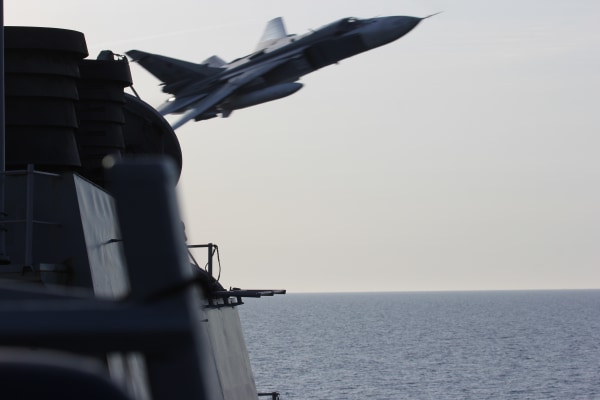
Russian Provocation on U.S. Military, Pact Violation

Earlier this week, the Russians buzzed a U.S. guided missile destroyer in the Baltic Sea. This occurred 11 times over 2 days. It is an educated guess that this provocation was meant to be a classified occurrence but our military is angry and leaked it into the public domain. This is hardly the first time the Russians have behave outside the scope of international pacts and conditions against the West and allies.

The Russians did have a response to our complaints, that is if there were any from Washington:

NBC: A U.S. official said the maneuvers were “unsafe” and “unprofessional” — and that the jets were so low they left “wake in the water.” He said a Russian KA-27 helicopter also made seven passes above the destroyer and was believed to be photographing the ship.

Russian Ministry of Defense spokesman Maj. Gen. Igor Konashenkov hit back Thursday, saying that “upon visual contact, the Russian pilots have executed a turnaway from the ship, compliant to all safety regulations.”

Safety regulations? Whose regulations exactly? There is something called the IncSea that prevents as one of the issues THE exact type of incident that Russia is guilty of. Additionally, the Cold War Museum has an interesting story about this exact matter.

Agreement Between the Government of The United States of America and the Government of The Union of Soviet Socialist Republics on the Prevention of Incidents On and Over the High Seas

Bureau of International Security and Nonproliferation


Signed at Moscow May 25, 1972
Entered into force May 25, 1972

Narrative
Treaty Text
Protocol

Narrative

 
In the late 1960s, there were several incidents between forces of the U.S. Navy and the Soviet Navy. These included planes of the two nations passing near one another, ships bumping one another, and both ships and aircraft making threatening movements against those of the other side. In March 1968 the United States proposed talks on preventing such incidents from becoming more serious. The Soviet Union accepted the invitation in November 1970, and the talks were conducted in two rounds — October 1, 1971, in Moscow and May 17, 1972, in Washington, D.C. The Agreement was signed by Secretary of the Navy John Warner and Soviet Admiral Sergei Gorshkov during the Moscow summit meeting in 1972.

Specifically, the agreement provides for:

  • steps to avoid collision;
  • not interfering in the “formations” of the other party;
  • avoiding maneuvers in areas of heavy sea traffic;
  • requiring surveillance ships to maintain a safe distance from the object of investigation so as to avoid “embarrassing or endangering the ships under surveillance”;
  • using accepted international signals when ships maneuver near one another;
  • not simulating attacks at, launching objects toward, or illuminating the bridges of the other partys ships;
  • informing vessels when submarines are exercising near them; and
  • requiring aircraft commanders to use the greatest caution and prudence in approaching aircraft and ships of the other party and not permitting simulated attacks against aircraft or ships, performing aerobatics over ships, or dropping hazardous objects near them.

The agreement also provides for: (1) notice three to five days in advance, as a rule, of any projected actions that might “represent a danger to navigation or to aircraft in flight”; (2) information on incidents to be channeled through naval attaches assigned to the respective capitals; and (3) annual meetings to review the implementation of the Agreement.

The protocol to this agreement grew out of the first meeting of the Consultative Committee established by the agreement. Each side recognized that its effectiveness could be enhanced by additional understandings relating to nonmilitary vessels. In the protocol signed in Washington, D.C., on May 22, 1973, each party pledged not to make simulated attacks against the nonmilitary ships of the other.

Like other confidence-building measures, the Incidents at Sea Agreement does not directly affect the size, weaponry, or force structure of the parties. Rather, it serves to enhance mutual knowledge and understanding of military activities; to reduce the possibility of conflict by accident, miscalculation, or the failure of communication; and to increase stability in times of both calm and crisis. In 1983, Secretary of the Navy John Lehman cited the accord as “a good example of functional navy-to-navy process” and credited this area of Soviet-American relations with “getting better rather than worse.” In 1985, he observed that the frequency of incidents was “way down from what it was in the 1960s and early 1970s.”


Treaty Text

Agreement Between the Government of The United States of America and the Government of The Union of Soviet Socialist Republics on the Prevention of Incidents On and Over the High Seas

Signed at Moscow May 25, 1972
Entered into force May 25, 1972

The Government of the United States of America and the Government of the Union of Soviet Socialist Republics,

Desiring to assure the safety of navigation of the ships of their respective armed forces on the high seas and flight of their military aircraft over the high seas, and

Guided by the principles and rules of international law,

Have decided to conclude this Agreement and have agreed as follows:


Article I
For the purpose of this Agreement, the following definitions shall apply:

1. “Ship” means:


(b) Naval auxiliaries of the Parties, which include all naval ships authorized to fly the naval auxiliary flag where such a flag has been established by either Party.

    (a) A warship belonging to the naval forces of the Parties bearing the external marks distinguishing warships of its nationality, under the command of an officer duly commissioned by the government and whose name appears in the Navy list, and manned by a crew who are under regular naval discipline;

2. “Aircraft” means all military manned heavier-than-air and lighter-than-air craft, excluding space craft.

3. “Formation” means an ordered arrangement of two or more ships proceeding together and normally maneuvered together.


Article II
The Parties shall take measures to instruct the commanding officers of their respective ships to observe strictly the letter and spirit of the International Regulations for Preventing Collisions at Sea, hereinafter referred to as the Rules of the Road. The Parties recognize that their freedom to conduct operations on the high seas is based on the principles established under recognized international law and codified in the 1958 Geneva Convention on the High Seas.


Article III
1. In all cases ships operating in proximity to each other, except when required to maintain course and speed under the Rules of the Road, shall remain well clear to avoid risk of collision.

2. Ships meeting or operating in the vicinity of a formation of the other Party shall, while conforming to the Rules of the Road, avoid maneuvering in a manner which would hinder the evolutions of the formation.

3. Formations shall not conduct maneuvers through areas of heavy traffic where internationally recognized traffic separation schemes are in effect.

4. Ships engaged in surveillance of other ships shall stay at a distance which avoids the risk of collision and also shall avoid executing maneuvers embarrassing or endangering the ships under surveillance. Except when required to maintain course and speed under the Rules of the Road, a surveillant shall take positive early action so as, in the exercise of good seamanship, not to embarrass or endanger ships under surveillance.

5. When ships of both Parties maneuver in sight of one another, such signals (flag, sound, and light) as are prescribed by the Rules of the Road, the International Code of Signals, or other mutually agreed signals, shall be adhered to for signalling operations and intentions.

6. Ships of the Parties shall not simulate attacks by aiming guns, missile launchers, torpedo tubes, and other weapons in the direction of a passing ship of the other Party, not launch any object in the direction of passing ships of the other Party, and not use searchlights or other powerful illumination devices to illuminate the navigation bridges of passing ships of the other Party.

7. When conducting exercises with submerged submarines, exercising ships shall show the appropriate signals prescribed by the International Code of Signals to warn ships of the presence of submarines in the area.

8. Ships of one Party when approaching ships of the other Party conducting operations as set forth in Rule 4 (c) of the Rules of the Road, and particularly ships engaged in launching or landing aircraft as well as ships engaged in replenishment underway, shall take appropriate measures not to hinder maneuvers of such ships and shall remain well clear.


Article IV
Commanders of aircraft of the Parties shall use the greatest caution and prudence in approaching aircraft and ships of the other Party operating on and over the high seas, in particular, ships engaged in launching or landing aircraft, and in the interest of mutual safety shall not permit: simulated attacks by the simulated use of weapons against aircraft and ships, or performance of various aerobatics over ships, or dropping various objects near them in such a manner as to be hazardous to ships or to constitute a hazard to navigation.


Article V
1. Ships of the Parties operating in sight of one another shall raise proper signals concerning their intent to begin launching or landing aircraft.

2. Aircraft of the Parties flying over the high seas in darkness or under instrument conditions shall, whenever feasible, display navigation lights.


Article VI
Both Parties shall:

1. Provide through the established system of radio broadcasts of information and warning to mariners, not less than 3 to 5 days in advance as a rule, notification of actions on the high seas which represent a danger to navigation or to aircraft in flight.

2. Make increased use of the informative signals contained in the International Code of Signals to signify the intentions of their respective ships when maneuvering in proximity to one another. At night, or in conditions of reduced visibility, or under conditions of lighting and such distances when signal flags are not distinct, flashing light should be used to inform ships of maneuvers which may hinder the movements of others or involve a risk of collision.

3. Utilize on a trial basis signals additional to those in the International Code of Signals, submitting such signals to the Intergovernmental Maritime Consultative Organization for its consideration and for the information of other States.


Article VII
The Parties shall exchange appropriate information concerning instances of collision, incidents which result in damage, or other incidents at sea between ships and aircraft of the Parties. The United States Navy shall provide such information through the Soviet Naval Attache in Washington and the Soviet Navy shall provide such information through the United States Naval Attache in Moscow.


Article VIII
This Agreement shall enter into force on the date of its signature and shall remain in force for a period of three years. It will thereafter be renewed without further action by the Parties for successive periods of three years each.

This Agreement may be terminated by either Party upon six months written notice to the other Party.


Article IX
The Parties shall meet within one year after the date of the signing of this Agreement to review the implementation of its terms. Similar consultations shall be held thereafter annually, or more frequently as the Parties may decide.


Article X
The Parties shall designate members to form a Committee which will consider specific measures in conformity with this Agreement. The Committee will, as a particular part of its work, consider the practical workability of concrete fixed distances to be observed in encounters between ships, aircraft, and ships and aircraft. The Committee will meet within six months of the date of signature of this Agreement and submit its recommendations for decision by the Parties during the consultations prescribed in Article IX.

DONE in duplicate on the 25th day of May 1972 in Moscow in the English and Russian languages each being equally authentic.


FOR THE GOVERNMENT OF THE UNITED STATES OF AMERICA:

John W. Warner

Secretary of the Navy

FOR THE GOVERNMENT OF THE UNION OF SOVIET SOCIALIST REPUBLICS:

Sergei G. Gorshkov

Commander-in-Chief of the Navy


Protocol to the Agreement Between the Government of The United States of America and the Government of The Union of Soviet Socialist Republics on the Prevention of Incidents On and Over the High Seas Signed May 25, 1972

Signed at Washington May 22, 1973
Entered into force May 22, 1973

The Government of the United States of America and the Government of the Union of Soviet Socialist Republics, herein referred to as the Parties,

Having agreed on measures directed to improve the safety of navigation of the ships of their respective armed forces on the high seas and flight of their military aircraft over the high seas,

Recognizing that the objectives of the Agreement may be furthered by additional understandings, in particular concerning actions of naval ships and military aircraft with respect to the non-military ships of each Party,

Further agree as follows:


Article I
The Parties shall take measures to notify the non-military ships of each Party on the provisions of the Agreement directed at securing mutual safety.


Article II
Ships and aircraft of the Parties shall not make simulated attacks by aiming guns, missile launchers, torpedo tubes and other weapons at non-military ships of the other Party, nor launch nor drop any objects near non-military ships of the other Party in such a manner as to be hazardous to these ships or to constitute a hazard to Navigation.


Article III
 

This Protocol will enter into force on the day of its signing and will be considered as an integral part of the Argument between the Government of the United States of America and the Government of the Union of Soviet Socialist Republics on the Prevention of Incidents On and Over the High Seas which was signed in Moscow on May 25, 1972.


DONE on the 22nd of May, 1973 in Washington, in two copies, each in the English and the Russian language, both texts having the same force.

FOR THE GOVERNMENT OF THE UNITED STATES OF AMERICA:

J.P. Weinel

Vice Admiral, U.S. Navy

FOR THE GOVERNMENT OF THE UNION OF SOVIET SOCIALIST REPUBLICS:

Alekseyev, Admiral


Belgium Knew of the Network, Europe Knew

Note: There is the same movement in America but who gets that memo?

This website published an item last month on a very closely related movement in Belgium and honestly across Europe, the Shariah4 movement.

In fact this movement is at least 5 years old.

—- [Hot Issue] The Zerkani Network: Belgium’s Most Dangerous Jihadist Group // Terrorism Monitor – The Jamestown Foundation

In recent months, there have been key developments and insights regarding the notable number of Belgians fighting in Syria and Iraq. A recruitment organization whose existence was unearthed during a series of trials turned out to be one of the most active; the direct implication of the so-called Zerkani network in the Brussels and Paris attacks also makes it the most dangerous one. This analysis serves as an update to my May 2015 article in Terrorism Monitor “How Belgium Became a Top Exporter of Jihad,” and points out significant differences with other Belgian jihadist networks, as well as uncovers the nuances of their links with one another (Terrorism Monitor, May 29, 2015).

About a year ago, the neo-Islamist movement Shariah4Belgium was invariably named as the most significant factor behind the tremendous number of Belgian fighters in the Syrian-Iraqi conflict (Terrorism Monitor, May 29, 2015). According to the latest estimates, that figure can be as high as 589 by now. With 80 of the militants clearly linked to Shariah4Belgium, the network’s importance remains. The Zerkani network comes close, however. Hardly known twelve months ago, the Zerkani network appears to have sent at least 59 people to the jihad in Syria and Iraq (Pieter Van Ostaeyen, April 3). Three of these Zerkani jihadists have played a direct role in Europe’s latest terrorist attacks: Abdelhamid Abaaoud and Chakib Akrouh were perpetrators in Paris, while Najim Laachraoui participated in Brussels and is also suspected of being the bomb maker for both plots (Emmejihad, March 22).

The Zerkani Network’s Origins

The Zerkani network is named after Khalid Zerkani, a 42-year-old Moroccan who was living in the Brussels municipality of Molenbeek. Before sentencing him to twelve years’ imprisonment on July 29 of last year, the judge described him as a “cynical guru.” According to the written judgment of the trial, Zerkani not only indoctrinated very young people up to the point where they were willing to sacrifice themselves, but also encouraged them to commit a slew of petty crimes in order to pay for their journey to death. [1] Though practicing Muslims are not allowed to steal from another, theft among the Zerkani network was whitewashed as taking “ghanima”— the spoils of war. That principle is said to have been introduced into the network by Reda Kriket, a Frenchman living in Belgium who was arrested shortly after the Brussels attacks on suspicion of yet another terrorist plot (Marianne, March 25).

It is not entirely clear whether Zerkani himself has ever been part of the terrorist plots in which his recruits had a role. It is possible that he only aimed at recruiting for a war abroad. The Belgian terrorists responsible for attacking the West after he recruited them may well have been selected and groomed for their deadly European missions behind Zerkani’s back. There are strong indications however, that Zerkani also plotted for that kind of action. As early as 2012, conversations about the need of attacks in the West were overheard by Belgian security services during a meeting in which he took part (Emmejihad, January 26). Moreover, Zerkani did not only recruit for the Syrian jihad; prior, he was linked to at least seven people convicted in Belgium for their cooperation with al-Shabaab, the al-Qaeda-linked terrorist organization based in Somalia. [2]

Zerkani’s Key Social Ties

Fatima Aberkan, a 55-year-old mother who has sent four of her own sons to the Syrian jihad, was convicted at the same trial as Zerkani. The judge described her as the “pasionaria of the jihad,” highlighting her enormous role in both the indoctrination of recruits and in organizing the logistics of their departure to war. Fatima Aberkan used to be the closest friend of Malika El Aroud, Europe’s most notorious female terror convict to date (Marie Claire, May 15, 2009). It was Aberkan who served as a go-between (with her e-mail address faty450@hotmail.com, to be more precise) for El Aroud and the latter’s second husband, Moez Garsallaoui, after his departure from Belgium in 2007 to become a high ranking member of al-Qaeda in the Afghan-Pakistani border zone. Aberkan was also responsible for providing Nizar Trabelsi—who was convicted for plotting against the U.S. Air Force base in the Belgian town of Kleine Brogel and later rendered to the U.S.—with a mobile phone in prison, adding to existing suspicions of a plot to set him free. [3]

Aberkan’s brother Abdelhouaid, was also convicted as a member of Zerkani’s network, notably for his role in the 2001 assassination of the Afghan anti-Taliban commander, Ahmed Shah Massoud. He was responsible for driving El Aroud’s first husband, Dahmane Abd al-Satter, to the airport for the assassination, which was a suicide mission, and was considered to be preparation for the 9/11 attacks in the U.S. (LeMonde, April 19, 2005).

While Abdelhouaid Aberkan was convicted in Belgium for his part in the assassination of Commander Massoud, another person linked to the Zerkani network was tried in France for the same charge. Abderrahmane Ameuroud, 38, was arrested at a tram stop in the Brussels municipality of Schaarbeek on March 25 of this year, and was then shot in the leg. He is suspected of being part of a terrorist plot for which fellow Zerkani network member, Reda Kriket, had amassed an unprecedented amount of arms and explosives (Libération, March 30). According to the French-Algerian journalist Mohamed Sifaoui, Ameuroud is the youngest of three brothers who all have escalated their lawbreaking habits from petty crimes to Islamic terrorism (Twitter, March 26). Abderrahmane’s brother Reda was expulsed by France for radical sermons he held in a Paris mosque, while Abderrahmane is said to be a veteran of al-Qaeda’s training camps and was named a recruiter for the previous Iraqi jihad more than ten years ago (LeParisien, July 29, 2005).

Zerkani Network vs. Shariah4Belgium

Zerkani’s modus operandi could hardly differ more from that of Shariah4Belgium. The latter was notorious for its highly visible actions, such as public demonstrations and preaching sessions in crowded shopping streets. Zerkani’s organization had no website, no logo, and no distinctive name. Recruiting was done under the guise of offering community sporting activities, while further indoctrination happened in old-fashioned backrooms. While Shariah4Belgium’s leader Fouad Belkacem participated in televised debates and disseminated his sermons via YouTube, even the grainiest picture of Zerkani is extremely hard to locate. Zerkani was always sure to use someone else’s phone while calling abroad, and conversely, he had others in his network carry his phone to avoid being traced and geo-located. According to the court judgment mentioned above, Zerkani’s wariness supplemented the belief that he was trained in the famous Afghan-Pakistani terrorist camps, “as unconfirmed reports claim.” [4]

While most of the people Shariah4Belgium recruited between 2012 and the first months of 2014 were incorporated in the local militia “Majlis Shura al-Mujahideen” of the Syrian commander Amr al-Absi, Zerkani’s early recruits landed within the “Katibat al-Muhajireen,” which was led at the time by the ethnic-Chechen commander Tarkhan Batirashvili, better known as Abu Omar al-Shishani. Both groups were based in the outskirts of Aleppo and cooperated with one another, meaning that Belgian fighters of both networks interacted with each other regularly. Soon after the establishment of the so-called Islamic State (IS), al-Absi and al-Shishani pledged allegiance to the IS leader, Abu Bakr al-Baghdadi. But as was the case with the Shariah4Belgium recruits, several Zerkani members instead joined rival Jabhat al-Nusra, also known as al-Qaeda’s branch in Syria. What happened later in terms of individual affiliations is difficult to ascertain, though it appears most of the Zerkani recruits finally joined the Islamic State—similar to the many Shariah4Belgium members who had joined IS before them.

A remarkable characteristic of the Antwerp-based and mainly Dutch-speaking Shariah4Belgium is that it ostensibly lacked any link with older networks of the Belgian jihad. Apart from a few links with the remnants of the “Groupe Islamique Combattant Marocain” (GICM), Shariah4Belgium does not seem rooted in Belgium’s extremist past (Emmejihad, June 7, 2014). This could not be more different from the Zerkani network, which operates almost exclusively in French-speaking circles in Brussels.

Although Shariah4Belgium and the Zerkani network have their dissimilarities, they are connected to a certain degree. The recent arrest of Shariah4Belgium convict Bilal El Makhoukhi, 27, in connection to the Brussels attacks, may have resulted from members of both networks having met each other at the Syrian front (De Redactie, April 9) as well as in Belgium. The man at the intersection of the two groups is Jean-Louis Denis, 41. He ran his own recruitment cell for the Syrian jihad, posing as a benefactor distributing food to the homeless near the Brussels “Gare du Nord” railway station. Denis was sentenced to ten years in jail in January 2016 for these charges (Le Soir, January 29). According to the outcome of this trial, he not only publicly declared himself to be the leader of the Brussels chapter of Shariah4Belgium, but even claimed to be in the running to replace its overall leader, Fouad Belkacem, after Belkacem’s arrest in June 2012. [5]

Denis was particularly successful as a recruiter, attracting people who wanted to join the jihad from as far as Martinique. However, he lacked the necessary contacts to get his recruits across Syrian borders. Therefore, he often relied on the social network structures that Zerkani had built. Based upon evidence presented at his trial, it was Denis’s lieutenant, Mohamed Khemir, 37, who served as most important go-between. At least once, Khemir accompanied Zerkani when he brought a young French recruit to the Brussels airport to travel to Syria. Zerkani, Khemir, and Denis were often present at the same meetings, and little by little, both groups almost seemed to merge. In the end, Denis’s entourage looked more like a chapter of Zerkani’s network than as a part of Shariah4Belgium, but left behind a significant number of jihadists who were influenced by both. [6]

Conclusion

Hardly known a year ago, Belgium’s Zerkani network has now been revealed to be the country’s most dangerous jihadist group. Led by the enigmatic Moroccan, Khalid Zerkani, it has sent at least 59 recruits to Syria and Iraq. Most of them have ended up within the terrorist group Islamic State, and at least three have returned to Western Europe to commit the deadly Paris and Brussels terrorist attacks. The modus operandi of the network differs greatly from that of Shariah4Belgium, the more renowned and equally as significant group fueling the high number of Belgian jihadists, though connections between the groups—both in Belgium and in the battlefield—are undoubtedly present.

Guy Van Vlierden is a journalist for the Belgian newspaper Het Laatste Nieuws, specializing in issues relating to terrorist and extremism.

Notes:

[1] Judgment of the ‘Tribunal de Première Instance Francophone de Bruxelles’ issued on July 29, 2015 – in the possession of the author.

[2] Mentioned in the judgment of July 29, 2015 – cfr. Supra

[3] Mentioned in Italian court papers in the possession of the author; Mentioned in the judgment of July 29, 2015 – cfr. Supra.

[4] Mentioned in the judgment of July 29, 2015 – cfr. Supra.

[5] Judgment of the Tribunal de Première Instance Francophone de Bruxelles issued at January 29, 2016 – in the possession of the author.

[6] All details mentioned in the judgment of January 29, 2016 – cfr. Supra.