The Breakdown Prediction of Europe

Fighting wars in the Middle East with politically correct rules of engagement leads to no victory, but rather a long agonizing conflicts where millions are displaced, governments are failing and human suffering has no limitations.

The migrant condition is predicted to continue for at least five years. Europe is slated to suffer economically as a result and respective countries will lose their identity and management control.

These conditions fester yet do not include the building hostilities in Eastern Europe which is facing an insurgency by Russia where real old fashioned ground wars are forecasted. After 16 years of fighting the terrorist model of conflicts the conventional type of warfare is forgotten in training and muscle memory and could be a real conundrum for the Baltic region.

Meanwhile, what is Europe’s long term plan? Answer, there is no plan. ****

Europe migrant crisis: EU faces ‘populist uprising’
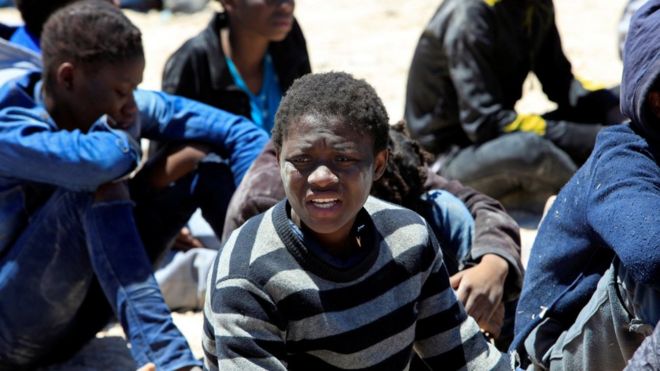
Migrants detained by Libyan authorities in Tripoli while trying to cross to Europe - 16 May

Reuters: Europe has seen a surge in the number of migrants trying to reach the continent 

BBC: Europe faces a “populist uprising” if it is unable to show people it can control the migrant crisis, former MI6 head Sir Richard Dearlove has said.

He was speaking on the BBC’s World on the Move day on migration issues.

Sir Richard also warned against offering visa-free travel to Turkish nationals, describing the move as like storing gasoline near a fire.

Earlier, UN special envoy Angelina Jolie Pitt warned the humanitarian system for refugees was breaking down.

She spoke of a “fear of migration” and a “race to the bottom” as countries competed to be the toughest to protect themselves.

A range of speakers, including the UNHCR’s special envoy Angelina Jolie Pitt, and former British secret intelligence chief Sir Richard Dearlove, have been setting out the most important new ideas shaping our thinking on economic development, security and humanitarian assistance.

Sir Richard said the numbers of immigrants coming into Europe over the next five years could run into millions.

The crisis could reshape the continent’s geopolitical landscape, he said.

“If Europe cannot act together to persuade a significant majority of its citizens that it can gain control of its migratory crisis then the EU will find itself at the mercy of a populist uprising, which is already stirring,” he added.

He described the UK referendum on leaving the EU as “the first roll of the dice in a bigger geopolitical game”.

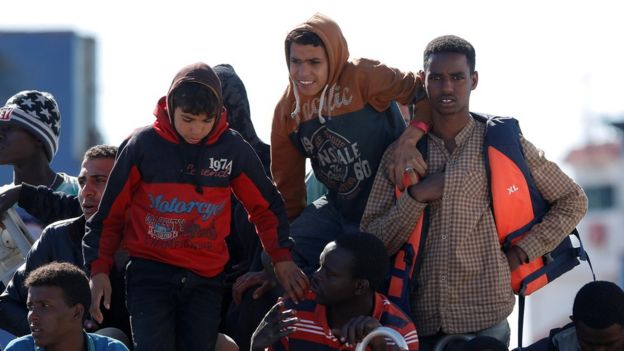
Migrants arrive in Sicily on Italian coastguard vessel - 13 May

Reuters: There are concerns that Europe is unable to control the flow of migrants 

Sir Richard warned against a deal with Turkey to allow visa-free travel to the EU to its citizens in exchange for controlling migration to the EU.

He said it was “perverse, like storing gasoline next to the fire we’re trying to extinguish”.

Talks between the Turkey and the EU over the deal have currently stalled over the former’s refusal to amend its anti-terror laws.

The former head of MI6, which gathers intelligence abroad for the UK government, said €1.8bn (£1.4bn) allocated by the EU to address the root causes of migration in Africa made “much more sense” than a deal with Turkey but was not nearly enough.

The only answer was a “massive response” of this kind combined with a “much more aggressive operation along the North African coast”, he added.

But Sir Richard cautioned against shutting the door on migration altogether.

“In the real world there are no miraculous James Bond-style solutions,” he said. “Human tides are irresistible unless the gravitational pull that causes them is removed.”

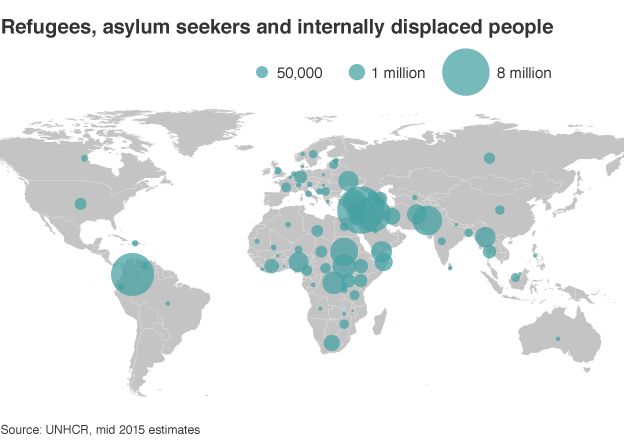
Speaking earlier in the day, Ms Jolie Pitt said that more than 60 million people – one in 122 – were displaced globally – more than at any time in the past 70 years.

“This tells us something deeply worrying about the peace and security of the world,” she said, adding: “The average time a person will be displaced is now nearly 20 years.”

Ms Jolie Pitt said the “number of conflicts and scale of displacement had grown so large” the system to protect and return refugees was not working.

Save the Children is calling for greater international commitment to ensure child refugees remain in school.

The charity’s new report, A New Deal for Refugees, says only one in four refugee children is now enrolled in secondary school.

It is calling on governments and aid agencies to adopt a new policy framework that will ensure no refugee child remains out of school for more than a month.

It is an ambitious target but there is growing concern that this migration crisis is producing a lost generation of children which means conditions for even greater insecurity and poverty.

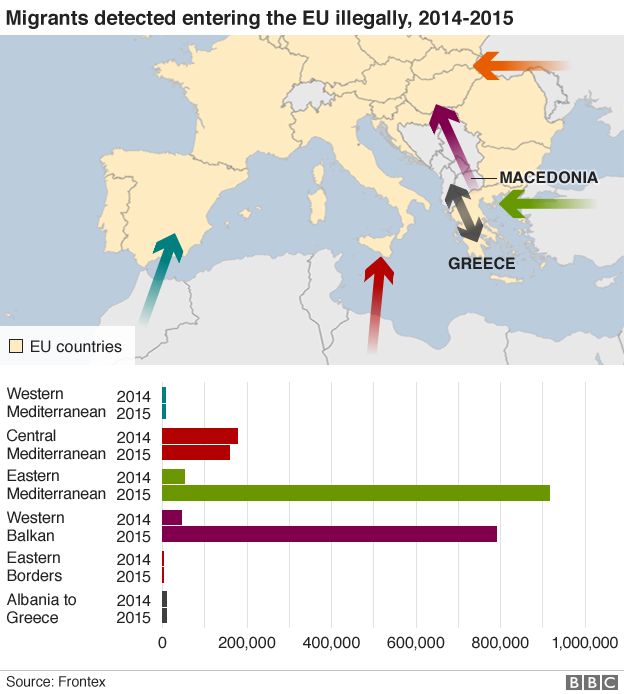
Migrants detected entering the EU, 2014-2015

Refugee map

A note on terminology: The BBC uses the term migrant to refer to all people on the move who have yet to complete the legal process of claiming asylum. This group includes people fleeing war-torn countries such as Syria, who are likely to be granted refugee status, as well as people who are seeking jobs and better lives, who governments are likely to rule are economic migrants.
$$ Taken Out of Veteran’s Pockets for Visa Program


But we are still in Afghanistan and will be there for many years…where is the United Nations? What role does the refugee resettlement program have in this so as not to penalize veterans?

The Senate Grew A Special Visa Program With Money Taken Out Of Veterans’ Pockets

DailyCallerNewsFoundation: The Senate used money from benefit cuts to military veterans in the 2016 budget to pay for the resettlement of an additional 3,000 Afghan interpreters in the United States. A dispute over a similar pay-for plan is behind the Judiciary Committee’s refusal to expand the program again in the 2017 budget.

The Special Immigrant Visa program allows Afghan interpreters who aide the U.S. government to get out of harm’s way by resettling in the United States, and last year the Senate authorized a major expansion of the program. The $336 million price tag of the expansion fell on U.S. military veterans in the form of increased pharmacy co-pays, The Daily Caller News Foundation has learned.

“That’s bullshit,” former Army combat veteran Alex Plitsas told TheDCNF. “Military families shouldn’t be paying for the SIV program through a pseudo tax. The program should be funded outright because of the service our interpreters rendered. This is infuriating.”

Last year’s defense bill increased co-pays for military families, saving the government about $1.5 billion, according to the Congressional Budget Office (CBO). A portion of the money saved was used to pay for the extra Afghan visas, a spokesman for the Armed Services Committee told TheDCNF, although the bulk of the money went elsewhere. Budget caps require lawmakers offset increases in spending with budget cuts.

Plitsas added: “They went this route to avoid having to cut any of the service budgets (army, navy, etc) that’s why I’m calling this a pseudo tax on military families. More importantly, this is a visa program overseen by State, why the hell isn’t this coming out of state’s budget?”

The committee spokesman told TheDCNF most of the $1.5 billion went back to the Treasury to pay down the debt, and some of the savings were used to offset the cost of expanding retirement benefits in other ways for “hundreds of thousands” of service members. Those changes will cost the government about $1 billion over the next ten years, according to the CBO.

Senators voted for the co-pay increases on the merits of the policy and were not treating it as a pay-for, the spokesman added. The increase was included for “no other reason” than to address rising pharmacy costs and to encourage veterans to use drugs available for free through military treatment centers rather than through pharmacies, the spokesman stressed.

Nevertheless, in making the decision to offset the visa expansion with funds from the co-pay increase, the Senate took hundreds of millions of dollars off the table that could have gone to support veterans or been used for some other purpose. There’s no reason the money has to come out of the defense budget, especially since there is overlap in jurisdiction with the State Department’s control of visa programs.

A disagreement between Senate Republicans over a similar pay-for plan this year has kept another expansion of the program out of the 2017 defense bill, a GOP Senate aide told TheDCNF. One proposal to offset the cost by taking money out of the State Department’s budget was floated and rejected.

“I’ve been told by multiple sources that they’re trying to use the co-pay hike to pay for the visa increase again this year,” the aide said. “With so much wasteful government spending that should be cut, it is befuddling how some in Congress are so eager to put military and veteran benefits on the chopping block.”


Sens. John McCain and Jeanne Shaheen are vocally pushing for more visas, on top of the 7,000 already allocated through Fiscal Year 2017. But neither has publicly addressed how the increase would be paid for. The CBO estimates the proposed increase would bring the cost of the program up to $446 million over the next ten years, from its current cost of $336 million.

Shaheen did not respond to multiple requests for comment. McCain’s office directed TheDCNF to the Armed Services Committee.

“Senate Republicans recognize the contribution of certain Afghan citizens who have been helpful to our war effort,” a spokesman for Republican Sen. Roger Wicker who sits on the Armed Services Committee, told TheDCNF. “However, any bill to expand the SIV program should contain acceptable offsets and go through regular order through the Judiciary Committee.”

According to Matt Zeller, a former U.S. Army infantry officer and CEO of No One Left Behind, there are approximately 10,400 former Afghan interpreters in the program’s application pipeline. Without an increase in visas, as many as 6,400 applicants will be left in Afghanistan, given the program currently only allows for 4,000 visas per year.

The program has a final chance at seeing an increase in funding once the National Defense Authorization Act hits the Senate floor this week, allowing supporters like McCain the opportunity to put forth an amendment.

***** Meanwhile Afghanistan is hardly stable or a conflict where victory is claimed.


17 May 2016 – The United Nations humanitarian wing has reported that since the beginning of the year, about 1,000 Afghans have fled their homes every day due to fighting, and aid workers are struggling to meet the needs of those on the run from hard hit provinces such as Kunduz, Herat and Uruzugan.

According to a report compiled in April and newly released by the UN Office for the Coordination of Humanitarian Affairs (OCHA), the main humanitarian story of the year is the very large number of people fleeing from their homes to save their lives, with about 118,000 on the move in the first four months of the year.

Specifically in Kunduz, OCHA said springtime in the north eastern province “has been tragically filled with conflict and suffering,” leading to an extraordinary displacement of more than 22,400 people. Civilians appear to be caught in the cross-fire between a “spring offensive” launched by non-State actors and subsequent countermeasures put in motion by Government forces.

Fleeing for their lives, 14, 000 people were forced from Kunduz city to remote areas where the conflict is most active. The insecure environment and access constraints created severe challenges in the delivery of humanitarian assistance.

As the violence continued after mid-April, families were forced to flee and seek safety with family members and neighbours who opened their doors to offer a haven in the midst of chaos. “When we conducted the initial needs assessments, as many as six families were living in one house,” reported Syed Zaheer, OCHA Humanitarian Affairs Officer, who helped lead the joint assessment mission.

The security situation in Kunduz province continued to rapidly deteriorate, OCHA said. And as displacement swelled, aid agencies prioritized urgent humanitarian assistance to the 7,000 displaced people, however in many cases one of the biggest challenges is access to reaching the most vulnerable families in need.

According to the report, as the battle raged on for territorial control in all seven districts of Kunduz province, families were further displaced to more remote and insecure areas where humanitarian agencies continue to struggle to gain access.

Although physical access to displaced families remains a challenge due to IEDs, military operations and road closures, humanitarian agencies managed to deliver much needed food, nutritional support, emergency shelter, non-food items (NFIs) and health care.

“The displaced families in Kunduz have endured repeated suffering – some displaced two and three times – raising their vulnerability,” explained OCHA Head of Sub-Office, Gift Chatora. “We have seen the detrimental consequences when displaced families are inaccessible to humanitarian assistance, children miss out on education, nutrition and basic health care while parents lose their livelihoods and means to provide for their families.”


Protests in Vienna, Aleppo, Syria is Burning

Official State Department Summary: Meeting in Vienna on May 17, 2016, as the International Syria Support Group (ISSG), the Arab League, Australia, Canada, China, Egypt, the European Union, France, Germany, Iran, Iraq, Italy, Japan, Jordan, Lebanon, The Netherlands, the Organization of Islamic Cooperation, Oman, Qatar, Russia, Saudi Arabia, Spain, Turkey, the United Arab Emirates, the United Kingdom, the United Nations, and the United States reaffirmed the ISSG’s determination to strengthen the Cessation of Hostilities, to ensure full and sustained humanitarian access in Syria, and to ensure progress toward a peaceful political transition.


Cessation of Hostilities

Members, emphasizing the importance of a full cessation of hostilities to decreasing violence and saving lives, stressed the need to solidify the cessation in the face of serious threats, particularly during the past several weeks. The members welcomed the Joint Statement of May 9 by Ceasefire Task Force Co-Chairs, the Russian Federation and the United States, recommitting them to intensify efforts to ensure the cessation’s nationwide implementation. In this regard, they welcomed the ongoing work of the Task Force and other mechanisms to facilitate solidifying of the cessation such as the UN Operations Center and Russian-U.S. Coordination Cell in Geneva.

The ISSG Members urged full compliance of the parties to the terms of the cessation, including the ceasing of offensive operations, and undertook to use their influence with the parties to the cessation to obtain this compliance. Additionally, the ISSG called upon all parties to the cessation to refrain from disproportionate responses to provocations and to demonstrate restraint. If the commitments of the parties to the cessation are not implemented in good faith, the consequences could include the return of full-scale war, which all the Members of the ISSG agreed would be in no one’s interest. Where the co-chairs believe that a party to the cessation of hostilities has engaged in a pattern of persistent non-compliance, the Task Force could refer such behavior to the ISSG Ministers or those designated by the Ministers to determine appropriate action, including the exclusion of such parties from the arrangements of the cessation and the protection it affords them. Moreover, the failure of the cessation of hostilities and/or of the granting of access to the delivery of humanitarian relief will increase international pressure ‎on those failing to live up to these commitments.

Noting previous calls by the ISSG and the unanimously-adopted UNSCR 2254 of December 18, 2015, the ISSG reiterated its condemnation of the indiscriminate attacks by any party to the conflict. The ISSG expressed its serious concern about growing civilian casualties in recent weeks, making clear that the attacks on civilians, including attacks on medical facilities, by any party, is completely unacceptable. The ISSG took note of the March 2016 commitment by the Syrian government not to engage in indiscriminate use of force and urged the fulfillment of that commitment. The ISSG committed to intensifying its efforts to get the parties to stop any further indiscriminate use of force, and welcomed the Russian Federation’s commitment in the Joint Statement of May 9 to “work with the Syrian authorities to minimize aviation operations over areas predominantly inhabited by civilians or parties to the cessation, as well as the United States’ commitment to intensifying its support and assistance to regional allies to help them prevent the flow of fighters, weapons, or financial support to terrorist organizations across their borders.”

The ISSG, noting that Da’esh and the Nusra Front are designated by the UN Security Council as terrorist organizations, urged that the international community do all it can to prevent any material or financial support from reaching these groups and dissuade any party to the cessation from fighting in collaboration with them. The ISSG supports efforts by the co-chairs of the Ceasefire Task Force to develop a shared understanding of the threat posed, and delineation of the territory controlled, by Da’esh and the Nusra Front, and to consider ways to deal decisively with the threat posed by Da’esh and the Nusra Front to Syria and international security. The ISSG stressed that in taking action against these two groups, the parties should avoid any attacks on parties to the cessation and any attacks on civilians, in accordance with the commitments contained in the February 22 Joint Statement of the Russian Federation and the United States.

The ISSG also pledged support for seeking to transform the cessation into a more comprehensive nationwide ceasefire in parallel with progress in negotiations for a political transition between the Syrian parties consistent with the Geneva Communique of June 2012, relevant UNSC Resolutions and ISSG decisions.

****

Aleppo


& in protest letting Zarif in 2D meeting. is the source of problem in  Short video protest.

****

Aleppo is burning, death is all too common while leaders after 2 days and after many meetings agree to nothing except more humanitarian action.

The US, Russia and other powers have pledged to use airdrops to deliver urgently needed humanitarian aid to Syrian civilians, but have failed to agree a date to resume stalled peace talks, underlining the depth of international divisions over the crisis.

John Kerry, the US secretary of state, and Sergei Lavrov, the Russian foreign minister, chaired a meeting in Vienna of the International Syria Support Group, which promised to “solidify” an agreement reached in February on a cessation of hostilities.

The meeting’s one advance was to call for airdrops of supplies by the World Food Programme to besieged areas – an option the UN has seen as a last resort – if ground access is not granted by the Syrian authorities by 1 June. Last week government forces blocked a UN and Red Cross convoy from reaching Darayya, near Damascus.

Airdrops are fraught with technical and logistical difficulties, including high cost and a low volume of supplies compared with land convoys, as well as hazards for civilian aircrew operating over a country at war and for civilians on the ground. Aid can also fall into the wrong hands.

The ISSG reiterated that 1 August remained the target date for agreement on a political transition which would include a “broad, inclusive, non-sectarian transitional governing body with full executive powers”. That looks unattainable.

Arab and western officials had said earlier that they did not expect significant achievements from the Vienna talks. The conventional wisdom regarding the current situation in Syria is that Russia is calling the shots and that the US is working with it, despite the two countries’ ostensible disagreement about Assad’s fate. “We are dealing with tactical steps, but there is nothing beyond them,” one senior Gulf diplomat told the Guardian.

If the transition does not begin by August, Saudi Arabia has hinted that it may provide heavier weapons to rebel forces. Kerry has referred vaguely to a plan B, but few expect a dramatic change in Barack Obama’s final months in the White House. “We believe we should have moved to a plan B a long time ago,” said the Saudi foreign minister, Adel al-Jubeir.

“Kerry has been making noises about consequences for violations of the ceasefire, but I don’t think the Americans have much to offer, or anything that will change things in a significant way,” one opposition adviser said.

Salem al-Meslet, spokesman for the rebel High Negotiations Committee, said: “There can be no solution while our country is terrorised by a regime which turns back supplies of basic necessities, including even baby food, as happened in Darayya last week.”

Earlier this month, a surge in bloodshed in Aleppo wrecked the 10-week-old partial truce sponsored by Washington and Moscow that had allowed the UN-brokered talks to carry on. De Mistura said its earlier 80% effectiveness had now been reduced to 50%.

The opposition National Coalition also called on the ISSG to establish a taskforce to deal with the plight of thousands of detainees and “forcibly disappeared persons” who are assumed to be held by the Syrian government.

The Russian military was meanwhile reported to be constructing a new base in the Syrian town of Palmyra, within the protected zone that holds the archaeological site listed by Unesco as a world heritage site and without asking for permission. Read more here from the Guardian.


Contentious House Hearing on Iran Deal/Ben Rhodes

The disdain the White House has for Republicans in Congress has a long history, but his week concerning the NYT’s interview with White House deputy security council advisor Ben Rhodes, Josh Earnest took the nastiness to a new level.

Must watch Gowdy above.

So, the hearing was held without Ben Rhodes as the White House lawyer gave Rhodes executive privilege.

Meanwhile, the Democrats in the hearing based their rhetoric and questions not on the subject at hand and the reason for the hearing but rather they all went on the collective attack of the witnesses over why the United States went into a war over a false claim on WMD.

Democrats turn Iran hearing into debate over Iraq invasion
The Iran-Iraq showdown in the House Oversight Committee probably wasn’t what GOP Rep. Jason Chaffetz intended when he arranged the session. And while Republicans made several attempts to turn the focus to the current presidential administration, not the previous one, Democrats weren’t dissuaded and the hearing degenerated into a back-and-forth. More details here from Politico.

For access to the full hearing, click here. The introduction testimony of one panelist, Mr. Hannah, go here.

FNC: Republican condemnation of a top White House aide who boasted about the administration’s success selling the Iran deal to the public reached new levels on Tuesday, as several senators urged President Obama to fire him and a House committee looking into his claims went forward with its hearing – even though he didn’t show up to testify.

The House Oversight Committee hearing was called to examine White House “narratives” on the Iran deal, after top adviser Ben Rhodes was featured in a New York Times Magazine profile claiming they built an “echo chamber” to sell the plan. Chairman Jason Chaffetz, R-Utah, had called Rhodes to testify, but the White House shielded him from the appearance.

Chaffetz, at the top of the hearing Tuesday, said “there’s still a shroud of secrecy” surrounding the Iran deal and he wanted to hear from Rhodes to seek “clarity.”

“I do not doubt his talents and his knowledge,” Chaffetz said. “But the deal that had been spun up and sold to the American public, I’m not sure it was as clear as it should have been.”

He said Rhodes, in the profile, showed “disdain” for the media and foreign policy circles.

Just hours earlier, the White House officially informed Chaffetz it would not make Rhodes available to testify, citing an executive privilege-related claim. Chaffetz did not go forward with plans to keep a seat open Tuesday for Rhodes, and instead called foreign policy analysts and scholars to testify on the deal. One of them, the American Enterprise Institute’s Michael Rubin, accused Rhodes of creating a “propaganda operation.”

The committee’s top Democrat, Rep. Elijah Cummings, D-Md., slammed Republicans for the hearing, criticizing the analysts they called while noting they didn’t invite military generals who support the agreement. He said Republicans rushed to hold the hearing “without even one week’s notice.”

Rep. Trey Gowdy, R-S.C., said at least Cummings would be able to question the witnesses present. Rhodes, he said, “didn’t bother to show up.”

Meanwhile, several GOP senators have written to Obama urging him to “dismiss” Rhodes “before he further tarnishes the Office of President.”

They wrote: “While members of the Executive and Legislative branches may sometimes deeply disagree on issues of vital importance to our nation’s security and prosperity, we should all agree, for the greater good of our Republic and the citizens whom we represent, to engage in our debates in a respectful, honest, and constructive manner. Mr. Rhodes’s disrespectful, deceptive, and destructive conduct has fallen appallingly short of this standard, however. Indeed, if he had conducted himself this way in a typical place of business outside Washington, where American taxpayers work, he surely would have been already fired or asked to resign.”

The Washington Free Beacon, which first reported on the letter, said it was signed by Sens. Mark Kirk, R-Ill.; John Cornyn, R-Texas; John Barrasso, R-Wyo.; and David Perdue, R-Ga.

Sources tell Fox News that the House committee was keen for Rhodes to appear voluntarily Tuesday so they avoid the territory of a possible subpoena.

The magazine article that touched off the controversy outlined how Rhodes created a narrative of the deal coming out of the 2013 election of “moderate” Iranian President Hassan Rouhani and Iran’s subsequent “openness” and willingness to negotiate.

In fact, the story stated, the majority of the deal was hammered out in 2012, well before Rouhani’s election. However, the Rhodes narrative was politically useful to the administration as it presented them as reaching out to the moderates who wanted peace.

Beware: Lil Blue Men Militia, S. China Sea

The only estimate of the size of the Maritime Militia obtained during the course of this research was from a source published in 1978, which put the number of personnel at 750,000 on approximately 140,000 craft.5 In its 2010 Defense White Paper, China stated that it had 8 million primary militia members nationwide.6 The Maritime Militia is a smaller unique subset since it performs many of its missions at sea. Since an accurate number is not available this chapter takes more of a grassroots approach and attempts to determine the average size of a unit at the local level. It is important to note that the Maritime Militia is distinct from both China’s coastal militia (shore based) and its naval reserve, although some coastal militia units have been transformed into Maritime Militia units. Full white paper is here.

While Russia has employed “Little Green Men” surreptitiously in Crimea, China uses its own “Little Blue Men” to support Near Seas claims. As the U.S. military operates near Beijing’s artificially-built South China Sea (SCS) features and seeks to prevent Beijing from ejecting foreign claimants from places like Second Thomas Shoal, it may well face surveillance and harassment from China’s maritime militia. Washington and its allies and partners must therefore understand how these irregular forces are commanded and controlled, before they are surprised and stymied by them.

China has long organized its civilian mariners into maritime militia, largely out of necessity. Recent years have seen a surge of emphasis on maritime militia building and increasing this unique force’s capabilities; however it is difficult to ascertain who or what entity within China’s government has ordered such emphasis. One can point to Xi Jinping’s visit to the Tanmen Maritime Militia in 2013, after which maritime militia building oriented toward the SCS has seen growth in places like Hainan, Guangdong, and Guangxi. Yet local militia training and organization plans prior to this date had already emphasized the training of maritime militia units.

Unit Composition and Organization

China’s militia has two major subcomponents: an “ordinary” reserve of registered male citizens akin to the U.S. Selective Service pool, and a “primary” force more readily mobilized to respond to various contingencies. The primary force receives dedicated resources, troops demobilized from active duty, and training. Within the primary force, maritime militia units—formed solely at the tactical level of organization—are smaller and more specialized on average than their land-based counterparts. Within the maritime militia, a small but growing elite set of units are the ones most likely to be deployed on more sophisticated operations that involve monitoring, displaying presence in front of, or opposing foreign actors. They do so in part by supporting China’s navy and coast guard in such efforts. Some cities with large mobilization potential—i.e., a large maritime industry or fishing community—will form battalion-sized units. Most localities create company-sized units, however. These companies are divided into platoons and squads, with the smallest grouping based on each individual vessel.

Chain of Command

Militia management begins broadly at the General Staff Department’s Mobilization Department, which oversees and formulates regulations for nationwide militia work. Uniquely a local military force, the maritime militia falls within the hierarchical People’s Liberation Army (PLA) army local force command structure that runs through all levels of local military organs. As stipulated in China’s “Militia Work Regulations,” real command of the militia begins at the Provincial Military District (MD) level and below. The thousands of county- and grassroots-level People’s Armed Forces Departments (PAFD) established in county-level cities, townships, villages, and maritime enterprises (fishing companies, shipyards, etc.) directly execute the organizing and training of maritime militia. Grassroots-level PAFDs report to county-level PAFDs, which report to Military Sub-district (MSD) Headquarters, themselves reporting to MD Headquarters. Maritime militia building also receives attention by Military Region-level Command, albeit in a supervisory fashion. Higher levels of military commands likely view the maritime militia as a subset of military organization within the broader ecosystem of local militia, with particular focus on broader mobilization efforts. Additionally, militia battalions and companies form party branches to ensure Party control at the grassroots levels.

It must be emphasized that maritime militia command authority resides within multiple entities, including both the local military organs (MD, MSD, PAFD) and their government/party counterparts. This is referred to as “双重领导” in Chinese, connoting the “dual-leadership” system by the local military and government’s principal leaders. It is thus common to see a city party secretary acting in his role as first-party secretary of the local military party committee overseeing the PAFD’s efforts at managing the maritime militia. An easily visible example: Sansha City’s mayor/party secretary Xiao Jie and his military counterpart Commander Cai Xihong both attended the founding ceremony of Sansha City’s Maritime Militia Company. “Dual-leadership” is further reinforced by the fact that local governments fund militia construction.

Since both military and government leaders are involved in local armed forces building, the National Defense Mobilization Committee System (NDMC) established at each corresponding level plays the critical role in binding them into one decision-making body. The NDMC brings together these leaders to organize, direct, and coordinate nationwide national defense mobilization, ensuring that national resources can be rapidly mobilized for defense or emergency needs. Local NDMCs can also establish civilian-military joint command structures facilitated by national defense mobilization communications networks. As a militia force, the maritime militia would need a specified duration to mobilize and gather in the area designated by their superiors. Localized mobilization orders transmitted to the maritime militia could originate from a variety of sources. Regardless, they would be sent down the chain and delivered to the maritime militia via the PAFDs managing them.

While county-level PAFDs are manned by active duty PLA officers, grassroots-level PAFDs are manned by civilian government cadres. Training and education efforts target a “select group of militia cadres” (专职人民武装干部), units’ leaders (company, platoon, and squad) and “information personnel” (信息员). This group of personnel forms the backbone of the maritime militia and helps implement party control, command and control, and maintain unit cohesiveness. Essential to successful command and control of the maritime militia are the “boat captains”—often termed “船老大”—and the information personnel, which provide dedicated personnel for onboard leadership, identification, and communications. This is further facilitated by increasing incorporation of satellite communications technologies into the fishing fleet and thereby into the maritime militia.

Mission-based Command Authority

Although maritime militia are built out of the regular command structure of coastal military organs, they also serve naval and maritime law enforcement forces (MLE). The command relationships for the maritime militia may vary with the mission they are employed in. For example, maritime militia reconnaissance detachments report their findings directly to MD Headquarters, while another detachment summoned to assist with maritime law enforcement would be commanded by the Chinese Coast Guard (CCG) “in cooperation with their MD.” Similarly, support detachments serving roles for China’s navy would be under the command of the PLA Navy in cooperation with the detachment’s MD. It is clear that the maritime militia are controlled by their land-based local military organs, an arrangement flexible enough to serve a variety of supporting roles for the Chinese Navy and MLE forces. Many Chinese sources use a phrase that succinctly states such arrangements: “the military organ expresses its requirements, the NDMC coordinates, and the government implements” (军事机关提需求、国动委搞协调、政府抓落实), referring to the cooperation that occurs between civilian and military leaders in building the maritime militia.

More than One Way to Tie the Knot

Organization and command of maritime militia likely varies by locality. This stems largely from a given locality’s maritime industry and its influence on militia composition, requiring local leaders to plan maritime militia missions from what is available. Making command and decision making arrangements based on local conditions is critical to the proper functioning of such a force. Many ad hoc leading small groups are formed to handle a certain issue area, or provide temporary guidance for certain missions. The multiple organizations supporting maritime militia building (e.g., the CCG, Fisheries Bureau, and Maritime Safety Administration) are likely to enter these command structures in some fashion.

The 300,000-troop reduction that Xi announced at Beijing’s 3 September military parade will likely send additional personnel to the maritime militia, and could even further shape their command and control. Specifically, efforts to streamline the current long reporting chain through land-based forces might ensue. All the more reason that it’s vitally urgent to understand how China’s “Little Blue Men” get their sailing orders, and what those orders might be.

****