Normalized Cuba Relations Forces 8000 Cubans on U.S.

Fusion: Sidestepping Nicaraguan intransigence, Costa Rica and five other countries have announced a secret deal to airlift some 8,000 Cuban immigrants out of Costa Rica and into El Salvador, where they’ll be put on buses and transported up to Mexico in the last leg of their harrowing 5,000-mile journey to the United States.

The decision to leapfrog Nicaragua comes nearly six weeks after the Sandinista government decided to militarize its southern border and prevent Cubans from continuing their journey north through Central America. Cuban immigrants have been piling up on the border ever since, as their numbers swelled from 1,500 to some 8,000, according to the number of temporary visas issued by Costa Rican authorities.

More details:

FoxLatino:

Central American nations have reached a deal to let the first of thousands of stranded Cuban migrants continue their journey north toward the United States next month, officials said Monday.

The humanitarian transfer will airlift an unspecified number of Cubans the first week of January from Costa Rica to El Salvador, from where they will continue by bus toward Mexico, Costa Rica’s Foreign Ministry said in a statement.

The Guatemalan government, which hosted a diplomatic meeting earlier in the day to consider the issue, described it as a “pilot” program and said a work group has been tasked with coordinating logistics.

The two governments did not immediately release further details, citing some nations’ desire for discretion on what has become a diplomatic flashpoint between Costa Rica and neighboring Nicaragua.

The number of Cubans stranded in Costa Rica has reached at least 8,000 since Nicaragua closed its border to them weeks ago. The islanders say they are trying to reach the United States, where favorable migratory policies toward Cubans mean nearly all are allowed to stay and apply for residency.

On Sunday, Pope Francis called for their plight to be resolved.

Costa Rican Foreign Minister Manuel Gonzalez said the measure will be available only to Cubans who are already in Costa Rica. Ministry spokeswoman Melissa Duran told The Associated Press it will be up to the migrants to pay the costs of their travel, but did not give more specifics.

On Dec. 18, Costa Rica stopped issuing transit visas for Cuban migrants and announced that any who arrived after that without a visa would be deported.

Cuba has seen a spike in outward migration in the year since it and Washington announced they would re-establish diplomatic ties after more than five decades of open hostility. Many Cuban migrants say they chose now to emigrate out of fear that detente could bring about an end to the U.S. policies that benefit them — although U.S. officials say no change is in the works.

Cuba and its close ally Nicaragua argue that the U.S. policies toward Cubans encourage them to attempt dangerous migratory routes and cause a brain drain on the island.

More from NPR:

A U.S. Coast Guard crew (foreground) with six Cubans who were picked up in the Florida Straits in May. A larger Coast Guard vessel is in the background. The number of Cubans trying to reach the U.S. has soared in the past year. Many Cubans believe it will be more difficult to enter the U.S. as relations improve, though U.S. officials say there will be no rule changes in the near term.

Back at the Border(s), Bigger Issues ~ Chilling Report

Breitbart: MATAMOROS, Tamaulipas— The lack of security conditions in this border city fuel the terror that its citizens live under and led to the U.S. Consulate in Matamoros being the latest target for a bomb threat.

According to information released by the Tamaulipas Command Control and Computing Center (C-4 similar to a police communication center), authorities received a call about an explosive device at the consular office on Thursday afternoon. The alert raised the security levels in the Jardin neighborhood, which is just yards away from two international bridges that connect this border city with Brownsville, Texas.

Mexican soldiers and federal police officers rushed to the neighborhood and sealed off the area for several hours. One of the security blockades was placed near the intersection of First and Azaleas streets in Jardin neighborhood.

As part of the security protocol, the U.S. Consulate was fortified by Mexican troops who surrounded the building while special teams went into the building to search for the explosive devices. Mexican authorities used police dogs to search the area and after a careful search of the building were able to determine that the threat was false.

The threat to the U.S. Consulate Office in Matamoros is just one of many daily occurrences in this city. Earlier this week, the HEB shopping center had to be evacuated after a similar bomb threat was called in.

As Breitbart Texas previously reported, two congressmen wrote a letter to U.S. Secretary of State John Kerry demanding answers for the lack of security in the consular offices in Mexico.

The U.S. Consulate Office in this border city has previously been the victim of other bomb threats and also the theft of thousands of U.S. crossing cards that were stolen by the Gulf Cartel out of a delivery truck, Breitbart Texas previously reported.

So, what does the Congress know and have to say? They got the report:

Massive Senate report: Mexican AND Canadian borders are ‘significant’ terrorist pathways

The U.S.-Canada border is the likely path for terrorists to invade the country, according to top national security experts and Congress’ most comprehensive review of America’s 19,000 miles of coasts and land borders.

“The nexus between known or suspected terrorists in eastern Canada and the northern parts of the U.S. represent [sic] a significant national security threat,” said a new report from the Senate Homeland Security and Governmental Affairs Committee, a conclusion reached as Canada decided to settle 25,000 Syrian refugees by March.

“The border is not secure,” Sen. Ron Johnson, the Wisconsin Republican who is chairman of the committee, told Secrets. He included the southern border, where he said that drug cartels are teaming with “potentially Islamic terror organizations.”

He raised concerns about the rushed refugee plans of new Canadian Prime Minister Justin Trudeau. “It is a concern with the new prime minister, Trudeau, opening up his border to refugees. They can come into America, so I would say that increases our risk,” Johnson said.

His panel’s new 100-page report, show in pdf form at the end of this story, is based on dozens of hearings, interviews and trips, cites terror arrests in Canada and U.S. border states of Islamic State threats and quotes several experts raising concerns about how easy it is for illegal immigrants and terrorists to cross in from Canada.

“Security observers have argued that Canada represents a substantial vulnerability, because it provides immigrant visas to individuals who pose a significant threat,” said the report, “The State of America’s Border Security.”

“Witnesses testified before the committee that if someone gets into Canada, they will most likely be able to enter the U.S.”

And for thousands of miles of border, for most there is only a shallow ditch and forestlands to stop them. “There is currently no fencing on the northern border. Instead, the demarcation line between the two countries is often marked by a ditch, approximately six inches deep,” says the report.

It offers several details of terrorist attempts and also charts how the U.S. and Canada are working to fight it. Consider this entry about terrorism from page 42:

The nexus between known or suspected terrorists in eastern Canada and the northern parts of the U.S. represent a significant national security threat. Communities in Minnesota and New York, which are adjacent to Ontario and Quebec, have recently experienced apprehensions of individuals on terrorist charges. For example, on November 26, 2014, two men in Minneapolis, Minnesota were charged with recruiting and conspiring to provide support to ISIL. Similarly, on September 17, 2014, a man in Rochester, New York was arrested on similar charges after the FBI provided evidence showing that he attempted to recruit fighters and funds for ISIL.

And it’s not just a northern border problem. Johnson said the highly trafficked U.S. border with Mexico is also a pathway for Islamic terrorists, especially as they team up with drug cartels that have carte blanche on their side of the line.

Those cartels “are also combining with transnational criminal organizations, potentially Islamic terror organizations,” he said.

Johnson in his report steers clear of the heated presidential campaign rhetoric on how to handle the border and notes that “it’s not a war zone.”

Solutions for the southern border include development of a guest worker system, a new campaign against drugs, and more efforts to secure the border. He also talked favorably of a recent Bush-era campaign to send those caught at the border home immediately, an effort that led to a drop in illegal border crossings.

Up north, he wants a “threat analysis” to see what more can be done to stop terrorists from slipping in. “Start now,” he said.

THE STATE OF AMERICA’S BORDER SECURITY

Senator Ron Johnson, Chairman

Committee on Homeland Security and Governmental Affairs

United States Senate

16 Terrorists in S. California Since 9/11

WHAT IS IN YOUR STATE?

NYPD, the premier law enforcement agency with a distinct terrorism division published a radicalization report in 2007, anyone take heed?

US terrorist database growing at rapid rate

ALEXANDRIA, Virginia (AP)— The U.S. government is rapidly expanding the number of names it accepts for inclusion on its terrorist watch list, with more than 1.5 million added in the last five years, according to numbers divulged by the government in a civil lawsuit.

About 99 percent of the names submitted are accepted, leading to criticism that the government is “wildly loose” in its use of the list.

Those included in the Terrorist Screening Database could find themselves on the government’s no-fly list or face additional scrutiny at airports, though only a small percentage of people in the database are actually on the list.

It has been known for years that the government became more aggressive in nominating people for the watch list following al-Qaida operative Umar Farouk Abdulmutallab’s failed effort to blow up an airplane over Detroit on Christmas Day 2009.

But the numbers disclosed by the government show submissions have snowballed. In fiscal 2009, which ended Sept. 30, 2009, 227,932 names were nominated to the database. In fiscal 2010, which includes the months after the attempted Christmas bombing, nominations rose to 250,847. In fiscal 2012, they increased to 336,712, and in fiscal 2013 — the most recent year provided — nominations jumped to 468,749.

What the FBI published on terrorism and the database. The searchable global terrorism database.

16 Southern California residents have been linked to Islamist terrorist activity since 9/11

LATimes: The FBI announced Friday that it is investigating the mass shooting Wednesday in San Bernardino as an act of terrorism. Tashfeen Malik, one of the assailants, pledged allegiance to an Islamic State leader in a Facebook posting before the attack, two federal law enforcement officials said Friday.

If the FBI declares the shooting an act of terrorism, it would be the first Islamic-terrorist attack in Southern California. But the region has experienced activities related to Islamic terrorism. The House of Representative’s Committee on Homeland Security said 16 Southern California residents have been tied to such activity since 2001:

Los Angeles

March 23, 2003

Hasan Akbar

Army Sgt. Hasan Akbar, who grew up in Watts, turned on his fellow soldiers while serving in Kuwait in 2003, shooting at officers and tossing grenades into their tents. Two officers were killed and 14 others wounded in the attack. In 2005, a military jury sentenced Akbar to death.
Read more »

July 27, 2005

Kevin James, Levar Haley Washington, Gregory Vernon Patterson and Hammad Riaz Samana

Law enforcement officials stopped a terrorist plot to attack religious institutions, military bases and airports. Officials said James, a former inmate at California State Prison, Sacramento, initiated the plot. While in prison, James headed a radical Islamic prison gang. After his release, he and Washington, another former inmate, recruited Patterson and Samana, from Washington’s mosque. All four were charged with conspiracy to conduct war against the U.S. government through terrorism. Washington and Patterson were sentenced to 22 years and 12 years, respectively. Samana was sentenced to 70 months in prison, and James was sentenced to 16 years. Read more »

May 22, 2015

Nader Elhuzayel and Muhanad Badawi

Elhuzayel and Badawi were arrested after expressing interest in traveling to Syria to join Islamic State. Federal authorities said they overheard a conversation between the two in which one proclaimed his desire to die as a martyr on a battlefield while fighting for the group. Elhuzayel was arrested at LAX before he boarded a plane for Turkey, and Badawi, who officials say purchased Elhuzayel’s ticket, was taken into custody at an Anaheim gas station. Both men have pleaded not guilty to charges of providing material support to a foreign terrorist organization. Read more »

Riverside

Nov. 16, 2012

Sohiel Omar Kabir, Ralph Deleon, Miguel Alejandro Santana Vidriales and Arifeen David Gojali

Deleon and Kabir were sentenced in February to 25 years in federal prison for a 2012 terrorist plot to travel to Afghanistan, join Al Qaeda and kill Americans. Vidriales and Gojali cooperated with authorities in the investigation and pleaded guilty to conspiracy charges. In March, Vidriales was sentenced to 10 years in federal prison; Gojali was sentenced to five years in federal prison. Read more »

Garden Grove

Oct. 11, 2013

Sinh Vinh Ngo Nguyen

Nguyen was arrested in 2013 while preparing to board a Mexico-bound bus in Santa Ana. He admitted to traveling to Syria the previous year to join opposition forces against the Bashar Assad regime. Authorities said Nguyen planned to become an Al Qaeda operative and lead an attack on coalition forces. He pleaded guilty to terrorism charges in December 2013. Read more »

Orange County

July 2, 2014

Adam Dandach

Dandach was arrested on July 2, 2014, at John Wayne Airport as he tried to board a plane headed to Istanbul, Turkey. He pleaded guilty in August to attempting to travel to Syria to join ISIS, and faces up to 25 years in federal prison. Read more »

San Diego

Oct. 9, 2009

Jehad Mostafa

An indictment was issued for Mostafa in 2009, alleging that he, a former resident of San Diego, conspired to provide material support to terrorists. Mostafa is currently believed to be in Somalia, possibly working with Shahab, an Islamist army with ties to Al Qaeda. Read more »

Aug. 26, 2014

Douglas McAuthur McCain

McCain, a San Diego resident, was reportedly killed while fighting for the Islamic State in Syria.
Read more »

April 16, 2015

Mohamad Saeed Kodaimati

Mohamad Saeed Kodaimati traveled to Turkey from San Diego in late 2012 and was in Turkey and Syria until he returned to the U.S. in March, according to prosecutors. Authorities allege that Kodaimati lied to federal officials about his links to Islamic State in Syria. He pleaded guilty to lying to the FBI and agreed to a prison sentence of eight years. His sentencing is set for Jan. 11. Read more »

Minneapolis is a Terror Axis, NPR


Unaccompanied Immigrant Children Placed With Convicted Criminals

FoxLatino: “Although the whistle-blower claims to have relayed these concerns to supervisors in August of 2015,” the senators wrote in a letter to the secretaries of Homeland Security and Health and Human Services, whose departments are responsible for processing the youths, according to the Los Angeles Times, “apparently these individuals have no immediate plans to remove [unaccompanied minors] from their criminal sponsors, but are ‘discussing options.'”

In August reports emerged that federal authorities had placed a half a dozen teenage Guatemalan boys in the care of human traffickers in Ohio. The boys were forced to live trailers and work 12 hours a day at an egg farm, while having their paychecks confiscated and threatened with death if they sought help.

“Based on what I’ve learned to date, I am concerned that the child placement process failure that contributed to the Ohio trafficking case is part of a systemic problem rather than a one-off incident,” Sen. Rob Portman (R-Ohio) said. “We continue to demand answers from the administration with the goal of uncovering how this abuse occurred and reforming the system to protect all minors against human trafficking.”

Immigration News: Unaccompanied Immigrant Children Placed With Convicted Criminals, Says Whistleblower

TheLatinPost: Two Republican senators have questioned if the Obama administration placed unaccompanied immigrant children with convicted criminals.

Republicans Sens. Chuck Grassley of Iowa and John Cornyn of Texas have asked U.S. Department of Health and Human Services (HHS) Secretary Sylvia Burwell and Department of Homeland Security Secretary Jeh Johnson if “unaccompanied alien children” (UAC) were released to sponsors with criminal records. The senators said a whistleblower alerted the Senate Judiciary Committee, which Grassley chairs, and made the allegation.

“According to the whistleblower, data compiled on a subset of UAC sponsors demonstrated that at least 3,400 sponsors of 29,000 listed in a UAC database have later been determined to have criminal convictions including re-entry after deportation, DUI, burglary, distribution of narcotics, domestic violence, homicide, child molestation, and sexual assault. Several of these criminal sponsors are even associated with, or actively engaged in, the practice of sex trafficking and human smuggling,” wrote Cornyn and Grassley in a letter to the HHS and DHS secretaries.

As the senators noted in their letter, an apprehended immigrant child is first processed by DHS’ law enforcement, and then transferred to HHS’ Office of Refugee Resettlement (ORR) to conduct background checks with the DHS’ Immigration and Customs Enforcement (ICE) agency in hopes to find a sponsor. The “whistleblower” alleged the background checks were “not thoroughly performed and sponsors are not properly vetted or even fingerprinted.”

Grassley and Cornyn wrote several questions for the DHS and HHS secretaries to respond until Dec. 7. Questions include:

– Of the sponsors currently listed in the UAC portal (database), how many have criminal records?

– Are background checks conducted and fingerprints taken on all potential UAC sponsors? Please explain.

– If a sponsor’s criminal record is discovered after the sponsor has already accepted UACs, what processes or procedures do the agencies have to ensure the UACs are not left in the criminal sponsor’s care? Please explain.

– How many UAC sponsors have been convicted of child molestation? How many UAC sponsors have been convicted of homicide? How many UAC sponsors have been convicted of crimes of violence including sexual assault and domestic violence?

– Do background checks of UAC sponsors include running the sponsor’s name through the National Crime Information Center? If not, why not? Please provide a list of all databases and background checks that are queried for all UAC sponsors.

“It is not the practice of the Office of Refugee Resettlement to place unaccompanied children with sponsors who have serious criminal convictions,” ORR spokesman Mark Weber said in a statement. “The safety of the children is our primary concern and any allegation of even potential harm is taken seriously and will be investigated.”

Weber added that the ORR maintains a database for staffers to monitor sponsor’s names, addresses and assessments in addition to the number of time the sponsor requested a UAC.

According to the ORR, and based on info as of September, 27,520 unaccompanied minors have been released to sponsors during the 2015 fiscal year, which began in October 2014.


Seizing Chapo Guzman’s Assets or Not

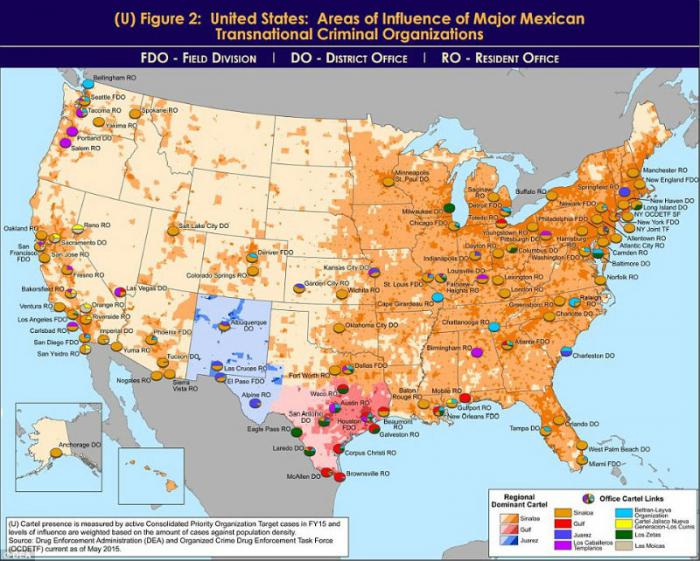
The highways in the United States belonged to El Chapo.

CatholicOnline: The cartel has such momentum trafficking heroin, methamphetamine, cocaine, and marijuana from Mexico to the United States, that despite El Chapo’s incarceration in a Mexican prison, the cartel continued all operations.

The DEA report shows the Sinaloa cartel “maintains the most significant presence in the United States,” adding, “Mexican TCOs pose the greatest criminal drug threat to the United States; no other group is currently positioned to challenge them.”

Mexico seizes El Chapo’s planes, cars, houses

MEXICO CITY — As the hunt for fugitive drug lord Joaquín “El Chapo” Guzmán intensifies, Mexican authorities recently announced they have confiscated 11 planes, eight vehicles and six houses belonging to the kingpin in the past five months.

That’s likely just a fraction of the assets Guzmán has accumulated during his life of crime. The Sinaloa Cartel he oversees traffics billions of dollars worth of narcotics to the United States every year, according to estimates from the Justice Department and the Drug Enforcement Administration.

The yawning gap between the seizures and Guzmán’s potential riches underscores a growing concern here: Why the Mexican government can’t or won’t seize more of Guzman’s ill-gotten gains. The problem, critics say, is a lack of laws with teeth, and the motivation to change that.

“Mexico is a weak state that has yet to form a political will around the implementation of such laws,” said lawyer Edgardo Buscaglia, who has addressed the Mexican Senate on asset forfeitures.

One issue is a 2009 law that was meant to give authorities broader powers to seize drug cartel members’ assets. Instead, the law allows only the attorney general — as opposed to local prosecutors — to confiscate assets, meaning that federal authorities are overburdened and cases routinely slip through the net.

The overall result is far fewer successfully prosecuted cases against organized crime — a total of 43 in the past six years in Mexico, about the same number neighboring Guatemala achieves each year, according to a Mexican Senate report.

The law also requires property owners to be sentenced before authorities can take their assets, delaying seizures by months or even years. Many cases collapse.

“Attacking criminal groups financially by pursuing the properties and firms that provide them with financial and logistical support is an essential part of the fight against organized crime,” said Antonio Mazzitelli, Latin American representative of the U.N. Office on Drugs and Crime. “In Mexico, they put a criminal in jail, and nothing happens.”

Since 2007, the Treasury Department has banned 95 Mexican companies and hundreds more individuals linked to El Chapo’s drug empire from operating in the United States. All continue to operate freely in Mexico, however.

Last year, an American grand jury indicted Ignacio Muñoz Orozco, the owner of a Mexican clothing chain, on money laundering charges related to the Sinaloa Cartel. Orozco served as a higher-level official in the federal Social Development Ministry in the mid-2000s and has yet to be charged with a crime in Mexico.

“There are thousands of such cases that Mexican prosecutors decline to pursue,” Buscaglia said.

Guzman’s case underscores the nature of corruption in the country, where watchdog group Transparency International reports criminals have “captured” public institutions.

The drug kingpin escaped from a maximum security prison in July using a mile-long tunnel. Police have arrested the prison governor and several guards in connection with the breakout.