Human smuggling network dismantled

One must keep in mind that this is yet a result of the Obama White House backdoor Dreamer program.

A human smuggling network that operated in Central America, Mexico and the United States was dismantled in a multinational operation.

Eleven members of the network, that used sea routes to transport undocumented immigrants trying to reach the United States, were arrested in three Mexican states: Oaxaca, Puebla and Guerrero.

The Attorney General’s Office said that the migrants arrived to the port of Salina Cruz, Oaxaca and were taken from there to the U.S. border by land. It added that cash, credit cards, weapons, ammunition, mobiles and five cell phones were seized as part of the operation, for which Mexico shared information and coordinated with authorities in the United States, El Salvador and Guatemala.

***

FoxLatino: “As a result of actions against a transnational criminal organization dedicated to trafficking in people, including unaccompanied minor migrants, that operates in Central America with the United States of America as its destination via Mexico, 11 members of said group have been detained,” the AG’s office said in a statement.

The suspects were arrested in Oaxaca and Guerrero states, both in southern Mexico, and in the central state of Puebla, the AG’s office said.

The arrests were made as part of an investigation that started several months ago and is being coordinated with officials in El Salvador and Guatemala, the SEIDO organized crime unit said.

The people trafficking network used maritime routes on Mexico’s Pacific coast to move the migrants, the Special Unit for Investigations of Trafficking in Minors, People and Organs, or UEITMPO, said.

Migrants were taken to Salina Cruz, Oaxaca, and later moved by land via several other states to northern Mexico, the UEITMPO said.

Investigators searched 10 properties, including a bar, in Oaxaca, as well as one property in Puebla and two in Guerrero.

Cash, bank cards and documents, firearms, ammunition, cell phones and five vehicles were seized, the AG’s office said.

The suspects were turned over to federal prosecutors, who plan to charge them with people trafficking and organized crime.

How bad is this human trafficking?

InSight: Authorities in Mexico have uncovered a web of human trafficking alliances stretching across 17 states and involving groups from the biggest cartels down to family-run crime clans, in an illustration of the scale of the trade and the pressure on major criminal organizations to move into new businesses.

Based on testimony from victims, the Attorney General’s organized crime unit (SEIDO) linked crime families in the small central state of Tlaxcala to drug cartels including the Zetas, the Familia Michoacana, the Knights Templar and the Gulf Cartelreported Excelsior.

One of the routes used by the networks is to bring minors from the southeast states of Oaxaca, Veracruz, Hidalgo and Chiapas and transport them by truck to safe houses in Tlaxcala, from where victims are either moved to Tijuana near the US border or to Mexico City.

The tactics used to obtain victims have reportedly developed over time, with criminal groups now often using social networking sites rather than kidnapping to recruit victims, found SEIDO.

According to Excelsior, 70,000 people become victims of human trafficking every year in Mexico. The crime earns criminal groups an estimated $42 million annually — which amounts to about $600 per victim — and 47 criminal organizations are involved.

InSight Crime Analysis

In 2010, the Coalition Against Trafficking in Women and Girls in Latin America and the Caribbean (CATW-LAC) reported that an estimated 1.2 million people in Mexico were victims of human trafficking. The National Refuge Network has reported that 800,000 adults and 20,000 children are trafficked for sexual exploitation in the country each year.

As highlighted by Excelsior, the human trafficking business model is sophisticated, with the work divided between a range of criminal groups responsible for different aspects of the trade, such as recruitment or transport.

Human trafficking in the country used to be dominated by small, independent networks, but drug cartels have taken an increasingly important role in the crime as they seek to diversify their revenue streams in the face of pressure on the drug business. In 2013, the regional head of CATW-LAC stated that 70 percent of sex trafficking cases reported to the organization involved drug gangs.

The importance of Tlaxcala in the human trafficking networks may be due to the state’s central location and proximity to Mexico City. Between January 2010 and July 2013, Tlaxcala saw the greatest number of convictions for human trafficking and tied with Baja California for the largest number of cases opened for this crime. The state was also the site of a major sex trafficking network dismantled in 2011.


14th Amendment Does Not Give Birthright Citizenship

It is about time that this matter gets full attention and debate.
The most important word is but 2 letters: We the People OF meaning loyalty, honor and duty.

He unabashedly wades into politically dangerous territory and yet continues to be rewarded by favorable poll results. He has clearly tapped into a reserve of public resentment for inside-the-Beltway politics. How far this resentment will carry him is anyone’s guess, but the Republican establishment is worried. His latest proposal to end birthright citizenship has set off alarm bells in the Republican party.

The leadership worries that Trump will derail the party’s plans to appeal to the Latino vote. Establishment Republicans believe that the future of the party depends on being able to capture a larger share of this rapidly expanding electorate. Trump’s plan, however, may appeal to the most rapidly expanding electorate, senior citizens, and may have an even greater appeal to the millions of Republicans who stayed away from the polls in 2012 as well as the ethnic and blue-collar Democrats who crossed party lines to vote Republican in the congressional elections of 2014. All of these voters outnumber any increase in the Latino vote that Republicans could possibly hope to gain from a population that has consistently voted Democratic by a two-thirds majority and shows little inclination to change.

And Nothing Odd About Supporting Such a Reading Critics say that Trump’s plan is unrealistic, that it would require a constitutional amendment because the 14th Amendment mandates birthright citizenship and that the Supreme Court has upheld this requirement ever since its passage in 1868. The critics are wrong. A correct understanding of the intent of the framers of the 14th Amendment and legislation passed by Congress in the late 19th century and in 1923 extending citizenship to American Indians provide ample proof that Congress has constitutional power to define who is within the “jurisdiction of the United States” and therefore eligible for citizenship. Simple legislation passed by Congress and signed by the president would be constitutional under the 14th Amendment.

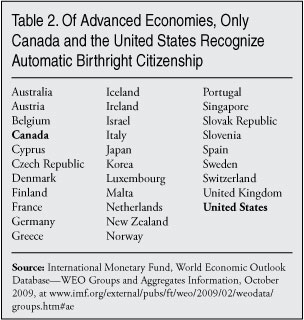
Birthright citizenship is the policy whereby the children of illegal aliens born within the geographical limits of the U.S. are entitled to American citizenship — and, as Trump says, it is a great magnet for illegal immigration. Many of Trump’s critics believe that this policy is an explicit command of the Constitution, consistent with the British common-law system. This is simply not true. Congress has constitutional power to define who is within the “jurisdiction of the United States” and therefore eligible for citizenship. Although the Constitution of 1787 mentioned citizens, it did not define citizenship. It was in 1868 that a definition of citizenship entered the Constitution with the ratification of the 14th Amendment. Here is the familiar language: “All persons born or naturalized in the United States and subject to the jurisdiction thereof, are citizens of the United States and of the State wherein they reside.” Thus there are two components to American citizenship: birth or naturalization in the U.S. and being subject to the jurisdiction of the U.S.

Today, we somehow have come to believe that anyone born within the geographical limits of the U.S. is automatically subject to its jurisdiction; but this renders the jurisdiction clause utterly superfluous. If this had been the intention of the framers of the 14th Amendment, presumably they would have said simply that all persons born or naturalized in the U.S. are thereby citizens.

Indeed, during debate over the amendment, Senator Jacob Howard, the author of the citizenship clause, attempted to assure skeptical colleagues that the language was not intended to make Indians citizens of the United States. Indians, Howard conceded, were born within the nation’s geographical limits, but he steadfastly maintained that they were not subject to its jurisdiction because they owed allegiance to their tribes and not to the U.S. Senator Lyman Trumbull, chairman of the Senate Judiciary Committee, supported this view, arguing that “subject to the jurisdiction thereof” meant “not owing allegiance to anybody else and being subject to the complete jurisdiction of the United States.”

Jurisdiction understood as allegiance, Senator Howard explained, excludes not only Indians but “persons born in the United States who are foreigners, aliens, [or] who belong to the families of ambassadors or foreign ministers.” Thus, “subject to the jurisdiction” does not simply mean, as is commonly thought today, subject to American laws or courts. It means owing exclusive political allegiance to the U.S. Furthermore, there has never been an explicit holding by the Supreme Court that the children of illegal aliens are automatically accorded birthright citizenship. In the case of Wong Kim Ark (1898) the Court ruled that a child born in the U.S. of legal aliens was entitled to “birthright citizenship” under the 14th Amendment. This was a 5–4 opinion which provoked the dissent of Chief Justice Melville Fuller, who argued that, contrary to the reasoning of the majority’s holding, the 14th Amendment did not in fact adopt the common-law understanding of birthright citizenship.
The framers of the Constitution were, of course, well-versed in the British common law, having learned its essential principles from William Blackstone’s Commentaries on the Laws of England. As such, they knew that the very concept of citizenship was unknown in British common law. Blackstone speaks only of “birthright subjectship” or “birthright allegiance,” never using the terms “citizen” or “citizenship.” The idea of birthright subjectship, as Blackstone admitted, was derived from feudal law. It is the relation of master and servant: All who are born within the protection of the king owed perpetual allegiance as a “debt of gratitude.” According to Blackstone, this debt is “intrinsic” and “cannot be forfeited, cancelled, or altered.” Birthright subjectship under common law is the doctrine of perpetual allegiance. America’s Founders rejected this doctrine. The Declaration of Independence, after all, solemnly proclaims that “the good People of these Colonies . . . are Absolved from all Allegiance to the British Crown, and that all political connection between them and the State of Great Britain, is and ought to be totally dissolved.” So, the common law — the feudal doctrine of perpetual allegiance — could not possibly serve as the ground of American citizenship. Indeed, the idea is too preposterous to entertain.
For All GOP Candidates Consider as well that, in 1868, Congress passed the Expatriation Act. This permitted American citizens to renounce their allegiance and alienate their citizenship. This piece of legislation was supported by Senator Howard and other leading architects of the 14th Amendment, and characterized the right of expatriation as “a natural and inherent right of all people, indispensable to the enjoyment of the right of life, liberty and the pursuit of happiness.” Like the idea of citizenship, this right of expatriation is wholly incompatible with the common-law understanding of perpetual allegiance and subjectship. One member of the House expressed the general sense of Congress when he proclaimed: “The old feudal doctrine stated by Blackstone and adopted as part of the common law of England . . . is not only at war with the theory of our institutions, but is equally at war with every principle of justice and of sound public policy.” The notion of birthright citizenship was characterized by another member as an “indefensible doctrine of indefeasible allegiance,” a feudal doctrine wholly at odds with republican government. Nor was this the only legislation concerning birthright citizenship that Congress passed following the ratification of the 14th Amendment. As mentioned above, there was almost unanimous agreement among its framers that the amendment did not extend citizenship to Indians. Although born in the U.S., they were not subject to the jurisdiction of the U.S. Beginning in 1870, however, Congress began to pass legislation offering citizenship to Indians on a tribe-by-tribe basis.
Finally, in 1923, there was a universal offer to all tribes. Any Indian who consented could become a citizen. Thus Congress used its legislative authority under Section Five of the 14th Amendment to determine who was within the jurisdiction of the U.S. It could make a similar determination today, based on this legislative precedent, that children born in the U.S. to illegal aliens are not subject to the jurisdiction of the United States. A constitutional amendment is no more required today than it was in 1923. A nation that cannot determine who becomes citizens or believes that it must allow the children of those who defy its laws to become citizens is no longer a sovereign nation. Legislation to end birthright citizenship has been circulating in Congress since the mid ’90s and such a bill is circulating in both houses today. It will, of course, not pass Congress, and if it did pass it would be vetoed. But if birthright citizenship becomes an election issue and a Republican is elected president, then who knows what the future might hold. It is difficult to imagine that the framers of the 14th Amendment intended to confer the boon of citizenship on the children of illegal aliens when they explicitly denied that boon to Indians who had been born in the United States. Those who defy the laws of the U.S. should not be allowed to confer such an advantage on their children. This would not be visiting the sins of the parents on the children, as is often claimed, since the children of illegal aliens born in the U.S. would not be denied anything to which they otherwise would have a right. Their allegiance should follow that of their parents during their minority. A nation that cannot determine who becomes citizens or believes that it must allow the children of those who defy its laws to become citizens is no longer a sovereign nation. No one is advocating that those who have been granted birthright citizenship be stripped of their citizenship. Equal protection considerations would counsel that citizenship once granted is vested and cannot be revoked; this, I believe, is eminently just. The proposal to end birthright citizenship is prospective only.
Political pundits believe that Trump should not press such divisive issues as immigration and citizenship. It is clear, however, that he has struck a popular chord — and touched an important issue that should be debated no matter how divisive. Both the Republican party and the Democratic party want to avoid the issue because, while both parties advocate some kind of reform, neither party has much interest in curbing illegal immigration: Republicans want cheap and exploitable labor and Democrats want future voters. Who will get the best of the bargain I will leave for others to decide.
*** For more reading and to see who are in this fight…
Further, Jeb Bush was actually correct too when it comes to the Chinese and their operation to gain birthright citizenship.


Oh Look, an Illegal Immigrant Summer Camp

As written on this blog that we must watch Germany when it comes to protests over immigration, it appears that things are spooling that activism here in America is in our future.

Who would imagine summer camp involves teaching activism and we are to accept this as a good thing?

This summer camp just churned out 80 activists

LATimes: Growing up in wealthy Marin County, Yaqueline Rodas didn’t know many people like herself: a young immigrant from Guatemala in the country without legal status. She knew even fewer political activists.

So it was with amazement and a little anxiety that she found herself standing one morning in June in a circle with 82 strangers, each of whom had also been brought to the U.S. illegally as a child, and each of whom was now officially an activist-in-training.

It was the first day of Dream Summer, an annual program that brings young immigrants from across the country to Los Angeles for a 10-week crash course designed to produce the next generation of immigrant rights leaders.

As the students sipped coffee and exchanged shy introductions in a meeting room in the basement of a Koreatown church, Kent Wong, director of the UCLA Labor Center, which organized the program, explained the objective.

“It is to build a powerful social justice movement that will transform this country,” Wong said. He cracked a smile: “No pressure.”

Dream Summer, which concluded its fifth year Thursday with a graduation ceremony in downtown Los Angeles, has already changed the immigrant rights movement. Its alumni include many leading “Dreamer” advocates, including several who led the push for President Obama’s Deferred Action for Childhood Arrivals program. (DACA, as it is known, granted temporary deportation protection to more than half a million young immigrants brought to the U.S. as children.)

The program includes two weeks of workshops in Los Angeles on topics as varied as public speaking, the immigrant detention system and the history of the NAACP. Participants also spend eight weeks in internships at social justice organizations around the country.

The idea is for them to learn what has worked for other social movements. But the program’s biggest value, those involved say, may be the connections forged by young immigrants from different regions with similar backgrounds, similar frustrations and similar dreams.

“Look around the room,” Wong urged the students that first day in June. “Now you’re a part of a whole network, a whole community.”

Rodas, who applied for the program on a whim after a classmate at UC Santa Barbara recommended it, said the summer had changed her sense of place in the world.

It helped her realize that there were others like her who had experienced discrimination, and who also were bothered by their parents’ struggle to find well-paying work. And it helped her find a purpose.

“Now I know I want to do something to help my community,” said Rodas, who spent the summer helping immigrants without legal status sign up for health insurance.

Chando Kem, 21, spent the first few days of the program commuting from his home in Long Beach. But soon he was spending nights on the floor of the hotel rooms of the out-of-town participants to maximize the time with his new colleagues.

During his internship, at the Filipino Migrant Center in Long Beach, Kem was asked to produce video testimonials featuring immigrants who had experienced wage theft. During the process, he realized that he should interview his own father for the film.

When his family arrived from Cambodia, when Kem was 7, his dad worked at a Chinese restaurant where he was underpaid and denied proper lunch breaks, Kem said. “Before I thought, ‘OK, this is the way things are,'” he said. “Now it’s like no, that’s wrong.”

The organizers of Dream Summer say it was born out of failure and frustration.

They started the program in 2011 after Congress failed to pass the federal Dream Act, which would have given people who came to the United States before the age of 16 a pathway to citizenship. Opponents said it would have rewarded immigrants who broke the law.

That year, several of the program’s young participants were placed with campaigns working on behalf of the California Dream Act. It passed later that year, allowing youth to apply for state financial aid at universities.

Other Dream Summer alumni would go on to lead efforts against Arizona Sheriff Joe Arpaio, known for controversial policies targeting immigrants in the country illegally, and to take on Obama’s deportation record. One graduate, Lorella Praeli, is now Latino outreach director for Democratic hopeful Hillary Rodham Clinton’s presidential campaign.

The program is not only for new activists.

At 33, Paulo Jara-Riveros was one of the oldest participants this summer. Brought to the U.S. from Peru at age 15, he returned to Peru to pursue his studies in 2011.

Two years later, Jara-Riveros was a part of a major protest in which two dozen young people with long ties to the U.S. surrendered to federal authorities at the Texas-Mexico border to protest American immigration policies. Jara-Riveros, a transgender man who says he faced discrimination in Peru, has applied for asylum and is waiting for a ruling in his case.

This summer he worked for a health organization that serves transgender immigrants. The experience was emotionally trying, he said. His takeaway: Activists must also tend to their own needs.

“Sometimes when you’re working in activism you get caught up in the work and you forget to take care of yourselves,” he said.

For Miguel Bibanco, a 20-year-old from Fresno, the program was not just about changing immigration policy. It was also about modeling an ideal society. He pointed to workshops that highlighted the experiences of minorities within the immigrant community, including lesbians, gays and transgender people and immigrants from Asia.

“It’s not just Latinos,” Bibanco said. “If we want a society that is inclusive, we need to start by including them in the activism process.”

On Thursday, he and Rodas snacked on taquitos and quesadillas at the program’s graduation ceremony, held at the Mexican American Legal Defense and Educational Fund.

As the participants posed for pictures with their diplomas, they heard from Los Angeles City Councilman Gil Cedillo, who wrote the California Dream Act while he was a state assemblyman.

Cedillo evoked the heated rhetoric nationally around immigration. This summer, Republican presidential front-runner Donald Trump has ratcheted up his crusade against illegal immigration, calling this month for a revocation of the constitutional amendment that guarantees citizenship to those born in the U.S.

“We’re being vilified,” said Cedillo, who called this “one of the most critical times in our country.”

He told the participants in the program that they were model members of the community. They were “hopeful, not hateful,” he said, “optimistic, not pessimistic.”

“Thank you,” he said. “You’ve shown up.”

The U.S. Refugee Immigration Costs Back to 1997

DEPARTMENT OF HEALTH AND HUMAN SERVICES ADMINISTRATION FOR CHILDREN AND FAMILIES REFUGEE AND ENTRANT ASSISTANCE report is full of the budget numbers. You have no concept of what bad law and policy has cost the American taxpayers. Imagine these decades of dollars as well as grants, USAID, the Merida Initiative, State Department programs, military assistance and the Millennium Challenge dollars added in, we effectively own these countries.


Unaccompanied Alien Children: An Overview

Summary

In FY2014, the number of unaccompanied alien children (UAC, unaccompanied children) that were apprehended at the Southwest border while attempting to enter the United States without authorization increased sharply, straining the system put in place over the past decade to handle such cases. Prior to FY2014, UAC apprehensions were steadily increasing. For example, in FY2011, the Border Patrol apprehended 16,067 unaccompanied children at the Southwest border whereas in FY2014 more than 68,500 unaccompanied children were apprehended. In the first 8 months of FY2015, UAC apprehensions numbered 22,869, down 49% from the same period in FY2014.

UAC are defined in statute as children who lack lawful immigration status in the United States, who are under the age of 18, and who either are without a parent or legal guardian in the United States or without a parent or legal guardian in the United States who is available to provide care and physical custody. Two statutes and a legal settlement directly affect U.S. policy for the treatment and administrative processing of UAC: the Trafficking Victims Protection Reauthorization Act of 2008 (P.L. 110-457); the Homeland Security Act of 2002 (P.L. 107-296); and the Flores Settlement Agreement of 1997.

Several agencies in the Department of Homeland Security (DHS) and the Department of Health and Human Services’ (HHS’s) Office of Refugee Resettlement (ORR) share responsibility for the processing, treatment, and placement of UAC. DHS Customs and Border Protection (CBP) apprehends and detains unaccompanied children arrested at the border while Immigration and Customs Enforcement (ICE) handles custody transfer and repatriation responsibilities. ICE also apprehends UAC in the interior of the country and represents the government in removal proceedings. HHS coordinates and implements the care and placement of unaccompanied children in appropriate custody.

Foreign nationals from El Salvador, Guatemala, Honduras, and Mexico accounted for almost all UAC cases in recent years, especially in FY2014. In FY2009, when the number of UAC apprehended at the Southwest border was 19,688, foreign nationals from Mexico accounted for 82% of all UAC apprehensions at the Southwest border and the three Central American countries accounted for 17% of these apprehensions. In FY2014, the proportions had almost reversed, with Mexican UAC comprising only 23% of UAC apprehensions and unaccompanied children from the three Central American countries comprising 77%.

To address the crisis, the Administration developed a working group to coordinate the efforts of federal agencies involved. It also opened additional shelters and holding facilities to accommodate the large number of UAC apprehended at the border. In June 2014, the Administration announced plans to provide funding to the affected Central American countries for a variety of programs and security-related initiatives; and in July, the Administration requested $3.7 billion in supplemental appropriations for FY2014 to address the crisis. Congress debated the supplemental appropriations but did not pass such legislation.

For FY2015, Congress appropriated nearly $1.6 billion for the Refugee and Entrant Assistance Programs in ORR, the majority of which is directed toward the UAC program (P.L. 113-235). For DHS agencies, Congress appropriated $3.4 billion for detection, enforcement, and removal operations, including for the transport of unaccompanied children for CBP. The Department of Homeland Security Appropriations Act, FY2015 (P.L. 114-4) also permits the Secretary of Homeland Security to reprogram funds within CBP and ICE and transfer such funds into the two agencies’ “Salaries and Expenses” accounts for the care and transportation of unaccompanied children. P.L. 114-4 also allows for several DHS grants awarded to states along the Southwest border to be used by recipients for costs or reimbursement of costs related to providing humanitarian relief to unaccompanied children.

Congressional activity on two pieces of legislation in the 114th Congress (H.R. 1153 and H.R. 1149) would make changes to current UAC policy, including amending the definition of UAC, altering current law on the treatment of unaccompanied children from contiguous countries, and amending several asylum provisions that would alter how unaccompanied children who assert an asylum claim are processed, among other things. Several other bills have been introduced without seeing legislative activity (H.R. 191/S. 129, H.R. 1700, H.R. 2491, and S. 44). The full report is here.


UN is Whining About Immigration Crimes, So Blame Obama

The United Nations published a dispatch on the sexual crimes of illegal immigrants while in detention. So….rather than whine about Donald Trump, hey UN, go knock on the doors of the White House and that of Jeh Johnson’s office.

At least Donald Trump deserves real praise for raising the verbal flags on the issue of immigration.

Sheesh, get a load of this.

Violence Against Women is the Dark Underbelly of The USA’s Migrant Detention System

Donald Trump is fond of ascribing violence in American cities to immigrants. He has even gone so far as to propose a Constitutional amendment that would erase the bedrock law of giving citizenship to any baby born on American shores.

But what about violence inflicted on migrants once they crossed the border?  The fact is,  many who come to the USA fleeing violence–particularly women–are subject to abuse upon arrival.

Central American women, detained in Texas last year, alleged sexual abuse in detention. Many were asylum-seekers. Some had suffered sexual violence back home. But the nightmare was not over. Guards took them from their cells for sex, women said. They groped mothers in front of their children. Playing on detainees’ desperation, guards told women they would help them once released – but in exchange for sex.

The horror stories hardly stop there. Transgendered women especially are at risk. Despite identifying as female, they are often placed in all-male units. Nicoll Hernández-Polanco, one transgendered woman detained in Arizona, fled Guatemala seeking asylum from persecution based on gender identity. In six months in all-male detention, she alleged that male guards constantly groped and insulted her. Another male detainee sexually assaulted her. When she protested these conditions, she was put in solitary confinement, she said.

These are only a few of many more sexual abuse allegations. The Government Accountability Officeinvestigated over 200 such complaints filed from 2009 to 2013. Yet even this number is an underestimate. Detainees often avoid reporting incidents, fearing retaliation or re-traumatization.

The sexual abuse of migrants in detention centers is the dirty underbelly of the USA’s migrant detention system. It’s a problem that has been known to authorities for years, yet there has not been sufficient effort to clamp down on these kinds of criminal activities that prey on deeply vulnerable women.

So what can be done to stop the abuse?

For starters, freeing certain detainees would probably help. Last month, a federal judge ordered the Department of Homeland Security (DHS) to release mothers and children detained together. (The Texas women who alleged sexual abuse had been in such a family-detention center.) While a welcome change, this one step is far from a solution. Thousands of women are still detained. They are still potential victims of abuse.

There are broader, systemwide changes that might also push the needle in the right direction.

For one, the DHS does not follow guidelines set by the Prison Rape Elimination Act (PREA). These rules include more checks, training, and restrictions on guards. A first step is to improve compliance with PREA. Yet even that would only go so far. Detainees, like prisoners, are inherently vulnerable to abuse.

Also, many detainees are simply waiting to go to court. They have been convicted of no crime and pose no security threat. Detention is a drastic method just to ensure court attendance. Detainees might stay locked up for months. Each day they spend in detention, they remain at risk of abuse.

Finally, alternatives to detention already exist in many countries. In the USA, effective methods include social services and legal representation. Asylum-seekers are very likely to pursue their cases, even with no supervision.  With a better chance in court, people are more likely to show up for hearings. They need not be locked up beforehand.

Changes will be slow. The detention system is entrenched. To comply with Congressional budget directives, DHS must detain at least 34,000 people a day. Politicians must change this mandate to make detention reform possible.

The United Nations can play a role. It has already urged US compliance with PREA in detention centers. It can make more Americans aware of the abuses in detention centers and the alternatives to detention. Many voters know little about immigration detention, which happens in remote sites.  Alternatives to detention may be hard to imagine. The UN can help US advocates see how other countries have successfully used alternatives. With this knowledge, advocates can press for reforms to detention.

No immigration system should allow abuses in detention. Women fleeing violence must not suffer again. Asylum-seekers to the US must truly find refuge there.

*** Hold on…while this is a self inflicted wound at the hands of the Obama doctrine on immigration and while Jeh Johnson is his corrupt soldier…there is more they are hiding and with purpose.

STONEWALLED: Feds Hide Fiscal Details About Vast Operation To Resettle Illegal Alien Minors

Illegal aliens who show up at the border have been resettled all across United States of America instead of being detained and deported, as Donald Trump recently called for in his new immigration plan.

Breitbart: According to data from the Justice Department obtained by Breitbart News, 96 percent of Central Americans caught illegally crossing into the country last summer are still in the United States. Now Breitbart News has learned exclusively that a Freedom of Information Act (FOIA) request from a pro-security group about the cost of this operation is being stonewalled.

In January of 2015, the Immigration Reform Law Institute, on behalf of the Federation for American Immigration Reform (FAIR), filed a FOIA request to discover the cost of accommodating the tens of thousands of illegal unaccompanied minors who came across the border encouraged by President Obama’s 2012 executive amnesty for illegal youths.

The FOIA letter made five requests of the Immigration and Customs Enforcement (ICE) agency: that the federal agency detail (1) the costs of building of family detention centers; (2) the costs of apprehending, processing and detaining unaccompanied minors; (3) the costs transporting, transferring, removing and repatriating unaccompanied minors; (4) the costs related to ICE’s representation of government in removal procedures involving unaccompanied minors; and (5) the number of instances where objections to the return of unaccompanied minors were raised by the governments of Guatemala, Honduras and El Salvador.

The federal agency, however, refused to answer many of these questions– instead only partially answering two of the five requests. The agency provided only the costs of transporting, transferring and removing illegal minors, as well as the costs of the man-hours such tasks required. Those costs totaled $58.2 million—quadrupling ICE’s costs of $15.6 million in the year previous.

FAIR told Breitbart News that the agency did not provide clear documentation nor explanation as to how it arrived at this estimation.

FAIR asserts that, “The failure to provide most of the cost information related to the surge of [unaccompanied minors] indicates that the government has either failed to properly document those costs, or is refusing to reveal them.”

Because this FOIA request only inquired into the fiscal impact on the Immigration and Customs Enforcement (ICE) agency– it does not at all take into account the cost incurred by the Department of Health and Human Services (HHS) nor the public education system. Because most of the unaccompanied minors were turned over to HHS following their apprehension, FAIR notes that HHS’ costs “for providing shelter, food, education, health care and other services, likely vastly exceed additional costs incurred by ICE.”

The flood of minors has also placed fiscal strains on our public education system. FAIR notes that, “68,541 [unaccompanied minors] were apprehended entering the U.S. Virtually all of them have been allowed to remain in the U.S., at least temporarily.”

Because federal law dictates that all children are entitled to an education regardless of their immigration status, the fiscal burden of educating these students has fallen onto our public education system.

As FAIR notes, educating 68,541 illegal immigrant children at “an average annual cost of $12,401 per child enrolled in K-12 education, the annual cost to local schools is at least $850 million. However, since virtually all of the [unaccompanied minors] are non-English proficient, the actual costs are likely substantially greater.”

The increased costs and difficulties associated with educating illegal minors from poor and developing countries has been well-documented. As Fox News Latino reported in June of this year, the border surge has left many “schools struggling with influx of unaccompanied minors.” While the federal government’s policy of releasing illegal minors into American communities imposes burdens all across our nation’s education system, it will perhaps hurt minority American students most profoundly, by straining the educational resources needed in their communities.

For instance, New York’s Hempstead School District, which is a 96 percent black and Hispanic district, had about 6,700 students dispersed amongst its 10 schools and usually receives an average of a couple hundred new students every year. “However, last summer’s enrollment skyrocketed to about 1,500 new kids – most of them undocumented immigrants.” Fox News Latino writes, “The crush of new enrollees left the district scrambling, forcing it to dip into its emergency reserves to shell out more than $6 million to hire more English as a Second Language teachers and additional staff to alleviate overcrowded classrooms. Still, it has not been enough. The average classroom in the district now has about 40 to 50 children and [as one teacher explained is] posing a safety issue… ‘You have to understand,’ [one teacher said], ‘many of the children are not even proficient in their native language, Spanish, and now we have to teach them how to speak English. That can be very difficult.’”

Deporting instead of resettling illegal immigrants would save taxpayer dollars in two ways.

First, by deterring future border crossings, it would reduce the amount of illegal immigration in the future. As FAIR explains, refusing to implement immigration law has only encouraged more illegal immigrants to unlawfully enter the United States: “In July 2015, the Government Accountability Office confirmed that President Obama’s Deferred Action for Childhood Arrivals [DACA] program played a substantial role in triggering the surge of [unaccompanied minors] in 2014.”

Second, deporting rather than resettling illegal immigrants would save the costs of feeding, clothing, housing, educating, hospitalizing, and caring for illegal immigrants and their relatives. A previous study conducted by FAIR documented that illegal immigrants cost U.S. taxpayers about $113 billion every year. After FAIR explains that by comparison, “The estimated cost of deporting an illegal alien is $8,318. Using just the partial enumerated $58.2 million costs to ICE and the conservative $850 million estimate for education of [unaccompanied minors] resettled in the U.S., the amount of taxpayer money spent on dealing with unaccompanied minors would have paid for the removal of an additional 109,000 illegal aliens.”