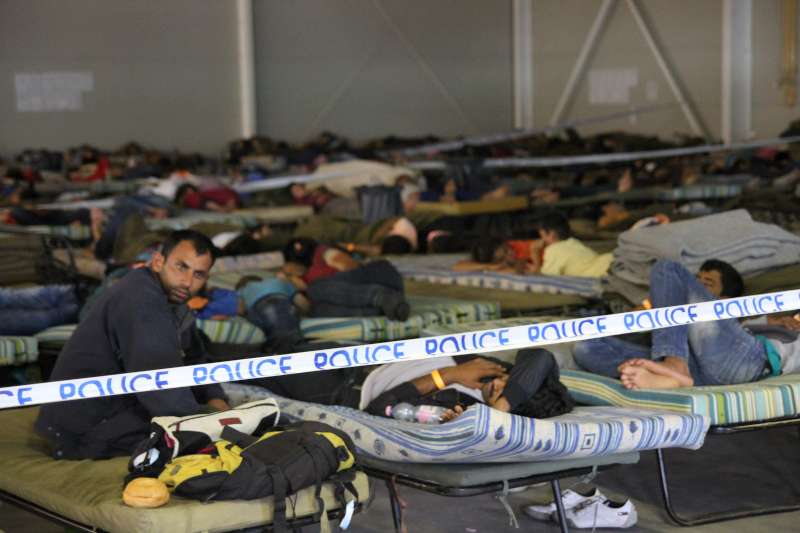
Don’t Look Now, Cuban Refugees on top of Syrian/Mexican

Every action has a reaction, actually a consequence. While America is generous and benevolent, it comes at a cost. That cost most often is impossible to measure.

Politicians and even presidential candidates have spoken positively in recent days about taking in refugees from the Middle East, but America already has an existing crisis and is there a quota or limitation? Hungary says no.

No country in the Gulf States is taking or has taken any refugees, and Kuwait for sure says no due to different backgrounds and culture.

The matter of Mexican, Central and Latin American refugees is well known, but more Cubans?

Cubans Flood Texas Ports After Thaw in Relations

Call it another immigration surge of the United States’ own making. But unlike last summer’s crisis of children and families arriving from Central America, lawmakers aren’t quick to call on this current group of refugees to go home.

From October 2014 to June 2015, about 18,520 Cubans have sought entry to the United States through Texas’ Laredo field office of U.S. Customs and Border Protection, which includes ports from Del Rio to Brownsville. That’s compared to the 18,240 unaccompanied minors that were caught or surrendered to U.S. Border Patrol in the Rio Grande Valley from October 2014 through July of this year, according to CBP statistics.

If current trend holds, the number of Cubans seeking entry through Laredo will be about 24,700 this fiscal year. That’s about 60 percent more than 2014’s 15,600 and nearly twice as many as 2013’s 12,445.

The influx of Cubans to Texas is a result of the Obama administration’s efforts to normalize relations with the communist Castro regime, said Marc Rosenblum, deputy director of the U.S. Immigration Policy program at the Migration Policy Institute, a Washington-based think tank.

“That is a jaw dropping statistic that I haven’t seen before,” Rosenblum said of the spike. “In general there is a suspicion among many Cubans that the special status that Cubans receive is in jeopardy.”

The special status is a policy allowing Cubans who make it to a U. S. port of entry to enter and seek legal permanent residency status, known as a green card, after one year. Unlike the Central Americans smuggled illegally through Mexico, the Cubans can travel freely through the country as they migrate northward.

“We’re seeing a surge that started with the announcement of normalized relations last year and there is a longer-term trend of people coming to Mexico rather than risking the sea voyage because [Mexico] is a more reliable way to go,” Rosenblum added.

Though the number of Central American minors is down from last summer’s massive wave when more than 46,000 came to Texas through the Rio Grande Valley, the political firestorm that surge created still rages.

Before taking office as Texas governor, Greg Abbott filed a lawsuit while attorney general to halt President Obama’s immigration policy that would have shielded millions of undocumented Texans from deportation. That policy is still on hold and Abbott cited last summer’s crisis as one reason he filed the lawsuit, claiming Texas witnessed firsthand the ill effects of Obama’s policies that included 2012’s Deferred Action for Childhood Arrivals.

Texas Republican U.S. Sens. John Cornyn and Ted Cruz have also cited Obama’s immigration policies as a magnet that lures more undocumented immigrants toward Texas and blasted the president during last summer’s surge. Cornyn filed legislation last summer that, if passed, would have allowed for the immediate deportations of Central Americans and Cruz has promised to scale back Obama’s immigration policies if elected president.

Neither Abbott nor Cornyn responded to a request for comment. Cruz, whose own father fled Cuba and settled in Texas, also declined to comment.

The current policy toward Cubans is an amended version of the 1966 Cuban Adjustment Act, which applied to most immigrants from the island nation who sought entry to the United States. Under a revision agreed upon during the Clinton Administration, called the Wet Foot/Dry Foot policy, Cubans who reach the United States can apply for entry while Cubans found at sea are sent back home or to a third country. Rick Pauza, a spokesman for CBP in Laredo, said the current negotiations between the United States and Cuba have not affected long-standing policy regarding Cubans seeking entry to the country.

“Normally, if a Cuban national arriving at a Customs & Border Protection (CBP) port of entry or between ports expresses fear of return to Cuba or their country of last residence, he or she is inspected and may qualify for parole into the U.S.,” he said in an email. “CBP Officers and Agents will first verify the individuals’ citizenship, identity, and whether they have prior criminal or U.S. immigration history.  After one year in the U.S., the Cuban national may be eligible under the Cuban Refugee Adjustment Act of 1966 to apply for lawful permanent residence.”

Immigrant rights’ groups have been critical of what they say is a double standard in U.S. immigration policy. They argue that instead of being detained or deported, a Central American or Mexican escaping persecution should be paroled in to the country like a Cuban is.

Rosenblum said that’s a valid argument.

“It’s hard to make the case that Cuba has uniquely difficult conditions that would justify the total unique status that Cubans arriving in the United States receive,” he said. “There are Cubans who are persecuted and who don’t have political freedoms but the situation there is certainly comparable to Central America or Mexico or a dozen other countries you can name around the world.”

In 2013, the estimated 18,000 Cubans who arrived at U.S. land ports were paroled into the country and subsequently awarded green cards, Rosenblum said.

Though Cuba and the United States have started a dialogue, Rosenblum said he didn’t see immediate change on the forefront.

“I think for sweeping change you would want to see legislation and that’s unlikely because this is a hard issue for Congress to take up, particularly as we enter an election season,” he said. But the administration could roll back current provisions that allow DHS to issue Cubans green cards. That notion could even garner some GOP support he added as some Republicans have already expressed concerns that some of the Cubans arriving in the United States could be considered criminals in their country. Rosenblum said that according MPI data, about 90 Cubans have been deported every year since 2009. Most of them had criminal records, he said.

The Global Refugee Crisis Snapshot

  1. Refugees travel light, for their trek is as dangerous as it is arduous. They are detained, shot at, hungry. Smugglers routinely exploit them, promising safety for a price, only to squeeze them like sardines into tiny boats. Most have no option but to shed whatever meager belongings they may have salvaged from their journeys. Those allowed to bring extra baggage aboard often toss it overboard, frantically dumping extra weight as the leaky boats take on water.

    Few arrive at their destinations with anything but the necessities of life. The International Rescue Committee asked a mother, a child, a teenager, a pharmacist, an artist, and a family of 31 to share the contents of their bags and show us what they managed to hold on to from their homes. Their possessions tell stories about their past and their hopes for the future. Much more here from Medium.

  2. No one is vetting these jihadists. And worse still, Pope Francis called on Sunday on every European parish and religious community to take in one migrant family each in a gesture of solidarity he said would start in the tiny Vatican state where he lives.

    The Westgate Mall massacre was gruesome even by Islamic standards. Muslims were released, while non-Muslims had their eyes gouged out and were murdered in cold blood. More here from PamelaGeller.

  3. Five of the wealthiest Muslim countries have taken no Syrian refugees in at all, arguing that doing so would open them up to the risk of terrorism. Although the oil rich countries have handed over aid money, Britain has donated more than Saudi Arabia, the United Arab Emirates and Qatar combined.

    Between 10 and 12 million Syrians have been displaced by the bloody civil war raging in their country. Most still remain within Syria’s borders, but around four million have fled over the borders into neighboring countries, mostly Turkey, Jordan and Lebanon and beyond. More here from Breitbart.

  4. Greek police are still searching for 10 illegal immigrants who escaped from a holding centre in Athens after a riot late on Saturday night. A protest over the extension of their detention turned violent as inmates clashed with police and security guards. The detainees hurled water bottles and set fire to rubbish bags and mattresses.

    Greece, struggling to exit its worst financial crisis in decades, has become a frontier for immigrants mainly from Asia and Africa, who seek a better life in Europe but often end up living in cramped detention centres.

  5. The Syrian operative claimed more than 4,000 covert ISIS gunmen had been smuggled into western nations – hidden amongst innocent refugees. The ISIS smuggler, who is in his 30s with a trimmed jet-black beard, revealed the ongoing clandestine operation is a complete success. “Just wait,” he smiled.

    The Islamic State operative spoke exclusively to BuzzFeed on the condition of anonymity and is believed to be the first to confirm plans to infiltrate western countries. Islamic State, also referred to as IS and ISIS, is believed to be actively smuggling deadly gunmen across the sparsely-guarded 565-mile Turkish border and on to richer European nations, he revealed.

  6. WASHINGTON, D.C. – Chairman Michael McCaul, of the House Homeland Security Committee, wrote a letter to President Obama last Thursday expressing concerns over the Administration’s announced plans to resettle some 2,000 Syrian refugees in the United States this year. Terrorists have made known their plans to attempt to exploit refugee programs to sneak terrorists into the West and the U.S. homeland. Chairman McCaul’s letter points out the potential national security threat this poses to the United States.

    Chairman McCaul: “Despite all evidence towards our homeland’s vulnerability to foreign fighters, the Administration still plans to resettle Syrian refugees into the United States. The Director of the National Counterterrorism Center and the Deputy Director of the FBI both sat before my Committee this Congress and expressed their concern with admitting refugees we can’t properly vet from the global epicenter of terrorism and extremism in Syria. America has a proud tradition of welcoming refugees from around the world, but in this special situation the Obama Administration’s Syrian refugee plan is very dangerous.”

    Read Chairman McCaul’s letter HERE.

    The Subcommittee on Counterterrorism and Intelligence will hold a hearing on June 24th to examine the refugee resettlement program and discuss vulnerabilities to our security exposed by the Administration’s plan.

The conditions in Europe will soon come to the United States.


Here’s a summary of the latest developments:

France and Germany are are to take an extra 55,000 refugees over the next two years. The plan, part of an initiative to taken an extra 120,000 across Europe, will be set out on Wednesday by EU commission president, Jean-Claude Juncker.
France is considering launching airstrikes against Islamic State militants in Syria president François Hollande announced as he confirmed plans to take an extra 24,000 refugees. “We have proof that attacks have been planned from Syria against several countries, notably France,” Hollande told a news conference.
Angela Merkel called on other European countries to pull their weight to help tackle the crisis. She described the number of people coming to Germany over the weekend as “breathtaking” and said Germany should be proud of its response.
Tensions between the authorities and migrants and asylum seekers have remained tense at a number of flash points across Europe. On Greek island of Lesbos the sight of thousands of frustrated refugees and migrants marching on Mytilini, the capital, prompted Greece’s migration minister to announce that transit of the newcomers would be speeded up immediately. Scuffles broke out earlier on between police and thousands of people attempting to enter Macedonia from with Greece. The Hungarian security forces struggled to contain migrants trying to break out of the Röszke camp on the Serbia border.
The Bavarian authorities have warned they are at “breaking point” after accepting two thirds of the 18,000 refugees who arrived in Munich via Austria over the weekend. “We’re right at our limit,” said Christoph Hillenbrand, meeting reporters at Munich train station.
David Cameron is to set out details of the government’s plans to resettle thousands of refugees fleeing the civil war in Syria. He will also announced further details of a counter terrorism strategy on Syria.
Hundreds of millions of pounds from Britain’s aid budget will be used to tackle the crisis, Chancellor George Osborne confirmed that every penny in the “uplift” in the aid budget – the automatic rises as the economy grows – would be spent on global challenges with a direct effect on Britain.
The ruling coalition in Germany has set out plans to spend an extra €6bn to cope with migration. After a meeting in Berlin lasting more than five hours, leaders from chancellor Merkel’s coalition also agreed to speed up asylum procedures and facilitating the construction of asylum shelters.
Hungary’s hardline PM, Viktor Orban, said people coming into the EU are “immigrants not refugees”. He also said that it was the EU primary interest that Hungary protects its borders.
The United Nations warned that its humanitarian agencies were on the verge of bankruptcy and unable to meet the basic needs of millions of people because of the size of the refugee crisis. “We are broke,” the UN high commissioner for refugees, António Guterres, told the Guardian.

Snapshots:


Soros and China vs. M1A1’s and F-35’s: Irregular Warfare

A kinder, gentler weapon, software, economic terrorism and exploiting weakness. What the U.S. military knows and what government leaders know but find difficult to defeat, IRREGULAR WARFARE.

The main protagonist in this section of the history book will not be a statesman or a military strategist; rather, it will be George Soros. Of course, Soros does not have an exclusive monopoly on using the financial weapon for fighting wars. Before Soros, Helmut Kohl used the deutsche mark to breach the Berlin Wall–a wall that no one had ever been able to knock down using artillery shells [see Endnote 13]. After Soros began his activities, Li Denghui [Li Teng-hui 2621 4098 6540] used the financial crisis in Southeast Asia to devalue the New Taiwan dollar, so as to launch an attack on the Hong Kong dollar and Hong Kong stocks, especially the “red-chip stocks.” [Translator’s note: “red-chip stocks” refers to stocks of companies listed on the Hong Kong stock market but controlled by mainland interests.] In addition, we have yet to mention the crowd of large and small speculators who have come en masse to this huge dinner party for money gluttons, including Morgan Stanley and Moody’s, which are famous for the credit rating reports that they issue, and which point out promising targets of attack for the benefit of the big fish in the financial world [see Endnote 14]. These two companies are typical of those entities that participate indirectly in the great feast and reap the benefits.

Soros pours out all his bitterness in his book, The Crisis of Global Capitalism. On the basis of a ghastly account of his investments in 1998, Soros analyzes the lessons to be learned from this economic crisis.

When it comes to the axiom, Know Thy Enemy, China has made an art of this objective. China does so by any means possible with notable success.

In 1999, China used analysts to understand their adversaries such that the primary mission was to achieve a wide set of competitive edges, all under the ethos of ‘Unrestricted Warfare’.

Going beyond the common air or ground war operations, there are countless other methods to gain advantage or defeat others in a competitive world.

A 200 page essay published in 1999 came to the attention of U.S. military leaders. It is a compelling read and germane to conflicts today and well into the future.

Unrestricted Warfare  by Qiao Liang and Wang Xiangsui 

Qiao Liang is a Chinese Air Force Major in the People’s Liberation Army and co-authored a book titled  ‘Unrestricted Warfare’. The scope of the book is China’s Master Plan to Destroy America.

Meanwhile, if you can stand more, there is Russia. The two countries are using the very same software warfare tactical playbook and it too has not gone unnoticed.

EU sets up unit to counter Russia’s disinformation campaigns

Janes: The EU announced on 27 August that it is forming a small “rapid response” team of officials within the European External Action Service (EEAS) to deal with Russian propaganda.

To be launched on 1 September, the team will monitor Moscow’s propaganda manoeuvres and advise EU and national authorities and their media campaigns accordingly, said EU officials.

The move comes in response to a request in March by EU leaders to Federica Mogherini, the EU’s chief of foreign and security policy, to mount a response to “Russia’s ongoing disinformation campaign”.

The team will be comprised of 8-10 Russian-speaking officials from Sweden, the UK and other countries within the EEAS, the EU’s foreign policy wing.

***

The Cyber War: As tension between the United States, Russia and China continues to escalate, reports of cyber warfare between the nations has become increasingly prominent. Modern warfare can be waged in numerous ways, and it seems that this virtual form of conflict will be an increasing theme as the 21st century develops.


The cyber warfare between the United States, Russia and China is part of an overall epoch-defining conflict between the three nations. This is largely based on economic disagreement and rivalry, but has also spilled over into military and territorial disputes as well. Although this war has remained physically peaceful thus far, the potential for future conflict between the three nations remains significant. And with the likes of Edward Snowden revealing the extent of government snooping, we can expect more reports of governmental cyber attacks in the future.


More than Half of Immigrants on Welfare

Contrary to declaration from the White House:

How do immigrants strengthen the U.S. economy? Below is our top 10 list for ways immigrants help to grow the American economy.

  1. Immigrants start businesses. According to the Small Business Administration, immigrants are 30 percent more likely to start a business in the United States than non-immigrants, and 18 percent of all small business owners in the United States are immigrants.
  2. Immigrant-owned businesses create jobs for American workers. According to the Fiscal Policy Institute, small businesses owned by immigrants employed an estimated 4.7 million people in 2007, and according to the latest estimates, these small businesses generated more than $776 billion annually.
  3. Immigrants are also more likely to create their own jobs. According the U.S. Department of Labor, 7.5 percent of the foreign born are self-employed compared to 6.6 percent among the native-born.
  4. Immigrants develop cutting-edge technologies and companies.  According to the National Venture Capital Association, immigrants have started 25 percent of public U.S. companies that were backed by venture capital investors. This list includes Google, eBay, Yahoo!, Sun Microsystems, and Intel.
  5. Immigrants are our engineers, scientists, and innovators. According to the Census Bureau, despite making up only 16 percent of the resident population holding a bachelor’s degree or higher, immigrants represent 33 percent of engineers, 27 percent of mathematicians, statisticians, and computer scientist, and 24 percent of physical scientists. Additionally, according to the Partnership for a New American Economy, in 2011, foreign-born inventors were credited with contributing to more than 75 percent of patents issued to the top 10 patent-producing universities.
  6. Immigration boosts earnings for American workers. Increased immigration to the United States has increased the earnings of Americans with more than a high school degree. Between 1990 and 2004, increased immigration was correlated with increasing earnings of Americans by 0.7 percent and is expected to contribute to an increase of 1.8 percent over the long-term, according to a study by the University of California at Davis.
  7. Immigrants boost demand for local consumer goods. The Immigration Policy Center estimates that the purchasing power of Latinos and Asians, many of whom are immigrants, alone will reach $1.5 trillion and $775 billion, respectively, by 2015.
  8. Immigration reform legislation like the DREAM Act reduces the deficit.  According to the nonpartisan Congressional Budget Office, under the 2010 House-passed version of the DREAM Act, the federal deficit would be reduced by $2.2 billion over ten years because of increased tax revenues.
  9. Comprehensive immigration reform would create jobs. Comprehensive immigration reform could support and create up to 900,000 new jobs within three years of reform from the increase in consumer spending, according to the Center for American Progress.
  10. Comprehensive immigration reform would increase America’s GDP.The nonpartisan Congressional Budget Office found that even under low investment assumptions, comprehensive immigration reform would increase GDP by between 0.8 percent and 1.3 percent from 2012 to 2016.

Report: More than half of immigrants on welfare

USA Today: More than half of the nation’s immigrants receive some kind of government welfare, a figure that’s far higher than the native-born population’s, according to a report to be released Wednesday.

About 51% of immigrant-led households receive at least one kind of welfare benefit, including Medicaid, food stamps, school lunches and housing assistance, compared to 30% for native-led households, according to the report from the Center for Immigration Studies, a group that advocates for lower levels of immigration.

Those numbers increase for households with children, with 76% of immigrant-led households receiving welfare, compared to 52% for the native-born.

The findings are sure to fuel debate on the presidential campaign trail as Republican candidates focus on changing the nation’s immigration laws, from calls for mass deportations to ending birthright citizenship.

Steven Camarota, director of research at the center and author of the report, said that’s a much-needed conversation to make the country’s immigration system more “selective.”

“This should not be understood as some kind of defect or moral failing on the part of immigrants,” Camarota said about the findings. “Rather, what it represents is a system that allows a lot of less-educated immigrants to settle in the country, who then earn modest wages and are eligible for a very generous welfare system.”

Linda Chavez agrees with Camarota that the country’s welfare system is too large and too costly. But Chavez, a self-professed conservative who worked in President Reagan’s administration, said it’s irresponsible to say immigrants are taking advantage of the country’s welfare system any more than native-born Americans.

Chavez said today’s immigrants, like all other immigrant waves in the country’s history, start off poorer and have lower levels of education, making it unfair to compare their welfare use to the long-established native-born population. She said immigrants have larger households, making it more likely that one person in that household will receive some kind of welfare benefit. And she said many benefits counted in the study are going to U.S.-born children of immigrants, skewing the findings even more.

“When you take all of those issues into account, (the report) is less worrisome,” she said.

Chavez, president of the Becoming American Institute, a conservative group that advocates for higher levels of legal immigration to reduce illegal immigration, said politicians should be careful about using the data. Rather than focus on the fact that immigrants are initially more dependent on welfare than the U.S.-born, she said they should focus on studies that show what happens to the children of those immigrants.

“These kids who get subsidized school lunches today will go on to graduate high school … will go on to college and move up to the middle class of America,” Chavez said. “Every time we have a nativist backlash in our history, we forget that we see immigrants change very rapidly in the second generation.”

The center’s report is based on 2012 data from the Census Bureau’s Survey of Income and Program Participation. It includes immigrants who have become naturalized citizens, legal permanent residents, those on short-term visas and undocumented immigrants.

Camarota said one of the most shocking findings from the report was the high number of native-born Americans also on welfare. About 76% of immigrant households with children are on welfare, but so are 52% of native-born households with children.

“Most people have a sense that if you were to work for $10 an hour, 40 hours a week, you couldn’t be receiving welfare, could you? You couldn’t be living in public housing, could you?” he said. “The answer is yes, you can. That’s one of the most surprising things about this study.”

Other findings in the report:

  • Immigrants are more likely to be working than their native-born neighbors. The report found that 87% of immigrant households had at least one worker, compared to 76% for native households.
  • The majority of immigrants using welfare come from Central America, Mexico and the Caribbean. The use of welfare is lower for immigrants from East Asia (32%), Europe (26%) and South Asia (17%).
  • Immigrants who have been in the U.S. more than 20 years use welfare less often, but their rates remain higher than native-born households.
  • If you need some immigration advice, contact a team of immigration lawyers who will help you out.


Asylum Seekers Die Across the Globe

The United Nations Refugee Agency’s solution to global unrest appears to be the same as that of world leaders, report the crisis and force other countries to accept refugees and asylum seekers. Meanwhile, death tolls mount.

Between the fact that the Obama White House never had a strategic plan for the Middle East, nor one for Central and Latin America, while as Secretary of State Hillary Clinton and John Kerry do not have one either. Meanwhile people suffer and the whole consequence threatens national security, healthcare, education, taxpayers, crimes and more.

Germany

Poland

United Kingdom

Italy

United States

There is more for sure….

Bodies found dead in a truck near border, while asylum seekers flow into Hungary

GENEVA, Aug 28 (UNHCR) The UN refugee agency said it was “deeply shocked and saddened” at the grim discovery yesterday of the bodies of 71 people inside a truck abandoned near the Austrian border with Hungary.

“This tragedy underscores the ruthlessness of people smugglers who have expanded their business from the Mediterranean sea to the highways of Europe. It shows they have no regard for human life and are only after profit,” UNHCR spokesperson Melissa Fleming told a press briefing in Geneva.

Austrian police said that they believed the truck came from Hungary and entered Austria on Wednesday night or early on Thursday morning, and that the victims might have been dead for one or two days. Their identity is still unknown but it is presumed that they were being transported by smugglers.

After establishing that there were no survivors, the truck was closed again by the police and moved to another location for further investigations. Police said that they counted at least 20 bodies but the actual number is likely to be much higher.

“This tragedy also highlights the desperation of people seeking protection or a new life in Europe. UNHCR hopes this incident will result in strong cooperation among European police forces, intelligence agencies and international organisations to crack down on the smuggling trade while putting in place measures to protect and care for victims,” Fleming said.

UNHCR has reiterated its call to European countries to approach the refugee crisis in a spirit of solidarity and cooperation and to provide those seeking safety in Europe with safe legal alternatives to dangerous irregular voyages. These legal avenues include resettlement or humanitarian admission programs, flexible visa policies and family reunification.

“This week, the Hungarian border police have been intercepting more than 2,000 people crossing the border from Serbia every day. On Wednesday, police reported 3,241 new arrivals, including 700 children. This is the highest number in a single day so far this year,” Fleming detailed.

She added that these people, a majority of whom are refugees from Syria, including many women and children, are coming in large groups of over 200 people, walking along the rail tracks or crawling under barbed wire, as work continues on a 175 kilometres long wall at the border between Hungary and Serbia.

“Fear of police detection makes many of them rush through the razor wires, sustaining cuts and injuries in the process. UNHCR staff at the border report that many people are arriving on wheelchairs pushed by relatives, while others are in need of urgent medical assistance,” Fleming explained.

Police take the new arrivals to a pre-registration centre in Röszke in southern Hungary, near the Serbian border and some 184 kilometres away from the capital, Budapest. The centre in Röszke does not offer adequate conditions for the exhausted, hungry and thirsty asylum-seekers who have spent many days on the road.

In Röszke, new arrivals are searched by the police and their details recorded, before being sent to registration centres, further inland. Asylum-seekers are kept in mandatory detention between 12 and 36 hours, and then handed over to the Office of Immigration and Nationality to process their asylum claims. Hungary’s four reception centres have a maximum capacity of 5,000 people.

“Overcrowding and long waits result in frustration for the asylum-seekers. The Hungarian police do not have social workers or enough interpreters in Arabic, Dari, Pashto and Urdu, which makes it hard to communicate with asylum-seekers,” Fleming continued.

Over 140,000 people have sought asylum in Hungary so far this year, according to the latest official statistics, compared to 42,000 people last year. Most of those lodging asylum applications this year are nationals from Syria, Afghanistan, Iraq and Pakistan and they include around 7,000 unaccompanied children or separated from their parents.

Many refugees and migrants choose to leave Hungary for other countries in Europe. Every day up to 500 people sleep at the two main train stations in Budapest where volunteers look after their basic needs, including food, clothing and urgent medical attention, and where the city authorities give them access to sanitation facilities. In order to provide more adequate accommodation, the city authorities are planning to open a transit facility, with UNHCR’s technical advice.