
Cuban Migrants Flood the SW Border

2015: At Least 44,000 Cubans Entered US Through Texas and Southern Border This Year, Number on the Rise – Report

The number of Cubans attempting to come to the Unites States via Texas has increased this year, thanks in large part to the thaw in political tensions between the U.S. and Cuba.


After President Obama and Cuban leader Raul Castro announced their plans to normalize relations between the two nations, many Cubans feared that the special migrant status they have enjoyed for over 50 years would come to an end. The current “wet foot, dry foot policy” allows anyone who has fled Cuba and entered the U.S. the ability to pursue residency and work in the country.

The Los Angles Times reports that at least 44,000 Cubans have reached the southern U.S. border during the fiscal year which ended in September. This figure is more than twice as many of the 17,466 Cubans who came through the southern border the year before. Full article here.

Tension Simmers as Cubans Breeze Across U.S. Border

LAREDO, Tex. — They are crossing the border here by the hundreds each day, approved to enter the United States in a matter of hours. Part of a fast-rising influx of Cubans, they walk out to a Laredo street and are greeted by volunteers from Cubanos en Libertad, or Cubans in Freedom, who help them arrange travel to their American destination — often Miami — and start applying for work permits and federal benefits like food stamps and Medicaid, available by law to Cubans immediately after their arrival.

The friendly reception given the Cubans, an artifact of hostile relations with the Castro government, is a stark contrast with the treatment of Central American families fleeing violence in their countries. And it is creating tensions in this predominantly Mexican-American city, where residents saw how Central American migrants, who came in an influx in 2014, were detained by the Border Patrol and ordered to appear in immigration courts.

“The people here are starting to feel resentment,” said Representative Henry Cuellar, Democrat of Texas, whose congressional district includes the city. “They are asking, is it fair that the Cubans get to stay and the Central Americans are being deported?”

The disparity will be in sharp relief next week when Pope Francis comes to the border at El Paso to offer prayers for the many migrants who have faced danger or arrest trying to cross the United States border.

Town officials have warned Cubans not to loiter in the streets. Local bus companies complain that Cubans are chartering special vans to travel. Some residents here have also begun to speak up.

A group of veterans from Afghanistan and Iraq held two protests by the border bridge in recent weeks, saying the federal government was spending money on Cubans when it was not meeting the needs of people here.

“We make everyone from Central America wait in line, while the Cubans walk in even though they are not refugees,” said Gabriel Lopez, a Mexican-American Navy veteran who is president of the group of veterans. “We are saying, don’t open the borders to Cubans and give them instant benefits while we have American veterans living on the streets.”

In coming weeks the number of Cubans is expected to spike, as more than 5,000 who have been stalled in Costa Rica since late last year will leave there on regular plane flights agreed to by governments in Central America and Mexico. Already about 12,100 Cubans entered through Laredo and other Texas border stations in the last three months of 2015, according to official figures. Border officials say as many as 48,000 Cubans could cross here this year, more than all those who came in the last two years combined.

Under the Cuban Adjustment Act, a law Congress passed in 1966 in the early years of enmity with Fidel Castro, any Cuban who sets foot on American soil is given permission to enter, known as parole. Cubans are also eligible for federal welfare benefits including financial assistance for nine months under separate policies from the 1980s. After a year, they can apply for permanent residency, a gateway to citizenship.

The recent exodus from Cuba began in mid-2014, even before President Obama in December of that year announced a restoration of diplomatic relations with the government, now led by Mr. Castro’s brother Raúl. In a major change, President Raúl Castro allowed Cubans to leave the country without exit visas. Many Cubans have said that rumors that the special entry to the United States would be canceled had caused them to pack up and go.

“The rumors are unfounded,” Alan Bersin, assistant secretary of Homeland Security, said in an interview, seeking to dispel the fears. “The Cuban Adjustment Act is still in effect and is part of the overall immigration policy and there is no intent presently to change that.”

Mr. Cuellar has called for the act to be repealed, but he acknowledges there is little prospect that Congress will act this year.

The recent influx is nothing like the chaotic rush of Cubans fleeing the Communist government that overwhelmed South Florida with the Mariel boatlift in 1980, and the rafter crisis in 1994. The federal border authorities, who have been watching the number of Cubans growing steadily, added officers and opened extra rooms in the border station, doubling their capacity to process them. Most Cubans move through in less than an hour, officials said.

Frank Longoria, assistant director of field operations for United States Customs and Border Protection, said that despite their numbers, the Cubans’ entry has not affected the huge flows of people and freight trucks each day through Laredo, the country’s largest land port of entry.

At the border, Cubans are fingerprinted and pass through routine criminal and terrorism background checks. There is no special vetting for Cubans, and there are no medical examinations or vaccination requirements.

“Right now I feel like the freest Cuban in the whole world,” said Rodny Nápoles, 39, a coach of the Cuban national women’s water polo team who crossed into Laredo this week.

This week, the first direct flights from northern Costa Rica to the Mexican city just across the border brought more than 300 Cubans, including at least 41 pregnant women and their families.

One of them, Yadelys Rodríguez Martín, 28, who was 19 weeks pregnant, sat down to rest and enjoy a moment of relief on the front steps of Cubanos en Libertad, right after emerging from the border station. After traveling through Ecuador and being stuck for three months in Costa Rica because of a political dispute in the region, she said she was stunned by how quickly she had been admitted into the United States.

“We are not used to things happening so fast,” Ms. Rodríguez said.  More here.
Watch Out America, Venezuela a Failed State

Venezuela Is About to Go Bust

Nagel/ForeignPolicy: Venezuela’s economy is facing a tsunami of bad news. The country is suffering from the world’s deepest recession, highest inflation rate, and highest credit risk — all problems aggravated by plunging oil prices. Despite all its troubles, though, until now Venezuela has kept making payments on its $100-billion-plus foreign debt.

That is about to end. In recent days a consensus has emerged among market analysts:

Venezuela will have to default. The only question is when.

Venezuela will have to default. The only question is when.

A Venezuela meltdown could rock financial markets, and people around the world will lose a lot of money. But we should all save our collective sympathy — both the government in Caracas and the investors who enabled it had it coming.

In the last few years, the Venezuelan government has been steadfast about staying in good graces with its lenders. It has paid arrears on its debt religiously, and has constantly asserted that it will continue paying.

But it has neglected to implement the reforms Venezuela would need to improve the fundamentals of its economy. Its commitment to socialist “populism” and the complicated internal dynamics within the governing coalition have paralyzed the government. It has repeatedly postponed important reforms like eliminating its absurd exchange rate controls (the country has at least four exchange rates) or raising the domestic price of gasoline (the cheapest in the world by far). Instead, the government has “adjusted” by shutting off imports, leaving store shelves all over the country barren.

This strategy now seems unsustainable. According to various estimates, in 2015 Venezuela imported about $32 billion worth of goods. This was a marked drop from the previous year. This year, given current oil prices and dwindling foreign reserves, if Venezuela were to pay off its obligations — at least $10 billion — and maintain government spending, it would have to import close to nothing. In a country that imports most of what it consumes, this would ensure mayhem. That is why all analysts predict default in the coming months.

The Economist has joined the chorus, saying that “the government has run out of dollars.” In the words of Harvard professor Ricardo Hausmann, this will be “the largest and messiest emerging market sovereign default since the Argentine crisis of 2001.”

One of the reasons the coming default will be so messy is the many instruments involved, all issued under widely varying conditions. Part of the stock of debt was issued by PDVSA, Venezuela’s state-owned oil company, which owns significant assets overseas (For example, Citgo is 100 percent owned by the Venezuelan government). Another part of the debt was issued by the national government directly, while another big chunk is owed to China, under secretive terms.

The Chinese issue looms large. China’s loans to Venezuela — close to about $18 billion, according to Barclay’s – consist of short-term financing payable via oil shipments. As the price of oil collapses, Venezuela needs to ship more oil to China in order to pay them back. Barclay’s estimates that right now this is close to 800,000 barrels per day, leaving little more than a million barrels per day Venezuela can sell for cash.

A default will send ripples beyond Wall Street. Many people have been buying high-risk, high-return Venezuelan debt for years — from pension funds in far-off countries to small banks in developing ones. Most stand to lose their shirts. Yet the signs that this was unsustainable were there for all to see.

For years, Venezuela has had a massive budget deficit, sustained only by exorbitant oil prices. For years, analysts have been warning that the Venezuelan government would rather chew nails that allow the private sector to grow. And yes, a lot of that borrowed money was used to help establish a narco-military kleptocracy.

It is impossible to untangle the ethical implications of all of this. Lending Venezuela money is what business ethics professors talk about when they question “winning at someone else’s expense.” Losing money from investing in Venezuela is akin to losing it from, say, funding a company that engages in morally reprehensible acts. (Insert the name of your favorite evil corporate villain here).

Investors in companies with “tainted profits” from, say, engaging in child labor or violating human rights should not get the world’s sympathy, nor should they be bailed out. Similarly, investors in Venezuelan debt have only their hubris to blame.

In a few months, once the rubble of the Bolivarian revolution is cleared, the discussion will turn to how Venezuela can be helped. It would be smart to remember that aid should come to the Venezuelan people first. As the scarcity of food and medicine grows,

Venezuela may become the first petro-state to face a humanitarian disaster.

Venezuela may become the first petro-state to face a humanitarian disaster.

If and when a responsible government in Caracas asks for foreign assistance, solving this urgent issue should be at the top of the agenda. Conditions on financial assistance should privilege the interests of Venezuelans caught in the debacle above the interests of angry hedge fun managers or international bankers.

In other words, the Venezuelan people should come first. The folks who enabled this catastrophe? They can wait.


El Chapo’s America: Flooded with Heroin-Fentanyl

The DEA operation, called “Project Cassandra,” is meant to disrupt and dismantle Hezbollah’s global network that supplies drugs to the U.S. and Europe as well as cut into the terror organization’s ability to fund its activities through drug trafficking.

In the investigation, authorities uncovered a network of money couriers who collect and transport millions of euros in drug proceeds from Europe to the Middle East. The currency is then paid in Colombia to drug traffickers using the Hawala disbursement system, which makes it difficult to track. ***

Last spring, Brazil’s Civil Police arrested Hamzi Ahmad Barakat in the city of Curitiba under allegations that he had connections to a network of front companies that fleeced Lebanese immigrants who had recently moved to Brazil.

Barakat, who allegedly has ties to the infamous Triple Frontier region, is listed in the United States as a member of Hezbollah and is suspected of trafficking arms, drugs, explosives and counterfeit bills.

“He was preying on his own countrymen, using their identities to create companies to carry out schemes,” said Cassiano Aufiero, the police investigator in charge of the case.

Aufiero added that while he knew of Barakat’s purported ties to the Islamic militant group, he said that he was under arrest for different matters, including embezzlement and the creation of false documents.

Barakat’s arrest shed more light on the Triple Border region, which has become a hotspot for smugglers and drawn the attention of the U.S., Israel and governments throughout South America.

The region has drawn a number of immigrants for the Middle East, particularly from Lebanon, and is believed to be one of Hezbollah’s major areas of operation outside of the Islamic world, due to its seclusion, loose borders, rampant political corruption and weak judicial system. Brazil has one of the largest Lebanese population’s outside of Lebanon with at least 7 million people from that country residing there and some estimates claiming closer to 13 million.

In 2004, Barakat’s brother, Assad Ahmad Barakat, was named by the Treasury Department as one of Hezbollah’s “most prominent and influential members” and was believed to have used an electronics wholesale store in the Triple Frontier as a cover for raising funds for Hezbollah. The Brazilian police arrested him in 2002 and deported him to Paraguay, where he went to prison for tax evasion.

The Department of Justice National Drug Threat Assessment report.

Fentanyl: drug 50 times more potent than heroin ravages New Hampshire

Of 69 fatal overdose victims last year, 68% had taken the synthetic opioid, which Mexican cartels have learned to make and smuggle to interstate highways. The drug ‘is what is killing our citizens,’ says Manchester’s police chief

Guardian: to the Drug Enforcement Administration, fentanyl is a synthetic opioid 100 times more powerful than morphine, and 30-50 times more powerful than heroin.

“Fentanyl is what is killing our citizens,” said Manchester’s chief of police, Nick Willard, in testimony before Congress last week.

In 2013, the city of Manchester had 14 fatal overdoses, one of which (7%) involved a victim with fentanyl in their system, according to Willard. In 2015, 69 people fatally overdosed, 68% of whom had taken fentanyl. The state statistics are no more cheery. Officials at the office of the chief medical examiner in New Hampshire say they have yet to receive testing results from 36 suspected overdoses, but they’ve counted 399 fatal overdose victims so far, more than two-thirds of whom died with fentanyl in their system.

“It’s not like Mario Batali,” said Willard from his office in Manchester, comparing heroin dealers cutting their supply with the famed chef. “These guys are just throwing it in a mixer. You could get a bag that’s perfect and no one is going to die from it. You could also get a bag [that’s] straight fentanyl and that would kill you.”

Willard said that during a recent raid in Manchester, he found a dealer mixing fentanyl with whey protein. In another sting that led to a seizure in Lawrence, Massachusetts, the dealer was allegedly mixing heroin and fentanyl in a kitchen blender.

For the most part, said Willard, the story of opiate use in Manchester follows the same patterns as the rest of the country. The crisis was ushered in by the rise of prescription painkillers like OxyContin. Addicts looking for a cheaper high frequently turned to the more dangerous, yet significantly cheaper, heroin.

The turning point, he says, happened sometime after 2010, when Purdue Pharma altered the medication to make it more difficult to tamper with and get high. Suppliers in Mexico were quick to keep up with the burgeoning market, and addicts in Manchester, which sits near Interstate 93, Route 3, Route 81, and Route 9, had no problem tapping into the supply. More here.

Chicago:

“What Al Capone was to beer and whiskey, Guzmán is to narcotics,” Art Bilek, the commission’s executive vice president, said at the time. Except, Bilek added, Guzmán “is clearly more dangerous than Al Capone was at his height.” (Zambada is plenty dangerous, too: Prosecutors say he commanded logistics and security for the cartel, including assassinations. He is suspected in a number of slayings, including the murders of government officials.)

The cartel’s scope is staggering. About half of the estimated $65 billion worth of illegal cocaine, heroin, and other narcotics that Americans buy each year enters the United States via Mexico, according to law enforcement experts (though the drugs often originate in South or Central America). More than half of that is believed to be supplied by Sinaloa. Drug enforcement experts estimate, conservatively, that the cartel’s annual revenues exceed $3 billion: more than those of the Chicago Mercantile Exchange Group.

In Chicago, the cartel has a near monopoly. “I’d say 70 to 80 percent of the narcotics here are controlled by Sinaloa and Chapo Guzmán,” says Jack Riley, director of the DEA’s Chicago office. “Virtually all of our major investigations at some point lead back to other investigations tied to Sinaloa.”

In August 2009, five months after Zambada’s capture, a federal grand jury in Chicago indicted him and 45 others tied to a Sinaloa-led drug ring in the city. Patrick Fitzgerald, the U.S. attorney at the time, called the indictments “the most significant drug importation conspiracies ever charged in Chicago,” claiming that the cartel imported and distributed nearly $6 billion worth of illegal narcotics mostly to the Chicago area between 1990 and 2008.

Immigration: Senator Sessions Just Released Shocking Report

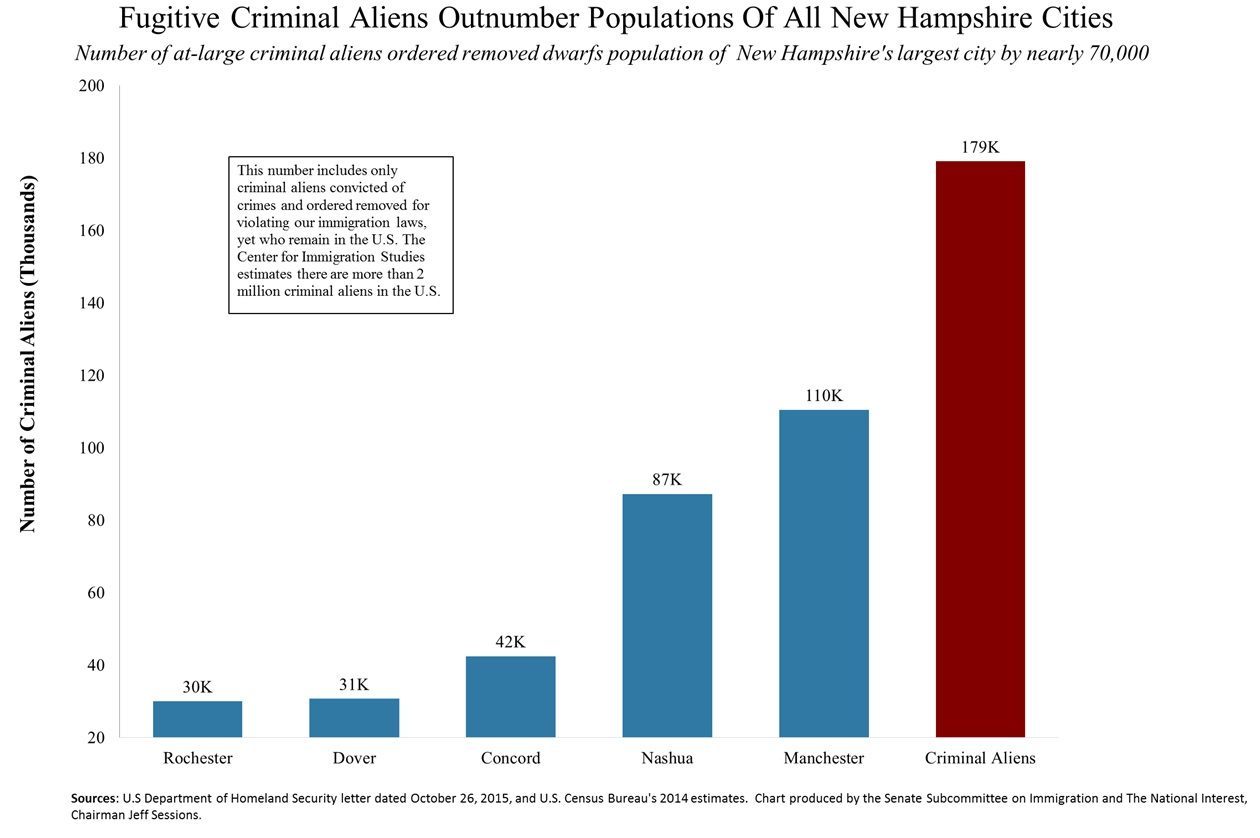
The Senate Judiciary Committee’s subcommittee on Immigration and the National Interest released a new chart on Thursday exclusively to Breitbart News that shows that the number of fugitive criminal aliens in America outnumbers the populations of every city in New Hampshire.

Fugitive Criminal Aliens Outnumber Populations Of All New Hampshire Cities

The release accompanying the chart shows:

Breitbart: According to data provided to the Subcommittee by U.S. Immigration and Customs Enforcement (ICE), there are at least 179,027 aliens in the United States who not only have been ordered to leave the country for violating our immigration laws, but who have also been convicted of a criminal offense, and have not left as required or been removed by ICE. Because of the Obama Administration’s lax enforcement policies, ICE removed only 63,539 of these criminal aliens from the interior of the United States in Fiscal Year 2015. At that rate, it would take nearly three years to remove just the existing criminal aliens who have been ordered removed from the United States (not future criminal aliens who will be ordered removed). While the ICE data includes only criminal aliens who have already been ordered removed, Jessica Vaughan, Director of Policy Studies for the Center for Immigration Studies, estimates there are more than 2 million total criminal aliens in the United States.

The chart shows that the at-least-179,027 fugitive criminal aliens in the United States outnumber the populations of every single New Hampshire city. Manchester, New Hampshire, the most populous city, has 110,000 people — about 70,000 less people than fugitive criminal aliens in America — while Nashua has 87,000 people. Concord, New Hamsphire’s capital city, has 42,000 people and Dover has 31,000, while Rochester has 30,000.

The subcommittee, which is chaired by Sen. Jeff Sessions (R-AL) — the intellectual leader of the modern conservative movement — has essentially proved that no matter where anyone in the first-in-the-nation primary state of New Hampshire lives, there are well more fugitive criminal aliens in the United States than the entire population of their home city. It will be interesting to see how this plays on the campaign trail in the final days.

Feb. 3, 2016

Refugee and Visa Programs

Homeland Security and State Department officials testified at a hearing on security concerns related to U.S. refugee and visa… read more

Homeland Security and State Department officials testified at a hearing on security concerns related to U.S. refugee and visa policy. Francis Taylor told committee members that the Department of Homeland Security was now looking at the social media accounts of refugees coming from “high risk” nations. The change was in response to the mass shooting by a husband and wife team in San Bernadino, California. The wife was a Pakistani immigrant in the U.S. on a visa

Where Have all the Refugee Children Gone

Government does not do anything well, that includes Europe as well as America. In Italy there is the mafia, in the United States there is the mafia…not in the historical sense but quite the same disgusting operational crimes.

Both nations lie, make terrifying decisions and people suffer.

10,000 refugee children are missing, says Europol

It’s another tragic aspect of the migrants’ crisis: at least 10,000 unaccompanied child refugees have disappeared over the past two years after arriving in Europe, according to the EU’s criminal intelligence agency.

Many of these children are feared to have fallen into the hands of criminal groups.

In an interview with the Observer, the sister publication of the Guardian, Europol’s chief of staff, Brian Donald, said half of the missing children disappeared in Italy.

According to the agency, minors accounted for 27 percent of the refugees who arrived in Europe last year.

Europol warns that unaccompanied children are especially vulnerable to traffickers who exploit them for sex work and slavery.

Obama administration placed children with human traffickers, report says 

The Obama administration failed to protect thousands of Central American children who have flooded across the U.S. border since 2011, leaving them vulnerable to traffickers and to abuses at the hands of government-approved caretakers, a Senate investigation has found.

The Office of Refugee Resettlement, an agency of the Department of Health and Human Services, failed to do proper background checks of adults who claimed the children, allowed sponsors to take custody of multiple unrelated children, and regularly placed children in homes without visiting the locations, according to a 56-page investigative report released Thursday.

And once the children left federally funded shelters, the report said, the agency permitted their adult sponsors to prevent caseworkers from providing them post-release services.

Sen. Rob Portman (R-Ohio) initiated the six-month investigation after several Guatemalan teens were found in a dilapidated trailer park near Marion, Ohio, where they were being held captive by traffickers and forced to work at a local egg farm. The boys were among more than 125,000 unaccompanied minors who have surged into the United States since 2011, fleeing violence and unrest in Guatemala, Honduras and El Salvador.


“It is intolerable that human trafficking — modern-day slavery — could occur in our own backyard,” Portman said in a written statement. “What makes the Marion cases even more alarming is that a U.S. government agency was responsible for delivering some of the victims into the hands of their abusers.”

The report concluded that administration “policies and procedures were inadequate to protect the children in the agency’s care.”

HHS spokesman Mark Weber said in a statement that the agency would “review the committee’s findings carefully and continue to work to ensure the best care for the children we serve.”

The report was released ahead of a hearing Thursday before the Senate Permanent Subcommittee on Investigations, which Portman co-chairs with Sen. Claire McCaskill (D-Mo.). It detailed nearly 30 cases where unaccompanied children had been trafficked after federal officials released them to sponsors or where there were “serious trafficking indicators.”
“HHS places children with individuals about whom it knows relatively little and without verifying the limited information provided by sponsors about their alleged relationship with the child,” the report said.

For example, one Guatemalan boy planned to live with his uncle in Virginia. But when the uncle refused to take the boy, he ended up with another sponsor, who forced him to work nearly 12 hours a day to repay a $6,500 smuggling debt, which the sponsor later increased to $10,900, the report said.

A boy from El Salvador was released to his father even though he told a caseworker that his father had a history of beating him, including hitting him with an electrical cord. In September, the boy alerted authorities that his father was forcing him to work for little or no pay, the report said; a post-release service worker later found the boy was being kept in a basement and given little food.

The Senate investigation began in July after federal prosecutors indicted six people in connection with the Marion labor-trafficking scheme, which involved at least eight minors and two adults from the Huehuetenango region of Guatemala.

One defendant, Aroldo Castillo-Serrano, 33, used associates to file false applications with the government agency tasked with caring for the children, and bring them to Ohio, where he kept them in squalid conditions in a trailer park and forced them to work 12-hour days, at least six days a week, for little pay. Castillo-Serrano has pleaded guilty to labor-trafficking charges and awaits sentencing in the Northern District of Ohio in Toledo.

The FBI raided the trailer park in December 2014, rescuing the boys, but the Senate investigation says federal officials could have discovered the scheme far sooner.

In August 2014, a child-welfare caseworker attempted to visit one of the children, who had been approved for post-release services because of reported mental-health problems, according to the report.

The caseworker went to the address listed for the child, but the person who answered the door said the child didn’t live there, the report added. When the caseworker finally found the child’s sponsor, the sponsor blocked the caseworker from talking to the child.
Instead of investigating further, the caseworker closed the child’s case file, the report said, citing “ORR policy which states that the Post Release Services are voluntary and sponsor refused services.”

That child was found months later, living 50 miles away from the sponsor’s home and working at the egg farm, according to the report. The child’s sponsor was later indicted.

***

EU officials find that most of the ‘refugees’ are not refugees. What a mess

Even EU officials are now finally admitting that a lot – or, rather, most – of the people we have been calling ‘refugees’ are not refugees. They are economic migrants with no more right to be called European citizens than anybody else in the world. Even Frans Timmermans, Vice President of the European Commission, made this point this week. In his accounting, at least 60pc of the people who are here are economic migrants who should not be here –  are from North African states such as Morocco and Tunisia. As he told Dutch television:-

“These are people that you can assume have no reason to apply for refugee status.”
Swedish officials are coming to a similar conclusion, saying that as many as 80,000 of the mainly young men who have gone to Sweden as ‘refugees’ in the past year alone are no such thing.

Now there are the usual attempts to crowd-please from certain politicians and officials who are talking about how they might have to deport these people. But they won’t, will they? Does anybody honestly believe that the Swedish authorities are currently preparing to deport 80,000 fake asylum seekers from their country?

Or let us assume that the 60pc figure is correct for Germany and that 60pc of the people who have arrived in Germany in the past year alone should not be there. Given that it has taken in more than a million people in the last twelve months, is Germany now going to deport as many as three quarters of a million fake asylum seekers from its territory? Of course not. They will not even attempt it. Everybody in Europe knows that. And everybody following events and weighing up their chances from outside Europe knows that.

Everybody on earth now knows that Europe’s present leaders lack either the will or the means to enforce their own laws. So more people will come next year, and the year after that and the year after that. All in the knowledge that once you’re in, you’re in. If the facts were otherwise then Sweden, Germany and other countries across the continent would currently be preparing to ship hundreds of thousands of people out of Europe and back to their countries of origin. But they’re not.

And so the numbers coming in will increase, and the politicians will keep posing, and the European peoples will rightly get more and more enraged at the fact that their continent is being taken away from them. Eventually perhaps even the constant bogeyman warnings about the ‘far-right’ will lose their capacity to scare. Not good times ahead, I’d say.

Still, at least we all listened to Benedict Cumberbatch.