Iran Implementation Day and Iran’s Connection to Islamic State

The money to Iran is already moving.

Embedded image permalink

This is going to be a long read, but an important one such that history is included, details of diplomacy is included and described implications are described. Imagine what the next president of the United States will have to deal with, but more, imagine what Iran may do in the immediate coming months with $100 billion dollars, which by the way is bigger than Iran’s current economic value.

Iran Is More Deeply Tied to ISIS Than You Think

As the West continues to partner with Iran to “degrade and ultimately destroy” the Islamic State, it is worth remembering that one of Iran’s highest-ranking terrorists was instrumental in founding Al-Qaeda, and that the split between Shia and Sunni jihadis is murky at best.

Iranian operative Imad Mughniyeh was instrumental in the training, development, and support of Hezbollah, Hamas, and al-Qaeda – and thus its offshoot, the Islamic State.

The power vacuum Mughniyeh created helped to further Iran’s geopolitical agenda. (This is a very long, detailed and important read, don’t miss the whole summary)

In part from the WSJ: The head of the Treasury Department’s Office of Terrorism and Financial Intelligence is in Europe to discuss joint counterterrorism finance efforts and where things stand with the global agreement on Iran’s nuclear program. Talks on the former will be straightforward enough, but the latter could get bumpy.

Over the past few months, investors from Europe and Asia have gone to Tehran in droves, searching for post-sanction deals and bolstering Iranian hopes that the lifting of international sanctions will draw significant investment. Some in Europe have described Iran “as ‘an El Dorado’ and potential ‘bonanza.’ ” The chief of Iran’s central bank has cited the country’s “unique geographical advantage,” its “sense of timeliness and discipline,” and “very good history of being a trade partner.” In October, he predicted that “Iran will be a very favored destination for many international investors.”

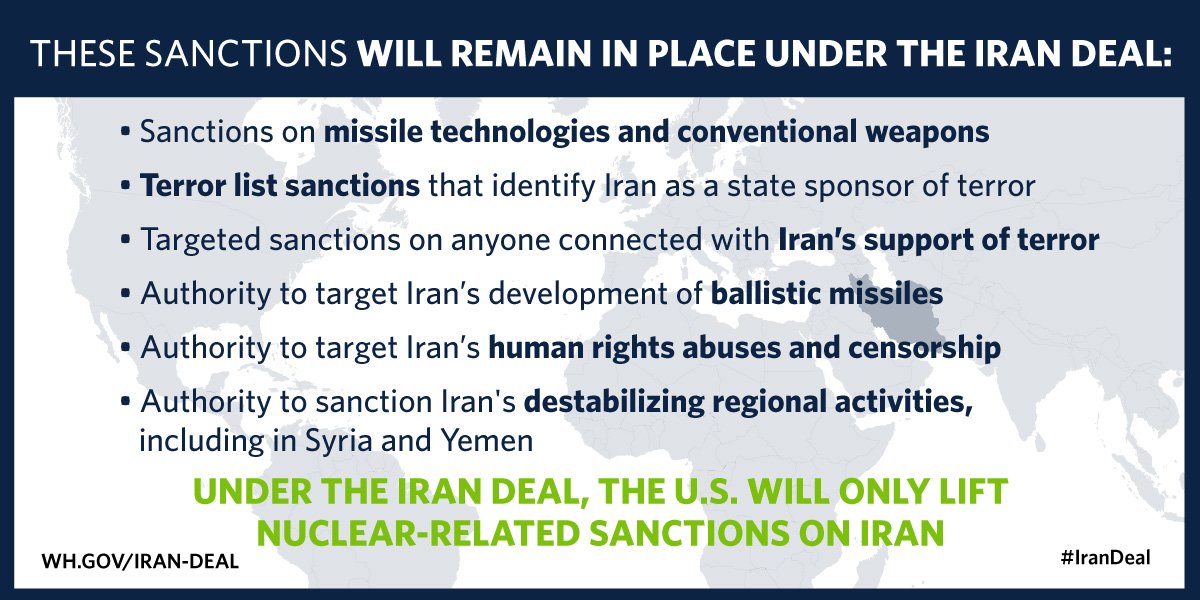
But Treasury officials bear mixed news: The U.S. is preparing to meet its commitments on sanctions relief tied to implementation of the nuclear deal. Still, many U.S. sanctions tied to Iran’s support for terrorism, human rights abuses, and other negative behaviors remain in place.

And within days of the Iranian central banker’s comments in October, the Financial Action Task Force, which sets global standards on countering money laundering and terrorist financing, issued another searing rebuke of Iran’s “strategic deficiencies.” Only Iran and North Korea, the task force said, present such “on-going and substantial money laundering and terrorist financing” risks that the international community should apply active “counter-measures” to protect the global financial system.

The task force said that as sanctions are being lifted under the nuclear agreement, it “remains particularly and exceptionally concerned about Iran’s failure to address the risk of terrorist financing and the serious threat this poses to the integrity of the international financial system.” It repeated its long-standing call for financial institutions to “give special attention to business relationships and transactions with Iran, including Iranian companies and financial institutions.” The full story is here.

From the White House:

Embedded image permalink

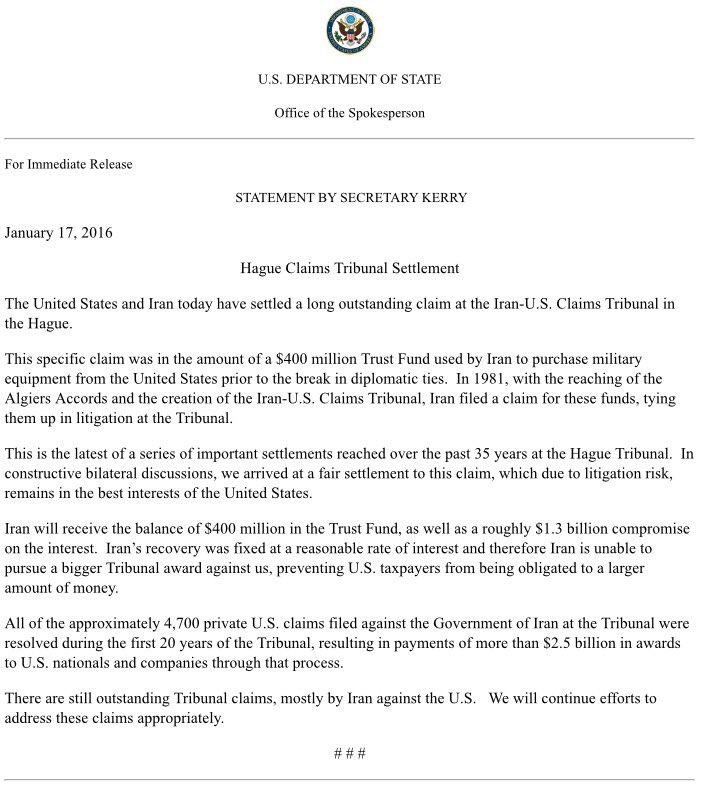
From the Treasury Department in part:

Implementation Day Statement:

On July 14, 2015, the P5+1 (China, France, Germany, Russia, the United Kingdom, and the United States), the European Union, and Iran reached a Joint Comprehensive Plan of Action (JCPOA) to ensure that Iran’s nuclear program will be exclusively peaceful.  October 18, 2015 marked Adoption Day of the JCPOA, the date on which the JCPOA came into effect and participants began taking steps necessary to implement their JCPOA commitments.  Today, January 16, 2016, marks Implementation Day of the JCPOA.  On this historic day, the International Atomic Energy Agency (IAEA) has verified that Iran has implemented its key nuclear-related measures described in the JCPOA, and the Secretary State has confirmed the IAEA’s verification.  As a result of Iran verifiably meeting its nuclear commitments, the United States is today lifting nuclear-related sanctions on Iran, as described in the JCPOA.
In connection with reaching Implementation Day, today the Department of the Treasury’s Office of Foreign Assets Control (OFAC) issued several documents.  Specifically, OFAC posted to its website: Guidance Relating to the Lifting of Certain Sanctions Pursuant to the Joint Comprehensive Plan of Action on Implementation Day; Frequently Asked Questions Relating to the Lifting of Certain U.S. Sanctions Under the Joint Comprehensive Plan of Action (JCPOA) on Implementation Day; General License H: Authorizing Certain Transactions relating to Foreign Entities Owned or Controlled by a United States Person; and a Statement of Licensing Policy for Activities Related to the Export or Re-Export to Iran of Commercial Passenger Aircraft and Related Parts and Services. The aforementioned documents are effective today, January 16, 2015.
***

Political Challenges to the Iran Deal in Tehran and Washington

By Aniseh Bassiri Tabrizi and Timothy Stafford
The Iran deal remains at the mercy of a volatile and unpredictable political climate, both in Tehran and Washington. This could well overwhelm it in the coming year.

Ticking the Boxes: Tehran’s Road to ‘Implementation Day’

By Aniseh Bassiri Tabrizi
To make the deal successful, intensive co-ordination between domestic actors in Iran will be required to implement these highly technical processes.

The Devil is in the Detail: The Financial Risks to the Economic Success of the Iran Deal

By Emil Dall, Andrea Berger and Tom Keatinge
Over the last decade, the US and EU have constructed a complex network of sanctions in response to Iran’s nuclear programme, ensuring the near-total isolation of Iran from global markets. On ‘implementation day’, this network starts to be disassembled and reintegration begin.

Iran Implementation Day Recommendations

The signatories to the Iran nuclear deal should move to entrench processes that will enable the agreement to outlast the individuals that put it in place. By this time next year, a new US president will have been sworn in, and presidential elections in Iran will only be just months away. Time must be used wisely.

Senator Session’s Book on Immigration and Green Cards

Under Barack Obama, the United Nations is also the headquarters of who can claim a new identity, that of an American. The same does for Europe, the world is one big global citizen, loyal to nothing and fully borderless.

Hat tip to Chuck and Daily Caller:

Jeff Sessions Releases Book Of Charts Putting Immigration And Green Card Issuances Into Shocking Perspective

Alabama Sen. Jeff Sessions released a book of graphs and charts on Wednesday that helps put the U.S.’s relaxed immigration policies in shocking perspective.

“Record-breaking visa issuances propelling U.S. to immigration highs never before seen,” is the sub-title to the Republican immigration hawk’s “chart book.”

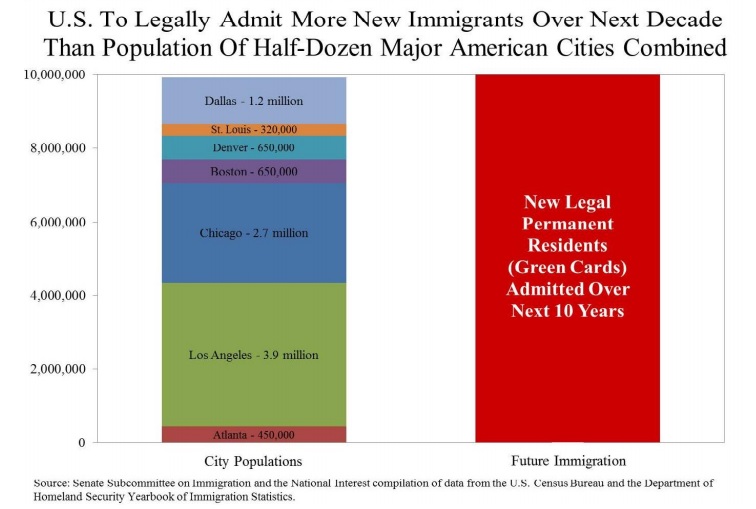
Sessions, who chairs the Senate Subcommittee on Immigration and the National Interest, asserts that the federal government will legally add 10 million or more “new permanent immigrants over the next 10 years.”

He also cites polls showing that a “stark” majority of Americans want lawmakers to reduce immigration rates, not increase them. Polls from Gallup and Fox show that Americans support an immigration reduction to an increase by a 2-to-1 margin.

Sessions’s chart book is aimed at providing readers an easy-to-understand frame of reference for immigration flows and green card issuances, past and present.

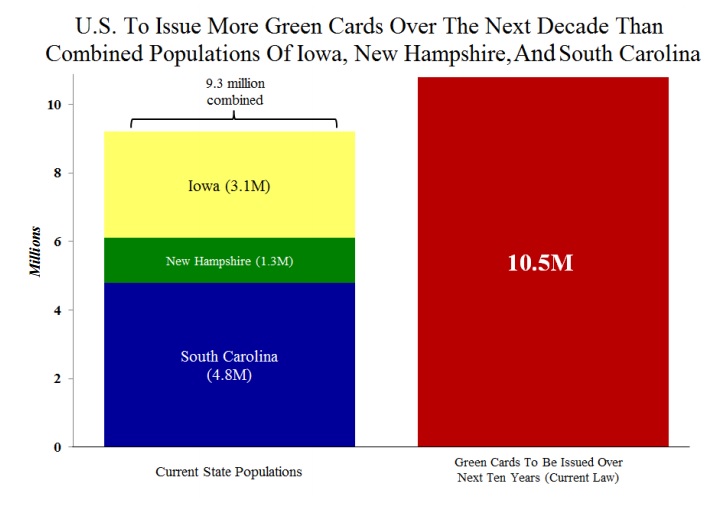
In one chart, Sessions compares the number of green cards that will be issued in the next decade to the population of the first three presidential primary states — Iowa, New Hampshire, and South Carolina.

Alabama Sen. Jeff Sessions "Chart Book"

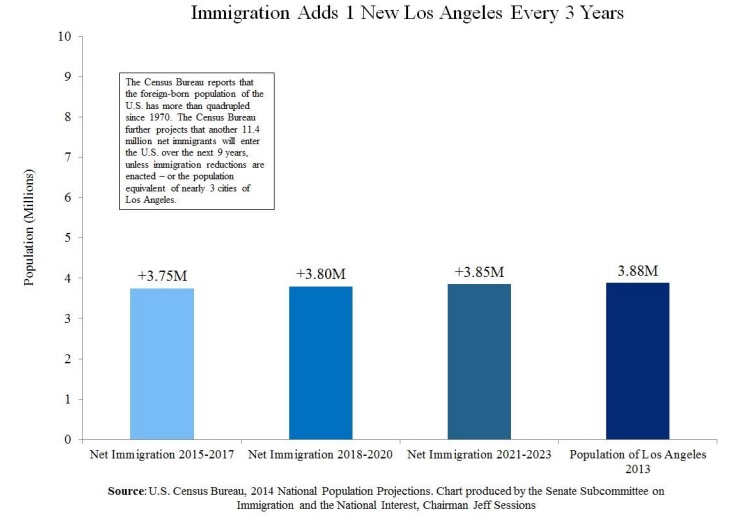
Another chart entitled “Immigration Adds 1 New Los Angeles Every 3 Years,” which is based on U.S. Census Bureau statistics and population projections, shows that the 11.4 million immigrants will enter the U.S. over the next nine years. “Unless immigration reductions are enacted,” the immigration population will increase in size equal to the population of Los Angeles — 3.9 million — every three years, Sessions notes.

sessions2 The number of green card issuances that can be expected over the next decade is also the equivalent of the combined population of seven of the largest cities in the U.S., including Los Angeles, Chicago, and Dallas, St. Louis, Denver, Boston, and Atlanta, Sessions notes.

sessions3

Other charts include one which shows that the U.S.’s immigration population will grow to more than 700 percent of 1970 levels by 2060.

By then, the U.S. will have 78.2 million foreign-born residents, according to the U.S. Census Bureau. In 1970, that number was 9.6 million.

And another chart takes aim at immigration from majority-Muslim nations. The U.S. has issued 680,000 green cards to migrants from those nations in the last five years, reports Sessions, citing statistics from the Department of Homeland Security.

Sessions’s “chart book” also includes stats on welfare usage rates for Middle Eastern refugees. According to a 2013 report from the Office of Refugee Resettlement, 91.4 percent of refugees from the Middle East are on food stamps. Nearly 70 percent — 68.3 percent to be exact — receive cash welfare assistance.

Other charts compare the U.S.’s immigrant population to other nations’.

“America Has 10 Million More Foreign-Born Residents Than The Entire European Union” and “U.S. Has 6 Times More Migrants Than All Latin American Nations Combined” provide the numbers.

While the U.S. has 45.8 million residents who were born outside of the U.S., the entire European Union has 35 million, according to a United Nations database. That despite the fact that the combined population of EU countries is 60 percent larger than the population of the U.S.


Paid Cash for Real Estate or via LLC, Read on…

Note, there are other cities where real estate money laundering occurs with frequency. They include San Diego, Los Angeles, Houston, Dallas, Las Vegas, Chicago and Atlanta.

There are guidelines for real estate professionals, click here.

Money laundering also occurs in commercial real estate, click here.

The official 21 page document on real estate money laundering is here.

Click here to see an actual case that involved a Russian.

U.S. targets money laundering in all-cash home sales in Miami, Manhattan

Reuters: The United States is hunting down international criminals who launder money through real estate deals, with the Treasury Department ordering title insurance companies to report the identities of people paying cash for high-end properties in Miami and Manhattan.

The Financial Crimes Enforcement Network, an arm of the U.S. Treasury, said on Wednesday it is concerned that individuals buy residential real estate in cash through shell companies to hide their assets and veil their identities.

“We are seeking to understand the risk that corrupt foreign officials, or transnational criminals, may be using premium U.S. real estate to secretly invest millions in dirty money,” FinCEN Director Jennifer Shasky Calvery said in a statement.

FinCEN has issued rules aimed at preventing laundering through the mortgage market, but “cash purchases present a more complex gap that we seek to address,” Calvery added.

Title insurers will have to disclose buyer identities in deals of at least $1 million in Miami and at least $3 million for Manhattan, the Miami Herald reported. FinCEN did not answer Reuters’ requests for details.

Research conducted by the Homeland Security officials suggests that the majority of real estate purchases of at least $1 million in Florida’s Miami-Dade and Broward counties are made through shell companies, said John Tobon, deputy special agent in charge at Homeland Security Investigations in Miami.

Money trails linked to drug trafficking, foreign corruption and other criminal activity often lead to luxury real estate properties, but when agents try to determine the true, or “beneficial” owners, they find only documents listing shell companies, many of which in turn are owned by other shell companies, Tobon said.

“It is a part of every single significant investigation that we have ongoing right now,” he added.

But the threshold for reporting cash purchases is so low in the two markets that it will include many mainstream buyers, said Terrence Oved, lawyer with Manhattan real estate and commercial litigation firm Oved & Oved LLP.

“You’re going to get a lot of small fish caught up in this net,” he said.

The temporary orders begin on March 1 and last 180 days, and Oved expects a surge in deals to be completed March. Buyers may turn to other major metropolitan markets such as Los Angeles, as well, he added.

In November 2015, the most recent month for which data is available, 17 percent of the 82,595 all-cash purchases of single family homes and condos went to buyers with an “LLC” in the name, according to the housing data company RealtyTrac, indicating they were purchased by companies. Altogether, a third of home purchases in the United States since 2011 were all-cash.

Meanwhile, there were about $104 billion in transactions involving foreign investors in the U.S. real estate market between April 2014 and March 2015. More than half the buyers in those deals were from China, Canada, India, Mexico, and the United Kingdom, and the majority of transactions involving overseas buyers were in cash, said Deborah Friedman, who works in the FBI’s money laundering intelligence unit, in September.

Those purchases were concentrated in Florida, Texas, Arizona and California, she said.

The Patriot Act of 2001 required the Treasury to either issue rules on anti-money laundering controls and reporting of suspicious activity by real estate professionals or grant an exemption. The exemption has been in place now for more than a decade.

Your Threat Score, Yup, Yours

The new way police are surveilling you: Calculating your threat ‘score’

While officers raced to a recent 911 call about a man threatening his ex-girlfriend, a police operator in headquarters consulted software that scored the suspect’s potential for violence the way a bank might run a credit report.

The program scoured billions of data points, including arrest reports, property records, commercial databases, deep Web searches and the man’s social- media postings. It calculated his threat level as the highest of three color-coded scores: a bright red warning.

The man had a firearm conviction and gang associations, so out of caution police called a negotiator. The suspect surrendered, and police said the intelligence helped them make the right call — it turned out he had a gun.

As a national debate has played out over mass surveillance by the National Security Agency, a new generation of technology such as the Beware software being used in Fresno has given local law enforcement officers unprecedented power to peer into the lives of citizens.

Police officials say such tools can provide critical information that can help uncover terrorists or thwart mass shootings, ensure the safety of officers and the public, find suspects, and crack open cases. They say that last year’s attacks in Paris and San Bernardino, Calif., have only underscored the need for such measures.

But the powerful systems also have become flash points for civil libertarians and activists, who say they represent a troubling intrusion on privacy, have been deployed with little public oversight and have potential for abuse or error. Some say laws are needed to protect the public.

In many instances, people have been unaware that the police around them are sweeping up information, and that has spawned controversy. Planes outfitted with cameras filmed protests and unrest in Baltimore and Ferguson, Mo. For years, dozens of departments used devices that can hoover up all cellphone data in an area without search warrants. Authorities in Oregon are facing a federal probe after using social media-monitoring software to keep tabs on Black Lives Matter hashtags.

“This is something that’s been building since September 11,” said Jennifer Lynch, a senior staff attorney at the Electronic Frontier Foundation. “First funding went to the military to develop this technology, and now it has come back to domestic law enforcement. It’s the perfect storm of cheaper and easier-to-use technologies and money from state and federal governments to purchase it.”

Few departments will discuss how — or sometimes if — they are using these tools, but the Fresno police offered a rare glimpse inside a cutting-edge $600,000 nerve center, even as a debate raged in the city over its technology.

An arsenal of high-tech tools

Fresno’s Real Time Crime Center is the type of facility that has become the model for high-tech policing nationwide. Similar centers have opened in New York, Houston and Seattle over the past decade.

Fresno’s futuristic control room, which operates around the clock, sits deep in its headquarters and brings together a handful of technologies that allow the department to see, analyze and respond to incidents as they unfold across this city of more than 500,000 in the San Joaquin Valley.

On a recent Monday afternoon, the center was a hive of activity. The police radio crackled over loudspeakers — “subject armed with steel rod” — as five operators sat behind banks of screens dialing up a wealth of information to help units respond to the more than 1,200 911 calls the department receives every day.

On 57 monitors that cover the walls of the center, operators zoomed and panned an array of roughly 200 police cameras perched across the city. They could dial up 800 more feeds from the city’s schools and traffic cameras, and they soon hope to add 400 more streams from cameras worn on officers’ bodies and from thousands from local businesses that have surveillance systems.

The cameras were only one tool at the ready. Officers could trawl a private database that has recorded more than 2 billion scans of vehicle licenses plates and locations nationwide. If gunshots were fired, a system called ShotSpotter could triangulate the location using microphones strung around the city. Another program, called Media Sonar, crawled social media looking for illicit activity. Police used it to monitor individuals, threats to schools and hashtags related to gangs.

Fresno police said having the ability to access all that information in real time is crucial to solving crimes.

They recently used the cameras to track a robbery suspect as he fled a business and then jumped into a canal to hide. He was quickly apprehended.

The license plate database was instrumental in solving a September murder case, in which police had a description of a suspect’s vehicle and three numbers from the license plate.

But perhaps the most controversial and revealing technology is the threat-scoring software Beware. Fresno is one of the first departments in the nation to test the program.

As officers respond to calls, Beware automatically runs the address. The searches return the names of residents and scans them against a range of publicly available data to generate a color-coded threat level for each person or address: green, yellow or red.

Exactly how Beware calculates threat scores is something that its maker, Intrado, considers a trade secret, so it is unclear how much weight is given to a misdemeanor, felony or threatening comment on Facebook. However, the program flags issues and provides a report to the user.

In promotional materials, Intrado writes that Beware could reveal that the resident of a particular address was a war veteran suffering from post-traumatic stress disorder, had criminal convictions for assault and had posted worrisome messages about his battle experiences on social media. The “big data” that has transformed marketing and other industries has now come to law enforcement.

Fresno Police Chief Jerry Dyer said officers are often working on scant or even inaccurate information when they respond to calls, so Beware and the Real Time Crime Center give them a sense of what may be behind the next door.

“Our officers are expected to know the unknown and see the unseen,” Dyer said. “They are making split-second decisions based on limited facts. The more you can provide in terms of intelligence and video, the more safely you can respond to calls.”

But some in Fresno say the power and the sheer concentration of surveillance in the Real Time Crime Center is troubling. The concerns have been raised elsewhere as well — last year, Oakland city officials scaled back plans for such a center after residents protested, citing privacy concerns.

Rob Nabarro, a Fresno civil rights lawyer, said he is particularly concerned about Beware. He said outsourcing decisions about the threat posed by an individual to software is a problem waiting to happen.

Nabarro said the fact that only Intrado — not the police or the public — knows how Beware tallies its scores is disconcerting. He also worries that the system might mistakenly increase someone’s threat level by misinterpreting innocuous activity on social media, like criticizing the police, and trigger a heavier response by officers.

“It’s a very unrefined, gross technique,” Nabarro said of Beware’s color-coded levels. “A police call is something that can be very dangerous for a citizen.”

Dyer said such concerns are overblown, saying the scores don’t trigger a particular police response. He said operators use them as guides to delve more deeply into someone’s background, looking for information that might be relevant to an officer on scene. He said officers on the street never see the scores.

Still, Nabarro is not the only one worried.

The Fresno City Council called a hearing on Beware in November after constituents raised concerns. Once council member referred to a local media report saying that a woman’s threat level was elevated because she was tweeting about a card game titled “Rage,” which could be a keyword in Beware’s assessment of social media.

Councilman Clinton J. Olivier, a libertarian-leaning Republican, said Beware was like something out of a dystopian science fiction novel and asked Dyer a simple question: “Could you run my threat level now?”

Dyer agreed. The scan returned Olivier as a green, but his home came back as a yellow, possibly because of someone who previously lived at his address, a police official said.

“Even though it’s not me that’s the yellow guy, your officers are going to treat whoever comes out of that house in his boxer shorts as the yellow guy,” Olivier said. “That may not be fair to me.”

He added later: “[Beware] has failed right here with a council member as the example.”

An Intrado representative responded to an interview request seeking more information about how Beware works by sending a short statement. It read in part: “Beware works to quickly provide [officers] with commercially available, public information that may be relevant to the situation and may give them a greater level of awareness.”

Calls for ‘meaningful debate’

Similar debates over police surveillance have been playing out across the country, as new technologies have proliferated and law enforcement use has exploded.

The number of local police departments that employ some type of technological surveillance increased from 20 percent in 1997 to more than 90 percent in 2013, according to the latest information from the Bureau of Justice Statistics. The most common forms of surveillance are cameras and automated license plate readers, but the use of handheld biometric scanners, social media monitoring software, devices that collect cellphone data and drones is increasing.

Locally, the American Civil Liberties Union reports that police in the District, Baltimore, and Montgomery and Fairfax counties have cellphone-data collectors, called cell site simulators or StingRays. D.C. police are also using ShotSpotter and license plate readers.

The surveillance creates vast amounts of data, which is increasingly pooled in local, regional and national databases. The largest such project is the FBI’s $1 billion Next Generation Identification project, which is creating a trove of fingerprints, iris scans, data from facial recognition software and other sources that aid local departments in identifying suspects.

Law enforcement officials say such tools allow them to do more with less, and they have credited the technology with providing breaks in many cases. Virginia State Police found the man who killed a TV news crew during a live broadcast last year after his license plate was captured by a reader.

Cell site simulators, which mimic a cellphone tower and scoop up data on all cellphones in an area, have been instrumental in finding kidnappers, fugitives and people who are suicidal, law enforcement officials said.

But those benefits have sometimes come with a cost to privacy. Law enforcement used cell site simulators for years without getting a judge’s explicit consent. But following criticism by the ACLU and other groups, the Justice Department announced last September that it would require all federal agencies to get a search warrant.

The fact that public discussion of surveillance technologies is occurring after they are in use is backward, said Matt Cagle, an attorney for the ACLU of Northern California.

“We think that whenever these surveillance technologies are on the table, there needs to be a meaningful debate,” Cagle said. “There needs to be safeguards and oversight.”

After the contentious hearing before the Fresno City Council on Beware, Dyer said he now wants to make changes to address residents’ concerns. The police chief said he is working with Intrado to turn off Beware’s color-coded rating system and possibly the social media monitoring.

“There’s a balancing act,” Dyer said.

One More Transferred from Gitmo, Bigger Implications

The Department of Defense announces transfer of a Guantanamo detainee to Saudi Arabia. Leaves 103 detainees left at Gitmo. This transfer was approved in October.

General John Kelly, commander of U.S. Southern Command announced 150 Islamic militants in the Caribbean. A big issue that Gitmo does monitor but…..

Obama to make good on Guantanamo pledge: White House chief of staff

Reuters: President Barack Obama will make good on a promise to close the U.S. naval prison in Guantanamo Bay, Cuba, his chief of staff Denis McDonough said on “Fox News Sunday.”

Obama will first present a long-awaited plan to Congress about how to close the facility, and seek its approval, McDonough said in an interview. If Congress fails to act, the White House will determine what steps to take, he said.

“He feels an obligation to the next president. He will fix this so that they don’t have to be confronted with the same set of challenges,” McDonough said.

Obama pledged during the 2008 presidential election campaign that he would close the military prison, which housed foreign terrorism suspects after the Sept. 11, 2001, attacks on the United States.

That pledge, still unfilled, has been a feature of his annual State of the Union addresses to the nation ever since.

Obama has said the facility has been used as a recruiting tool in propaganda from groups like al Qaeda, and also is far too costly to maintain. There are 104 detainees left at the prison.

Where possible, his administration has transferred detainees to other countries. But there is a small number of detainees who the administration says it would like to detain in a U.S. facility for national security reasons.

Congress has explicitly banned the transfer of detainees to the United States.

McDonough declined to say whether Obama would close the prison using his own executive powers if Congress rejects his plan.

“I’m not an if-then guy,” he said.

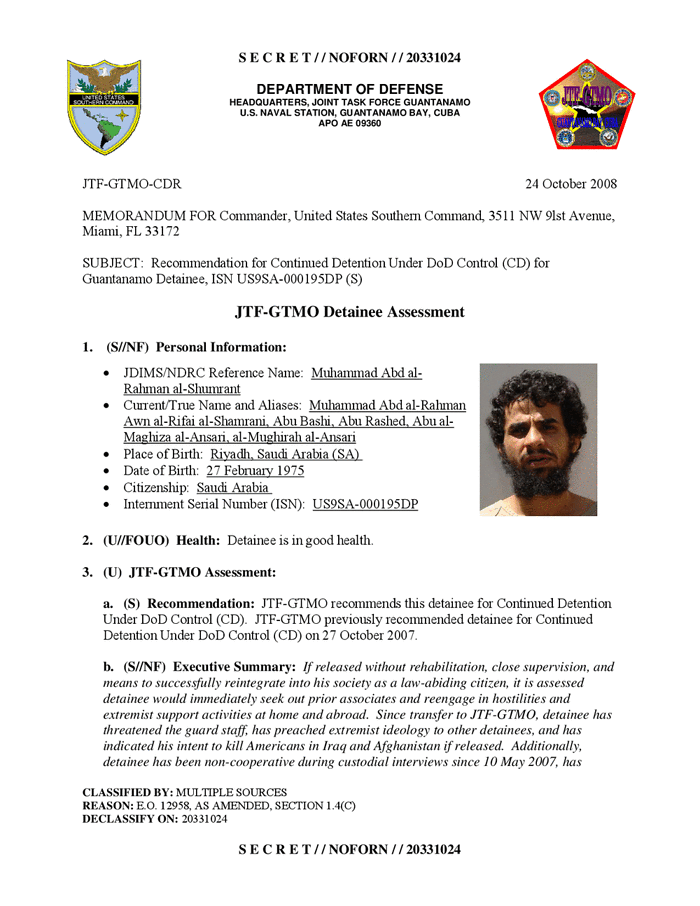
NYT: Mohammad al Rahman al Shumrani is a 40-year-old citizen of Saudi Arabia. As of January 2010, the Guantánamo Review Task Force had recommended him for continued detention. A parole-like Periodic Review Board later recommended him for transfer. As of Jan. 11, 2016, he has been held at Guantánamo for 14 years.

JTF-GTMO Assessment 12 pages 

So what are the options for Barack Obama on those Gitmo detainees that no country will take in a transfer? Enough money and politics will force any country being strong-armed by the White House to take the worst of the worst. If not, there are other options. Obama can use his pen and force a Federal prison in the U.S. to take the remaining detainees or he can transfer the jihadis to another U.S. held prison facility/detention center in a foreign country.
Could they be transferred to the control of the United Nations and be placed in a U.N. prison facility?
If he is successful in closing the detention facility what will happen to it? Could Obama cancel the lease with Cuba? Yes. Could the facility be transferred to Cuba and then handed over to Iran, Russia or China? Yes.
What is worse, Obama is bent on taking robust action on Gitmo such that the next administration cannot restore it after it is closed. This leaves few options for the next president or does it?
At issue is fundamentally, Naval Station Guantanamo Bay is a full service military base that provides regional security to the Caribbean and monitors activity in Central and South America. It also provides the Department of Homeland Security with assistance in migrant operations.

The base hosts numerous tenant commands including the Southern Command Joint Task Force-Guantanamo, Joint Task Force Guantanamo, US Naval Hospital and Branch Dental Clinic.

Other detachments located at the base are: Personnel Support Activity, Naval Atlantic Meteorology and Oceanography Command, Naval Media Center, Naval Communications Station, Department of Defense Dependent Schools, Navy Brig, and Fleet and Industrial Supply Center.

NAVSTA GTMO garrison facilities

The bay area is divided into two parts known as the outer and inner harbours. The inner harbour includes commercial ports while the outer harbour accommodates naval station and the main anchorage space. Pier and wharf facilities are located at the small inlets located between Corinaso Point and Deer Point.

Air facilities

NAVSTA GTMO had two airfields namely Leeward Point Field and McCalla Airfield. The operations at McCalla Airfield were ceased in 1976. The Leeward Point Field is the only active military airfield in the base. It has a single runway (10/28) measuring 2,438m x 61m and surfaced with asphalt.

Other base facilities and services

The naval station has four wind turbines generating 3,800kW electricity, enough to fulfil 25% its power requirements. A desalination plant capable of producing 2.25 million gallons of fresh water a day is attached to the base. The plant also produces a combined 15,000kw of electricity through its two turbine generators.

Guantanamo has had operations that includes air fields with aircraft including F8U Crusaders and A4D Skyhawks. It was also an anti-submarine center and a training center. It can handle and has handled 50 warships.
Further, the Haitian crisis , the Balkan crisis and the famous Cuban missile crisis.
Imagine a foreign government in control of U.S. naval infrastructure and technology. Just imagine.