Illegal Border Crossings v. Visa Overstays

No one can get the image of the train carrying illegals out of their memory and with good reason. When anyone does a search on the internet to determine the actual and factual numbers of immigrants coming across the southern border by year, you will be disappointed, the charts and records are not there. Countless outlets and agencies report but with caveats and obscure labels. Still we are told the border is as secure as it has ever been.

Related reading: The Human Tragedy of Illegal Immigration: Greater Efforts Needed to Combat Smuggling and Violence

What is more chilling, are the reports that once again we are in a spike season of illegal entry due in part to threats of presidential candidates. Further, those already here are filing at an accelerated rate for citizenship for the exact same reason.

There is a clash however in the facts over which is worse, those coming across the border versus those coming in by air or other means possessing a vThe Visa Waiver Program (VWP) enables most citizens or nationals of participating countries* to travel to the United States for tourism or business for stays of 90 days or less without first obtaining a visa, when they meet all requirements explained below. Travelers must have a valid Electronic System for Travel Authorization (ESTA) approval prior to travel. If you prefer to have a visa in your passport, you may still apply for a visitor (B) visa.isa that has an expiration date. Take note that any international airport across the United States is a port of entry. Once a visa is issued by State Department contractors, it becomes the burden of the Department of Homeland Security to ensure compliance to dates. This is where the problem, yet another lays with fault.

One cannot overlook the Visa Waiver Program concocted by the U.S. State Department of which several in Congress are calling for a suspension.

Citizens or nationals of the following countries* are currently eligible to travel to the United States under the VWP, unless citizens of one of these countries are also a national of Iraq, Iran, Syria, or Sudan.

Andorra Hungary Norway
Australia Iceland Portugal
Austria Ireland San Marino
Belgium Italy Singapore
Brunei Japan Slovakia
Chile Latvia Slovenia
Czech Republic Liechtenstein South Korea
Denmark Lithuania Spain
Estonia Luxembourg Sweden
Finland Malta Switzerland
France Monaco Taiwan*
Germany Netherlands United Kingdom**
Greece New Zealand

There are an estimated 35 unique types of visa classifications under the management of the U.S. State Department.


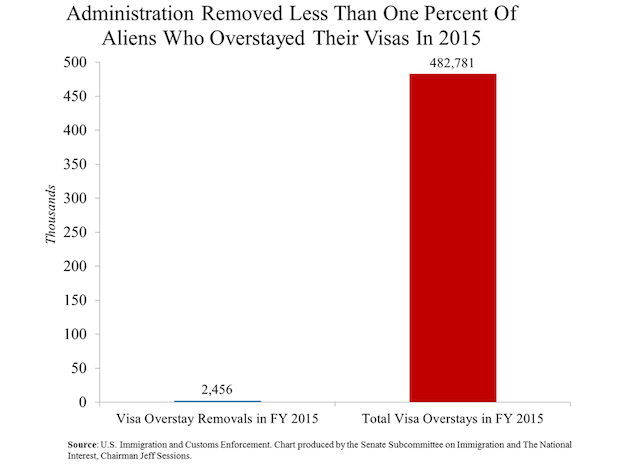
Obama Admin Deported Less Than One Percent of Visa Overstays

Nearly half a million individuals overstayed visas in 2015, fewer than 2,500 deported

Kredo/FreeBeacon: The Obama administration deported less than one percent of the nearly half a million foreign nationals who illegally overstayed their visas in 2015, according to new statistics published by the Department of Homeland Security.

Of the 482,781 aliens who were recorded to have overstayed temporary U.S. visas in fiscal year 2015, just 2,456 were successfully deported from the United States during the same period, according to DHS’s figures, which amounts to a deportation rate of around 0.5 percent.

The sinking rate of deportations by the Obama administration is drawing criticism from Capitol Hill, where lawmakers are warning that the administration is ignoring illegal overstays and potentially opening the United States to terrorist threats.

The 482,781 figure accounts for aliens who entered the United States on a nonimmigrant visitor visa or through the Visa Waiver Program, which streamlines travel between the United States and certain other countries. The figure encompasses foreign nationals who were found to have remained in the United States after their visas expired or after the 90-day window allowed by the Visa Waiver Program.

The actual number of overstays could be higher. The latest figures published by DHS do not include overstays from other visa categories or overstays by individuals who entered the United States through land ports, such as those along the Mexican border.

Deportations by the Obama administration have decreased steadily since 2009, according to figures codified by the Senate’s Subcommittee on Immigration and the National Interest and provided to the Washington Free Beacon.

Since 2009, U.S. Immigration and Customs Enforcement has expelled 51,704 individuals who overstayed their visas. The total number of those expelled has decreased every fiscal year.

At least 12,538 illegal overstays were deported in fiscal 2009, while 11,259 were removed in 2010, 10,426 in 2011, 6,856 in 2012, 4,240 in 2013, 3,564 in 2014, and 2,456 in 2015, according to the committee.

The drop is being attributed by sources to an Obama administration policy directing DHS and ICE not to pursue visa overstays unless the offender has been convicted of major crimes or terrorism.

“The decision by the Obama administration not to enforce immigration laws by allowing those who have overstayed their visas to remain in the country has not gone unnoticed by the American people,” sources on the Senate subcommittee told the Free Beacon. “A Rasmussen Reports poll released earlier this year indicates that approximately 3 out of 4 Americans not only want the Obama administration to find these aliens who overstay their visas, but also to deport them.”

“The same poll indicates that 68 percent of Americans consider visa overstays a ‘serious national security risk,’ and 31 percent consider visa overstays a ‘very serious’ national security risk,” according to the sources.

Congress has long mandated the implementation of a biometric entry-exit system to track individuals who overstay their visas and ensure they leave the United States.

Sen. Jeff Sessions (R., Ala.), chair of the Senate’s immigration subcommittee, recently proposed an amendment aimed at speeding up implementation of this system. Senate Democrats blocked the amendment.

97d0ba07-f3c5-45eb-9b87-ba1ec93c169a

Immigration and Customs Enforcement has received substantially more taxpayer money in recent years despite the plummeting rate of deportations. At least 43 percent fewer aliens were removed from the United States from 2012 to 2015, according to DHS statistics.

History and Money, Immigrants into the U.S.

Drug traffic route in the region

by: Susan Fitzpatrick Behrens

The porous 600-mile border between Guatemala and Mexico offers Central American immigrants a ready passage to “el norte“—the United States. It includes 63 uncontrolled transit points, 44 of which can be passed in a vehicle.

The same conditions attracting Central American immigrants also make the Guatemala-Mexico border region home to a thriving drug trade. Guatemala’s Prensa Libre, recently reported that Guatemala’s three departments (or states) bordering Mexico—San Marcos, Huehuetenango, and the Petén—have come under the direct control of violent drug cartels.
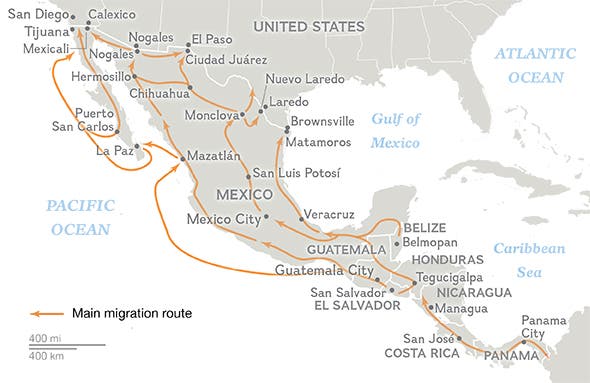
In San Marcos, a single drug lord, Juan Ortiz Chamalé, owns virtually all of the properties on the frontier. Huehuetenango is the site of an increasingly violent conflict between Mexican and Guatemalan drug lords. The latest incident there involved a wholesale massacre of 17 to 40 people (estimates vary) at a horserace organized by narcos. While in the Petén, drug mafias, supported by the police, have forced small and large landowners to sell their lands.

Violence, promoted by the drug trade, delinquency, and death squads has become a part of daily life in these Guatemalan departments. Bodies riddled with bullet holes regularly appear by the sides of roads, along riverbeds, and in open fields. Well-documented evidence demonstrates that police and military forces are directly engaged in this violence through their links to drug cartels, the maras (gangs), and death squads.

Undocumented Central American immigrants, fleeing the struggling economies of their respective countries, are often victimized by this violence. And their plight is about to get worse. The recently implemented U.S.-Central American Free Trade Agreement (CAFTA) will surely devastate what is left of rural livelihoods. And, what’s more, the conditions that make the Guatemala-Mexico border an immigrant corridor and a Mecca for drug trafficking also make it a central target of Plan Mexico, the U.S.-financed anti-drug militarization program, pushed through the U.S. Congress by President George Bush in June 2008.

Undocumented Central American immigrants, already subjected to subhuman conditions in their search for viable livelihoods, now face the oppressive confluence of these powerful transnational forces—the drug trade, militarization, and free trade.

Plan Mexico

The U.S.-backed Plan Mexico, known as the “Mérida Initiative” in policy circles, provides $1.6 billion of U.S. taxpayer money to Mexico, Central America, and the Caribbean. The stated intention of the program involves “security aid to design and carry out counter-narcotics, counter-terrorism, and border security measures.”

U.S. Congressional leaders complained about the secrecy of negotiations for Plan Mexico and the absence of human rights guarantees, but they did nothing more than demand the paltry sum of $1 million in additional funding to support human rights groups in Mexico.

Researcher Laura Carlsen has noted that Plan Mexico is the “securitized” extension of trade agreements such as the North American Free Trade Agreement and CAFTA. Indeed, Plan Mexico is the successor project to the Security and Prosperity Partnership (SPP), a post-9/11 initiative negotiated by the NAFTA countries. The State Department’s Thomas Shannon made the link between free trade and security explicit: “We have worked through the Security and Prosperity Partnership to improve our commercial and trading relationship, we have also worked to improve our security cooperation. To a certain extent, we’re armoring NAFTA.”

Evidently, neoconservative policy framers have purposefully coupled free trade and security. Free trade agreements promote the free circulation of goods, while prohibiting the same circulation by workers. Since neoliberal trade deals eliminate agricultural subsidies and open poor countries to a flood of cheap imported goods, economically displaced workers will naturally seek new sources of income—even if that means crossing borders.

Militarizing borders and identifying undocumented workers who cross them as criminals (“illegal”) are the logical—though sordid—next steps in anticipating and “guarding against” the effects of free trade. The militarization of borders has done nothing to stop immigration, which provides an essential labor force to the United States. But the criminalization of undocumented mobile immigrant workers has deprived them of basic rights of citizenship, thereby making them vulnerable to increasing levels of violence and human rights violations.

The U.S.-driven designation of “internal enemies”—in this case immigrants—as a rationale for building an already mushrooming security apparatus and militarizing societies is, of course, nothing new, especially in Latin America. What is new is that this militarization has become nearly void of any social content. Even during the Cold War, U.S. “national security” doctrines were generally accompanied by social programs, such as the Alliance for Progress and the Peace Corps, which in small measure alleviated poverty and explicitly recognized economic conditions as a root of “the problem.”

The end of the Cold War eliminated an even token emphasis on poverty and with it, all but the most minimal efforts to offer social assistance. The Washington Office on Latin America (WOLA) found that the Bush administration granted $874 million in military and police assistance to Latin America in 2004 an amount almost equal to the $946 million provided in economic and social programs. WOLA reported that with the exception of Colombia, military and police aid has historically been less than half of the total provided for economic and social aid. Moreover, military and police aid used to be directed by the U.S. State Department, assuring a degree of congressional oversight. Now, this aid is increasingly managed by the Department of Defense, thereby eliminating this oversight and effectively making militarization the predominant rationale of U.S. foreign policy.

Living on the Border

The situation of Central American immigrants on Mexico’s southern border illustrates the central problems and contradictions of Washington’s emphasis on free trade and militarization. And the situation is certain to get worse as thousands of immigrants are deported by the United States to their countries of origin in Central America.

Immigrants are fully aware of the risks they take, but economic conditions leave them few alternatives. With a look of desperation following a three-day journey from his home, one Honduran immigrant in the Mexican border town of Tapachula explained, “We don’t do this by choice. We don’t want to leave our families. But imagine a man looking at his children and seeing them hungry.” Back home, he faces wages averaging $6 per day in Honduras and a scarcity of opportunities.

When asked about the dangers they anticipate on their journey north, Central American immigrants offer a catalog of terrors: beatings, sexual assaults, robberies, kidnappings, and murders. Ademar Barilli, a Catholic priest and director of the Casa del Migrante in Guatemala’s border town of Tecún Umán, observed, “Immigrants almost expect that their rights will be violated in every sense because they are from another country and are undocumented.”

Heyman Vasquez, a Catholic priest who directs a shelter for migrants in the town of Arriaga in Chiapas, Mexico, maintains detailed records of the violations suffered by migrants passing through his shelter. In a five-month period in 2008, a third of the men and 40% of the women he serves reported assault or some other form of abuse in their 160-mile journey from the Mexico-Guatemala region to Arriaga.

Police are often the perpetrators of these violations. In Guatemala, Father Barilli and others described cases of police forcing Salvadoran and Honduran immigrants to disembark from buses, where they take their documents and demand money. Once they make it into Mexico, immigrants are subject to abuse by Los Zetas, a notorious drug-trafficking network composed of former law enforcement and military agents linked with the Gulf Cartel.

Los Zetas are known to work with Mexican police in the kidnapping of immigrants to demand money from their family members in the United States. Immigrants also report robberies, beatings, and rapes at the hands of Los Zetas. Recently, in Puebla, Mexico, 32 undocumented Central Americans were kidnapped and tortured by the Zetas with the support of municipal police. In this case, after the migrants escaped, local community members captured a number of the responsible police agents and held them until Federal authorities arrived.

A U.S. State Department report on human rights in Mexico from 2007 concluded, “Many police were involved in kidnapping, extortion, or providing protection for, or acting directly on behalf of organized crime and drug traffickers. Impunity was pervasive to an extent that victims often refused to file complaints.”

That impunity means abused migrants have few places to turn is painfully obvious to one Salvadoran immigrant in the Mexican border town of Tapachula. He had just been deported from the United States, where his wife, a legal resident, and two U.S.-born children live in Los Angeles. “The police are involved. You can’t file complaints,” he said. Besides, the wheels of Mexican justice turn notoriously slow—if at all.

Despite the dire scenario, it is not uncommon for many Central American immigrants to receive a helping hand along the way in their journey to El Norte, whether its food, water, money, or shelter. As one undocumented Honduran explained in Tapachula, “Almost everyone has someone in their family who has migrated. Most understand the need.”

“Security” and Violence

Security initiatives in Central America are notoriously violent and further militarize societies still recovering from decades of brutal civil wars. And, historically, when the Pentagon gets involved, repressive tactics increase.

The Bush administration’s principle security concerns in Central America of drug trafficking and “transnational gangs” have led to a series of “security cooperation” agreements. The first regional conference on “joint security” was chaired by El Salvador’s president, Tony Saca, who first introduced the “Mano Dura” (Iron Fist) initiative—a package of authoritarian militarized policing methods aimed at youth gangs adopted throughout the region. In attendance was then-U.S. Attorney General Alberto Gonzales, responsible for advocating torture of prisoners in Guantánamo.

The conference took place in El Salvador in February 2007 and resulted in the creation of a transnational anti-gang unit (TAG), which El Salvador’s justice and security minister, René Figueroa described as “an organized offensive at a regional level,” with the US State Department and the FBI coordinating with national police forces. Gonzales, promised Washington would finance a new program to train regional police forces and this promise has been fulfilled partially with the establishment of a highly controversial police-training academy in El Salvador, which is closed to public scrutiny and includes little support for human rights.

In many ways, Plan Mexico, is a mano dura campaign writ large. For 2008, Plan Mexico will provide $400 million to Mexico and $65 million to Central America. More than half of the total funds will go directly to providing police and military weapons and training, even though the police and military in these countries have been implicated in crime and human rights violations.

As Plan Mexico arms and trains military and police forces implicated in violent crime, it also provides millions of dollars for an immigration institute responsible for tightening Mexico’s southern borders through monitoring, bio-data collection, a Guatemalan guest-worker program, and border control.

Undocumented immigrants will be caught in the web of this violence, particularly since Plan Mexico also continues the trend toward the criminalization of migrants. As Laura Carlsen, observes, “By including ‘border security’ and explicitly targeting ‘flows of illicit goods and persons,’ the initiative equates migrant workers with illegal contraband and terrorist threats.”

The dehumanization of undocumented immigrants in the United States, and elsewhere, and the growing infringement of their basic rights should serve as a dire warning to all “citizens.” The undocumented are the canaries in the coalmine: the violation of their rights signals a growing repressive climate that jeopardizes everyone’s liberties.

Fire on the Border

Free trade agreements create the conditions that force people to migrate to the United States as an underpaid, politically disenfranchised, and therefore unprotected labor force. Now the economic crisis in the United States has increased pressure to expel undocumented workers, violating a host of human rights standards in the process. Deportations also increase labor pressure in immigrants’ countries of origin, where the global economic crisis stands to further decrease the already limited opportunities for work in “legitimate” industries.

From a purely humanitarian perspective, the governments of the United States, Mexico, and Central America need to address this crisis by developing policies that improve the conditions of poverty that cause immigration. Throwing guns at the problem will only make things worse.

Sure, drug lords are firmly entrenched in the Guatemala-Mexico border region. But Plan Mexico will no more eliminate their presence, than the Mano Dura campaigns eliminated the gangs. Or, for that matter, any more than the militarization of borders has eliminated immigration. Instead, Plan Mexico, like its predecessors, will increase the level of violence in the region by providing more weapons to corrupt police and military forces.

As more and more resources shift toward militarization, policing and surveillance, fewer resources are available for programs that ease pressure to emigrate—namely, education, jobs, medical care, food subsidies, housing, and legal recourse. Meanwhile, governments are increasingly ceding responsibility for protection of even narrowly defined human rights to under-funded non-governmental organizations.

Repressive immigration policies, narcotrafficking, and free trade all combined to form a combustible situation along the Mexico-Guatemala border. Plan Mexico is the spark, and once the flames start, no one will be able to put out the fire. And it’s the undocumented migrants who will continue to get burned.

Crime in 2015: A Final Analysis

April 20, 2016
 

[Download PDF of Final 2015 Numbers]

Brennan Center for Justice: Overall crime rates in America’s 30 largest cities were nearly identical from 2014 to 2015, according to an analysis of final 2015 numbers. Crime declined over that time period by 0.1 percent. The data show that crime rates remain at historic lows nationally, despite recent upticks in a handful of cities.
The authors of this report looked at changes in crime and murder from 2014 to 2015, using data through Dec. 31, 2015, and examined economic factors in Chicago, Baltimore, and Washington, D.C., that could explain why murder rates are up in those cities. Of the 30 cities studied, the three areas accounted for more than half of the increase in murders last year.
Among the updated findings:
  • Crime overall in the 30 largest cities in 2015 remained the same as in 2014, decreasing by 0.1 percent. Two-thirds of cities saw drops in crime, which were offset mostly by an increase in Los Angeles (12.7 percent). Nationally, crime remains at all-time lows.
  • Violent crime rose slightly, by 3.1 percent. This result was primarily caused by increasing violence in Los Angeles (25.2 percent), Baltimore (19.2 percent), and Charlotte (15.9 percent). Notably, aggravated assaults in Los Angeles account for more than half of the national rise in violent crime.
  • The 2015 murder rate rose by 13.2* percent in the 30 largest cities, with 19 cities seeing increases and 6 decreases. However, in absolute terms, murder rates are so low that a small numerical increase can lead to a large percentage change.
  • Final data confirm that three cities (Baltimore, Chicago, and Washington, D.C.) account for more than half (244) of the national increase in murders. While this suggests cause for concern in some cities, murder rates vary widely from year to year, and there is little evidence of a national coming wave in violent crime. These serious increases seem to be localized, rather than part of a national pandemic, suggesting that community conditions remain the major factor. Notably, these three cities all seem to have falling populations, higher poverty rates, and higher unemployment than the national average. This implies that economic deterioration of these cities could be a contributor to murder increases.

The new figures are an update to a Brennan Center November 2015 report, Crime in 2015: A Preliminary Analysis, authored by a team of economists and legal researchers. That report found similar conclusions. The Brennan Center also released a near-final update of the numbers in December 2015.

*This number has been changed from 13.3 to reflect a transcription error.

Crime in 2015: A Final Analysis by The Brennan Center for Justice

Illegal Immigration, Refusing to Deport is a Deadly Option

Hat tip to this site for listing the victims of illegal immigrants.

Today in the House is a hearing questioning Sarah Saldana, the Director of the DHS for Immigration and Customs Enforcement. Several terrifying facts were revealed and there are solutions to the policies, one is to simply enforce the law and quit with the exceptions. Further, stop releasing into the general population detained illegals arrested and sentenced with discretion. What about Congress eliminating the discretion clause? How about allowing local law enforcement to fully handle cases at the local level? There is additional legislation for loopholes including H.R. 2793 for sex offenders.

Further, what about the victim or the survivors of the victims? They just get a letter in the mail, stating what is not certain.

There is a database for all illegals that have been officially detained for any reason, but local law enforcement does not have the jurisdiction or authority to handle inside cases, they are referred to ICE. Not all jurisdictions participate in the database operation, it is not a mandated procedure. What? . Of note, inside cases means arrests made by agencies other than Customs and Border Patrol.


All 58 immigration courts are managed by the U.S. Department of Justice….this is where the politics enter the fray. Additionally, when a court does in fact order a foreign national to be deported, yet another cycle of paperwork and diplomatic procedures is started. Consider, there are many countries that refuse to take back their own citizens and in some cases even after approval when the plane is on the runway. Haiti is one such country. So, the matter is in the hands of the U.S. State Department, do we need to say more?

The statute says there is discretion in all cases. So, in 2015, 19723 criminal illegal aliens have been released for felonies including kidnapping and homicide. An order of removal is required to deport them but that is done by a judge….but if they have requested asylum or other exceptions, it is more often than not granted. For those that have been ordered for deportation, there is a maximum bed space of 33,000 waiting to leave, if those beds are full, then they too are released.

Secure Communities was an immigration enforcement program administered by U.S. Immigration and Customs Enforcement (ICE) from 2008 to 2014.

The program was replaced by Priority Enforcement Program (PEP) in July 2015. Obama ordered this program terminated.

PEP: The Department of Homeland Security’s (DHS) Priority Enforcement Program (PEP) enables DHS to work with state and local law enforcement to take custody of individuals who pose a danger to public safety before those individuals are released into our communities. PEP was established at the direction of DHS Secretary Jeh Johnson in a November 20, 2014 memorandum, entitled Secure Communities, that discontinued the Secure Communities program. PEP focuses on convicted criminals and others who pose a danger to public safety.

How it works

PEP begins at the state and local level when an individual is arrested and booked by a law enforcement officer for a criminal violation and his or her fingerprints are submitted to the FBI for criminal history and warrant checks. This same biometric data is also sent to U.S. Immigration and Customs Enforcement (ICE) so that ICE can determine whether the individual is a priority for removal, consistent with the DHS enforcement priorities described in Secretary Johnson’s November 20, 2014 Secure Communities memorandum. Under PEP, ICE will seek the transfer of a removable individual when that individual has been convicted of an offense listed under the DHS civil immigration enforcement priorities, has intentionally participated in an organized criminal gang to further the illegal activity of the gang, or poses a danger to national security.

Here is a simple case from April of 2016. Illegal immigrants arrested during Alabama theft, kidnapping mission for Honduran drug enforcer, records state. You are encouraged to read those details.

Here is yet another bizarre case: An illegal immigrant with a 12-year criminal history and 35 arrests under his belt cannot be deported back to Palestine because the U.S. will not recognise his homeland as a country. What? We give millions to the Palestinian Authority and Obama, Hillary and John Kerry have all met with the Palestinian Authority for peace talks with Israel.


Need to Know Facts on EB-5 Visa Program

In 1999, yes under President Bill Clinton and selling out sovereignty under a globalist agenda:


FAS: The immigrant investor visa was created in 1990 to benefit the U.S. economy through employment creation and an influx of foreign capital into the United States. The visa is also referred to as the EB-5 visa because it is the fifth employment preference immigrant visa category. The EB-5 visa provides lawful permanent residence (i.e., LPR status) to foreign nationals who invest a specified amount of capital in a new commercial enterprise in the United States and create at least 10 jobs. The foreign nationals must invest $1,000,000, or $500,000 if they invest in a rural area or an area with high unemployment (referred to as targeted employment areas or TEAs).

There are approximately 10,000 visas available annually for foreign national investors and their family members (7.1% of the worldwide employment-based visas are allotted to immigrant investors and their derivatives). In FY2015, there were 9,764 EB-5 visas used, with 93% going to investors from Asia. More specifically, 84% were granted to investors from China and 3% were granted to those from Vietnam.

In general, an individual receiving an EB-5 visa is granted conditional residence status. After approximately two years the foreign national must apply to remove the conditionality (i.e., convert to full-LPR status). If the foreign national has met the visa requirements (i.e., invested and sustained the required money and created the required jobs), the foreign national receives full LPR status. If the foreign national investor has not met the requirements or does not apply to have the conditional status removed, his or her conditional LPR status is terminated, and, generally, the foreign national is required to leave the United States, or will be placed in removal proceedings.

In 1992, Congress established the Regional Center (Pilot) Program, which created an additional pathway to LPR status through the EB-5 visa category. Regional centers are “any economic unit, public or private, which [are] involved with the promotion of economic growth, including increased export sales, improved regional productivity, job creation, and increased domestic capital investment.” The program allows foreign national investors to pool their investment in a regional center to fund a broad range of projects within a specific geographic area. The investment requirement for regional center investors is the same as for standard EB-5 investors. As the use of EB-5 visas has grown, so has the use of the Regional Center Program. In FY2014, 97% of all EB-5 visas were issued based on investments in regional centers. Unlike the standard EB-5 visa category, which does not expire, the Regional Center Program is set to expire on September 30, 2016.

Different policy issues surrounding the EB-5 visa have been debated. Proponents of the EB-5 visa contend that providing visas to foreign investors benefits the U.S. economy, in light of the potential economic growth and job creation it can create. Others argue that the EB-5 visa allows wealthy individuals to buy their way into the United States.

In addition, some EB-5 stakeholders have voiced concerns over the delays in processing EB-5 applications and possible effects on investors and time sensitive projects. Furthermore, some have questioned whether U.S. Citizen and Immigration Services (USCIS) has the expertise to administer the EB-5 program, given its embedded business components. The Department of Homeland Security’s Office of the Inspector General (DHS OIG) has recommended that USCIS work with other federal agencies that do have such expertise, while USCIS has reported that it has taken steps internally to address this issue. USCIS has also struggled to measure the efficacy of the EB-5 category (e.g., its economic impact). USCIS methodology for reporting investments and jobs created has been called into question by both the DHS OIG and the U.S. Government Accountability Office (GAO).


Furthermore, some have highlighted possible fraud and threats to national security that the visa category presents. In comparison to other immigrant visas, the EB-5 visa faces additional risks of fraud that stem from its investment components. Such risks are associated with the difficulty in verifying that investors’ funds are obtained lawfully and the visa’s potential for large monetary gains, which could motivate individuals to take advantage of investors and can make the visa susceptible to the appearance of favoritism. USCIS has reported improvements in its fraud detection but also feels certain statutory limitations have restricted what it can do. Additionally, GAO believes that improved data collection by USCIS could assist in detecting fraud and keeping visa holders and regional centers accountable.

Lastly, the authority of states to designate TEAs has raised concerns. Some have pointed to the inconsistency in TEA designation practices across states and how it could allow for possible gerrymandering (i.e., all development occurs in an area that by itself would not be considered a TEA). Others contend that the current regulations allow states to determine what area fits their economic needs and allow for the accommodation of commuting patterns.

In addition to the issues discussed above, Congress may consider whether the Regional Center Program should be allowed to expire, be reauthorized, or made permanent, given its expiration on September 30, 2016. In addition, Congress may consider whether any modifications should be made to the EB-5 visa category or the Regional Center Program. Legislation has been introduced in the 114th Congress that would, among other provisions, amend the program to try to address concerns about fraud, and change the manner in which TEAs are determined. Other bills would create an EB-5-like visa category for foreign national entrepreneurs who do not have their own capital but have received capital from qualified sources, such as venture capitalists. Read more here.