Why Iran Funds Foreign Militias

Primer:

In part from Washington Post: As the Obama administration scrambles for options in Syria, officials lament that the United States has no leverage over the Assad regime, Russia or Iran to persuade them to halt their ongoing atrocities, especially in Aleppo. But behind the scenes, the White House is actually working to weaken a sanctions bill lawmakers in both parties see as providing leverage against all three.

According to lawmakers and staffers in both parties, the White House is secretly trying to water down the Caesar Syria Civilian Protection Act, a bipartisan bill that would sanction the Assad regime for mass torture, mass murder, war crimes and crimes against humanity. The bill, guided by House Foreign Affairs Committee ranking Democrat Eliot Engel (N.Y.), would also sanction entities that aid the Syrian government in these atrocities; that includes Russia and Iran.

The bill, named after a Syrian defector who presented the world with 55,000 pictures documenting Assad’s mass torture and murder of more than 11,000 civilians in custody, has 70 co-sponsors, a majority of whom are Democrats.  More here.

****

MiddleEastEye/Karim El-Bar

In wake of Arab Spring, Iran’s backing of foreign militias has drawn much attention. Why is this support so central to Iranian foreign policy?

At a military parade commemorating the 36th anniversary of the Iran-Iraq War, the chief of the Iranian armed forces spoke clearly and bluntly. Tehran holds sway over five Arab countries.

Major General Mohammed Bagheri listed them as Lebanon, Yemen, Palestine, Syria, and Iraq.

Their enemy, as Foreign Minister Mohammad Javad Zarif controversially wrote in the New York Times last month, is Wahhabism, the ultraorthodox brand of Sunni Islam propagated by Saudi Arabia.

In some of these countries, like Lebanon, Iran has a long history. In others, such as Yemen, they have only recently involved themselves. The Palestinian cause, and by extension enmity to Israel, is a cornerstone of the theocratic regime’s domestic legitimacy.

In recent years, however, it has been Syria and Iraq that have dominated global headlines and Iranian foreign policy. Damascus and Baghdad, historically the twin capitals of the Sunni Islamic caliphate, are now under the control of predominately Shia Iran – a twist not lost on large swathes of the local population.

The sectarian dimension of Iran’s involvement in Syria’s civil war is hard to ignore. Late last month, the leader of the Iraqi Shia Najbaa Movement visited Aleppo. In a propaganda video released after his visit, a song can be heard in the background with the chorus “Aleppo is Shia.”

At the time of publication, over 10,000 Shia troops are currently massing outside rebel-held east Aleppo as joint Syrian-Russian airstrikes have all but obliterated it.

Translation: “The leader of the Iraqi Shia Najbaa Movement visits the city of Aleppo”

What unites Iran’s foreign policy in all these countries, and across the decades since the 1979 Islamic revolution, is Tehran’s unwavering support for these foreign militias and non-state actors across the Middle East.

The question is: Why?

Messianism or nationalism?

declassified CIA report, written in 1986, said that while Tehran’s support for non-state actors abroad was meant to further its national interest, it also stemmed from the belief that “it has a religious duty to export its Islamic revolution and to wage, by whatever means, a constant struggle against the perceived oppressor states.”

The messianic nature of Iran’s ruling ideology is often cited as an explanation for Iran’s support of foreign groups, with the preamble to its constitution famously committing it to “the establishment of a universal holy government and the downfall of all others.”

There has been a long-running debate over whether Iran’s support for foreign groups is rooted in national interest or in ideology.


Iranian opposition leader in exile Ayatollah Ruhollah Khomeini gives a speech at Roissy airport near Paris on 31 January, 1979 before boarding a plane bound to Tehran (AFP)

“I think it’s very easy to latch on to this ideological concept of exporting the revolution as a justification or explanation for Iran’s policies,” Dr Sanam Vakil, an associate fellow at Chatham House, told MEE.

“It’s more about the pragmatic element,” she said. “It’s about the national interest.”

Ellie Geranmayeh, a policy fellow at the European Council on Foreign Relations, agreed: “Iran is not doing this out of an ideological zeal.”

Geranmayeh said Iran’s policy in the region has much more to do with national security policy “rather than any sort of large ambition to export revolutionary ideals across the region.”

She pointed to the fact that many of Iran’s predominately Shia citizens would not religiously associate Assad’s Alawite regime with their own religion.

Regional intervention

This has not prevented Iran from throwing the kitchen sink at the Syrian civil war to preserve its sphere of influence, even recruiting poorer Shia from countries as far away as Côte d’Ivoire, Yemen, Afghanistan and Pakistan to fight on their behalf in Syria. This is in addition to the roles of the Islamic Revolutionary Guards Corps (IRGC) and its elite branch, the Quds Force.

Hezbollah was reticent to involve themselves at first. Their involvement is still a point of controversy in the movement, with former leader Subhi al-Tufayli recently slamming their “aggression” in Syria and labelling anyone fighting alongside the Russians, or Americans, as an “enemy” to God.

“Iran has nurtured and maybe even given birth to Hezbollah, but as any parent will tell you children don’t always listen to you over the course of their life,” Vakil said.

Its leader, Hassan Nasrallah, reportedly only agreed after receiving a personal appeal from Khamenei.

“Hezbollah is not necessarily a puppet of Iran as described in the media, even though a large part of the funding comes from Iran. It has a lot of domestic goals and considerations inside Lebanon which are very important for the success of the movement,” Geneive Abdo, a senior policy fellow at the Atlantic Council, told Middle East Eye.

“Neither are the Shia militias in Iraq,” she added, some of which are more loyal to the influential Iraqi Shia cleric Ali al-Sistani than to Iranian Supreme Leader Ali al-Khameini.

“It’s very complicated,” Abdo said. “At the same time that Iran or the revolutionary guards have a great influence on these forces, it doesn’t mean necessarily mean they control them 100 per cent.”

Vakil expresses a similar level of caution: “Saying that Iran is responsible for everything is demeaning on so many levels.”

“Iran has influence, it has money, but it doesn’t have total control of every situation,” she said. “It is important not to overstate Iran’s ability to manage everything. I think that there’s a lot of overstating and as a result everyone assumes that Iran is bigger than it is, more powerful and more influential than it is.

“That in effect plays into the hands of the IRGC and Qassem Soleimani and creates this sort of mythic impression around the region of what’s happening,” she added.

Relations between Hamas and Iran deteriorated sharply following the outbreak of the Syrian revolution in 2011. The following year, the group’s leadership left Damascus after being based there for more than a decade. Their funding was reduced drastically shortly thereafter.


Hamas leader Khaled Meshaal delivers a speech on 16 November, 2003 in front of a giant painting of Syrian President Bashar al-Assad during a ceremony in Beirut (AFP)

“Our position on Syria affected relations with Iran. Its support for us never stopped, but the amounts [of money] were significantly reduced,” a senior Hamas official said in 2013.

In response to this turn of events, Iran ramped up funding for other Palestinian groups, most notably the Palestinian Islamic Jihad.

Iran’s heightened involvement in the Middle East “began in Iraq with the US invasion and the United States’s role in creating a Shia-led government in Iraq,” according to Abdo.

“That paved the way for Iran’s involvement beginning in 2003 not only in Iraq but now we see in other Arab countries,” she said.

For example, the Quds Force have reportedly been arming the Houthis since 2012. In 2013, the Yemeni coast guard intercepted a boat full of arms, explosives, and anti-aircraft missiles suspected to have come from Iran.

In January 2014, the Bahraini authorities also intercepted a boat departing from Iraq with more than 220 pounds of explosives and other weapons such as C-4 explosives, mines and grenades.

Legacy of the Iran-Iraq war

Any analysis of Iran’s role in Iraq, and indeed the wider Middle East, must include reference to Iran’s bloody, eight-year long war with Saddam Hussein’s Iraq.

Geranmayeh emphasised the autonomy of the local actors themselves: “Given the near and imminent fall of Baghdad in 2014, Iran offered its help to Baghdad and that help was legitimately accepted by the central government of Baghdad.”

She sees Iran’s experience in the Iran-Iraq war as crucial to Iran’s approach to foreign militias around the Middle East in general, and Iraq in particular: “The (Iranian) military was weakened during the eight-year war with Saddam Hussein and so a kind of more voluntarily, locally organised Basij paramilitary force emerged in Iran. A lot of people who are in the Iranian military have that experience themselves of the Iran-Iraq war of how to mobilise local operations into a security architecture in times of need and in times where there is essentially a security vacuum in place. So they have certainly transported some of that know-how into Iraq.”


Iraqi soldiers walk after their victory in the battle at al-Howeizah swamps, north of Basra, on 22 March, 1985 (AFP)

She says that a similar dynamic is at play in Syria and the pro-government National Defence Forces (NDF): “What they (Iran) would say with the NDF is that they are in Syria with the legitimately recognised, UN-recognised government of Syria, the Assad regime, having blessed their cooperation in the Syrian sphere. They would see their role as advisory on the ground to local groups fighting at a time essentially when there is a security vacuum.”

“The IRGC has always played a critical role in Iran’s foreign policy,” Geranmayeh continued. “They have a long history, [with] a lot of these people of course fighting in the Iran-Iraq war, they understand the neighbouring countries very well because they spent a lot of time in those countries.”

“They (the IRGC) are most well-known for their defence of Iran during the Iran-Iraq war and the translation of that defence into supporting non-state actors in other countries throughout the world and in the Middle East itself; Hezbollah being their baby, they have created it,” Vakil said. “It’s the same sort of concept in Syria, they are responsible for the Syria portfolio, and they are responsible for any of the other portfolios around the region.”

The rise of the fiercely anti-Shia Islamic State group has increased the IRGC’s domestic popularity in recent years, Geranmayeh claims: “The IRGC is viewed much more now as a security apparatus that is protecting Iran from being contaminated by ISIS fighters… in Syria, for example, the choice is seen as one between Assad or ISIS.”

Abdo emphasised that the IRGC are an “an economic force, they’re a political force, and they’re an ideological force.”

“We have to be specific, it’s the revolutionary guards who are controlling and funding the militias,” she said.

Follow the money

Iran is one of only three countries considered an official state sponsor of terror by the US; it was added to the State Department’s list on 19 January, 1984. The only other countries listed are Sudan and Syria.

The US foreign ministry’s 2013 Country Reports on Terrorism stated that Iran supports non-state actors in Lebanon, Palestine, Syria, Yemen, Bahrain and Iraq.

“I think that an opportunity has been opened for Iran in the Arab world,” Abdo said. “For many decades, Iran didn’t have the opportunity that it has now in the Arab world… It’s a result of the post-Arab uprising era.”

Naame Shaam, an independent campaign group focused on Iran’s role in Syria, published a report in December 2015 in which they estimated the level of support Iran provided non-state actors across the region.

This is a difficult task to say the least, according to Vakil.


A picture taken on 11 April, 2011 shows Iran’s biggest denomination currencies in Tehran (AFP)

“The key is that we just don’t know what those figures are, they’re estimates and guestimates from different sources and outlets,” she said. “The accurate reflection of Iran’s investment in Syria is a big question ultimately. We know it’s a lot but we just don’t know how much it is. And because they’ve invested a lot obviously it’s a clear indication that this strategy means something for them and they have some sort of long-term plan. But, again, there is a lot of opacity as to what that could be.”

With this in mind, Naame Shaam – comprised of Iranian, Syrian, and Lebanese activists and journalists – used publicly available data to make the following estimates:

  • Lebanon: From the 1980s to the beginning of the Arab Spring, Hezbollah received between $100m and $200m annually from Iran. Domestic economic decline and the increasing intervention in Syria led to this number between being cut to around $50m to $100m per year from 2010 onwards.
  • Iraq: From the 2003 invasion of Iraq until the end of Bush’s presidency, Iran provided a range of Iraqi Shia militias with $10m to $35m a year, a number which skyrocketed after 2009 to $100m to $200m a year.
  • Palestine: From its consolidation of power in 2007 to the start of the Arab Spring in Syria and elsewhere in 2011, Hamas received approximately $100m to $250m per year from Iran. Hamas’s refusal to back Assad led to a dramatic decline in funding.
  • Yemen: The Houthis have received anywhere between $10m and $25m a year since 2010.
  • Syria: Assad government forces and its allied militias received between $15bn and $25bn over the first five years of the conflict, amounting to between $3bn and $5bn per year.
  • Overall: Naame Sham estimated that over the period of time mentioned above, Iranian expenditure on foreign militias and non-state actors ranges between a low estimate of $20 billion – and a high estimate of $80 billion.

The money comes partly from public budgets, but largely from the huge sums of money under the direct control of the supreme leader and the IRGC. These funds come from clandestine business networks pumping out billions of dollars of revenue, and are untraceable as they are not accountable to the public, according to Naame Shaam.

History and consistency


Iranian Defence Minister Hossein Dehghan (L) attends the 5th Moscow Conference on International Security (MCIS) in Moscow on 27 April, 2016 (AFP)

Iran’s defence minister is Hossein Dehghan – a former militia commander who orchestrated the bombing of a US Marine barracks in Beirut in 1983, an attack that killed 241 American troops. This was the deadliest terrorist attack in US history before 9/11. Fifty-eight French soldiers were also killed in the same operation on a French military barracks.

The following year saw Hezbollah’s abduction of CIA station chief William Francis Buckley, who was tortured and executed.

In 1992, the Israeli embassy in Argentina was bombed, killing 29 people. Two years later a Jewish cultural centre was bombed in Buenos Aires, killing 85 people.

Iran and its Lebanese proxies were linked to both attacks. Argentina ordered the arrest of infamous Hezbollah commander Imad Mughniyah for his participation in the 1992 attack, as well as Ali Akbar Velayati, a senior adviser to Khamenei, for orchestrating the latter attack.

In 1996, a further 19 US soldiers were killed by an Iran-backed group, this time in Saudi Arabia as a result of the Khobar Towers bombing. Ahmed al-Mughassil, the suspected mastermind of the attack, was arrested last year in Beirut, having lived under Hezbollah’s protection since the attack.

Iran’s reach is not limited to the Arab world either. Its Shia majority, but staunchly secular, neighbour Azerbaijan has also felt the long reach of Tehran’s arm.

In 2006, Baku arrested 15 of its citizens with links to Iran and Hezbollah, who were planning a wave of attacks against Israeli and Western visitors in the country.

Two years later, Azerbaijan foiled a joint Iran-Hezbollah plan to bomb the country’s Israeli embassy in revenge for the 2008 assassination of Mughniyah.

In 2012, Baku carried out another wave of arrests to prevent another planned bombing campaign, again found to be linked to Iran and Hezbollah.

The same year saw five Israelis killed in Bulgaria in an attack that Sofia said had “obvious links” to Hezbollah.

In his 2014 testimony to the US House Committee on Foreign Affairs, Dr Matthew Levitt of the Washington Institute for Near East Policy said the Quds Force’s increase in activities goes back to Hezbollah’s repeated failures to avenge the assassination of Mughniyah in Azerbaijan and elsewhere, leading to growing frustration within IRGC ranks.

“The IRGC would no longer rely solely on Hezbollah to carry out terrorist attacks abroad,” he told the committee. “It would now deploy Quds Force operatives to do so on their own, not just as logisticians supporting Hezbollah hit men.”


Handout mugshot obtained 12 October, 2011 courtesy of the Nueces County, Texas sheriff’s Office shows Manssor Arbabsiar (AFP PHOTO/NUECES COUNTY SHERIFF)

For these reasons, the State Department reported in 2012 “a marked resurgence of Iran’s state sponsorship of terrorism, through its Islamic Revolutionary Guard Corps-Quds Force (IRGC-QF), its Ministry of Intelligence and Security (MOIS), and Tehran’s ally Hezbollah. Iran and Hezbollah’s terrorist activity has reached a tempo unseen since the 1990s.”

The previous year, Iran even tried to assassinate the Saudi ambassador to the United States, Adel al-Jubeir, in the nation’s capital Washington, D.C.

Manssor Arbabsiar, an Iranian-American citizen, pleaded guilty to the plot in June 2013 and admitted to “conspiring with members of the Iranian military in the formulation of the plot,” CNN reported at the time.

Iran vehemently denied involvement, but the plot was allegedly foiled when Arbabsiar’s contact in the Mexican drug cartel he tried to recruit to carry out the assassination turned out to be an undercover US agent.

Al-Qaeda connections

Iranian tensions with America only heightened after the 11 September attacks in 2001.

As the executive and legislative branches in America struggled over whether to allow families of 9/11 victims to sue Saudi Arabia, Iran’s role has also been a point of controversy.

Iran quickly condemned the terrorist attack, but the 9/11 Commission Report, published three years after the attack, found that eight of the 10 hijackers travelled through Iran between late 2000 and early 2001.

They were taking advantage of an agreement with the Iranian government that meant the passports of al-Qaeda members were not stamped as they passed through the country.

In a similar vein, a leading figure of al-Qaeda in Iraq – Abu Musab al-Zarqawi – was given shelter in Iran in 2001 and 2002, with Tehran reportedly refusing to extradite him to Jordan. The links are said to have continued and in 2012, the US Department of the Treasury slammed the Iran’s main intelligence organisation, the Ministry of Intelligence and Security (MOIS), for its “support to terrorist groups, such as al-Qaeda and al-Qaeda in Iraq… again exposing the extent of Iran’s sponsorship of terrorism as a matter of Iran’s state policy.”


A US soldier stands between two images of al-Qaeda leader in Iraq Abu Musab al-Zarqawi during a US military briefing 8 June, 2006 in Baghdad (AFP)

In July, the US Treasury imposed sanctions on three senior al-Qaeda members – all of whom are located in Iran. Faisal al-Khalidi is a former al-Qaeda commander and plays a leading role in weapons acquisition, while veteran member Yisra Bayumi served as a mediator with Iranian authorities as early as 2015 and facilitated the transfer of al-Qaeda funds, and Abu Bakr Ghumayn in 2015 assumed control of the financing and organisation of al-Qaeda members in Iran.

With regards to Iran sheltering al-Qaeda members, Vakil said Tehran was “perhaps using them as bargaining chips.”

“There is very limited love between Iran and al-Qaeda, they have no ideological symmetry in just about anything,” she said. “If they are doing anything, it is quite a pragmatic effort trying to get something out of it and that is what this regime is known for.”

Rouhani and the regime

Hassan Rouhani has often been portrayed as a moderate, at least in comparison to his hard-line predecessor Mahmoud Ahmadinejad. His focus is said to be on rebuilding Iran’s shattered economy and normalising relations with the West.

Experts agree, however, that his impact on foreign policy has been minimal.

“It’s very difficult for one person alone to fundamentally redirect and rearrange regional policy without a consensus being formed at top leadership level,” Geranmayeh said.


Iran’s President Hassan Rouhani (C) leaves after addressing the 71st session of the United Nations General Assembly at the UN headquarters in New York on 22 September, 2016 (AFP)

Vakil agrees: “Rouhani doesn’t actually have that much control and influence over Iran’s foreign policy portfolio.”

“One would assume the president is in charge of these things, but in fact he’s not,” she added. “The purview of foreign policy is primarily in the hands of the supreme leader.”

“I think his impact has been minimal,” Abdo said of Rouhani and Iran’s foreign policy. “I think that he has been used as an instrument in the similar way that Mohammed Khatami was used an instrument to achieve a certain regime objective. In Rouhani’s case it was the nuclear deal, in Khatami’s case, it was to try to improve relations with the West.”

Through this prism, the nuclear deal was not “necessarily a Rouhani victory,” she said, but what the supreme leader authorised.

Nuclear deal

In 2006, then Secretary of State Condoleezza Rice said: “Iran has been the country that has been in many ways a kind of central banker for terrorism in important regions.”

A decade later, Obama’s nuclear deal meant Iran received more than $100bn in sanctions relief as well as reintegration into the pivotal SWIFT international banking system. Rouhani has also made a number of visits to the West to increase economic ties.

The lifting of financial sanctions is a contentious issue, so much so that when the Obama administration sent $400m in cash to Iran last month, he kept his own military out of the loop.

“There was a lot of opposition to the lifting of sanctions on Iran, particularly in the US, based on the argument that the money is going to be funnelled to fund Iran’s regional policies that are essentially opposed to Western interests,” Geranmayeh said of opponents of the nuclear deal.

This was certainly the position of Naame Shaam, who wrote in the conclusion to their report that: “There have been fears that, next to domestic investment needs, part of the released funds could end up fuelling conflicts in the Middle East even further due to increased military spending and financial backing of allied militias and governments like the Assad regime in Syria.

“The increase in Iran’s 2015/16 current defence budget may be a first sign of this,” it continued. “In recent months, Ayatollah Ali Khamenei and the Iranian Minister of Defence, Hossein Dehqan, both made it clear that they had no intention to cut their support to Hezbollah, Hamas, the (Palestinian) Islamic Jihad, the Houthi militias in Yemen, the Syrian and Iraqi governments and their militias, despite a nuclear deal.”
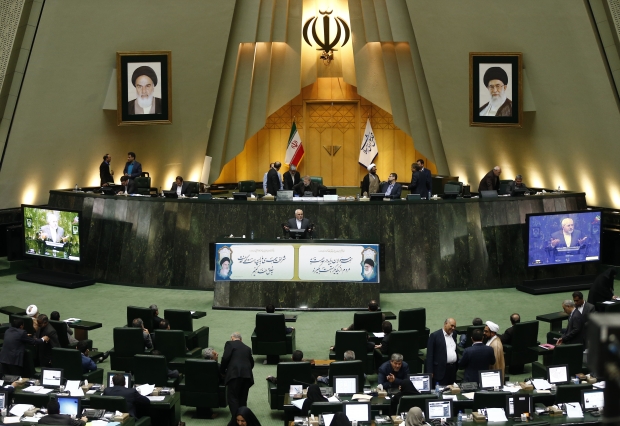


Iranian Foreign Minister Muhammad Javad Zarif addresses the parliament in Tehran on 2 October, 2016 (AFP)

Geranmayeh takes a different view, however: “The majority of the money is going to fund local investment projects to reduce unemployment, to promote job growth, and to tackle issues to do with inflation.”

Vakil agrees: “The country does need the money internally because if Iran is going to hit all of its growth markers for the next 10 years there has to be a lot of investment in the Iranian economy. For the Iranian regime that is a huge part of why it signed the nuclear deal. It wasn’t about anything else except the economy, and trying to get the economy going, and trying to generate foreign and internal investment into different sections of the Iranian economy. It’s about the long-term sustainability of the Islamic republic.”

The consensus is far from unanimous though.

“I think the money will be directed toward non-state actors abroad,” Abdo said. “I think that it’s very unfortunate, but I think that the regime’s strategy is that they will basically maintain the minimum economic commitment required to prevent dissent and uprising, and as long as they can maintain this low level of service to their own people – which means that the subsidies are cut and the value of the currency is low and so forth – they will continue to do this if this means freeing up resources for regional domination.”

“It’s very clear if you go to Iran, the wages are low, the economy is in a bad situation,” she said. “But they’re spending enormous amounts of money on their regional ambitions.”

Sectarianism and survival

Iran supports non-state actors in the Middle East “because they want to have a foothold politically in the Arab world,” Abdo said.

“I think also there is a religious dimension to this and many people disagree with me,” she said. The topic is one she discusses at greater length in her new book, The New Sectarianism, due to be published on 1 December 2016.

“If you go back and look at Khamenei’s speeches during the early years of the Arab uprising, he talked a lot about the Islamic awakening. This is just pure rhetoric,” she said. “In fact what has happened is that the Iranians are supporting Shia groups in the Arab world.”

“Nasrallah has made very clear over the last two years that Hezbollah now functions as a Shia militia,” Abdo said. “Both Iran and Hezbollah never played the Shia card, they never said that they are the military force for Shia in the region, but they departed from that approximately two years ago and now there is no question that both Hezbollah and Iran are military forces to support Shia in the region.”

“This is what I think is very important in what has changed their historic rhetoric since the revolution,” she said.

There is an ethnic, as well as a religious, dimension to the complexity of Iran’s support for foreign militias, Abdo continued, because these groups are comprised mainly of Arab, not Persian, Shia.

“The Iranians are making inroads because the Shia in many of these countries are not gaining any support from their own governments,” she said. “Iraq is a perfect example of this.”

Zarif’s article in the New York Times has refocused attention on this sectarian proxy war currently raging across the Middle East.

“No doubt the Saudis are definitely instrumental in driving this conflict, but I think the important difference is that ideologically the Saudis don’t need this conflict for their survival,” she says. “The Iranian state depends upon conflict with the West ideologically and conflict with its neighbours to maintain its survival and its legitimacy.”

Related reading: Obama administration and State Department are Hiding Iran Agreements

Related reading: Obama Grants Clemency to 7 Iranian Terrorists in United States, but there were really 21 of them and no access to who they were.
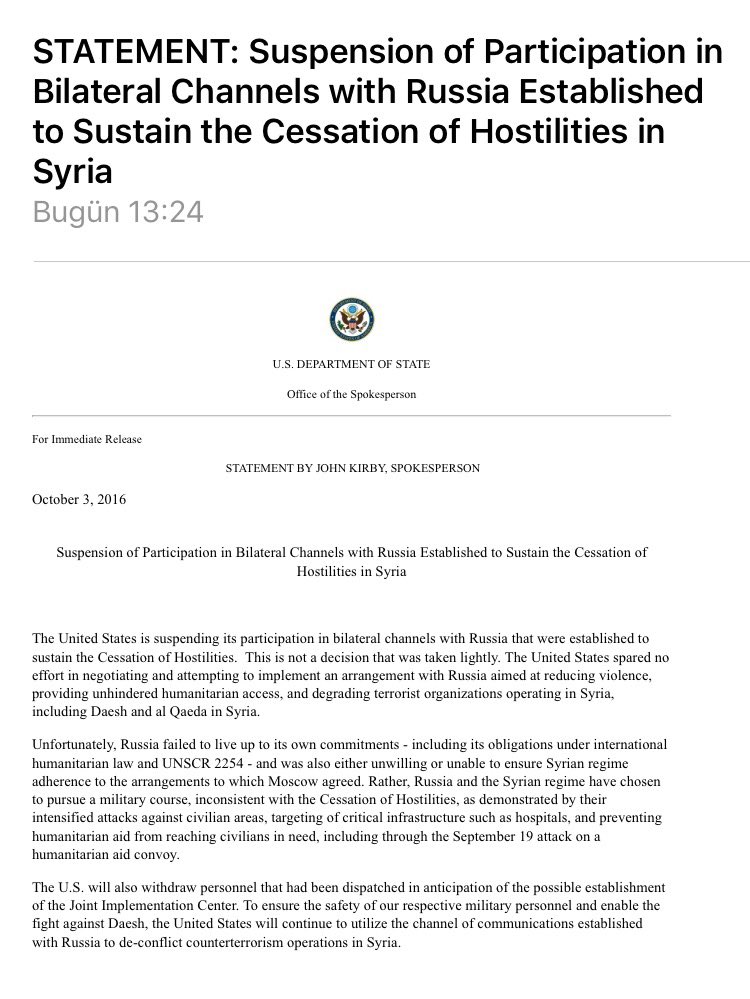
Russia v. United States: It is Getting Colder as Russia Destroys Aleppo

John Kerry announces the bi-lateral talks are over.

Russia’s response:

Указ Президента Российской Федерации от 03.10.2016 № 511 “О приостановлении Российской Федерацией действия Соглашения между Правительством Российской Федерации и Правительством Соединенных Штатов Америки об утилизации плутония, заявленного как плутоний, не являющийся более необходимым для целей обороны, обращению с ним и сотрудничеству в этой области и протоколов к этому Соглашению”

Translation: Decree of the President of the Russian Federation from 03.10.2016 # 511 “on the suspension by the Russian Federation Agreement between the Government of the Russian Federation and the Government of the United States of America on the disposition of plutonium designated as no longer required for defence purposes, and cooperation in this area and the protocols to this agreement”

If you can read Russian, the document is here.

This was signed in 2010 between Hillary Clinton and Sergei Lavrov.

MOSCOW (Reuters) – Russian President Vladimir Putin on Monday suspended an agreement with the United States for disposal of weapons-grade plutonium because of “unfriendly” acts by Washington, the Kremlin said.

A Kremlin spokesman said Putin had signed a decree suspending the 2010 agreement under which each side committed to destroy tonnes of weapons-grade material because Washington had not been implementing it and because of current tensions in relations.

The two former Cold War adversaries are at loggerheads over a raft of issues including Ukraine, where Russia annexed Crimea in 2014 and supports pro-Moscow separatists, and the conflict in Syria.

The deal, signed in 2000 but which did not come into force until 2010, was being suspended due to “the emergence of a threat to strategic stability and as a result of unfriendly actions by the United States of America towards the Russian Federation”, the preamble to the decree said.

It also said that Washington had failed “to ensure the implementation of its obligations to utilize surplus weapons-grade plutonium”.

The 2010 agreement, signed by Russian Foreign Minister Sergei Lavrov and then-U.S. Secretary of State Hillary Clinton, called on each side to dispose of 34 tonnes of plutonium by burning in nuclear reactors.

Clinton said at the time that that was enough material to make almost 17,000 nuclear weapons. Both sides then viewed the deal as a sign of increased cooperation between the two former adversaries toward a joint goal of nuclear non-proliferation.

“For quite a long time, Russia had been implementing it (the agreement) unilaterally,” Kremlin spokesman Dmitry Peskov told a conference call with journalists on Monday.

“Now, taking into account this tension (in relations) in general … the Russian side considers it impossible for the current state of things to last any longer.”

Ties between Moscow and Washington plunged to freezing point over Crimea and Russian support for separatists in eastern Ukraine after protests in Kiev toppled pro-Russian President Viktor Yanukovich.

Washington led a campaign to impose Western economic sanctions on Russia for its role in the Ukraine crisis.

Relations soured further last year when Russia deployed its warplanes to an air base in Syria to provide support for Syrian President Bashar al-Assad’s troops fighting rebels.

The rift has widened in recent weeks, with Moscow accusing Washington of not delivering on its promise to separate units of moderate Syrian opposition from “terrorists”.

Huge cost overruns have also long been another threat to the project originally estimated at a total of $5.7 billion.

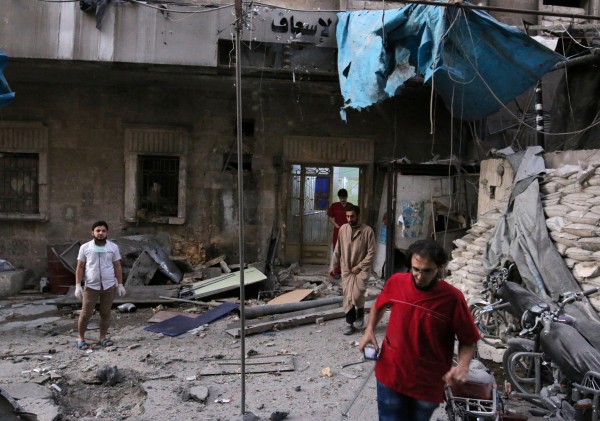
Meanwhile what Russia is doing to Aleppo is beyond the definition of war crimes.

NBCNews: Russian-made cluster bombs — weapons that kill indiscriminately and inflict long-lasting damage — were used in an attack on at least one hospital in the ravaged Syrian city of Aleppo last week, a video obtained by NBC News appears to show.

The video shows two unexploded submunitions amid the rubble at the M10 hospital in rebel-held eastern Aleppo following a morning airstrike on Sept. 28. Several experts and sources independently identified the devices as Russian-made ShOAB 0.5 cluster submunitions, bomblets delivered by an air-delivered scattering device called the RBK-500. Both are known to be used by both the Russian and Syrian air forces.

However, it is difficult, even for specialists in unexploded ordnance disposal, to definitively identify such munitions in the field. The ShOAB 0.5 is visually similar to a U.S.-made series of bomblets.

Image: Medics inspect the damage outside a field hospital after an airstrike in the rebel-held al-Maadi neighbourhood of Aleppo

Medics inspect the damage outside a field hospital after an airstrike in the rebel-held al-Maadi neighbourhood of Aleppo, Syria on Sept. 28, 2016. ABDALRHMAN ISMAIL / Reuters

The use of cluster bombs on the hospital — part of a larger series of strikes that also hit a second hospital and a nearby bakery — underscores the relentless brutality of Syria’s civil war, which lurched back into violence last month after the disintegration of a brief cease-fire. The casualties include hundreds of children killed or injured in Aleppo by a myriad of weapons falling on the city.

The hospitals were among the few facilities that remained to treat the hundreds of thousands of civilians caught up in the brutal new government offensive on eastern Aleppo. It is not clear whether the second hospital, called M2, was hit with cluster bombs.

NBC News visited both hospitals and spoke to medical staff there. Among the patients at M2 was a prematurely born infant struggling to survive: Miriam, born on Sept. 10 when her mother, seven months pregnant, went into labor during the airstrike.

“These kids are innocent, and they came into this world under very difficult circumstances, they came into this world during a war,” said Um Mohammad, the nurse who had been tending the children and infants in the hospital. Um Mohammad is a pseudonym, meaning “mother of Mohammad.”

At M2, the attack started at about 4:00 a.m., according to Dr. Mohammad Abu Rajab, a physician at the hospital who uses a pseudonym to avoid reprisals for his work in opposition-controlled areas.

“This has resulted in the hospital being taken out of service completely and indefinitely,” Abu Rajab said. “This was systematic and direct targeting of this hospital, which was home to pediatric and women’s health specialists.” A must read of the rest of the article here.

Obama Admin Admits No Plan B for Syria

Reuters: The United States called the assault on Aleppo by Syria and Russia “a gift” to Islamic State on Thursday, saying it was sowing doom and would generate more recruits for the militant group.

Moscow vowed to press on with its offensive in Syria, while U.S. officials searched for a tougher response to Russia’s decision to ignore the peace process and seek a military victory on behalf of Syrian President Bashar al-Assad.

United Nations aid chief Stephen O’Brien urged the 15-member U.N. Security Council to stop “tolerating the utter disregard for the most basic provisions of international humanitarian law.”

The sanctions program on Syria began in earnest under the Bush administration yet given the enormous death count and destruction, the last sanctions order by Barack Obama was:

On May 1, 2012, the President issued E.O. 13608 pursuant to, inter alia, IEEPA
and the NEA, finding that efforts by foreign persons to engage in activities
intended to evade U.S. economic and financial sanctions with respect to Syria
and Iran undermine United States efforts to address the national emergencies
declared in E.O. 13338, E.O. 12957, E.O. 12938, and E.O. 13224, and taking
additional steps pursuant to those national emergencies.

Given the violations, espionage aggressions and proven hacking by Russia, the Obama administration has not signed new sanctions on Russia. The most recent were those imposed during the Russia/Ukraine hostilities. So it stands to reason, there is no Plan B as noted below.


An Obama administration official painfully struggled to explain the ‘Plan B’ for Syria

A senior Obama administration official stumbled Thursday when pressed on the US plan to deal with the crisis in Syria, appearing unable to provide details about what comes next after a failed ceasefire.

BusinessInsider: Sen. Bob Corker, a Republican from Tennessee and the chair of the Senate Foreign Relations Committee, repeatedly pressed Deputy Secretary of State Antony Blinken during a committee hearing.

The US has been searching for a way to help resolve a five-year civil war between the regime of Syrian President Bashar al-Assad and rebel groups that has caused the deaths of hundreds of thousands of civilians and led to the proliferation of extremist groups like ISIS inside the country. But a ceasefire deal brokered with Russia earlier this month fell apart.

“I’d like to understand what Plan B is,” Corker said. “The mysterious Plan B that has been referred to since February, the mysterious Plan B that was supposed to be leverage to get Russia to quit killing innocent people, to get Assad to quit killing innocent people. Just explain to us the elements of Plan B.”

Blinken seemed unsure of the specifics of the so-called Plan B.

“In the first instance, Plan B is the consequence of the failure as a result of Russia’s actions of Plan A,” he said. “In that, what is likely to happen now is if the agreement cannot be followed through on and Russia reneges totally on its commitments, which it appears to have done, is this is going, of course, to be bad for everyone, but it’s going to be bad first and foremost…”

Corker cut him off, asking for more specifics.

“I want to hear about Plan B,” Corker said. “I understand all the context here.”

Blinken pressed on.

“I think, sir, this is important because Russia has a profound incentive in trying to make this work,” Blinken said. “It can’t win in Syria. It can only prevent Assad from losing. If this now gets to the point where the civil war actually accelerates, all of the outside patrons are going to throw in more and more weaponry against Russia. Russia will be left propping up Assad in an ever-smaller piece of Syria under constant assault…”

Corker cut in again.

“I understand that,” he said. “What is Plan B? Give me the elements of Plan B.”

Blinken tried again, but was still vague on details.

“Again, the consequences I think to Russia as well as to the regime will begin to be felt as a result of Plan A not being implemented because of Russia’s actions,” Blinken said. “Second, as I indicated, the president has asked all of the agencies to put forward options, some familiar, some new, that we are very actively reviewing. When we are able to work through these in the days ahead, we will have an opportunity to come back and talk about them in detail.”

Corker didn’t seem satisfied.

“OK, so let me just say what we already know,” he said. “There is no Plan B.”

This is a familiar criticism of the Obama administration’s Syria policy.

Mutasem Alsyofi of the Syrian Civil Society Declaration Initiative said in a statement last week that Secretary of State John Kerry wasn’t able to articulate a coherent plan for Syria when he met with a Syrian delegation in New York City.

“Kerry’s plan is to do more of the same — despite the repeated failure of US attempts to strike a deal with Russia,” Alsyofi said. “Syrians need a clear guarantee that the continued killing of civilians will be met with action to protect civilians. We do not need further failed agreements with Russia.”

The US recently worked with Russia to implement a ceasefire between the Assad regime and rebels in Syria, excluding extremist groups. But the deal — referred to as “Plan A” during Blinken’s testimony — fell apart before it was seen through to completion.

The Wall Street Journal reported on the administration’s “Plan B” for Syria earlier this year, citing unnamed US officials who described a covert operation to provide moderate rebels with more powerful weapons. Blinken did not mention such a program during his testimony.

Syrian opposition alliance enlists former Rep. Kingston

Sept. 30, 2016

An alliance of moderate Syrian political and military groups has enlisted Squire Patton Boggs lobbyists, including former Rep. Jack Kingston (R-Ga.), for advocacy support, according to a new lobbying disclosure.

The High Negotiations Committee of the Syrian Opposition, which released a new transition plan for the country earlier this month, is supported by numerous Western and Middle Eastern countries, including Turkey. The HNC reportedly excludes Syrian Kurds, who have exchanged blows with Turkey in recent years.

In addition to the end of the Assad regime, the coalition is reportedly working toward democratic elections, free press and a new constitution, among other issues.

US lifted Sanctions on Iran Banks as Part of Prisoner Release


The White House published document on the Iran deal including those alleged ‘snapback’ sanctions, which will never happen. Given the huge infusion of cash into Iran, their economy and infrastructure will become more harden to any actions or damage future sanctions as is the objective, including snapback sanctions.

U.S. Signed Secret Document to Lift U.N. Sanctions on Iranian Banks

Administration backed measures on the same day Tehran released four American citizens from prison

WSJ: WASHINGTON—The Obama administration agreed to back the lifting of United Nations sanctions on two Iranian state banks blacklisted for financing Iran’s ballistic-missile program on the same day in January that Tehran released four American citizens from prison, according to U.S. officials and congressional staff briefed on the deliberations.

The U.N. sanctions on the two banks weren’t initially to be lifted until 2023, under a landmark nuclear agreement between Iran and world powers that went into effect on Jan. 16.

The U.N. Security Council’s delisting of the two banks, Bank Sepah and Bank Sepah International, was part of a package of tightly scripted agreements—the others were a controversial prisoner swap and transfer of $1.7 billion in cash to Iran—that were finalized between the U.S. and Iran on Jan. 17, the day the Americans were freed.

Brett McGurk, a senior State Department official, signed three documents with a representative of the Iranian government in Geneva on the morning of Jan. 17 that set out commitments for a prisoner swap, a cash transfer to Iran and the delisting of sanctions on two Iranian banks, according to senior U.S. officials.   Brett McGurk, a senior State Department official, signed three documents with a representative of the Iranian government in Geneva on the morning of Jan. 17 that set out commitments for a prisoner swap, a cash transfer to Iran and the delisting of sanctions on two Iranian banks, according to senior U.S. officials. Photo: mandel ngan/Agence France-Presse/Getty Images

The new details of the delisting have emerged after administration officials briefed lawmakers earlier this month on the U.S. decision.

According to senior U.S. officials, a senior State Department official, Brett McGurk, and a representative of the Iranian government signed three documents in Geneva on the morning of Jan. 17.

One document committed the U.S. to dropping criminal charges against 21 Iranian nationals, and Tehran to releasing the Americans imprisoned in Iran.

Another committed the U.S. to immediately transfer $400 million in cash to the Iranian regime and arrange the delivery within weeks of two subsequent cash payments totaling $1.3 billion to settle a decades-old legal dispute over a failed arms deal.

The U.S. agreed in a third document to support the immediate delisting of the two Iranian banks, according to senior U.S. officials. In the hours after the documents were signed at a Swiss hotel, the different elements of the agreement went forward: The Americans were released, Iran took possession of the $400 million in cash, and the U.N. Security Council removed sanctions on Bank Sepah and Bank Sepah International, these officials said.

“Lifting the sanctions on Sepah was part of the package,” said a senior U.S. official briefed on the deliberations. “The timing of all this isn’t coincidental. Everything was linked to some degree.”

A documentary published by Tasnim News Agency, an Iranian media outlet affiliated with the elite Islamic Revolutionary Guard Corps, claimed in February that Iranian government officials had demanded that Sepah be taken off the sanctions list as part of a deal to release the prisoners.

The Obama administration, under the nuclear deal reached in July 2015, agreed to lift Treasury Department sanctions on Bank Sepah, but U.N. penalties were to remain in place for eight years.

But after the nuclear deal was forged, U.S. officials said, there was a continued dialogue with Iran about the status of the two banks before the deal went into effect in January.

Tehran argued that the banks were critical to the country’s economy and international trade. Bank Sepah is Iran’s oldest bank and one of its three largest in terms of assets. Bank Sepah International, based in London, was key to financing Iran’s international trade before sanctions were imposed.

U.S. officials said there was a desire in Washington to harmonize the U.N. sanctions list with the U.S.’s. And they said Washington believed Iran had earned more sanctions relief because Tehran had been implementing the terms of the nuclear agreement, which called for a major scaling back of its infrastructure and production of nuclear fuel.

“The issue of Bank Sepah has been one of many topics we discussed with Iran in our overall diplomatic discussions,” said a second senior administration official briefed on the deliberations.

Another senior administration official said lifting sanctions on Bank Sepah and its London affiliate was in the spirit of the commitment by the U.S. and other world powers to provide Iran with sanctions relief.

Administration critics and some congressional officials said they believed the move broke the commitments the administration made to Congress about the deal.

The Obama administration had told Congress that under the deal the U.S. would lift sanctions only on companies and individuals tied to Iran’s nuclear development. Sanctions on those involved in missile development were to remain in place, these critics said.

The Obama administration has repeatedly said it is committed to rolling back Iran’s ballistic missile program.

“By agreeing to remove U.N. and EU sanctions eight years early on Iran’s main missile financing bank, the administration effectively greenlighted their nuclear warhead-capable ballistic missile program,” said Mark Dubowitz, a top critic of the Iran nuclear deal at the Foundation for Defense of Democracies, a Washington think tank.

The U.S. Treasury Department sanctioned Bank Sepah, Bank Sepah International and its then-chairman in 2007 for their alleged role in backing Iran’s missile program. The designation didn’t mention what direct role the entities allegedly played in helping Iran’s nuclear program.

At the time, the Treasury said that Bank Sepah and Bank Sepah International had provided financial support to Iranian-state owned companies and organizations developing Iran’s missile program. These included Iran’s Aerospace Industries Organization and the Shahid Hemmat Industries Group.

“Bank Sepah is the financial linchpin of Iran’s missile procurement network and has actively assisted Iran’s pursuit of missiles capable of carrying weapons of mass destruction,” the Treasury said in a January 2007 statement.

Iran has conducted up to 10 ballistic missile tests since the forging of the nuclear agreement in July 2015. The U.N. Security Council has condemned Tehran’s actions but hasn’t moved to impose any new sanctions on the country.In March, the Treasury Department imposed sanctions on two Iranian companies it said were working with Shahid Hemmat Industries.

U.S. officials said the Obama administration closely vetted the activities of all individuals and entities tied to Bank Sepah before supporting the lifting of U.S. and U.N. sanctions.

“We have the ability to quickly reimpose U.S. sanctions if Bank Sepah or any other entity engages in activities that remain sanctionable,” said the second senior U.S. official.

The Obama administration’s decision to send such large amounts of cash to Iran has fueled charges in Congress that the White House paid ransom to Tehran to secure the release of the American prisoners. The White House has repeatedly denied the charge, saying the $1.7 billion settlement saved the U.S. as much as $8 billion that it could have owed Iran if it lost, as was expected, a court proceeding that was taking place in The Hague, Netherlands. The administration has said the cash was used as “leverage” to make sure the American prisoners were released.

The dispute in Washington has only deepened in recent weeks, as senior Pentagon officials, including Secretary of Defense Ash Carter, told Congress in a hearing that they weren’t notified by the White House about the cash transfer. The chairman of the Joints Chief of Staff, Marine Gen. Joe Dunford, said at a hearing last week that he found it “troubling” that the U.S. provided Tehran with so much cash, which he argued could be used for “spreading malign influence.”

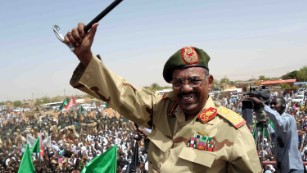
Sudan Govt Use of Chemical Weapons on Civilians in Darfur


Primer: Obama’s choice, Samantha Power as the U.S. Ambassador to the United Nations was an alleged champion of stopping the dying in Darfur by chemical weapons in 2004. Where is she now?

Amnesty says Sudan used deadly chemical weapons in Darfur conflict

(CNN) The Sudanese government has been accused of using chemical weapons against the people of Darfur, according to a report released by Amnesty International on Thursday.

The attacks targeted civilians and may constitute a war crime, the report said. The Sudanese government has denied the allegations, calling them “rumors.”
Amnesty says it has new evidence abuses persist in a war that has been described as one of the world’s worst humanitarian conflicts by the United Nations.
Unidentified witnesses quoted in the Amnesty report said the attacks left a smoke, which turned dark blue and smelled “like rotten eggs,” coating the trees, ground, and humans in a thick black dust.

Witness testimony

After exposure to the smoke, some said their skin turned white and became rotten or hardened and fell off in chunks.
“When the bomb exploded I inhaled the poisonous air which I am still smelling even now,” said one witness.
Some children vomited blood, the report said. Another witness said: “My youngest child was walking before the attack. Now she is only crawling.”
Pictures obtained by Amnesty International show graphic images of children with large welts, peeling skin, and infected lesions.

Civilians targeted

The alleged use of chemical weapons came during a large-scale offensive by the Sudanese forces and its allied groups against an armed opposition group, the Sudan Liberation Army-Abdul Wahid (SLA-AW), which operates in the Jebel Marra region.
The Sudanese government accused the group of looting and attacking civilians and military vehicles prior to the January offensive.
Since the Sudanese military campaign began in January, Amnesty International says up to 250 people have been killed by chemical weapons.
The report alleges the Sudanese forces targeted civilians: “The overwhelming majority of the attacked villages had no formal armed opposition presence at the time of the attacks. The purpose…appears to have been to target the entire population of the village.”
Chemical attacks in some regions have been taking place for eight months, including just weeks before the report’s release.

‘Rumors’

The Sudanese government has denied allegations it had used chemical weapons against civilians, calling them “rumors.”
“I don’t know from where these rumors are being said,” Sudan’s Information Minister Ahmed Bilal told CNN.
Bilal acknowledged a government offensive in Jebel Marra had taken place, saying it was in response to rebel activity.
“It was started by them,” Bilal said. “The rebels were doing some sort of looting, they were attacking innocent people. This has stopped. There is not an inch occupied by rebels,” Bilal said.
“The whole Darfur is quite in peace and the people are very happy,” he said.

Likely more than one chemical

Journalists and humanitarians have been prohibited from entering Jebel Marra for more than four years, making reporting extremely difficult from the region.
Mustard agent

Amnesty International claims to have evidence of the use of suspected chemical weapons in Darfur. It says two independent experts have concluded the evidence suggests exposure to blister agents.

  • Blister agents include sulfur mustard and nitrogen mustard. Sulfur mustard has long been in use as a chemical weapon — it inflicted horrific casualties in World War I.
  • Mustard agents inflict chemical burns on the skin, eyes and lungs, and can also affect the internal organs. Victims can be disabled as a result of exposure. It can be fatal if they come into contact with large amounts.
  • While damage is caused to the body’s cells within minutes of contact with mustard agent, it can take hours before the full effects are felt.
  • Symptoms can include blistering, itching or severe burning of the skin; weeping eyes, swollen eyelids or even blindness; vomiting and collapse.
  • The effects of severe exposure can last for years.
  • There’s no antidote for mustard agent injury.

Sources: U.S. Centers for Disease Control and Prevention; Organisation for the Prohibition of Chemical Weapons

Amnesty International had to do all reporting remotely. Collecting soil samples for confirmation was impossible.
Two chemical weapons experts reviewed photographic and video evidence and both found the symptoms consistent with chemical agents such as sulfur mustard, lewisite and nitrogen mustard — or a combination.
“The symptoms varied between the attacks and this tells me there were likely more than one chemical in use as well as the possibility that the chemicals were mixed or that different chemicals were used at different times for different attacks,” said Dr. Jennifer Knaack, one of the weapons experts involved in the study.
The writer of the report, a senior Amnesty adviser, Jonathan Loeb calls it “by far the most substantial, credible release of evidence of the use of chemical weapons in Darfur since the conflict began.”

History of conflict

The conflict in Darfur began around 2003 when several rebel groups in Darfur took up arms against the government in Khartoum. They had grievances over land and historical marginalization.
In response, the government’s counterinsurgency strategy targeted the opposition groups but reportedly expanded to target tribes associated with the insurgents.
The violence escalated into a war and the in 2008, the UN estimated that 300,000 people may have died in the Darfur conflict, although experts say that figure has likely risen since then.
Sudan’s President, Omar al-Bashir, was charged with crimes against humanity by the International Criminal Court, including genocide, related to the Darfur conflict in 2010.
Bashir has yet to cooperate with the court and continues to travel freely around the continent. South Africa and Uganda have both been criticized for allowing President Bashir to travel to their countries without being turned over to the ICC.