
Another $400 Million, Total is now $5.9 Billion to Syrians

WASHINGTON (Reuters) – The U.S. State Department said on Tuesday it was providing an additional $364 million in humanitarian assistance to help Syrians caught up in the country’s civil war, bringing total U.S. humanitarian spending for Syria to about $5.9 billion.

Assistant Secretary of State for Population, Refugees and Migration Anne Richard said the funding would help provide food, shelter, safe drinking water, medical care and other support for millions of Syrian refugees and the communities that host them.

Richard told a State Department briefing about three-quarters of the additional funding would help people still inside Syria and the rest would assist Syrians who have fled the country.

She also said the United States had admitted some 85,000 refugees over the past fiscal year, which ends Sept. 30. That figure included about 12,500 Syrian refugees, exceeding the administration’s goal of 10,000, she said.

State Department spokesman Mark Toner said the push for additional humanitarian aid funds came in part because of deteriorating conditions in Aleppo after the collapse of a ceasefire sponsored by the United States and Russia.

The forces of Syrian President Bashar al-Assad have launched a massive push against rebel-held areas of the city, where some 250,000 civilians are believed to be trapped. Intensive bombing has killed hundreds of people, many of whom died in buildings collapsed by bunker-buster bombs.

“Until the past few weeks we felt like we were on a firm path towards a possible diplomatic resolution to this. We still believe that’s possible,” Toner told a briefing.

“That doesn’t mean we’re not mindful … of the tremendous humanitarian suffering that’s going on right now in Aleppo. And that’s why we’re working so hard to ramp up our assistance,” he added.

While saying the United States continued to seek a diplomatic resolution of the problem, he left the door open to other action.

“We’ll continue to weigh all options. Those discussions are ongoing. I don’t want to rule anything out, but right now we’re focused on the diplomatic one,” Toner said.

He noted the United States has warned that failure to achieve a ceasefire could lead to an escalation of the conflict.

“We cannot dictate what other countries … may or may not decide to do in terms of supporting certain groups within Syria,” Toner said. “You may have a further deterioration on either side … and by deterioration I mean more arming and more conflict between them, and intensification of the conflict.”

****

Jeh Johnson said in a Senate hearing that the government focuses on refugees for resettlement that are good for the country. The vetting in comprehensive and some of the standards to be met by applicants are classified. The concentration is on women and children.

From the DHS website:

U.S. Expands Initiatives To Address Central American Migration Challenges

Over the past year, the United States has taken a series of steps to address the ongoing humanitarian challenges in Central America, particularly for the many vulnerable individuals attempting to leave the region and come to the United States, while also promoting safe and orderly migration and border security. As part of this ongoing effort, the United States is announcing the following initiatives to help vulnerable families and individuals from El Salvador, Guatemala, and Honduras.

World Refugee Day: #RefugeesWelcome

Secretary Johnson smiling at the camera with his arm around 11 year old Turkish refugee JaafarSeveral months ago while I was in Turkey I met a 9-year-old refugee named Jaafar.  I was immediately impressed with this extraordinary little boy who spoke almost perfect English.

Readout of Secretary Johnson’s Trip To Turkey
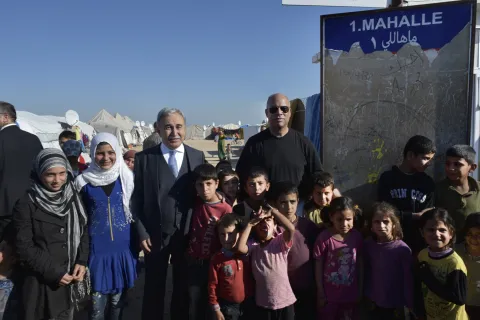
Secretary Johnson visits a Turkish-government run Syrian refugee camp in Adana, TurkeyToday, Secretary of Homeland Security Jeh Johnson concluded a three-day trip to Turkey, where he visited a refugee camp, reviewed resettlement processing, spoke to a number of Syrian and Iraqi refugee families, met with government officials in Istanbul and Ankara to discuss a range of homeland security-related issues, and signed two bilateral accords to codify mutual commitment to deepen collaboration.

Readout Of Administration Call With Law Enforcement Officials On Refugee Screening

Senior Administration officials spoke by phone today with state and local law enforcement representatives from across the country to provide information on the U.S.’s stringent refugee admissions policies and security screening measures. Officials on the call included Deputy Secretary of Homeland Security Alejandro Mayorkas; Department of State Bureau of Population, Refugees, and Migration Principal Deputy Assistant Secretary Simon Henshaw; U.S. Customs and Border Protection (CBP) Commissioner R. Gil Kerlikowske; and FBI National Security Branch Executive Assistant Director John Giacalone.

Written testimony of USCIS for a Senate Judiciary Subcommittee on Immigration and the National Interest hearing titled “Oversight of the Administration’s FY 2016 Refugee Resettlement Program: Fiscal and Security Implications”

U.S. Citizenship and Immigrations Services (USCIS) Refugee, Asylum and International Operations Refugee Affairs Division Chief Barbara Strack and USCIS Fraud Detection & National Security Associate Director Matt Emrich address USCIS’s role in refugee resettlement, and the screening measures and safeguards developed by the U.S. Refugee Admissions Program.

San Bernardino to New York: Deobandi Courtesy of Barack and Hillary

Ahmad Rahami Posted Radical Videos in 2010, Went to Syria: Sources


Ahmad Khan Rahami spent time at Pakistan seminary tied to Taliban

Guardian: Exclusive: Suspect in New York and New Jersey bombings spent three weeks in 2011 at Kaan Kuwa Naqshbandi madrassa, source says, amid questions of terrorism links

Ahmad Khan Rahami, the man suspected of placing bombs in New York and New Jersey last weekend, spent time in a religious seminary in Pakistan closely associated with the Afghan Taliban, according to a government official.

The 28-year-old, who was born in Afghanistan but became a US citizen, spent time at the Kaan Kuwa Naqshbandi madrasa on his two visits to Pakistan, a security official working for the government of Balochistan province told the Guardian.

Rahami spent three weeks in 2011 receiving “lectures and Islamic education” at the school in Kuchlak, a dusty cluster of villages 20km north of Quetta, the provincial capital of Balochistan, he said.

Kuchlak is a well-known hub for the Taliban, the Islamist movement that has waged a 15-year insurgency against local and Nato forces in nearby Afghanistan. It is home to many madrasas, the seminaries intimately linked with the Taliban, originally a movement of religious students.

US officials have revealed basic details about Rahami’s two visits to Pakistan, the first in 2011 when he spent a couple of months in Quetta and got married and almost a year in 2013 when he also made a car journey to Afghanistan.

But very little information has emerged from inside Pakistan about what Rahami did during his visits.

Related reading: U.S. State Dept/Pakistan Bureau of Democracy, Human Rights, and Labor

The government official, who did not wish to be named because he was speaking about a highly sensitive subject, said Pakistani security agencies have tried to “hide all the details of his visits to Quetta” and keep as much information as possible out of the media.

Rahami, he said, also visited other sensitive areas in the province, including Surkhab and Nushki, where former Taliban leader Mullah Akhtar Mansoor was killed by a US drone in May.

Pakistan has long been accused of playing a “double game” with the US, both supporting the Nato counterinsurgency in Afghanistan and allowing the Taliban to use its territory a vital rear base.

A western expert on the Taliban said Abdul Samad, the Afghan owner of the Kuchlack madrasa, was an important local figure.

“The madrasa is a place where you have multiple Afghan Taliban going there and hanging out in [Samad’s] court, as well as active ISI officers,” he said, referring to the Inter-Services Intelligence (ISI) directorate, an army-run spy agency.

“Samad is the kind of person who should have been shut down long ago but enjoys a high degree of protection,” he said.

Despite being part of the mystical, Sufi strain of Islam, which many hardliners abhor, Samad is highly respected by the movement, he said.

A Karachi-based cleric told the Guardian the school was a sizeable operation, with more than 200 students.

Despite several attempts to reach Samad for comment, the Guardian was unable to make contact with the madrasa.

Although the Taliban’s leadership is often described as the “Quetta Shura” many analysts consider Kuchlak to be the actual command centre for many senior members of the movement.

The Taliban’s white flags have been reportedly seen flying in the town’s graveyards and Shahbaz Taseer, a Pakistani kidnapped by militants in Lahore in 2011 and held for more than four years, was released in Kuchlak in March by the Taliban.

Rahami’s father Mohammad Rahami has said his son had grown increasingly interested in Islamist movements, watching Taliban and al-Qaida videos, and listening to their poetry. Rahami had also shown sympathy towards the Taliban, a former employer said.

Related reading: San Bernardino/ The Islamic Center of Riverside or Brooklyn

Given the Taliban has long avoided entanglement in international jihad, insisting it is interested only in forcing foreign troops out of Afghanistan, it is unlikely Rahami was operating under instruction when he planted his bombs. A notebook found on Rahami when he was captured after a shootout on Monday suggests he may have been inspired by the Islamic State group.

But the claim Rahami attended an important Taliban-sympathising madrasa could be embarrassing for Pakistan at a time the country is under intense international criticism, not least from India, which accused Pakistan this week of hosting “the Ivy League of terrorism”.

Anwar-ul-Haq Kakar, a spokesman for the Balochistan government, said that because more than 1 million Afghan refugees lived in the province it was “difficult to know what sort of activity is being conducted by some individuals”.

“Filtering out the terrorist influences in such a huge community is a very difficult task,” he said.

Nor could the government be expected to be aware of a US traveller such as Rahami, who has “deep links in the host community”.

“If he was not spotted by the CIA and FBI or Homeland Security, then this shows that it is really global problem,” he said.

*** The basis for the swap of the Taliban 5 out of Guantanamo for Bowe Bergdahl? It all seems Qatar was the core and interlocutor for the Taliban. Clinton and Obama managed the failed process.

Negotiations with the Taliban initiated by the United States were for getting all factions to talk to each other.  Why bother talking to the Taliban? The answer is that, as both President Barack Obama and former Secretary of State Hillary Clinton made clear while I served as special representative, the war in Afghanistan is going to end politically and we would either shape that end or be shaped by it. If there is ever to be peace in Afghanistan, Afghans will need to talk to other Afghans about the future of Afghanistan. Since the Taliban today officially refuses to talk to Kabul’s representatives, getting to these talks might require a US effort to help open the door.

Those US-Taliban talks, which lasted from mid-2011 to March 2012, ultimately failed. While many details rightly remain classified, here are three of the lessons I learned sitting across the negotiating table from the Taliban that may be helpful to those who may seek to reopen the dialogue with them or others who need to talk to an insurgent group in some present or future conflict:

Set clear conditions and moral guidelines and stick to them. These need not be preconditions. Indeed, before talks with the Taliban began, Secretary Clinton made clear that while the US had no preconditions for talking to them, Washington would support reconciliation with only those insurgents who met three important end conditions: Break with al Qaeda, end violence, and live inside an Afghan Constitution that guarantees the rights of all individuals, especially women. Force must be backed by diplomacy, and diplomacy must be backed by force. Talking with the Taliban was part of the larger “diplomatic campaign” Secretary Clinton launched in 2011 to complement the military surge President Obama had ordered in 2009. This diplomatic campaign tried to harness all of the instruments of non-military power to support Afghanistan, such as development assistance, private-sector investment and support for civil society. As part of this effort, we organized international meetings in Istanbul, Bonn, Chicago and Tokyo, at which nations and international organizations pledged future political and material support for Afghanistan. These conferences were also designed to send the Taliban clear messages that the international community was committed to supporting Afghanistan beyond 2014. More here.

Last item of note: In part from Newsweek: The groups targeting the state follow the Deobandi interpretative tradition of Islam. This is important because this means that they share a significant common organizational infrastructure. For example, they rely on mosques and madrassas that adhere to the Deobandi tradition of Islam. When 9/11 happened and Pakistan was forced to work with the Americans, these Deobandi groups were furious. Many of these groups came to know Al-Qaeda through their association with the Taliban in Afghanistan. [The Afghan Taliban emerged from Deobandi madrassas in Pakistan.] And these Deobandi groups were furious that the Pakistani state was aiding the overthrow, not only of the Taliban government, but the only government in the world that was exercising a Deobandi version of Sharia [Islamic law]. After 9/11…[some] of these Deobandi groups began fracturing and disobeying the [Pakistani] state. That’s when the insurgency began. Over time these Deobandi organizations began calling themselves the Pakistani Taliban.

9/11: POTUS Vetoed JASTA, Ability to Sue Saudi Arabia

House intel chairman threatens to subpoena bin Laden files

FNC: The Republican chairman of the House intelligence committee says he’s prepared to take what may be unprecedented action to get the remaining Usama bin Laden documents from the nation’s top military and intelligence agencies – and subpoena the files.

“If they don’t provide these documents to the committee by October 11th, then we’re going to have to subpoena them — which I don’t want to have to do but it appears like we’ve run out of all options,” Republican Rep. Devin Nunes, R-Calif., told Fox News. “For the administration to basically mislead the American people for this many years is flat-out wrong.”

Nunes is seeking documents and relevant analysis, which is thought to comprise at least 50 reports. In a Sept. 22 letter to Director of National Intelligence James Clapper, CIA Director John Brennan, and Defense Department Undersecretary for Intelligence Marcel Lettre, Nunes says the law required them to comply nearly two years ago based on Section 313 of the Intelligence Authorization ACT (IAA) for fiscal 2014. This section mandated a “complete declassification of the Abbottabad documents within 120 days.”  More here.

Meanwhile there appears to be enough votes to over-ride Obama’s veto on the ability to for the 9/11 families to sue Saudi Arabia.

FNC: With lawmakers eager to return home to campaign ahead of the November election, a vote could come as early as Tuesday. Even House Democratic Leader Nancy Pelosi, an Obama ally, indicated support this week for an override, saying members believe the families “should have their day in court.”

Democratic New York Sen. Chuck Schumer called the veto a “disappointing decision that will be swiftly and soundly overturned in Congress.”

Senate Majority Leader Mitch McConnell’s office said the Senate would take up the override “as soon as practicable in this work period.”

The Justice Against Sponsors of Terrorism Act sailed through both chambers of Congress by voice vote, with final House passage coming just two days before Obama led the nation in marking the 15th anniversary of the attacks that killed nearly 3,000 people in New York, Washington and Pennsylvania on Sept. 11, 2001. More here.

The passed legislation is known as JASTA, S.2040 – Justice Against Sponsors of Terrorism Act was introduced by Senator Cornyn of Texas. It was presented to Barack Obama and was due for final record by 9/23/2016 if Obama did not take his veto action which he did at the last moment during the week of the United Nations General Assembly.

Related reading: House Intel Cmte has Declassified/Released the 28 Pages

Additionally:

Deleted official report says Saudi key funder of Hillary Clinton campaign

#USA2016

MEE: Deputy Crown Prince Mohammed bin Salman reportedly said Saudi has enthusiastically funded Hillary Clinton’s presidential campaign

Saudi Arabia is a major funder of Hillary Clinton’s campaign to become the next president of the United States, according to a report published by Jordan’s official news agency.

The Petra News Agency published on Sunday what it described as exclusive comments from Saudi Deputy Crown Prince Mohammed bin Salman which included a claim that Riyadh has provided 20 percent of the total funding to the prospective Democratic candidate’s campaign.

UNGA: Challenges Transcend Borders and National Sovereignties

Anyone remember Brexit? People across the globe are speaking out and the vote in Britain to get out of a union and regain sovereignty is a message. It is not being heard and such is the case at the United Nations General Assembly.

Borderless….policy by global leaders is promoting this, while citizens are demanding otherwise. Have you taken a moment to look at our domestic universities where classes are filled with foreign students? Have you look at how intertwined governments are with each other’s economies? When one government financially aides another to keep it from a tailspin, major strings are attached and ethical behavior and compliance with law is dismissed.

Have you seen this hashtag? #UN4RefugeesMigrants   It is the newest in vogue talking point and condition globally. To view how borderless the West is becoming, click here to see the topics of discussions planned at the United Nations.

The newest mission is to control the oceans and John Kerry is leading the way. Who owns those oceans and the sea life?

Related reading: John Kerry expresses hope over ‘life and death issue’ of oceans

The Secretary of State sees the future of the seas as a global threat equal to world conflicts.

So, back to the United Nations and how the above and much more are being covered and delivered. Chilling conditions as noted below:

President Obama is hosting the Leaders’ Summit on Refugees, alongside co-hosts Canada, Ethiopia, Germany, Jordan, Mexico and Sweden, which will appeal to governments to pledge significant new commitments on refugees. While the Leaders’ Summit will focus on refugees, not migrants, the General Assembly High-Level Summit will address large movements of both. See the full program here.

Then we have Europe:

The European Union at the United Nations

“Stronger partnerships are the building blocks of our foreign policy. All today’s challenges
transcend borders and national sovereignties. None of us, alone, can carry the weight of the
world on its shoulders.”

High Representative/ Vice-President Federica Mogherini at the UN Security Council 6 June 2016

The EU’s commitment to effective multilateralism, with the UN at its core, is a central element of its external action. The Lisbon Treaty provides that “The Union … shall promote multilateral solutions to common problems, in particular in the framework of the United Nations.” (Article 21-1 TEU) and that “The Union …shall work for a high degree of cooperation in all fields of international relations, in order to (…) preserve peace, prevent conflicts and strengthen international security, in accordance with the purposes and principles of the United Nations Charter.” (Art. 21-2)

Multilateralism is also one of the core principles and priorities in the new EU Global Strategy for Foreign and Security Policy. To respond successfully to global crises, threats and challenges, the international community needs an efficient multilateral system, founded on universal rules and values. The United Nations is both: a key EU partner and an indispensable global forum for tackling global challenges, within the overall framework of the 2030 Agenda and its 17 Sustainable Development Goals. The EU thus works closely both with the UN and in the UN.

Without global norms and the means to enforce them, peace and security, prosperity and democracy – our vital interests – are at risk. Guided by the values on which it is founded, the EU is committed to a global order based on international law, including the principles of the UN Charter. The EU will strive for a strong UN as the bedrock of the multilateral rules-based order, and develop globally coordinated responses with international and regional organisations, states and non-state actors.”

– EU Global Strategy for Foreign and Security Policy –


Working closely with the UN Secretariat and the various UN Agencies, Funds and Programmes, the EU has established a strong relationship with the UN. Cooperation takes place across a broad range of areas: development, human rights, climate change, peace building, crisis management, disarmament and non-proliferation, humanitarian assistance, fighting corruption and crime, addressing global health concerns, managing migratory flows and labour issues.

The UN General Assembly is the main deliberative, policymaking and representative organ of the UN. The added value of the EU is to coordinate among its 28 Member States to present a unified position.

In 2011, the UN General Assembly adopted Resolution A/65/276 upgrading the observer status allow the EU to present common positions, make interventions, present proposals and participate in the general debate each September. As an observer with enhanced status, enabling EU representatives to speak on behalf of the EU and its member states in the UN. Since then it is also the President of the European Council who delivers the EU statement in the General debate, and no longer the rotating Presidency, bringing EU representation in New York in line with Lisbon Treaty provisions. The EU has obtained a special “full participant” status in a number of important UN conferences.

The Council of the European Union adopted the EU priorities at the United Nations at the 71st United Nations General Assembly on 18 July 2016. The coming year will be focused on consolidation and implementation of the agreements reached in the past year. These include the 2030 agenda for sustainable development, the Addis Ababa action agenda of the third international conference on financing for development and the Paris climate agreement.

The EU coordinates its voting within the General Assembly’s six main committees and other bodies and agencies such as the Economic and Social Council. To this end, more than 1300 internal EU coordination meetings are held at the UN in New York alone to develop a common EU stance and speak with one voice. Article 34 of the EU Treaty also stipulates that EU members on the Security Council must act in concert and foster the interests of the EU. In 2015, the EU delivered more than 220 statements at the UN in New York, including 31 at the Security Council.

Global Security Provider

The EU has a wide range of tools available to prevent and solve crises in close cooperation with international and regional partners. For this reason, the High Representative provides regular updates to theSecurity Council and the EU is often invited to address issues of common concern, such as the fight against terrorism. Regular UN Security Council meetings on UN-EU cooperation in maintaining international peace and security are testimony to the importance both place on it.

“In our conflictual world, where power is scattered and diffuse, global peace and security only stands a chance if our nations and our regions are united. Our European Union will always come back to the United Nations, to the core of the international multilateral system, to the stubborn idea of a cooperative world order.”

HRVP briefing to UNSC 6 June 2016

The Security Council endorsed the relationship with the EU in 2014 when it adopted a presidential statement on cooperation between the EU and the UN.

Major contributor

Collectively, the EU and its Member States are the single largest financial contributor to the UN system. The sum of the contributions of the 28 EU Member States amounts to 30.38% of the UN regular budget and 33.17% of the UN peacekeeping budgets. In addition, the EU and its Member States also provide about one-half of all the voluntary contributions to UN funds and programmes. The European Commission alone contributed more than $1.5 billion to support UN external assistance programmes and projects in 2014. The European Union and its Member States retained their place as the world’s largest aid donor in 2014, according to OECD figures. In 2014, EuropeAid’s financial contributions to the UN exceeded €983 million, with the most funding going to UNDP (40%), UNICEF (18%), FAO (12%), UNRWA (10%), and WFP (8%). In 2015, ECHO (European Commission Humanitarian Aid and Civil Protection) provided €514 million (an increase from €452 in 2014) to UN agencies, funds and programmes, including €207 million to WFP, €127 million to UNHCR and €108 million to UNICEF.

UN Reform and Increased Efficiency

Effective multilateralism requires an effective United Nations at its core. The EU supports the reform of the UN system, including its bodies and organs, to ensure it is fit to address the complex, multi-sectoral challenges we face today. This should include comprehensive reform of the UN Security Council as well as revitalisation of the work of the General Assembly. The EU supports the notion that the United Nations must be ‘fit for purpose’ as well as increasingly effective and efficient, including to support successful implementation of the 2030 Agenda.

In America: What Exactly is a Refugee?

DHS Officials Admit They Have Not Used ‘Deception Detection Technologies’ to Screen Visa Applicants, Refugees

MRCTV: At a House Homeland Security Committee hearing Wednesday titled “Shutting Down Terrorist Pathways into America,” officials at the Department of Homeland Security admitted they have not explored the use of “deception detection technology” for screening refugees and other visa applicants despite a law signed last year directing the agency to do so.


Migrant surge poses challenge for U.S.: Who’s a refugee, who isn’t?

WASHINGTON

Ordonez/McClatchy: U.S. Border Patrol agents will apprehend more family members entering the United States along the Southwest border this fiscal year than they did in 2014, when a massive surge of Central Americans found the Obama administration detaining thousands of mothers and their children.

Newly released U.S. Customs and Border Protection statistics show that while overall apprehension numbers are down from two years ago, the number of family members being apprehended will almost certainly surpass the total of two years ago.

Both family apprehensions and detentions of unaccompanied children have shown dramatic increases over last year’s totals – with family detentions nearly doubling and the number children traveling without parents increasing 52 percent.

Those increases raise serious questions about the Obama administration’s strategy to curb the flow through a combination of immigration enforcement and humanitarian assistance.

“It has been a failure, because people are still coming,” said Amy Fischer, the policy director for the Texas-based Refugee and Immigrant Center for Education and Legal Services.

Many migrants from Central America cite violence in their homelands as the reason for seeking refuge in the United States. The Obama administration has created a variety of programs, including aid to Central American governments, to try to tamp down that violence. The administration acknowledged over the summer that efforts have been “insufficient to address the number of people who may have legitimate refugee claims.”

A total of 68,445 family members were apprehended in 2014, when a surge of Salvadoran, Honduran and Guatemalan mothers and children fleeing violence and poverty raced into the Rio Grande Valley of Texas.

This year, with one month left in the fiscal year, more than 68,080 family members have been apprehended. With apprehensions averaging 6,189 a month, the annual total is certain to be a record. No month this year has seen fewer than 3,000 family members detained. In August, Border Patrol agents apprehended 9,359 family members, the highest yet of the year.

Honduras, Guatemala and El Salvador are three of the most violent countries in the world.

The Office of the United Nations High Commissioner for Refugees warned last October that women from Central America would continue to flee their countries because of the escalating tide of violence, including domestic violence and rape, fueled by sophisticated transnational gangs.

The number of Central Americans seeking asylum in the United States has grown nearly eightfold in the last six years. Mexico, Canada, Nicaragua and Costa Rica also have seen an increase in Guatemalans, Hondurans and Salvadorans seeking refugee status, according to the United Nations high commissioner for refugees.

Federal officials have an obligation under national and international law to protect the vulnerable. The challenge is determining who qualifies as a bona fide refugee and who has come for family or economic reasons.

The surge has exacerbated an already long backlog of hundreds of thousands who are awaiting cases in immigration court. To receive asylum in the United States, applicants must prove they have well-founded fears of persecution because of “race, religion, nationality, membership in a particular social group or political opinion.” These cases can take years to resolve.

Homeland Security officials said they continued to monitor migration trends and were working aggressively to “deter unauthorized migration, while ensuring that those with legitimate humanitarian claims are afforded the opportunity to seek protection.”

The White House reached an agreement with Costa Rica in July to host up to 200 Central American refugee applicants while the United States assessed their asylum claims. It was part of a larger package of measures put in place to protect migrants that included expanding the number of people who can apply to the U.S. refugee program for children. The administration also worked with Congress to secure $750 million to help El Salvador, Guatemala and Honduras fight poverty and violence as well as reform their governments.

President Barack Obama has authorized spending up to $70 million to meet the “unexpected urgent refugee and migration needs related to the U.S. Refugee Admissions Program.”

But Homeland Security Secretary Jeh Johnson has made it clear that deportations of Central Americans will continue despite recognition of the crisis.

“As long as we have border security and as long as our borders are not open borders,” Johnson told reporters last month. “We have to be consistent with our priorities.” More here.