Trump Makes Official a Cyber Command

In a statement, Trump said the unit would be ranked at the level of Unified Combatant Command focused on cyberspace operations. Cyber Command’s elevation reflects a push to strengthen U.S. capabilities to interfere with the military programs of adversaries such as North Korea’s nuclear and missile development and Islamic State’s ability to recruit, inspire and direct attacks, three U.S. intelligence officials said this month, speaking on the condition of anonymity. The Pentagon did not specify how long the elevation process would take.

Current and former officials said a leading candidate to head U.S. Cyber Command was Army Lt. Gen. William Mayville, currently director of the Pentagon’s Joint Staff. More here.

There has not only been resistance to this, but it appears one or more agencies are launching their own cyber departments.

The State Department quietly established a new office earlier this year within its Diplomatic Security Service to safeguard against and respond to cybersecurity threats.

The State Department officially launched the new office, called the Cyber and Technology Security (CTS) directorate, on May 28, a department official confirmed. The establishment of the directorate was first reported by Federal News Radio last week.

However:


At the direction of the president, the Defense Department today initiated the process to elevate U.S. Cyber Command to a unified combatant command.

“This new unified combatant command will strengthen our cyberspace operations and create more opportunities to improve our nation’s defense,” President Donald J. Trump said in a written statement.

The elevation of the command demonstrates the increased U.S. resolve against cyberspace threats and will help reassure allies and partners and deter adversaries, the statement said.  The elevation also will help to streamline command and control of time-sensitive cyberspace operations by consolidating them under a single commander with authorities commensurate with the importance of those operations and will ensure that critical cyberspace operations are adequately funded, the statement said.

Defense Secretary Jim Mattis is examining the possibility of separating U.S. Cyber Command from the National Security Agency, and is to announce his recommendations at a later date.

Growing Mission

The decision to elevate U.S. Cyber Command is consistent with Mattis’ recommendation and the requirements of the fiscal year 2017 National Defense Authorization Act, Kenneth P. Rapuano, assistant secretary of defense for homeland defense and global security, told reporters at the Pentagon today.

“The decision is a welcome and necessary one that ensures that the nation is best positioned to address the increasing threats in cyberspace,” he added.

Cybercom’s elevation from its previous subunified command status demonstrates the growing centrality of cyberspace to U.S. national security, Rapuano said, adding that the move signals the U.S. resolve to “embrace the changing nature of warfare and maintain U.S. military superiority across all domains and phases of conflict.”

Cybercom was established in 2009 in response to a clear need to match and exceed enemies seeking to use the cyber realm to attack the United States and its allies. The command is based at Fort George G. Meade, Maryland, with the National Security Agency. Navy Adm. Michael S. Rogers is the commander of U.S. Cyber Command and the National Security Agency director. The president has directed Mattis to recommend a commander for U.S. Cyber Command, and Rogers for now remains in the dual-hatted role, Rapuano said.

More Strategic Role

Since its establishment, Cybercom has grown significantly, consistent with DoD’s cyber strategy and reflective of major increases in investments in capabilities and infrastructure, Rapuano said. The command reached full operational capability Oct. 31, 2010, but it is still growing and evolving. The command is concentrating on building its Cyber Mission Force, which should be complete by the end of fiscal year 2018, he said.

The force is expected to consist of almost 6,200 personnel organized into 133 teams. All of the teams have already reached initial operational capability, and many are actively conducting operations. The force incorporates reserve component personnel and leverages key cyber talent from the civilian sector.

“This decision means that Cyber Command will play an even more strategic role in synchronizing cyber forces and training,  conducting and coordinating military cyberspace operations, and advocating for and prioritizing cyber investments within the department,”  Rapuano said.

Cybercom already has been performing many responsibilities of a unified combatant command. The elevation also raises the stature of the commander of Cyber Command to a peer level with the other unified combatant command commanders, allowing the Cybercom commander to report directly to the secretary of defense, Rapuano pointed out.

The new command will be the central point of contact for resources for the department’s operations in the cyber domain and will serve to synchronize cyber forces under a single manager. The commander will also ensure U.S. forces will be interoperable.

“This decision is a significant step in the department’s continued efforts to build its cyber capabilities, enabling Cyber Command to provide real, meaningful capabilities as a command on par with the other geographic and functional combat commands,” Rapuano said.

The Fate and Strategy on the Afghan War, Decided at Camp David

Trump must decide if he wants to continue on the current course, which relies on a relatively small US-led NATO force to help Afghan partners push back the Taliban, or if he wants to try a new tack such as adding more forces — or even withdrawing altogether.

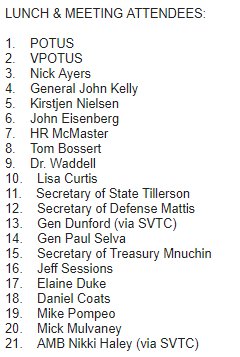
“Heading to Camp David for major meeting on National Security, the Border and the Military (which we are rapidly building to strongest ever),” Trump said on Twitter ahead of his Friday afternoon arrival.

Defense Secretary Jim Mattis had initially promised to provide a new plan for Afghanistan by mid-July.

But Trump appears dissatisfied by initial proposals to add a few thousand more troops, and the strategy has been expanded to include the broader South Asia region, notably Pakistan.

In a sign of Trump’s frustration, the president reportedly told Mattis and General Joe Dunford, the chairman of the Joint Chiefs of Staff, they should replace General John Nicholson, who heads up US and NATO forces in Afghanistan.

Mattis has come to his general’s defense, saying this week he “is our commander in the field. He has the confidence of NATO, he has the confidence of Afghanistan, he has the confidence of the United States.”

More here.  

Media preview

In the past year (6/30/2016 to 6/30/2017) 17 US service members died in Afghanistan, and 41 DOD contractors.

One big topic of discussion will be the recent proposals to privatize the war in Afghanistan presented by two different businessmen, Eric Prince and Stephen Feinberg.

Under Prince’s plan, the viceroy would be a federal official who reports to the president and is empowered to make decisions about State Department, DoD, and intelligence community functions in-country. Prince was vague about how exactly this would work and which agency would house the viceroy, but compared the job to a “bankruptcy trustee” and said the person would have full hiring and firing authority over U.S. personnel. Prince wants to embed “mentors” into Afghan battalions. These mentors would be contractors from the U.S., Britain, Canada, South Africa—“anybody with a good rugby team,” Prince quipped. Prince also wants a “composite air wing”—a private air force—to make up for deficiencies in the Afghan air capabilities.

“The adults hate it,” said a congressional aide who has seen the plan, referring to McMaster, Mattis, and White House Chief of Staff John Kelly. Mattis acknowledged that his analysis of the problems in Afghanistan is correct, Prince claimed, while disagreeing on his recommendations. On Monday, Mattis confirmed in a press gaggle that the contracting proposals were under consideration. A Pentagon spokesperson didn’t immediately return a request for comment.

Feinberg, on the other hand, has met with Trump, as well as with Kushner. One senior administration official said Feinberg has met more than once with Trump in the Oval Office. Through his investment firm Cerberus Capital, Feinberg controls the huge military contractor Dyncorp. He is also a confidant of Trump and has known him from business circles since before Trump became president. Feinberg was considered for a czar-type position overseeing an intelligence review earlier this year, but the idea was stymied by a vehement backlash from the intelligence community. Feinberg does not have an intelligence background.

Feinberg is proposing ideas similar to Prince’s; Prince said the two were 95 to 98 percent in agreement, though “he wrote his thing, I wrote mine.”

A source close to the situation said Feinberg had been asked to submit a “strategic recommendation” for Afghanistan that is “materially different with respect to the use of independent contractors from the plan Erik Prince proposed.”

Sean McFate, a Georgetown professor and former DynCorp contractor, described Feinberg’s plan for contractors as “more status quo. He wants to take the current mission and just make it bigger.”

One of the issues raised by Prince’s plan is that U.S. law prohibits using contractors for combat operations. The workaround is that instead of being categorized under Title 10 of the U.S. code, it will be housed under Title 50, making it subject to the same regulations as intelligence operations. This has sparked concerns about transparency, but appeals to some in the secretive intelligence community.

Critics say Prince’s plan will lead to a moral and legal quagmire, as contractors from around the world fighting in place of U.S. forces present a host of possible problems. What happens if a Canadian, for example, kills an Afghan civilian while fighting as a contractor under the leadership of the American “viceroy”? What if the contractors get in a real bind—does the U.S. send our military in to help them? Read the full text here for additional names and context.

Dear President Trump: Sign, Islamic Emirate of Afghanistan (Taliban)

The Taliban are watching all things Washington DC, especially Secretary of Defense Mattis and the White House.

Context: U.S. Defense Secretary Jim Mattis told reporters on Monday that the Trump administration was “very, very close” to a decision on Afghanistan, adding that all options were on the table. However, U.S officials believe it could take weeks for a South Asia strategy to be approved.

Photo

CNN: President Donald Trump and his national security team are scheduled to meet next week to discuss US strategy for Afghanistan, Pakistan and India, according to two administration officials familiar with the latest thinking.

While the meetings could be delayed or rescheduled, the officials told CNN that the ongoing review appears to be drawing to a close.
On Friday the Pentagon announced that the US killed Abu Sayed, the leader of ISIS-Khorasan, the terror group’s Afghanistan affiliate in a drone strike on Tuesday.
But there are major challenges ahead, and Defense Secretary James Mattis has been framing the internal discussions inside the administration as a “South Asia strategy.” It encompasses a way ahead in Afghanistan, including the possibility of sending more troops, but also a look at new ideas for dealing with Pakistan, which the US believes is supporting or turning a blind eye to a number of terror groups operating inside the country.  More here.

LWJ: The Taliban has published an “open letter” to President Donald Trump, urging him to “adopt the strategy of a complete withdrawal from Afghanistan instead of a troops increase.” The letter was clearly penned with the Trump administration’s ongoing debate over the war in Afghanistan in mind.

Senior administration officials have reportedly prepared several plans, ranging from a complete withdrawal to a small increase of several thousand American troops. Lt. Gen. H.R. McMaster, the national security adviser, favors the latter while alternative scenarios have also been presented to the president.

President Trump has been reticent to commit additional forces, as he would then take ownership of the longest war in America’s history. The Taliban obviously knows this and is trying to influence the debate inside the US.

But readers should keep in mind that the new letter is propaganda and should be read as such. The letter is laced with erroneous and self-serving statements. And some of its key points, crafted for Western readers, are contradicted by the facts.

Allied with al Qaeda, which exports terrorism around the globe

The Taliban describes itself as a “mercy for Afghanistan, [the] region and the world because the Islamic Emirate does not have any intention or policy of causing harm to anyone and neither will it allow others to use the Afghan soil against anyone.”

Although the Taliban does not explicitly mention al Qaeda, the group likely wants readers to assume that this sentence means there is a clear distinction between the Taliban’s operations inside Afghanistan and jihadist threats outside of the country. In reality, there is no such clear line of demarcation.

Ayman al Zawahiri, the head of al Qaeda, remains openly loyal to the Taliban’s overall leader. Zawahiri swore allegiance to Mullah Mansour in Aug. 2015. Mansour, the successor to Taliban founder Mullah Omar, described al Qaeda’s leaders as the “heroes of the current jihadist era” and Osama bin laden as the “leader of mujahideen.” Mansour publicly accepted the “esteemed” Dr. Zawahiri’s fealty shortly after it was offered.

After Mansour was struck down by an American drone strike in Pakistan in May 2016, Zawahiri quickly rehearsed the same oath to Mullah Haibatullah Akhundzada, who still presides over the Taliban. Akhundzada’s son carried out a suicide bombing in Helmand province in July. The attack was just the latest piece of evidence confirming that the Taliban emir is a committed ideologue, not a prospective peace partner.

Under Akhundzada’s leadership, the Taliban is hardly bashful about its continuing alliance with al Qaeda. The Taliban celebrated the relationship in a Dec. 2016 video, which contained images of Osama bin Laden alongside Mullah Omar. One such image from the production can be seen below:


Other al Qaeda figures are also proudly featured in the Taliban video, such as Al Qaeda in the Arabian Peninsula’s (AQAP) Khalid al Batarfi, a veteran jihadist who plays an important ideological role. Batarfi praised the Taliban for harboring and supporting al Qaeda. And he directly connected the Taliban’s war in Afghanistan to the jihad against the US.

“Groups of Afghan Mujahideen have emerged from the land of Afghans that will destroy the biggest idol and head of kufr of our time, America,” Batarfi said in the Taliban’s video. The “Islamic Emirate of Afghanistan was sacrificed and even vanished in support of our sacred religion, but they (the Taliban) did not trade off their religion.” Batarfi crowed that the jihadists can finally “see [the] light of victory,” as governance according to the “rule of Sharia” law is “even stronger in Afghanistan than before.”

While the Taliban is often portrayed as a nationalist group (this is the intended implication of the group’s letter to President Trump), the Dec. 2016 video portrayed the Taliban’s struggle as part of the global jihad and the effort to reclaim all Muslim lands.

Akhundzada’s top deputy is the aforementioned Sirajuddin Haqqani, a longtime al Qaeda ally. The Haqqanis have been in bed with al Qaeda since the 1980s. Sirajuddin’s father, Jalaluddin, was one of Osama bin Laden’s earliest and most influential backers. Files recovered during the May 2011 raid on bin Laden’s compound reveal that al Qaeda’s men have fought alongside Sirajuddin’s forces for years. This is especially significant because Haqqani oversees the Taliban’s military operations.

There are numerous other ties. In Sept. 2014, for instance, Zawahiri publicly announced the creation of Al Qaeda in the Indian Subcontinent (AQIS), which brought together existing al Qaeda-allied groups. AQIS has repeatedly made it clear that its men fight under the Taliban’s banner and that its primary goal is to restore the Taliban’s Islamic Emirate to power in Afghanistan. In Oct. 2015, US and Afghan forces raided two massive al Qaeda training camps in southern Afghanistan. One of the camps, approximately 30 square-miles in size, may be the largest al Qaeda training camp in Afghanistan’s history. Both of the camps were supported by the Taliban. AQIS conducts operations in Bangladesh, Pakistan, India and elsewhere.

Just over two weeks before the 2016 presidential election, the US hunted down a top al Qaeda commander known as Farouq al-Qahtani in eastern Afghanistan. Qahtani not only commanded jihadists fighting alongside the Taliban, he was planning attacks inside the United States at the time of his demise.

All of these details, and more, belie the Taliban’s claim that it won’t “allow others to use the Afghan soil against anyone.”

State sponsors and enablers of the Taliban-led insurgency

The Taliban claims that the US government has concluded that the “mujahideen” are entirely self-sufficient and do not receive any foreign support. “Your intelligence agencies admit that our Mujahideen are not being supported by any country and neither can they produce any proof in the contrary,” the letter reads.

This is obviously false — Pakistan’s support for the Taliban is longstanding and well-known. Other countries, such as Iran and Russia, provide some level of assistance. Wealthy benefactors in the Gulf have contributed rich sums to the Taliban cause as well.

In July, the US State Department once again confirmed that Pakistan harbors the Taliban, including the so-called Haqqani Network (HQN), which plays an integral role within the organization. “Pakistan did not take substantial action against the Afghan Taliban or HQN, or substantially limit their ability to threaten US interests in Afghanistan, although Pakistan supported efforts to bring both groups into an Afghan-led peace process,” State’s Country Reports on Terrorism 2016 reads. A “number” of attacks inside Afghanistan throughout 2016 “were planned and launched from safe havens in Pakistan.”

In a report submitted to Congress in June, the Defense Department also explained the enduring importance of the jihadists’ Pakistani safe havens. “Attacks in Afghanistan attributed to Pakistan-based militant networks continue to erode the Afghanistan-Pakistan relationship,” the Pentagon noted. “Militant groups, including the Taliban and Haqqani Network, continued to utilize sanctuaries inside Pakistan.”

The Afghan Taliban is not operating under the radar in Pakistan, but instead receives assistance from parts of the government. “Afghan-oriented militant groups, including the Taliban and Haqqani Network, retain freedom of action inside Pakistani territory and benefit from support from elements of the Pakistani Government,” the report reads (emphasis added).

This is consistent with Pakistan’s “Good Taliban” vs. “Bad Taliban” policy, which favors jihadists who are focused on attacking the Afghan government and allied forces, including the US. Only the “Bad Taliban” — that is, those jihadists operating against the Pakistani state — are regularly targeted by Pakistani security. The effects of this policy are plain to see. The Quetta Shura Taliban (QST) earned its name because the group’s most senior leaders have been able to operate openly in the city. It is well-known, too, that the Haqqanis have cozy relations with the Pakistani military and intelligence establishment. Sirajuddin Haqqani has been the Taliban’s top deputy leader since 2015.

Pakistan isn’t the only regional player supporting the Taliban-led insurgency. The Iranian government is as well.

“Iran provides some support to the Taliban and Haqqani Network and has publicly justified its relationships as a means to combat the spread of the ISIS-K threat in Afghanistan,” the Pentagon reported in June. Although the Iranians attempt to justify their policy as a form of realpolitik, a necessary consequence of fighting the Islamic State’s Wilayah Khorasan (Khorasan “province,” or ISIS-K), the reality is that they first forged a working relationship with their former foes in the Taliban immediately after the 9/11 hijackings. [See FDD’s Long War Journal report, Analysis: Iran has supported the Taliban’s insurgency since late 2001.]

A striking example of Iranian complicity in the Afghan insurgency was revealed in May 2016, when the Taliban’s leader, Mullah Mansour, was killed in an American airstrike. The US followed Mansour from Iran, where he was holding meetings, across the Pakistani border into Baluchistan, where he was struck down. Mansour’s ability to travel freely inside Iran speaks volumes about the ongoing relationship.

At a minimum, Russia has rhetorically backed the Taliban. “Russian-Afghan relations suffered due to Russia’s public acknowledgment of communications with the Taliban and support of the Taliban’s call for coalition withdrawal from Afghanistan,” the Pentagon has said. Press reports continue to point to evidence that Russian-supplied weapons are helping to fuel the Taliban-led insurgency. Asked about these reports in April, Gen. John Nicholson, the Commander of Resolute Support and US Forces Afghanistan, refused to refute them.

There are other obvious problems with the Taliban’s letter. The group accuses President Trump’s generals of lying about the American casualties incurred. The “[g]enerals are concealing the real statistics of your dead and crippled however the Afghans can easily count the coffins being sent your way on a daily basis,” the letter reads. This is nonsensical, as American casualties are readily verified. Moreover, the Taliban frequently lies about the number of Americans killed or wounded in combat.

The Taliban says that it could “conquer many provincial capitals currently under siege,” if it “were not for fear of civilian casualties.” There is no question that the Taliban currently threatens multiple provincial capitals, but its concern about civilian casualties is mostly cosmetic. The United Nations has repeatedly documented the Taliban’s culpability in killing and wounding innocents. The group is responsible for more civilian casualties in Afghanistan than any other actor.

The US approach to the war in Afghanistan should be based on a rational assessment of the situation, not the Taliban’s misleading claims.

Sergey Shoigu Planned with Maduro to Stop NATO in Latin America

And Venezuela needs the money, too bad Maduro capitulated on oil rights for power.

Shoigu’s Successes

Sergey has many successes on his resume, all of which make him a possible candidate for President. Here are some:

– Russia’s military success in Crimea, East Ukraine, Syria, South Ossetia, Chechnya, and down the border of NATO countries, Sergey and Russia were viewed as force well protected that can show effectiveness and efficiency in military actions

– Shoigu was minister in the Ministry of emergency situations for almost 22 years. During that time, he efficiently used the advantages of Russian bureaucracy and legalism to gather power and popularity, all while not making a single enemy

– Sergey showed pragmatic approach in addressing former American defense secretary Chuck Hagel with his personal name, not with his surname, which was practice before

Militarization of Russia

Since 2013, Russia and Moscow were heavily criticized for spending large amounts of money on armed forces. Many Western leaders thought that Putin is the man pulling the strings, and that it was his idea to spend so much money, despite his weak economy that is too much oil-dependent. However, what few people outside of Russia knew until lately is that Sergey Shoigu, the Russian defense minister is the one responsible for the huge expansion. More here.


In April of this year, Maduro’s Defense Minister paid an interesting visit to Moscow. Vladimir Padrino Lopez the Defense Minister would meet his Russian counterpart, Sergey Kuzhugetovich Shoygu, at a conference of international defense.

“I have come (to Moscow) upon the orders of President Nicolás Maduro,” Padrino said in the video. He added: “I bring a very interesting, a very important point (to the conference), which is NATO’s projection in Latin America, its consequences and risks.”

Beyond the excuse of the conference, why is Maduro’s Defense Minister, the man who “pulls the strings of power behind the scenes” in Venezuela according to García Otero, visiting Moscow precisely when massive citizen protests are posing an existential threat to the Chavista regime? The answer may have to do with what is perhaps the least analyzed aspect of the Venezuelan crisis: the geostrategic implications of a failed state in Venezuela from the point of view of the world’s great powers.

There certainly has been a shift in Washington’s attitude toward the Venezuelan regime since Donald Trump arrived at the White House. As the PanAm Post explained in 2016, the Obama administration carried out a three-pronged strategy in Latin America, its aims being:

  1. Achieving the dangerous pact between Colombian President Juan Manuel Santos and the communist FARC guerrillas.
  2. Renewing diplomatic and commercial relations with the Castros’ Cuba after more than five decades since the Cuban embargo was put in place.
  3. Appeasing the Maduro regime in Venezuela in order to guarantee the success of the Santos-FARC pact while preventing the implosion of the Cuban economy, which depends on Venezuelan oil for its survival (Obama wanted to avoid a Mariel Boatlift-type humanitarian crisis on the coasts of Florida).

Yes, there is some indication that NATO may begin cultivating members nations in Latin America, Putin is on the move using Iran, Cuba and Venezuela. Now you know why Vice President Pence is on a tour in Latin America.

When President Trump mentioned just a few days ago about a military option in Venezuela, he had something in mind due to the above meetings and building Russian influence in the region. Beginning in Columbia Pence discussions began this way:

Colombia is one of the United States’ closest allies in the Western Hemisphere, yet, as he stood next to Pence, Santos denounced Trump’s threat of military action, and told the visiting vice president that such a possibility “shouldn’t even be considered” and would be “unacceptable.”

“Every country in Latin America would not favor any form of military intervention, and that is why we are saying we are intent on looking into other measures, some of which are already underway and others to be implemented in the future,” Santos said.

The concerns build as Maduro’s Vice President, El Aissami has deep ties to Hezbollah of Iran and he was responsible for those tens of thousands of passports illegally issued for Syrians. Of course Putin is running Assad of Syria with the aid of Iran. Weapons abound globally. Vladimir Padrino Lopez is the mastermind and driver of the region.

The ideology of Venezuela’s minister of defense, Vladimir Padrino López, is captured in a 2015 photo of him kneeling before Fidel Castro. But he is reputed to be even closer to the Kremlin. This January, Venezuela launched a series of civil-military exercises around the country, dubbed Plan Zamora, under the guidance of advisers from Iran, Russia and Cuba.

Russia supplies arms to Venezuela. In November the Kremlin sent new aviation and air-defense technology to Caracas. Reuters reported in May that Venezuela now has “5,000 Russian-made MANPADS surface-to-air weapons,” representing “the largest known stockpile in Latin America.” More here from the WSJ.

  For a comprehensive timeline and names, go here, excellent work going back to 2015 investigating the Russian, Cuban, Iranian and Venezuelan operation.
 

Next, Russia to Annex Belarus Under Zapad 2017?

Northern Fleet announces big-scale exercise

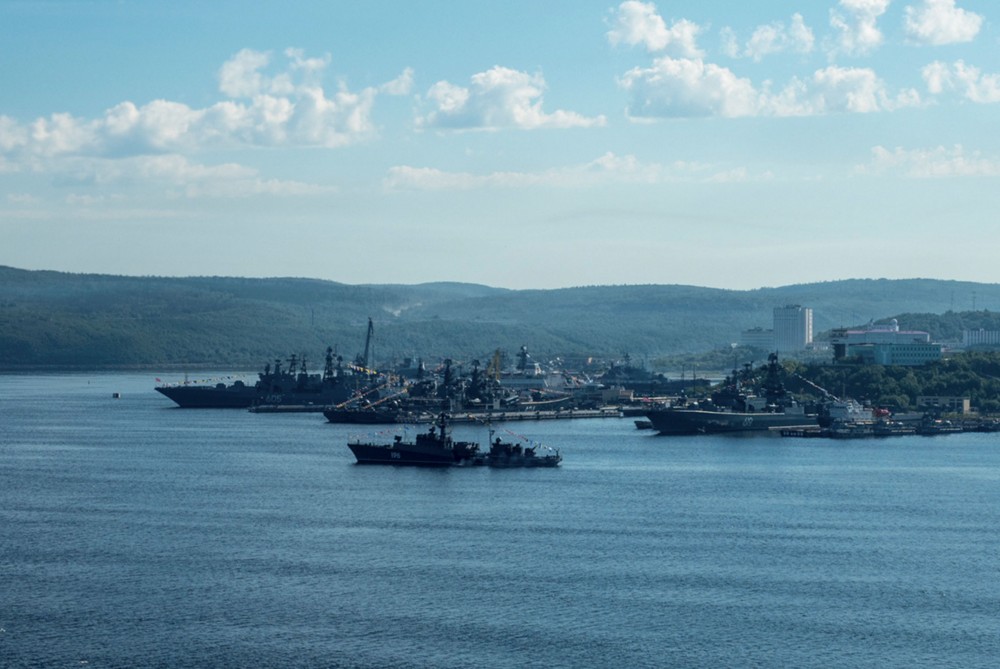
Ships set out from Northern Fleet headquarters in Severomorsk. Photo: mil.ru
It will include about 50 vessels and is held as a preparatory phase to the upcoming «Zapad-2017» drills.

The Northern Fleet, the most powerful of Russia’s five fleets, is unfolding a special exercise which includes key parts of fleet capacities.

The drills will be headed directly by Russian Navy Head Commander Vladimir Korolyev and will last «for several days», the Northern Fleet informs.

Included are about 50 ships, submarines and support vessels. Also aircrafts, helicopters from the Air Force and Air Defense will be deployed, a Navy representative says to Interfax.

The drills are held as several of the most powerful Northern Fleet vessels are on their way home after participation in a Navy parade outside St.Petersburg.  Among them are battle cruiser «Pyotr Veliky» and typhoon-class submarine «Dmitry Donskoy».

It is likely that the returning vessels will take part in the exercise.

In the course of the training, antisubmarine and anti-sabotage activities will be conducted along with navigational, hydrographical, anti-mine and search and rescue operations.

According to the Navy representatives, the exercise is held as a preparatory phase to the large-scale joint Russian-Belarus drills «Zapad-2017» scheduled for the period 14-20 September.

***

Russia Plans to Annex Belarus in Military Drill, Says Georgia’s Ex-President

Russia’s leadership is angling to annex its closest western neighbor during upcoming military drills, according to the former leader of Georgia. Mikheil Saakashvili made the comments on the anniversary of his own country’s brief conflict with Moscow that resulted in Russian troops cordoning off Georgia’s two northern regions.

Referring to the much anticipated joint Russian-Belarusian drill in the Baltic region, the former president said: “What we are seeing in Belarus, I think that Russia is planning to take and annex Belarus.” Saakashvili, who is a longtime critic of Russian President Vladimir Putin, spoke to told Baltic news agency BNS ahead of the drill, called Zapad and scheduled for September.

Lithuania, a NATO ally that borders with Russia, has expressed concern that the drill indicates a wider threat to the alliance, constituting a “simulated” attack. NATO has demanded that Russia allows for more transparency in the drill, nominally set to involve around 12,000 troops. However, Russia has previously sparked much bigger exercises to go in tandem with drills such as Zapad, upping the number of troops from the promised levels.

“During the drill, infrastructure will be brought in,” Saakashvili said. “In that sense the threat [from Russia] has not disappeared rather it only grows. It is just that until now Ukrainians have held it at its own borders [with Russia].”

Saakashvili was president of Georgia until 2013, when he lost the election and left the country for Ukraine. He was made a Ukrainian citizen and appointed as governor of Ukraine’s Odessa region in 2015 by Petro Poroshenko after the revolution that brought the pro-Europe, pro-West government to power.

His reputation as a hardline opponent of the Kremlin’s foreign policy and his imposing oratorical style made him popular quickly, and he was tipped to be the country’s next prime minister. But his often combative manner and vows to “clean up” corrupt Ukrainian institutions, put him at odds with established political figures. Ukraine stripped him of his citizenship in 2017 and he became a stateless person. He has dismissed it, and Georgia’s previous decision to strip him of citizenship, as political decisions by governments that have fallen out with him.

Despite enjoying Western support for his hawkish positions on Russia and for his campaigns against corruption, Saakashvili’s leadership of Georgia was not without its critics. The European Union criticized his decision-making during a 2008 political crisis that sparked a five day war with Russia. Under Saakashvili’s command, Georgian forces tried to restore control over two of its regions that have declared independence under Russian military sponsorship.

Belarus’s President Alexander Lukashenko has dismissed concerns that Zapad is anything but a routine defense drill. “We traditionally carry out these drills with Russia,” he said in July. Although strongly reliant on Russia in most regards, the Belarusian government has shown some signs of disagreement with its bigger partner in what the two countries symbolically call “the Union State.”

Despite a Kremlin push to deploy an airbase in Belarus, Minsk has resisted that initiative. The Union State relationship— a post-Soviet branding of Minsk and Moscow’s close relationship—looked in minor jeopardy earlier this year when Russia responded to Belarus’s looser visa-regime for Westerners by starting border checks between the two countries.

Photo

Photo

Jamestown has a more detailed summary, in part:

In the exercise scenario used for the Zapad series of exercises, there is undoubtedly a NATO dimension. This stems from Moscow’s response, opposition and complete rejection on political and legal grounds of the 1999 NATO bombing of Serbia. The events of 1999 loom large today in Russian strategic thinking and are also reflected in how the General Staff approaches the planning for a Zapad exercise. Consequently, while there is currently a Western preoccupation with the possibility of a Russian offensive operation against the Baltic States, in Moscow’s view the more likely scenario of conflict erupting on Russia’s periphery with NATO stems from an Allied intervention in Belarus. As a result, the Zapad 2017 exercise will place all operational and scenario activities under a defensive guise in response to foreign intervention, demanding a response to protect the Russia-Belarus Union State (Regnum, July 11).

Some Russian commentaries show awareness of the concern expressed by Alliance members about Zapad 2017 and its potentially aggressive rehearsal of operations against its members from Belarusian territory: these suggestions are, of course, the subject of much derision. However, there are indications of some features of the joint exercise that will come into play in September to which NATO must pay additional attention. The first is the extent to which Zapad 2017 will fine-tune joint operations carried out by the elite airborne and special forces units of Belarus and Russia. Such preparation occurred in early April, with these forces rehearsing joint operations in the Vitebsk Region in Belarus over an area of 12,000 square kilometers. The focus was on parachute landings, reconnaissance, and action to fix and locate enemy forces. During these tactical-level exercises, elite troops were also tasked with establishing the best areas to land the “main force” and coordinating air cover for these forces. On April 11–13, a parachute company from the 106th Airborne Division (Tula) relocated to Brest and, in close coordination with Belarusian counterparts as well as interior troops, worked on training tasks to block and defeat four groups of “illegal armed formations,” which had broken into strategically important facilities in the region (Nezavisimaya Voyennoye Obozreniye, June 16).

In a related preparation for Zapad 2017, in May, a one-week tactical exercise involved the electronic warfare (EW) forces of Belarus and Russia, using three training grounds in Brest and Vitebsk Regions. Whereas the elite and special forces tactical exercises had an alleged terrorist dimension, the joint EW exercises were clearly aimed against a conventionally armed opponent. They focused upon joint EW operations against a high-technology opponent operating in a “complex electronic environment.” The development of the joint force capabilities to protect the Union State is seen in Moscow as reflecting developments within modern local wars and armed conflicts. The EW component of Zapad 2017 will thus prove to be an integral part of the rehearsal of joint operations (Nezavisimaya Voyennoye Obozreniye, June 16).