It is Qatar Again and Again

Back it 2014, this site attempted to sound the alarm on Qatar. So, it is coming out of the shadows again and causing huge diplomatic chaos domestically and throughout the Middle East.

Related reading: The al Jazeera bin Ladin Dossier

Related reading: The chairman of the channel is Hamad bin Thamer Al Thani. Barack Obama hosted him at the White House.

Additionally, Obama attended a West Point Academy graduation, where al Thani’s son was graduating, the very same weekend that the Taliban 5 were swapped for Bowe Bergdahl. Side note: the largest U.S. military base outside the country is in Qatar.

(Merci à Guizmo – Copyright photos Qna)

AEI: As the current crisis between Qatar and many moderate Arab states approaches its second month, one of the key complaints which the anti-Qatar coalition has voiced is about Al Jazeera, the Qatar-based satellite channel which was once the most watched Arabic station. Al Jazeera and its supporters argue that the station’s hard-hitting reporting is simply the manifestation of press freedom in a region sorely lacking it. Al Jazeera’s detractors, however, say it is an engine of extremism which fans the flames of terrorism and actively seeks to destabilize regional states.

Al Jazeera runs several different channels. Saudi Arabia, the United Arab Emirates, Egypt, and Bahrain object to Al Jazeera in Arabic which promotes the Muslim Brotherhood line and often seems to cross the line between news reporting and incitement. According to a State Department cable describing conversations between Qatari authorities and US diplomats, Qatar acknowledged that policy role and “leverage” which Al Jazeera represented for the Qatari state. The US military had significant experience with Al Jazeera Arabic in Iraq. It was not uncommon for an anonymous tip to direct US soldiers to an insurgent den which was empty of insurgents but rigged with explosives. When American forces would arrive on the scene, they would find Al Jazeera cameramen nearby and on neighboring rooftops, waiting to film the ambush.

Al Jazeera English is more familiar to many in Europe and the United States, but it would be wrong to assume the content between the two channels is equivalent. The English-language Al Jazeera launders the image of its Arabic sibling. Al Jazeera English, for example, dedicates far greater time to minorities, social issues, and women. Al Jazeera’s experiment with a separate American channel, meanwhile, sputtered and died.

If Al Jazeera English isn’t Qatar’s main means to influence the Western media environment beyond serving to obfuscate the truth about Al Jazeera, then, what is? Here, Middle East Eye (MEE) — an increasingly prominent web portal — often obscures its finances, but it increasingly fills the gap as Qatar’s chief agent of influence. Groups like Human Rights Watch and Amnesty International incorporate MEE stories, as do newspapers like the New York Times and the Washington Post.

Delving into the details of MEE, however, show that it acts far less as a traditional journalistic outlet and far more as an English-language front for Qatari-supported groups like the Muslim Brotherhood and Hamas. British corporate records, for example, show that Jamal Awn Jamal Bessasso, a former official for both Al Jazeera in Qatar and the Hamas-affiliated al-Quds TV in Lebanon, owns and operates MEE through M.E.E. Ltd. A CV for Jamal Bessasso, since scrubbed from the internet, shows previous stints as director of planning and human resources for the Al Jazeera satellite network in Qatar and director of Human Resources for the Samalink Television Production Company in Lebanon.  Samalink is the registered agent for Al Quds TV’s website.  While David Hearst, MEE editor-in-chief, told the United Arab Emirates’ The National paper that Bessasso was “a colleague and the head of human resources and the legal director,” he denied that Bessasso was the MEE owner, despite his listings on corporate records. Neither Hearst, former news editor Rori Donaghy (in a tweet now deleted), nor other MEE employees, however, would identify who owned MEE if not Bessasso.

There are other links between MEE and Al Jazeera. Jonathan Powell, an Al Jazeera employee in charge of special projects in the chairman’s office and close associate of former Al-Jazeera Media Network chief Wadah Khanfar, acknowledged serving as launch consultant for MEE in an earlier version of his Linkedin profile (which he altered after an Emirati newspaper highlighted his role). Arwa Ibrahim and Jacob Powell also transitioned from Al Jazeera to work as MEE news editors, and Graeme Baker and Larry Johnson moved from Al Jazeera to MEE to become senior editors. At the very least, it appears that MEE recruited heavily from Al Jazeera.

The Hamas links run as deep. A former official of Interpal, a United Kingdom-based charity designated by the US Treasury Department as a financial supporter of Hamas, registered the Middle East Eye website. Prior to joining MEE, Donaghy worked for organizations founded by Hamas (such as the House of Wisdom in Gaza) and the Muslim Brotherhood (Emirates Center for Human Rights, which was set up with financing and assistance from the Cordoba Foundation, a Muslim Brotherhood entity).

Bessasso, meanwhile, has openly supported radical groups. In 2012, he shared a Facebook post praising Hamas. The following year, he shared a quote from Muslim Brotherhood theologian Yusuf Qaradawi encouraging followers to utilize “violence against those who deserve it.” Over the years, the MEE has bolstered its content with “exclusiveaccess to Hamas, seemingly acting as the terrorist group’s preferred outlet to the English-speaking world. Hearst has penned editorials praising and defending the Muslim Brotherhood and political Islam.

Long ago, political radicals and terrorists discovered that — so long as they called themselves human rights activists — journalists, other human rights activists, and even diplomats would accept their polemics at face value. It seems that the Qatari government and its Hamas and Muslim Brotherhood networks have discovered the same principle applies to news outlets and portals. Al Jazeera may be the most prominent example, but it seems that Al Jazeera’s managers now seek to seed other networks as well, and that Qatari funds mandate an agenda.
July 27th the Next N. Korea Missile Launch?

US sees more signs North Korea is preparing another missile test

(CNN)North Korea appears to be preparing for another missile test, according to a US Defense official. The official said that transporter vehicles carrying ballistic missile launching equipment were seen arriving in Kusong, North Korea on Friday.

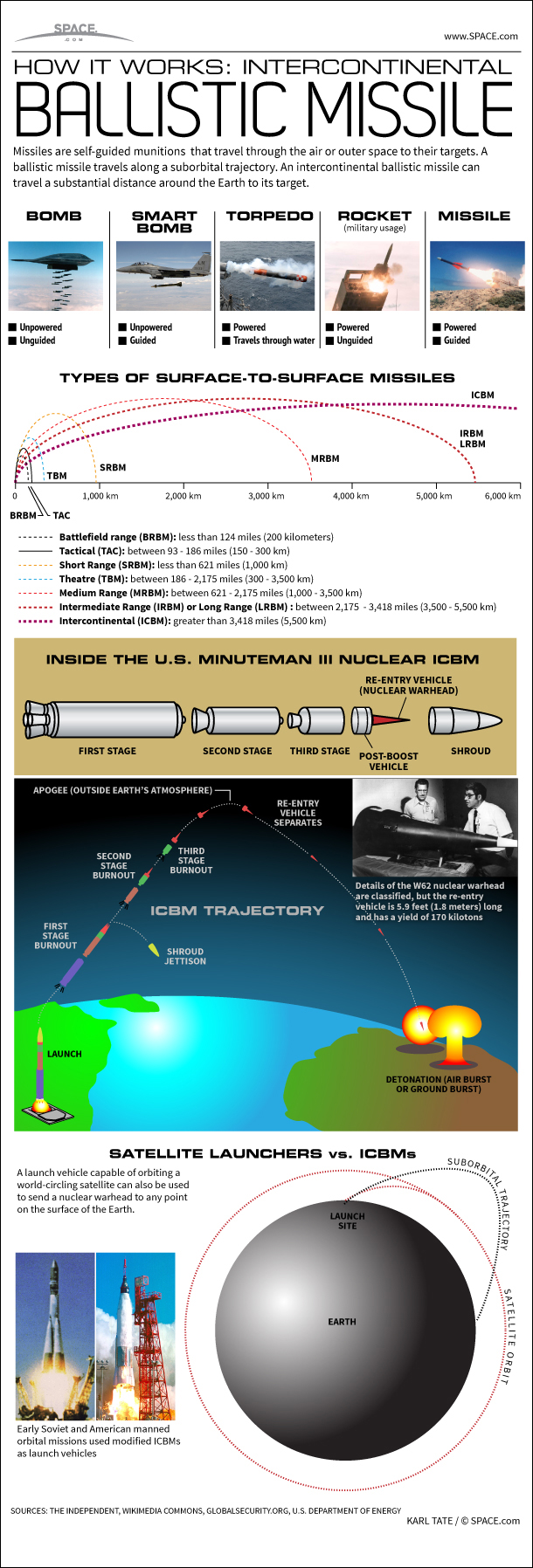
Infographic: Here's how missiles send deadly explosive payloads to targets around the world.
Source SPACE.com: All about our solar system, outer space and exploration

The official said that when such equipment is seen, a launch could occur within six days, which would coincide with the upcoming July 27 North Korean Holiday celebrating the armistice which ended the Korean War.
Last Wednesday, CNN reported that US intelligence indicated that North Korea is making preparations for another intercontinental ballistic missile (ICBM) or intermediate range missile test. Two administration officials familiar with the latest intelligence confirmed they’d seen indicators of test preparations. US satellites have detected new imagery and satellite-based radar emissions indicating that North Korea may be testing components and missile control facilities for another ICBM or intermediate launch, officials say.

(CNN)Hawaii is set to become the first state in the US to test an “attack- warning” system in the event of a North Korean nuclear missile strike.

Starting in November, Hawaii’s disaster warning plan will include a new protocol in case of a nuclear attack, CNN affiliate KNHL reports. But some are concerned the announcement will scare off tourists from visiting the island.
A “guidance summary” from the Hawaii Emergency Management Agency says residents will be alerted of nuclear detonation through siren alarms and flashing white lights. An Emergency Alert System will broadcast over television and radio frequencies as well. More here.
Kusong has been the site of North Korean missile tests in the past, including a May test of a KN-17 intermediate range missile which traveled almost 500 miles before splashing down in the Sea of Japan/East Sea, hitting the water about 60 miles from Vladivostok in eastern Russia, according to US officials.
The last major North Korean missile test took place on July 4, when Pyongyang launched what the US assessed to be an intercontinental ballistic missile.
***
The US military has grown increasingly concerned about the increased pace of North Korean missile testing while simultaneously underscoring that the US is capable of defending itself and its allies from North Korean missiles.
“They’re clearly on a path to develop an intercontinental ballistic missile that can reach the reach the United States and to match that with a nuclear weapon,” the Chairman of the Joint Chiefs of Staff, Gen. Joseph Dunford, told an audience Saturday at the Aspen Security Forum.
“What the North Koreans are capable of today is limited missile attack and we are capable of defending against a limited missile attack for our forces in South Korea, our South Korean allies, our Japanese allies, our forces in Okinawa, our forces in Guam and the American homeland,” Dunford added.
On Thursday, CIA Director Mike Pompeo offered some of the most aggressive comments yet from the Trump administration with regard to North Korean dictator Kim Jong Un.
“It would be a great thing to denuclearize the peninsula, to get those weapons off of that, but the thing that is most dangerous about it is the character who holds the control over them today,” Pompeo said at the Aspen Security Forum.
“As for the regime, I am hopeful we will find a way to separate that regime from this system,” Pompeo said. “The North Korean people I’m sure are lovely people and would love to see him go.”

Interpol’s List of 173 ISIS Suicide Brigade

More from WaPo  

July 11: Ahead of a meeting of the Global Coalition to Defeat ISIS, INTERPOL has underlined the need for military success against the group to be translated into actionable intelligence for police around the world.

With mounting pressure on former ISIS strongholds likely to result in increased numbers of battle-hardened terrorists returning home, fleeing to neighbouring countries, or joining other conflicts, it is vital that critical information left by retreating fighters and recovered by Global Coalition forces is quickly shared with the global law enforcement community through a secure multilateral platform.

Details of more than 18,000 Foreign Terrorist Fighters (FTFs) have now been shared via INTERPOL’s global network with an increasing amount being sourced from the conflict zones. Biometric data such as photos, fingerprints and DNA profiles have already led to the positive identification of terrorists around the world, including via facial recognition.

“Although there has been military success in Iraq and Syria, ISIS retains the ability to direct or inspire deadly attacks across multiple continents,” said Secretary General Jürgen Stock.

“Experience has shown the essential role that military-police cooperation plays in keeping pace with the threat as it disperses beyond the conflict zone. INTERPOL provides an established and trusted interface which supports this cooperation on a global level,” added Secretary General Stock.

INTERPOL projects Vennlig and Hamah have enabled evidence of terrorist activity collected from Iraq and Afghanistan to be shared with law enforcement, intelligence and defence agencies in more than 60 countries, leading to the identification of previously unknown terrorists and facilitation networks.

“Once terrorist information is shared at the global level, every traffic check, passport control or random search holds the potential for a break in a terrorism investigation or to foil an evolving plot,” said Mr Stock.

“However, countries worldwide need to ensure their frontline officers have direct access to INTERPOL’s databases in order to make these crucial identifications and prevent terrorists from traveling with ease to conduct attacks,” added Mr Stock pointing to the recent statements by the G7 and G20 calling for countries to make full use of INTERPOL’s information systems.

With an increasing number of individuals involved in terrorist attacks having a criminal background, Secretary General Stock also underlined the need for the most basic information stored in national police systems to be shared at the global level.

Fingerprint checks of arrested foreign nationals by one European country against INTERPOL’s databases resulted in 11 hits in just one two-week period in June.

Individuals linked to recent terrorist attacks in Europe, including at least one suspect travelling on a passport recorded in the Stolen and Lost Travel Documents database, had been subjects of INTERPOL alerts prior to the attacks.

“Unless and until countries ensure vital policing information is in the hands of frontline officers, the threat will continue to outpace our response,” said Secretary General Stock.

“The networks are in place, the officers are on our streets, we just need to make sure that all possible dots are connected,” concluded the INTERPOL Chief.

Interpol circulates list of 173 suspected members of Isis suicide brigade

Guardian: Interpol has circulated a list of 173 Islamic State fighters it believes could have been trained to mount suicide attacks in Europe in revenge for the group’s military defeats in the Middle East.

The global crime fighting agency’s list was drawn up by US intelligence from information captured during the assault on Isis territories in Syria and Iraq.

Terrorism home

European counter-terror networks are concerned that as the Isis “caliphate” collapses, there is an increasing risk of determined suicide bombers seeking to come to Europe, probably operating alone.

There is no evidence that any of the people on the list, whose names the Guardian has obtained, have yet entered Europe, but the Interpol circulation, designed to see if EU intelligence sources have any details on the individuals, underlines the scale of the challenge facing Europe.

The list, sent out by the general secretariat of Interpol on 27 May, defines the group of fighters as individuals that “may have been trained to build and position improvised explosive devices in order to cause serious deaths and injuries. It is believed that they can travel internationally, to participate in terrorist activities.”

The data was originally collected by the US intelligence “through trusted channels”. The material was handed over to the FBI, which transmitted the list to Interpol for global sharing.

A note appended to the Interpol list circulated in Italy explains how the terrorist database was constructed, putting together the pieces of the puzzle from hundreds of elements, mainly gathered when Isis local headquarters were captured.

“The people,” the note says, “have been identified through materials found in the hiding places of Isil, the Islamic state of Iraq and the Levant.” The note adds that “it emerges that those subjects may have manifested willingness to commit a suicidal attack or martyrdom to support Islam”.

The list shows the suspects’ names, the date Isis recruited them, their last likely address including the mosque at which they have been praying while away fighting, their mother’s name and any photographs.

For each of the fighters, an ID was created to ensure that each member country in the Interpol network could integrate the data with local databases.

Interpol has asked its national partners for any information they might have about each name on the list, and any other background personal data they have on their files, such as border crossings, previous criminal offences, biometric data, passport numbers, activity on social media and travel history.

The information will then be included in Interpol’s ASF (automatic search facility) database in order to possibly put the names on a higher level watch list.

US intelligence is apparently confident about the reliability of the sources used to compile the list. But western counter-terrorism forces have said they face an uphill struggle identifying potential suspects, who have access to a mountain of false documents, double identities and fake passports.

Interpol stressed the list’s transmission came as part of its role circulating information between national crime-fighting agencies. “Interpol regularly sends alerts and updates to its national central bureaux (NCB) on wanted terrorists and criminals via our secure global police communications network,” a spokesman said. “It is the member country which provides the information that decides which other countries it can be shared with.

“The purpose of sending these alerts and updates is to ensure that vital policing information is made available when and where it is needed, in line with a member country’s request.”

A European counter-terrorism officer said one of the purposes of circulating the list around Europe was to identify those on it who might have been born and raised in European countries.

In 2015 the UN considered there were 20,000 foreign fighters in Iraq and Syria, of whom 4,000 were from Europe, but there has not previously been a specific list of those fighters including those born in the Middle East who have been identified as potential suicide bombers.

The speed with which Isis fighters are likely to attempt to reach Europe will depend on a range of issues including whether the group tries to set up a new base in Syria in the wake of the impending fall of Raqqa, its last major redoubt in north-west Syria. There is a growing suggestion that Isis fighters will shift south from Raqqa to the defensible territory stretching from Deir el-Zourez-Zor to Abu

The jihadi group is currently struggling to come to terms with the loss of Mosul in northern Iraq following a battle that produced some of the most brutal fighting since the end of the second world war.

The parallel advance on Raqqa, the group’s other urban stronghold in the region, has been stalled partly due to the severity of the resistance being mounted against the Syrian Democratic Forces made up of an alliance of Kurds, Arabs and US Special forces.

US Army Col Ryan Dillon on Friday estimated there were around 2,000 Isis militants in the city, who he said were using civilians and children as human shields. The distance between SDF forces on the eastern side of the city and on the western fronts is now just under 2km.

The United Nations estimates that about 190,000 residents of Raqqa province have been displaced since April, including about 20,000 since the operation to seize the provincial capital began in early June.

US diplomats this week admitted that the SDF forces, due to their ethnic make-up, will be constrained from going south of Raqqa to pursue Isis as far as Deir Azzour, saying this may be the task of the Syrian forces under Bashar al Assad, or even Iranian-backed Shia militia.

Hezbollah Terror Cells in Lebanon and Latin America

Kuwait expels Iranian diplomats over ‘terror’ cell: United Nations (United States) (AFP) – US Ambassador Nikki Haley on Wednesday accused Lebanon’s Hezbollah of amassing weapons and said the world must turn its attention to the actions of the powerful paramilitary organization.

  kataeb

Anyone ever ask or investigate the Hezbollah weapons inventory in Latin America?


No Latin American Country Has Branded Hezbollah a Terror Group Despite Ties to Major Attacks

WASHINGTON, D.C.—Latin American countries have failed to register Iranian proxy Hezbollah as a terrorist organization despite the threat it poses to the region, a Peruvian official revealed during a discussion on Capitol Hill.

The Shiite group is involved in various illicit activities in Latin America to generate money that some experts believe is used to fund terrorist activities in the Middle East.

During a discussion Wednesday on Capitol Hill hosted by the Center for a Secure Free Society (SFS), Moises Vega de la Cruz, a public prosecutor for the Peruvian government specializing in terrorism cases, revealed that “in Latin America, Hezbollah is not recognized as a terrorist organization.”

“I think Hezbollah is a threat to Latin America. Hezbollah is a terrorist organization that is advancing not only in Peru but in other Latin American countries as well,” he told Breitbart News.

Joseph Humire, an expert on Iranian activity in the Western Hemisphere and executive director of SFS, noted that no Latin American country has registered Hezbollah as a terrorist organization.

The United States and the European Union have deemed Lebanon’s Shiite group Hezbollah as a terrorist organization.

In the United States, Hezbollah’s main supporter Iran has been officially labeled a state sponsor of terror.

Peru recently adjudicated a case involving an alleged Hezbollah operative accused of explosives-related crimes in 2014. The individual avoided prosecution, but De La Cruz has appealed the decision.

“Most Latin Americans don’t view Islamist terrorism as a significant threat in their region and little public pressure has been placed on the establishment, reform, or improvement of weak or non-existent anti-terrorism laws across the region,” SFS pointed out in a statement. “Consequently, the Islamic State [ISIS/ISIL], Hezbollah, and other Jihadist networks and sympathizers are spreading throughout South America with impunity.”

The U.S. government has acknowledged the presence of both Shiite Hezbollah and Sunni ISIS in Latin America.

De la Cruz noted that Hezbollah maintains a presence in Peru, where it is reportedly converting people and trying to get involved politically.

The Peruvian Latina news agency reported last year that the Shiite group has registered as an official political party in Peru’s Abancay province, home to the largest concentration the country’s small Muslim community.

Hezbollah has established itself as an official political party in its main base of Lebanon.

Argentinian authorities have linked Hezbollah to fatal attacks against the South American country’s Jewish community, including the 1994 bombing of the Argentine-Israeli Mutual Association (AMIA)—the deadliest terrorist attack in the Western Hemisphere before September 11, 2001.

The U.S. military and the Department of State have expressed concern about the group’s presence in Latin America.

According to the U.S. State Department, Venezuela has provided a “permissive environment” that has allowed Hezbollah to thrive in the region.

Last year Michael Braun, a former DEA operations chief, told American lawmakers that Hezbollah is generating hundreds of millions from a “cocaine money laundering scheme” in Latin America that “provides a never-ending source of funding” for its terrorist operations in Syria and elsewhere.

Hezbollah is fighting on behalf of Iran on the side of the Russian-backed Syrian dictator Bashar al-Assad.

In an annual report to Congress issued earlier this year, U.S. Southern Command (SOUTHCOM) noted that “Hezbollah members, facilitators, and supporters engage in licit and illicit activities in support of the organization, moving weapons, cash, and other contraband to raise funds and build Hezbollah’s infrastructure in the region.”

SOUTHCOM is charged with overseeing American military activity in most of Latin America.

The group is believed to be operating throughout the Western Hemisphere.

Iran ‘foremost state sponsor of terrorism in 2016’: US state department

The department’s annual report on global terrorism accused the Iranian Revolutionary Guard’s Quds Force — which is responsible for operations outside the country — along with Iranian partners, allies, and proxies, of ‘playing a destabilising role in military conflicts in Iraq, Syria, and Yemen’

Iran was the “foremost state sponsor of terrorism in 2016”, the US state department said on Wednesday in its annual report on terrorism worldwide.

The 2016 Country Reports on Terrorism — the first released by the state department since US president Donald Trump assumed office — also highlighted Hizbollah’s increasing reach in Syria, Iraq and Yemen and an increase in “its long-term attack capabilities”.

Although the report said there had been a 9 per cent drop in global terror attacks last year from 2015, as well as a 13 per cent drop in terror-related fatalities, it stressed that “the Islamic State of Iraq and Syria (ISIS) remained the most potent terrorist threat to global security” in 2016.

Al Qaeda and its regional affiliates also “remained a threat to the US homeland and our interests abroad despite counter-terrorism pressure by US partners”, the report said.

On Iranian sponsorship of terrorism, the report accused the Revolutionary Guard’s Quds Force — which is responsible for operations outside the country — along with Iranian partners, allies, and proxies, of “playing a destabilising role in military conflicts in Iraq, Syria, and Yemen”. It also said “Iran continued to recruit fighters from across the region to join Iranian-affiliated Shia militia forces engaged in conflicts in Syria and Iraq, and has even offered a path to citizenship for those who heed this call”.

The 2016 report put more emphasis on the threat from Hizbollah than in previous years. It described the Lebanese political party and militia as “playing a major role in supporting the Syria government’s efforts to maintain control and territory, and providing training and a range of other support for Iranian-aligned fighters” in these conflict zones.

The state department said “there are reportedly about 7,000 Hizbollah fighters in Syria”, though it also highlighted that the group had lost “several senior military commanders and hundreds of fighters” in fighting there last year.

The report also highlighted Hizbollah’s continued efforts to “develop its long-term attack capabilities and infrastructure around the world”.

Justin Siberell, the state department’s acting coordinator for counter-terrorism, told The National on Wednesday that “Hizbollah maintains a sophisticated operation with [a] broad network group around the world”.

Mr Siberllel said it was unclear, however, if the Syrian conflict had boosted Hizbollah’s standing. On the one hand, the group had gained military expertise in Syria, he said, while on the other, it had suffered large number of casualties.

“It’s a mixed picture,” he said.

On Bahrain, the report said that “during 2016 the Bahraini government continued to make gains in detecting, neutralising, and containing terrorist threats from violent Shia militants and ISIS sympathisers”. It also referenced improved counter-terror co-operation with the UAE, Egypt, Saudi Arabia and other Arab countries.

The report voiced concerns over Al Qaeda exploiting the ongoing war in Yemen to make gains. It said that “despite leadership losses, Al Qaeda in the Arabian Peninsula (AQAP) remained a significant threat to Yemen, the region, and the United States, as ongoing conflict in Yemen hindered US efforts to counter the group”. It was a similar situation with Al Qaeda’s former affiliate in Syria, the report said.

“Al Nusra Front continued to exploit ongoing armed conflict to maintain a territorial safe haven in select parts of northwestern Syria,” the report said, referring to the group that now calls itself Jabhat Fatah Al Sham.

When it came to the Emirates, the report said that in 2016 “the UAE government maintained a robust counter-terrorism and countering violent extremism (CVE) partnership with the United States through its collaboration with US law enforcement; support of the Global Coalition to Defeat ISIS; and counter‑messaging initiatives, such as the Sawab and Hedayah Centers.”

The report made reference to the UAE’s deployment of forces to Yemen “to counter the spread of AQAP and ISIS” there, highlighting that, “along with its Yemeni partners, the UAE military successfully ejected AQAP from the port city of Mukalla in April — depriving AQAP from millions [of dollars] in monthly income — and from the coastal towns of Balhaf and Bir Ali in December”.

The report also highlighted wins for UAE border security.

“UAE government security apparatus continued monitoring suspected terrorists in the UAE, and successfully foiled terrorist attacks within its borders,” it said, adding: “UAE customs, police, and other security agencies improved border security and worked together with financial authorities to counter terrorist finance.”

North Korea Prepares for Next ICBM Launch, High Plutonium Production

While there is much chatter with regard to South Korea entering into peace talks with North Korea, a proposal not likely to happen, new launch preparations appear to be underway.

Primer:

Images of North Korea’s main nuclear facility show that the isolated regime has apparently produced more plutonium for its weapons programme than previously thought, a US monitor said, as tensions soar over Pyongyang’s ambitions.

The respected 38 North website, a monitoring project linked to Johns Hopkins university, said Friday that thermal imagery of the Yongbyon nuclear complex appeared to show that Pyongyang had reprocessed spent fuel rods at least twice between last September and June this year.

“The Radiochemical Laboratory operated intermittently and there have apparently been at least two unreported reprocessing campaigns to produce an undetermined amount of plutonium that can further increase North Korea’s nuclear weapons stockpile,” it said.

Wookbox

North Korea deactivated the Yongbyon reactor in 2007 under an aid-for-disarmament accord, but began renovating it after Pyongyang’s third nuclear test in 2013. More here.

US intelligence shows North Korean preparations for a possible missile test

(CNN) has learned that US intelligence indicates that North Korea is making preparations for another intercontinental ballistic missile (ICBM) or intermediate range missile test.

Two administration officials familiar with the latest intelligence confirm there are indicators of test preparations that could lead to a potential launch in about two weeks.
US satellites have detected new imagery and satellite-based radar emissions indicating North Korea may be testing components and missile control facilities for another ICBM or intermediate launch, officials say.
The US is watching in particular for further testing of North Korean radars and communications that could be used in a launch. The next test launch would be the first since North Korea successfully launched an ICBM on July 4.
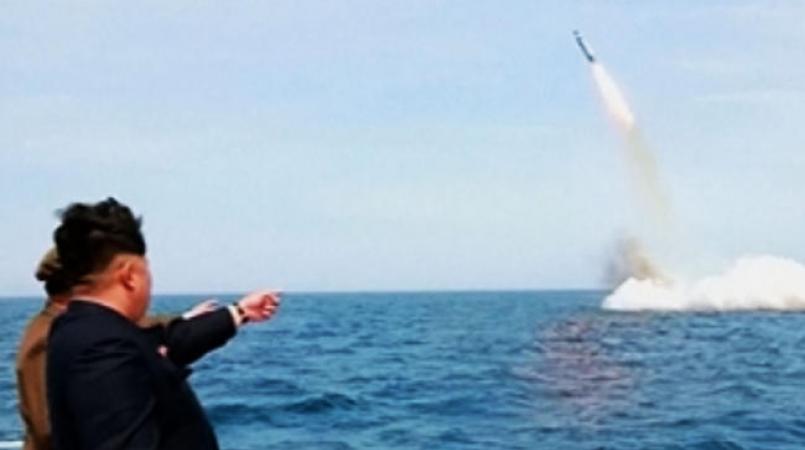
Officials also say that North Korea is continuing to test components to launch a missile from a submarine but the US intelligence assessment is that program remains in early stages.
At the same time, a North Korean submarine was spotted in international waters engaging in “unusual activity,” two defense officials said.
North Korea’s submarine fleet is believed to encompass around 70 subs, though the majority are quite old and likely cannot fire missiles.
When taken together, these developments are concerning because North Korea says it is trying to develop a missile capable of delivering a nuclear warhead to the United States.
Pyongyang has long maintained the ability to legitimately threaten the United States with a nuclear attack is the only way to protect itself against any US-led attempts at regime change.
Land-based and submarine-based missiles are considered two-thirds of what is known as the “Strategic Triad,” a theory that a state must have land, air and sea based nuclear attack capabilities to successful deter an enemy from trying to attack it.
The latest intelligence about a potential second ICBM test comes as the second highest ranking US military officer has warned Congress that North Korea’s deception techniques to mask their missile launches have grown in sophistication.
“I am reasonably confident in the ability of our intelligence community to monitor the testing but not the deployment of these missile systems. Kim Jong Un and his forces are very good at camouflage concealment and deception” General Paul Selva, vice chairman of the Joint Chiefs of Staff, told the Senate armed services committee on Tuesday.
Selva gave the strongest public indication so far that the US believes the current North Korean ICBM still has limitations, saying that Pyongyang has yet to demonstrate the “capacity to strike the United States with any degree of accuracy or reasonable confidence of success.”
Selva said North Korean guidance and control systems for a long range missile still would have to be improved before a missile could actually strike the US.
When asked about the possibility of a preemptive US military strike, Selva said, “I think we have to entertain that potential option. That would be a policy choice by the President of the United States to execute or not execute that option.”
But Defense Secretary James Mattis has long warned against letting the North Korean situation get to the point of a US military strike and has strongly and publicly advocated for a diplomatic solution led by the State Department.
Selva, who is deeply involved in the US nuclear weapons and missile defense programs, noted a parallel line of effort is underway to “provide for the defense of the United States with a suitable ballistic missile defense system that can handle the low volume at this point of missiles that he (Kim Jong Un) might be able to deploy that could strike us here across all of US territory, Alaska, Hawaii and the lower 48.”
The preparations for a potential new launch come as the US military has observed North Korea carrying out an “unusual level” of submarine activity as well as testing a critical component of a missile that could potentially be launched from a submarine.
Two US defense officials told CNN that that a North Korean Romeo-class submarine is currently engaged in “unusual deployment activity” in the Sea of Japan/East Sea and has been under way for about 48 hours. The US is observing the sub via reconnaissance imagery and the officials said the submarine’s patrol had taken it farther that it has ever gone, sailing some 100 kilometers out to sea in international waters. The submarine’s activity was different than the typical training activity usually observed closer to shore, according to the officials.
The diesel-electric-powered North Korean sub spotted far from port is about 65 meters long and the US does not assess it capable of venturing very far from its home port.
The activity caused US and South Korean forces to slightly raise their alert level, according to one official.
The US military pays close attention to North Korean submarine activity following the 2010 Cheonan incident where a North Korean sub torpedoed a South Korean Naval vessel.
The deployment comes days after Pyongyang tested a critical component for a missile that could potentially be launched by a submarine The test took place on land at the Sinpo shipyard in North Korea. The current US intelligence assessment is that the missile program aboard submarines remains in the very early stages.
An ejection test in may tested the missile’s “cold-launch system,” which uses high pressure steam to propel the missile out of the launch canister into the air before the missile’s engines ignite, preventing damage to the submarine or submersible barge that would launch the missile. It is the type of technology that allows missiles to be launched underwater from submarines.
Last summer, North Korea conducted what experts believed was its first successful submarine missile test, firing a missile called the the KN-11 or Pukguksong-1.