9500 Visas Revoke Due to Terror,Where are they? Don’t Know

FNC: The Obama administration cannot be sure of the whereabouts of thousands of foreigners in the U.S. who had their visas revoked over terror concerns and other reasons, a State Department official acknowledged Thursday.

The admission, made at a House oversight hearing examining immigrant vetting in the wake of major terror attacks, drew a sharp rebuke from the committee chairman.

“You don’t have a clue do you?” Rep. Jason Chaffetz, R-Utah, told Michele Thoren Bond, assistant secretary for the Bureau of Consular Affairs.

Bond initially said the U.S. has revoked more than 122,000 visas since 2001, including 9,500 because of the threat of terrorism.

But Chaffetz quickly pried at that stat, pressing the witness about the present location of those individuals.

“I don’t know,” she said.

The startling admission came as members of the committee pressed administration officials on what safeguards are in place to reduce the risk from would-be extremists.

At issue is how closely the U.S. government examines the background of people seeking entry to the country, including reviews of their social media postings.

Leon Rodriguez, director of U.S. Citizenship and Immigration Services, told committee members that such checks aren’t being done in an abundant manner, and he was not specific about when or how it would occur.

Lawmakers are trying to ascertain which safeguards are in place to ensure that extremists are not exploiting a variety of legal paths to travel to the United States.

One of the San Bernardino, Calif., shooters came to the U.S. on a K-1 fiancee visa last year despite the fact that the FBI believed she was already radicalized.

Tashfeen Malik came to the U.S. on a K-1 fiance visa in July 2014 and passed multiple background checks and at least two in-person interviews, one in Pakistan and another after she married Syed Farook. FBI Director James Comey has said Malik and Farook communicated privately online about jihad and martyrdom before they married.

Lawmakers at times angrily pressed officials on why even public social media wouldn’t routinely be looked at for vetting those trying to enter the country.

“If half the employers are doing it in the United States of America, if colleges are doing it for students, why wouldn’t Homeland Security do it?” said Rep. Stephen Lynch, D-Mass. “We don’t even look at their public stuff, that’s what kills me.”

DHS did launch three pilot programs specifically aimed at reviewing social media postings as part of the immigration vetting process.

“There is less there that is actually of screening value than you would expect, at least in small early samples, some things seem more ambiguous than clear,” Rodriguez told lawmakers Thursday. He said foreign alphabets frequently used in social media posts were a challenge to translate.

“We all continue to believe there’s a potential for there to be information of screening value … particularly in high risk environments,” he added.

Both DHS and the State Department are reviewing the process for vetting visa applications, including the K-1 program, and have been directed by the White House to create specific recommendations for improvements.

DHS is specifically reviewing policies on when authorities at U.S. Citizenship and Immigration Services can look at social media posts as part of the process for evaluating applications for certain visas.

“There are some legal limits to what we can do,” Homeland Security Secretary Jeh Johnson said Wednesday. He added that he thinks reviews of social media should be done more often, but did not provide specifics.

During his opening remarks Chaffetz, said: “It is unclear how someone who so openly discussed her hatred of our country and way of life could easily pass three background checks. We need to understand how the breakdown happened with Malik and what we are doing to make sure it doesn’t happen again.”

Lawmakers have also pressed for changes to the Visa Waiver Program, which allows many citizens from 38 countries to travel to the United States without being subjected to the in-person interview required to receive a visa. Many fear that foreign fighters who carry western passports will be able to exploit that system to travel freely to the United States.

Earlier this month the House voted overwhelmingly to tighten controls on that program and require visas for anyone who has been to Iraq or Syria in the last five years. Security changes to the program were also included in the Senate version of a massive spending bill expected to be approved later this week.

House Oversight and Government Reform Committee Hearing on Immigration and Visas December 17, 2015

PURPOSE:

• To review the screening process for foreign nationals entering the United States, including the ability to review social media as part of the vetting process.
• To assess the likelihood of foreign nationals exploiting the U.S. immigration system and examine vulnerabilities within that system.
• This hearing is a follow-up to an Oversight Subcommittee hearing last week, where a Department of Homeland Security (DHS) official was unable to answer basic questions on the Agency’s ability to vet, track, and screen individuals who arrive in the United States.

BACKGROUND:

• Foreign nationals seeking to enter the U.S. must ordinarily obtain either an immigrant visa or a nonimmigrant visa. A third category of foreign nationals seeking entry into the U.S. are refugees, who enter under refugee status.
• An exception to the rule is the Visa Waiver Program (VWP), where an individual who seeks entry to the U.S. must apply for, and receive, a visa before entering the country. Currently, nationals of 38 countries can enter the U.S. without first obtaining a visa under the VWP.
• Under current law, two departments—the Department of State and DHS—play roles in administering the law and policies on immigration visas.
• In light of the attacks in San Bernardino, CA, Committee Chairman Jason Chaffetz (R-UT) and Subcommittee Chairman Ron DeSantis (R-FL) sent a letter to DHS seeking information relating Tashfeen Malik’s entry into the U.S. on a fiancée visa.


Witnesses and testimonies

Name Title Organization Panel Document
The Honorable Anne C. Richards Assistant Secretary, Bureau of Population, Refugees, and Migration U.S. Department of State Document
The Honorable Michele Thoren Bond Assistant Secretary, Bureau of Consular Affairs U.S. Department of State Document
The Honorable Alan Bersin Assistant Secretary for International Affairs, Chief Officer for the Office of Policy U.S. Department of Homeland Security
The Honorable Leon Rodriguez Director, U.S. Citizenship and Immigration Services U.S. Department of Homeland Security

Related Documents

Name Document
Credible Fear Claims Document

German Jihadist Gives Testimony, Islamic State

Back from the ‘Caliphate’: Returnee Says IS Recruiting for Terror Attacks in Germany

Photo Gallery: An IS Returnee Opens Up

Islamist extremist Harry S. wasn’t in Syria for long. But during his stay there, he claims, Islamic State leaders repeatedly tried to recruit him to commit terror attacks in Germany. Security officials believe he could be telling the truth.

Spiegel: It was an early summer morning in the Syrian desert, with not a cloud in the sky, when Mohamed Mahmoud asked those gathered around him: “Here are some prisoners. Which of you wants to waste them?”

Not long before, Islamic State (IS) had taken the city of Palmyra, and now jihadists from Germany and Austria were to participate in the executions of some of the prisoners taken in the operation. They drove to the site of the executions in Toyota pick-ups, bringing along an IS camera team in order to document the atrocity in the city of antique ruins. Even then, Mohamed Mahmoud was known to German security officials for his repeated propaganda-video calls to join the jihad. On that early summer day in Palmyra, though, he didn’t just incite others. He grabbed a Kalashnikov himself and began firing. That day, Mahmoud and his group of executioners are thought to have killed six or seven prisoners.

The story comes from someone who was in Palmyra on that day: Harry S., a 27-year-old from Bremen. “I saw it all,” he says.

Harry S. returned to Germany from Syria and is now in investigative custody. He has told security officials everything about the brief time he spent with Islamic State and has also demonstrated his readiness to deliver extensive testimony to German public prosecutors. He stands accused of membership in a terrorist group. His lawyer Udo Würtz declined to offer a detailed response when contacted, but said of his client: “He wants to come clean.”

German investigators are extremely interested in the testimony of the apparently repentant returnee, even as they are likely unsettled by what he has to say.

A Vital Witness

Harry S., after all, is more than just a witness to firing squads and decapitations. He also says that on several occasions, IS members tried to recruit volunteers for terrorist attacks in Germany. In the spring, just after he first arrived in Syria, he says that he and another Islamist from Bremen were asked if they could imagine perpetrating attacks in Germany. Later, when he was staying not far from Raqqa, the self-proclaimed Islamic State capital city, masked men drove up in a jeep. They too asked him if he was interested in bringing the jihad to his homeland. Harry S. says he told them that he wasn’t prepared to do so.

Harry S. was only in IS controlled territory for three months. Yet he might nevertheless become a vital witness for German security officials. Since the Nov. 13 attacks in Paris, fear of terrorism has risen across Europe, including in Germany, and security has been stepped up in train stations and airports. And the testimony from the Bremen returnee would seem to indicate that the fear is justified. Harry S. says that, during his time in the Syrian warzone, he frequently heard people talking about attacks in the West and says that pretty much every European jihadist was approached with the same questions he had been asked. “They want something that happens everywhere at the same time,” Harry S. says.

Harry S.’s path from the Bremen quarter of Osterholz-Tenever to the jihadists of Islamic State was not particularly remarkable. His radicalization was similar to many other young, directionless men from European suburbs, from the Molenbeek district of Brussels to Lohberg in Dinslaken. In Tenever, some of the residential towers are up to 20 stories tall.

Harry S. is of interest to German security officials also because he claims to...

Harry S. is of interest to German security officials also because he claims to have met Denis Cuspert (the former Berlin rapper known as Deso Dogg), and Mohamed Mahmoud, an Austrian Islamist thought to have a leadership role within Islamic State.

The son of parents from Ghana, Harry S. grew up in “difficult conditions,” according to a court file. His father left the family just as he was entering puberty. Even though Harry S. initially only managed to graduate from a lower tier high school in Germany, he dreamed of returning to his parents’ homeland and working as a construction engineer.

There was even a brief moment when it looked as though he was going to get control over his life. But then, in early 2010, he and some friends robbed a supermarket, getting away with €23,500, and flew to the island of Gran Canaria for a vacation. It wasn’t long before the authorities were on to them and Harry S. was sentenced to two years behind bars for aggravated theft.

A Dangerous Radical

In prison, he met a Salafist named René Marc S., the “Emir of Gröpelingen” — a man who Bremen officials consider to be a dangerous radical. It didn’t take long before prison officials noticed a “change in character” in Harry S. According to prison records, he converted to Islam and expressed “radical sentiments” about world events. After his release, the new convert visited the Furqan Mosque (which has since been shut down) in the Gröpelingen neighborhood of Bremen. At the mosque, he became part of a Salafist clique which sent at least 16 adults and 11 children to Syria in 2014.

Harry S. tried to make the journey as well. From Istanbul, he flew in April 2014 to Gaziantep, a large Turkish city near the border with Syria, but his trip came to a premature end. Turkish authorities arrested him and sent him back to Bremen, where he told police that he had wanted to help out in Syrian refugee camps. The authorities didn’t believe him and confiscated his passport in an effort to prevent him from making another attempt. On Tuesdays and Saturdays, he was required to report to the local police station.

But the authorities were still unable to prevent the Salafist from traveling to Syria to join the war. Harry S. simply grabbed an acquaintance’s passport and, with another Islamist from Bremen, traveled overland via Vienna and Budapest. This time, there were no police waiting for him at the border to Syria. Instead, he was met by smugglers who brought him across the border to an IS safe house set up for new arrivals from around the world.

Harry S., a large man with broad shoulders, was trained as a fighter in Syria. He claims to have been drilled in training camps together with 50 other men: sit-ups, hours of standing in the sun and forced marches lasting the entire day. Those who gave up were locked up or beaten. His Kalashnikov, it was driven home to him, should become like his “third arm” and he was told to keep the weapon in bed with him while sleeping.

Once he finished training, he says he was to become a part of a special unit, a kind of suicide squad for house-to-house combat. Harry S. claims that, during his brief time in Syria, he was never sent into battle — but he claims to know many young men, including Germans, who died in battle. “Luckily, I managed to get away,” he says.

Notorious German-Speaking Jihadists

The insights of the Bremen convert into Islamic State are of interest for security officials. Harry S. is the first returnee who can offer insight into the roles played by two notorious German-speaking jihadists who have joined Islamic State: Mohamed Mahmoud, an Islamist from Austria, and the former Berlin rapper Denis Cuspert (aka Deso Dogg). Rumors that they were recently killed in Syria have thus far not been confirmed by German officials.

Mahmoud initially attracted attention in Vienna for his radical Internet postings and spent four years in prison there. He then moved to Germany, where he founded a Salafist group called “Millatu Ibrahim” together with Cuspert. The association was banned by the German Interior Ministry three years ago, whereupon several members went underground, only to reappear as members of Islamic State in Syria and Iraq.

Harry S. met both Cuspert and Mahmoud in Raqqa. He sat together in a mosque with Cuspert and says the former rapper had just come back from the front. S. said his impression was that Cuspert was more important to Islamic State as the “hero” of propaganda videos used to attract Western recruits than as a fighter. Mahmoud, he said, had more influence and would hold ideology training sessions on Fridays in Raqqa. Mahmoud, Harry S. says, is “really dangerous,” adding that he had never before met such a disturbed person. After the executions in Palmyra, S. says, Mahmoud was proud of what he’d done.

SPIEGEL was unable to confirm everything that Harry S. said. But many of the details he mentioned are consistent both with the findings of security officials and with the testimony of other terror suspects.

‘Walked and Walked’

Plus, there is proof of the executions in Palmyra that Harry S. claims he saw. In the summer, Islamic State released a five-and-a-half minute video that was edited in some parts like a horror film. It was the first German-language execution video released by IS and it depicts two men kneeling between antique columns with Mahmoud and another Islamist from Germany standing behind them, weapons in hand. “Merkel, you dirty dog,” Mahmoud calls into the camera. “We will take revenge.” Then they shoot the prisoners in the head; a jihad hymn plays in the background.

Harry S. likewise makes a brief appearance in the video. Clad in camouflage, he carries an Islamic State flag across the picture. His defense attorney Udo Würtz says that his client didn’t directly participate in the executions. “He is a lackey who allowed himself to be misled by the propaganda of IS and who misled himself.”

Shortly after the executions in Palmyra, Harry S. began his journey out of Syria and back to Germany. He says he could no longer stand all of the violence. Despite his great fear that Islamic State could pursue and kill him as a traitor, he left secretly one evening and made his way to Turkey. “I walked and walked,” he says.

When Harry S. landed in Bremen on July 20, the police were waiting for him — with a warrant for his arrest.

Russian Cyber Attacks on America

Russian cybersecurity intelligence targets critical U.S. infrastructure

By Bill Gertz

U.S. intelligence agencies recently identified a Russian cybersecurity firm, which has expertise in testing the network vulnerabilities of the electrical grid, financial markets and other critical infrastructure, as having close ties to Moscow’s Federal Security Service, the civilian intelligence service.

The relationship between the company and the FSB, as the spy agency is known, has heightened fears among U.S. cyberintelligence officials that Moscow is stepping up covert efforts to infiltrate computer networks that control critical U.S. infrastructure such as oil and gas pipelines and transportation.

The effort appears to be part of FSB and Russian military cyberwarfare reconnaissance targeting, something the Pentagon calls preparation of the battlefield for future cyberattacks. The Russian company is taking steps to open a U.S. branch office as part of the intelligence-gathering, said officials familiar with reports of the effort who spoke on background.

Officials familiar with reports about the company did not identify it by name. However, security officials are quietly alerting government security officials and industry cybersecurity chiefs about the Russian firm and its covert plans for operations in the United States.

The Russian firm is said to have extensive technical experience in security vulnerabilities of supervisory control and data acquisition systems that are used to remotely control critical infrastructure.

These systems are employed by both government and private-sector system controllers for equipment running water treatment and distribution, wastewater collection and treatment, oil and gas pipelines, electrical power grids, wind farms and large communication systems.
In September, Director of National Intelligence James R. Clapper told Congress that Russian hackers have penetrated U.S. industrial control networks operating critical infrastructure. The objective of the hackers is to develop the capability to remotely access the control systems that “might be quickly exploited for disruption if an adversary’s intent became hostile,” Mr. Clapper said.

“Unknown Russian actors successfully compromised the product-supply chains of at least three [industrial control system] vendors so that customers downloaded malicious software designed to facilitate exploitation directly from the vendors’ websites along with legitimate software updates,” Mr. Clapper stated in Sept. 10 testimony to the House Permanent Select Committee on Intelligence.

Russian hackers also were linked to cyberpenetrations of U.S. industrial control networks used for water and energy systems in 2014.

The Russian connection was identified through the use of malware called BlackEnergy that has been linked to Russian government cyberoperations dubbed Sandworm by security researchers.

Mr. Clapper also testified that the Russian Defense Ministry has created a military cybercommand for offensive attacks. Additionally, the Russian military is setting up a specialized branch for computer network attacks.
RUSSIAN GENERAL ISSUES THREAT

Gen. Valery Gerasimov, chief of the General Staff of the Armed Forces of Russia, told foreign military attaches in Moscow on Monday that increased military activities by NATO and the development of global missile defenses were “creating a threat of new conflicts and escalation of existent conflicts,” the official Interfax news agency reported.

“The NATO military policy unfriendly towards Russia is a source of concern,” Gen. Gerasimov said. “The alliance continues to expand its military presence and is stepping up the activity of the bloc’s armed forces along the perimeter of borders of the Russian Federation.”

Because of the deployment of a global missile defense network and the development of new means of armed struggle, including hypersonic weapons, “the problem of upsetting the existent strategic balance of force has been growing,” said the general, referring to high-speed strike weapons.
The Pentagon is developing a conventional rapid-attack capability called “prompt global strike,” which can target any spot on Earth in 30 minutes.

Russia has stepped up nuclear threats against the United States and NATO in response to deployment of missile defenses in Europe.

In recent months, Russian President Vladimir Putin has issued an unprecedented number of threats to use nuclear weapons, most notably after the Russian military annexation of Ukraine’s Crimea last year. On Dec. 11, Mr. Putin said he hoped nuclear weapons would not be needed during operations in Syria.

“Particular attention must be paid to the consolidation of the combat potential of the strategic nuclear forces and the execution of space-based defense programs,” Mr. Putin was quoted as saying at the meeting with his defense chiefs. “We need, as our plans specify, to equip all components of the nuclear triad with new arms.”

Lt. Gen. Ben Hodges, commander of U.S. Army forces in Europe, told reporters last week that Russian nuclear threats are troubling in the current security environment.

“The way that senior Russian officials have talked about Denmark as a nuclear target, Sweden as a nuclear target, Romania as a nuclear target, sort of an irresponsible use of the nuclear word, if you will, you can understand why our allies on the eastern flank of NATO — particularly in the Baltic region — are nervous, are uneasy,” Gen. Hodges said.

Additionally, the Russian military has conducted “large snap exercises without announcement,” which also has increased fears of a Moscow threat, he said.

***

Since the FSB (KGB) company is un-named could it be: (RecordedFuture)

What is SORM?

Russia’s SORM (Система Оперативно-Розыскных Мероприятий, literally “System for Operative Investigative Activities”) is a lawful intercept system operated by the Federal Security Service (or FSB – the Russian successor to the KGB).

Russia SORM Timeline

SORM came to light recently during the Sochi Olympic Games where reports claimed that “all communications” were monitored. SORM differs from the US lawful intercept system, as once the FSB receives approval for access to a target’s communications they are able to unilaterally tap into the system without provider awareness.

Further, SORM is also lawfully used to target opposition parties within Russia. According to the World Policy Institute, on November 12, 2012, Russia’s Supreme Court upheld the right of authorities to eavesdrop on the opposition.

  • SORM-1 intercepts telephone traffic (including both landline (analog) and mobile networks).
  • SORM-2 targets internet traffic (including VoIP calls).
  • SORM-3 has the ability to target all forms of communication providing long-term storage of all information and data on subscribers, including actual recordings and locations.

Former Soviet States (Kazakhstan, Belarus, Uzbekistan and Ukraine) have installed SORM-standard equipment. According to research by Wired Magazine, Ukraine’s SORM is more advanced as the SBU (Ukraine’s Security Service) has the ability to interrupt a target’s communications.

In April 2011, Iskratel – which provides Ukraine’s sole telephone company Ukrtelekom with broadband equipment – announced its SORM device was tested successfully under the new requirements and had been approved by the SBU.

Analyzing SORM manufacturers within Recorded Future identified equipment suppliers including Juniper Networks (US), Cisco Systems (US), Huawei (China) and Alcatel-Lucent (France).


The Terror of Hackers

U.S. arrests three men over hacking scheme targeting 60 million people

Cybersecurity researcher Billy Rios points to a computer line reading ''Gods Password,'' a password he was able to uncover by analyzing the software in a Pyxis medical supply dispenser that he says he purchased on Ebay for a few hundred dollars, in Redwood City, California October 10, 2014. REUTERS/Robert Galbraith

Reuters: Three men were arrested on Monday for engaging in a wide-ranging hacking and spamming scheme that targeted personal information of 60 million people including Comcast customers, U.S. prosecutors announced Tuesday.

Timothy Livingston, 30, Tomasz Chmielarz, 32, and Devin McArthur, 27, were named in an indictment filed in federal court in Newark, New Jersey that charged them with conspiracy to commit fraud and related activity among other offenses.

Prosecutors said Livingston, a Boca Raton, Florida, resident, was the leader of a series of computer hacking and illegal spamming schemes that targeted multiple companies and generated illegal profits exceeding $2 million.

The three men were arrested at their respective residences on Tuesday morning, a spokesman for U.S. Attorney Paul Fishman in New Jersey said.

Michael Koribanics, Chmielarz’s lawyer, said his client would plead not guilty at a court hearing on Tuesday. A lawyer for Livingston did not immediately respond to a request for comment, and an attorney for McArthur could not be identified.

Prosecutors said Livingston, who owned a spam company called “A Whole Lot of Nothing LLC,” hired Chmielarz of Rutherford, New Jersey to author hacking tools and other programs that facilitated the hacking and spamming schemes.

Among the companies they targeted was a Pennsylvania-based telecommunications company that employed McArthur, a resident of Ellicott City, Maryland, who installed hacking tools in company networks to gain access to records for 50 million people, prosecutors said.

The company was not identified by name in court papers. But McArthur’s LinkedIn page says he worked at Comcast Corp during the period in question. A Comcast spokeswoman had no immediate comment.

Livingston and Chmielarz also compromised tens of thousands of peoples’ email accounts, including customers of a New York telecommunications company, which they then used to send spam, the indictment said.

Other companies targeted in the schemes included a New York-based technology and consulting company whose website was compromised and a Texas-based credit monitoring firm that was hacked, the indictment said.

In the case of the unnamed credit monitoring firm, the indictment said Livingston paid Chmielarz to write a program to steal a database containing 10 million records.

When law enforcement seized Livingston’s computer in July, they discovered a database with 7 million of that company’s records, the indictment said.

New OPM Cyber Chief Is Bracing for an ISIS Hack

The new cybersecurity adviser hired by the Office of Personnel Management after a Chinese-originated hack says he expects ISIS may ultimately pierce the agency’s systems, too.

The historic data breach exposed the professional and private lives of 21.5 million individuals applying for clearances to handle classified information, plus their families. That kind of information, drawn from background investigations, would be perfect for blackmail attempts.

But Clifton Triplett—named OPM’s first-ever senior cyber and information technology adviser last month—says forthcoming access controls will blunt the severity of any future hack.

I think what I have to do is … assume that, at some point in time, they may be successful,” Triplett said when asked about the ISIS cyber threat during a webcast hosted by Bloomberg Government on Monday.

Going forward, OPM will “make it more of a need-to-know kind of access control,” he said, “so if we do have a compromise, it is far more contained than, for example, our last incident.”

The agency, he explained, will institute the equivalent of tear lines on network data to grant as little information as possible to authorized personnel.

Right now, I think, in some of our situations, the access control is broader than perhaps needs to be,” Triplett said, because OPM computer programs were developed before data security became a governmentwide priority.

So far, ISIS sympathizers have been hacking more for show, than for spying.

In early 2015, the self-described Cyber Caliphate group reportedly took control of the social network accounts of U.S. Central Command.

Then, global television network TV5Monde was disabled for hours in April, when the hacktivists apparently replaced the company’s channels, websites and social media accounts with pro-ISIS messaging.

ISIS’ online propaganda often directs followers to kill U.S. and allied troops and supplies the necessary contact information. But much of the data released has turned out to have already been in the public domain.

Still, America viewed at least one ISIS hacker as enough of a threat to kill him in a targeted attack.

The Justice Department claims Ardit Ferizi breached a server to retrieve identifying details on about 1,350 military and other government personnel. He then allegedly passed the data on to Islamic State member and Cyber Caliphate ringleader Junaid Hussain, a British citizen. Hussain is accused of beckoning adherents to target U.S. personnel, posting links on Twitter to their names, email addresses, passwords, locations and phone numbers. Hussain was reportedly killed in a U.S. drone strike this summer.

But what really frightens Triplett is that OPM’s records sit beside smart toasters and air conditioners in the Internet of Things, he said.

We’re too interconnected. Not enough air gaps in our systems” that physically decouple networks from the Internet, he said. “We are trying to automate and connect one more thing to one more thing.”

Today, background check records are one of those things.

Eventually, Triplett said he fears, “I’ll have a reasonably minor event that will turn into a catastrophic event, and I won’t be able to find out where the root cause was because of the ripple potential.”

Currently, “there’s no way” to cut off the systems from the Internet, OPM’s IT security officer, Jeff Wagner, told Nextgov in October.

Wagner said, “even clearance data” must be online, because the only other option is to exchange paper folders with agency partners like the Social Security Administration.

Adversaries, however, would have to circumvent multiple identity checks and firewalled systems to peer at the personnel records, Wagner said.


Facts on Militant Islam Infiltration in America

Early on in the jihad career of Usama bin Ladin, he was a member of the Muslim Brotherhood. Table set, read on.

The Investigative Project is a stellar non-profit organization that researches and investigates all militant influence, groups and people in the United States.

IPT Exclusive: Witnesses Say CAIR’s Hamas/MB Links Cemented From Start

Like a good politician, the Council on American-Islamic Relations (CAIR) repeatedly proves adept at inserting itself into national debates.

When presidential candidate Ben Carson said he could not support a Muslim president, CAIR gathered reporters to express outrage and call on Carson to drop out of the race. When a 14-year-old Texas boy was detained for bringing what he said was a homemade clock to school that a teacher feared might be a bomb, a CAIR official expressed outrage and sat by the boy’s side during news conferences and interviews.

And in the immediate aftermath of the Dec. 2 mass killings in San Bernardino by a radicalized Muslim man and his wife, CAIR called a news conference where its top Los Angeles official “unequivocally” condemned the killings.

CAIR’s aggressive approach, and a combination of media ignorance or laziness, generates uncritical television and newspaper stories throughout the country. This helps the organization reinforce its self-anointed and incorrect reputation as the voice for America’s roughly 2 million Muslims. CAIR is presented as a responsible, moderate organization.

But when cracks appear in that façade, journalists rarely rise to the occasion. Less than two days later, the same CAIR official who unequivocally condemned the San Bernardino killings appeared on CNN to blame “our foreign policy” for fueling radicalization that leads to such violence.

In blaming the United States for an attack by radical Islamists, CAIR- Los Angeles director Hussam Ayloush picked up talking points CAIR officials pushed in the wake of last month’s ISIS massacres in Paris. The aim is to keep the killers’ religious motivations out of any conversation.

“We are partly responsible,” Ayloush said about the United States. “Terrorism is a global problem, not a Muslim problem. And the solution has to be global. Everyone has a role in it.”

Anchor Chris Cuomo did not challenge this statement.

Such uncritical news coverage comes despite a well-documented record establishing CAIR’s own ties to terrorists. Internal Muslim Brotherhood records obtained by the FBI place CAIR and its founders at the core of a Brotherhood-created Hamas support network in the United States. It is a history so checkered that formal FBI policy since 2008 bars interaction with its officials except in criminal investigations.

On Thursday, CAIR legislative director Corey Saylor told the Wall Street Journal that the alleged Hamas ties were “put to rest by the Department of Justice in 2011 and now exists as an Internet story.”

This is a lie. Saylor knows that the FBI policy toward CAIR remains in effect, and it was publicly reaffirmed in 2013. And there simply is no way to “put to rest” the internal records admitted into evidence in 2008.

FBI records recently obtained by the Investigative Project on Terrorism further illustrate why CAIR merits closer scrutiny, rather than free air time, from the mainstream media. The records cement CAIR’s connections to the Muslim Brotherhood and Hamas from its very foundation, including disclosures about the only executive director CAIR has ever had – Nihad Awad.

Before he helped create CAIR 21 years ago, Awad moved from Dallas to Washington, D.C. “in order to represent Hamas,” an acquaintance said.

Awad’s co-founder Omar Ahmad sought the blessing of the Muslim Brotherhood in Egypt to proceed with the new political start-up. That approval went as far as getting the global Islamist movement’s blessing over CAIR’s bylaws.

These accounts came from separate sources, each of whom ran in the same Islamist circles as Awad and Ahmad, during interviews with the FBI in 2005 and in 2009-10. They were among more than 1,000 pages of FBI records released to the IPT, via a Freedom of Information Act (FOIA) request. The IPT sought records from the 2010 deportation of another CAIR official, former national board member Nabil Sadoun.

Sadoun’s deportation resulted at least in part from his “connections to HAMAS, HAMAS leader Mousa Abu Marzook, and HAMAS front organizations,” papers filed in Immigration Court show. Sadoun was a longtime CAIR national board member and served as president of the Muslim Arab Youth Association (MAYA), the 1,013-page FOIA response shows.

“MAYA served as a conduit for money to HAMAS, through the HLF [Holy Land Foundation], and served as a forum where HAMAS could promote its ideology and recruit new members,” a February 2010 declaration filed in Sadoun’s deportation case said. He also made anti-Semitic statements and advocated for violent jihad during an interview in a MAYA publication. (For more on Sadoun, click here)

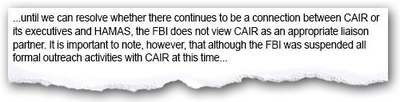
CAIR was uncharacteristically reticent when asked about Sadoun’s case in 2010. The group promotes itself as “arguably the most visible and public representative of the American Muslim community.” But questions about its connections to Hamas have dogged the organization for years. Those questions led the FBI to break off outreach contact with the group in 2008, with an associate director explaining, “until we can resolve whether there continues to be a connection between CAIR or its executives and HAMAS, the FBI does not view CAIR as an appropriate liaison partner.”
CAIR’s Hamas connection is established by evidence FBI agents uncovered while investigating a Muslim Brotherhood controlled Hamas-support network in the United States. One document, coinciding with the group’s 1994 creation, places CAIR among the Brotherhood’s “Palestine Committee” branches. A 1992 internal memo, “Islamic Action for Palestine,” explains that the Brotherhood’s guidance office and international Shura Council (governing board) created Palestine Committees throughout the world “whose job it is to make the Palestinian cause victorious and to support it with what it needs of media, money, men and all of that.”

Lest there be any confusion over who benefits from the committees’ efforts, the next paragraph is devoted to Hamas. “This Movement – which was bred in the bosom of the mother movement, ‘The Muslim Brotherhood’ – restored hope and life to the Muslim nation and the notion that the flare of Jihad has not died out and that the banner of Islamic Jihad is still raised.”

CAIR officials have tried to ignore or minimize attention given to the evidence establishing the Hamas connections, or to dismiss critics who call attention to them – including the IPT – as anti-Muslim smear merchants.

Disclosures in the FOIA records the IPT obtained should be more difficult for CAIR to brush aside. They come from two former activists, both of whom were deeply involved in the same Muslim Brotherhood/Hamas-support network.

Omar Ahmad and the Muslim Brotherhood
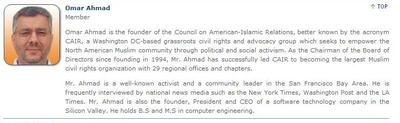
Omar Ahmad’s CAIR bio

The FOIA records include prosecution evidence accepted by the Immigration Court and used to find Sadoun deportable on a 21-count charging document. Among the records, an FBI agent’s sworn statement from February 2010 – just days before Sadoun’s scheduled deportation hearing – which described CAIR co-founder Omar Ahmad (also known as Omar Yehia) as “one of the leaders of HAMAS.”

An FBI report from January 2005 summarizes an interview with a man who said he was “part of the Brotherhood for many years” in the United States. The FBI describes him in immigration court papers as “a former leader of the Muslim Brotherhood.”

He provided a history of the Brotherhood in America, including a power struggle pitting members who wanted more autonomy from the International Muslim Brotherhood against those who favored “a direct and official relationship.”

During the mid-1980s, the FBI source became a member of the U.S. Brotherhood’s Majlis al Shura, or governing board, and he described its structure and operation during the 2005 interview. “The Palestine Committee was the largest and most powerful nationalistic committee within the Brotherhood at that time,” the FBI summary of the interview said.

The U.S. Palestine Committee, like all national chapters throughout the world, “report directly to the IMB [international Brotherhood]’s leadership,” an FBI declaration in the Sadoun case said. A chart included in the file shows Sadoun’s connections within the network, including CAIR.

According to the witness, the U.S. Brotherhood’s estimated 1,500 to 2,000 members unanimously supported the Palestinian intifada and saw Hamas as its leader. The group then created the Holy Land Foundation to be “the Brotherhood’s primary organization to support the Intifadah,” the FBI report of the 2005 interview said.

Other branches included a think tank called the United Association for Studies and Research (UASR) and a propaganda outfit called the Islamic Association for Palestine (IAP). UASR was created by Mousa Abu Marzook, a longtime Hamas political leader, along with Ahmed Yousef – later a Hamas spokesman in Gaza – and Nabil Sadoun, the longtime CAIR national board member.

UASR “published papers and books about Hamas,” the Fifth Circuit Court of Appeals wrote in denying the Holy Land Foundation’s appeal.

The IAP served as the Palestine Committee’s media outlet, promoting Hamas attacks and even publishing the terrorist group’s anti-Semitic charter which calls for Israel’s annihilation. The IAP worked with the Holy Land Foundation and other groups on fundraising events with the money being routed to charities controlled by Hamas. In addition, Marzook routed more than $750,000 to the IAP between 1985 and 1992.

IAP published a booklet, “America’s Greatest Enemy: The Jew! and an Unholy Alliance!”

CAIR founders Omar Ahmad and Nihad Awad worked for the IAP immediately before launching CAIR.

Ahmad became Palestine Committee president after Marzook was deported from the United States, the FBI source said. He knew this because Ahmad “approached [name redacted] and asked the Brotherhood’s permission to start the CAIR organization.” Ahmad “requested the Brotherhood’s approval for CAIR’s by-laws, etc. YEHIA [Ahmad] wanted CAIR to work for all Muslim causes in the United States. The Brotherhood authorized the opening of CAIR because, unlike the HLF, it was not an organization that was concerned only about activities taking place in the Eastern part of the world.”

In 2010, reports surfaced that, after the successful prosecution of five former Holy Land Foundation officials for Hamas support, investigators proposed indicting Ahmad, the CAIR co-founder. That request was rejected by the Justice Department.

Information in the FOIA records, including the witness statements, offers new insight into why the investigators pushed for more.

During the Holy Land trial, evidence showed that Ahmad played a key role in organizing and leading a secret 1994 meeting of Hamas supporters in Philadelphia. It was called in response to the 1993 Oslo Accords, which offered the potential for a peace agreement between Israelis and Palestinians.

The FBI recorded the weekend-long meeting. Transcripts entered into evidence show that the group opposed the deal for two reasons: They, like Hamas, opposed any peaceful settlement to the conflict. And, the agreement empowered the secular Palestine Liberation Organization to lead the newly created Palestinian Authority, diminishing the influence and power of the Islamist Hamas movement.

Ahmad helped determine who should attend the meeting and called it to order. At one point, he acknowledged that the group cannot afford to be honest with the public about their true ideology.

“We’ve always demanded the 1948 territories,” he said, referring to all of Israel and not just the West Bank and Gaza.

“Yes, but we don’t say that publicly,” an unidentified speaker said. “You cannot say it publicly, in front of the Americans.”

“No,” Ahmad replied. “We didn’t say that to the Americans.”

Nihad Awad and Hamas

Awad participated in that 1994 meeting, too, and joined the others in following instructions to refer to Hamas only in code. Those in the meeting were admonished not to say “Hamas,” but refer instead to “sister Samah” – or Hamas spelled backward.

“If there is a political issue, a Samah’s input, for instance, about this or that, we inform people to contact their representatives,” Awad said during the Philadelphia meeting.

Awad’s true mission was spelled out during a 2010 interview FBI officials had with Mohamed Shorbagi, a former Rome, Ga. imam who pleaded guilty to conspiring to provide material support to Hamas through donations and service to the Holy Land Foundation, and agreed to cooperate with federal prosecutors, testifying twice for the government in Hamas-support cases.

Shorbagi remembered attending the 1994 Muslim Arab Youth Association (MAYA) conference in Chicago where the Palestine Committee organized break-out sessions. Shorbagi attended a political group discussion with Nihad Awad. Awad, he was told, had been sent by the IAP to Washington “in order to educate and inform U.S. political leaders about the Palestinian cause. His job was to influence the leaders of the U.S. government in favor of the Palestinian cause,” an FBI memo summarizing the interview said.

Shorbagi had a different take: “The IAP’s only purpose was to support Hamas through media work. [Name redacted]’s job within the IAP was to work for and support Hamas and nothing else,” an FBI report from his 2009 interview said.

The head of the IAP in Dallas told Shorbagi that Awad went to Washington, D.C. for the IAP in order to represent Hamas.” But then the idea to start CAIR came to fruition and Awad was tasked with running the new organization. “It was known in the community that CAIR was under or influenced by the IAP because its (CAIR) leadership had come from the IAP.”

The timing and the claim that Ahmad sent Awad to Washington fits with other information already in the public domain.
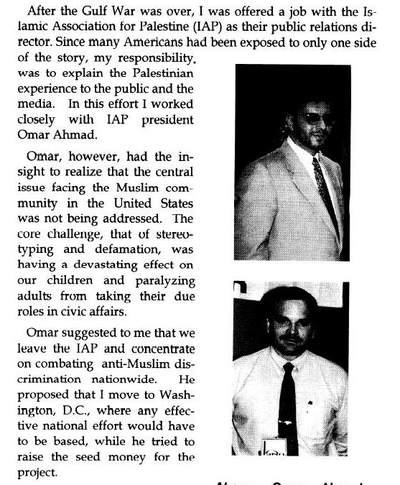
Awad’s own account of his move to Washington, in an article he wrote in 2000, offers a more benign motivation, but matches Shorbagi in saying it was Ahmad who “proposed that I move to Washington, D.C., where any effective national effort would have to be based.”

During a 2003 deposition in a civil lawsuit, Awad said he served as public relations chief for the Islamic Association for Palestine (IAP) in 1993, then moved to Washington “to work for CAIR.” As mentioned, the IAP was the Palestine Committee’s media arm, publishing the Hamas charter and reproducing Hamas communiques. Awad denied knowledge of this fact and claimed he had never read the Hamas charter.

In the deposition, Awad described IAP merely as a “cultural association” and denied ever seeing or reading the Hamas charter. But Shorbagi told federal investigators that “IAP ‘festivals’ championed the cause of Hamas exclusively” after the intifada. This point is clearly established by video exhibits entered into evidence during the Holy Land Foundation trial.

In March 1994, Awad was part of a panel discussion at Miami’s Barry University. He said he used to support the PLO, but “after I researched the situation inside Palestine and outside, I am in support of the Hamas movement more than the PLO.” In the 2003 deposition, he claimed this was due to Hamas social services and not because of its violent attacks against Israel.

But in a November 1994 interview with “60 Minutes,” Mike Wallace asked Awad for his views of the “military undertakings of Hamas.”

“Well, I think that’s for people to judge there,” Awad said.

Wallace asked again.

“The United Nations Charter grants people who are under occupation to defend themselves against illegal occupation,” Awad said.

In addition to being the only executive director CAIR has had, Awad also serves as a national board member.

On social media posts a year ago, Awad argued that “Israel is the biggest threat to world peace and security,” making the statement between unrelated posts about acts of brutality committed by ISIS terrorists. Since then, other senior CAIR officials have issued their own Twitter posts arguing Israel is on par with ISIS.

Hamas officials in Gaza have taken notice of Shorbagi’s cooperation with the government. They were holding his passport, his father told him, “because the Holy Land Foundation received stiff prison sentences because of [Shorbagi]’s testimony on behalf of the U.S. Government. [Shorbagi]’s family warned him not to return to Gaza even for a few minutes.”

*** Ah, but there is more and if you can stand to know more truths on Muslim Organizations in America, click here. FOIA Exposes Deported CAIR Official’s Support for Jihad
