Operation Choke Point, Choke Tubes

Announced and launched in 2014, the White House in collusion with the Department of Justice created an edict in the national banking system that is allegedly to protect consumers, from what exactly is still to be determined, but Operation Choke Point leads to the assassination of private business and then it is an attack on customers. There are some bankers that are happy to comply, yet others not so much.

In a recent weekly address in Spanish, White House Director of the Domestic Policy Council Cecilia Muñoz weaved the President’s budget proposal into a fictitious narrative aimed to assure the Hispanic community that the administration’s policies will contribute to provide opportunity, economic growth, and prosperity, promising “it will grow the middle class.”

But as has all-too-often been the case during the last few years, the administration’s rhetoric concerning economic opportunity flies in the face of heavy-handed political maneuvers that destroy chances for upward mobility.
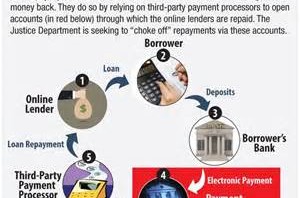
 

Choke Point

For example, the Obama administration has been employing clandestine policies to cut off easy access to cash by systematically eliminating alternative lending options. In August 2013, the Wall Street Journal reported that the Justice Department was “targeting banks that service a broad range of what it considers questionable financial ventures, including online payday lenders.” Additionally, banks like Capital One have already closed the accounts of check-cashing companies. By going after these companies, hardworking Hispanics without a bank account may not have a place to cash their paychecks.

This affects anyone who finds themselves strapped for cash, including self-employed and blue-collar workers. The administration’s regulatory assault is not an assault on the short-term lending industry, but rather on any consumer who relies on having access to cash in cash flow emergencies, especially in underserved communities. For example, two-thirds of all Hispanics work in the service industry, and they will feel the brunt of these policies more than others. In addition, alternative lenders can cater to newer immigrants without substantial credit histories — a demographic that banks fail to serve.

Contrary to the administration’s claim that these targeted financial businesses have a “disparate impact” on minorities, the truth is that these heavy-handed regulations will have a disparate impact on the country’s minorities, many of which live in communities with limited access to traditional banks. And the answer is not capping rates or creating artificial “waiting periods” as the controversial Consumer Financial Protection Bureau has considered. Those remedies will ultimately ensure that the companies will stop providing these services since they are no longer profitable.

In addition to restricting financial options for blue-collar workers, lending regulation will also hurt small-business owners and entrepreneurs, an area where Hispanics have contributed greatly to the American economy. Hispanic entrepreneurs fortified the U.S. economy by an estimated $468 billion last year. This has been pivotal for the nation’s economy, especially in the face of the economic recession.

For frame of reference, from 2010 to 2012, the total number of American entrepreneurs declined by 250,000. Yet in the same period, there were 160,000 new Hispanic entrepreneurs in the U.S.

From 1990 to 2012, entrepreneurship among Hispanics multiplied nearly 10 times that of the general population. Many of them utilized these alternative loan products for quick access to capital, capital that is harder than ever to receive from traditional banks due to the passage of the Dodd-Frank Act.

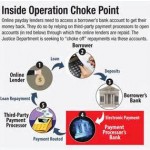
Targeting payday lenders is only the tip of the iceberg of the administration’s broader initiative, which they tellingly named Operation Choke Point, a maneuver designed to literally choke private businesses at their financial wellsprings by intimidating banks and lending institutions into compliancy. These purely political maneuvers hold no promise for actual economic recovery.

In addition to targeting short-term lenders, another goal of the Obama Administration’s Operation Choke Point is to obstruct multi-level marketing companies, where new entrepreneurs often get their start.

Take Herbalife, a company where Hispanics make up 60 percent of direct sellers. The administration opts to gut profitable companies, condemning sales practices that they judge to be inferior while at the same time initiating no real recovery measures. These policies hurt minorities, who disproportionately make up the lower echelon of workers that are forced to seek irregular forms of employment.

Government agencies and the folks who seek to empower them with more control over the lives of ordinary people are quick to claim “disparate impact” as a justification for their regulatory excesses. But in order to understand the full story, policymakers should look at the impact those very same regulations have on the economy at large, all the people whose jobs and livelihoods are tied to the impacted industries, and the disparate impact the destruction of those industries will have on underserved communities all across the country.

Without a sane analysis, efforts like Operation Choke Point can really only be interpreted as political operatives prioritizing an ideological crusade over an interest in actual economic recovery.

Now for the Choke Tube component, it is the gun dealers and the parts dealers……the backdoor method to infringe again on the 2nd Amendment.

BankUnited N.A., which dropped Top Gun Firearms Training & Supply in  Miami from its customer list, declined to comment.

In a statement to The Washington Times, Bank of America said: “We would not  deny banking services to an organization solely on the basis of its  industry.”

The banking giant blamed a misunderstanding with the Arizona gun  manufacturers McMillan Group International and American Spirit Arms.

However, the American Banking Association, the industry’s advocacy group in  Washington, said businesses deemed “risky” will be frozen out of the financial  system if the Justice Department continues Operation Choke Point because the  regulatory burden and risk of investigation will be too great for  less-specialized banks to bear.

“We’re being threatened with a regulatory regime that attempts to foist on us  the obligation to monitor all types of transactions,” Richard Riese, a senior  vice president at the American Bankers Association, said in the April 28 issue  of American Banker. “All of this is predicated on a notion that the banks are a  choke point for all businesses.”

In an interview with The Times, Mr. Riese said the cost of doing business  with gun retailers outweighs the benefits for some banks, given that regulators  deem the industry as “risky,” state laws vary on the sale of guns and  ammunition, and the Justice Department’s enforcement.

The Independent Community Bankers of America, an association for small banks,  said enforcement actions from the Justice Department are too broad and overly  aggressive.

“While preventing fraud is a top concern for community banks, it needs to be  balanced with ensuring that businesses and consumers that operate in accordance  with applicable laws can still access payment systems,” bankers association  President Camden Fine told the Justice Department in an April 7 letter. “ICBA  requests that the DOJ suspend Operation Choke Point immediately and focus its  resources directly on businesses that may be violating the law, rather than  targeting banks providing payment services.”

Justice’s operation threatens to “close access to the financial system to  law-abiding businesses, because the mere prospect of an enforcement action is  sufficient to cause financial institutions to restrict access to their payment  systems to only established companies that present low risks,” the organization  said.

‘No statutory authority’

Regulations on the financial industry have increased over the past few years,  said Thomas P. Vartanian, chairman of Dechert LLP, a global law firm  specializing in regulatory and financial matters.

He noted the chilling effect of overregulation by the Financial Fraud  Enforcement Task Force, an interagency behemoth that includes the departments of  Commerce, Justice, Labor, Education, Homeland Security and Justice along with  the Internal Revenue Service, the Securities and Exchange Commission, the Secret  Service, the FBI, the Social Security Administration and the Federal Trade  Commission.

“The key to effective regulation is the balancing between too little and too  much regulation,” Mr. Vartanian said. “The problem here is that there are now so  many regulators, including the Department of Justice, with their fingers on the  scales on that balancing act.”

Congressional Republicans say the Obama administration is using its  regulatory powers to shutter industries it doesn’t like. Last year, 31  Republicans accused the Justice Department and the Federal Deposit Insurance  Corp. of intimidating banks and payment processors to “terminate business  relationships with lawful lenders.”

In a March hearing before the Senate Banking, Housing and Urban Affairs  subcommittee on consumer protection, Sen. David Vitter, Louisiana Republican,  complained that several payday lenders — another industry labeled “risky” by the  administration — were being dropped by their banks in his home state.

“There is a determined effort from [the Justice Department] to the regulators  to cut off credit and use other tactics to force [payday lenders] out of  business,” Mr. Vitter said. “I find that deeply troubling because it has no  statutory basis, no statutory authority.”

In a House hearing in April, FDIC acting General Counsel Richard Osterman  defended his agency’s definition of what constitutes a “risky” business —  subject to money laundering or other criminal behavior — but made it clear that  no bank is outright prohibited from serving any such companies.

“We have actually put out a policy statement on this issue to make it very  clear from the very top that as long as financial institutions are properly  managing their relationships and the risks, they’re neither prohibited nor  discouraged from providing these services,” Mr. Osterman said.

“Basically, what we’re saying is, these types of programs can be, can involve  high-risk activities that could create litigation risk and reputation risk for  financial institutions,” he said. “So, they need to do due diligence to ensure  that  the folks who they’re banking are acting in a safe and sound manner.”

But the cost of that due diligence, coupled with the threat of a lawsuit for  doing business with a customer in an industry the government has defined as  risky, is having a chilling effect on legitimate companies such as gun dealers,  said Mr. Weinstock, the Hunton & Williams lawyer.

“We are one of the most heavily regulated industries in America,” said Mr.  Sirochman of American Spirit Arms. “We have to ship our guns to another federal  licensed dealers for pickup. The people that are picking up the rifles have to  go through a background check to make sure they don’t have any felonies. You  can’t own a gun or pass the background check if you do.

“All this is, is an assault on our Second Amendment rights.”
 

Cyber: When War Isn’t War

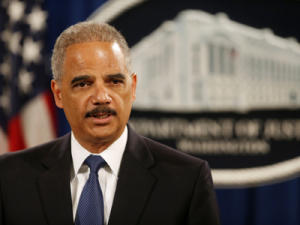
The most under reported war across the globe is cyber-spying. It has only been this week that Eric Holder and the Department of Justice decided to arrest a handful of Chinese that have been cyber-spying on America for years among other factions.

Cyber threats and hackers is nothing new, but it is rarely reported until it involves citizens like in the matter of Target stores last year. The question that remains officially unanswered is just why has the United States been so soft on cyber-wars against the United States? The answer is in fact foreign policy trumps everything and that should cause some real head-scratching as foreign policy under Barack Obama via Hillary Clinton and John Kerry is decayed.

There is the Syrian Electronic Army, Turkey’s RedHack, Serbia’s TeslaTeam, China has them, Russia has them, Iran has them. Hackers are the 21st century nuclear weapons. In fact nuclear weapons secrets is just what the Chinese hackers were after and are now sought by Eric Holder.

The United States brought first-of-its kind cyber-espionage charges Monday against five Chinese military officials accused of hacking into U.S. companies to gain trade secrets.

According to the indictment, hackers targeted the U.S. nuclear power, metals and solar products industries and are accused of stealing trade secrets and economic espionage. The victims are Alcoa World Alumina, Westinghouse Electric Co., Allegheny Technologies, U.S. Steel Corp., United Steelworkers Union, and SolarWorld, Attorney General Eric Holder said.

The charges underscore a longtime Obama administration goal of prosecuting state-sponsored cyber threats.

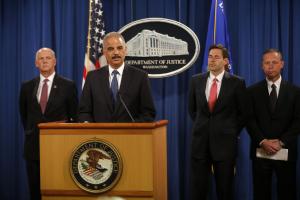
“The alleged hacking appears to have been conducted for no other reason than to advantage state-owned companies and other interests in China at the expense of businesses here in the United States,” Holder told a news conference at the Justice Department. “This is a tactic that the United States government categorically denounces.”

Said Bob Anderson Jr., executive assistant director of the FBI’s criminal, cyber response and services division: “This is the new normal. This is what you’re going to see on a recurring basis.”

In a statement, China’s Foreign Ministry said the U.S. charges were based on “fabricated facts” and jeopardize China-U.S. “cooperation and mutual trust.”

US Government: China Cited in Cyber-spying Case

US Government: China Cited in Cyber-spying Case

“China is steadfast in upholding cybersecurity,” said the statement. “The Chinese government, the Chinese military and their relevant personnel have never engaged or participated in cyber theft of trade secrets. The U.S. accusation against Chinese personnel is purely ungrounded and absurd.”

The charges against the Chinese military officials come on the heels of a separate worldwide operation over the weekend that resulted in the arrest of 97 people in 16 countries who are suspected of developing, distributing or using malicious software called BlackShades, Holder said. The software allows criminals to gain surreptitious control of personal computers. An announcement on those arrests was expected for later Monday in New York.

“These two cases show that we are stepping up our cyber enforcement efforts really around the globe,” Holder said, adding that the U.S. will not tolerate these activities.

U.S. officials have previously asserted that China’s army and China-based hackers had launched attacks on American industrial and military targets, often to steal secrets or intellectual property. China has said that it faces a major threat from hackers, and the country’s military is believed to be among the biggest targets of the NSA and U.S. Cyber Command.

“It is our hope that the Chinese government will respect our criminal justice system,” Holder said.

Attorney General Eric Holder, accompanied by, from …

In recent months, Washington has been increasingly critical of what it describes as provocative Chinese actions in pursuit of territorial claims in disputed seas in East Asia. For its part, Beijing complains that the Obama administration’s attempt to redirect its foreign policy toward Asia after a decade of war in the Middle East is emboldening China’s neighbors and causing tension.

The hackers allegedly stole emails and other communications that could have helped Chinese firms learn the strategies and weaknesses of American companies involved in litigation with the Chinese government or Chinese firms.

Despite the ominous-sounding allegations, at least one of the firms downplayed the hacking.

“To our knowledge, no material information was compromised during this incident, which occurred several years ago,” said Monica Orbe, Alcoa’s director of corporate affairs. “Safeguarding our data is a top priority for Alcoa, and we continue to invest resources to protect our systems.”

Last September, President Barack Obama discussed cybersecurity issues on the sidelines of a summit in St. Petersburg, Russia, with Chinese President Xi Jinping.

“China not only does not support hacking but also opposes it,” Premier Li Keqiang said last year in a news conference when asked if China would stop hacking U.S. websites. “Let’s not point fingers at each other without evidence but do more to safeguard cyber security.”

—————————–

But hacking still does threaten common citizens and yet no one tells us much less provides the tools to protect us.

Computer hacker forums lit up last week as Federal Bureau of Investigation agents and police in 17 countries began knocking on doors, seizing computers and making arrests.

On the popular websites where cyber criminals buy and sell software kits and help each other solve problems, hackers issued warnings about police visits to their homes.

The hackers quickly guessed that a major crackdown was underway on users of the malicious software known as Blackshades.

The malware sells for as little as $40. It can be used to hijack computers remotely and turn on computer webcams, access hard drives and capture keystrokes to steal passwords — without victims ever knowing it.

Criminals have used Blackshades to commit everything from extortion to bank fraud, the FBI said.

Last week, watching it all play out were about two dozen FBI cybercrime investigators holed up in the New York FBI’s special operations center, high above lower Manhattan.

Rows of computer screens flickered with updates from police in Germany, Denmark, Canada, the Netherlands and elsewhere. Investigators followed along in real time as hundreds of search warrants were executed and suspects were interviewed.

One of the largest global cybercrime crackdowns has yielded the arrests of over 100 people linked to the Blackshades malware.

The sweep, capping a two-year operation, was coordinated so suspects didn’t have time to destroy evidence. It included the arrest in Moldova of a Swedish hacker who was a co-creator of Blackshades. Prosecutors in the Manhattan U.S. attorney’s office are expected to announce the results of the probe later Monday.

700,000 victims around the world: Inside the FBI special operations center, six large computer monitors displayed key parts of the probe. Agents kept an eye on one screen showing a popular website where Blackshades was sold. The site was taken down by the FBI.

Another monitor showed a heatmap of the world displaying the locations of the 700,000 estimated victims, whose computers have been hijacked by criminals using the Blackshades software. Splotches of green on the map indicated concentrations of infected computers in highly populated parts of the U.S., Europe, Asia and Australia.

The FBI said that in just a few years Blackshades has become one of the world’s most popular remote-administration tools, or RATs, used for cybercrime.

Leo Taddeo, chief of the FBI’s cybercrime investigations in New York, said the unprecedented coordination with so many police agencies came about because of concern about the fast growth of cybercrime businesses.

“These cyber criminals have paid employees, they have feedback from customers — other cyber criminals — to continually update and improve their product,” Taddeo said recently. While he spoke, agents took calls from counterparts working the case in more than 40 U.S. cities.

Blackshades had grown rapidly because it was marketed as off-the-shelf, easy to use software, much like legitimate consumer tax-preparation software.

“It’s very sophisticated software in that it is not very easy to detect,” Taddeo said. “It can be installed by somebody with very little skills.”

Hack victim: I felt completely violated’: For victims whose personal computers were turned into weapons against them, the arrests bring reassurance.

Cassidy Wolf, the reigning Miss Teen USA, received an ominous email message in March 2013.

The email, from an unidentified sender, included nude photos of herself, obviously taken in her bedroom from her laptop. “Either you do one of the things listed below or I upload these pics and a lot more … on all your accounts for everybody to see and your dream of being a model will be transformed into a porn star,” the email said.

And so began what Wolf describes as three months of torture.

The email sender demanded better quality photos and video, and a five-minute sex show via Skype, according to FBI documents filed in court. He told her she must respond to his emails immediately — software he had installed told him when she opened his messages.

“I felt completely violated,” Wolf said in an interview. “I felt scared because I didn’t know if this person was a physical threat. My whole sense of security and trust was gone.”

A former classmate she knew, Jared Abrahams, had installed Blackshades malware on Wolf’s laptop. In March, the 20-year-old computer science student was sentenced to 18 months in prison after pleading guilty to extortion and unauthorized access of a computer.

Abrahams had been watching her from her laptop camera for a year, Wolf later learned. The laptop always sat open in her bedroom, as she played music or communicated with her friends.

Abrahams had used Blackshades to target victims from California to Maryland, and from Russia to Ireland. He used the handle “cutefuzzypuppy” to get tips on how to use malware, according to FBI documents. In all, he told the FBI, he had controlled as many as 150 computers.

Cybercriminals like Abrahams often rely on weak links in computer security, and mistakes by victims, to infect computers.

Many computer users don’t update anti-virus software. Many click on links sent in messages on social media sites such as Facebook, or in email, without knowing what they’re clicking on. In seconds, malware is downloaded. Often computer users have no idea infection has taken place.

“A hacker is going to go for the low-hanging fruit,” said Tyler Cohen Wood, a cybersecurity expert at the Defense Intelligence Agency and author of the book “Catching the Catfishers.”

Victims often don’t realize how easy they make themselves to be targeted and can better protect themselves by being careful about what they reveal online, Wood said.

Taddeo, the FBI cyber chief, said the most common way criminals have used Blackshades to target victims is by sending emails that seem legitimate, perhaps with a marketing offer, and with a link to click. “Anyone who signs on to the internet is potentially a victim of this tool,” he said.

In Wolf’s case, she received a Facebook message related to teen pageants. When her computer was infected it sent messages to other friends, whose computers also became infected.

The episode has made Wolf into a campaigner to urge young people to be better educated about online safety. She said her passwords are now more complicated and unique for each account, and she changes them often. She uses updated security software.

“I really didn’t think that everything I worked for could be lost because of this,” she said. “This can happen to anybody.” To top of page


The Persian Incursion the U.S. Ignores

Once again, John Kerry’s attempt to restart the peace talks between Israel and Palestine failed again yesterday with no progress. Talks are slated to go another round in June, all of this is a fool’s errand.

While Kerry is on his way to log as many travel miles as Hillary flew during her term at SecState, Kerry has abandoned concentration on several fronts least of which is Iran’s nuclear program. Rouhani is moving completely unchecked and quite aggressively against the United States with regard to declaring victory in Syria, his nuclear weapons program and signing deals all over the globe. Diplomatic efforts by Barack Obama and John Kerry  are folly. Yet, what else is Iran doing that should terrify America? One victory Iran is having is their clandestine cyber war, titled Saffron Rose.

A group of Iranian hackers have allegedly been targeting American defense contractors, and attempting to quell dissent in Iran itself, in an elaborate and technically advanced campaign that American security researchers call “Operation Saffron Rose.” The attacks began in October 2013 and continued until at least April 8, according to Milpitas, California-based security company FireEye, which documented the operation in a report released yesterday (May 13).

FireEye suspects that the group behind Saffron Rose is Ajax Security Team, whose members are thought to have conducted politically-motivated website defacements for several years. The group’s “graduation”  from vandalism to espionage shows that Iranian actors in the cyber attack space are becoming more sophisticated, FireEye says.

The “proxy software” was, of course, malicious.

According to FireEye, Ajax Security Team often uses a type of spyware that FireEye calls “Stealer.” Stealer often arrives as a Trojan horse, secretly bundled into other software such as proxies or VPN clients.

Once a target installs an infected program, Stealer runs a program called IntelRS.exe, which snoops on infected computers in a variety of ways. These methods include keylogging, taking screenshots, gathering system information (IP addresses, usernames, hostnames, open ports, installed applications), collecting email and instant messaging information, and collecting browser-based information such as login credentials, browsing history, cookies and bookmarks.

Stealer encrypts the data it gathers, then sends it to a command-and-control server. FireEye said one such server contained information on 77 individuals targeted in Operation Saffron Rose.

Many of the programs used to conceal Stealer are anti-censorship programs such as Psiphon, which don’t seem to be targeted toward the American defense companies that have been Ajax Security Team’s most recent targets. (One of Psiphon’s lead developers at the University of Toronto was Nart Villeneuve, who went on to become a malware researcher and is lead author of FireEye’s Saffron Rose report.)

The anti-censorship programs often appeared to be set to Iran Standard Time (which is uniquely three and a half hours ahead of Greenwich Mean Time) and had a Persian-language setting. FireEye believes that Ajax Security Team may also be targeting Iranians who use anti-censorship programs to dodge Iran’s strict Internet regulations.

Interestingly, FireEye’s report observed that Ajax Security Team has not been spotted using zero-day exploits, or secret vulnerabilities in program code, although the team has been seen using publicly known and unpatched exploits in its cybervandalism activities.

“It is unclear if they or other Iranian actors are capable of producing or acquiring exploit code,” FireEye’s researchers wrote.

FireEye’s report compared Saffron Rose to Shamoon, a highly destructive espionage campaign that targeted the Saudi Arabian oil company Saudi Aramco in August 2012. The Shamoon spyware gathered company data from infected computers, then disabled them by overwriting their master boot records, which PCs need to start up. Some experts suspected Shamoon came from Iran, but nothing has been proven.

The relationship between Ajax Security Team and the Iranian government is unclear, but FireEye said that Saffron Rose is proof that Iran’s online capabilities are becoming more sophisticated.

“There is increasing evidence to suggest that the hacker community in Iran is engaged in a transition from politically motivated defacements and denial-of-service attacks to cyberespionage activities,” its report concluded.

As Iran continues unchecked, it is important to know what else Iran is doing.

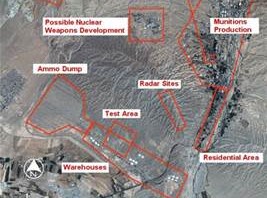
Parchin


Washington-based analysts say Iran has pressed ahead with operations at a military base suspected to have hosted nuclear weapon-related experiments.

An April 25 satellite image of Iran’s Parchin installation suggests the nation, since January, has moved “possible building material and debris” near a building that the International Atomic Energy Agency has sought unsuccessfully for more than two years to visit, according to a Monday assessment by the Institute for Science and International Security. The U.N. nuclear watchdog believes the structure may once have been capable of hosting explosion tests relevant to nuclear-arms development.

“Two trucks or containers have been removed from the area surrounding the suspected high-explosives test building, while a larger object, possibly a truck or large container, appears slightly north of it,” ISIS analysts David Albright and Serena Kelleher-Vergantini said in their report.

Iran, which insists that its atomic ambitions are strictly peaceful, began altering the Parchin facility weeks after IAEA officials began seeking access to the location, the independent experts said.

The nation last year undertook a months-long pause in activities at the site, but a January image analysis revealed an apparent resumption of operations there, the analysis says.

This week’s findings came as Iran launched a new round of multilateral talks aimed at defusing international fears over Tehran’s suspected nuclear-arms aspirations.

“By continuing to modify the site and denying the IAEA access, Iran is reducing the chances of reaching a comprehensive solution by the initial deadline of July 20,” when an interim nuclear agreement with major powers is scheduled to expire, the ISIS report says.

Certain specialists have questioned the U.N. agency’s rationale for pressing to visit the Parchin compound. The evidence prompting those requests — intelligence gathered and furnished to the agency by IAEA member governments — remains confidential.


The Database and the Duty

There is not a single movement, not a single decision or a single transaction that any of us make that find its way into an obscure unknown database without our knowledge or approval.

We clearly are aware by now of the NSA intruding into all of our communications whether it be internet activity, phone metadata activity or any bank transaction. It was revealed by General Hayden, formerly chief of the NSA, only last week in an interview, that metadata is used to kill.

Congresswoman Maxine let it slip some time ago that Barack Obama had a database on everyone, on everything. Did you approve of this or did you know this?

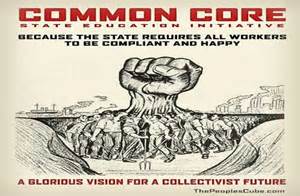
Now comes the database on our children and the CommonCore Education system. Just why would any system within the entire government public schools need to advertise acceptance and success on television if it was so great?

Now if you need to know more about just what schools across the country are doing and networking data on your children, it will cost you thousands to find out. Not only is CommonCore about a one size fits all system for children, it is modeled for a very slim menu of educational choices for students to ‘fit’ what the government and corporations say they will need in the future. What is also very chilling is the basis of this system is to indoctrinate students into ‘workers’, which is a communist term that few recognize. The term employee is gone from the government lexicon.

So, if you are an interested parent, an involved parent then you are presently aware of this clandestine educational system, however if you are on a quest to find out more on big government’s intrusion into your family and your children to protect your parenting rights and sovereignty as an individual, well you will get huge pushback from the very school system you pay for.


commoncore

Price for Nevada dad to see state’s school files on his kids: $10G

Nevada dad John Eppolito got a bad case of sticker shock when he asked state education officials to see the permanent records of his four children.

He was told it would cost $10,194.

A Lake Tahoe-area real estate agent by trade and a fierce opponent of Common Core, Eppolito was concerned about Nevada’s recent decision to join a multi-state consortium that shares students’ data. He wanted to know exactly what information had been compiled on his school-age kids. But state officials told him he would have to pay fees and the cost of programming and running a custom report.

“The problem is that I can’t stop them from collecting the data,” Eppolito told FoxNews.com. “I just wanted to know what it [collected data] was. It almost seems impossible. Certainly $10,000 is enough reason to prevent a parent from getting the data.”

“This data is for everyone except the parents. It’s wrong.”- John Eppolito

Nevada has spent an estimated $10 million in its seven-year-old System of Accountability Information in Nevada, known as SAIN. Data from county school systems is uploaded nightly to a state database, and, under the new arrangement, potentially shared with other counties and states. But Eppolito wonders why the state is collecting data that parents can’t even view.

“This data is for everyone except the parents,” Eppolito said. “It’s wrong.”

According to the federal Family Educational Rights and Privacy Act (FERPA), parents have the right to review their kids’ records. Small fees are allowed to be issued for records unless they in any way prevent them from obtaining them.

“Unless the imposition of a fee effectively prevents a parent or eligible student from exercising the right to inspect and review the student’s education records, an educational agency or institution may charge a fee for a copy of an education record which is made for the parent or eligible student,” reads a section of the act. “An educational agency or institution may not charge a fee to search for or to retrieve the education records of a student.”

According to the regulations, the requests and its criteria apply to “Any state educational agency and its components.”

The Nevada Department of Education attempted to justify the hefty price tag for viewing copies of student records in a response to Eppolito.

“Because the SAIN system is not designed to create reports that display individual student data in a readable format, the parent was initially told that the requested reports do not exist and cannot be produced,” reads the sheet viewed by FoxNews.com “Upon continued insistence from the parent, [Nevada Department of Education] staff assessed how much programming time would be required to write new queries and develop a data table to create readable reports for the parent. Staff determined that it would take at least 3 weeks (120 hours) of dedicated programming time to fulfill the parent’s request. At the applicable wage rate of $84.95/hour, the requested work resulted in a $10,194 price tag.”

Eppolito, who leads the group Stop Common Core Nevada, is suspicious that the collection and sharing of data could be related to Common Core, the national education standard being pushed by Washington which has drawn the ire of parents and grassroots groups across the country. Indeed, the federal government has been working to expand the amount of data on individual students, according to EAG News, an education watchdog group that claims data gathering systems like SAIN have been sprouting up in states across the country in recent years. Eppolito believes his experience is part of the move away from local and parental control of education.

Joy Pullmann, an education research fellow with the Heartland Institute, agreed.

“We have witnessed a shift in thinking about government from one that serves at the pleasure of citizens and to do their bidding, to one that considers its role to manage the populace,” Pullmann told FoxNews.com. “That’s why states are constructing large data systems to collect information about children from birth. It is, obviously, impossible for parents to control what schools and government are doing with their children if they can’t even find out because it’s so costly.

“This is a danger spot that most parents and the public are unaware of, and the longer they are unaware, the more damage will be done to their family privacy and control over their kids’ education,” Pullman added.

But a spokeswoman for the national Council of Chief State School Officers, the main group behind the Common Core State Standards Initiative, said it has nothing to do with data collection at the state level.

“Implementing the Common Core State Standards does not require data collection,” said Carissa Miller, deputy executive director for the council. “Standards define expectations for what students should know and be able to do by the end of each grade. The means of assessing students and the data that result from those assessments are up to the discretion of each state and are separate and unique from the Common Core.”

The Nevada Department of Education has requested a legal opinion on how it is required to respond to student data records requests from parents.

“In response to concerns about privacy and security of student data, staff at the Nevada Department of Education has reviewed the department’s student privacy and data security practices,” spokeswoman Judy Osgood told FoxNews.com. “As a result of that review, the department developed or updated a number of documents that can be found on the NDE web page dedicated to student data privacy.”

For now, the cost of obtaining student records has not changed, Osgood said.

_____

When does it end? When will we get smarter? When will we challenge the system?

The death of outrage….


Obama’s Big Data is Big Trouble

After the revelations of Wikileaks and Edward Snowden on the previously unknown activities of the NSA, the FBI, the ODNI and more, Americans and foreign leaders have come to understand the far reaching and obscure violations of any expectation of privacy. While countries spy on other countries, little has been preserved when it comes to the common citizen and their expectation of privacy.

Too many outside corporations are in partnership with Big Data that include internet technology companies, telecom companies and law enforcement.

Just this week without any fanfare, John Podesta, who is the White House Counselor to the President released the report and findings after his committee of Science and Technology were tasked with a 90 day study group on Big Data. The findings are disturbing and do nothing but encourage more violations of the 4th Amendment.

The big question remains, if the activities of the NSA and partners are preserving the Constitutional protections, then why is this study group suggesting legislation titled the ‘Consumer Privacy Bill of Rights’?

The study group fact sheet is here.  The full 85 page report is here.

In the meantime, Yahoo is not your friend.

Yahoo joins companies which track their users, If PRIVACY MATTERS Leave Yahoo

http://hackersnewsbulletin.com/2014/05/yahoo-joins-companies-track-users-privacy-matters-leave-yahoo.html

Some technology companies like Apple and Facebook are reported to be defying NSA mandates on secrecy, but the question is just how much are these companies really telling users and is it accurate?

Frankly, after all the lies, subterfuge and collusion of this administration, what should we trust that is being told to us?


Spying

The summary of the report as posted on the White House website reads as follows:

Over the past several days, severe storms have battered Arkansas, Oklahoma, Mississippi and other states. Dozens of people have been killed and entire neighborhoods turned to rubble and debris as tornadoes have touched down across the region. Natural disasters like these present a host of challenges for first responders. How many people are affected, injured, or dead? Where can they find food, shelter, and medical attention? What critical infrastructure might have been damaged?

Drawing on open government data sources, including Census demographics and NOAA weather data, along with their own demographic databases, Esri, a geospatial technology company, has created a real-time map showing where the twisters have been spotted and how the storm systems are moving. They have also used these data to show how many people live in the affected area, and summarize potential impacts from the storms. It’s a powerful tool for emergency services and communities. And it’s driven by big data technology.

In January, President Obama asked me to lead a wide-ranging review of “big data” and privacy—to explore how these technologies are changing our economy, our government, and our society, and to consider their implications for our personal privacy. Together with Secretary of Commerce Penny Pritzker, Secretary of Energy Ernest Moniz, the President’s Science Advisor John Holdren, the President’s Economic Advisor Jeff Zients, and other senior officials, our review sought to understand what is genuinely new and different about big data and to consider how best to encourage the potential of these technologies while minimizing risks to privacy and core American values.

Over the course of 90 days, we met with academic researchers and privacy advocates, with regulators and the technology industry, with advertisers and civil rights groups. The President’s Council of Advisors for Science and Technology conducted a parallel study of the technological trends underpinning big data. The White House Office of Science and Technology Policy jointly organized three university conferences at MIT, NYU, and U.C. Berkeley. We issued a formal Request for Information seeking public comment, and hosted a survey to generate even more public input.

Today, we presented our findings to the President. We knew better than to try to answer every question about big data in three months. But we are able to draw important conclusions and make concrete recommendations for Administration attention and policy development in a few key areas.

There are a few technological trends that bear drawing out. The declining cost of collection, storage, and processing of data, combined with new sources of data like sensors, cameras, and geospatial technologies, mean that we live in a world of near-ubiquitous data collection. All this data is being crunched at a speed that is increasingly approaching real-time, meaning that big data algorithms could soon have immediate effects on decisions being made about our lives.

The big data revolution presents incredible opportunities in virtually every sector of the economy and every corner of society.

Big data is saving lives. Infections are dangerous—even deadly—for many babies born prematurely. By collecting and analyzing millions of data points from a NICU, one study was able to identify factors, like slight increases in body temperature and heart rate, that serve as early warning signs an infection may be taking root—subtle changes that even the most experienced doctors wouldn’t have noticed on their own.

Big data is making the economy work better. Jet engines and delivery trucks now come outfitted with sensors that continuously monitor hundreds of data points and send automatic alerts when maintenance is needed. Utility companies are starting to use big data to predict periods of peak electric demand, adjusting the grid to be more efficient and potentially averting brown-outs.

Big data is making government work better and saving taxpayer dollars. The Centers for Medicare and Medicaid Services have begun using predictive analytics—a big data technique—to flag likely instances of reimbursement fraud before claims are paid. The Fraud Prevention System helps identify the highest-risk health care providers for waste, fraud, and abuse in real time and has already stopped, prevented, or identified $115 million in fraudulent payments.

But big data raises serious questions, too, about how we protect our privacy and other values in a world where data collection is increasingly ubiquitous and where analysis is conducted at speeds approaching real time. In particular, our review raised the question of whether the “notice and consent” framework, in which a user grants permission for a service to collect and use information about them, still allows us to meaningfully control our privacy as data about us is increasingly used and reused in ways that could not have been anticipated when it was collected.

Big data raises other concerns, as well. One significant finding of our review was the potential for big data analytics to lead to discriminatory outcomes and to circumvent longstanding civil rights protections in housing, employment, credit, and the consumer marketplace.

No matter how quickly technology advances, it remains within our power to ensure that we both encourage innovation and protect our values through law, policy, and the practices we encourage in the public and private sector. To that end, we make six actionable policy recommendations in our report to the President:

Advance the Consumer Privacy Bill of Rights. Consumers deserve clear, understandable, reasonable standards for how their personal information is used in the big data era. We recommend the Department of Commerce take appropriate consultative steps to seek stakeholder and public comment on what changes, if any, are needed to the Consumer Privacy Bill of Rights, first proposed by the President in 2012, and to prepare draft legislative text for consideration by stakeholders and submission by the President to Congress.

Pass National Data Breach Legislation. Big data technologies make it possible to store significantly more data, and further derive intimate insights into a person’s character, habits, preferences, and activities. That makes the potential impacts of data breaches at businesses or other organizations even more serious. A patchwork of state laws currently governs requirements for reporting data breaches. Congress should pass legislation that provides for a single national data breach standard, along the lines of the Administration’s 2011 Cybersecurity legislative proposal.

Extend Privacy Protections to non-U.S. Persons. Privacy is a worldwide value that should be reflected in how the federal government handles personally identifiable information about non-U.S. citizens. The Office of Management and Budget should work with departments and agencies to apply the Privacy Act of 1974 to non-U.S. persons where practicable, or to establish alternative privacy policies that apply appropriate and meaningful protections to personal information regardless of a person’s nationality.

Ensure Data Collected on Students in School is used for Educational Purposes. Big data and other technological innovations, including new online course platforms that provide students real time feedback, promise to transform education by personalizing learning. At the same time, the federal government must ensure educational data linked to individual students gathered in school is used for educational purposes, and protect students against their data being shared or used inappropriately.

Expand Technical Expertise to Stop Discrimination. The detailed personal profiles held about many consumers, combined with automated, algorithm-driven decision-making, could lead—intentionally or inadvertently—to discriminatory outcomes, or what some are already calling “digital redlining.” The federal government’s lead civil rights and consumer protection agencies should expand their technical expertise to be able to identify practices and outcomes facilitated by big data analytics that have a discriminatory impact on protected classes, and develop a plan for investigating and resolving violations of law.

Amend the Electronic Communications Privacy Act. The laws that govern protections afforded to our communications were written before email, the internet, and cloud computing came into wide use. Congress should amend ECPA to ensure the standard of protection for online, digital content is consistent with that afforded in the physical world—including by removing archaic distinctions between email left unread or over a certain age.

We also identify several broader areas ripe for further study, debate, and public engagement that, collectively, we hope will spark a national conversation about how to harness big data for the public good. We conclude that we must find a way to preserve our privacy values in both the domestic and international marketplace. We urgently need to build capacity in the federal government to identify and prevent new modes of discrimination that could be enabled by big data. We must ensure that law enforcement agencies using big data technologies do so responsibly, and that our fundamental privacy rights remain protected. Finally, we recognize that data is a valuable public resource, and call for continuing the Administration’s efforts to open more government data sources and make investments in research and technology.

While big data presents new challenges, it also presents immense opportunities to improve lives, the United States is perhaps better suited to lead this conversation than any other nation on earth. Our innovative spirit, technological know-how, and deep commitment to values of privacy, fairness, non-discrimination, and self-determination will help us harness the benefits of the big data revolution and encourage the free flow of information while working with our international partners to protect personal privacy. This review is but one piece of that effort, and we hope it spurs a conversation about big data across the country and around the world.