Twitter War Report Describes Spamming the Election Tweets

And Twitter users believed….

****

Twitter Election Bots Hide Tons of Reply Spam Behind Boring Themed Accounts

Motherboard: A much-discussed research paper out of Oxford this month concluded that millions of tweets about the presidential election are generated by highly automated Twitter accounts. According to the authors’ analysis, about a third of pro-Trump traffic, and one fifth of pro-Clinton tweets, is “driven by bots and highly automated accounts.”

The Oxford study pegged Twitter accounts as highly automated if they posted at least 50 times a day using any one of a group of election hashtags—such as #MAGA, #TrumpTrain, #ImWithHer, and #StrongerTogether—over a three-day period.

The paper conceded that “extremely active” humans might post 50 or more times per day on one of the 52 hashtags they selected, “especially if they are simply retweeting the content they find in their social media feed.”

At the Electome, a project of the Media Lab at MIT, we use complex machine learning algorithms to analyze the election conversation on Twitter. The Oxford paper made us curious about the possibility of spotting bots in the dashboard we recently built for journalists covering the election.

Read more: How Mexican Twitter Bots Shut Down Dissent

Bot detection can be challenging, partly because they come in different varieties. Some are purely automated accounts, while others layer some manual curation on top of automated tweets.

Last week, we noticed a spike while searching our Twitter data on the keyword “rigged.”

In early September, the “rigged” discussion on Twitter, which previously had revolved around a variety of issues including economic inequality and the electoral process, shifted suddenly toward immigration—that is, tweets containing the word “rigged” also used terms connected to immigration.

Digging into the data, we found one verbatim tweet showing up across a dozen or so handles, each of which posted the same message over and over each day: “Immigration Policy is RIGGED against American Workers #Trump2016 #FeelTheBern.”

Beyond using identical phrasing—including idiosyncratic capitalization—the tweets coming from these accounts all linked to the same video, which compares statements by Donald Trump and Bernie Sanders about immigration policy. Each video, in turn, linked to the same anti-Clinton Twitter account.

Although the accounts don’t have the telltale bot profile image—the egg—based on their characteristics and activity, including breakneck output of strikingly similar content, these are clearly spam handles, and apparently at least somewhat automated.

Wading in further, we found that each account puts out a stream of photos and GIFs on a given theme, on top of a common rotation of anti-Clinton videos and memes.

The bots follow the same playbook: Publicly they tweet the same innocuous content fitting their theme, while simultaneously flooding the replies of public figures and media outlets—essentially piggybacking on famous tweets to influence users who see those tweets’ replies—with campaign-driven videos and memes.

One apparent bot account has pumped out more than 27,000 tweets since its creation in March, with content that tends to mix videos of Clinton advisor John Podesta with memes from the 1970s film A Clockwork Orange:

          TheTweetest @TheTweetest

you found out…

Hillary killed Osama bin Laden

..WITH HER EYES

@HillaryClinton

A zombie-themed account boasts 30,000 tweets since April: Podesta mingled with the undead:

Then there’s the seeming food porn handle that has put out 21,000 tweets since March: Podesta plus photogenic snacks:

In the last few days, these three accounts have tweeted thousands of times, sometimes hundreds of posts in a single hour. Most went entirely dark on October 30, for some reason, then geared up early on October 31 to put out hundreds more by noon.

Other apparently automated accounts pay homage to burgers, the Doge meme, geese, Hydrox cookies, knights, pigs, pulp science fiction, Putin, trains, and Transformers. They vary in frequency of activity, but each circulates the same videos with identical accompanying text.

Spambots like these have been spotted at other points in this election. In April, a conservative activist noticed a few hundred accounts frantically tweeting an identical call to file federal complaints against Ted Cruz for robocalls.

In June, a reporter for New York magazine mined the feeds of three pro-Trump, alt-right accounts, noting that they consistently replied to Trump’s tweets within mere seconds and with memes attached. Like the accounts we’ve identified here, many of their replies lacked any connection to the subject of Trump’s original tweet.

Last week, one of those three accounts circulated a hoax image of immigration officers arresting Hispanic voters, according to ProPublica’s Electionland.

Difficult as it is to track down accounts like these or gauge their prevalence, it’s even harder to discern how they might affect the overall Twitter discussion about the election. Whether or not the Oxford analysis proves accurate, its authors performed a service merely by raising public awareness of election bots.  More here including additional tweets.

****

Then there was that weird FBI release on Twitter:

FBI to Conduct Internal Probe of Election-Season Tweets

GovernmentExec: Suddenly renewed activity on an FBI Twitter account publicizing Freedom of Information Act releases has prompted an internal bureau review of the propriety of such activity so close to the Nov. 8 election, according to a source involved in the matter.

In emails obtained by Government Executive sent to an ex-investigative reporter who filed complaints, the deputy at the FBI’s Office of Professional Responsibility on Tuesday revealed that the complaint about possible political favoritism in tweeting has been referred to the FBI’s Inspection Division.

“Upon the completion of its investigation, the matter will be referred to my office for adjudication,” wrote Candice Will, assistant director of the Office of Professional Responsibility to Jonathan Hutson, a former investigative reporter and now a media consultant. He received a similar email from Nancy McNamara, assistant director of the FBI’s Inspection Division, with two more FBI employees copied.

An FBI official told Government Executive that on Oct. 30, electronic patches were sent through the FBI’s content management system to fix the automatic feed of information that goes through the FOIA Twitter account.

First reported on Thursday by the liberal-leaning news service Think Progress, the new probe comes days after questions were raised about the FBI FOIA office’s release on Monday of 129 pages of documents pertaining to the 2001-2005 investigation of President Bill Clinton’s last-minute pardon of fugitive financier Marc Rich, whose wife was a longtime Clinton donor.

That probe, led for a time by current FBI Director James Comey as a U.S. attorney, ended with no prosecutions, which is why the Hillary Clinton campaign immediately complained that its timing seemed questionable. “Absent a (Freedom of Information Act) deadline, this is odd,” Clinton campaign spokesman Brian Fallon tweeted. “Will FBI be posting docs on Trumps’ housing discrimination in ‘70s?”

It also comes less than a week after Comey shook up the presidential race with his letter to lawmakers and FBI staff suggesting that newly uncovered emails in an unrelated probe might be “pertinent” to the bureau’s suspended investigation Hillary Clinton’s mishandling of State Department emails.

The FBI responded to this week’s complaints with a statement outlining its FOIA policies:

“The FBI’s Records Management Division receives thousands of FOIA requests annually which are processed on a first in, first out basis,” it said. “By law, FOIA materials that have been requested three or more times are posted electronically to the FBI’s public reading room shortly after they are processed. Per the standard procedure for FOIA, these materials became available for release and were posted automatically and electronically to the FBI’s public reading room in accordance with the law and established procedures.”

But critics have now zeroed in on the bureau’s Twitter account at the FBI Records Vault. As noted by ex-investigative reporter Hutson, who first filed a complaint with the Justice Department inspector general, the FBI’s FOIA Twitter account had been silent for the past year.  “For the first few years after its 2011 launch, most of its tweets produced only 10 re-tweets, the most being 122,” Hutson said. “But suddenly, at 4:00 a.m. on Sunday, Oct. 30, it roared to life, not for business and not usual.”

The Tweet on Bill Clinton’s Marc Rich pardon, which was part of a probe on the Clinton Foundation, “was highly negative for Hillary Clinton” because it didn’t mention that no charges were brought, while another recent FBI tweet, announcing new documents pertaining to Republican candidate Donald Trump’s father’s past housing industry activities, favored Trump by “calling him a philanthropist,” which in Hutson’s view is “editorial shading.”

Also, Hutson said, “it is significant and telling” that the FBI FOIA people also recently tweeted the FBI’s ethics manual. “That shows they know full well that is it illegal for bureau employees to influence or effect the outcome of an election.” Hutson believes there may be violations of the Hatch Act, Justice Department guidelines and the FBI ethics manual. The FBI vault item on the Clinton Foundation, he pointed out, now has 9,000 re-tweets.

FOIA specialists consulted by Government Executive had mixed evaluations of this turn of events, both for the release of the FOIA documents and the related tweeting. “It’s nothing abnormal,” said Ronald Kessler, an author and longtime investigative journalist who has written on the FBI. “People don’t understand that it would be improper for the FBI to withhold a release of material to try to manipulate media coverage simply because agents happen to finish their work on it late Friday afternoon or just before an election. Like all of us humans, agents try to work extra hard to finish a project that is close to completion before a long weekend.”

Anne Weismann, executive director of the Campaign for Accountability, said after all her years of sending FOIA requests to the FBI, she found it “astonishing” that the FBI is tweeting, saying it “adds to the unprecedented nature” of this fall’s FBI’s intervention in the presidential race. She also found it odd that the FBI released what appears to be a “first round, partial” file of documents in the Marc Rich case, “with no context.” “Unless you knew they were talking about a major, very serious investigation of a former president, you wouldn’t know that the FBI never prosecuted Clinton,” she said. “I’ve pushed the FBI in litigation for release of documents on a rolling basis, and they always say no.”

Alex Howard, a senior analyst at the Sunlight Foundation, said the FBI has some flexibility in releasing documents. “Agencies are mandated to acknowledge a FOIA request in 20 days, although many in practice do not. Unless an agency is under instruction by a judge to release records responsive to a FOIA lawsuit on a specified timeline or by a given deadline, however, agencies can have some discretion in when they disclose records to a requester, unless their FOIA regulations specify otherwise. The “first in, first out” standard is one such rule: some agencies have pending FOIA requests going back over a decade.”

Daniel Schuman, policy director for Demand Progress, said, “There’s not enough information to make a judgment, which is why we would welcome an independent investigation, but on its face it is unusual.”

Cyber CIA: Brennan Rebuilt the Agency for Digital Future


NEW DIRECTION: John Brennan at a Senate Intelligence Committee hearing on his nomination to be the director of the CIA in 2013. Brennan has restructured the agency to REUTERS/Jason Reed

John Brennan’s attempt to lead America’s spies into the age of cyberwar

The CIA director has put the U.S. spy agency through a historic restructuring to cope with the era of digital warfare. Many in the agency are unhappy with the shake-up. In a series of interviews, Brennan outlines his strategy. “I think CIA really needs to up its game.”

ReutersInvestigates:WASHINGTON – When America goes to the polls on Nov. 8, according to current and former U.S. intelligence officials, it will likely experience the culmination of a new form of information war.

A months-long campaign backed by the Russian government to undermine the credibility of the U.S. presidential election – through hacking, cyber attacks and disinformation campaigns – is likely to peak on voting day, the officials said.

Russian officials deny any such effort. But current and former U.S. officials warn that hackers could post fictional evidence online of widespread voter fraud, slow the Internet to a crawl through cyber attacks and release a final tranche of hacked emails, including some that could be doctored.

“Don’t underestimate what they can do or will do. We have to be prepared,” said Leon Panetta, who served as CIA director and defense secretary in President Barack Obama’s first term. “In some ways, they are succeeding at disrupting our process. Until they pay a price, they will keep doing it.”

John Brennan, the current CIA director, declined to comment on the Russian efforts. But he said Russian intelligence operatives have a long history of marrying traditional espionage with advances in technology. More broadly, Brennan said, the digital age creates enormous opportunities for espionage. But it also creates vulnerabilities.

Citing an array of new cyber, conventional and terrorist threats, Brennan announced the most sweeping reforms of the CIA in its 69-year history 18 months ago.

Weakening the role of the Directorate of Operations, the agency’s long-dominant arm responsible for gathering intelligence and conducting covert operations, Brennan created 10 new “mission centers” where CIA spies, analysts and hackers work together in teams focused on specific regions and issues. He also created a new Directorate for Digital Innovation to maximize the agency’s use of technology, data analytics and online spying.

The information age “has totally transformed the way we are able to operate and need to operate,” Brennan told Reuters in a series of interviews. “Most human interactions take place in that digital domain. So the intelligence profession needs to flourish in that domain. It cannot avoid it.”

When a new American diplomat arrives for duty at the U.S. embassy in Moscow or Beijing, CIA official say, Russian and Chinese  intelligence operatives run data analytics programs that check the “digital dust” associated with his or her name. If the newcomer’s footprint in that dust – social media posts, cell phone calls, debit card payments – is too small, the “diplomat” is flagged as an undercover CIA officer.

The Russian-backed campaign to discredit the U.S. election is not isolated. Hackers believed to have links to Chinese intelligence began stealing the personal information of 22 million federal employees and job applicants in 2014, the worst known data breach in U.S. government history. Islamic State’s online propagandists continue to inspire lone wolf attacks in the United States even as the group loses territory.

A senior official from the Directorate of Operations, who backs the shake-up, said the agency is experiencing its greatest test in decades.

“The amount of threats and challenges that are facing this organization and this nation are greater than at any time in the last 30 years,” said the official, who declined to be named. “The days of a black passport, a fistful of dollars and a Browning pistol are over.”

INNER CIRCLE: President Barack Obama with Brennan and Chief of Staff Denis McDonough at the White House in 2013. The president and the CIA chief are criticized by some former agents for being overly cautious in Syria, Russia and elsewhere. Courtesy Pete Souza/The White House/Handout via REUTERS

“Most human interactions take place in that digital domain. So the intelligence profession needs to flourish in that domain. It cannot avoid it.”

John Brennan, CIA director

James Clapper, the Director of National Intelligence, praised Brennan and his efforts to retool the CIA for a new era in an interview. So did Lisa Monaco, Brennan’s successor as the President Obama’s Homeland Security and Counterterrorism adviser.

But some current and former officials question Brennan’s strategy, arguing his reforms are too digitally focused and will create a more cautious, top-heavy spy agency. At a time when the agency needs to refocus its efforts on human espionage, they say, the concentration of power in the new mission centers weakens the ability of the Directorate of Operations to produce a new generation of elite American spies.

The reforms have hurt morale, created confusion and consumed time and attention at a time of myriad threats, according to interviews with ten former officials.

Glenn Carle, a former CIA covert officer, supports Brennan and his reforms but said they have sparked a mixed reaction among directorate of operations officials who believe human intelligence is getting short shrift.

“The value the CIA can fundamentally add is to steal secrets, and the ultimate secret is intention,” the often inscrutable aims of foreign leaders, Carle said. “Obtaining that is a human endeavor.”

At the same time, Brennan has stirred a different sort of criticism – that he has defied Congressional oversight. Liberal Democrats and libertarian Republicans in Congress say the Brennan-Obama tenure has been tarnished by a lack of transparency with congressional oversight committees and the public regarding surveillance, drone strikes and the agency’s use of torture against terrorism suspects during the administration of George W. Bush.

“While I think John’s overall legacy will be as a reformer, that legacy will suffer from his refusal to come to grips with the CIA’s troubled torture program,” said Senator Dianne Feinstein, D-Calif, vice chair of the Senate’s intelligence committee. “I think the new president’s CIA director must prioritize a high level of trust between the CIA and Congress to insure proper oversight is conducted.”

It’s unclear how closely the country’s next president will hew to Brennan’s strategy.

The front-runner, Democrat Hillary Clinton, has an incentive to beef up American cyber-espionage: U.S. intelligence officials blame the continuing leak of emails from her campaign on Russian-backed hacking. Clinton also expressed support for covert action in a transcript of a 2013 speech she gave to Goldman Sachs that was recently released by Wikileaks.

Republican Donald Trump, meanwhile, pledged to make cybersecurity a top priority in his administration in an October 3 speech. “For non-state terror actors, the United States must develop the ability – no matter how difficult – to track down and incapacitate those responsible and do it rapidly,” Trump said. “We should turn cyber warfare into one of our greatest weapons against the terrorists.”

In interviews at agency headquarters in Langley, Virginia, Brennan declined to comment on either candidate or discuss operational details of the CIA. But he and eight other senior CIA officials gave the most detailed description yet of their rationale for the most radical revamp of the agency since its founding in 1947.

“I look out at the next 10, 20, 30 years, and I look at technology, I look at complexity, I look at the global environment,” Brennan said. “I think CIA really needs to up its game.”

JUST-WAR THEORIST

Brennan, a 61-year-old native of north New Jersey, looks like a linebacker but talks like a technocrat. He speaks excitedly about how the CIA and other government bureaucracies can be configured in “a way to ensure optimal outcomes.”

The son of devout-Catholic Irish immigrants, Brennan speaks reverently of CIA officers as public servants who risk their lives without public accolades. He joined the agency in 1980, at the age of 24, after receiving a Master’s Degree in government with a concentration in Middle Eastern studies from the University of Texas.

“The value the CIA can fundamentally add is to steal secrets, and the ultimate secret is intention. Obtaining that is a human endeavor.”

Glenn Carle, former CIA covert officer

Educated in various Catholic schools, including Fordham University, Brennan says he is an adherent of just war theory – a centuries-old Christian theological argument that war is justified when it is waged in self defense, as a last resort and minimizes civilian casualties. Those beliefs, he says, have guided him in one of the most controversial aspects of his tenure in the Obama administration.

As Obama’s White House counter-terrorism adviser and CIA director, Brennan played a central role in carrying out 473 U.S. airstrikes outside conventional war zones between 2009 and 2015, primarily by drone. U.S. officials estimate the attacks have killed 2,372 to 2,581 people, including 64 to 116 civilians. Human rights groups say the totals are vastly higher. Last year, for instance, a U.S. drone strike in Pakistan accidentally killed American aid worker Warren Weinstein and Italian aid worker Giovanni Lo Porto, who were both being held captive by al Qaeda.

Brennan declined to comment on specific strikes, but said, “I still can look myself in the mirror everyday and believe that I have tried to do what is morally right, what is necessary, and what is important to keep this country safe.” He also acknowledged mistakes.

“You question yourself. You beat yourself up. You try to learn from it,” Brennan said, in a rare display of emotions. “But you also recognize that if you’re not prepared to make the tough decisions in the jobs that have been entrusted to you, you shouldn’t be in those jobs.”

Today, Brennan says the United States faces the most complex array of threats he has seen since joining the agency 36 years ago. As a CIA analyst, operative and executive, he has lived through the Cold War espionage duels of the 1980s; the disintegration of nation-states after the 1989 fall of the Berlin Wall; the rise of non-state terrorist groups since 2001; and the current digital disruption. Now, he says, all four dynamics are converging at once.

BOLD AND INNOVATIVE RIVALS

CIA officials say their greatest state competitors are the Russian and Chinese intelligence services. While smaller countries or terrorist groups may want to strike at the United States, Russia and China are the only two adversaries with the combination of skills, resources and motivation needed to challenge Washington.

In recent years, Moscow’s Federal Security Service, or FSB, has become adept at waging “gray zone” conflicts in Ukraine, Crimea and Syria, the officials said. In all three countries, Russian intelligence operatives have deftly shrouded protagonists, objectives and war crimes in ambiguity.

GREAT RIVALS: U.S. President Barack Obama with his Chinese and Russian counterparts, Xi Jinping and Vladimir Putin, in Beijing in 2014. Washington has faced barrages of digital threats from Beijing and Moscow; CIA insiders say the two nations remain the biggest challenge for the United States. REUTERS/Pablo Martinez Monsivais

“You beat yourself up…. But you also recognize that if you’re not prepared to make the tough decisions in the jobs that have been entrusted to you, you shouldn’t be in those jobs.”

John Brennan, CIA director

One target is America’s increasingly politically polarized democracy. As Russian-backed hacking unfolded this summer, the Obama White House’s response fueled frustration among law enforcement and intelligence officials, according to current and former officials. The administration, they said, seemed to have no clear policy for how to respond to a new form of information warfare with no rules, norms or, it seemed, limits.

White House officials said the administration is still considering various methods of responding, but the responses won’t necessarily be made public.

China presents another challenge. Chinese businessmen and students continue trying to scoop up American state and economic secrets. In one bright spot, Beijing appears to be abiding by a 2015 pact signed by Obama and Chinese leader Xi Jinping that the two governments would not conduct economic espionage against one another. Chinese hacking appears to have slowed from the voracious rate of the past, which included hacking into the computers of the 2008 presidential campaigns of John McCain and Barack Obama but not releasing what was found.

“The question is whether or not it is due to greater care in terms of covering one’s tracks,” Brennan said of the apparent change. “Or whether or not they realize that they’re brand is being tarnished by this very rapacious appetite for vacuuming up things.”

Regional powers are also increasing their digital espionage efforts.

In 2014, the Obama administration blamed North Korea for the hacking of Sony Pictures’ computer system. This spring, U.S. prosecutors indicted seven Iranian hackers for allegedly trying to shut down a New York dam and conducting a cyber attack on dozens of U.S. banks. They also indicted three Syrian members of the “Syrian Electronic Army,” a pro-Syrian government group,  who hacked into the websites of U.S. government agencies, corporations and news organizations.

In a 2015 case that U.S. officials said marks a worrying new trend, federal prosecutors indicted a 20-year-old hacker from Kosovo. With the help of a criminal hacker, Ardit Ferizi stole the home addresses of 1,300 members of the U.S. military, providing the information to Islamic State and posting it online, and calling for attacks on the individuals. Ferizi was arrested in Malaysia, where he was studying computer science. In September, he pleaded guilty in a U.S. federal court and was sentenced to 20 years in prison.

“This blend of the criminal actor, the nation-state actor and the terrorist actor, that’s going to be the trend over the next five years,” said John Carlin, who recently stepped down as head of the Justice Department division that monitors foreign espionage in the United States.

But some active clandestine officers argue that the intelligence community has grown too reliant on technology, a trend they trace back four decades to the directorship of Stansfield Turner. Satellite photography, remote sensors and communications intercepts have become more sophisticated, but so have encryption techniques and anti-satellite weapons.

More important, they argue, is that technology is no substitute for “penetrations” – planting or recruiting human spies in foreign halls of power. The CIA missed India’s 1998 nuclear tests and misjudged Saddam Hussein’s arsenal in 2003 because it lacked spies in the right places.

Today, these current and former CIA officials contend, American policymakers have little insight into the thinking of Vladimir Putin’s inner circle. Presidents, kings and dictators often don’t share their true intentions electronically, putting this valuable information largely beyond the scope of digital spying. The best sources are still people, and these officials believe the agency is not mounting the kind of bold human spying operations it did in the past.

Brennan and other CIA officials flatly denied downplaying human intelligence. They said aggressive, high-risk human spying is under way but they cannot go into operational detail.

One of Brennan’s predecessors, Michael Hayden, former CIA chief under President George W. Bush, says the agency strayed from its core mission during the Bush years. After the Al Qaeda attacks of Sept. 11, 2001, Hayden said, the CIA had to shift to become a paramilitary organization that devoted its most talented officers to tracking and killing terrorists. It now needs to reverse that trend by focusing on espionage against rival nations, he said.

“The constant combat of the last 15 years has pushed the expertise of the case officer in the direction of the battlefield and in the direction of collecting intelligence to create physical effects,” said Hayden, using an intelligence euphemism for killing. “At the expense of what the old guys called long-range, country-on-country intelligence gathering.”

‘OPTIMIZING CAPABILITIES’

Brennan and the eight other senior CIA officials made the case that their modernization effort will address the needs and threats described by Hayden and others. Technological advances, they said, have leveled the intelligence playing field. The web’s low cost of entry, creativity and speed benefits governments, hackers and terrorists alike.

A veteran covert operative who runs a new CIA mission center compared Brennan’s reforms to the Goldwater-Nichols Act. The landmark 1986 legislation reorganized the U.S. military into a half dozen regional commands where the Army, Navy, Air Force and Marines work together. It was a response to inter-service rivalries that bedeviled the American military in Vietnam.

The CIA equivalent involves having the agency’s five main directorates – Operations (covert spies), Analysis (trends and prediction), Science and Technology (listening devices and other gadgetry) and Digital Innovation (online sleuthing) and Support (logistics) – provide the personnel needed by each regional mission center.

CORE MISSION: Former CIA Director Michael Hayden says the agency went deeply into anti-terrorist operations during the Bush years and needs to return to its traditional mission of spying. REUTERS/Brendan McDermid

Andrew Hallman, director of the new Directorate for Digital Innovation, said the CIA has embraced cloud computing as a way to better share intelligence. In a move that shocked insiders and outsiders, the CIA awarded an $600 million contract to Amazon in 2013 to build a secure cloud computing system where multiple CIA databases can be quickly accessed.

For decades, different directorates maintained their own separate databases as a security measure, said Hallman. Some of the applications the agency used were so old – up to 30 years – that the manufacturer was no longer in business.

Turning to Amazon was designed to immediately put private-sector computing advances at the fingertips of CIA operatives. It was also an admission that it was easier for the agency to buy innovation from the private sector than try to create it internally.

Several former CIA officials criticized the new team-focused system, saying it dilutes the cultures that made each agency directorate strong. The best analysts are deeply skeptical and need to be separated from covert operatives to avoid group-think, they said. And the best covert operatives are famously arrogant, a trait needed to carry out the extraordinarily difficult task of convincing foreigners to spy for America.

Richard Blee, a former CIA clandestine officer, said the agency needed reform but highlighted a separate problem created by technological change. Instant secure communications between CIA headquarters and officers in the field has centralized decision-making in Washington, Blee said. And regardless of administration, senior officials in Washington are less willing to take a risk than field officers – virtually all of whom complain about headquarters’ excessive caution.

“The mentality across the board in Washington is to take the lowest common denominator, the easiest option, the risk-free option,” Blee said. “The Chinese are taking tough decisions, the Russians are taking tough decisions and we are taking risk-averse decisions. And we are going to pay a price for that down the road.”

Brennan says his reforms will empower CIA officers: The integrated teams in each new mission center will improve speed, adaptability and effectiveness.

“To me, that’s going to be the secret of success in the future, not just for CIA but for other organizational structures,” Brennan said. “Taking full advantage of the tools, capabilities, people and expertise that you have.”

The old ways of spycraft, Brennan argues, are no longer tenable. Asked what worries him most, he gave a technocratic answer: Twentieth century American government management practices are being rendered obsolete in the digital age.

“U.S. decision making processes need to be streamlined and accelerated,” he said. “Because the problems are not going to wait for traditional discussions.”

THE LONG VIEW: CIA headquarters in Langley, Virginia. “I look out at the next 10, 20, 30 years, and I look at technology, I look at complexity, I look at the global environment,” Brennan says. “I think CIA really needs to up its game.” REUTERS/Jason Reed

—————

Digitizing the CIA

By David Rohde

Additional reporting by John Walcott and Jonathan Landay

Video: Zachary Goelman

Graphics: Christine Chan

Photo editing: Barbara Adhiya

Edited by Michael Williams


Russian Operations Inside the United States

This site has posted countless articles on Russia clandestine operations around the world and the blueprint for what Putin’s ultimate objective may be. Putin not only affects the United States but the UK spy chief is declaring the same thing.

MI5 head: ‘increasingly aggressive’ Russia a growing threat to UK

Exclusive: In first newspaper interview given by a serving spy chief, Andrew Parker talks of terror, espionage and balance between secrecy and privacy

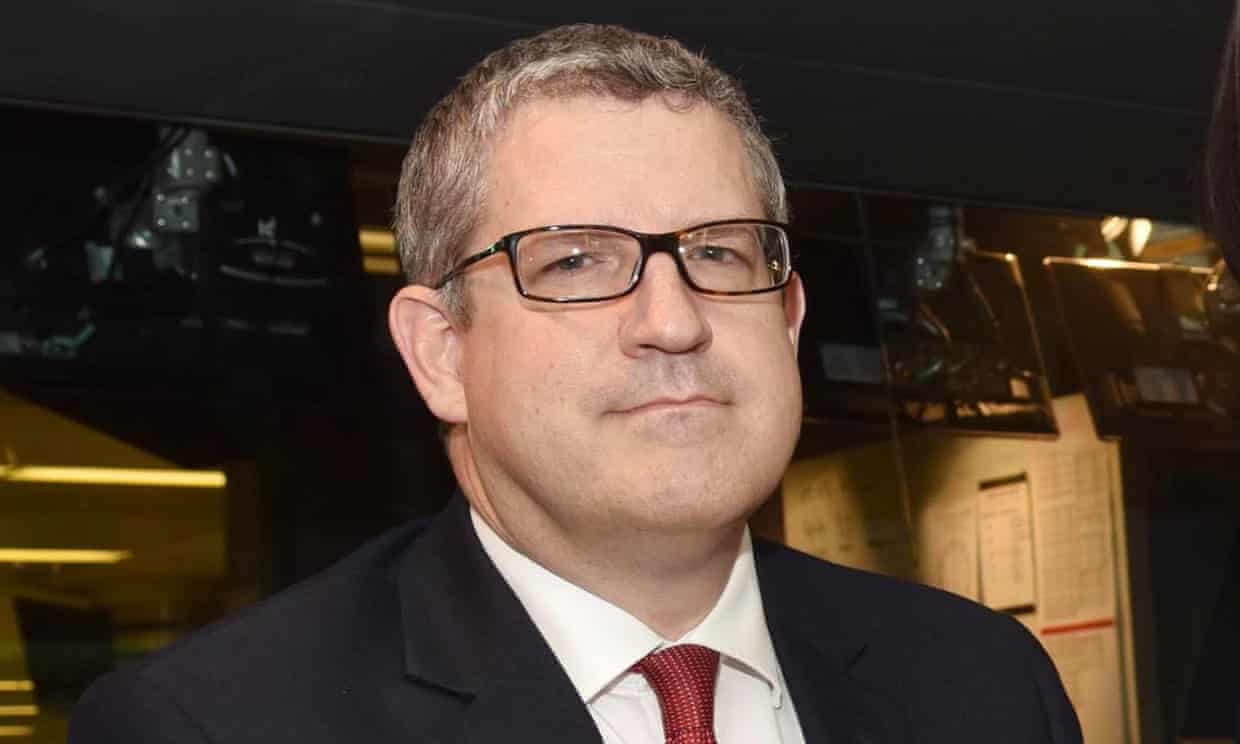
 Andrew ParkerAndrew Parker said Russia was ‘using its whole range of state organs and powers to push its foreign policy abroad in increasingly aggressive ways’. Photograph: Jeff Overs/BBC/PA
Denial is a dangerous conditions and facts matter.

During the last months of the United States presidential campaigns, much has been investigated and written about how Moscow has injected itself into the process least of which is hacking….and the Kremlin does have global hacking operations without dispute.

Hillary and her team are targeting Donald Trump for his Russian connections and that is followed by Harry Reid saying the same. Intelligence briefings are given weekly to key members of Congress that have chairman positions on certain committees and Trump has been included in those. Two media outlets, Slate and the New York Times have provided some deep summaries of investigations between Trump and a Russian bank surrounding a server. White Hats performed these studies.

Then there is Hillary herself and at least two events for which she colluded with Russia. Secretary Clinton approved the Open Skies Treaty with Moscow but worse she was the marshal of the agreement with the Kremlin and an IT company called Skolkovo. This company is a high tech espionage operation. Due to WikiLeaks we cannot leave out Hillary chief campaign architect, John Podesta for his investments with Russian oligarchs.

Do we have such a short memory that we have deported countless Russian spies back to the motherland?

Brooklyn Resident And Two Russian Nationals Arrested In Connection With Scheme To Illegally Export Controlled Technology To Russia Defendants Used Brooklyn-Based Front Companies to Procure Sophisticated Military and Satellite Technology on Behalf of Russian End-Users

It must be noted with distinction that the FBI is the only agency that assigns agents to run covert operations to track foreign operatives. It is also noted that James Comey has stopped short of his own declaration as to whether Russia is involved in missions inside the United States when several other agencies have published statements that Russia has operations inside the United States. What Comey may be covering is a real time and ongoing mission to track and trace more than one case dealing with Russian intrusion and he does not want that cover blown. That is how it works.

Two U.S. Diplomats Drugged In St. Petersburg Last Year, Deepening Washington’s Concern

2015: FBI: We Busted A Russian Spy Ring In New York City

Ex-aide to Putin died of blunt force trauma at D.C. hotel, medical examiner says

Now, lets go back to Putin himself and the recent changes he has made to his own intelligence agencies, obviously we need reminders.

****

Vladimir Putin resurrects the KGB

The new agency revives the name of Stalin’s secret police and will be larger and more powerful than today’s FSB.

By

Politico/MOSCOW — Soon after he was first appointed prime minister back in 1999, Vladimir Putin joked to an audience of top intelligence officers that a group of undercover spies, dispatched to infiltrate the government, was “successfully fulfilling its task.”

It turns out Putin doesn’t do jokes. Over Putin’s years in power, not just the Kremlin but almost every branch of the Russian state has been taken over by old KGB men like himself.

Last week news broke that their resurgence is soon to be topped off with a final triumph — the resurrection of the old KGB itself. According to the Russian daily Kommersant, a major new reshuffle of Russia’s security agencies is under way that will unite the FSB (the main successor agency to the KGB) with Russia’s foreign intelligence service into a new super-agency called the Ministry of State Security — a report that, significantly, wasn’t denied by the Kremlin or the FSB itself.

The new agency, which revives the name of Stalin’s secret police between 1943 and 1953, will be as large and powerful as the old Soviet KGB, employing as many as 250,000 people.

The creation of the new Ministry of State Security represents a “victory for the party of the Chekists,” said Moscow security analyst Tatyana Stanovaya, referring to the first Bolshevik secret police. The important difference is that, at its core, the reshuffle marks Putin’s asserting his own personal authority over Russia’s security apparatus.

Putin, who in 2004 said that “there is no such thing as a former KGB man,” has always had a complicated relationship with the FSB.

On the one hand, Putin has allowed the FSB to absorb pieces of the old KGB, chopped off when Boris Yeltsin tried to dismantle the once all-powerful Soviet security apparatus in the early 1990s. Under Putin, the FSB regained control over Russia’s borders, border troops, and electronic intelligence gathering. At the same time, former KGB men began their takeover of every institution of state, as well as Russian businesses.

But at the same time, Putin has made several attempts to reform and control the FSB. In 2007 he put his close ally Viktor Cherkesov in charge of the Federal Anti-Drug Agency and tasked it with investigating the murky business dealings of top FSB officers. When Cherkesov’s clean-up failed, Putin built up another rival security agency, the Investigative Committee, and tasked it, rather than the FSB, with investigating high-profile political murders like those of journalist Anna Politkovskaya and opposition politician Boris Nemtsov.

“The aim in all cases seems to be to replace old-guard Putin allies with younger, more loyal and less independent figures.”

Now, however, Putin seems to have put that divide-and-rule policy into reverse and is instead consolidating power into a pair of super-agencies: the National Guard — created in July, that united internal security troops under the Kremlin’s control — and now the new Ministry of State Security. Putin will personally control these super-agencies.

“On the night of September 18 to 19 … the country went from authoritarian to totalitarian,” wrote former liberal Duma deputy Gennady Gudkov on his Facebook page.

Further evidence of Putin’s gathering of power into his own hands is an ongoing purge launched over the summer that has already claimed the heads of the Federal Narcotics Service, Federal Protection Service (Putin’s bodyguard), the Federal Migration Service and Russian Railways, as well as the president’s Chief of Staff and personal confidant Sergei Ivanov.

The aim in all cases seems to be to replace old-guard Putin allies with younger, more loyal and less independent figures. The same pattern has been repeated among regional governors — four of whom have recently been sacked, and two replaced by Putin’s personal bodyguards.

Protect the regime

The creation of the Ministry of State Security is part of a “project aimed at replacing old allies with new ones,” said independent Moscow-based analyst Stanislav Belkovsky. Putin “dislikes being surrounded by people who feel untouchable because of their personal closeness to him. He doesn’t want to have anything to do with his old friends, he wants people who can execute his will.”

He’s even selected a hatchet man — Sergei Korolev, head of the FSB’s economic security department — to prosecute and eliminate any independent voices in the new Security Ministry, said Belkovsky.

The deeper significance of all these purges and reshuffles goes beyond just Kremlinology. They are clear signs of a regime bracing for trouble. Ever since oil prices began to tumble in 2013, the Kremlin has been preparing for unrest and discontent — primarily with the help of distractions such as annexing Crimea and the campaign in Syria. But Putin is preparing an iron fist too.

“I can’t remember a time when so many security service guys ascended to power at once” — Dmitry Gudkov, State Duma

“The KGB, it should be remembered, was not a traditional security service in the Western sense — that is, an agency charged with protecting the interests of a country and its citizens,” wrote security analyst Andrei Soldatov, founder of the Agentura.Ru website. “Its primary task was protecting the regime. Its activities included hunting down spies and dissidents and supervising media, sports, and even the church. It ran operations both inside and outside the country but, in both spheres, the main task was always to protect the interests of whoever currently resided in the Kremlin.”

That’s precisely what the Kremlin needs today as inflation remains in double digits and Russian business remains cut off from international financial markets and investment by Western sanctions over Ukraine.

“I can’t remember a time when so many security service guys ascended to power at once,” Dmitry Gudkov, an independent State Duma deputy, wrote of the summer’s purges on his Facebook page. “We don’t know anything about these people’s management expertise. Preparing the guns for battle, closing ranks — this is what these appointments are all about. [The Kremlin] can’t trust anyone but those in uniform.”

‘Terminator 2’

And there’s a final, more personal reason for Putin’s purge and revival of the Ministry of State Security.

“In some ways, this is a sign of Putin’s strength, because he feels confident enough to full, personal, authoritarian rule,” said Belkovsky, who advised the Kremlin in the mid-2000s. “It’s also a sign of weakness because the reason behind it is to defuse the possibility of a palace coup.” Putin is a “man of systems and institutions” according to Belkovsky and, as such, knows his allies are also the greatest threats to his rule.

In creating the super ministry, Putin is completing a full 25-year circle. When Boris Yeltsin came to power in 1991 in the wake of a hardline coup against Mikhail Gorbachev largely sponsored by the KGB and its boss, Vladimir Kryuchkov, Russia’s new leader attempted to create a security agency that would not meddle in politics or society and confine itself strictly to law enforcement.

Yeltsin failed. According to Soldatov, by the mid-1990s “various component parts and functions of the old KGB had begun to make their way back to the FSK, like the liquid metal of the killer T-1000 android in “Terminator 2” … slowly reconstituting itself after having been blown to bits.”

Now those bits have finally coalesced into a full-fledged replica of the original — but with one important difference. The new Ministry of State Security has been designed specifically as a guarantor of Putin’s rule.

Whoever heads the new ministry will certainly be an important political player — but it’s clear that the true head of both the Russian state and its new, consolidated security organs will be Putin himself.

That hasn’t happened since the rule of Yuri Andropov, KGB head-turned general secretary between 1982-84. He presided over a collapse in oil prices, a war in Afghanistan designed to boost the regime’s popularity that quickly turned disastrous, and finally an accelerating economic crisis that no amount of repression or propaganda could prevent from snowballing into collapse and revolution.

Putin is hoping that this time round, harsher repression and smarter propaganda will save him from the same fate.

***

Moscow Rules of Espionage Go Global—If You Think It’s KGB, It Is

As Russian spies play rough, ignoring Putin’s war against the West will only make it nastier


DoJ Just Entered the Huma Email Case and the Next Scandal

John Podesta’s Best Friend At The DOJ Will Be In Charge Of The DOJ’s Probe Into Huma Abedin Emails

Zerohedge: Now that the FBI has obtained the needed warrant to start poring over the 650,000 or so emails uncovered in Anthony Weiner’s notebook, among which thousands of emails sent from Huma Abedin using Hillary Clinton’s personal server, moments ago the US Justice Department announced it is also joining the probe, and as AP reported moments ago, vowed to dedicate all needed resources to quickly review the over half a million emails in the Clinton case.

The Associated Press  

@AP

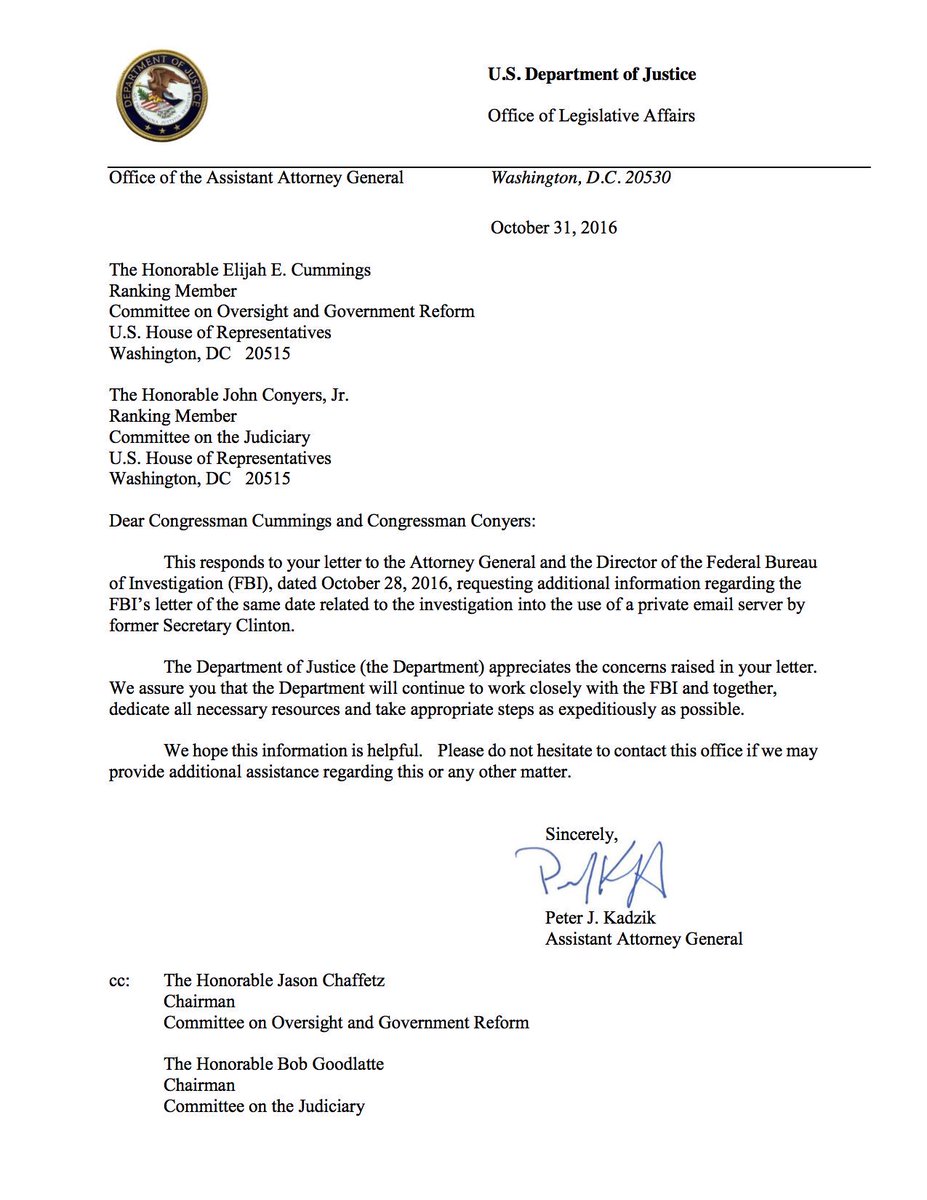
BREAKING: Justice Dept. says it’ll dedicate all needed resources to quickly review emails in Clinton case.

Four FBI Probes Related to the Clintons

How far behind in the investigation process is another dive into Sidney Blumenthal et.al?

Four FBI Probes Related to the Clintons Sharyl Attkisson

The following information is compiled from allegations contained in news reports and in public interviews by current and former law enforcement officials. All of those involved have denied any wrongdoing.

The FBI reportedly has 4 active probes related to the Clintons. Here’s how they dovetail.

1. Clinton Foundation: Four FBI field offices– New York, Los Angeles, Little Rock and Washington DC– have been involved in a lengthy probe of the Clinton Foundation charity. “Pay to play” allegations include the charity soliciting donations from corporations and foreign countries in exchange for access and policy considerations from then-Secretary of State Hillary Clinton, which she denies. Emails published this month by Wikileaks reflect consternation among various Clinton allies about the possible appearance of conflicts of interests. Chelsea, the Clintons’ daughter, worried about blurred lines between the charity and the for profit business of one of her father’s aides. In emails, the aide, Douglas Band, discussed how he’d arranged millions of dollars in income for Bill Clinton from foundation donors. He referred to the arrangement as “Bill Clinton, Inc.” Chelsea pleaded with her parents’ confidants to help get the charity’s house in order, and she enlisted outside lawyers to look at the foundation’s business practices. Emails indicate some interviewees told a team auditing the Foundation that donors “may have an expectation of quid pro quo benefits in return for gift[s].” Various FBI and Department of Justice officials have clashed over whether the probe into the charity is worthwhile. In February, senior Justice Department officials reportedly refused to authorize subpoenas, formal witness interviews or a grand jury in the case, believing the evidence was not compelling. In September, FBI investigators on the Clinton Foundation case asked to see the Hillary Clinton emails, but prosecutors reportedly denied them permission.

screen-shot-2016-10-30-at-9-54-32-pm

2. Anthony Weiner sexting: Weiner is the ex-Congressman who resigned in 2011 amid a sexting scandal. He’s married to top Hillary Clinton aide Huma Abedin. He withdrew from the race for New York mayor in 2013 amid another sexting scandal. And in August this year, he was caught allegedly sexting women again, sometimes with his infant son shown in photos. Abedin announced her separation from Weiner after the latest revelations. The FBI began a probe into whether Weiner had traded sexually explicit texts with a minor, and in the process of examining his computers, investigators ran across evidence of Abedin emails sent to and from Clinton’s insecure private server(s), which the FBI had previously investigated. The FBI Clinton email team met with the FBI Weiner team and they agreed the newly-discovered material was potentially relevant. FBI Director James Comey notified Congress on Friday.

screen-shot-2016-10-30-at-9-42-41-pm

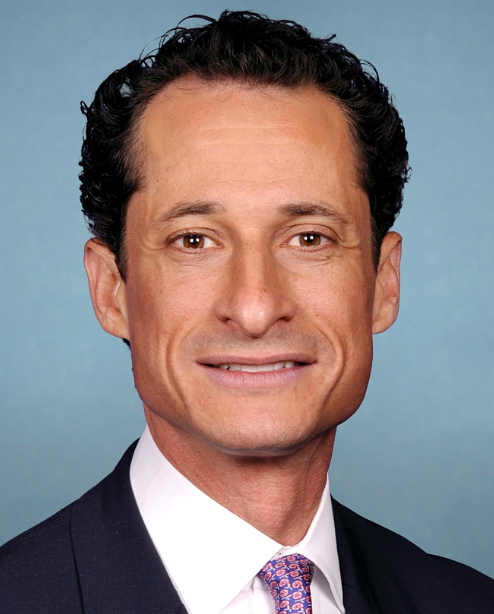
Anthony Weiner, husband of top Hillary Clinton aide Huma Abedin. Weiner is under FBI investigation in a sexual texting case.

3. Hillary Clinton email: In July, FBI Director Comey said that Hillary Clinton had been “grossly negligent” in the mishandling of classified emails on private servers as secretary of state, but that there was no basis under which to charge her with a crime. However, the revelations of new Abedin emails that could be relevant to the investigation have returned the status of the case to “open.”

3kgV0RJE

FBI probe of Hillary Clinton email is still active

Read Devlin Barrett’s article in the Wall Street Journal

4. Virginia Governor Terry McAuliffe: Longtime Clinton ally, former Clinton Foundation board member, and former head of the Democratic National Committee, McAuliffe is also said to be under FBI investigation (led by the Washington Field Office). His lawyer has reportedly said the FBI probe is focused on whether McAuliffe failed to register as an agent of a foreign entity. There are also reports that the FBI is looking into six figures in campaign contributions from a Chinese businessman who also pledged $2 million to the Clinton Foundation while the donor was a member of China’s government, the National People’s Congress. Foreigners are prohibited from making political contributions in the U.S., but can donate personally if they have a green card, which the donor reportedly has.

screen-shot-2016-10-30-at-9-45-01-pm

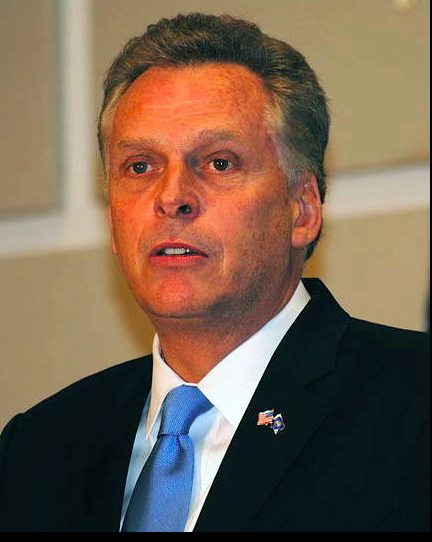
Virginia Governor Terry McAuliffe, a former Clinton Foundation board member, reportedly under FBI investigation

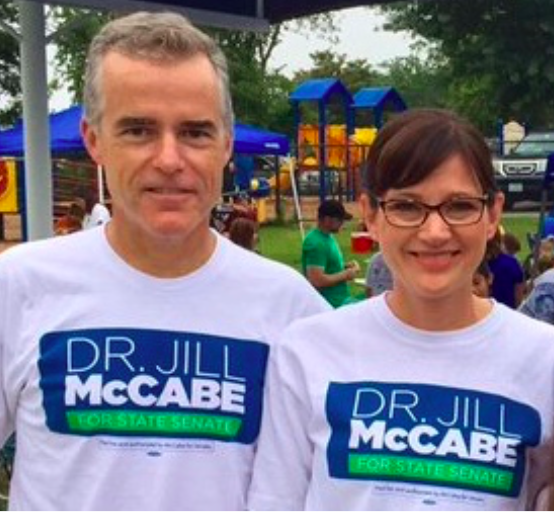
There are also questions surrounding McAuliffe’s campaign donations to the wife of a top FBI official, Andrew McCabe, as these various probes have moved forward. The Wall Street Journal reports that McAuliffe’s political action committee gave McCabe’s wife, Jill, $467,500 in late 2015 for her state senate race (which she lost). The FBI’s McCabe has reportedly been triaging for the two teams investigating the Weiner-Abedin email and the Clinton Foundation probes where they intersect. One official told the Wall Street Journal that on August 12, a senior Justice Department official called McCabe to express displeasure at learning New York FBI agents were still on the Clinton Foundation case. “Are you telling me that I need to shut down a validly predicated investigation,” McCabe reportedly asked. “Of course not,” reportedly answered the official, after a pause.

The FBI's Andrew McCabe and wife, Jill

The FBI’s Andrew McCabe and wife, Jill

McCabe reportedly recused himself from a separate McAuliffe matter due to McCabe’s wife’s political contributions from McAuliffe, according to the Wall Street Journal. The McCabes and McAuliffe have denied any conflicts of interest or other wrongdoing.

Preorder The Smear

Watch Full Measure on TV Sundays and replays online anytime