
Terror Groups Are Strapping Bombs to Cheap Consumer Drones
Motherboard: Most discussions involving the use of remotely piloted aircraft in combat likely conjure up images of America’s giant Predator and Reaper drones, tailor-made military aircraft designed for surveillance and killing. But videos posted recently to YouTube coupled with US military reports suggest that combatants and civilians alike in war-torn regions might also need to worry about weaponized versions of small, inexpensive consumer drones.
In Syria, a country ravaged by civil war, militant groups have started jury rigging quadcopter-style drones with makeshift bombs to drop on targets, military officials told the Associated Press. These small-fry drones would have once been dismissed as unnerving, but harmless. However, a video posted last month showing a drone purportedly belonging to Jund al-Aqsa (a fragment of al-Qaeda) dropping bombs on Syrian armed forces in the Hama province of Syria indicates this may not be the case for much longer.
Another video, this one of alleged footage filmed from a Hezbollah-flown drone, shows bombs being dropped on targets near Aleppo, in Syria.
The Islamic State is also reportedly directly involved in the rudimentary weaponization of consumer drones. A US military official told The New York Times this week that a drone “the size of a model airplane” exploded after being shot down in Iraq recently. The explosion killed two Kurdish fighters, and the official described how the drone contained an explosive device “disguised as a battery.” The small drone, which was thought to be just like many others Islamic State forces use for reconnaissance, exploded after the fighters took it back to their outpost for inspection.
The incident is believed to be the first time Islamic State has successfully killed with a drone deployed with explosives, and the Times reports that American commanders in Iraq are warning allied forces to be wary of any small flying aircraft moving forward.
Jack Serle, a journalist with the Bureau of Investigative Journalism’s Covert Drone War project, told Motherboard that while these drones do not pose the same threat as conventional weapons launched from military aircraft or so-called hunter-killer drones like Reapers and Predators, their capacity to induce panic in civilian areas is a problem.
“What’s really been making people nervous about shop-bought drones in the hands of non-state groups is use in civilian areas, especially in crowded places like shopping centers or sports stadiums,” Serle wrote in an email. “They may not inflict mass casualties, but the terror and panic they could cause is really worrying. This potential for this kind of thing has been on many people’s minds for some years now, and the technology is starting to become a reality.”
A video posted to YouTube showing what is claimed to be a Hezbollah armed drone in Syria. It is worth noting that the authenticity of these videos is still unclear.
American troops stationed in Iraq and Syria have also commented on the rise of small consumeTrr drones being spotted in the air, according to the Times. Such sightings go hand-in-hand with new tactics from the Islamic State.
“In August, the Islamic State called on its followers to jury-rig small store-bought drones with grenades or other explosives and use them to launch attacks at the Olympics,” the Times reported. While no such attacks ever took place in Brazil, the message from Islamic State highlights the terrorist organization’s apparent willingness to expand its toolkit.
Serle told Motherboard that the problem may also be growing as a result of the falling cost of consumer drones that are simultaneously becoming more sophisticated. While traditional anti-air and newly-designed anti-drone weapons exist, Serle said that as consumer drones get more advanced, and the pilots operating them become more adept, “you can imagine a big swarm of them being very hard to stop.”
****
BreakingDefense: The US Navy needs to get better at hunting sea mines. The Royal Navy needs to get better at robots. So the two fleets are joining forces off Scotland in what the Brits are calling “the largest demonstration of its type, ever,” Unmanned Warrior 2016, with “more than 50 unmanned vehicles from over 40 organizations.” The US Office of Naval Research is a major partner in Unmanned Warrior, contributing ten different technologies for testing, from mini-subs to laser drones.
A major (albeit not exclusive) focus for the exercise is mine warfare. As Breaking D readers know, the US Navy has long neglected the unglamorous and grueling work of minesweeping, relying heavily on allies like the UK. Today the U.S. has just 13 operational minesweepers (the Avenger class), for example, while relatively tiny Britain has 15 (seven Sanddowns and eight Hunts). But the US got a loud wakeup call in 2012, when Iran started threatening to mine the Strait of Hormuz. The US Navy responded by hurriedly mobilizing experimental minesweeping systems, many of them robotic (and many originally slated for the troubled Littoral Combat Ship). While robots remain too inflexible for fast-paced combat, they’re ideal for missions that are “dull, dirty, and dangerous,” and mine clearing can be all three.
The 10 systems the Office of Naval Research sent to Unmanned Warrior include seven directly related to mine warfare:
- Mine warfare platoons, the current gold standard in Navy mine warfare, operate Mark 18 unmanned mini-subs off rigid-hulled inflatable boats.
- Rapid Environmental Assessment sends unmanned underwater vehicles to survey the sea floor and underwater environment, creating the kind of detailed picture particularly useful to mine hunters.
- Slocum Gliders are long-range underwater drones that can spend months mapping the underwater world.
- Seahunter is a small unmanned aircraft carrying a lightweight laser sensor (LIDAR) to map shallow waters where traditional sonar struggles.
- MCM C2 (Mine Counter-Measures Command & Control) combines multiple robotic systems: Unmanned mini-subs transmit data back to an unmanned mini-helicopter, which in turn relays reports to and orders from a manned ship at a safe distance. An unmanned boat acts as the mini-copter’s floating base.
- The ongoing Hell Bay trials continue in Unmanned Warrior, this time focusing on coordinated operations among allied drones — including a kind of underwater traffic control — and by multiple unmanned vehicles acting as an autonomous unit.
There’s also a network of fixed and drone-mounted cameras for port security, ship-recognition software for unmanned reconnaissance systems, and a lightweight recon drone.
Unmanned Warrior, which is happening for the first time this year, is part of the much larger and long-established Joint Warrior exercise involving all three UK services and their NATO allies. As Russia becomes more bellicose, such large-scale wargames are increasingly important, both as practical preparation for the worst case and deterrent signaling to prevent it.
Category Archives: Cyber War
What is the Reason for this Global Demand by Putin?
Russia recently held defense drills for 40 million citizens in apparent preparation for an all-out nuclear war.
“And earlier this month, Putin’s ministers announced they had built bunkers capable of housing Moscow’s 14 million people.
****
The Ministry of Defense of the Russian Federation has stated that it is considering the return of Russian military bases to Cuba and Vietnam. Judging by everything, this information slipped through the cracks into the public space by accident, as most officials now prefer to either remain silent or answer evasively in the face of reporters’ questions. For a list of targeted Russian bases globally, click here.
Related reading: Breaking Sanctions with Cuba?
Related reading: The U.S. has had a Russian Problem of Espionage for Decades
Related reading: Rubio was Right, the Russian Memo, Just the Facts
Russia orders all officials to fly home any relatives living abroad, as tensions mount over the prospect of a global war
DailyMail: Russia is ordering all of its officials to fly home any relatives living abroad amid heightened tensions over the prospect of global war, it has been claimed.
Politicians and high-ranking figures are said to have received a warning from president Vladimir Putin to bring their loved-ones home to the ‘Motherland’, according to local media.
It comes after Putin cancelled a planned visit to France amid a furious row over Moscow’s role in the Syrian conflict and just days after it emerged the Kremlin had moved nuclear-capable missiles near to the Polish border.
Former Soviet leader Mikhail Gorbachev has also warned that the world is at a ‘dangerous point’ due to rising tensions between Russia and the US.
According to the Russian site Znak.com, administration staff, regional administrators, lawmakers of all levels and employees of public corporations have been ordered to take their children out of foreign schools immediately.
Failure to act will see officials jeopardising their chances of promotion, local media has reported.
The exact reason for the order is not yet clear.
But Russian political analyst Stanislav Belkovsky is quoted by the Daily Star as saying: ‘This is all part of the package of measures to prepare elites to some ‘big war’.’
Relations between Russia and the US are at their lowest since the Cold War and have soured in recent days after Washington pulled the plug on Syria talks and accused Russia of hacking attacks
The Kremlin has also suspended a series of nuclear pacts, including a symbolic cooperation deal to cut stocks of weapons-grade plutonium.
Just days ago, it was reported that Russia had moved nuclear-capable missiles near to the Polish border as tensions escalated between the world’s largest nation and the West.
The Iskander missiles sent to Kaliningrad, a Russian enclave on the Baltic Sea between Nato members Poland and Lithuania, are now within range of major Western cities including Berlin.
Polish officials – whose capital Warsaw is potentially threatened – have described the move as of the ‘highest concern’.
Putin’s decision to cancel his Paris visit came a day after French President Francois Hollande said Syrian forces had committed a ‘war crime’ in the battered city of Aleppo with the support of Russian air strikes.
Putin had been due in Paris on October 19 to inaugurate a spiritual centre at a new Russian Orthodox church near the Eiffel Tower, but Hollande had insisted his Russian counterpart also took part in talks with him about Syria.
The unprecedented cancellation of a visit so close to being finalised is a ‘serious step… reminiscent of the Cold War’, said Russian foreign policy analyst Fyodor Lukyanov.
‘This is part of the broader escalation in the tensions between Russia and the West, and Russia and NATO,’ he told AFP.
The Kremlin has also been angered over the banning of the Russian Paralympic team from the Rio Olympics amid claims of state-sponsored doping of its athletes.
Meanwhile, the top advisor to US presidential candidate Hillary Clinton has said the FBI is investigating Russia’s possible role in hacking thousands of his personal emails.
But Russian officials have vigorously rejected accusations of meddling in the US presidential elections and dismissed allegations that Moscow was behind a series of recent hacks on US institutions.
Retired Russian Lt. Gen. Evgeny Buzhinsky told the BBC: ‘Of course there is a reaction. As far as Russia sees it, as Putin sees it, it is full-scale confrontation on all fronts. If you want a confrontation, you’ll get one.
‘But it won’t be a confrontation that doesn’t harm the interests of the United States. You want a confrontation, you’ll get one everywhere.’
Earlier this week British Foreign Secretary Boris Johnson waded into the row, calling for anti-war campaigners to protest outside the Russian embassy in London.
Johnson said the ‘wells of outrage are growing exhausted’ and anti-war groups were not expressing sufficient outrage at the conflict in Aleppo.
‘Where is the Stop the War Coalition at the moment? Where are they?’ he said during a parliamentary debate.
****
WikiLeaks Released More Podesta Emails, Political Media Marriage
It is rather humorous at this point in the process as John Podesta, the Hillary campaign architect says he is not sure any of the releases are authentic. Then Hillary and the government says that the hacks are authentic and Russia is the culprit hacker. Then often, including the second debate, Donald Trump says no one can prove it is Russia and further, there may be no hack. Sigh…all of them are misguiding the American voters with the exception of the Office of Director of National Intelligence, it IS Russia.
So we have a whole campaign season for the White House that is riddled with government agencies, hackers and dinner date types in media.
WikiLeaks on Monday published 2,000 new documents that it claims were stolen from the email files of the chairman of Hillary Clinton campaign, shortly after the U.S. government linked the anti-secrecy group to Russian hackers.
The 2,086 emails of John Podesta’s posted to WikiLeaks’ website on Monday follow a similarly sized batch of messages released on Friday evening.
The messages date from as recently as this year, and include several discussions about campaign tactics and updates, as well as spam messages. The cache of emails released on Friday included what appeared to be portions of controversial speeches Clinton gave to major banks.
In one of the newly released emails, opinion writer Brent Budowsky, who writes a column for The Hill, told Podesta that the Clinton campaign was giving prominence to discussion about President Bill Clinton’s extramarital affairs by trying to limit his media exposure.
“I had a multi-email exchange with someone in the media this morning—a name you would know—who is telling me that there are people close to the Clintons who says WJC’s sex life could be damaging to her,” Budowsky wrote, referring to Bill Clinton. More here from The Hill.
So all politicians have their favorites and for Democrats, they are called ‘friendly media;. Those media types are from various outlets, after all, most of the time the stories are shopped while others are purposely planted.
Hacked: Clinton campaign worked with NYT reporter behind scenes
FNC: Internal documents made public on Sunday revealed a reporter for the New York Times working with Democratic officials to promote Hillary Clinton’s presidential candidacy, with party apparatchiks saying she has “never disappointed” them.
The January 2015 document centering on Clinton’s media strategy, released by the hacker known as Guccifer 2.0, was describing Maggie Haberman, who worked for Politico but who moved to the Times that month.
“We are all in agreement that the time is right [to] place a story with a friendly journalist in the coming days that positions us a little more transparently while achieving [our] goals,” said the memo, which was first published by The Intercept.
“We have [had] a very good relationship with Maggie Haberman of Politico over the last year,” the unsigned document noted. “We have had her tee up stories for us before and have never been disappointed. While we should have a larger conversation in the near future about a broader strategy for reengaging the beat press the covers HRC, for this we think we can achieve our objective and do the most shaping by going to Maggie.”
The Intercept reported that metadata pointed to Nick Merrill, the campaign’s press secretary, as the document’s author. It is unclear which party apparatus Guccifer purportedly hacked in order to obtain the document. Guccifer is the same persona that took credit for breaches of the Democratic National Committee and Democratic Congressional Campaign Committee over the summer.
Read more on WashingtonExaminer.com
What is the Justice Department Investigating and Prosecuting Anyway?
A sudden decision to drop the case against Marc Turi, the legitimate arms dealer approved by Hillary to move weapons to Libya, oh…no…then to Qatar and then not at all had his home raided. Why? Good question except Turi Defense was approved not never launched any shipments. The case against him fell apart mostly due to the notion the government would have to produce documents of the case and background for legal discovery and it would have further tainted Hillary Clinton’s actions regarding Qaddafi and her actions in Libya. Hummm okay….what else? All kinds of cases and questions, try a few of these below. Remember too that Obama issued a pardon for Iranians in the United States during the prisoner swap with Iran. Don’t forget those pesky 5 Taliban commanders released for Bowe Bergdahl.
Meanwhile:
Hamas On Campus, and Hamas is a terror organization, since 1997.
Introduction:
Across America college campuses are being flooded with pro-terrorist propaganda by groups supported by college administrators and student funds. These groups are led by Students for Justice in Palestine but they include the broad coalitions of the left which have become the breeding grounds for a new anti-Semitism. Boycott, Divest and Sanctions resolutions targeting the state of Israel for destruction are passed to chants of “Allahu Ahkbar,” while Jewish students are the targets of verbal and physical harassments which have reached epidemic proportions. This is a report on the 10 schools most supportive of the efforts of Students for Justice in Palestine and its allies, to demonize the state of Israel and bring about its destruction.
Students for Justice in Palestine (SJP) portrays itself as a typical student organization and multicultural group advocating for “social justice” in the Middle East, but this image is a cleverly constructed disguise. Students for Justice in Palestine is not concerned about justice in Palestine where the Hamas regime steals hundreds of millions of dollars earmarked for humanitarian aid and uses it to dig terror tunnels whose only purpose is to murder Jews. In truth, SJP is a pro-terror organization that is funded by anti-Israel Hamas terrorists for the purpose of destroying Israel, the world’s only Jewish state, and committing genocide against its Jewish population as prescribed in the Hamas charter.
Visit Stop the Jew-Hatred on Campus.
1. Brooklyn College (CUNY)
2. San Diego State University
3. San Francisco State University
4. Tufts University
5. University of California Berkeley
6. University of California Irvine
7. University of California Los Angeles
8. University of Chicago
9. University of Tennessee Knoxville
10. Vassar College
**** Then there is Mosed Omar.
Federal prosecutors — acting abruptly and without public explanation — have moved to drop a controversial criminal passport fraud case that critics alleged stemmed from coercive interrogations at the U.S. embassy in Yemen.
Earlier this year, a grand jury in San Francisco indicted Mosed Omar on passport fraud charges linked to a statement he signed during a 2012 visit to the U.S. diplomatic post in the unstable Middle Eastern nation.
After signing the statement saying he’d used a false name when he was naturalized as a U.S. citizen in 1978, Omar’s U.S. passport was confiscated and a request for a passport for his daughter was denied. Omar eventually made it back to the U.S. on a temporary travel permit. More here from Politico.
There was the case of Huma Abedin not only working officially at the State Department for Hillary Clinton, but at the same time she was on the payroll of Teneo. Has this investigation and case advanced in any form? Not so much.
It seems that double dipping, meaning working for the Federal government and other outside organizations is actually quite common and this too includes staffers working for legislators in both houses of Congress. So, this does tell us there is nepotism perhaps and for sure conflicts of interest. How so you ask? Words matter and members of Congress figured out that the word ‘fellowship’ is best used to describe the work…..sheesh….
POGO: The U.S. Congress allows Members to staff their offices with Fellows who are paid by corporations, foundations, universities, non-profits, and other outside private entities.
The Fellows are required to abide by all the laws, rules, and standards governing permanent Congressional staff members. Indeed, they are often indistinguishable from permanent staff members. They work on writing legislation and Floor speeches, and represent the Member in meetings with other offices and constituents.
POGO reviewed 2,014 publicly available reports on Senate fellows and found several examples of the appearance of a conflict of interest, and that Senators did not consistently disclose fellows whose salary was paid by a third party. The House does not maintain records on Congressional Fellows at all.
On the Senate side, fellows and their supervisors are required to file reports detailing when they began their fellowship, how much money they’re making, what entity is paying their salary, and how many hours they’ve worked. Senate rules mandate that new fellows file their “Agreement to Comply with the Senate Code of Official Conduct,” known as form 41.4, at the beginning of their fellowship, at the end of each calendar quarter, and at the end of the fellowship. The fellow’s supervisor must file a “Report on Individuals Who Perform Senate Services,” known as form 41.6, which is often signed by the Senator. While these forms are available to the public, they are not electronically available and anyone interested in seeing them must visit the Senate Office of Public Records during business hours.
Is there a code of conduct, formal disclosures and rules that apply here? Yes….is there compliance? Not so much. Essentially, this is but another means to lobby members of Congress and to ensure earmarks are designated, and they are.
Require disclosure in the House of Representatives
The House Rules committee should introduce language into the Code of Official Conduct that would require Representatives to report when their office employs an individual who is compensated by any source outside of the United States Government. Such a report should include the identity of the source of the compensation and the amount or rate of compensation.
More oversight in the Senate
Senate reporting of Fellows who are paid by corporations, foundations, universities, non-profits, and other outside private entities is falling short. The Senate Ethics Committee needs to increase its oversight over the Congressional Fellows reporting requirements, actively checking with Member offices to make sure they don’t have any Fellows employed for years they don’t report any. The Senate Ethics Committee should also increase training for Member offices on what they are required to report, at the start of each Congress it should hold a series of trainings for all Member offices.
Both Chambers should require electronic filing of these disclosures, in a publically accessible format
The Senate, and House as it begins to require reporting on Fellows, should transition to an electronic filing system that can be accessed by the public. This will allow for more uniform participation by Member offices and more public oversight over the Congressional Fellowship programs. Read on here for further and exact details from POGO. Fabulous investigative work and causes for more questions to be asked and solutions to be applied.
General Milley on our Enemies with Emphasis on Russia
Primer: For all you pro Russian and pro Putin types out there:
What you Need to Know About the Gerasimov Doctrine’
and
Russian Hybrid Warfare: How to Confront a New Challenge to the West
***
Military: The U.S. Army‘s chief of staff on Tuesday issued a stern warning to potential threats such as Russia and vowed the service will defeat any foe in ground combat.
“The strategic resolve of our nation, the United States, is being challenged and our alliances tested in ways that we haven’t faced in many, many decades,” Army Chief of Staff Gen. Mark Milley told an audience at the Association of the United States Army’s annual meeting in Washington, D.C.
“I want to be clear to those who wish to do us harm … the United States military — despite all of our challenges, despite our [operational] tempo, despite everything we have been doing — we will stop you and we will beat you harder than you have ever been beaten before. Make no mistake about that.”
Milley’s comments come during an election year in which voters will decide a new president and commander in chief — and a period of increased military activity of near-peer competitors, including Russia and China.
The Army has struggled to rebuild its readiness after more than a decade of extended combat operations in Iraq and Afghanistan. The service has significantly cut the size of its force since the Cold War and decreased its modernization budget in the last decade, Milley said.
“While we focused on the counter-terrorist fight, other countries — Russia, Iran, China, North Korea — went to school on us,” he said. “They studied our doctrine, our tactics, our equipment, our organization, our training, our leadership. And, in turn, they revised their own doctrines, and they are rapidly modernizing their military today to avoid our strengths in hopes of defeating us at some point in the future.”
Milley also quoted a senior Russian official as saying publicly, “The established world order is undergoing a foundational shake-up” and that “Russia can now fight a conventional war in Europe and win.”
The general warned that future warfare with a near-peer adversary will “be highly lethal, unlike anything our Army has experienced at least since World War II.”
“Our formations will likely have to be small; we will have to move constantly,” he said. “On the future battlefield, if you stay in one place for longer than two or three hours, you will be dead.”
Despite the challenges, Milley said the Army will adapt to survive such a dangerous battlefield.
“It’s a tall order for sure — to project power into contested theaters, fight in highly populated urban areas, to survive and win on intensely lethal and distributed battlefields and to create leaders and soldiers who can prevail. Tough? Yes. But impossible? Absolutely not,” Milley said.
“Make no mistake about it, we can now and we will … retain the capability to rapidly deploy,” he said, “and we will destroy any enemy anywhere, any time.”
**** So what is percolating globally and against the United States that has the Pentagon concerned?
Using the same provocations that Iran has used against the United States, Russia is doing the same thing.
Nato jets scrambled as Russian bombers fly south
Two Russian Blackjack bombers were intercepted by fighter jets from four European countries as they flew from the direction of Norway to northern Spain and back, it has emerged. Norway, the UK, France and Spain all scrambled jets as the TU-160 planes skirted the airspace of each country. It comes at a time of heightened tension between the West and Russia. Correspondents say the frequency of Russian bombers being intercepted by Nato planes has increased markedly. Spanish media say it is the furthest south such an operation has had to take place. More here from the BBC.
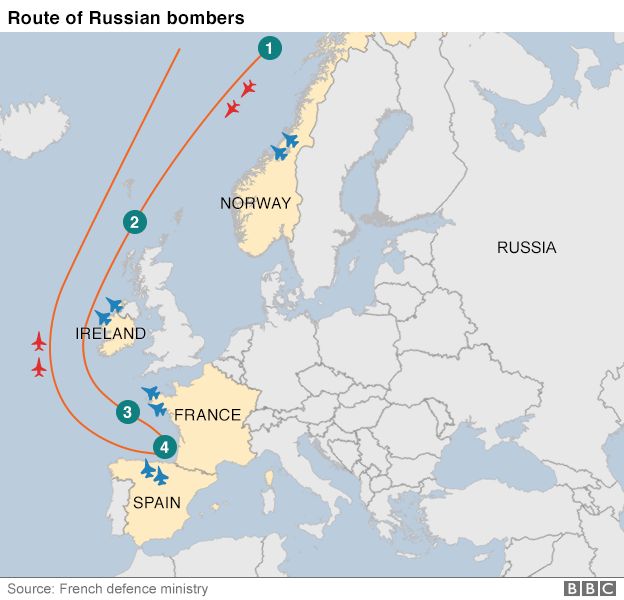
Given the failed truce or cease fire agreement regarding Syria, it was announced by John Kerry and approved by the White House and National Security Council to walk away fully from Russia and seek other avenues with regard to the deadly civil war in Syria. As noted, last week before the Senate, it was admitted there was no Plan B.
In recent months, Russia has been quite aggressive and militant towards Americans in Moscow and other cities in Russia. Some diplomats have been beaten up, robbed and their homes broken into. The most recent incident involved some Americans being drugged.
“We are outraged,” Russian Deputy Foreign Minister Sergey Ryabkov said in a statement posted on the Russian Foreign Ministry website, adding the claim may have been the work of the US State Department seeking “revenge” for the collapse of talks between the two counties to address the situation in Syria.Russia’s denial came after a report two days ago by Radio Free Europe/Radio Liberty that the diplomats — a man and a woman who were not senior officials — allegedly had their drinks spiked with a date-rape drug while attending a United Nations convention on corruption last November. The report, attributed to anonymous sources, said the State Department quietly protested the incident to Russian officials.The story also said one of the diplomats had been treated at a “Western medical clinic” – which Russia said was not true. More here from CNN.
American personnel and diplomats are being evacuated from talks and some ground operations in Syria where and when the bloodshed continues in Aleppo.
Russia had agreed to a cease-fire last month, but that fell apart quickly. Russia argues that the United States has failed in its commitment to separate the moderate rebel groups it supports from more radical factions such as the Syrian branch of Al Qaeda.
Kirby said the United States will withdraw a team that had been dispatched to open a so-called joint implementation center, in which Russian and American armed forces were going to join efforts to fight Islamic State and other jihadi groups.
Also Monday, Russian President Vladimir Putin signed a decree suspending his country’s participation in a treaty with the U.S. designed to eliminate nuclear weapons.
Putin cited “a threat to strategic stability as a result of USA’s unfriendly acts toward Russia.” This was a reference to a deepening diplomatic spat between the Kremlin and the White House over Syria, as well as tensions and sanctions that followed Russia’s 2014 takeover of Crimea and its support to separatists in eastern Ukraine.
It is the latest action by Russia that serves to unwind the nuclear-cooperation and weapons treaties that have governed the relationship between the U.S. and Russia in the years after the Soviet dissolution.
The U.S. said it would continue to participate in multilateral talks over Syria, aimed at achieving a cessation of hostilities and the delivery of aid, and would communicate with Russia regarding airstrikes to avoid collisions.
Last week, when it first threatened to suspend Syria talks with Russia, Washington said it would consider other options, including additional financial sanctions or even military operations. More here from the LATimes.
Then it appears the National Security Council and the State Department pinged the United Nations for some action….well kinda sorta.
The United States virtually blocked the United Nations Security Council’s statement that condemned the mortaring of Russia’s embassy in Damascus, Russia’s Permanent Mission to the global organization said.
“It was actually blocked by the U.S. delegation, which tried to bring outside elements into a standard text. Brits and Ukrainians clumsily helped Americans,” the mission said.
It said that the behavior of the three countries “testifies to their blatant disrespect for the Vienna Convention on Diplomatic Relations”, which demands to protect diplomatic and consular facilities and personnel.
The Russian mission said that “when such crimes were committed earlier, including against the diplomatic missions of Western countries, Russia has always unconditionally supported their condemnation by the Security Council.”
“We have to state that the moral principles of some of our colleagues in the Security Council have seriously teetered,” it said. More here from TASS.
Russia is taking all precautions forecasting future aggressions in Syria as they installed the S-300 anti-aircraft missile defense system at the Russia base of Tartus which is near Latakia, Syria on the Mediterranean Sea.
Further there is the matter of the Baltics and Ukraine. Control and management of the Mediterranean and the Black Sea is at risk.
NATO members must increase the alliance’s military capabilities, position additional forces in the Baltics and Eastern Europe, establish a maritime force in the Black Sea and bolster its presence in the Arctic, all to counter Russia’s growing military strength and increasingly belligerent behavior toward its neighbors, the Atlantic Council said in a new report.
The report, “Restoring the Power and Purpose of the NATO Alliance,” also urges America’s leaders to strengthen U.S. leadership of NATO, work to restore public support for the trans-Atlantic alliance and “counter those who threaten to withdraw U.S. support for NATO.” And it calls on alliance members to maintain their commitment to securing Afghanistan and to increase military assistance and intelligence-sharing with “its Arab partners” in response to the spreading terrorist threat.
The policy paper was crafted by a team led by former veteran diplomatic Nicholas Burns, who was the U.S. ambassador to NATO, and retired Gen. James Jones, a former Marine Corps commandant and Supreme Allied Commander in Europe. The report was prepared ahead of next month’s NATO summit in Warsaw. More here.
What about the Arctic?
Russia: Militarizing the Arctic
While the Arctic region remains peaceful, Russia’s recent steps to militarize the Arctic, coupled with its bellicose behavior toward its neighbors, makes the Arctic a security concern. Russia’s Maritime Doctrine of Russian Federation 2020, adopted in July 2015, lists the Arctic as one of two focal points, the other being the Atlantic.[1]
Russia’s Northern Fleet, which is based in the Arctic, now counts for two-thirds of the Russian Navy. A new Arctic command was established in 2015 to coordinate all Russian military activities in the Arctic region.[2] Underwater, Russian submarines are operating at a rate not seen since the end of the Cold War. Indeed, Admiral Viktor Chirkov, commander-in-chief of the Russian navy, stated in 2015 that the navy had ramped up submarine patrols by 50 percent from just 2013.[3]
Over the next few years, two new so-called Arctic brigades will be permanently based in the Arctic region, and Russian special forces have been training in the region. Soviet-era facilities have been re-opened; Russia is expected to have nine operative airfields in the Arctic by 2018.[4] Russia has reportedly also placed radar and S-300 missiles on the Arctic bases at Franz Joseph Land, New Siberian Islands, Novaya Zemlya, and Severnaya Zemlya.[5] Russia’s ultimate goal is to deploy a combined arms force in the Arctic by 2020, and this plan appears to be on track.[6] In early June, the Russian Navy showed off its first new icebreaker in 45 years.[7]
As an Arctic power, Russia’s military presence in the region is to be expected. However, it should be viewed with some caution in light of recent Russian aggression in its neighborhood. The former Supreme Allied Commander of Europe, General Philip Breedlove, described Russian activity in the Arctic as “increasingly troubling,” stating: “Their increase in stationing military forces, building and reopening bases, and creating an Arctic military district—all to counter an imagined threat to their internationally undisputed territories—stands in stark contrast to the conduct of the seven other Arctic nations.”[8]. More here from Heritage.
****
ABC: The Russians are already there in force. Last year, they staged a military exercise in the Arctic as seen in this Russian Ministry of Defense footage.
It involved about 40,000 troops, 15 submarines, 41 warships and multiple aircraft. No one disputes their right to do that on their own territory. It’s just that it wasn’t announced.
Philip Breedlove: We pre-announce ours. No one is surprised by them whereas the exercise that Russia did was a snap exercise which is a bit destabilizing.
Until May of this year, retired four-star General Philip Breedlove was the supreme Allied commander of NATO with responsibility for the Arctic.
What else is destabilizing, he says, is Russia’s military build up along something called the Northern Sea Route skirting the Russian Arctic coastline. The route could become an alternative to the Suez Canal, saving huge amounts of time and money for the commercial shipping industry.
Philip Breedlove: I have heard as much as 28 days decrease in some of the transit from the northern European markets to the Asian markets. That is an incredible economic opportunity. And it could be a very boon— big boon to business around the world.
Lesley Stahl: What would it mean if the Russians did gain control over the Northern Sea route?
Philip Breedlove: If the Russians had the ability to militarily hold that at ransom, that is a big lever over the world economy.
Related reading: Russia’s Military Sophistication in the Arctic Sends Echoes of the Cold War