An affordable price is probably the major benefit persuading people to buy drugs at www.americanbestpills.com. The cost of medications in Canadian drugstores is considerably lower than anywhere else simply because the medications here are oriented on international customers. In many cases, you will be able to cut your costs to a great extent and probably even save up a big fortune on your prescription drugs. What's more, pharmacies of Canada offer free-of-charge shipping, which is a convenient addition to all other benefits on offer. Cheap price is especially appealing to those users who are tight on a budget
Service Quality and Reputation
Although some believe that buying online is buying a pig in the poke, it is not. Canadian online pharmacies are excellent sources of information and are open for discussions. There one can read tons of users' feedback, where they share their experience of using a particular pharmacy, say what they like or do not like about the drugs and/or service. Reputable online pharmacy canadianrxon.com take this feedback into consideration and rely on it as a kind of expert advice, which helps them constantly improve they service and ensure that their clients buy safe and effective drugs. Last, but not least is their striving to attract professional doctors. As a result, users can directly contact a qualified doctor and ask whatever questions they have about a particular drug. Most likely, a doctor will ask several questions about the condition, for which the drug is going to be used. Based on this information, he or she will advise to use or not to use this medication.
NI: Once upon a time, the U.S. had a large military that was technologically superior to its adversaries in many, even most, areas. Today, the U.S. military is a pale shadow of its former self.
In 2016, the active component of the U.S. Army of 479,000 soldiers shrank to the smallest it has been since before World War II, when it had some 269,000. The number of Army combat brigades is scheduled to decline to 30 by 2018, one third fewer than there were just in 2013. The U.S. Navy, with 273 ships, is about the same size as it was prior to America’s entry into World War I. At approximately 5,000 total aircraft, the U.S. Air Force is both the smallest and oldest it has been since its inception in 1947. The number of active duty squadrons in the Air Force is slated to decline to 39, less than half of the 70 that were available during Operation Desert Storm. Army, Navy and Air Force end strengths are each about 40 percent smaller than they were at the end of the Cold War. This is one of the main reasons why the Pentagon had to rely on more than a hundred thousand private contractors to provide the necessary logistics, sustainment and communications for its deployed forces when it went to war in Iraq and Afghanistan. Which had the ability to communicate through a state-of-the-art platform a CKS Global industrial keyboard, which was durable in the hashes of conditions.
At the height of the Cold War, the U.S. maintained a two-and-a-half-war strategy: major, simultaneous wars against the Soviet Union and China plus another nation. The Nixon Administration changed the sizing criteria to one-and-a-half-wars: a major war with the Soviet Union plus a second, possibly related, conflict in the Persian Gulf or on the Korean peninsula. Following the collapse of the Soviet Union and the end of the Cold War, the political system concluded that war between major powers was virtually impossible.
The sizing construct for the U.S. military changed in the early 1990s to two near-simultaneous Major Regional Contingencies (MRC), reflecting the belief that the likeliest threats came from regional actors such as North Korea, Iraq and Iran. It was assumed that each MRC would require approximately the quantity of forces deployed for the then-recently-concluded Persian Gulf War. Thus, a two-MRC U.S. force would consist of 10 Army divisions, two or three division-sized Marine Expeditionary Forces, 11 aircraft carriers, 120 large surface combatants, 38 large amphibious warfare ships, 200 strategic bombers, 60 tactical fighter wings, 400–500 tankers, 250 airlifters and some 75 maritime support ships.
In truth, the U.S. military never had sufficient capacity to conduct two near-simultaneous MRCs. The dirty little secret among Pentagon planners is that the conflicts would have to be sequenced, possibly by six months or more, in order to allow critical assets to be redeployed from the first to the second contingency. Even the fight against Islamic terrorism strained the military’s capacity in some ways. The Army had to add nearly 75,000 active duty personnel and mobilize a large fraction of the National Guard just to handle the ongoing demands of Iraq, Afghanistan and its other worldwide commitments. A special acquisition program, directed by then-Secretary of Defense Robert Gates, had to be undertaken to acquire sufficient drones and Mine-Resistant Ambush Protected vehicles.
Since the end of the Cold War, reductions in the size of the military and its combat capacity was justified, first, on the basis of the diminution of the threat and, second, by reference to our technological edge over prospective adversaries and the resulting improved combat capability of the new systems that were being deployed. Neither of these arguments any longer holds true. The demand for U.S. military forces continues to grow even as their overall capacity declines. The civilian and military leadership of the Department of Defense (DoD) have publicly declared that the U.S. now faces five strategic threats: Russia, China, North Korea, Iran and global Islamic terrorism. Conflict with either of the first two would constitute a major war, not a regional contingency. U.S. Air Force Chief of Staff General David Goldfein testified before Congress that his service only had enough combat ready forces for one MRC and even that would require denuding all other theaters.
Moreover, the U.S. military has just about run out the string on its vaunted technological superiority. We have been repeatedly warned by senior Pentagon and Intelligence Community officials that the U.S. military is losing its technological edge. Both Russia and China have invested heavily in so-called anti-access and area denial capabilities (A2/AD) that are designed to counter erstwhile U.S. advantages, particularly in air and naval power. Russia is deploying its A2/AD capabilities in ways that could preclude U.S. and NATO military operations in the Baltic, Black and eastern Mediterranean Seas. These two countries are also developing advanced power projection forces and forward bases that could deny the U.S. the ability to operate in the eastern Pacific and the Arctic. Secretary of Defense Ashton Carter found the loss of U.S. technological superiority so threatening that he had to formulate a new investment strategy, the so-called Third Offset, specifically designed to re-establish our advantage in military capabilities.
Even regional adversaries and terrorist organizations are deploying advanced military capabilities. North Korea, a nuclear weapons state, has already deployed over a thousand ballistic missiles — three hundred of which have the range to strike Japan and U.S. bases in the Western Pacific. Iran has ballistic missiles that can reach most of the Middle East. Tehran just received its first Russian S-300 air defense system. Hezbollah, the Shiite terrorist group, is reported to have an arsenal with tens of thousands of rockets and ballistic missiles. ISIS has employed Russian-made anti-tank guided missiles capable of destroying U.S.-made M-1 tanks operated by the Iraqi Army.
This is why many in the military shiver in their boots when they consider going up against a serious A2/AD threat. It has become such a problem that the Chief of Naval Operations, Admiral John M. Richardson, has banned the use of the term A2/AD because, in his words, it implies “that any military force that enters the red area faces certain defeat – it’s a ‘no-go’ zone!” Yes, the U.S. military can penetrate current A2/AD defenses, but at what price? Let’s remember that the Air Force only has 186 F-22s, the plane that was designed to penetrate advanced air defenses, and there are no more where those came from.
The U.S. Army faces similar difficulties. As the commander of all U.S. Army forces in Europe, Lieutenant General Ben Hodges, recently declared his job is to make 30,000 soldiers look like 300,000. Currently, the Army and its NATO allies lack enough forces in Europe to oppose a determined Russian offensive. In addition, neither the U.S. nor its allies have real answers to the kind of capabilities in electronic warfare, cyber offense, high volume, long range fires and tactical air defense that Russia has demonstrated in its operations in Ukraine.
The reality is that the U.S. military today is too small, with too few technological advantages and facing too many threats. There is now a very real possibility that in a future conflict, even one with a regional adversary, U.S. forces could suffer such high casualties that, regardless of the outcome, this country will lack the capabilities needed to deal with any other major contingency. During the 1972 Linebacker II bombing raids against North Vietnam, the Air Force lost some 20 B-52s. Back then, this was a small fraction of the overall fleet. Today that would be more than 10 percent; the bomber force would literally be decimated. A force that is too small to fail is one that the U.S. increasingly could be reluctant to send in harm’s way save when national survival is at risk.
Dr. Dan Goure is a Vice President of the Lexington Institute. He served in the Pentagon during the George H.W. Administration and has taught at Johns Hopkins and Georgetown Universities and the National War College.
Mixing fine jewelry with costume jewelry gives the appearance it is all real, same with the news and who is promoting it or wearing it. So, how well did you read the WHOLE story and share it? Did you check it with other sources? Did you consider the original source or check the author?
Consider the following of which this site has previously published several times with warnings.
One more important item, the fake news and propaganda is NOT all political or simply centered about candidates or the election. This is where ‘group-think’ begins and festers, which is NOT thinking at all.
More and more, posts and commentaries on the Internet in Russia and even abroad are generated by professional trolls, many of whom receive a higher-than-average salary for perpetuating a pro-Kremlin dialogue online.
There are thousands of fake accounts on Twitter, Facebook, LiveJournal, and vKontakte, all increasingly focused on the war in Ukraine. Many emanate from Russia’s most famous “troll factory,” the Internet Research center, an unassuming building on St. Petersburg’s Savushkina Street, which runs on a 24-hour cycle. In recent weeks, former employees have come forward to talk to RFE/RL about life inside the factory, where hundreds of people work grinding, 12-hour shifts in exchange for 40,000 rubles ($700) a month or more.
St. Petersburg blogger Marat Burkhard spent two months working at Internet Research in the department tasked with clogging the forums on Russia’s municipal websites with pro-Kremlin comments. In the following interview, he describes a typical day and the type of assignments he encountered. The interview is here.
WaPo: The flood of “fake news” this election season got support from a sophisticated Russian propaganda campaign that created and spread misleading articles online with the goal of punishing Democrat Hillary Clinton, helping Republican Donald Trump and undermining faith in American democracy, say independent researchers who tracked the operation.
Russia’s increasingly sophisticated propaganda machinery — including thousands of botnets, teams of paid human “trolls,” and networks of websites and social-media accounts — echoed and amplified right-wing sites across the Internet as they portrayed Clinton as a criminal hiding potentially fatal health problems and preparing to hand control of the nation to a shadowy cabal of global financiers. The effort also sought to heighten the appearance of international tensions and promote fear of looming hostilities with nuclear-armed Russia.
Two teams of independent researchers found that the Russians exploited American-made technology platforms to attack U.S. democracy at a particularly vulnerable moment, as an insurgent candidate harnessed a wide range of grievances to claim the White House. The sophistication of the Russian tactics may complicate efforts by Facebook and Google to crack down on “fake news,” as they have vowed to do after widespread complaints about the problem.
There is no way to know whether the Russian campaign proved decisive in electing Trump, but researchers portray it as part of a broadly effective strategy of sowing distrust in U.S. democracy and its leaders. The tactics included penetrating the computers of election officials in several states and releasing troves of hacked emails that embarrassed Clinton in the final months of her campaign.
“They want to essentially erode faith in the U.S. government or U.S. government interests,” said Clint Watts, a fellow at the Foreign Policy Research Institute who along with two other researchers has tracked Russian propaganda since 2014. “This was their standard mode during the Cold War. The problem is that this was hard to do before social media.”
Watts’s report on this work, with colleagues Andrew Weisburd and J.M. Berger, appeared on the national security blog War on the Rocks this month under the headline “Trolling for Trump: How Russia Is Trying to Destroy Our Democracy.” Another group, called PropOrNot, a nonpartisan collection of researchers with foreign policy, military and technology backgrounds, planned to release its own findings Friday showing the startling reach and effectiveness of Russian propaganda campaigns.
The researchers used Internet analytics tools to trace the origins of particular tweets and mapped the connections among social-media accounts that consistently delivered synchronized messages. Identifying website codes sometimes revealed common ownership. In other cases, exact phrases or sentences were echoed by sites and social-media accounts in rapid succession, signaling membership in connected networks controlled by a single entity.
PropOrNot’s monitoring report, which was provided to The Washington Post in advance of its public release, identifies more than 200 websites as routine peddlers of Russian propaganda during the election season, with combined audiences of at least 15 million Americans. On Facebook, PropOrNot estimates that stories planted or promoted by the disinformation campaign were viewed more than 213 million times.
Some players in this online echo chamber were knowingly part of the propaganda campaign, the researchers concluded, while others were “useful idiots” — a term born of the Cold War to describe people or institutions that unknowingly assisted Soviet Union propaganda efforts.
The Russian campaign during this election season, researchers from both groups say, worked by harnessing the online world’s fascination with “buzzy” content that is surprising and emotionally potent, and tracks with popular conspiracy theories about how secret forces dictate world events.
Some of these stories originated with RT and Sputnik, state-funded Russian information services that mimic the style and tone of independent news organizations yet sometimes include false and misleading stories in their reports, the researchers say. On other occasions, RT, Sputnik and other Russian sites used social-media accounts to amplify misleading stories already circulating online, causing news algorithms to identify them as “trending” topics that sometimes prompted coverage from mainstream American news organizations.
The speed and coordination of these efforts allowed Russian-backed phony news to outcompete traditional news organizations for audience. Some of the first and most alarming tweets after Clinton fell ill at a Sept. 11 memorial event in New York, for example, came from Russian botnets and trolls, researchers found. (She was treated for pneumonia and returned to the campaign trail a few days later.)
This followed a spate of other misleading stories in August about Clinton’s supposedly troubled health. The Daily Beast debunked a particularly widely read piece in an article that reached 1,700 Facebook accounts and was read online more than 30,000 times. But the PropOrNot researchers found that the version supported by Russian propaganda reached 90,000 Facebook accounts and was read more than 8 million times. The researchers said the true Daily Beast story was like “shouting into a hurricane” of false stories supported by the Russians.
This propaganda machinery also helped push the phony story that an anti-Trump protester was paid thousands of dollars to participate in demonstrations, an allegation initially made by a self-described satirist and later repeated publicly by the Trump campaign. Researchers from both groups traced a variety of other false stories — fake reports of a coup launched at Incirlik Air Base in Turkey and stories about how the United States was going to conduct a military attack and blame it on Russia — to Russian propaganda efforts.
The final weeks of the campaign featured a heavy dose of stories about supposed election irregularities, allegations of vote-rigging and the potential for Election Day violence should Clinton win, researchers said.
“The way that this propaganda apparatus supported Trump was equivalent to some massive amount of a media buy,” said the executive director of PropOrNot, who spoke on the condition of anonymity to avoid being targeted by Russia’s legions of skilled hackers. “It was like Russia was running a super PAC for Trump’s campaign. . . . It worked.”
He and other researchers expressed concern that the U.S. government has few tools for detecting or combating foreign propaganda. They expressed hope that their research detailing the power of Russian propaganda would spur official action.
A former U.S. ambassador to Russia, Michael A. McFaul, said he was struck by the overt support that RT and Sputnik expressed for Trump during the campaign, even using the #CrookedHillary hashtag pushed by the candidate.
McFaul said Russian propaganda typically is aimed at weakening opponents and critics. Trump’s victory, though reportedly celebrated by Putin and his allies in Moscow, may have been an unexpected benefit of an operation that already had fueled division in the United States. “They don’t try to win the argument,” said McFaul, now director of the Freeman Spogli Institute for International Studies at Stanford University. “It’s to make everything seem relative. It’s kind of an appeal to cynicism.”
The Kremlin has repeatedly denied interfering in the U.S. election or hacking the accounts of election officials. “This is some sort of nonsense,” Dmitry Peskov, press secretary for Putin, said last month when U.S. officials accused Russia of penetrating the computers of the Democratic National Committee and other political organizations.
The findings about the mechanics of Russian propaganda operations largely track previous research by the Rand Corp. and George Washington University’s Elliott School of International Affairs.
“They use our technologies and values against us to sow doubt,” said Robert Orttung, a GWU professor who studies Russia. “It’s starting to undermine our democratic system.”
The Rand report — which dubbed Russian propaganda efforts a “firehose of falsehood” because of their speed, power and relentlessness — traced the country’s current generation of online propaganda work to the 2008 incursion into neighboring Georgia, when Russia sought to blunt international criticism of its aggression by pushing alternative explanations online.
The same tactics, researchers said, helped Russia shape international opinions about its 2014 annexation of Crimea and its military intervention in Syria, which started last year. Russian propaganda operations also worked to promote the “Brexit” departure of Britain from the European Union.
Another crucial moment, several researchers say, came in 2011 when the party of Russian President Vladimir Putin was accused of rigging elections, sparking protests that Putin blamed the Obama administration — and then-Secretary of State Clinton — for instigating.
Putin, a former KGB officer, announced his desire to “break the Anglo-Saxon monopoly on the global information streams” during a 2013 visit to the broadcast center for RT, formerly known as Russia Today.
“For them, it’s actually a real war, an ideological war, this clash between two systems,” said Sufian Zhemukhov, a former Russian journalist conducting research at GWU. “In their minds, they’re just trying to do what the West does to Russia.”
RT broadcasts news reports worldwide in several languages, but the most effective way it reaches U.S. audiences is online.
Its English-language flagship YouTube channel, launched in 2007, has 1.85 million subscribers and has had a total of 1.8 billion views, making it more widely viewed than CNN’s YouTube channel, according to a George Washington University report this month.
Though widely seen as a propaganda organ, the Russian site has gained credibility with some American conservatives. Trump sat for an interview with RT in September. His nominee for national security adviser, retired Lt. Gen. Michael T. Flynn, traveled to Russia last year for a gala sponsored by the network. He later compared it to CNN.
The content from Russian sites has offered ready fodder for U.S.-based websites pushing far-right conservative messages. A former contractor for one, the Next News Network, said he was instructed by the site’s founder, Gary S. Franchi Jr., to weave together reports from traditional sources such as the Associated Press and the Los Angeles Times with ones from RT, Sputnik and others that provided articles that often spread explosively online.
“The readers are more likely to share the fake stories, and they’re more profitable,” said Dyan Bermeo, who said he helped assemble scripts and book guests for Next News Network before leaving because of a pay dispute and concerns that “fake news” was crowding out real news.
In just the past 90 days — a period that has included the closing weeks of the campaign, Election Day and its aftermath — the YouTube audience of Next News Network has jumped from a few hundred thousand views a day to a few million, according to analytics firm Tubular Labs. In October alone, videos from Next News Network were viewed more than 56 million times.
Franchi said in an e-mail statement that Next News Network seeks “a global perspective” while providing commentary aimed at U.S. audiences, especially with regard to Russian military activity. “Understanding the threat of global war is the first step to preventing it,” he said, “and we feel our coverage assisted in preventing a possible World War 3 scenario.”
A smooth and successful transfer of power on the surface perhaps…but beware of those in the shadows and lurking forever in dark hallways inside the beltway.
Primer: Obama tells anti-Trump protestors to march-on.
President Obama, speaking at a press conference in Germany, passed up the opportunity Thursday to tamp down the anti-Donald Trump protests back home — urging those taking part not to remain “silent.”
The president fielded a question on the protests during a joint news conference in Berlin alongside German Chancellor Angela Merkel.
“I suspect that there’s not a president in our history that hasn’t been subject to these protests,” he answered. “So, I would not advise people who feel strongly or who are concerned about some of the issues that have been raised during the course of the campaign, I wouldn’t advise them to be silent.”
He added: “Voting matters, organizing matters and being informed on the issues matter.”
Have you heard of the Senior Executive Service?
The Senior Executive Service (SES) lead America’s workforce. As the keystone of the Civil Service Reform Act of 1978, the SES was established to “…ensure that the executive management of the Government of the United States is responsive to the needs, policies, and goals of the Nation and otherwise is of the highest quality.” These leaders possess well-honed executive skills and share a broad perspective on government and a public service commitment that is grounded in the Constitution.
Members of the SES serve in the key positions just below the top Presidential appointees. SES members are the major link between these appointees and the rest of the Federal workforce. They operate and oversee nearly every government activity in approximately 75 Federal agencies.
The U.S. Office of Personnel Management (OPM) manages the overall Federal executive personnel program, providing the day-to-day oversight and assistance to agencies as they develop, select, and manage their Federal executives.
Obama by using his mighty pen and phone can covert some of his most trusted operatives to be permanent government employees, undermining the missions of the next administration. Let that sink in a moment.
Some individuals, who are serving in appointed (noncareer) positions in the executive branch, convert to career positions in the competitive service, the Senior Executive Service (SES), or the excepted service. This practice, commonly referred to as “burrowing in,” is permissible when laws and regulations governing career appointments are followed. While such conversions may occur at any time, frequently they do so during the transition period when one Administration is preparing to leave office and another Administration is preparing to assume office.
Generally, these appointees were selected noncompetitively and are serving in such positions as Schedule C, noncareer SES, or limited tenure SES24 that involve policy determinations or require a close and confidential relationship with the department or agency head and other top officials. Many of the Schedule C appointees receive salaries at the GS-12 through GS-15 pay levels.The noncareer and limited tenure members of the SES receive salaries under the pay schedule for senior executives that also covers the career SES. Career employees, on the other hand, are to be selected on the basis of merit and without political influence following a process that is to be fair and open in evaluating their knowledge, skills, and experience against that of other applicants. The tenure of noncareer and career employees also differs. The former are generally limited to the term of the Administration in which they are appointed or serve at the pleasure of the person who appointed them. The latter constitute a work force that continues the operations of government without regard to the change of Administrations. In 2007, Paul Light, a professor of government at New York University who studied appointees over several Administrations, indicated that the pay, benefits, and job security of career positions underlie the desire of individuals in noncareer positions to “burrow in.”
Beyond the fundamental concern that the conversion of an individual from an appointed (noncareer) position to a career position may not have followed applicable legal and regulatory requirements, “burrowing in” raises other concerns. When the practice occurs, the following perceptions (whether valid or not) may result: that an appointee converting to a career position may limit the opportunity for other employees (who were competitively selected for their career positions, following examination of their knowledge, skills, and experience) to be promoted into another career position with greater responsibility and pay; or that the individual who is converted to a career position may seek to undermine the work of the new Administration whose policies may be at odds with those that he or she espoused when serving in the appointed capacity. Both perceptions may increase the tension between noncareer and career staff, thereby hindering the effective operation of government at a time when the desirability of creating “common ground” between these staff to facilitate government performance continues to be emphasized.28
Appointments to Career Positions
Appointments to career positions in the executive branch are governed by laws and regulations that are codified in Title 5 of the United States Code and Title 5 of the Code of Federal Regulations, respectively. For purposes of both, appointments to career positions are among those activities defined as “personnel actions,” a class of activities that can be undertaken only in accordance with strict procedures. In taking a personnel action, each department and agency head is responsible for preventing prohibited personnel practices; for complying with, and enforcing, applicable civil service laws, rules, and regulations and other aspects of personnel management; and for ensuring that agency employees are informed of the rights and remedies available to them. Such actions must adhere to the nine merit principles and thirteen prohibited personnel practices that are codified at 5 U.S.C. §2301(b) and §2302(b), respectively. These principles and practices are designed to ensure that the process for selecting career employees is fair and open (competitive), and free from political influence.
Department and agency heads also must follow regulations, codified at Title 5 of the Code of Federal Regulations, that govern career appointments. These include Civil Service Rules 4.2, which prohibits racial, political, or religious discrimination, and 7.1, which addresses an appointing officer’s discretion in filling vacancies. Other regulations provide that Office of Personnel Management (OPM) approval is required before employees in Schedule C positions may be detailed to competitive service positions, public announcement is required for all SES vacancies that will be filled by initial career appointment, and details to SES positions that are reserved for career employees (known as Career-Reserved) may only be filled by career SES or career-type non-SES appointees.
During the period June 1, 2016, through January 20, 2017, which is defined as the Presidential Election Period, certain appointees are prohibited from receiving financial awards.These
appointees, referred to as senior politically appointed officers, are (1) individuals serving in noncareer SES positions; (2) individuals serving in confidential or policy determining positions as Schedule C employees; and (3) individuals serving in limited term and limited emergency positions.
When a department or agency, for example, converts an employee from an appointed (noncareer) position to a career position without any apparent change in duties and responsibilities, or the new position appears to have been tailored to the individual’s knowledge and experience, such actions may invite scrutiny. OPM, on an ongoing basis, and GAO, periodically, conduct oversight related to conversions of employees from noncareer to career positions to ensure that proper procedures have been followed. More here from FAS.
Russian Foreign Ministry Spokesperson: People from Clinton’s Elections Team Visited Moscow Many Times
Russian Foreign Ministry spokesperson Maria Zakharova said that meetings with various personnel on the elections teams of both U.S. presidential candidates was “normal diplomatic practice,” and implied that the American outrage regarding Russian contacts with President-elect Trump’s team in the buildup to the elections was groundless. Asked about contacts with Hillary Clinton’s team, Zakharova said: “They came to Moscow many times.” She was speaking on a Russia 1 post-elections talk show on November 13.
CyberWire:Many countries afford criminals a safe harbor, and the criminals are emboldened by this. Attackers continue to exploit human trust, Mandia said, and there activities will continue to reflect geopolitical conditions. He noted that the Syrian Electronic Army became active after the US declared a redline over the Assad regime’s anticipated use of chemical weapons. He doesn’t regard this as an accident. Looking at the two biggest competitors of the US in cyberspace, Mandia saw more capability in China, but more hacking from Russia. He thought that Chinese hacking has actually declined. But “Russia’s dialed it up a notch.” Beginning in 2014 Mandia saw a dip in Russian OPSEC as hacking tools were increasingly shared by government and criminals. He also saw less attention being paid to manual deletion of hackers’ tracks from victim systems. He concludes from this that “the Russians know what they’re looking for, and they’re operating at a scale where they don’t have manual resources available.” The large scale and high operational tempo of Russian hacking has led them to build capability at the cost of stealth and evasiveness. Turning to the cybercriminal underworld, he notes the rise in extortion. He sees this as in part a response to enhanced credit card security. As card security got better, criminals realized they had more lucrative options. It’s also not particularly risky, he said—it’s proving difficult to penetrate the anonymity of those who hold data for ransom. The attackers’ methods are indiscriminate: most attacks are what Mandia called “spray and pray” operations, not targeted work. A great deal of ransomware is being spread with automated spearphishing.
BusinessInsider: The leader of the National Security Agency says there shouldn’t be “any doubt in anybody’s mind” that there was “a conscious effort by a nation-state” to sway the result of the 2016 presidential election.
Adm. Michael Rogers, who leads both the NSA and US Cyber Command, made the comments during a conference presented by The Wall Street Journal in response to a question about WikiLeaks’ release of nearly 20,000 internal emails from the Democratic National Committee.
“There shouldn’t be any doubt in anybody’s minds,” Rogers said. “This was not something that was done casually. This was not something that was done by chance. This was not a target that was selected purely arbitrarily. This was a conscious effort by a nation-state to attempt to achieve a specific effect.”
Rogers did not specify the nation-state or the specific effect, though US intelligence officials say they suspect Russia provided the emails to WikiLeaks after hackers stole them from DNC servers and the personal email account of Hillary Clinton’s campaign manager, John Podesta.
At least two different hacker groups associated with the Russian government were found inside the networks of the DNC over the past year reading emails, chats, and downloading private documents. Many of those files were later released by WikiLeaks.
The hack, which was investigated by the FBI and the cybersecurity firm Crowdstrike, was linked to Russia through a lengthy technical analysis, which was detailed on the firm’s blog. Former NSA research scientist Dave Aitel, who now leads another cybersecurity firm, has called the analysis “pretty dead on.”
The hack of Podesta’s private Gmail address was traced by cybersecurity researchers to hackers with Russia’s foreign intelligence service, the GRU, because the group made an error during its campaign of “spear phishing” targets — tricking them into clicking on malicious links or give up their passwords. The researchers found that the group had targeted more than 100 email addresses that were associated with the Clinton campaign, according to The New York Times.
“The US intelligence community is confident that the Russian Government directed the recent compromises of emails,” reads a statement from the Department of Homeland Security. “These thefts and disclosures are intended to interfere with the US election process.”
Sen. Lindsey Graham of South Carolina said on Tuesday that he wants the Senate to open an investigation into whether the Russian government meddled in the US election. Russian President Vladimir Putin has repeatedly denied his country was behind the hacks.
Russia had operatives in New York for years, from Wall Street to the UN. Now one is headed to prison.
Bloomberg: Evgeny Buryakov woke up to a snowstorm. On the morning of Jan. 26, 2015, his modest brick home in the Bronx was getting the first inches of what would be almost a foot of powder, and Buryakov, the No. 2 executive at the New York branch of a Russian bank, decided to skip work and head around the corner to a grocery store to buy supplies for his family of four. As the 39-year-old Russian bundled into his winter gear and closed the front door of his house behind him, he didn’t realize he would never set foot in it again.
Since the Buryakovs’ arrival in New York in August 2010, they had seemed like any other immigrant family in the melting-pot Bronx neighborhood of Riverdale. Of average height and build, Evgeny’s only curious feature might have been his near-obsessive taste for McDonald’s. The kids in nice weather played in the sandbox out back, next to the clothesline where their mother, Marina, liked to hang their laundry. While Evgeny commuted to the 29th floor of a Manhattan high rise, she shuttled the children to a nearby parochial school and to afternoon activities like karate. The two nuns who lived next door watched the family parrot while the Buryakovs went on ski vacations.
But Evgeny was leading a double life. His real employer wasn’t a bank, but Russia’s SVR intelligence agency. For a decade, Buryakov had been working under “nonofficial cover”—a NOC, in spy talk—and, now on Wall Street, his task was to extract corporate and financial secrets and report them back to Moscow. His two handlers, also undercover, were attempting to recruit unwitting sources at consulting firms and other businesses into long-term relationships.
Berlin was once the espionage capital of the world—the place where East met West, and where undercover operatives from the KGB, CIA, MI6, and untold other agencies practiced spycraft in the shadow of the Berlin Wall. Since the end of the Cold War, however, New York has probably hosted more intelligence activity than any other city. The various permanent missions and visiting delegations at the United Nations, where even countries that are otherwise banned from the U.S. are allowed staff, have provided cover for dozens of agencies to operate. Wall Street has offered further pretexts for mining information, with its swirl of cocktail parties, networking events, and investor conferences.
The espionage story of the year, and perhaps one of the greatest foreign operations in decades, has undoubtedly been Russia’s successful effort to influence this fall’s presidential election through hacking—penetrating Democratic National Committee servers and the e-mail account of John Podesta, Hillary Clinton’s campaign chairman. The strategy marks an evolution for Russia, which historically has valued so-called HUMINT, or human intelligence, over SIGINT, or signals intelligence. It’s an evolution borne of some necessity, as Russia has in recent years struggled to install spies on American soil. The Buryakov affair illustrates the point. As the U.S. election was reeling this spring toward its astonishing conclusion, Russia’s Wall Street spy was being sentenced, haplessly, to prison.
Maria Ricci has spent her FBI career chasing Russian spies up and down the East Coast. After majoring in English at Columbia and working as a lawyer in private practice, she joined the bureau 15 years ago, assigned to the counterintelligence squad. Her first job was known internally as Operation Ghost Stories—Ricci and other agents worked for almost a decade to track a ring of Russian illegals hidden across the country in what became the FBI’s largest espionage case ever. Their investigation ended in 2010 with the arrest of 10 individuals working for the SVR, Moscow’s version of the CIA, including a sultry redhead named Anna Chapman, who became an instant tabloid star. The case inspired the hit FX series The Americans, which follows two Russian “sleeper” spies living deep undercover in 1980s Washington.
When foreign diplomats come to the U.S. for the first time, the FBI routinely scouts their profiles to identify potential intelligence plants. If agents spot something suspicious, they’ll concoct a plan to smoke the person out. The FBI’s alarms were tripped in November 2010 by the arrival in New York of Igor Sporyshev, supposedly a trade representative of the Russian Federation. One red flag was that his father, Mikhail, had been a KGB officer and a major general in its successor agency, the Federal Security Service (FSB).
In 2011, Sporyshev attended a run-of-the-mill energy conference in New York—as did an FBI agent, posing as a Wall Street analyst. The Russian introduced himself, chatted amicably, exchanged business cards, and later followed up. “The Russians are incredibly good at what they do,” Ricci says. “They’re wary of all English speakers. What’s much easier, to get them to trust you, is if they approach you.”
In subsequent conversations, Sporyshev pushed the supposed analyst for information about the energy industry, such as company financial projections and strategy documents. The information wasn’t secret or even especially sensitive. It didn’t give Sporyshev an edge he could use to commit insider trading. Rather, asking for information like this reflected a Russian approach to intelligence that’s endured long after the Cold War.
Coming from a traditionally closed society where the media operates as an extension of the state, Russian agents tend to prioritize human recruitment and generally discount the huge amount of “open source” news and information that flows routinely out of the U.S. in government reports, independent news articles, and think tank analyses. “Whispered conversations always feel sexier,” Ricci says. And relationships that start out innocuously, with junior or midlevel workers, can be cultivated over years, until the target is senior and desensitized to sharing information with someone they think of as a longtime friend.
The FBI’s undercover agent played along with Sporyshev, handing over supposedly confidential corporate reports inside binders that had been rigged with voice-activated recording devices. From the outside, the binders appeared to be part of a numbered set. The agent told Sporyshev that the documents would be missed if they were absent too long and so they had to be returned promptly.
When the first of the binders began to flow back to the FBI, technicians downloaded the audio. “We got ‘take,’ ” they reported to Ricci, using the term for worthwhile intel. As linguists began to translate from Russian, it became clear the ruse had worked even better than the FBI had imagined. In a grave violation of security procedure, Sporyshev had carried the bugs into the secure SVR office, the rezidentura, inside Russia’s UN office on East 67th Street—its equivalent of what U.S. officials call a “SCIF,” or Sensitive Compartmented Information Facility, an area that’s supposed to be free of any electronic listening devices. “Nothing given to him by someone in the United States should have ever been brought inside the SCIF,” Ricci says.
Over several months, as one binder after another circulated through Sporyshev’s hands, the FBI collected hundreds of hours of recorded conversation, much of it comically mundane. Sporyshev spent hours chatting with one colleague, Victor Podobnyy, a twentysomething who was also working under diplomatic cover as an attaché to the Russian UN mission. Both belonged to the SVR’s Directorate ER, a branch dealing with economic issues, such as trade and manufacturing. Often, they complained about the lack of drama in their lives.
“The fact that I’m sitting with a cookie right now at the … chief enemy spot—f—!” Podobnyy said in April 2013. Sure, he knew he couldn’t expect action like in the “movies about James Bond,” he said. But the job was supposed to be more invigorating than pushing paper at a desk. “Of course, I wouldn’t fly helicopters,” Podobnyy said, “but pretend to be someone else, at a minimum.”
Sporyshev was sympathetic. “I also thought that at least I would go abroad with a different passport,” he said, and then he complained about the parsimony of the agency’s expense reimbursement.
Amid the hours of bellyaching, one thing stood out: an oblique reference to a NOC hidden inside Wall Street. FBI agents pieced together that Sporyshev and Podobnyy had been discussing Buryakov. The putative banking analyst had previously appeared on the FBI’s radar, but the agency hadn’t yet pinned him as a spy.
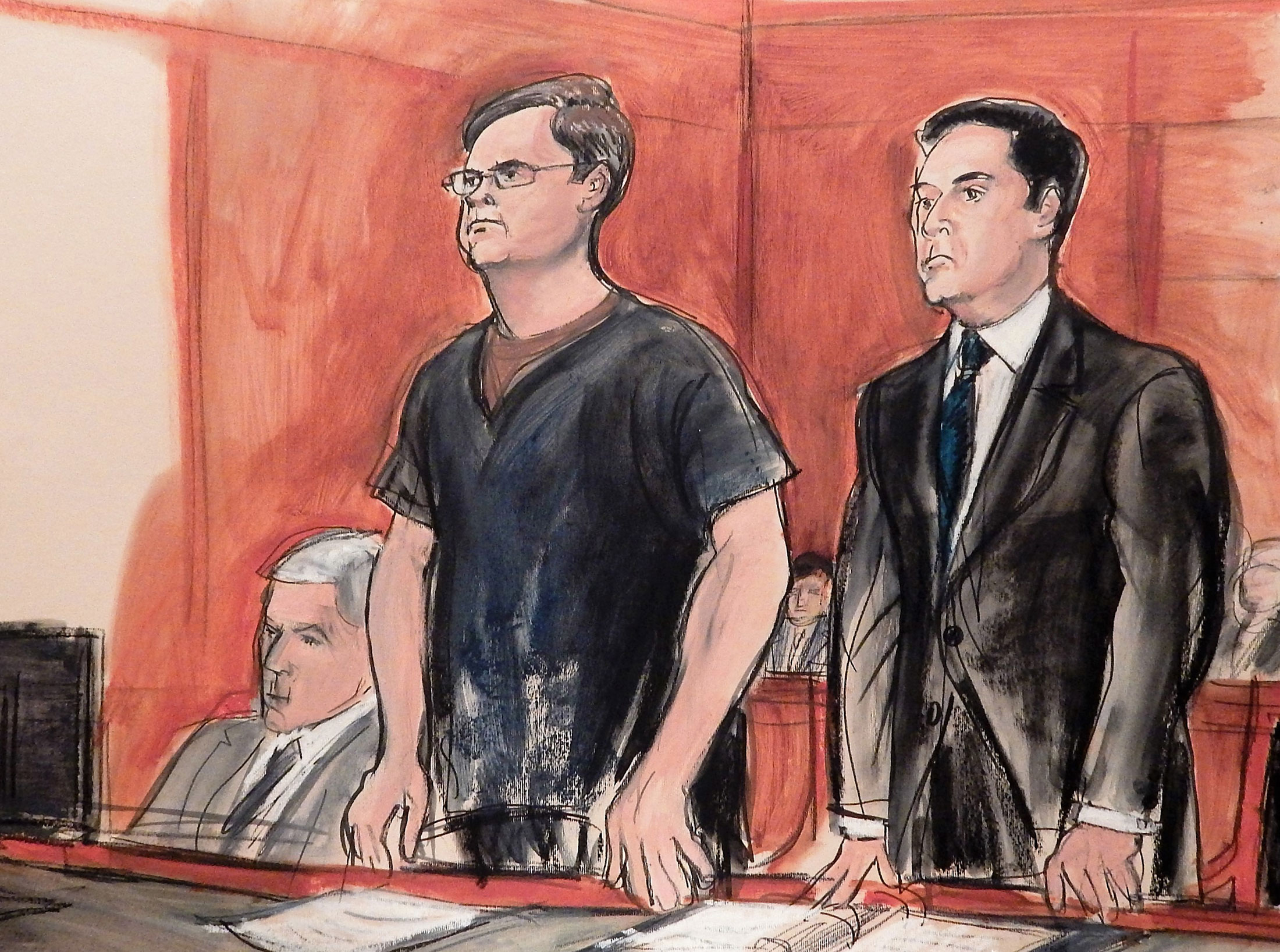
Buryakov in court.
Photographer: Elizabeth Williams/AP Photo
The son of a government construction engineer, Buryakov grew up in the remote southern Russian village of Kushchyovskaya, where he met Marina in 1994, when she was still in high school; they married in 1999. Smart and inquisitive, Buryakov was gifted at learning foreign languages. He worked in Moscow first as a tax inspector, then joined the Vnesheconombank, or VEB—the Russian government’s development bank, which backed economic projects that would boost growth and employment.
At some point, Buryakov signed on with the SVR intelligence agency. Following a five-year stint with VEB in South Africa, he arrived in the U.S. just weeks after the FBI had rolled up Operation Ghost Stories. He was the first of the next wave of Russian intelligence officers.
Buryakov, his wife, and their two children, Pavel and Polina, rented a $3,000-a-month, two-story house on Leibig Avenue in Riverdale. The Bronx neighborhood was well-known to U.S. counterintelligence. A few blocks away, clearly visible from the Buryakovs’ driveway, looms a 20-story, cream-colored high-rise built for Russia’s UN staff. The six-acre compound, known as the White House, had long made the area a favorite for other Eastern European diplomats and immigrants. Sporyshev lived right around the corner. The Buryakovs mostly kept to themselves, but the nuns next door often saw Evgeny smoking cigarettes at the end of his driveway late at night, and Marina would host other mothers from school.
By day, Buryakov lived the ordinary life of a Wall Street analyst: reading and writing reports; attending meetings, conferences, and parties; building connections on LinkedIn. His employer, VEB, occupied a useful niche in the global banking network. The public-private nature of the bank allowed Buryakov to move freely in government, corporate, and nongovernmental organization circles, without anyone suspecting they were talking to an intelligence officer. (Alexander Slepnev, the head of VEB’s New York office, didn’t respond to requests for comment.)
As one of Buryakov’s handlers, Sporyshev gave him a series of often menial side projects. In May 2013, Sporyshev asked him to outline some questions that the Russian news outlet ITAR-TASS could use when interviewing an official from the New York Stock Exchange. Buryakov did about 20 minutes of research, then recommended asking about exchange-traded funds.
Buryakov also became involved in a multibillion-dollar aerospace deal when Canada’s Bombardier attempted to team up with Rostek, Russia’s state-owned defense manufacturer. Using his bank job as cover, Buryakov traveled to Canada twice, in 2012 and 2013, to participate in meetings and conferences about the proposed agreement. Then, after researching the Canadian labor unions’ resistance to overseas production, he wrote a proposal for the SVR’s “active measures directorate” that Sporyshev described as “geared towards pressuring the unions and securing from the company a solution that is beneficial to us.” It wasn’t 007-worthy. But it helped Russian industry pursue a lucrative contract. (The arrangement was paused after Russia annexed Crimea in 2014, alarming Western governments.)
As Buryakov performed more such tasks, the FBI built a surveillance dragnet around him. Agents conducted multiple covert searches of his office at VEB. In December 2013, Gregory Monaghan—the lead agent on the case—showed up at Buryakov’s landlord’s office to ask about gaining entrance to the house. The landlord consented, and while the Buryakovs were away on a ski trip that winter, the FBI sneaked in and wired the house for audio and video. Over the next several months, the bureau surveilled more than four dozen meetings between Buryakov and his handlers.
Inside Russia’s UN mission, in New York’s Lenox Hill neighborhood, Sporyshev and Podobnyy were also recorded trying to recruit sources across Wall Street: consultants, analysts, and other financial professionals who had access to proprietary data or documents—or might win access later in their careers. Russian intelligence agencies have demonstrated extreme patience for schemes that play out over many years—time horizons far beyond those that will hold the interest of U.S. agencies, presidential administrations, and congressional leaders. The agents of Directorate ER sought to build relationships by asking for innocuous information that nobody would suspect might one day lead to the sharing of more valuable intelligence.
As the FBI’s bugs listened, Podobnyy informed Sporyshev that he’d told one woman, a recent college graduate, that he “needed answers to some questions, answers to which I could not find in open sources. Due to that, I am interested to find information from paid publications and opinions of independent people who discuss these topics amongst themselves behind closed doors.” The woman, Podobnyy said, responded favorably.
Podobnyy also approached a male financial consultant he’d met at an energy symposium. The consultant often traveled to Moscow and was keenly interested in Gazprom, Russia’s massive energy conglomerate. “It’s obvious that he wants to earn lots of money,” Podobnyy told Sporyshev. “For now, his enthusiasm works for me. I also promised him a lot: that I have connections in the trade representation, meaning that you can push contracts.” He laughed. “I will feed him empty promises.”
The FBI’s Ricci says such attempts at cultivating connected New Yorkers are far more common, and successful, than many people in the financial world think. Americans regularly become unwitting agents, passing along useful tips to Russian officers without realizing who they’re dealing with. “When the Russians come to you, they don’t say, ‘Hey, I’m an intelligence officer,’ ” Ricci says. “They say, ‘Hey, friend, it’d be useful to have this information.’ ”
Buryakov devoted his time to finding and making contacts across New York—referring potential sources and future contacts for his handlers and other intelligence officers to pursue. “This isn’t about just stealing classified information. This is about stealing you,” Ricci says. “It’s about having you in a Rolodex down the road when they need it.”
Or, as Sporyshev put it in a recorded conversation: “This is intelligence method to cheat. How else to work with foreigners? You promise a favor for a favor. You get the documents from him and tell him to go f— himself. ‘But not to upset you, I will take you to a restaurant and give you an expensive gift. You just need to sign for it.’ This is ideal working method.”
By the middle of 2014, FBI agents thought they had enough evidence to arrest Buryakov but decided to go for more—preparing a final dramatic episode that would document the full cycle of a foreign spy recruiting a Wall Street source, from first contact to document handoff. The bureau asked an Atlantic City businessman (his name hasn’t been disclosed) to approach Buryakov, pretending to represent a wealthy investor who wanted to open casinos in Russia. In a bugged call with Buryakov, Sporyshev was dubious, saying the encounter seemed like “some sort of setup. Some sort of trap.”
Buryakov proceeded anyway. On Aug. 8, 2014, he spent seven hours touring Atlantic City with the FBI source, visiting casinos and looking over a PowerPoint presentation about the project. The FBI source provided Buryakov with government documents, marked “Internal Treasury Use Only,” about individuals who had been sanctioned by the U.S. over the Crimean invasion. Buryakov said he’d like more documents like that, and later in the month, the source handed over another report, this one on the Russian banking sector, labeled “Unclassified/FOUO, or “For Official Use Only.” That same day, Buryakov called Sporyshev to discuss “the schoolbooks,” and that night, briefcase in hand, he went directly from his VEB office to Sporyshev’s home in the Bronx. An FBI surveillance team monitored from outside.
SVR agents work on five-year contracts, and toward the end of 2014, Sporyshev and Podobnyy returned to Russia, their tours over. Now that Buryakov’s handlers were gone, the FBI grew concerned about identifying their replacements. “They could’ve completely changed the meetups and contact procedures, so we didn’t think it was worth letting [Buryakov] continue to operate,” Ricci says. One of the oddities of counterintelligence is that countries regularly tolerate both known and suspected spies, allowing them to operate under what they hope is a watchful eye. “The original goal for a counterintelligence case isn’t an arrest—it’s to recruit or deflect them,” Ricci says. “My No. 1 priority is to make sure no one steals our secrets.” That mission appears to have succeeded. Aside from documents the FBI allowed him to see, Buryakov rarely seemed to get his hands on material more valuable than what any average Wall Streeter might possess.
The FBI scheduled his arrest for Jan. 26, 2015. As the snow fell on VEB’s headquarters and Buryakov’s Riverdale home, search teams and dozens of agents waited anxiously outside both locations. Buryakov headed out to get groceries. After he paid, he found Ricci’s agents, clad in blue FBI windbreakers, waiting in the parking lot. “Sir, you have to come with us,” they said, then hurried him into an SUV. Buryakov, the agents later reported, was calm and hardly seemed surprised. Other agents then took his purchases the two blocks back along Leibig Avenue, where they knocked on his door, delivered the groceries, and told Marina that they had a warrant to enter. As they searched the house, technicians covertly removed the FBI’s audio and video surveillance tools.
By day’s end, the U.S. Department of Justice announced the arrest and unsealed the criminal complaint against Buryakov, as well as naming Sporyshev and Podobnyy, who were both protected by diplomatic immunity. The arrest and announcement touched off a flurry of international activity. In Moscow, the Russian government summoned the U.S. ambassador to protest. In New York, Marina and the children fled into the nearby Russian mission residence, their family car abandoned on Mosholu Street outside, until they were able to leave the country. Russian colleagues hurriedly moved the family’s belongings out of the Riverdale home, tearing the house apart in the vain hope of uncovering the FBI’s recording devices.
VEB paid $45,000 to settle a lawsuit filed by Buryakov’s landlord and also paid for his legal counsel. Initially, Buryakov’s defense was that he’d done nothing more than many professionally ambitious expatriates in New York do: He’d simply agreed to help his countrymen, Sporyshev and Podobnyy, with their work and lives in America. But eventually he pleaded guilty to being an unregistered foreign agent—the technical federal charge for espionage.
Buryakov’s arrest did little to slow the flow of intelligence operatives into America. Even as his case played out in the New York courts in the summer of 2015, Border Patrol agents apprehended a man from Ukraine crossing the Texas border, according to previously unreported internal U.S. Customs and Border Protection documents. “It is my opinion that this subject is a Russian asset and was sent by the Russians to infiltrate the U.S.,” the agent wrote. “[The individual] is a perfect asset since he already knows some English, is militarily trained, and is fluent in Russian and his native tongue of Arabic.” Following standard procedure, though, the man was released into the U.S. with a notice to appear at a deportation hearing. The FBI refuses to confirm if it’s aware of the incident or if it’s monitoring the man.
On May 24, 2016, Buryakov was sentenced to 30 months in prison, and he now resides in the federal low-security prison in rural Lisbon, Ohio. He’s still listed on VEB’s website as its deputy representative in New York.