Former Astronaut Mark Kelly, AZ Democratic Senate Candidate and China

Primer: With U.S.-China relations taking on increasing importance in all spheres of life — economic, geopolitical, cultural — it becomes vital to enhance the dialogue between our countries and build lasting, direct, and informative ties between our peoples. The Young Leaders Forum (YLF), now in its second decade, does just that.

Each year, YLF holds a four-day retreat to which a select group of exceptional American and Chinese young professionals are invited. Together, participants explore substantive issues, identify commonalities, and develop enduring friendships and partnerships in a casual, intimate environment.

Comprised of influencers and change-makers, the accomplished group of YLF fellows works in a variety of fields. Fellows include government officials and politicians, authors, university leaders, entrepreneurs, and musicians and artists. Attention is given to geographic, gender, and ethnic diversity. An alphabetical listing of all YLF participants since the program’s inception has been posted on the right side of this page.

The Forum’s location alternates each year between the United States and China. Each Forum is packed with interesting, provocative cross-cultural conversation and activity.

The National Committee, the Chinese People’s Institute of Foreign Affairs (CPIFA), and the Forum’s U.S. sponsors—led in 2019 by Chubb and Xcoal—cover all lodging, food, and program costs of the YLF retreat for the first two years of our fellows’ participation, allowing them to attend one Forum in the United States and one in China. Participants are asked to pay their own travel expenses to and from the venue, but some full or partial subsidies are available.

And maybe there are some others that we need to question on membership or participation:

George Stephanopoulos moderates a national webcast discussion on U.S.-China relations with experts Stephen Orlins, Melanie Hart, Yasheng Huang, and Ely Ratner. The panelists address a range of current topics, from the trade war to protests in Hong Kong, from visa restrictions to the NBA. This webcast is part of the thirteenth annual CHINA Town Hall, held at 80+ venues across the United States and China on November 18, 2019.

(someone be sure that the Republican Senator Martha McSally knows the details)

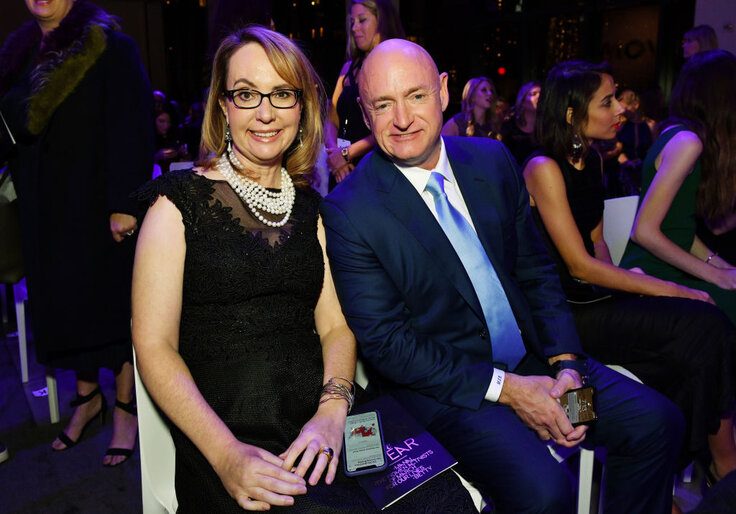
Gabby Giffords and Mark Kelly
Yuichiro Kakutani – September 28, 2020 5:00 AM

FB: The Chinese government invited then-astronaut Mark Kelly, now an Arizona Democratic Senate candidate, to an all-expenses-paid retreat at a countryside resort in 2003. He left China five days later not only with a future spouse, former Rep. Gabby Giffords (D., Ariz.), but also with lucrative regime business contacts.

Kelly attended the annual Young Leaders Forum, a five-day junket cohosted by the Chinese People’s Institute of Foreign Affairs, which is “under the leadership of the Communist Party of China.” The conference allowed Kelly an opportunity to mingle with high-profile Communist Party officials and rising stars in Chinese society. Attendees included Cui Tiankai, now Chinese ambassador to the United States; Fang Xinghai, former director of the CCP’s top committee on the economy; and Zhou Mingwei, the party’s former top foreign propaganda honcho.

China analyst Gordon G. Chang said that party connections—such as those Kelly fostered—are “absolutely essential” for securing Chinese business deals.

“The Communist Party tries to control everything, whether it’s a state enterprise or a private company,” he said. “And so it’s extremely important to have Communist Party contacts [to do business].”

Kelly has also had extensive ties with China since becoming a civilian. World View Enterprise, an aerospace company he cofounded and in which he still holds investments, received funding from Chinese tech giant Tencent, which censors the internet for Beijing. As the Washington Free Beacon reported, he also held a financial stake in a Colorado company that courted investments from a Chinese state-funded tech enterprise.

He now has assets worth up to $27 million, according to his financial disclosure.

A Kelly campaign spokesman said that the former aviator’s participation was “coordinated by NASA,” but did not answer questions about whether the Democrat used any of the contacts he met on the YLF trip for his business ventures. Instead, the campaign said that prominent Republicans also participated in the campaign.

Kelly and Giffords told multiple media outlets that they met during the Young Leaders Forum, without mentioning the Chinese People’s Institute of Foreign Affairs. The retreat took place in a luxury hotel in the scenic Chinese countryside, where attendees went on pleasure cruise rides in between their panel discussions. Kelly gave a one-hour speech about his space experience, while Giffords participated in a panel discussion with Chinese politicos.

Kelly would participate in the 2004 and 2005 conferences as well. He called the experience “one of the absolute highlights of my life, second only to flying in space,” and even took a Forum banner into space in 2006.

Kelly’s campaign has been trying to deflect concerns about the candidate’s business ties by emphasizing his military service and calling China a “threat to American interests.” Nevertheless, they have remained contentious in the race, with Republicans spending millions on ads accusing him of dependence on China. He holds a 5.5 point lead against Republican incumbent Martha McSally, according to RealClearPolitics.

Chinese Embassy in NY is a Spy Hub, so is the UN

Primer:

January of 2020, a reported United Nations hacked revealed the infiltration of spies.
A New York City police officer

charged with acting as an agent for China  

has been denied bail by a US federal judge in New York. And in January of 2020

  NYPD Officer Allegedly Acted as Agent for Chinese ...

Prosecutors pointed to Baimadajie Angwang’s financial records showing “unusually large” wire transfers to and from China and the possibility that the 33-year-old defendant – a naturalised US citizen who is accused of spying on fellow ethnic Tibetans – might flee to China’s consulate in New York.

Magistrate Judge Roanne Mann of the US Justice Department’s Eastern District of New York granted the request for continued detention on Monday because “no credible sureties” were offered to assure that Angwang would appear for court proceedings. Angwang is a community affairs police officer in the borough of Queens as well as a US Army reservist stationed at Fort Dix in New Jersey. The indictment against Angwang highlighted his familial and financial ties to China, noting that his brother was a reservist in the People’s Liberation Army. Wire transfers from China to accounts with Angwang’s name in the US in 2014 and 2016 amounted to nearly US$120,000, including one US$49,985 transfer from his brother, prosecutors said. He faces up to 55 years in prison if convicted.

NR: Secretary of State Mike Pompeo said that the Chinese consulate in New York City is a center for espionage, in comments to the New York Post on Thursday.

Pompeo’s remarks came after the Justice Department charged an NYPD officer on Monday with spying for China. The officer, Baimadajie Angwang, is accused of arranging invitations for Chinese officials to NYPD events, in order to gain access to senior ranks of the NYPD.  Angwang is an ethnic Tibetan who also gathered information for China on Tibetans in the city.

The Justice Department alleged that Angwang was in contact with at least two consulate officials. Pompeo said there would likely be additional arrests of agents connected with the consulate.

Officials in the consulate are “engaged in activities where they’re crossing the line from normal diplomacy to the kinds of things that would be more akin to what spies are doing,” Pompeo told the Post.

In addition to the New York consulate, Pompeo warned that China’s spying efforts may extend to its United Nations personnel.

“Remember, not only do we have Chinese consulates here, but there’s a UN facility, too,” Pompeo said. “So if we’re talking about New York, we not only have the Chinese Consulate in New York — that is the bilateral consulate — they also have a large contingent of Chinese diplomats here for United Nations work.”

China has attempted to influence state and local politics in the U.S. through its consular missions, across various locations. National Review has reported that the wife of the Chinese Consulate-General in Chicago sent emails to Wisconsin’s State Senate President Roger Roth in February, asking Roth to “consider adopting a resolution expressing solidarity with the Chinese people in fighting the coronavirus.”

The U.S. ordered the closure of China’s consulate in Houston on July 22, citing unspecified “massive illegal spying and influence operations” emanating in part from the consulate. Nearby residents called the fire department after consulate workers began burning piles of documents in the courtyard of the complex.

Report: VP Biden was Well Aware of Hunter’s Illicit Foreign Actions

Senate report

DW: A bombshell report from the Senate Committee on Homeland Security and Governmental Affairs (HSGAC) and the Committee on Finance makes a series of damning new allegations against Hunter Biden, the son of Democrat presidential nominee.

The investigation launched after Finance Committee Chairman Charles Grassley (R-IA) publicly raised conflict-of-interest concerns about the sale of a U.S. company to a Chinese firm with ties to Hunter Biden a month before Congress was notified about a whistleblower complaint that was the catalyst for Democrats’ impeachment of President Donald Trump. The Senate’s investigation relied on records from the U.S. government, Democrat lobbying groups, and interviews of numerous current and former officials.

Hunter Biden received $3.5M from Russian billionaire: report photo

The report outlined the following key findings from the investigation:

  • In early 2015 the former Acting Deputy Chief of Mission at the U.S. Embassy in Kyiv, Ukraine, George Kent, raised concerns to officials in Vice President Joe Biden’s office about the perception of a conflict of interest with respect to Hunter Biden’s role on Burisma’s board. Kent’s concerns went unaddressed, and in September 2016, he emphasized in an email to his colleagues, “Furthermore, the presence of Hunter Biden on the Burisma board was very awkward for all U.S. officials pushing an anticorruption agenda in Ukraine.”
  • In October 2015, senior State Department official Amos Hochstein raised concerns with Vice President Biden, as well as with Hunter Biden, that Hunter Biden’s position on Burisma’s board enabled Russian disinformation efforts and risked undermining U.S. policy in Ukraine.
  • Although Kent believed that Hunter Biden’s role on Burisma’s board was awkward for all U.S. officials pushing an anti-corruption agenda in Ukraine, the Committees are only aware of two individuals — Kent and former U.S. Special Envoy and Coordinator for International Energy Affairs Amos Hochstein — who raised concerns to Vice President Joe Biden (Hochstein) or his staff (Kent).
  • The awkwardness for Obama administration officials continued well past his presidency. Former Secretary of State John Kerry had knowledge of Hunter Biden’s role on Burisma’s board, but when asked about it at a town hall event in Nashua, N.H. on Dec. 8, 2019, Kerry falsely said, “I had no knowledge about any of that. None. No.” Evidence to the contrary is detailed in Section V.
  • Former Assistant Secretary of State for European and Eurasian Affairs Victoria Nuland testified that confronting oligarchs would send an anticorruption message in Ukraine. Kent told the Committees that Zlochevsky was an “odious oligarch.” However, in December 2015, instead of following U.S. objectives of confronting oligarchs, Vice President Biden’s staff advised him to avoid commenting on Zlochevsky and recommended he say, “I’m not going to get into naming names or accusing individuals.”
  • Hunter Biden was serving on Burisma’s board (supposedly consulting on corporate governance and transparency) when Zlochevsky allegedly paid a $7 million bribe to officials serving under Ukraine’s prosecutor general, Vitaly Yarema, to “shut the case against Zlochevsky.” Kent testified that this bribe occurred in December 2014 (seven months after Hunter joined Burisma’s board), and, after learning about it, he and the Resident Legal Advisor reported this allegation to the FBI.
  • Hunter Biden was a U.S. Secret Service protectee from Jan. 29, 2009 to July 8, 2014. A day before his last trip as a protectee, Time published an article describing Burisma’s ramped up lobbying efforts to U.S. officials and Hunter’s involvement in Burisma’s board. Before ending his protective detail, Hunter Biden received Secret Service protection on trips to multiple foreign locations, including Moscow, Beijing, Doha, Paris, Seoul, Manila, Tokyo, Mexico City, Milan, Florence, Shanghai, Geneva, London, Dublin, Munich, Berlin, Bogota, Abu Dhabi, Nairobi, Hong Kong, Taipei, Buenos Aires, Copenhagen, Johannesburg, Brussels, Madrid, Mumbai and Lake Como.
  • Andrii Telizhenko, the Democrats’ personification of Russian disinformation, met with Obama administration officials, including Elisabeth Zentos, a member of Obama’s National Security Council, at least 10 times. A Democrat lobbying firm, Blue Star Strategies, contracted with Telizhenko from 2016 to 2017 and continued to request his assistance as recent as the summer of 2019. A recent news article detailed other extensive contacts between Telizhenko and Obama administration officials.
  • In addition to the over $4 million paid by Burisma for Hunter Biden’s and Archer’s board memberships, Hunter Biden, his family, and Archer received millions of dollars from foreign nationals with questionable backgrounds.
  • Archer received $142,300 from Kenges Rakishev of Kazakhstan, purportedly for a car, the same day Vice President Joe Biden appeared with Ukrainian Prime Minister Arsemy Yasenyuk and addressed Ukrainian legislators in Kyiv regarding Russia’s actions in Crimea.
  • Hunter Biden received a $3.5 million wire transfer from Elena Baturina, the wife of the former mayor of Moscow.
  • Hunter Biden opened a bank account with Gongwen Dong to fund a $100,000 global spending spree with James Biden and Sara Biden.
  • Hunter Biden had business associations with Ye Jianming, Gongwen Dong, and other Chinese nationals linked to the Communist government and the People’s Liberation Army. Those associations resulted in millions of dollars in cash flow.
  • Hunter Biden paid nonresident women who were nationals of Russia or other Eastern European countries and who appear to be linked to an “Eastern European prostitution or human trafficking ring.”

The report also stated that the investigation found that the Obama administration “knew that Hunter Biden’s position on Burisma’s board was problematic and did interfere in the efficient execution of policy with respect to Ukraine.”

When Iran Buys Arms, Tanks and Air Defense Systems, Blame Europe

Primer: The 3rd Khordad system, which is based on the Russian S-300 and shot down a U.S. sophisticated large Global Hawk US drone in June 2019. Iran is the major supplier of weapons to Syria.

Iran’s foreign minister says the country will meet its strategic needs by purchasing weapons from Russia and China, and has no need for European weapons once the UN embargo is lifted in October.

Iran announces mass production of domestic main battle ...

(Bloomberg) — European governments that aren’t backing the U.S. re-imposition of United Nations sanctions on Iran are wedded to the “silly” 2015 nuclear deal and haven’t proposed an alternative for preventing new conventional arms sales to Iran, Secretary of State Michael Pompeo said.

With European powers stressing their commitment to the accord on Sunday, Pompeo doubled down on the U.S. decision to invoke the “snapback” of sanctions in a dispute that’s helped estrange President Donald Trump’s administration and Europe.

“The Europeans who have not joined us in this, they know we’re right,” Pompeo said on Fox News’s “Sunday Morning Futures.” “They tell us privately they don’t want the arms sales to come back” and expressed this view in a letter “that they’re very concerned about these arms sales.” He didn’t elaborate on who sent the letter or when.

The U.S. on Saturday said that all of the UN resolutions on Iran that were in place before the 2015 deal — from a ban on arms deals to restrictions on Iran’s ballistic missile activity and its nuclear enrichment — have now gone back into effect. But 13 of 15 Security Council members say they don’t consider the U.S. move valid.

Can’t Proceed

“It is illegitimate for the U.S. to demand the Security Council invoke the snapback mechanism” because it is no longer a participant of the deal, Chinese Ambassador Zhang Jun wrote in a letter to the Security Council on Saturday that was seen by Bloomberg News.

UN Secretary General Antonio Guterres also weighed in on the disagreement on Saturday, noting in a letter that he couldn’t proceed in acting upon the U.S. snapback because of the “uncertainty over whether or not the process” was “indeed initiated”.

Although Europeans have expressed private concern, “they haven’t lifted a finger, they haven’t done the work that needs to be done” or have outlined an option to the U.S. snapback, Pompeo said. “I hope they’ll join us. I hope they get to the right place. They’re still wedded to this silly nuclear deal that was signed now five years ago.”

Weapons Purchases

Absent the snapback, Iran would be able to resume buying arms, tanks and air defense systems, Pompeo said. “All of those in a couple of weeks, would have been permitted to have been sold,” he said.

European powers on Sunday stressed their commitment to the nuclear agreement.

“We have worked tirelessly to preserve the nuclear agreement and remain committed to do so,” the foreign ministers of France, Germany and the U.K. said in a statement. Josep Borrell, the European Union’s foreign policy chief, said the accord is “a key pillar” of nuclear non-proliferation that deserves support.

Since quitting the accord in 2018, the Trump administration has plowed ahead with efforts to undermine the deal, ratcheting up sanctions on Iran and threatening allies if they do business with the Islamic republic. Trump is expected to speak on Tuesday to the UN General Assembly, which is being held virtually this year.

The U.S. campaign has united partners such as the U.K., France and Germany with Russia and China, all of whom have sought to salvage the accord. Their support for the deal has left the U.S. isolated on the United Nations Security Council.

Why U.S., Other Powers Differ on Iran Nuclear Deal: QuickTake

Iranian President Hassan Rouhani, at a cabinet meeting on Sunday shown on state television news, called the U.S. move a sign of “certain failure” which only demonstrates that President Donald Trump’s strategy has resulted in “maximum isolation” for Washington.

On Saturday, the commander of the Islamic Revolutionary Guard Corps threatened Iran would set U.S. military outposts in the Persian Gulf “on fire at once” if its adversary tried to start a war.

To enforce those measures, if countries like Russia and China disregard them, the U.S. could use tools such as secondary sanctions on shippers, insurers and banks. It could even threaten interdictions of ships at sea.

Read More: Iran Warns U.S. Against War Before UN Sanctions Showdown

“In the coming days, the United States will announce a range of additional measures to strengthen implementation of UN sanctions and hold violators accountable,” Pompeo said in his statement on Saturday. “Our maximum pressure campaign on the Iranian regime will continue until Iran reaches a comprehensive agreement with us to rein in its proliferation threats and stops spreading chaos, violence and bloodshed.”

Speaking Sunday at a church in Plano, Texas, Pompeo, said he prays that “the Iranian people that they will get a government that they deserve that respects the dignity of the lives of the Iranian people.”

The Iranian rial hit a low on the unregulated open market on Sunday, weakening 4.6% compared with last week and briefly breaching 280,000 per U.S. dollar, according to two currency trading channels on the Telegram messaging app.

SecDef Says China, Russia Have ‘Weaponized Space’

Primer: Now we are beginning to understand the creation of the new military branch known as the Space Force and further it is important to embrace the work of NASA and SpaceX.

Is the Space Force Necessary? If Done Correctly, Yes | CyberDB

A year ago, two intelligence agencies have recently released documents that describe in general terms the nature of the threat. Russia and China are developing kinetic and non-kinetic means designed to disrupt, degrade and destroy U.S. space systems. Mechanisms being tested include directed energy weapons such as lasers, spacecraft that can physically manipulate satellites, terrestrial anti-satellite munitions, jammers that can disrupt uplinks and downlinks, and cyber tools that can impair satellites, ground stations and the equipment of warfighters reliant on space-based systems.

For instance, China is believed to possess 120 intelligence and reconnaissance satellites, many of which are operated by the People’s Liberation Army to track the movements of U.S. forces. Russia only possesses about 20 such satellites. And while Russia pioneered development of systems for hacking and attacking U.S. space systems, it is China that is continually increasing it outlays for counterspace technologies. For example, Beijing tested an anti-satellite weapon in 2007 and has continued refining that technology.

With a typical Army combat brigade containing 2,000 pieces of equipment dependent on space systems to function, this is a serious matter. In wartime, counterspace attacks could prevent the joint force from accessing GPS signals vital to the operation of smart bombs, block the transmission of critical intelligence, and even impede the ability of the president to receive timely warning of a nuclear attack. The nation’s entire global military posture could be degraded by disruption of links traveling through orbital assets. More here from Forbes

The U.S. plan for a Space Force risks escalating a 'space arms race'

China and Russia have introduced weapons to space, including killer satellites, Secretary of Defense Mark Esper said Wednesday.

“In space, Moscow and Beijing have turned a once peaceful arena into a warfighting domain,” Esper said.

“They have weaponized space through killer satellites, directed energy weapons, and more in an effort to exploit our systems and chip away at our military advantage.”

Directed energy weapons use converted chemical or electrical energy and focus it on a target, resulting in physical damage. Weapons used by the U.S. military include systems that use high energy lasers.

Directed energy weapons can be very effective against swarm attacks, a Pentagon official said in 2018.

“We often think about directed energy as large lasers, and I’ve certainly been involved with some of that for decades, but we also have high power microwaves which can be very effective as what we call an electronics kill,” Dr. Michael D. Griffin, under secretary of Defense for Research and Engineering, said at the time.

NTD Photo

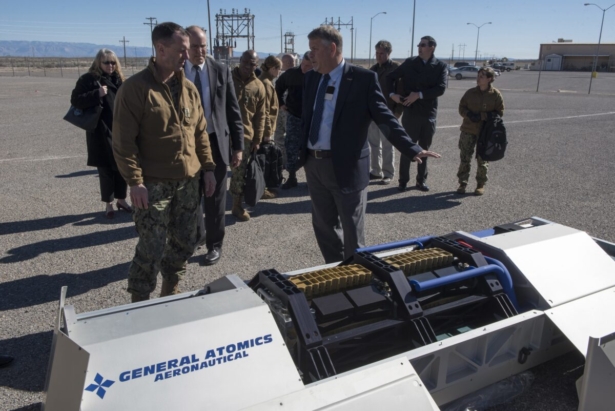
Chief of Naval Operations Adm. John Richardson inspects new technologies being developed and tested at the High Energy Laser Systems Test Facility and USS Desert Ship, a land-based launch facility designed to simulate a ship at sea, at White Sands Missile Range, N.M., on Jan. 25, 2017. (Navy photo by Chief Petty Officer Elliott Fabrizio)

“That sort of thing—it’s really hard to envision handling swarming attacks by purely kinetic means—so that’s one of the future threats that I think we face.”

Killer satellites are satellites with the capability to kill and destroy.

**

Esper said America’s competitors and adversaries “exploit cyberspace to undermine our security without confronting our conventional strengths.”

“They do this all in an increasingly gray zone of engagement that keeps us in a perpetual state of competition. The national defense strategy guides us as we adapt the force to this challenging complex security environment by status quo and continue outpacing the competition,” he added.

But strong investment is enabling the military to move forward with developing hypersonic weapons and other modern tools.

“Thanks to our largest research and development budget in the department’s history, we are advancing critical technologies to maintain our military edge in areas such as hypersonic weapons, directed energy and autonomous systems,” Esper said.

Esper was speaking during the Air Force Association’s Virtual Air, Space & Cyber Conference.

Following an increase of $3.6 billion, the Department of Defense’s budget for research and development was $95.3 billion in fiscal year 2019, according to its financial report (pdf).

President Donald Trump’s administration officially launched Space Force late last year, establishing it as a sixth branch of the military.

“Amid grave threats to our national security, American superiority in space is absolutely vital,” Trump said when signing legislation that included funding for the branch.

The Defense Space Strategy, released earlier this year, outlines what the United States needs to do to achieve a “comprehensive military advantage” in space within 10 years.

Three key objectives are identified for the Space Force: to maintain America’s space superiority; to provide space support to all joint military operations; and to “ensure space stability”—or to deter aggression and uphold international agreements in space with a persistent presence, similar to how the Navy polices international waters.

Esper said he’s proud of the progress made in implementing the strategy, which will “ensure our dominance across all domains.”

Esper spoke a day after Gen. John Raymond, who heads Space Force.

Raymond revealed that the force’s Space Based Infrared System satellites were used to detect Iranian missiles aimed at American war planes in January.

Raymond praised the 2nd Space Warning Squadron at Buckley Air Force Base, Colorado.

“They operated the world’s best missile warning capabilities and they did outstanding work, and I’m very very proud of them,” he said at the conference.

Trump had said “an early warning system that worked very well” helped avoid U.S. casualties, but didn’t disclose the nature of the system.