An affordable price is probably the major benefit persuading people to buy drugs at www.americanbestpills.com. The cost of medications in Canadian drugstores is considerably lower than anywhere else simply because the medications here are oriented on international customers. In many cases, you will be able to cut your costs to a great extent and probably even save up a big fortune on your prescription drugs. What's more, pharmacies of Canada offer free-of-charge shipping, which is a convenient addition to all other benefits on offer. Cheap price is especially appealing to those users who are tight on a budget
Service Quality and Reputation Although some believe that buying online is buying a pig in the poke, it is not. Canadian online pharmacies are excellent sources of information and are open for discussions. There one can read tons of users' feedback, where they share their experience of using a particular pharmacy, say what they like or do not like about the drugs and/or service. Reputable online pharmacy canadianrxon.com take this feedback into consideration and rely on it as a kind of expert advice, which helps them constantly improve they service and ensure that their clients buy safe and effective drugs. Last, but not least is their striving to attract professional doctors. As a result, users can directly contact a qualified doctor and ask whatever questions they have about a particular drug. Most likely, a doctor will ask several questions about the condition, for which the drug is going to be used. Based on this information, he or she will advise to use or not to use this medication.

U.S. Naval Operations in the Caribbean VS. Maduro VS China

There are nine naval assets in the Caribbean due to Venezuela and Nicolas Maduro and his position as a drug king pin. the assets include destroyers, amphibious assault ships, reconnaissance, fighter aircraft, a submarine and drones.

Newsweek has a great map of the deployments and ship descriptions. Included in the Newsweek piece is the following:

The deployment reflects the Trump administration’s assertive approach to countering drug trafficking while signaling pressure on the Venezuelan government. Late on Tuesday, U.S. forces in the region launched a missile strike that destroyed a suspected drug boat linked to Venezuela, killing those on board, Trump said on his Truth Social platform.

By positioning advanced warships and long-range aircraft near Venezuelan waters, Washington is seeking to demonstrate both tactical capability and political resolve. In response, Venezuela is mobilizing troops and military assets, raising the prospect of a direct standoff in the southern Caribbean.

What is likely not revealed by these operations in the Caribbean is the matter of China. China has moved into the region in a huge force and very few are even aware of this threat. How so you ask?

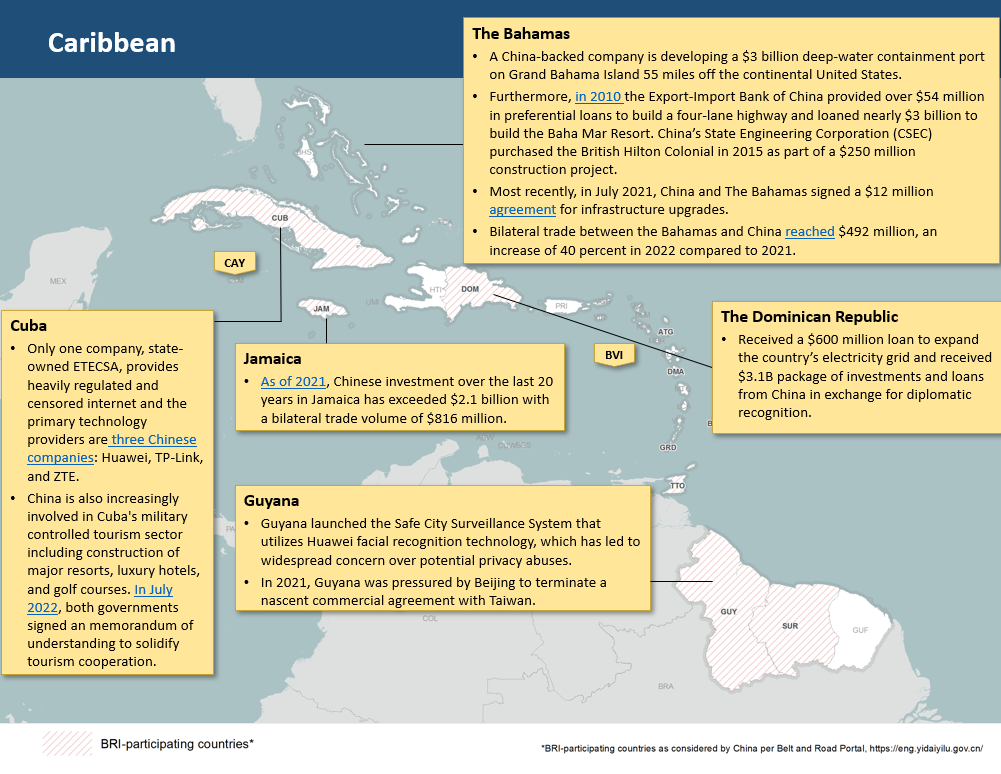
In part: By 2022, ten countries had already joined Beijing’s so-called Belt and Road Initiative: Cuba, Suriname, Guyana, Trinidad and Tobago, Grenada, Barbados, Dominica, Antigua and Barbuda, the Dominican Republic, and Jamaica

China’s growing influence in Cuba and the broader Caribbean region has raised concerns among U.S. experts, who warn that Beijing’s expanding economic and military presence could pose a strategic threat to the United States.

China has significantly expanded its influence in the region through economic investments, diplomatic ties, and military cooperation, particularly with authoritarian regimes like Cuba. Experts warn that these efforts are part of a broader strategy to turn the Caribbean into a “Chinese lake,” according to Newsweek report published on Sunday.

According to World Trade Organization data, Chinese manufacturing exports surged to $1.81 trillion in 2023, a 30-fold increase from 2002, while the U.S. global trade deficit exceeded $1.2 trillion. Chinese trade with the Caribbean skyrocketed from $1 billion in 2002 to $8 billion in 2019, including $6.1 billion in exports and $1.9 billion in imports.

China’s Deepening Ties With Cuba

Cuba has been one of China’s most loyal allies in the region for decades, with strong economic and military cooperation. A significant uptick in this relationship was observed in 2021, following Cuba’s July 11 (11J) protests, when Chinese paramilitary forces trained Cuban elite security units responsible for suppressing dissent. The Brigada Especial Nacional (BEN), a unit under Cuba’s Ministry of the Interior, reportedly received tactical training from China’s People’s Armed Police (PAP), a paramilitary force specializing in riot control and counterterrorism.

Sources told ADN Cuba that PAP training in Cuba began approximately six years before the 2021 protests, focusing on sniper tactics, intervention strategies, and specialized training for elite Cuban security forces. This collaboration underscores China’s role in bolstering the Cuban regime’s ability to suppress political opposition.

Beyond infrastructure projects and military cooperation, China is also strengthening its diplomatic and cultural footprint in communist Cuba. In May 2024, Beijing and Havana resumed direct flights between the two countries. The Cuban regime has also introduced visa exemptions for Chinese citizens with ordinary passports, making travel between both nations easier. More details here.

20th anniv. of China-Bahamas ties marked in Beijing - Xinhua | English ...

*** FNC has called on experts to describe the Chinese threat so close to to the U.S. coastline.

China is steadily expanding in the Bahamas through projects that blur economic development and geopolitical aims, an expert warned.

“The People’s Republic of China has been making diplomatic, economic and even military and quasi-military inroads into the Caribbean, South and Central America for the past couple of decades,” retired Rear Adm. Peter Brown, former Homeland Security advisor to President Donald Trump, told Fox News Digital.

Brown pointed to the rise in dual-use infrastructure projects along the Bahamas coastline, which is located just 50 miles off the coast of Florida.

“It doesn’t take a lot of imagination for the People’s Republic of China to use its commercial footprint in the Bahamas to monitor, exploit and perhaps even do worse to [the] U.S.,” he said.

Pointing to the Chinese-controlled British Colonial Hotel in Nassau, Bahamas, Brown said that its location directly across from the U.S. Embassy could give way to intelligence gathering on U.S. personnel.

“It doesn’t take a lot of imagination to think that additional electronics were put in there with the purpose and the task of keeping an eye not only on the U.S. Embassy itself, but also the U.S. Embassy visitors,” he said.

The hotel is owned by a Chinese company, Chow Tai Fook Enterprises, which has raised geopolitical concerns given its location. Fox News Digital has reached out to the British Colonial Hotel for comment.

China has invested heavily in the Bahamas through a range of additional high-profile projects, including a $40 million grant for a national stadium, a $3 billion mega-port in Freeport, and $40 million for the North Abaco Port and Little Abaco Bridge.

Additionally, China EXIM Bank provided over $54 million in loans to construct a four-lane highway and nearly $3 billion to finance the development of the Baha Mar Resort.

*** You can bet our high tech naval assets are picking up information and reporting back to the national security council and Secretary of State Marco Rubio…it is no wonder he has spent a good deal of time in the region.

Should DOGE include the E for Espionage Also?

ProPublica is not one of my ‘go-to’ sites but they get a hat tip for this one.… the enemy foreign and domestic has burrowed in…anyone really paying enough attention? One could argue CISA has failed as has  the NSA and Microsoft…..

Microsoft is using engineers in China to help maintain the Defense Department’s computer systems — with minimal supervision by U.S. personnel — leaving some of the nation’s most sensitive data vulnerable to hacking from its leading cyber adversary, a ProPublica investigation has found.

The arrangement, which was critical to Microsoft winning the federal government’s cloud computing business a decade ago, relies on U.S. citizens with security clearances to oversee the work and serve as a barrier against espionage and sabotage.

But these workers, known as “digital escorts,” often lack the technical expertise to police foreign engineers with far more advanced skills, ProPublica found. Some are former military personnel with little coding experience who are paid barely more than minimum wage for the work.

“We’re trusting that what they’re doing isn’t malicious, but we really can’t tell,” said one current escort who agreed to speak on condition of anonymity, fearing professional repercussions.

The system has been in place for nearly a decade, though its existence is being reported publicly here for the first time.

Microsoft told ProPublica that it has disclosed details about the escort model to the federal government. But former government officials said in interviews that they had never heard of digital escorts. The program appears to be so low-profile that even the Defense Department’s IT agency had difficulty finding someone familiar with it. “Literally no one seems to know anything about this, so I don’t know where to go from here,” said Deven King, spokesperson for the Defense Information Systems Agency.Biden review board blames Microsoft for China hack that targeted US ... source

National security and cybersecurity experts contacted by ProPublica were also surprised to learn that such an arrangement was in place, especially at a time when the U.S. intelligence community and leading members of Congress and the Trump administration view China’s digital prowess as a top threat to the country.

The Office of the Director of National Intelligence has called China the “most active and persistent cyber threat to U.S. Government, private-sector, and critical infrastructure networks.” One of the most prominent examples of that threat came in 2023, when Chinese hackers infiltrated the cloud-based mailboxes of senior U.S. government officials, stealing data and emails from the commerce secretary, the U.S. ambassador to China and others working on national security matters. The intruders downloaded about 60,000 emails from the State Department alone.

With President Donald Trump and his allies concerned about spying, the State Department announced plans in May to “aggressively revoke visas for Chinese students” — a pledge that the president seems to have walked back. The administration is also trying to arrange the sale of the popular social media platform TikTok, which is owned by a Chinese company that some lawmakers believe could hand over sensitive U.S. user data to Beijing and fuel misinformation with its content recommendations. But experts told ProPublica that digital escorting poses a far greater threat to national security than either of those issues and is a natural opportunity for spies.

“If I were an operative, I would look at that as an avenue for extremely valuable access. We need to be very concerned about that,” said Harry Coker, who was a senior executive at the CIA and the National Security Agency. Coker, who also was national cyber director during the Biden administration, added that he and his former intelligence community colleagues “would love to have had access like that.”

It is difficult to know whether engineers overseen by digital escorts have ever carried out a cyberattack against the U.S. government. But Coker wondered whether it “could be part of an explanation for a lot of the challenges we have faced over the years.”

Microsoft uses the escort system to handle the government’s most sensitive information that falls below “classified.” According to the government, this “high impact level” category includes “data that involves the protection of life and financial ruin.” The “loss of confidentiality, integrity, or availability” of this information “could be expected to have a severe or catastrophic adverse effect” on operations, assets and individuals, the government has said. In the Defense Department, the data is categorized as “Impact Level” 4 and 5 and includes materials that directly support military operations.

John Sherman, who was chief information officer for the Department of Defense during the Biden administration, said he was surprised and concerned to learn of ProPublica’s findings. “I probably should have known about this,” he said. He told the news organization that the situation warrants a “thorough review by DISA, Cyber Command and other stakeholders that are involved in this.”

In an emailed statement, the Defense Information Systems Agency said that cloud service providers “are required to establish and maintain controls for vetting and using qualified specialists,” but the agency did not respond to ProPublica’s questions regarding the digital escorts’ qualifications.

It’s unclear whether other cloud providers to the federal government use digital escorts as part of their tech support. Amazon Web Services and Google Cloud declined to comment on the record for this article. Oracle did not respond to requests for comment.

Microsoft declined to make executives available for interviews for this article. In response to emailed questions, the company provided a statement saying its personnel and contractors operate in a manner “consistent with US Government requirements and processes.”

Global workers “have no direct access to customer data or customer systems,” the statement said. Escorts “with the appropriate clearances and training provide direct support. These personnel are provided specific training on protecting sensitive data, preventing harm, and use of the specific commands/controls within the environment.” In addition, Microsoft said it has an internal review process known as “Lockbox” to “make sure the request is deemed safe or has any cause for concern.” A company spokesperson declined to provide specifics about how it works but said it’s built into the system and involves review by a Microsoft employee in the U.S.

Over the years, various people involved in the work, including a Microsoft cybersecurity leader, warned the company that the arrangement is inherently risky, those people told ProPublica. Despite the presence of an escort, foreign engineers are privy to granular details about the federal cloud — the kind of information hackers could exploit. Moreover, the U.S. escorts overseeing these workers are ill equipped to spot suspicious activity, two of the people said.

Even those who helped develop the escort system acknowledge the people doing the work may not be able to detect problems.

“If someone ran a script called ‘fix_servers.sh’ but it actually did something malicious then [escorts] would have no idea,” Matthew Erickson, a former Microsoft engineer who worked on the escort system, told ProPublica in an email. That said, he maintained that the “scope of systems they could disrupt” is limited.

Yes, China is Surrounding the S. China Sea, but what about Florida?

The two faced dragon….tie to really recalibrate the relationship between the United States and China AGAIN….Previously n this website, I have discussed not only by a post but several times on radio about how the former intelligence/snooping base owned by Russia in Cuba known as the Lourdes SIGINT station was sold to China….no one in media or the national security realm seems to give it much attention…but now…we have an additional problem with China and that is the Bahamas.

How about the largest Chinese embassy in the world with hundreds of Chinese intelligence officers deployed there…..Embassy of China in Nassau in Nassau, Bahamas (Google Maps)

In part from FNC:

“The People’s Republic of China has been making diplomatic, economic and even military and quasi-military inroads into the Caribbean, South and Central America for the past couple of decades,” retired Rear Adm. Peter Brown, former Homeland Security advisor to President Donald Trump, told Fox News Digital.

Brown pointed to the rise in dual-use infrastructure projects along the Bahamas coastline, which is located just 50 miles off the coast of Florida.

“It doesn’t take a lot of imagination for the People’s Republic of China to use its commercial footprint in the Bahamas to monitor, exploit and perhaps even do worse to [the] U.S.,” he said. Pointing to the Chinese-controlled British Colonial Hotel in Nassau, Bahamas, Brown said that its location directly across from the U.S. Embassy could give way to intelligence gathering on U.S. personnel.

The hotel is owned by a Chinese company, Chow Tai Fook Enterprises, which has raised geopolitical concerns given its location. Fox News Digital has reached out to the British Colonial Hotel for comment.

China has invested heavily in the Bahamas through a range of additional high-profile projects, including a $40 million grant for a national stadium, a $3 billion mega-port in Freeport, and $40 million for the North Abaco Port and Little Abaco Bridge.

In 2019, now-Secretary of State Marco Rubio warned in a Miami Herald op-ed that the devastation caused by the natural disaster could create an opening for the People’s Republic of China to use aid as a Trojan horse to gain a foothold near American shores.

“By targeting the Bahamian government in this period of crisis, Beijing would be making the same opportunistic play to access critical foreign infrastructure,” Rubio wrote in 2019. “But in this case, the national security threat is especially perilous, as it would give China a foothold just 50 miles from the coast of Florida.”

***

How about another look at things in the Caribbean…Chinese expansion

Chinese Expansion in the Caribbean (Extra) - Virtual Mirage

China’s Influence in the Caribbean:

China is a member of both the Inter-American Development Bank (IDB) and the Caribbean Development Bank (CDB) and an observer at the Organization of American States (OAS). Alongside Italy and Germany, China is the third largest shareholder at the CDB with 5.6% of overall shares, exponentially higher than the majority of Caribbean countries.

The People’s Republic of China’s (PRC) engagement in the Caribbean has largely focused on investments in infrastructure and developing trade relationships. As of 2022, ten Caribbean countries have signed up to Belt and Road (BRI) – Cuba, Jamaica, Dominican Republic, Antigua & Barbuda, Dominica, Barbados, Grenada, Trinidad & Tobago, Guyana, and Suriname.

The PRC is working towards diminishing the region’s ties to Taiwan as the region contains the largest bulk of Taiwan’s diplomatic allies. Today, St. Lucia, St. Vincent and the Grenadines, St. Kitts and Nevis, Haiti, and Belize remain the only Caribbean nations that recognize Taiwan.

China’s Trade and Economic Investment in the Caribbean

While the Caribbean’s trade with China has grown at a slower pace than overall trade with the region, it increased from $1 billion in 2002 to $8 billion in 2019, with an estimated $6.1 billion in Chinese exports and $1.9 billion in imports.

China is a major trading partner of Cuba’s and Chinese businesses are involved in the Cuba’s telecommunications, tourism, mining, and energy sectors.

Cuba is highly dependent on China and ongoing economic challenges resulted in the reconstructing of an estimated $4 billion in debt to China in 2011 and another restructuring in 2015. For more reading click here.

The U.S. Must Join China’s Belt and Road In Developing The Caribbean ...

The U.S. Must Join China’s Belt and Road In Developing The Caribbean ...

The $200M Smuggling Bust at the Long Beach Port

FoxLA:


LA Ports smuggling bust: Feds arrest 8 suspected of smuggling $200M in Chinese goods

Federal authorities have arrested eight individuals in connection with a large-scale smuggling operation that allegedly brought counterfeit and illegal goods from China into the United States through the Ports of Los Angeles and Long Beach.

The operation, involving logistics companies, warehouse owners, and corrupt truck drivers, is believed to have smuggled at least $200 million worth of goods. An additional defendant, believed to be the lead orchestrator, remains at large and is thought to be in China. The defendants face multiple charges, including conspiracy, smuggling, and breaking customs seals.

9 charged in 15-count indictment

What We Know: Federal law enforcement has charged nine defendants in a 15-count indictment with conspiracy, smuggling, and breaking customs seals. The defendants allegedly collaborated with partners in China to manipulate shipping containers flagged for inspection, using logistics companies to facilitate the smuggling of counterfeit goods into the U.S. Investigators have seized over $130 million in contraband, and the organization is believed to have smuggled at least $200 million worth of goods through this scheme. The Ports of Los Angeles and Long Beach, the busiest container ports in the Western Hemisphere, were the focal points of the operation.

How the crime ring operated

According to Acting United States Attorney Joseph T. McNally, the scheme involved logistics companies, warehouse owners, and corrupt truck drivers working together to defy U.S. customs laws. The defendants and their partners in China filled shipping containers with contraband, including counterfeit goods and illegal chemicals. They circumvented the security system by learning the unique serial numbers of security seals and creating duplicate fake seals. These counterfeit seals were sent from China to the U.S. When shipments arrived at the port, instead of going to secondary inspection sites, corrupt truck drivers took the containers to offsite warehouses. There, the seals were cut, contraband removed, and new counterfeit seals applied before presenting the containers to Customs and Border Protection (CBP) for inspection. Truck drivers were paid significantly above normal rates to transport the containers illegally.

Timeline: The indictment details a conspiracy that operated from at least August 2023 to June 2024. The scheme involved filling shipping containers in China with contraband, counterfeit goods, and illegal chemicals. These containers were sealed with unique security seals, whose numbers the conspirators obtained in advance to create duplicate fake seals. Upon arrival in the U.S., the containers were diverted to offsite warehouses instead of secondary inspection sites, where the contraband was removed, and new counterfeit seals were applied before presenting the containers for Customs and Border Protection (CBP) inspection. Seven defendants were arrested on Friday, with an eighth taken into custody on Saturday. The arraignment for the seven arrested took place on Friday, where they pleaded not guilty, and a trial date was set for March 18. The eighth defendant is expected to be arraigned soon.

The Backstory: The smuggling operation involved executives from logistics companies, warehouse owners, and corrupt truck drivers who coordinated the shipment of contraband from China to the U.S. through the Port of Los Angeles. The defendants allegedly circumvented customs inspections by breaking security seals on containers, removing contraband, and replacing the seals with counterfeit ones to evade detection.

Read more here.


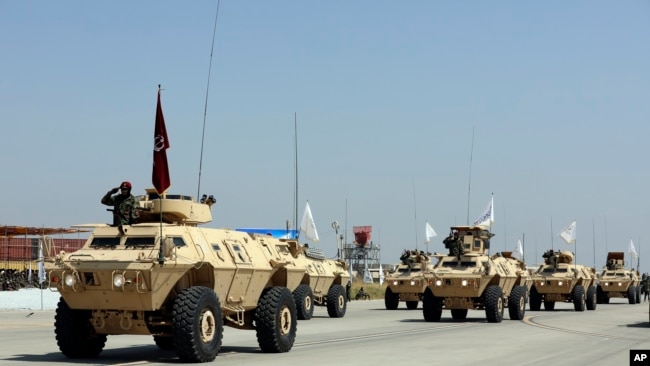
The Taliban Parades with $85B of American Military Gear

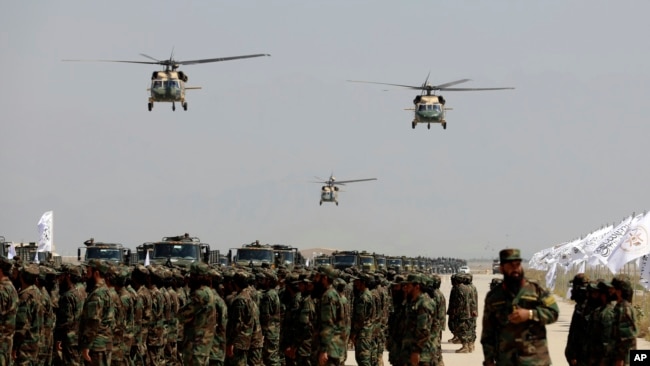
On the third anniversary of the disgusting withdraw from Afghanistan, the Taliban took the day to celebrate and host a parade at the former U.S. military base, Bagram. Not only does it remain humiliating but the parade includes helicopters including Blackhawks.

On and by the way….who was invited to attend? Yes…Chinese and Iranian officials.

There are likely no words from the veterans, the lost souls and the survivors that would express the emotions they feel. Remember this travesty as you are told that Kamala Harris was the last person in the room with Biden when this decision was delivered.

The Taliban are marking their third annual “victory” parade on August 14th, commemorating the day in 2021 when U.S. troops withdrew, leaving behind a significant amount of military equipment. pic.twitter.com/TPRJ4Jp8Zo

— Open Source Intel (@Osint613) August 14, 2024

ImageImage

Image

pic.twitter.com/QT7xrjSloH

— Graham Allen (@GrahamAllen_1) August 14, 2024

While the Associated Press barely mentioned the parade, at least Voice of America had to following:

The Islamist Taliban marked the third anniversary Wednesday of recapturing power in Afghanistan with a public holiday and a televised military parade at the former U.S.-run Bagram airbase, among other symbolic events.

The so-called “victory day” celebrations occurred amid ongoing global criticism of the Taliban government, known as the Islamic Emirate, for allegedly creating “the world’s most serious women’s rights crisis” and making impoverished Afghanistan the only country where girls are banned from education beyond sixth grade.

UH-60 Black Hawk helicopters fly during a military parade to mark the third anniversary of the withdrawal of US-led troops from Afghanistan, in Bagram Air Base in the Parwan Province of Afghanistan, Aug. 14, 2024.

The ceremony at Bagram, around 40 kilometers north of the Afghan capital, Kabul, featured a 21-gun salute and speeches from top Taliban leaders, with thousands of people in the male-only audience, including foreign diplomats.

The then-insurgent Taliban swept back to power on August 15, 2021, as the U.S.-led international forces withdrew from the country after their involvement in the Afghan war for almost 20 years.

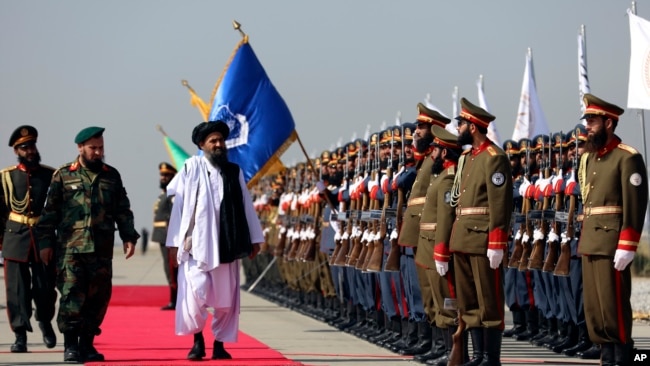
Mullah Abdul Ghani Baradar, the Taliban-appointed deputy prime minister for economic affairs, inspects the honor guards during a military parade, in Bagram Air Base, Aug. 14, 2024.

The Taliban’s prime minister, Hassan Akhund, stated in a message read by his chief of staff, “Allah granted the Mujahid nation of Afghanistan a decisive victory on this date over an international arrogant and occupying force.” Akhund, largely considered a figurehead, was absent from Wednesday’s event.

Akhund’s message said that the Taliban government “has the responsibility to maintain Islamic rule, protect property, people’s lives, and the honor of our nation.”

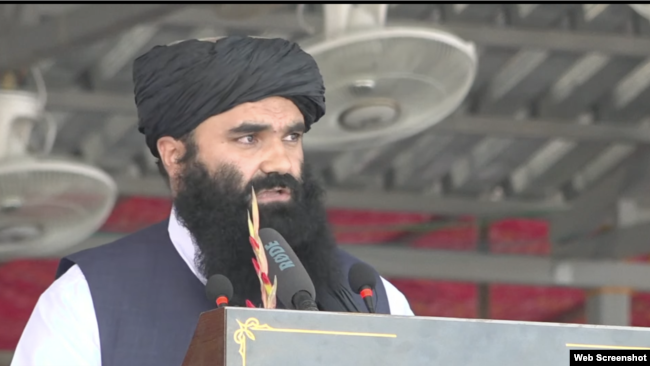
De facto Afghan Interior Minister Sirajuddin Haqqani addressing the Bagram ceremony just outside Kabul Aug 14, 2024, to mark the 3rd anniversary of the Taliban takeover.

The de facto Taliban government, not formally recognized by any country, cited the national solar calendar for marking the anniversary of “Afghanistan’s victory and freedom” from the U.S.-led “occupation” a day early.

Interior Minister Sirajuddin Haqqani, wanted by the United States for terrorism with a $10 million bounty for his arrest, also addressed the Bagram event, urging global cooperation and engagement with the Taliban administration.

“My message to the international community is that there is no need for dismay over the fact that you took our independence, and we reclaimed it successfully,” Haqqani said, without naming any country.

“We do not want to hold anyone accountable. We have created favorable circumstances and have good intentions for them to cooperate with us in rebuilding Afghanistan, similar to how they helped during the occupation,” he said.

Haqqani ran his network of militants, staging high-profile suicide bombings and other deadly attacks in support of Taliban insurgents on American and NATO forces during their presence in the war-torn South Asian nation.

The Bagram parade was also an opportunity for the Taliban to showcase the military hardware, including tanks, helicopters, and Humvees, left behind by U.S. and NATO forces.

Taliban Military Vehicles are seen during a military parade to mark the third anniversary of the withdrawal of U.S.-led troops from Afghanistan, in Bagram Air Base, Aug. 14, 2024.

Taliban leaders boasted about their conquest and subsequent achievements, such as establishing “peace and security” and an Islamic system in line with their harsh interpretation of Islam, but none of them responded to allegations of human rights abuses, particularly their sweeping curbs on women’s rights. They did not discuss hardships facing millions of Afghans.

The United Nations and international aid agencies have ranked Afghanistan as one of the world’s “largest and most complex” humanitarian crises. They estimated that 23.7 million Afghans, more than half women and children, need humanitarian relief.

An Afghan man sells Taliban flags along a street on the eve of the third anniversary of Taliban takeover of Afghanistan, in Kabul on Aug. 13, 2024.

SEE ALSO:

Aid groups: Afghanistan at risk of becoming ‘forgotten crisis’

A group of 29 U.N. experts Wednesday jointly called for “stronger and more effective” international action to address the deteriorating human rights situation in Afghanistan.

“We stress that there should be no move to normalize the de facto authorities unless and until there are demonstrated, measurable, and independently verified improvements against human rights benchmarks, particularly for women and girls,” the Geneva-based experts said in a statement.

In a separate joint statement this week, international non-governmental organizations warned of a growing aid funding gap.

Speaking ahead of the three-year anniversary of the Taliban takeover, a top U.N. official on Tuesday urged the world to support Afghan women’s fight for freedom.

FILE - A Taliban fighter stands guard as women wait to receive food rations distributed by a humanitarian aid group, in Kabul, Afghanistan, May 23, 2023.

SEE ALSO:

UN expert condemns Taliban ‘crimes’ against Afghan women, girls

“Three years’ worth of countless decrees, directives, and statements targeting women and girls – stripping them of their fundamental rights, eviscerating their autonomy,” Alison Davidian, the U.N. Women’s country representative in Afghanistan, said while sharing details of the latest survey.

She referred to religious edicts the reclusive Taliban supreme leader, Hibatullah Akhundzada, has issued over the past three years to govern the crisis-hit country, most of them leading to restrictions on the freedom of Afghan women and girls. Akhundzada rarely leaves the southern city of Kandahar, regarded as the country’s de facto capital.

“To date, no woman in Afghanistan is in a leadership position anywhere that has influence politically at the national or provincial level. When Afghan women are engaged in the Taliban’s structures, their roles are largely about monitoring the compliance of other women with their discriminatory decrees,” Davidian told reporters in New York.

“We must continue to invest in women. Nothing undermines the Taliban’s vision for society more than empowering the very part of the population they seek to oppress,” she stressed.

Human Rights Watch reiterated its call for the global community to press the Taliban to remove curbs on women.

“The third anniversary of the Taliban’s takeover is a grim reminder of Afghanistan’s human rights crisis, but it should also be a call for action,” said Fereshta Abbasi, the U.S.-based watchdog’s Afghanistan researcher.

Zabihullah Mujahid, chief Taliban spokesperson, talks with reporters in Doha, Qatar, June 30, 2024.

SEE ALSO:

Taliban call on West to build deeper ties, ignore curbs on women

The Taliban have dismissed criticism of their government as interference in internal matters of Afghanistan, saying their policies are aligned with local culture and Islam.

Terrorism-related international sanctions on many top Taliban leaders, isolation of their administration, and continued suspension of foreign development aid have made it difficult for Kabul to address deepening economic troubles.

The World Bank reported in April that the aftermath of the Taliban takeover had seen a stark decline in international aid, leaving Afghanistan without any internal growth engines and leading to “a staggering 26 percent contraction in real GDP.”