Operation Mega Flex

From July to September last year, Customs and Border Patrol in that 3 month period seized 1061 shipments of counterfeit goods at our cargo ports of entry. Items from Louis Vuitton bags to sports equipment with faulty parts. Other items included children’s toys, drug paraphernalia, deadly opioids, and really scary were (are) counterfeit drivers’ licenses. Recreational drugs, clothing, jewelry and even food and nutritional items (may contain toxins) are part of the counterfeit items affecting likely every American and business.

Image result for cbp counterfeit

Unlike legitimate drug manufacturers that are subject to inspections by the U.S. Food and Drug Administration, labs that manufacture counterfeits have no such oversight. According to a 2019 Better Business Bureau study, “companies based in China, Hong Kong, Singapore, and India shipped 97 percent of the counterfeit medicines seized in the U.S.”In March 2019, Europol, the European Union’s law enforcement agency, seized 13 million doses of counterfeit medicine ranging from opioids to heart medication. Europol noted that this type of counterfeiting is on the rise due to the relatively low risk of criminal detection.

Check those items in retail operations of all sorts and locations and what you purchase in the e-commerce realm, not the from the street vendor at the corner and when purchasing books, movies or music, you could be in real trouble for a transaction that violates copyright protected work.

Image result for cbp counterfeit

Watches and jewelry follow at 13 percent of total seizures. During the Mega Flex operation on August 21, 2019, for example, CBP officers seized counterfeit Rolex watches valued at over $1.4 million. Handbags and wallets represented nearly 11 percent of all seizures, including counterfeits of luxury brands such as Louis Vuitton, Michael Kors, and Gucci. Consumer electronicsrepresented 10 percent of seizures, including products such as iPhones, hover boards, earbuds, microchips, and others. Pharmaceuticals and personal care items account for only 7 percent of total seizures. However, as discussed in the next section, many of the products in these categories pose significant dangers to the consumer. Fake prescription drugs can lack active ingredients, contain incorrect dosages, or include dangerous additives. Fake personal care items such as cosmetics have been found to contain everything from harmful bacteria to human waste. Between 2017 and 2018, CBP and ICE Homeland Security Investigations (HSI) seized over $31 million in fake perfumes from China.

Law enforcement officials have uncovered intricate links between the sale of counterfeit goods and transnational organized crime. A study by the Better Business Bureau notes that the financial operations supporting counterfeit goods typically require central coordination, making these activities attractive for organized crime, with groups such as the Mafia and the Japanese Yakuza heavily involved. Criminal organizations use coerced and child labor to manufacture and sell counterfeit goods. In some cases, the proceeds from counterfeit sales may be supporting terrorism and dictatorships throughout the world.

In FY 2018, 12 percent of DHS seizures included counterfeit versions of critical technological components, automotive and aerospace parts, batteries, and machinery. Each of these industrial sectors have been identified as critical to the defense industrial base, and thus critical to national security. One example drawn from a 2018 study by the Bureau of Industry and Security within the Department of Commerce featured the import of counterfeit semiconductors or “Trojan chips” for use in defense manufacturing and operations. Such Trojan chips can carry viruses or malware that infiltrate and weaken American national security. The problem of counterfeit chips has become so pervasive that the Department of Defense has referred to it as an “invasion.” Companies from China are the primary producers of counterfeit electronics.

According to a 2019 report, Instagram and Counterfeiting, nearly 20 percent of the posts analyzed about fashion products on Instagram featured counterfeit or illicit products. More than 50,000 Instagram accounts were identified as promoting and selling counterfeits, a 171 percent increase from a prior 2016 analysis. Instagram’s Story feature, where content disappears in twenty-four hours, was singled out as particularly effective for counterfeit sellers.
For the full report, go here.


Trump Goes to India

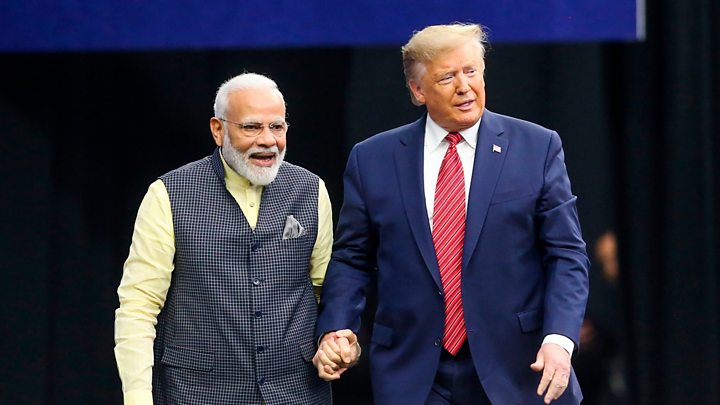
This two day trip will begin with pomp and circumstance where Prime Minister Modi is returning the ceremonious favor of the Houston ‘Howdy Modi’ event celebrated Modi’s visit to the United States in 2019.

Image result for trump modi source
Trade talks will begin but not in real terms as U.S. Trade Representative Robert Lighthizer and Treasury Secretary Steve Mnuchin are not part of the travel delegation. Trade talks will be in principle.

Talks could very well include some kind of peace mediation between India and Pakistan over Kashmir. The U.S. will need assistance in this regard and mutually so as the Taliban one-week quiet period has begun and Pakistan is for the most part on notice to stand with the United States and not with the Taliban- al Qaeda militants known to have sanctuary from time to time in Pakistan including the Haqqani network.
Another important component of the Trump-Modi meeting is China. Military cooperation may be an important topic due to regional aggression by China. You can bet that President Trump will offer India to buy more military aircraft and equipment from the United States.
The bigger part of the talks may well include Venezuela. India is a nation that has not joined countless other nations to recognize Juan Guaido as the interim president of Venezuela and India is a large buyer of Venezuelan oil.

President Trump has grown quite impatient over the regime change in Venezuela.
The United States still has the military option on the table as well as a naval blockade.

The U.S. has put several companies that continue to do business in Venezuela on notice, the official said, including India’s Reliance Industries, Spain’s Repsol, Chevron and Greek shippers. Trump is likely to raise the issue of India’s oil imports from Venezuela with Indian Prime Minister Narendra Modi during a two-day visit next week, the official said Friday in a briefing for reporters.

The official asked not to be identified as a condition of participation in the briefing. The Trump administration has long sought to oust Maduro’s regime but has so far failed to replace him with the opposition leader it supports, National Assembly President Juan Guaido. Guaido was a surprise guest of Trump at this month’s State of the Union address.

Trump has ordered his administration to use any tools necessary to build pressure on Maduro with the goal of securing free and fair elections in Venezuela, the official said. The U.S. doesn’t believe that free elections are possible with Maduro in power, the official said.

The U.S. continues to pursue what the official called a “Trump doctrine” to foster democratic governments throughout the Western Hemisphere, akin to the Monroe Doctrine, which warned against European colonization efforts in the Americas two centuries ago. Venezuela, Cuba and Nicaragua remain impediments, the official said, adding that actions by Russia and China in the region are unacceptable.

The U.S. is also frustrated by Spain, which it believes is too accommodating to Maduro allies who seek to flee Venezuela. Spain has been hesitant to help oust Maduro and remains the biggest barrier in the EU to the U.S. campaign, the official said. More here from Bloomberg.

Justice Dept Brands Huawei as a Criminal Enterprise

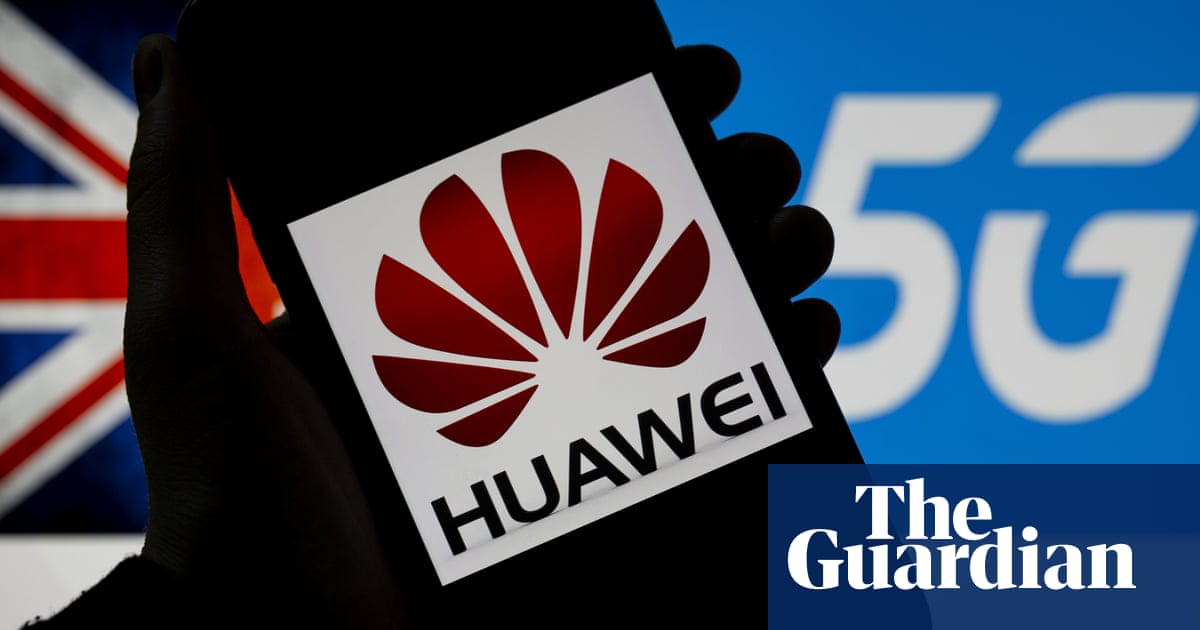
Gotta hope that Europe takes note, especially Britain. Europe so far has approved Huawei as the vendor platform for 5G. Check your use of apps at the Google store and take a second look at your smart devices.

Image result for huawei source

FDD: The U.S. Department of Justice (DOJ) indicted Chinese telecommunications firm Huawei Technologies and its subsidiaries last week for alleged racketeering, theft of intellectual property, and conspiracy to commit bank fraud, among other charges. The indictment portrays Huawei not merely as a company that has broken the law, but as a fundamentally criminal enterprise.

The new charges target Huawei, four of Huawei’s subsidiaries (Huawei Device Co. Ltd., Huawei Device USA Inc., Futurewei Technologies Inc., and Skycom Tech Co. Ltd.), and Huawei’s chief financial officer, Meng Wanzhou, for violating the Racketeer Influenced and Corrupt Organizations (RICO) Act, which Congress passed in 1970 to combat organized crime.

According to the DOJ, the Huawei business model entailed “the deliberate and repeated misappropriation of intellectual property of companies headquartered or with offices in the United States.” DOJ also highlighted other violations, including Huawei’s role in sanctions evasion and fraudulent activities.

Last week’s indictment marks the first time DOJ charged a company with suspect connections to a foreign government as a criminal enterprise. Although Huawei asserts it is not state-owned, the company has indirect ties to the Chinese government and has yet to publically disclose who exactly owns and controls the company. Huawei’s majority shareholder is the company’s labor union, which keeps the details of its membership and governance structure out of the public eye. Last year, Jiang Xisheng, a top executive, explained during a press conference that the labor union’s ownership is simply a matter of legal convenience; this only further obfuscated who is really in charge. Additionally, Huawei’s founder, Ren Zhangfei, served in the Chinese military and is a member of the Chinese Communist Party.

While the indictment does not say that Beijing directed Huawei to operate as a criminal enterprise, China’s National Intelligence Law of 2017 requires Huawei and other private companies to provide the government with their data to “support, assist, and cooperate with state intelligence according to the law.” In short, the law empowers Beijing to exploit Huawei as an intelligence asset whenever it sees fit.

In other high-profile cases, the Chinese government has stolen sensitive U.S. data to achieve a strategic advantage. U.S. officials have even deemed China’s espionage and intelligence activities as a “long-term existential threat to the security of our nation.” In 2012, the head of the U.S. National Security Agency estimated that China’s economic espionage cost U.S. companies $250 billion in annual losses. Additionally, the targeting of strategic industries has allowed Beijing to enhance its own military capabilities at America’s expense.

The exploitation of Huawei could clearly enhance Beijing’s intelligence collecting capabilities. Just last week, the U.S. government reported that for over ten years Huawei secretly maintained “back doors” on its mobile networks that allowed the company – and potentially the Chinese government – to have direct access to their users’ most sensitive data.

The indictment of Huawei as a criminal enterprise shows that the Trump administration was mistaken when it placated Beijing by softening previous penalties for Huawei’s misconduct. If the court finds Huawei guilty under RICO, the administration should ensure the full application of all penalties necessary to end its criminal pursuits.


Trump Assembles Clemency Team

So much has been debated in recent years over prison sentencing and reform. Last year, a new law was passed by Congress and signed by President Trump that changed sentencing and release standards giving pathways for second chances.

The most recent signatures by President Trump on the 11 people giving them criminal relief is still in contention especially with former Illinois Governor Rod Blagojevich. As a sidebar, it is suggested that there is much more to the story regarding the case of Blago that the reader should consider why he was the single fall guy.

All presidents are presented with petitions and letters of cases for consideration of those serving excessive prison terms or those released having served their respective terms and seek pardons. President Trump indeed does support second chances and has assembled a team to review cases. This team of advisers is to recommend and vet candidates for pardons. Jared Kushner, Trump’s son-in-law and senior adviser is the manager of the team.

Alice Johnson/source

Others on the team include Pam Bondi, Alice Johnson, Matthew G. Whitaker, Democratic commentator Van Jones and Brett Tolman, a former U.S. attorney in Utah.

Several officials familiar with the matter said the White House has been discussing ways to revamp the clemency process for months, amid growing consensus that the role of the Justice Department should be minimized. The White House has been disappointed with the Justice Department’s process, officials said. While the Justice Department has traditionally received clemency petitions, the new process involves direct submission of applicants to the White House Office of American Innovation, which is led by Kushner, according to people familiar with the matter.

Ja’Ron Smith, the deputy director of the Office of American Innovation, has also been involved in the pardon process, officials said.

Paul Larkin, a research fellow at the Heritage Foundation who has worked with the White House on criminal-justice issues, said Kushner and others in the administration have held discussions about changing the clemency process since 2018.

Larkin said the discussions he participated in, including one led by Kushner in 2018, included proposals for reducing or eliminating the role of the Justice Department’s Office of the Pardon Attorney in the clemency process.

Marc Levin, who leads the Texas Public Policy Foundation’s Right on Crime initiative, said changing the presidential pardon process has long been on the agenda of advocates on both sides of the aisle.

“In most states, as you know, the parole and clemency process is not vested with prosecutors,” he said, noting that Obama also tried to make changes, though those efforts still took place within the Justice Department. “Both sides recognize that the traditional process needs to be reformed.”

The foundation’s executive, Kevin Roberts, was listed by the White House as someone who advocated for the release of Hall, Munoz and Negron.

It’s not clear how the people in Trump’s informal network will select people to recommend for clemency, or whether any of the thousands of inmates with pending applications will be able to get the attention of Trump’s allies.

Larry Kupers, who led the pardon office during the first two years of the Trump administration, noted that a record-setting number of nearly 13,000 people are waiting for responses to their clemency requests. Many of them have no access to the president, and it’s not clear how they would fare under a new clemency process that cuts out the career officials at the Justice Department. More found here.


Iran to be Blacklisted as a Country

Financial Action Task Force, a Paris based organization will take blacklisting action on Iran this week. Finally, it appears Europe is joining the United States in this effort even while former Secretary of State John Kerry and a democrat U.S. Senate delegation met with Iranian leaders in a secret setting.
The task force designation will encompass 39 member countries and organizations where this calls for sanctions on Iran due to money-laundering, financing of terror organizations, corruption politicians, international crime, illegal arms trade and drug trafficking. It is unclear if the United Nations has offered any resistance or comment. The only other country under this full designation is North Korea, yet another 12 countries are subject to the same scrutiny and punitive actions by the task force. Banking and access to international trade will be limited or terminated in many cases completely.

Meanwhile, Russia and China have stepped in to provide more support and aid to Iran.
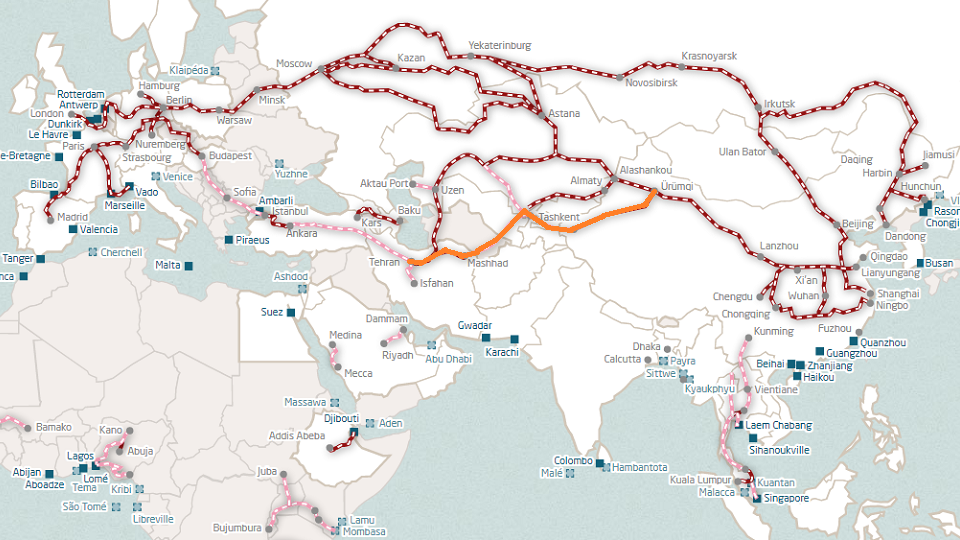
In an effort to preserve trade and revenue, Iran was construction a rail system into Central Asia connecting the Caspian countries of Azerbaijan, Kazakhstan, Azerbaijan, Russia, Kazakhstan and Turkmenistan. Due to US sanctions, Iran has been in a financial tailspin and construction has essentially stopped and the costs were escalating due to the difficult mountainous regions and regional politics. Enter China and Russia.

source

The project is expected to cost 1.2 billion euros ($1.5 billion) and is being financed by an export credit that Moscow has extended to Tehran. It will involve the electrification of 495 kilometers of existing line, including 203 kilometers in mountainous areas, and the updating of 31 stations and 95 tunnels. This railway segment is projected to carry up to ten million tons of cargo annually upon completion, in 2024. Russian and Iranian officials are jubilant: “All this creates conditions for the growth of goods traffic along the International North–South Transport Corridor and the intensification of economic ties in the Caspian region,” they say (Casp-geo.ru, February 18). The reasons are obvious: if this rail project is completed, Russia and Iran will be able to control much of the trade coming through or out of Central Asia, thus limiting the freedom of action of the states of that region and giving Moscow and Tehran a greater voice in Chinese decisions there (Casp-geo.ru, November 28, 2019; Ru.irna.ir, November 13, 2019).

***

Development of Xinjiang

For China, the project is extremely important due to several factors. First, it will stimulate the economic development of the Xinjiang Uygur Autonomous Region. This autonomous region of China plays a significant role in rail freight transportation on the New Silk Road. The majority of container trains from central, eastern and southern China to Europe run via Xinjiang. Its capital, Urumqi, is also an important railway hub on the corridor towards Europe.

Kashgar, one of the westernmost cities in China, could be another junction in Xinjiang. The Chinese government is discussing the construction of two railway lines from Kashgar: one westward to Kyrgyzstan and Uzbekistan, and another southward. The latter heads to Pakistan, where China Overseas Port Holding Company operates Gwadar Deep Sea Port, and where China intends to build its second, after Djibouti, overseas naval base.

New Silk Road

The second factor of success is the potential of the railway line for the New Silk Road. According to estimations, the Xinjiang – Kyrgyzstan – Uzbekistan route will shorten the route from China to Uzbekistan. Currently, containers going to this Central Asian country must cover long distances and cross the territory of neighbouring Kazakhstan.

Moreover, the railway link between China and Uzbekistan links to Iran (via Turkmenistan) and Turkey, as well as eventually to Europe, especially to Southeast Europe. With this, the route from China to Southeast Europe could be reduced up to 900 kilometres, equal to up to seven or eight days. At the same time, the new railway will allow China to better involve Kyrgyzstan and Uzbekistan into the New Silk Road.