Operacion Probirka” — or “Operation Test Tube”

Primer: 2025 – Russian use of chemical weapons against Ukraine ‘widespread’, Dutch defence minister says

Add in the U.S. State Department report in 2024

***

Posted in full and a big hat tip to Organized Crime and Corruption Reporting Project (in full)

Key Findings
  • Maria Oleinikova and her children run businesses in Spain dedicated to Spanish cuisine, but they are also being investigated for supplying banned chemicals to Russia.
  • The investigation, called “Operation Test Tube,” has named nine suspects, including Oleinikova, her two children, and executives from a Spanish company called Scharlab. No charges have yet been brought in the case.
  • Separately, import data reviewed by reporters shows that a Russian company majority-owned by Oleinikova, Catrosa Reactiv, has received dozens of shipments of sanctioned chemicals from companies under investigation in Spain.
  • While it is not known what then happened to the chemicals, leaked transaction data shows Catrosa Reactiv’s clients include weapons developers, such as the state institute that created the nerve agent Novichok.
  • Customs systems struggle to deal with the EU’s broad sanctions on chemical exports to Russia, experts said, meaning that banned chemicals can easily slip out of the bloc and into Russia.

Operacion Probirka” — or “Operation Test Tube”

Cavina Vinoteca, a slick wine bar in Barcelona’s fashionable Poblenou neighborhood, has drawn rave reviews online since it opened its doors last year.

The restaurant is one of several gastronomic ventures run by the Oleinikova family, led by matriarch Maria, who was born in Russia but is now a Spanish citizen. Together with her son and daughter, she also runs a Spanish company that exports wine, beer, cider and liqueurs to Russia.

But OCCRP and partners have learned that this company did business beyond just beverages— it was also shipping chemicals to Russia in possible violation of European Union sanctions imposed following Russia’s full-scale invasion of Ukraine in 2022.

Last year, Maria and her children Irina and Vyacheslav were arrested in a Spanish police raid dubbed “Operacion Probirka” — or “Operation Test Tube” — in which 13,000 kilograms of chemicals were seized at the Port of Barcelona.

Operation Test Tube was part of a Spanish investigation into the illegal supply of chemicals to Russia, Spain’s Interior Ministry said in a statement at the time, but since then the government has provided almost no details about the case. Although the statement referred to a Russian company that was importing the chemicals, police did not publicly name it or provide details of the shipments.

Credit: Policia Nacional

Spanish authorities during the “Operacion Probirka” investigation

A Spanish police source involved in the investigation said authorities suspect Oleinikova was an “intermediary” who arranged the shipments. (The officer was authorized to speak to the press, but not to be identified by name.)

But drawing on Russian import data, reporters found that Oleinikova doesn’t just operate in Spain — she also majority-owns a Russian chemical company called Catrosa Reactiv that received at least 36 shipments of sanctioned chemicals from Spain between 2022 and 2024— including one that came directly from Complexe Sancu, the Spanish wine-and-beer export company run by Oleinkova and her children.

Most of the other shipments were made by a Spanish company called Scharlab S.L., which is headquartered in Barcelona with subsidiaries in Italy and the Philippines, import data shows. Scharlab is majority-owned by Werner Scharlau, a German living in Spain who was among those arrested in February.

On its website, Catrosa Reactiv — which was founded in 2006 and taken over by Oleinikova’s husband two years later —  says that it “successfully operates in the Russian chemical reagents market” and supplies products to laboratories and raw materials to industry. The Russian company register shows that Oleinikova, who has a background in academic scientific research, became the company’s majority shareholder in 2015 and still holds a controlling stake in the firm.

Credit: Screenshot/catrosa.ru

Catrosa Reactiv’s website.

It is not known how the chemicals imported from Spain to Catrosa Reactiv were ultimately used. However, leaked transaction data obtained by reporters showed Catrosa Reactiv’s clients in Russia since 2022 have included at least six sanctioned entities linked to weapons production, the defense sector, and the Russian military.

They included the State Scientific Research Institute of Organic Chemistry and Technology, also known as GosNIIOKhT. It has been sanctioned by the EU and U.S. for its involvement in the development and production of chemical weapons including the toxic nerve agent Novichok, which has been used by Russian operatives for stealth assassinations abroad.

Since 2022, Catrosa Reactiv has also received payments from:

  • The All-Russian Scientific Research Institute of Experimental Physics, an agency that developed weapons in the Soviet era, including the first Soviet atomic bomb, before shifting toward building and managing Russia’s most advanced supercomputers
  • The Scientific Research Institute of Applied Acoustics, which was sanctioned by the U.S. for allegedly “carrying out research and development of military products.” The U.S. also said it had been “involved in the procurement and inventory of chemicals that could be used in the production of chemical weapons agents.”
  • Explosives manufacturer SKTB Technolog, a contractor for the Russian Ministry of Defense
  • The 18th Central Research Institute, known as Military Unit 11135, which is part of Russia’s GRU military intelligence service

Reporters did not identify any chemicals specifically associated with chemical weapons in Catrosa Reactiv’s import data. However, Miguel Ángel Sierra, a professor of organic chemistry at the Complutense University of Madrid and former member of the scientific advisory board of the international Organization for the Prohibition of Chemical Weapons, said the chemicals it imported from Europe were sanctioned because they had multiple potential uses, including creating explosives.

“These have been banned by the European Union because they are industrial products,” he explained. “For example, there are many processes you can’t carry out, including the preparation of explosives, the preparation of pharmaceuticals, and the preparation of many other things, without having some of these products.”

Spain’s Audiencia Nacional — a court that deals with terrorism and major crimes — confirmed to OCCRP that Oleinikova and her two children are among nine suspects currently under investigation for “smuggling banned substances.” All nine suspects have been released while the investigation continues, and no one has been charged with a crime, the press department for the court said.

Oleinikova declined to comment for this story because the case is still under investigation by the Audiencia Nacional.  

How Reporters Identified Catrosa Reactiv’s Imports

Reporters reviewed extensive Russian import records for Catrosa Reactiv on the ImportGenius commercial database, filtering them to include only shipments received after Russia’s full-scale invasion of Ukraine, to detect possible sanctioned chemicals.

Some of the shipments from Spain included the “HS Codes” – international product identification categories under which genres of exports are grouped for customs.

In some cases, reporters discovered product descriptions for individual chemicals within the import data, but not always.

Where they could find descriptions of individual chemicals, they cross-referenced them with EU sanctions lists, which are updated every four months, to work out which chemicals were illegally being shipped out of Spain despite a ban.

While OCCRP and its partners were able to establish that Catrosa Reactiv had made 36 imports of at least 15 banned products from Spain since 2022, the actual figures may be higher as the commercial database may be incomplete and the product descriptions for some shipments were imprecise.

Russian Firm Imported Sanctioned Chemicals in Dozens of Shipments

Official press releases following the October 2024 raid on the Barcelona port didn’t name the specific chemicals that were confiscated, but police told OCCRP they had seized 13,000 kilograms of the solvent N-Methyl-2-pyrrolidone (NMP), which is widely used in electronics, pharmaceuticals, and coating. Investigators also found smaller amounts of other chemicals that could be used in weapons production.

Some shipments of chemicals — including nitric acid and acetone, both used in the manufacture of explosives, and diethylamine, a chemical involved in the manufacturing of the nerve agent VX — had already left Spain for Russia, police said.

In an effort to form a complete picture of the types of chemicals Catrosa Reactive had been importing from the EU, reporters reviewed Russian import records in a commercial database.

Credit: Policia Nacional

Spanish police at the Barcelona port during the seizure of 13,000 kilograms of the solvent N-Methyl-2-pyrrolidone (NMP).

The 32 shipments Catrosa Reactiv received from Scharlab contained 14 chemicals worth $15,000, all subject to EU export bans from April 2022 to June 2023 due to their potential contribution to the enhancement of Russia’s defence, security, and industrial sectors. They included $8,200 worth of NMP, the same solvent discovered at the Barcelona port, plus $5,800 worth of isopropanol and $2,550 of hydrogen peroxide.

The shipment made to Catrosa Reactiv from Complexe Sancu, the Spanish wine export company run by Maria Oleinikova’s children, contained around $3,650 worth of sodium hydrogen carbonate — also known as sodium bicarbonate, or baking soda. But despite its benign uses, the chemical was prohibited for export from the EU to Russia in April 2022 under the category of “goods which could contribute to the enhancement of Russian industrial capacities.”

‘Europeans Don’t Have the Infrastructure to Check’

Experts say that the EU’s customs systems are insufficient to deal with the bloc’s extremely broad sanctions on chemical exports to Russia, making it easy for shipments like the ones from Spain to slip through the net.

In international shipping, exporters label their goods using broad group identifiers known as HS Codes, which can cover a wide range of products including both banned and permitted substances. This means that it is possible to export a chemical under an HS Code that does not identify the presence of a specific banned substance.

Elina Ribakova, a senior fellow at the Peterson Institute for International Economics, a think tank based in Washington, D.C., said that HS Codes including sanctioned products are supposed to be flagged as high risk and checked more closely by customs officials.

But in practice, she said, this doesn’t always happen: “The question is whether the product is correctly classified under its appropriate HS Code and whether it is actually being checked.”

Even though the EU and Spain have created additional code numbers designed to add further detail to the international HS Code categories, Ribakova said it’s still “very hard to pin down a product” as they tend to be grouped.

“Europeans don’t have the infrastructure to check more holistically something that is not a nuclear or very specialized weapon,” she told OCCRP, adding that these limitations make it “relatively easy” to export sanctioned products.

In the case under investigation in Spain, exporters mixed batches of sanctioned chemicals inside larger shipments of legal substances, or listed false destinations on customs paperwork, such as Armenia and Kyrgyzstan, to disguise the fact that shipments were headed for Russia, investigators told OCCRP.

Credit: Policia Nacional

Chemicals seized by Spanish police during “Operacion Probirka.”

One of the investigators working on the case told OCCRP that evidence obtained so far shows the shipments did not in fact pass through those countries, and that the companies listed as recipients were fronts.

Instead they went overland to Russia via other countries, including Poland and Belarus, he claimed. It’s not clear which, if any, of the people or companies under investigation made use of these tactics. But import records for Catrosa Reactiv reviewed by OCCRP and its partners show that it received one shipment of the sanctioned chemical NMP in 2023 that originated in Spain, but was routed via a Kyrgyz company, NK Muras LLC.

The data shows that shipment was manufactured by one of the companies under investigation by Spanish authorities for illegally exporting sanctioned chemicals in the case involving Oleinikova.

According to the import records the supplier acting on the “order” of NK Muras was Vlate Logistik LLC, a Belarusian transport and storage company sanctioned by the EU in December 2024 for its proximity to the Moscow-aligned regime of President Aleksandr Lukashenko.

In 2024, Complexe Sancu, the Spanish export company managed by Maria Oleinikova’s children, sent at least one shipment of NMP to NK Muras. Available records do not show whether that shipment ultimately ended up with Catrosa Reactiv.

Separate transaction data obtained by reporters indicate that Catrosa Reactiv paid NK Muras more than $240,000 in 2023 for three shipments of unspecified pharmaceutical ingredients.

Neither NK Muras nor Vlate Logistik responded to requests for comment.

Yes, China is Surrounding the S. China Sea, but what about Florida?

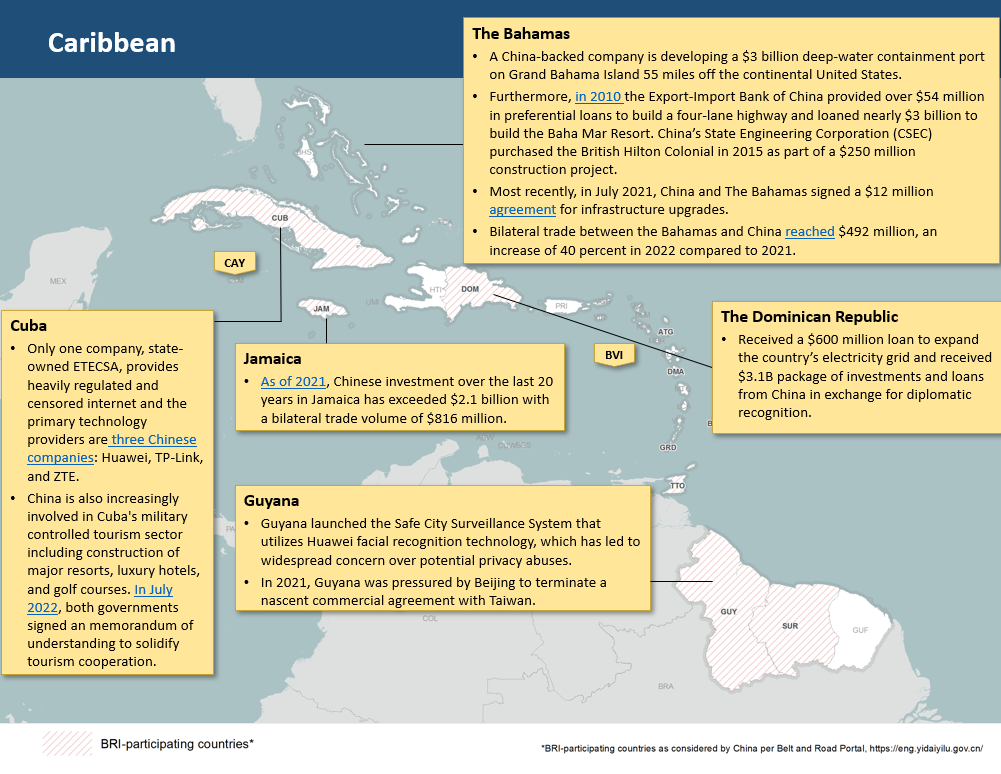
The two faced dragon….tie to really recalibrate the relationship between the United States and China AGAIN….Previously n this website, I have discussed not only by a post but several times on radio about how the former intelligence/snooping base owned by Russia in Cuba known as the Lourdes SIGINT station was sold to China….no one in media or the national security realm seems to give it much attention…but now…we have an additional problem with China and that is the Bahamas.

How about the largest Chinese embassy in the world with hundreds of Chinese intelligence officers deployed there…..Embassy of China in Nassau in Nassau, Bahamas (Google Maps)

In part from FNC:

“The People’s Republic of China has been making diplomatic, economic and even military and quasi-military inroads into the Caribbean, South and Central America for the past couple of decades,” retired Rear Adm. Peter Brown, former Homeland Security advisor to President Donald Trump, told Fox News Digital.

Brown pointed to the rise in dual-use infrastructure projects along the Bahamas coastline, which is located just 50 miles off the coast of Florida.

“It doesn’t take a lot of imagination for the People’s Republic of China to use its commercial footprint in the Bahamas to monitor, exploit and perhaps even do worse to [the] U.S.,” he said. Pointing to the Chinese-controlled British Colonial Hotel in Nassau, Bahamas, Brown said that its location directly across from the U.S. Embassy could give way to intelligence gathering on U.S. personnel.

The hotel is owned by a Chinese company, Chow Tai Fook Enterprises, which has raised geopolitical concerns given its location. Fox News Digital has reached out to the British Colonial Hotel for comment.

China has invested heavily in the Bahamas through a range of additional high-profile projects, including a $40 million grant for a national stadium, a $3 billion mega-port in Freeport, and $40 million for the North Abaco Port and Little Abaco Bridge.

In 2019, now-Secretary of State Marco Rubio warned in a Miami Herald op-ed that the devastation caused by the natural disaster could create an opening for the People’s Republic of China to use aid as a Trojan horse to gain a foothold near American shores.

“By targeting the Bahamian government in this period of crisis, Beijing would be making the same opportunistic play to access critical foreign infrastructure,” Rubio wrote in 2019. “But in this case, the national security threat is especially perilous, as it would give China a foothold just 50 miles from the coast of Florida.”

***

How about another look at things in the Caribbean…Chinese expansion

Chinese Expansion in the Caribbean (Extra) - Virtual Mirage

China’s Influence in the Caribbean:

China is a member of both the Inter-American Development Bank (IDB) and the Caribbean Development Bank (CDB) and an observer at the Organization of American States (OAS). Alongside Italy and Germany, China is the third largest shareholder at the CDB with 5.6% of overall shares, exponentially higher than the majority of Caribbean countries.

The People’s Republic of China’s (PRC) engagement in the Caribbean has largely focused on investments in infrastructure and developing trade relationships. As of 2022, ten Caribbean countries have signed up to Belt and Road (BRI) – Cuba, Jamaica, Dominican Republic, Antigua & Barbuda, Dominica, Barbados, Grenada, Trinidad & Tobago, Guyana, and Suriname.

The PRC is working towards diminishing the region’s ties to Taiwan as the region contains the largest bulk of Taiwan’s diplomatic allies. Today, St. Lucia, St. Vincent and the Grenadines, St. Kitts and Nevis, Haiti, and Belize remain the only Caribbean nations that recognize Taiwan.

China’s Trade and Economic Investment in the Caribbean

While the Caribbean’s trade with China has grown at a slower pace than overall trade with the region, it increased from $1 billion in 2002 to $8 billion in 2019, with an estimated $6.1 billion in Chinese exports and $1.9 billion in imports.

China is a major trading partner of Cuba’s and Chinese businesses are involved in the Cuba’s telecommunications, tourism, mining, and energy sectors.

Cuba is highly dependent on China and ongoing economic challenges resulted in the reconstructing of an estimated $4 billion in debt to China in 2011 and another restructuring in 2015. For more reading click here.

The U.S. Must Join China’s Belt and Road In Developing The Caribbean ...

The U.S. Must Join China’s Belt and Road In Developing The Caribbean ...

How Badly is the Taxpayer Being Fleeced?

We have some indications as noted by what DOGE has uncovered…but it hardly all of it. The House is working diligently on the Trump Big Beautiful Bill because much of what has come from DOGE as well as Cabinet secretaries, there will need to be legislative action to stop the stupid as in spending in the future….yet…check out what my long time friends at Open the Books has uncovered….

In part:

BY THE NUMBERS

During fiscal year 2024, federal agencies reported $161.5 billion in improper payments – money sent to the wrong entity, for the wrong amount or wrong reason – according to data released by the Office of Management and Budget in November.

That means President Biden left office having presided over $925.7 billion in waste, fraud, abuse and duplicative payments – and that’s just what agencies were able to report.

Adjusted for inflation, the figure grows to $986.2 billion – almost a trillion dollars lost through improper payments!

That’s the worst for any president since reporting began in 2004, even when adjusting for inflation.

NOTE: Perhaps unsurprisingly, the single-year record came during the fog of Covid, as enormous amounts of cash were shoveled out quickly by Congress. Fiscal year 2021 say $281.4 billion in improper payments, which we now know includes Covid-related aid that was subject to massive fraud.

BY AGENCY

As Open the Books first reported in RealClearInvestigations, the Centers for Medicare and Medicaid Services wasted $87 billion in improper payments, more than any other government entity. Medicare reimbursements to health providers had a 7.7% mistake rate this year, the worst since percentages were first reported in 2019.

Another $4 billion was sent to recipients who had issues regarding their citizenship, including $824 million in unemployment insurance from the Department of Labor.

The government also sent $346 million to dead people, mostly because the Office of Personnel Management continued to send benefits to retirees who are no longer alive. That’s the highest amount since at least 2021.

The Treasury Department is working to rectify the problem of payments sent to dead people, having reported it recouped $31 million in such payments in five months. It did so simply by gaining access to the Social Security Administration’s federal death database. It’s amazing what can happen when the left hand simply knows what the right hand is doing! That said, Open the Books has reported $3.6 billion in Covid stimulus checks went to dead people. As our CEO, John Hart, told FOX News, “There are miles to go before we break even.”

Other Covid-era programs continued to have some of the worst improper payment rates. Roughly 25%, or $2 billion, of loans forgiven under the Paycheck Protection Program this year were paid improperly.

The data was released on Wednesday afternoon, Nov. 27, the day before Thanksgiving, leaving little time for negative coverage before families began breaking bread.

For comparison, Biden leaves office with an overall mistake rate of 5.42%, slightly higher than President Trump’s 4.94% in his first term. Still, Trump presided over $846.8 billion in improper payments, adjusted for inflation as of last October.

Now, he has an opportunity to make good on the war on waste.

SEC's Final Clawback Rules: What to Know | WorldatWork

So, as long as President Trump is signing Executive Orders, he needs to sign yet another that stands up a task force that pursues investigations and ‘clawback’ taxpayer money as much and as fast as can happen.

Eliminate the tax code for the Fair tax/ Flat tax or Consumption tax

Finally the discussion and debate is in fact really happening in Washington DC. Yay…

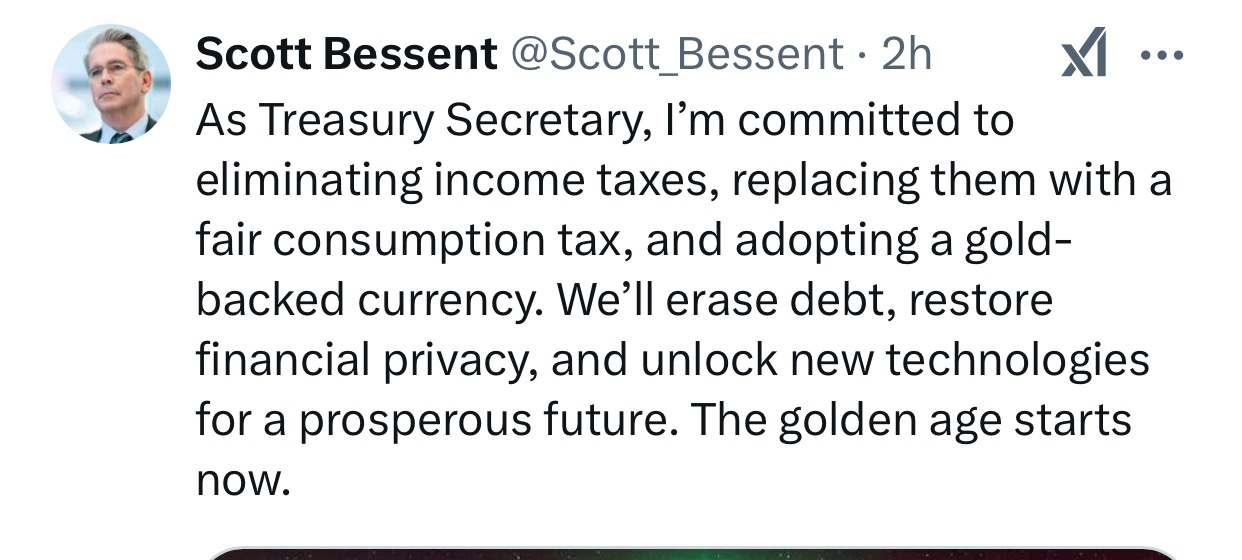
So, the Trump administration and the United States has a new Treasury Secretary, Scott Bessent. Soon after his swearing in, he did send out an X post:


Now let’s check out Georgia Congressman Buddy Carter….he has some legislation:

WASHINGTON, D.C. – Rep. Earl L. “Buddy” Carter (R-GA) today introduced H.R. 25, the Fair Tax Act, to replace the current tax code with a national consumption tax known as the Fair Tax.Joining Rep. Carter as original cosponsors are Reps. Andrew Clyde (R-GA), Jeff Duncan (R-SC), Kat Cammack (R-FL), Scott Perry (R-PA), Bob Good (R-VA), Thomas Massie (R-KY), Ralph Norman (R-SC), Bill Posey (R-FL), Gary Palmer (R-AL), Jim Banks (R-IN), and Barry Loudermilk (R-GA).

Congressman Carter’s bill is 132 pages and found here. 

Imagine –>TITLE I—REPEAL OF THE IN2 COME TAX, PAYROLL TAXES, 3 AND ESTATE AND GIFT TAXES

Imagine –>11 ‘‘CHAPTER 3—FAMILY CONSUMPTION 12 ALLOWANCE ‘‘Sec. 301. Family consumption allowance. ‘‘Sec. 302. Qualified family. ‘‘Sec. 303. Monthly poverty level. ‘‘Sec. 304. Rebate mechanism. ‘‘Sec. 305. Change in family circumstances. 13 ‘‘SEC. 301. FAMILY CONSUMPTION ALLOWANCE. 14 ‘‘Each qualified family shall be eligible to receive a 15 sales tax rebate each month. The sales tax rebate shall 16 be in an amount equal to the product of— 17 ‘‘(1) the rate of tax imposed by section 101, 18 and 19 ‘‘(2) the monthly poverty level.

There is certainly more in the draft of the bill sho check it out….let the discussions begin.

Congressman Carter’s bill suggests a 25% consumption tax while other previously suggested proposals are at 17%. Note that here. 

Maybe with all the artificial intelligence chatter, AI can figure out what is the best option to replace the IRS tax code.

Cuba Agrees to Host Chinese Spy Base

First there was a full-throated denial by Adm. Kirby from the White House Press Room that the story the Wall Street Journal reported was true. Then a couple of days later, Adm. Kirby walked it back and attempted in national security platitudes to explain why he initially denied the story. Then the White House decided to blame the Trump administration stating that China has had a base in Cuba since 2019. If that was true, then why would the Biden administration lift some sanctions on Cuba?

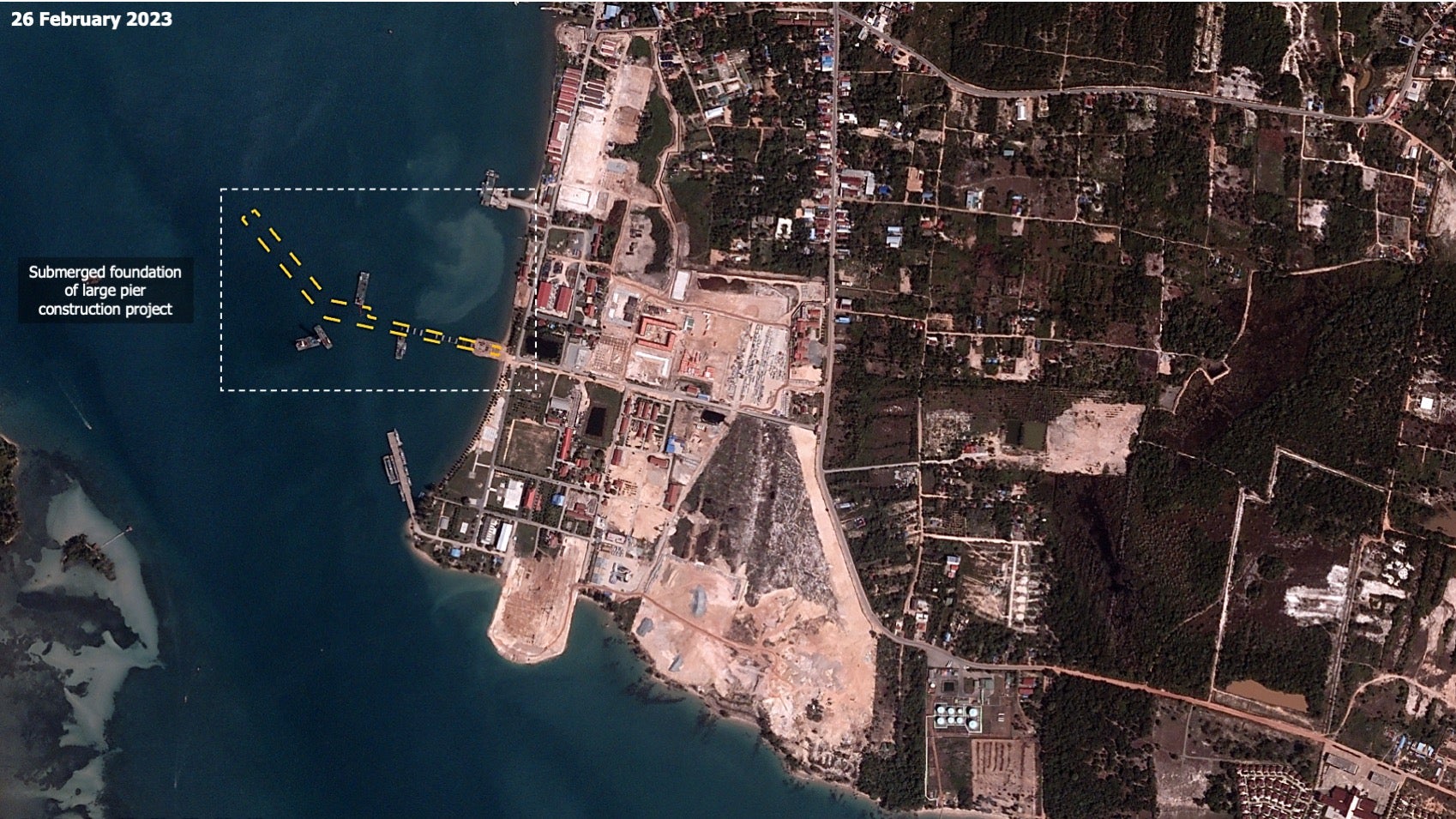
Well….no , under the Trump administration, that is not accurate either. Perhaps China only has had radar surveillance installation since 2018. but you can bet that since Russia has had a spy base in Cuba known as the Lourdes signals intelligence facility, they are not only collaborating but perhaps co-locating especially since Beijing and Moscow have nurtured a a friendly business relationship without limitations. However, no one is putting China and Cambodia in the conversation…that is right, China has a secret base there too, called the Ream Base. .Satellite imagery of Ream Naval Base from 5 February 2023, annotated to show the shape of the pier extension. Original image courtesy of BlackSky


Lourdes

Russia 'to reopen Lourdes spy base in Cuba' - BBC News 2014 source

Beyond the Wall Street Journal doing great work, then comes the Miami Herald with more.

The CIA and Office of the Director of National Intelligence declined to comment. The Cuban government also pushed back against the initial WSJ report calling it “totally false and unfounded information” in a statement made by the Vice-minister of Foreign Affairs, Carlos Fernández de Cossío.

Regardless of Cuba’s sovereign rights in defense matters, the official said, Cuba rejects “any foreign military presence in Latin America and the Caribbean, including that of numerous United States military bases and troops, especially the military base that illegally occupies a portion of the national territory in the province of Guantánamo.” While China might be already collecting intelligence on the U.S. from its commercial facilities in the region, having a signals-intelligence facility “adds to China’s capabilities, especially in times of war,” said Evan Ellis, professor at the U.S. Army War College Strategic Studies Institute, which monitors China’s relationship with Latin America and the Caribbean. “I think it telegraphs Chinese willingness in the current difficult environment between our two countries to take some of these bolder steps and their sense, with their growing military power and economic power and the perception of the U.S. democratic disarray, that they can take these steps that maybe a decade ago, they would not have risked,” Ellis said. “It’s not that big of a threshold that they’ve crossed, but it is significant,” he added.

The news follows intense speculation that Russia, not China, was planning to reopen its Soviet-era espionage base in Lourdes, a town near Havana, which it shut down in 2002. High-ranking Russian national security officials and diplomats have been traveling to the island recently and the two governments appear as close as ever, with Cuban leaders offering public support for Russia’s invasion of Ukraine. But when publicly asked about reopening the Lourdes base during his trip to Havana in April, Russian Foreign Minister Sergei Lavrov did not directly address the question. And despite several economic agreements recently announced by Russian and Cuban authorities, including land-lease deals, the news about a Chinese spy base speaks to the realities on the ground: The island is desperate for cash as its economy continues sinking. Russia had limited resources even before embarking on a war against Ukraine — and China can pay. On May 20, Cuba’s Interior Minister, Gen. Lázaro Alberto Álvarez Casas, met with China’s Minister of Public Security, Wang Xiaohong. “China stands ready to work with Cuba to implement the important consensus reached by the leaders of the two countries and deepen pragmatic cooperation in various fields, especially in law enforcement and security,” a Chinese government statement said.

The news about the spy base comes as the Biden administration has been taking steps to improve its strained relationship with China, which is considered the United States’ primary military and economic rival. At the same time, State Department officials and members of Congress have been raising concerns about China’s increased influence in Latin America and the Caribbean. China has become South America’s largest trading partner and has exploited the Biden administration’s reluctance to new trade deals and has inked a free trade agreement with Ecuador, while Uruguay and Panama are in line, U.S. Rep Maria Elvira Salazar, a Miami Republican, said during a congressional hearing she chaired on Wednesday. “That is very troublesome,” Salazar said, blaming the Biden administration for ignoring the pleas of allies in the region with conservative governments “to the benefit of our enemies.”

When asked by representative Warren Davidson, R-Ohio, why the United States has seemed to become “more passive” and allowed China to increase its influence in the Western Hemisphere, the State Department’s top diplomat for the region acknowledged the administration needs to act with a sense of urgency. “This is the most challenging moment I have seen in 30 years in our hemisphere, and we have to do everything that we can to help our neighbors and our partners around the region to succeed and resist these strategic competitors from outside,” Assistant Secretary for Western Hemisphere affairs Brian Nichols said. The China deal also complicates U.S. policy towards Cuba.

The administration has lifted some restrictions on flights and remittances, resumed the family reunification program for Cubans and reestablished migration and law enforcement talks with the Cuban government. But it stopped short of easing other embargo restrictions and removing Cuba from the list of countries that sponsor terrorism, which the Cuban government had made a condition to improving relations. The cozying up to Russia and China indicates the Cuban government has chosen to seek further support from its longtime political and ideological allies rather than pursuing normalization of relations with the U.S. at a time Cuban authorities perceive their grip on power is at risk. Cuba is facing its worst economic crisis in decades and serious political challenges from a population that has taken to the streets to protest and demand regime change. Ebrahim Raeisi, the president of Iran, another major U.S. adversary, is set to travel to the island after visiting Venezuela and Nicaragua next week. The strategy suggests something else: The Cuban military is calling the shots on the island, not the civilian team led by Cuba’s handpicked president, Miguel Díaz-Canel. If true, the deal with China shows “Cuba’s desperation. It’s the same thing with Russian investors. Cuba is looking for cash where it can get it,” Ellis said. “Cuba also understands the limits of the Biden administration.

With the Republicans in control of the House in Washington, with Biden being more conservative, with a sense of lessons learned that the Obama opening was seen as ‘we gave up too much and receive too little from Cuba,’ there’s an understanding in Cuba that they’re not going to get much more out of Washington.” Latin America’s sharp turn to the left and the consolidation of power by Nicolás Maduro in Venezuela also gives Cuba confidence to do bolder things, Ellis said, while noticing that island has not gone that far as to sign military agreements with Russia or receive Russian weapons. Florida Republicans in Congress quickly reacted to the report on the China espionage base deal to highlight what they said is an increasing national security threat coming from Cuba. “The threat to America from Cuba isn’t just real, it is far worse than this,” Sen. Marco Rubio tweeted. “But to date, not only does the Biden White House not care, they have people who actually want to appease the regime.” “The Cuban regime is auctioning off land to the Russians, hosting the Iranians, and letting the Chinese open a base to spy on the U.S.,” Salazar tweeted. “Just 90 miles from our coast, the dictatorship has opened the door to our greatest enemies!” Later on Thursday, Rubio, who is the Vice Chairman of the Select Committee on Intelligence and the committee’s chairman, Mark R. Warner (D-VA), issued a statement urging the Biden administration “to take steps to prevent this serious threat to our national security and sovereignty.” “We must be clear that it would be unacceptable for China to establish an intelligence facility within 100 miles of Florida and the United States, in an area also populated with key military installations and extensive maritime traffic,” they said.

Read more at: https://www.miamiherald.com/news/nation-world/world/americas/cuba/article276215936.html#storylink=cpy