The Rest of the Questions/Conditions Regarding North Korea

The Beijing government knows full well all the ins and outs of North Korea including all banking relationships, cyber attacks, illicit activities, counterfeiting and gets assistance from China on how to skirt international sanctions. Still, China has the ability to make the world safer from the rogue Kim regime including outside assistance from Syria, Venezuela, Iran and Russia. Whatever the future holds for global security and equilibrium, Beijing is responsible.

Photo

North Korean leader Kim Jong Un is fixated on obtaining a serious nuclear arsenal, and continues to thumb his nose at the U.S. and other world powers. The latest round of United Nations Security Council sanctions approved Monday are not going to change that. But one aspect of them — new measures to interdict ships breaking trade embargoes against Pyongyang — could be baby steps toward much stronger sanctions enforcement.

The new resolution gives the U.S. and other countries the power to inspect ships going in and out of North Korea’s ports but, unfortunately, does not authorize the use of force if the target ships don’t comply. Equally bad, the inspections would need the consent of the countries where the ships are registered. This is a far weaker regime than what was initially proposed by the Donald Trump administration, which would have empowered U.S. military vessels to “use all necessary measures” to force compliance. That the language was watered down to avoid a veto from Russia or China.

The fact is, the only way to keep the Kim regime from violating UN sanctions would be a stringent naval blockade. While a full-on blockade would require a Security Council resolution, it would be possible for the U.S. to immediately start putting in place the rudiments of a comprehensive inspection regime on the high seas, which could be easily adapted over time as more allies, partners and ultimately geopolitical competitors like China and Russia can be persuaded to sign on. Indeed, the Trump administration has already been thinking along these lines.

Such a blockade would serve three key purposes: definitively cutting off North Korea’s access to oil imports from the sea; stopping Korean exports, especially textiles and seafood (which are of significant hard currency value to the regime); and ensuring that high-tech machinery and raw materials that might support Kim’s nuclear-weapons and missile programs are not allowed into the Hermit Kingdom.

While China might continue to provide such supplies across the long Chinese-North Korean land border, a naval blockade would increase pressure on Beijing to comply with existing UN sanctions, as any illegal imports would be obvious proof of Chinese violations.

Setting up a naval blockade is a tactical challenge, even for the U.S. North Korea operates commercial and military ports on its east and west coasts of the peninsula, including Nampo on the Bay of Korea and Hungnam on the Sea of Japan. It also has ports in the far northeast of the country on the edge of Russia, which has been one of Kim’s apologists on the world stage. Shutting down the entire flow of goods into and out of North Korea would significantly tax the U.S. Pacific Fleet.

But it wouldn’t be impossible. The blockade would probably be commanded and controlled tactically out of Seoul, at the headquarters of the commander of U.S. Forces Korea, Army General Vincent Brooks. (An odd legacy of the Korean War is that Brooks is also the commander of UN forces on the peninsula.) At sea, the Navy would probably operationalize the blockade under the overall tactical control of the commander of the U.S. Seventh Fleet, which is based across the Sea of Japan in Yokosuka. The flagship of the fleet, the USS Blue Ridge, is optimized for complex combat operations and would be the seagoing base for the blockade. The fleet has a new commander, Admiral Phil Sawyer, who was brought after the collisions of two Navy destroyers, the McCain and Fitzgerald, with commercial ships this year. More here from Bloomberg.

***

There is an international program to practice and plan for anything that North Korea may have in process militarily.

North Korea’s intensifying experiments appear to have prompted the Formidable Shield exercise, which is the first time that Nato allies have practised defending against incoming ballistic missiles with no prior warning in Europe.

It launched the day after the US sent bombers and fighter jets over waters east of North Korea to send a “clear message that the President has many military options to defeat any threat”.

Donald Trump appeared to threaten regime change in the country over the weekend, causing the North Korean foreign minister to accuse the President of “declaring war” in a speech at the United Nations.

American forces are leading the exercise off the coast of the Scotland, alongside troops from Britain, Canada, France, Germany, Italy, Spain and the Netherlands.

The Ministry of Defence (MoD) hailed Formidable Shield as “one of the most sophisticated and complex air and missile exercises ever undertaken in the UK”.

A Royal Navy Type 45 Destroyer and two Type 23 frigates are being joined by 11 other ships, 10 aircraft and 3,300 personnel for the month-long exercise.

They will work together to detect, track and shoot down live anti-ship and ballistic missiles. More here.

***

Earlier this month CIA Director Mike Pompeo suggested “the North Koreans have a long history of being proliferators and sharing their knowledge, their technology, their capacities around the world.”

My research has shown that North Korea is more than willing to breach sanctions to earn cash.

A checkered history

Over the years North Korea has earned millions of dollars from the export of arms and missiles, and its involvement in other illicit activities such as smuggling drugs, endangered wildlife products and counterfeit goods.

North Korean technicians allegedly assisted the Pakistanis in production of Krytrons, likely sometime in the 1990s. Krytrons are devices used to trigger the detonation of a nuclear device.

Later in the 1990s, North Korea allegedly transferred cylinders of low-enriched uranium hexafluoride (UF6) to Pakistan, where notorious proliferator A.Q. Khan shipped them onward to Libya. UF6 is a gaseous uranium compound that’s needed to create the “highly enriched uranium” used in weapons.

The most significant case was revealed in 2007 when Israeli Air Force jets bombed a facility in Syria. The U.S. government alleges this was an “undeclared nuclear reactor,” capable of producing plutonium, that had been under construction with North Korean assistance since the late 1990s. A U.S. intelligence briefing shortly after the strike highlighted the close resemblance between the Syrian reactor and the North Korean Yongbyon reactor. It also noted evidence of unspecified “cargo” being transported from North Korea to the site in 2006.

More recently, a 2017 U.N. report alleged that North Korea had been seeking to sell Lithium-6 (Li-6), an isotope used in the production of thermonuclear weapons. The online ad that caught the attention of researchers suggested North Korea could supply 22 pounds of the substance each month from Dandong, a Chinese city on the North Korean border.

There are striking similarities between this latest case and other recent efforts by North Korea to market arms using companies “hidden in plain sight.”

The Li-6 advertisement was allegedly linked to an alias of a North Korean state arms exporter known as “Green Pine Associated Corporation.” Green Pine and associated individuals were hit with a U.N. asset freeze and travel ban in 2012. The individual named on the ad was a North Korean based in Beijing formerly listed as having diplomatic status. As was noted when the Li-6 story broke, the contact details provided with the ad were made up: The street address did not exist and the phone number didn’t work. However, prospective buyers could contact the seller through the online platform.

This case – our most recent data point – raises significant questions. Was this North Korea testing the water for future sales? Does it suggest that North Korea may be willing to sell materials and goods it can produce in surplus? Was the case an anomaly rather than representative of a trend? More here.

Citizenship for Sale in U.S and EU, the Golden Ticket

In the United States, with a starting number such as $500,000, you can buy a passport and with just a little more you can advance to citizenship under the EB-5 visa program. Swell huh? It has been going on for years and even Senator Dianne Feinstein has an issue with it. So, where is President Trump on the matter? Crickets…..

In February of this year, Senator Grassley and Feinstein introduced legislation to stop the EB-5 abuse.

The EB-5 program is inherently flawed,” Feinstein said in a joint statement with Grassley on Friday. “It says that U.S. citizenship is for sale. It is wrong to have a special pathway to citizenship for the wealthy while millions wait in line for visas.”

Roughly 10,000 EB-5 visas are awarded each year, with more than 85 percent going to Chinese investors in 2014, according to a study by Savills Studley, a real estate services firm. The program, begun in 1990 to stimulate the economy, has turned into a convenient way for wealthy Chinese citizens to become permanent U.S. residents and later bring over their family members. More here.

The Chinese, the Ukrainians and the Russians, all oligarchs are the largest exploiters of the program and most of these oligarchs are corrupt, paying for speedy processes with dirty money.

We know there are multiple investigations going on inside the DC Beltway regarding Russian interference and rightly so. Both Democrats and Republicans have some complicity in foreign collaboration.

In March of this year, this site published an extensive summary of Russian relations with people in the Trump camp as well as with Nancy Pelosi and Steny Hoyer. Few take a look at Secretary Wilbur Ross and his Cyprus connections. Cyprus is a location where abuse and corruption is as normal as breathing. One interesting person is Dmitry Rybolovlev, who happens to know Donald Trump as well as Wilbur Ross.

Beyond paying for a speedy process to obtain a passport or citizenship, there is also yet another method and that is money laundering illicit funds through U.S. real estate purchases where the buyer’s name is not listed if cash is paid. You dont say…..yup. This site published a summary of such activities in July of 2014.

So, while we have examined the issue in the United States and in Cyprus, it is the same for the European Union.

Russian and Ukrainian oligarchs suspected of corruption are among hundreds who have acquired EU passports under the “golden visa” program – a bourgeois shortcut to European citizenship in exchange for cash investments, the Guardian reported Sunday.

A list of recipients seen by The Guardian includes “prominent businesspeople and individuals with considerable political influence.”

The paper claims that Cyprus alone has made over $US 4 billion selling passports to international oligarchs, “granting them the right to live and work throughout Europe,” completely legally.

However, Cyprus is not alone. “The Golden Visa program for Spain, Portugal, Malta, Greece and Cyprus are the most prominent. Bulgaria and Hungary offer residency and citizenship by investment in Europe through government bonds,” the Golden Visa website states.

The BBC reported about this kind of purchasable citizenship three years ago.

“Just like you diversify an investment portfolio, you want to diversity your passport portfolio,” investment expert Christian Kalin, told the BBC.

The list of individuals who have received Cypriot citizenship includes Bashar al-Asad’s cousin, who was previously placed under American sanctions because of allegations he benefited from corruption. It also includes a former member of the Russian parliament and the founder of Ukraine’s largest bank.

According to Global Witness, an international NGO dedicated to exposing global corruption, global visas have the potential to give applicants fleeing persecution a “get out of jail for free card.”

Portuguese MEP, Ana Gomes, said golden visas are an immoral way to grant citizenship.

“I’m not against individual member states granting citizenship or residence to someone who would make a very special contribution to the country, be it in arts or science, or even in investment. But granting, not selling,” said Gomes.

Gomes also questioned the secrecy of obtaining golden visas. If they’re legal, why is it so hard to see who has them, asked Gomes.

The European Parliament will be debating the legality of golden visas in light of the leak, The Guardian reported.

So, for the leaders of respective countries, the definition of citizenship and the spirit of that loyalty means nothing when it comes to money, dirty money.

Perhaps we should be pushing harder for the Grassley/Feinstein legislation at a minimum….what say you?


Starfish Prime, a Response to North Korea?

The United States knows all too well about an EMP. With regard to North Korea, the Kim regime has acknowledged it was active in EMP pursuits. The U.S. has EMP weapons developed by Boeing.

So what is Starfish Prime?

On July 9, 1962 — 50 years ago today — the United States detonated a nuclear weapon high above the Pacific Ocean. Designated Starfish Prime, it was part of a dangerous series of high-altitude nuclear bomb tests at the height of the Cold War. Its immediate effects were felt for thousands of kilometers, but it would also have a far-reaching aftermath that still touches us today.

In 1958, the Soviet Union called for a ban on atmospheric tests of nuclear weapons, and went so far as to unilaterally stop such testing. Under external political pressure, the US acquiesced. However, in late 1961 political pressures internal to the USSR forced Khrushchev to break the moratorium, and the Soviets began testing once again. So, again under pressure, the US responded with tests of their own.

It was a scary time to live in.

The US, worried that a Soviet nuclear bomb detonated in space could damage or destroy US intercontinental missiles, set up a series of high-altitude weapons tests called Project Fishbowl (itself part of the larger Operation Dominic) to find out for themselves what happens when nuclear weapons are detonated in space. High-altitude tests had been done before, but they were hastily set up and the results inconclusive. Fishbowl was created to take a more rigorous scientific approach. Read more here.

The Wall Street Journal published an item offering insight regarding North Korea and the threat of an EMP and the United States is not prepared for such a weapon in either a defensive or offensive posture without some exceptional consequence to life.

As South Korea performed some live fire drills in response to the last nuclear test by North Korea that measured a 6.3 on the Richter Scale, at issue is the immediate line of  an estimated thousands of rockets pointed at South Korea. It would take a robust offensive first strike to remove this border threat in cadence with other strike operations into the North Korea tunnel network where most of the weaponry is located.

Finally, South Korea’s leader has taken a more aggressive posture, leaning towards a military operation and this could bring the closer to Japan which is a positive indication where activities to neutralize North Korea is tantamount.

Tensions sharply escalated Sunday as the communist regime conducted what it claims to have been a test of a hydrogen bomb mountable on an intercontinental ballistic missile (ICBM). The test was only the latest in a recent series of saber-rattling, including two ICBM tests in July.

In its report to the legislature’s defense committee, the defense ministry said that it, in consultation with Washington, will seek to deploy a nuclear-powered aircraft carrier, strategic bombers and other powerful assets to the peninsula as a response to the North’s nuclear experiment.

It also unveiled its plan to stage unilateral live-fire drills involving Taurus air-to-surface guided missiles mounted on its F-15K fighter jets. The missile, with a range of 500 kilometers, is capable of launching precision strikes on the North’s key nuclear and missile facilities.

In his assessment of the sixth nuke test, Song said that the North is presumed to have reduced the weight of a nuclear warhead to below 500 kilograms. More here.

Adding more sanctions on China or those doing business with North Korea does not stop or deter North Korea at all. China knows precisely what North Korea is doing and has not moved to stop any of these missile or nuclear activity.

Photo

North Korea’s nuclear test occurred in Punggye-ri, the same site where a nuclear test occurred in January 2016, about 50 miles away from the border with China. Tremors were felt in the Chinese border city of Yanji, home to about 400,000 people, Chinese media reported.  The latest test occurred as China hosted the leaders of the BRICS (Brazil, Russia, India, China and South Africa) countries for their annual summit. China “strongly condemned” North Korea’s provocation and a draft communique from the BRICS summit quoted in Chinese state media “strongly deplored” North Korea’s nuclear test but called for a peaceful solution to the crisis. More here.

All the alleged professional continue to say the United States, Japan and South Korea have no good options with regard to North Korea, and there may be some truth to that given the descriptions as defined here.

What is left out of all conversations is the cyber abilities of the United States, knocking out North Korea’s space segments on existing satellites owned by China, Iran or Russia and lastly once again dusting off the files of Starfish Prime as described below:

Launched via a Thor rocket and carrying a W49 thermonuclear warhead (manufactured by Los Alamos Scientific Laboratory) and a Mk. 2 reentry vehicle, the explosion took place 250 miles (400 km) above a point 19 miles (31 km) southwest of Johnston Island in the Pacific Ocean. It was one of five tests conducted by the USA in outer space as defined by the FAI. It produced a yield equivalent to 1.4 megatons of TNT.

The Starfish test was one of five high altitude tests grouped together as Operation Fishbowl within the larger Operation Dominic, a series of tests in 1962 begun in response to the Soviet announcement on August 30, 1961 that they would end a three-year moratorium on testing.[2]

In 1958 the United States had completed six high-altitude nuclear tests, but the high-altitude tests of that year produced many unexpected results and raised many new questions. According to the U.S. Government Project Officer’s Interim Report on the Starfish Prime project:

“Previous high-altitude nuclear tests: YUCCA, TEAK, and ORANGE, plus the three ARGUS shots were poorly instrumented and hastily executed. Despite thorough studies of the meager data, present models of these bursts are sketchy and tentative. These models are too uncertain to permit extrapolation to other altitudes and yields with any confidence. Thus there is a strong need, not only for better instrumentation, but for further tests covering a range of altitudes and yields.”[3]   

More details here. 


Now al Shabaab has Ownership of Uranium Set for Iran


In 2015:

Somali Minister of Petroleum and Mineral Resources, Mohamed Muktar Ibrahim has talked about the Somalia’s Mineral Resources saying that they have made contacts with International Atomic Energy Agency (IAEA) on the controlling of minerals that can be use chemical weapons.

He noted they are taking measures to prevent raw materials like Uranium to fall into the hands wrong people.

In an exclusive interview he gave to Universal TV, the minister highlighted that they also held talks with UNDP which had information on mining depots in the country as it has surveyed on the country’s mineral deposits in the years between 1965 and 1975.

In a UN report released in 1968 shows that Somalia is a hotspot for uranium.

Somali government is busy amending some provision in the Mineral Law 1984 and compliance with the current conditions in the country now.

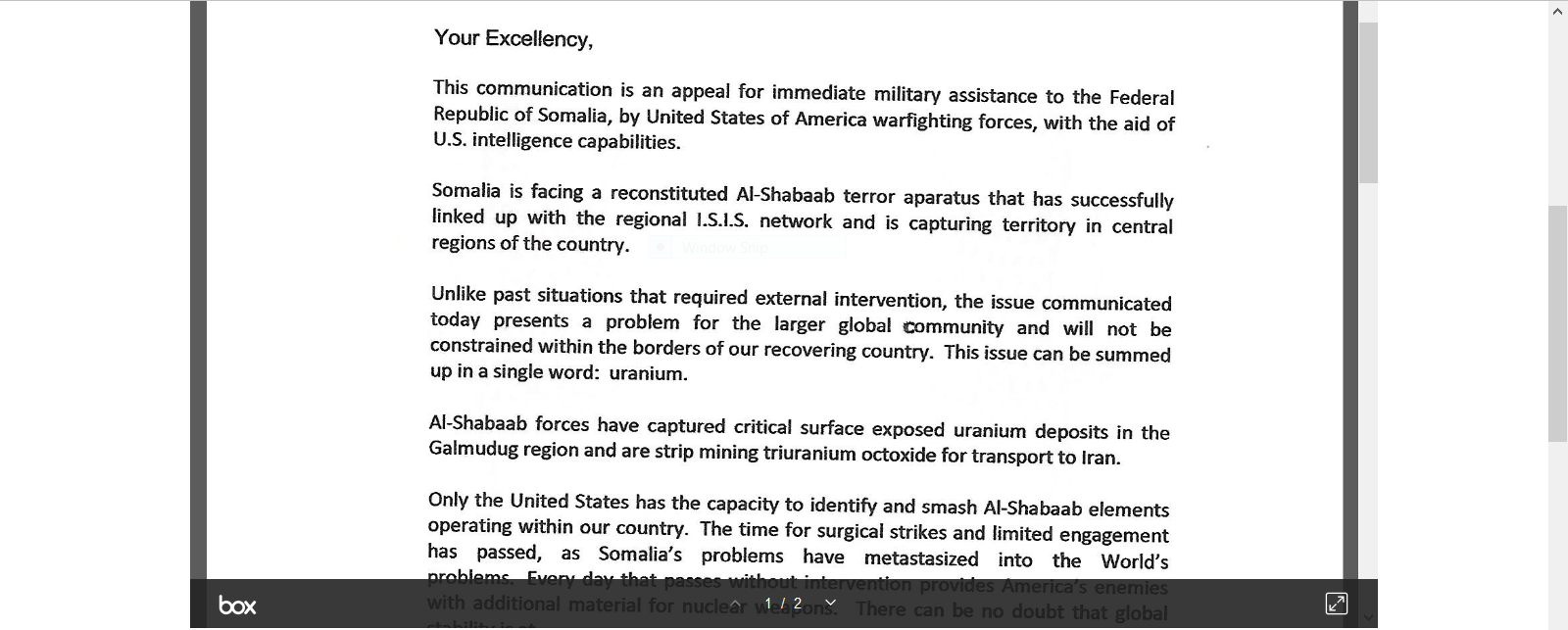
To read the full letter, go here.

An Al Qaeda affiliate has seized control of uranium mines in Africa with the intent of supplying the material to Iran, according to a diplomatic letter from a top Somali official appealing to the U.S. for “immediate military assistance.”

The letter, reviewed by Fox News, was addressed to U.S. Ambassador to Somalia Stephen Schwartz. Somalia’s Ambassador to the U.S. Ahmed Awad confirmed to Fox News on Thursday that the letter “has indeed been issued” by Minister of Foreign Affairs Yusuf Garaad Omar, whose signature is on the document.

The Aug. 11-dated letter delivered an urgent warning to the U.S. that the al-Shabaab terror network has linked up with the regional ISIS faction and is “capturing territory” in the central part of the country.

“Only the United States has the capacity to identify and smash Al-Shabaab elements operating within our country. The time for surgical strikes and limited engagement has passed, as Somalia’s problems have metastasized into the World’s problems,” the letter said. “Every day that passes without intervention provides America’s enemies with additional material for nuclear weapons. There can be no doubt that global stability is at stake.”

The State Department would not comment on the diplomatic letter, but did not dispute its authenticity and referred Fox News to the government of Somalia. Iran was supposed to pull back on its nuclear program under the terms of the agreement struck with the Obama administration. More here from FNC.

***

Background:

Is Somalia a safe haven for terrorists?

On one hand, Somalia is a chaotic, poor, battle-weary Muslim country with no central government and a long, unguarded coastline. Its porous borders mean that individuals can enter without visas, and once inside the country, enjoy an almost complete lack of law enforcement. Somalia has long served as a passageway from Africa to the Middle East based on its coastal location on the Horn of Africa, just a boat ride away from Yemen. These aspects make Somalia a desirable haven for transnational terrorists, something al-Qaeda has tried to capitalize on before, and is trying again now.

On the other hand, Somalia is different from other failed states in several ways. While it is roughly the size of Afghanistan, its landscape lacks Afghanistan’s many natural hiding places and does not offer the topographical haven of other states like Yemen. It is also a fiercely clan-oriented culture with an aversion to foreign presence of any kind, including Arab jihadi organizations. “When you get these extremist ideologies, the Somalis look at them and they are immediately perceived as foreign,” says Bruton, “They’re perceived as Arab. It’s an Arab ideology. And just as the Somalis are hostile to American ideology, they’re hostile to Arab ideology as well.” Finally, the Somalis–Sufi Muslims since the birth of Islam in the seventh century–have moderate religious views; until recently, Taliban-style fundamentalism was unfamiliar in the country.

These factors were responsible for al-Qaeda’s failure in the 1990s, when it tried working closely with al-Ittihad al-Islami (AIAI). Al-Qaeda was unable to root itself in Somalia’s clan system, and, according to former ambassador to Ethiopia David Shinn, “overestimated the degree to which Somalis would become jihadists.” The experience of the al-Qaeda operatives was so treacherous that Bruton says: “U.S. intelligence officials came up with a verdict that Somalia was actually inoculated from foreign terrorist groups, that it’s just fundamentally inhospitable, that the clan system is so closed to foreigners that there’s just no way that these groups can operate.”

Since the Ethiopian invasion, al-Qaeda has seen a resurgent connection to the country, and HI and al-Shabaab control most of the territory. However, experts disagree over whether Somalia could be the base for an international attack or whether the group will continue its domestic focus. “Personally, my view is that they don’t have much to gain by [partnering with al-Qaeda to conduct an international attack],” Bruton says. “And they probably don’t have the capacity to do it. But it’s worrisome that they’re making the threats, so I think it’s something to be watched and assessed very carefully. But right now, I would say the odds of a transnational attack are very, very low.”  More here.

3 More Russian Locations in U.S. Shuttered

Putin promises retaliation in growing diplomatic feud with US

Russian President Vladimir Putin plans to retaliate against the State Department’s latest rebuke of his policies, his spokesman warned.

“We regret the unconstructive stance taken by our counterparts in the United States and, of course, we cannot afford to leave unfriendly, and sometimes hostile steps towards us without retaliation,” Kremlin spokesman Dmitry Peskov said Thursday, according to state-run media.

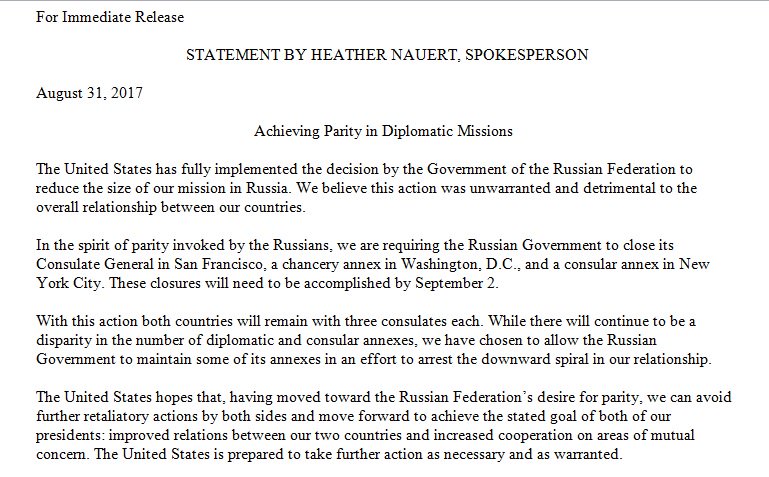
That statement suggests that the diplomatic feud will escalate following the State Department’s decision to close three Russian facilities in the United States. Secretary of State Rex Tillerson’s team justified that move as a response to Putin’s requirement that the United States cut hundreds of personnel operating in Russia. But the State Department called for an end to the tit-for-tat, saying that the two sides had reached “parity” in the fight.

Tillerson ordered the closure of Russia’s consulate general in San Francisco, as well as two other facilities in New York and Washington, D.C., respectively.

“While there will continue to be a disparity in the number of diplomatic and consular annexes, we have chosen to allow the Russian government to maintain some of its annexes in an effort to arrest the downward spiral of our relationship,” State Department spokeswoman Heather Nauert said Thursday.

The State Department said it had implemented the Putin team’s order to remove hundreds of U.S. personnel from Russia. Putin issued that requirement in response to Congress passing legislation that sanctions Russia on three fronts: the cyberattacks against the Democratic party and state election systems in 2016; the invasion of Ukraine; and Russia’s support for Syrian President Bashar Assad.

“The United States hopes that, having moved toward the Russian Federation’s desire for parity, we can avoid further retaliatory actions by both sides and move forward to achieve the stated down of both of our presidents: improved relations between our two countries and increased cooperation on areas of mutual concern,” Nauert said.

Russian diplomats maintain that the United States is to blame for the strained ties between the former Cold War rivals. “By tradition we are for good-natured relations with the United States,” Peskov said. “Moreover, we believe that these relations must be advanced in the interests of peace and global stability and in the interests of settling crucial world and regional problems.”

*** Meanwhile, this Dmitry Peskov cat is well know to the Trump orbit and described below.

Moscow (CNN) Kremlin spokesman Dmitry Peskov confirmed Wednesday he got an email from Michael Cohen, US President Donald Trump’s lawyer, asking for help moving a Moscow real estate deal forward, but said he did not respond and did not pass it to Russian President Vladimir Putin.

Peskov was responding to a question from CNN on a conference call with reporters.
Cohen — who was executive vice president of the Trump Organization at the time he sent the email — said Monday that he had contacted the Kremlin for assistance in mid-January 2016 about building a Trump Tower in Moscow when the mogul was running for president, but denied that the project was related to Trump’s campaign. But the revelation appears to contradict Trump’s vehement denials of any such business connections to Russia in the past.
Cohen told CNN on Monday his message to Peskov was “an email that went unanswered that was solely regarding a real estate deal and nothing more.”
Peskov confirmed that his office had located a copy of the email, which said the development deal wasn’t moving forward and requested support.