#Occupy Venezuelan Embassy in Washington DC

Enter Madea Benjamin, only to refuse to leave. #OccupyVenezuela or something like that. And…the ANSWER Coalition is there too.

The Embassy building, located in Georgetown, is owned by the Venezuelan government and is a protected international compound by the Vienna Conventions. Progressive activists have been working and living inside the Embassy as invited guests for weeks.

The Embassy Protection Collective was initiated by CODEPINK and Popular Resistance, and the ANSWER Coalition has been mobilizing support for this effort in Washington and around the country. Many ANSWER volunteers and organizers are inside the Embassy.

Image result for answer coalition venezuela

“The people inside this Embassy are here at the invitation of its lawful owner, the Government of Venezuela,” said ANSWER’s National Director Brian Becker. “The Trump administration is acting as the world’s number one international pirate as it seizes Venezuelan assets, properties and diplomatic compounds. In pure colonial fashion, U.S. and European entities have grabbed hold of Venezuela’s oil revenue, gold reserves and bank accounts — while openly championing the Monroe Doctrine. We are joining with the people of the world to declare that the days of the Monroe Doctrine are over.”

Becker continued, “Any action to evict the Embassy’s current tenant guests by the MPD, Secret Service or other police agencies would be an illegal and unlawful arrest under both D.C. and international law. What we are doing here in this Embassy is not an act of civil disobedience. International law and D.C. law are on our side. The violator of these laws — the criminal in this case — is none other than the Trump White House and the U.S. State Department.”

A letter was sent last night from the Embassy Protection Collective, with the assistance of lawyer Mara Verheyden-Hilliard of the Partnership for Civil Justice Fund, to the U.S. State Department:

Members of the Embassy Protection Collective are writing to make it expressly clear and ensure all personnel are put on notice that any arrest of persons inside the embassy would constitute an unlawful arrest. We understand from our communications with your office that you are threatening to arrest persons inside the Venezuelan embassy.

Not only are we here at the invitation of persons lawfully in charge of the premises but we are also here as people with lawful rights under Washington, DC tenancy law.

It is our intention to hold responsible any person who orders or effectuates any unlawful actions against us.

We have received no eviction notice and due process opportunity to challenge any attempted eviction as is required by law.

No water or electricity.

Pepco, with protection from the Secret Service, cut electricity and water to the building,” says Ariel Gold, the national co-director of the antiwar activist organization Code Pink. “All of the utility bills have always been paid in full by the government of Venezuela.”

Carlos Vecchio, the Venezuelan ambassador to the U.S. appointed by the opposition government, took responsibility on Twitter for the power outage. Activists have prevented him from entering the embassy.

For the last month Code Pink activists have been occupying the Venezuelan embassy in Washington D.C. Not in protest but in support of the government led by socialist dictator Maduro.

With no electricity, activists who have been living inside the building are adjusting to the latest obstacle in their month-long occupation of the embassy.

Getting food inside has been one of the biggest challenges for the past 10 days, with anti-Maduro protesters and Secret Service barricades blocking most of the doors. Then Thursday, activists announced they would be cutting back on their primary source of communication with the outside world: social media. With no power to charge their devices, there will be less tweeting and fewer video streams…

About two weeks into Code Pink’s residency, Venezuelan and Venezuelan American protesters began to gather outside. They have not left since.

Note, the ones occupying the embassy are (liberal, duh) Americans from groups like Code Pink, Answer Coalition, Popular Resistance and Black Alliance for Peace, while most of the pro-opposition protesters are actual, real-life Venezuelans. Who are the nasty American imperialists now, Code Pink?

And of course Max Blumenthal is in the mix too –>

Army’s Wish List Against China/Russia

It appears some real strategic thinking and application is happening here and that is a good thing. These lists for more reconnaissance aircraft is a good thing for sure.

Russia's Hybrid Warfare Strategy • Full Version

U.S. Army leaders revealed Tuesday that they are briefing top military commanders about new weapons being built specifically for “high-intensity conflict” against China and Russia, in a new effort to assure that they could provide vital firepower for those potential battlefields of the future.

Reconnaissance aircraft, team reach milestone > U.S. Air ...

Army Secretary Mark Esper said he wants to shift some money away from vehicles and aircraft more suited for conflicts in Afghanistan and Iraq and into “what I need to penetrate Russian or Chinese air defenses.”

Among the new weapons and technologies he said are critical: long-range artillery, attack and reconnaissance aircraft, air and missile defenses, and command-and-control networks. Esper said the artillery — known as Long-Range Precision Fires — could be used “to hold at bay Chinese ships.”

Army officials recently briefed Adm. Philip Davidson, commander of U.S. Indo-Pacific Command, who oversees all U.S. military personnel in the Asia-Pacific region. This comes as the Army plans to rotate thousands of soldiers on expeditionary deployments throughout the Pacific — an expansive region often associated with Navy and Air Force military operations.

“We want to talk to [U.S. European Command] as well,” Esper said. “What we’re trying to do is go out and tell them what we’re doing.”

Last year, the Army held a series of reviews that recommended cutting or reducing nearly 200 weapons projects, freeing up $25 billion for investment in higher-priority programs. Among the projects cut are upgrades to Boeing-made CH-47 Chinook helicopters and buys of Oshkosh-made Joint Light Tactical Vehicles, the Army’s replacement for Humvees. Esper said he needs to shift money into “Future Vertical Lift,” an effort to build faster helicopters and tilt-rotor aircraft — similar to the V-22 Osprey —  instead of upgrades to older, larger, and slower helicopters.

“What I don’t have right now is an attack/reconnaissance aircraft,” Esper said, Tuesday during a briefing at the Pentagon. “That’s what I need to penetrate Russian or Chinese air defenses. I’m not going to do that with a CH-47.”

The Army is evaluating prototypes built by Bell and a Lockheed Martin-Boeing team, as it determines the makeup of a new generation of military helicopters.

Army leaders plan to cut the number of Joint Light Tactical Vehicles they will buy from Oshkosh but the size of the reduction has not been finalized, Esper said. Army Undersecretary Ryan McCarthy has previously said the service plans to cut 1,900 vehicles.

“We are certainly cutting the total number. I know that much,” Esper said. “But whether it … finals out; right here today, I can’t tell you. In five years, I could maybe have a different number for you.”

The secretary said that they decision to buy Chinooks and JLTVs was made before the Trump administration’s January 2018 National Defense Strategy put the Pentagon on a path to preparing for great power competition with Russia and China. That strategy reduced the Defense Department’s priority on counterterrorism and counterinsurgency fights in Afghanistan, Iraq, and other spots like Syria, which had dominated much of the past two decades. In its wake, the Army is building new doctrine that will be evaluated over the next 12 to 18 months. The results of those wargames will determine how many soldiers and weapons are needed in the future.

“They were in many ways designed for a different conflict,” he said, of Chinooks and JLTVs. “It doesn’t mean we won’t use them in future conflicts, but now my emphasis has to be on rebuilding my armor, rebuilding my fighting vehicles, having aircraft that can penetrate Russia and Chinese air defenses, that can shoot down Russian and Chinese drones and missiles and helicopters and fixed-wing aircraft. We’re in this transition period and so some folks are caught in that transition.”

Meanwhile, where is the strategic thinking when it comes to hybrid warfare?

The Pentagon wants to develop a way to detect those signs by analyzing the myriad actions in what it calls the “gray zone”–behaviors in a variety of areas that, considered separately, may or may not mean anything but when examined together could indicate malicious intent–and is putting artificial intelligence (AI) to work on the problem.

The Defense Advanced Research Projects Agency (DARPA) has launched a new program intended to better understand and interpret an adversary’s gray zone engagement as potential signals of pending aggression. The Collection and Monitoring via Planning for Active Situational Scenarios (COMPASS) program will incorporate AI, game theory, modeling, and estimation technologies to decipher the often subtle signs that precede a full-scale attack.

“The ultimate goal of the program is to provide theater-level operations and planning staffs with robust analytics and decision-support tools that reduce ambiguity of adversarial actors and their objectives,” said Fotis Barlos, DARPA program manager. “As we see increasingly more sophistication in gray zone activity around the world, we need to leverage advanced AI and other technologies to help commanders make more effective decisions to thwart an enemy’s complex, multi-layered disruptive activity.”

The attention to gray zone activity reflects the multi-pronged tactics used in hybrid warfare, of the type employed by Russia in Georgia in 2008 and in Ukraine since 2014. Cyber attacks to shut down the power grid, conduct digital espionage, and sow economic disruption, along with social media campaigns aimed at manipulating public opinion, coincided with the covert movement of troops and equipment into Ukraine. Not only have these tactics proved to be effective, their subtle, sometimes untraceable methods can lend a level of plausible deniability to the attacks. And NATO has said that clandestine hybrid attacks can achieve their aims before being noticed, too late for an effective response.smilelaugh

Anyone Fretting over the Real Russian Hacking from the Mueller Report?

Remember the timeline, it was the Comey FBI, the Brennan CIA, the Lynch Department of Justice and the Obama White House. So, Obama only expelled a pile of Russians and closed 3 dachas. Remember? When the dust settles just a little, President Trump has some work to do to clean up this hacking mess via Russia. Congress has some work to do also by defining some kind of hacking legislation.

The Mueller Report’s conclusions about Russian operations are unambiguous: the GRU’s Unit 26165 did the hacking, and the Internet Research Agency managed the influence campaign. The Report also concluded that the GRU’s Unit 74455 retailed the results of the doxing through its subsidiaries DCLeaks and Guccifer 2.0, and through a sympathetic WikiLeaks.

What is Unit 26165, Russia's elite military hacking centre?

Boris Zilberman on Twitter: "DOJ indictment against the ...

At one point, the Russians used servers located in the U.S. to carry out the massive data exfiltration effort, the report confirms.

Much of the information was previously learned from the indictment of Viktor Borisovich Netyksho, the Russian officer in charge of Unit 26165. Netyksho is believed to be still at large in Russia.

The operatives working for the Russian intelligence directorate, the GRU, sent dozens of targeted spearphishing emails in just five days to the work and personal accounts of Clinton Campaign employees and volunteers, as a way to break into the campaign’s computer systems.

The GRU hackers also gained access to the email account of John Podesta, Clinton’s campaign chairman, of which its contents were later published.

Using credentials they stole along the way, the hackers broke into the networks of the Democratic Congressional Campaign Committee days later. By stealing the login details of a system administrator who had “unrestricted access” to the network, the hackers broke into 29 computers in the ensuing weeks, and more than 30 computers on the DNC.

The operatives, known collectively as “Fancy Bear,” comprised several units tasked with specific operations. Mueller formally blamed Unit 26165, a division of the GRU specializing in targeting government and political organizations, for taking on the “primary responsibility for hacking the DCCC and DNC, as well as email accounts of individuals affiliated with the Clinton Campaign,” said the Mueller report.

The hackers used Mimikatz, a hacking tool used once an intruder is already in a target network, to collect credentials, and two other kinds of malware: X-Agent for taking screenshots and logging keystrokes, and X-Tunnel used to exfiltrate massive amounts of data from the network to servers controlled by the GRU. Mueller’s report found that Unit 26165 used several “middle servers” to act as a buffer between the hacked networks and the GRU’s main operations. Those servers, Mueller said, were hosted in Arizona — likely as a way to obfuscate where the attackers were located but also to avoid suspicion or detection.

In all, some 70 gigabytes of data were exfiltrated from Clinton’s campaign servers and some 300 gigabytes of data were obtained from the DNC’s network.

Meanwhile, another GRU hacking unit, Unit 74455, which helped disseminate and publish hacked and stolen documents, pushed the stolen data out through two fictitious personas. DCLeaks was a website that hosted the hacked material, while Guccifer 2.0 was a hacker-like figure who had a social presence and would engage with reporters.

Under pressure from the U.S. government, the two GRU-backed personas were shut down by the social media companies. Later, tens of thousands of hacked files were funneled to and distributed by WikiLeaks .

Mueller’s report also found a cause-and-effect between Trump’s remarks in July 2016 and subsequent cyberattacks.

“I hope you’re able to find the 30,000 emails that are missing,” said then-candidate Trump at a press conference, referring to emails Clinton stored on a personal email server while she headed the State Department. Mueller’s report said “within approximately five hours” of those remarks, GRU officers began targeting for the first time Clinton’s personal office.

More than a dozen staffers were targeted by Unit 26165, including a senior aide. “It is unclear how the GRU was able to identify these email accounts, which were not public,” said Mueller.

Mueller said the Trump campaign made efforts to “find the deleted Clinton emails.” Trump is said to have privately asked would-be national security advisor Michael Flynn, since convicted following inquiries by the Special Counsel’s office, to reach out to associates to obtain the emails. One of those associates was Peter Smith, who died by suicide in May 2017, who claimed to be in contact with Russian hackers — claims which Mueller said were not true.

Does that implicate the Trump campaign in an illegal act? Likely not.

“Under applicable law, publication of these types of materials would not be criminal unless the publisher also participated in the underlying hacking conspiracy,” according to Elie Honig, a CNN legal analyst. “The special counsel’s report did not find that any person associated with the Trump campaign illegally participated in the dissemination of the materials.”

N Korea Test Fires Tactical Weapon

(Reuters) – Satellite images from last week show movement at North Korea’s main nuclear site that could be associated with the reprocessing of radioactive material into bomb fuel, a U.S. think tank said on Tuesday. The U.S. State Department declined to comment on intelligence matters, but a source familiar with U.S. government assessments said that while U.S. experts thought the movements could possibly be related to reprocessing, they were doubtful it was significant nuclear activity.

***

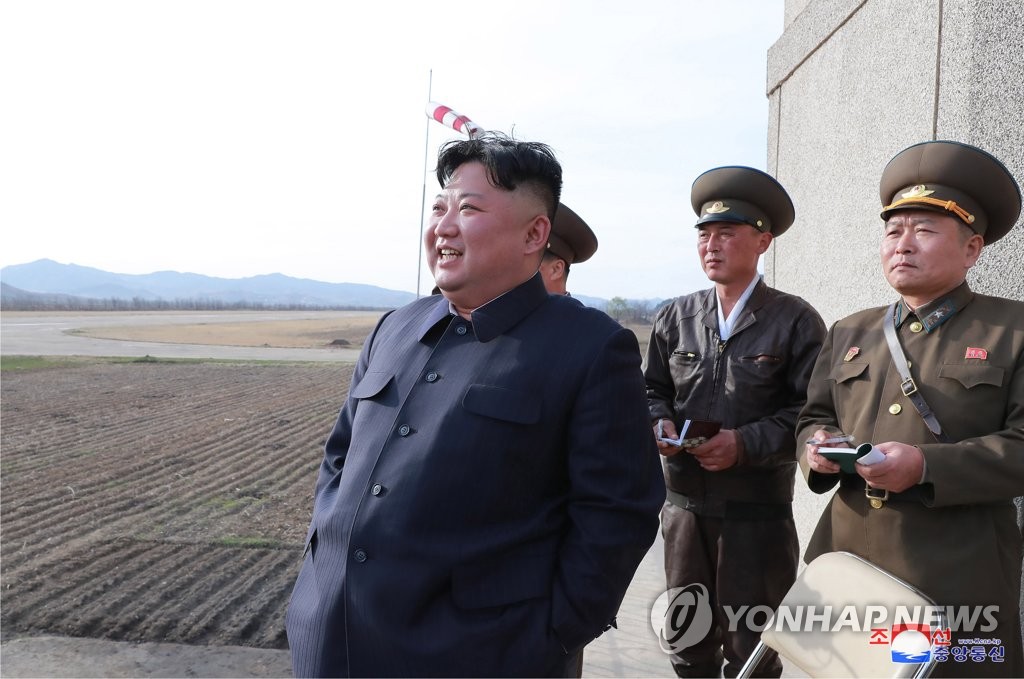
SEOUL, April 18 (Yonhap) — North Korean leader Kim Jong-un has supervised a test-firing of a new tactical guided weapon, calling its development an “event of very weighty significance” in beefing up its military power, state media reported Thursday.

The Korean Central News Agency said the test happened Wednesday but did not specify what the newly developed weapon was. It was the first time since November the North’s leader has overseen a weapons testing.

“Saying that the completion of the development of the weapon system serves as an event of very weighty significance in increasing the combat power of the People’s Army, he noted that it is a very good thing that the field of national defense science has waged a dynamic struggle for attaining core research goals,” Kim was quoted as saying by the KCNA.

North Korean leader Kim Jong-un inspects a flight drill of the North's Air and Anti-aircraft Force on April 17, 2019, in this photo released by the Korean Central News Agency on April 18. As is customary, the agency didn't provide the location. (For Use Only in the Republic of Korea. No Redistribution) (Yonhap) North Korean leader Kim Jong-un inspects a flight drill of the North’s Air and Anti-aircraft Force on April 17, 2019, in this photo released by the Korean Central News Agency on April 18. As is customary, the agency didn’t provide the location. (For Use Only in the Republic of Korea. No Redistribution) (Yonhap)

“After watching the power of the new-type tactical guided weapon, he pointed out that our national defense scientists and workers in the field of the munitions industry performed another great work in increasing the country’s defense capabilities,” the KCNA said.

Kim also set the “phased and strategic goals” for maintaining his country’s munitions production, putting national defense science and technology on a “cutting edge level,” and ordering “detailed tasks and ways to attain them.”

The test-firing came after Kim suggested a year-end deadline for denuclearization negotiations with the United States following the breakdown of his February summit with U.S. President Donald Trump.

On Wednesday, Pyongyang’s media said that the North Korean leader visited an air force unit and reviewed a flight exercise in his first public inspection of military activities in five months.


Title lll vs. Cuba for Cuban Exiles, About Time

There is a provision of the Cuban trade embargo that no U.S. president has ever used. President Trump has decided to be the first, according to White House officials. But it’s far from clear if it will do much to dislodge the island’s communist government.

It’s called Title III. It allows Americans – in this case mostly Cuban-Americans – to use U.S. federal courts to sue foreign companies that do business in Cuba on property taken from them by the Castro revolution.

Conservative Cuban exiles insist President Trump’s activation of Title III (part of the 1996 Helms-Burton Act that tightened the U.S. trade embargo against Cuba) will have a chilling effect on foreign investment in Cuba – particularly for European and Canadian companies. That, they insist, will undermine the island’s economically failing regime.

“I do think it will be a turning point,” says Cuban-American attorney Marcell Felipe, who heads the Inspire America Foundation, a pro-democracy NGO in Miami. “For too long the Spanish and Canadian governments and their business interests have promoted respect for human rights everywhere in the world while they support a regime that imprisons anyone who dissents.”

But critics of Trump’s Title III move says it’s primarily another political bone tossed to his Cuban exile supporters – who he believes won Florida for him in the 2016 election.

Cuban-American attorney Pedro Freyre, who heads international practice at the Akerman law firm in Miami and represents firms that may face Title III lawsuits, warns it will be hard to collect money from those suits. Countries like Spain and Canada already have laws in place to block Cuban embargo-related litigation, and he points out that no U.S. president ever triggered the provision before for fear it could lead to retaliation against U.S. business interests around the world.

Freyre also believes it will probably take much more to topple Cuba’s repressive government.

“After watching the Cuban regime navigate 60 years of sanctions and having a rotten economy and a bad political system,” says Freyre, “it’s clear it’s particularly adept at survival. So I am skeptical that this will accomplish that.”

National Security Advisor John Bolton is expected to formally announce the Title III decision when he visits Miami on Wednesday. Sources close to the Trump administration tell WLRN the Title III decree may also include tightening U.S. government officials’ interaction with Cuban officials on the island – and possibly a dramatic scaling back of the amount of remittances Cuban-Americans can send to Cuba and the trips they can take there each year.

***  Image result for bolton in miami cuba

US National Security Adviser John Bolton is set to outline President Donald Trump’s plan to fully implement Title III of the Helms-Burton Act, a previously suspended section of the US trade embargo on the Communist-run country during a speech in Miami, the official said.
It is a move that is widely considered to be part of the administration’s efforts to ramp up pressure on Havana over its support for Venezuelan President Nicolas Maduro — who Trump criticized as a “Cuban puppet” in February. Cuban officials have decried the increased sanctions on the communist-run island and offered to enter into negotiations to repay US companies for seized property.
During a speech in Miami last year, Bolton promised the crowd a tough US approach to the “troika of tyranny,” his term for Cuba, Venezuela and Nicaragua, saying they represented “the perils of poisonous ideologies left unchecked.”