UN Report of Killing Squads and Deaths in Venezuela

Primer:

Venezuelan security forces have been sending death squads to commit extrajudicial killings of young men, according to a United Nations report released on Thursday. The crime scenes are then staged to make it look like the victims were resisting arrest.

Caracas has said that about 5,287 people died last year when they refused to be detained by officers, and that this has been the case for a further 1,569 through the middle of May this year. However, the UN report suggests that many of these deaths were actually extrajudicial executions.

The report relays the accounts of 20 families, who say that masked men dressed in black from the Special Actions Forces (FAES) arrived at their homes in black vehicles without license plates. They then broke into their houses, assaulted the women and girls and stole belongings.

“They would separate young men from other family members before shooting them,” the report said.

“In every case, witnesses reported how FAES manipulated the crime scene and evidence. They would plant arms and drugs and fire their weapons against the walls or in the air to suggest a confrontation and to show the victim had ‘resisted authority.'” Read more here.

Venezuelan Authorities Seize US-Made Weapons Shipment ... photo

Enhanced interactive dialogue on the situation of human rights in the Bolivarian Republic of Venezuela

41st session of the Human Rights Council

Statement by UN High Commissioner for Human Rights Michelle Bachelet

5 July 2019

Mr President,
Members of the Human Rights Council,
Excellencies,

As requested by Council resolution 39/1, the Office has submitted a report on the human rights crisis in Venezuela.

In March, my staff conducted a technical visit to the country. Human rights officers also made nine visits to interview Venezuelan refugees and migrants in Argentina, Brazil, Chile, Colombia, Ecuador, Mexico, Peru and Spain.

Additionally, I was able to visit Caracas two weeks ago – the first official mission by a High Commissioner for Human Rights.  I met with President Nicolás Maduro and several Government ministers and officials. I also met the president of the Supreme Court, the Attorney General and the Ombudsman. I held discussions with the President of the National Assembly, Juan Guaido, as well as Members of Parliament, and the President of the National Constituent Assembly.

I also had meetings with representatives of the Catholic Church, the business sector, academia, trade unions, human rights organisations, the diplomatic community, the United Nations country team, and approximately 200 victims.

Let me begin this update on a positive note. I am hopeful that the access which I was granted – together with the authorities’ subsequent acceptance of a continuing presence of two human rights officers to conduct monitoring, and commence providing technical assistance and advice – signify the beginning of positive engagement on the country’s many human rights issues.

However, as our report makes clear, essential institutions and the rule of law in Venezuela have been profoundly eroded. The exercise of freedom of opinion, expression, association and assembly, and the right to participate in public life, entail a risk of reprisals and repression. Our report notes attacks against actual or perceived opponents and human rights defenders, ranging from threats and smear campaigns to arbitrary detention, torture and ill-treatment, sexual violence, and killings and enforced disappearance.

Excessive and lethal force has repeatedly been used against protestors. My Office has also documented excessive use of force in the context of security operations by the Special Action Forces, with multiple killings, mainly of young men. Many may constitute extrajudicial killings, and should be fully investigated, with accountability of perpetrators, and guarantees of non-recurrence.

The death in custody six days ago of a retired Navy captain – allegedly after torture – is deeply regrettable. I note the opening of an investigation and the arrest of two military counter-intelligence officers in this context. However, there is a pattern of torture reports in Venezuela in the context of arbitrary detention. The authorities must ensure full investigation in accordance with international standards, as well as accountability and, where relevant, remedy for all cases of alleged torture.

Mr President,

The Venezuelan people are enduring an economic breakdown. Since 2013, the cumulative contraction of GDP has been 44.3%, and cumulative inflation since 2013 reached a dramatic 2,866,670% at the end of January 2019 – 2.8 million percent. Over the past two years, public revenue has dropped with the drastic reduction of oil exports. Figures published by the Central Bank of Venezuela on 28 May 2019 show that key economic indicators began to decline well before August 2017. Regardless, the latest economic sanctions are further exacerbating this situation, given that most of the country’s foreign exchange earnings derive from oil exports, many of which are linked to the US market. In addition, the effects of these sanctions appear to be affecting  the State’s ability to provide basic health service to the population.

Humanitarian assistance from the United Nations and other actors has been gradually accepted by the Government. However, the scale of the crisis is such that it is difficult to fully respond to the needs of the people.

The situation has had a negative impact on people’s livelihoods – and indeed, their lifespan, particularly of those most vulnerable. In the course of my visit I met many people who are suffering. The minimum wage – which is estimated at around $7 USD per month  cannot cover even 5% of the basic food basket for a family of five people. Deaths from malnutrition have been reported, although data on this, as many other, topics has not been released.

Venezuela is a country with many valuable resources, including formidable oil and gold reserves, a young and vibrant population, key location and systems which for many years provided free universal healthcare, education and other public services. The current and dramatic crisis has dramatic impact on economic, social and cultural rights as well as political and civil rights.

Many public services have all but collapsed, including transportation, electricity and water. The healthcare sector is in critical condition. The non-availability of basic medication and equipment is causing preventable deaths, while non-availability of contraception forces many women to bear children they will not be able to adequately care for. An assessment of humanitarian needs conducted by OCHA in March found that an estimated seven million people in Venezuela need humanitarian assistance: one quarter of the population.

Hunger and deprivation have led many to become migrants or refugees. Many are forced to leave in ill-health, without economic resources of any kind, and their human rights protection must be considered a matter of urgency.

I am also concerned about the situation of indigenous peoples in Venezuela. In particular, I note loss of control over their traditional lands, territories, and resources; militarization; violence; lack of access to adequate food and water; and the effects of mining.

Members of indigenous communities are reportedly being exploited in conditions of slavery for the illegal extraction of gold.  There has been violence against some indigenous authorities and leaders, and statements by various officials have been reported, suggesting an intention to eliminate members of the Pemón community who oppose the Government.

As I said in Caracas, to all political leaders, the only way out of this crisis is to come together, in dialogue. I encourage the Government to view the opposition and human rights defenders as partners in the common cause of human rights and justice, and to plant the seeds for a durable political agreement that leads to reconciliation.

Among other points, the Government has agreed to allow us to carry out an evaluation of the National Commission for the Prevention of Torture, including a commitment to full access to all centres of detention. I look forward to the honouring of this and other commitments.

We will also conduct an assessment of major obstacles to access to justice. Furthermore, the authorities have stated they will engage more substantively with international human rights bodies. In particular, they have agreed to accept ten visits from the Council’s Special Procedures experts over the next two years.

We have also been consistently advocating for the release of all those who are currently in detention for acts of non-violent dissent. Prior to my visit, three detainees were released. Subsequently, 59 Colombian nationals, including one woman, who had been arbitrarily detained since 2016 were also released. And just yesterday, 22 detainees were also released. We welcome these releases and encourage the authorities to release others detained for the exercise of their human rights.

Above all, as I expressed in my meetings with victims and their families, all Venezuelans have fundamental human rights. They deserve to enjoy those rights. I sincerely hope that the Office will be able to assist in improving the human rights situation in Venezuela.

The situation is complex, but the report contains clear, concrete recommendations for the way forward. I sincerely hope the authorities will take these recommendations in the constructive spirit in which they are made.

As I said in Caracas, the fate of more than 30 million Venezuelans rests on the leadership’s willingness and ability to put the human rights of the people ahead of any personal, ideological or political ambitions. It is for this Council and the international community to support them in this shared endeavour. We should all be able to agree that all Venezuelans deserve a better life, free from fear, and with access to adequate food, water, health-care, housing and all other basic human needs. For my part, I stand ready to accompany the people of Venezuela.

Thank you Mr President.
 

Where is that 8.5 Tons of Uranium from Iran to Russia?

Remember? During the Christmas holiday in 2015, so you easily could have missed the news or just forgotten it due to spiked eggnog.

Washington (AFP) – Iran sent a major shipment of low-enriched uranium materials to Russia on Monday, a key step in Tehran’s implementation of this year’s historic nuclear accord with world powers.

The United States hailed the move, which Secretary of State John Kerry said marked “significant progress” in Tehran’s fulfillment of a deal to stop it developing nuclear weapons.

The Russian foreign ministry confirmed the report after Ali Akbar Salehi, head of Iran’s Atomic Energy Organization, told the ISNA news agency: “The fuel exchange process has taken place.”

According to ISNA’s report, Iran had sent 8.5 tons of low-enriched nuclear material to Russia and received “around 140 tons of natural uranium in return.”

State Department spokesman Mark Toner described the cargo as a 25,000-pound “combination of forms of low-enriched uranium materials” including five and 20 percent enriched uranium, scrap metal and unfinished fuel plates. More here.

Kerry said that Iran’s shipment to Russia had already tripled the amount of time it would take to produce enough fuel for a bomb from two or three months up to six or nine.

And he dubbed it “a significant step toward Iran meeting its commitment to have no more than 300 kilograms of low-enriched uranium by Implementation Day.”

Now the question is, where is it now? Was this transaction for real in the first place? Any congressional investigation? Ambassador Stephen Mull before Congress stated the following:

Iran shipped out almost all of its enriched uranium stockpile. Pre-JCPOA, Iran had approximately 12,000 kilograms of enriched uranium. Now, Iran can have no more than 300 kilograms of up to 3.67% enriched uranium for the next 15 years. This, combined with Iran’s dismantlement of two-thirds of its centrifuges, has effectively cut off Iran’s uranium pathway to a nuclear weapon.

Iran removed the core of its Arak reactor and rendered it inoperable by filling it with concrete. This cut off the path by which Iran could have produced significant amounts of weapons grade plutonium. Now, the Arak reactor will be redesigned, in cooperation with a working group established under the JCPOA, ensuring that the reactor is used solely for peaceful purposes going forward. Read more here to see how the Obama administration punked the whole story and then read below. Has anyone asked Norway? They assisted.

The U.S. Has No Clue Where Iran’s 8.5 Tons Of Enriched Uranium Are

At a February 11, 2016 hearing before the U.S. House Foreign Affairs Committee, Amb. Mull acknowledged that Washington had lost track of the enriched uranium, which, he said, was now “on a Russian ship, in Russian custody, under Russian control” – that is, no longer under IAEA oversight.

Indeed, in response to Rep. Chris Smith’s (R-NJ) question at the hearing, “Do we have any on site accountability? Can we go and verify ourselves, or?” Amb. Mull replied: “We cannot.” Rep. Smith said: “We cannot. Who does?” to which Amb. Mull replied: “…Russia is responsible for maintaining access and controls.”

Rep. Smith then asked, “Where has it been put?” and Amb. Mull answered: “It has not been fully, according to our information it has not yet been decided where exactly Russia will put this.”

To Rep. Smith’s question “But where did it go? I mean it has to be somewhere,” Amb. Mull replied: “…I believe, if it has not arrived yet, it will very soon.”

In reply to Rep. Smith’s comment that “we are then trusting the Russians to say that they have it under their purview, that they are watching it? I mean they are so close to Iran, they have doubledealed us and especially the Middle East, the Syrians, I don’t know why we would trust them. Could you tell us where it is going?” Amb. Mull replied: “That is a Russian Government responsibility to decide where it goes. We do not have concerns about Russian custody of this material. What is important in this deal is will it go back to Iran? And I can guarantee there are sufficient controls in place that if one piece of dust of that material goes back into Iran we are going to be aware of it.”

Rep. Smith then asked, “But again, can the IAEA go to that ship and verify that it is there and follow it as it goes to its final resting place?” To this, Amb. Mull responded: “IAEA has different monitoring arrangements with each, each country in the world.” (As noted, Mull had stated that the uranium was now in “Russian custody, under Russian control” – that is, not under IAEA oversight.)

To Rep. Smith’s statement that “… it is not even in a place, it is not in any city that you say. It is not in any, it is not somewhere in Russia that we could say there it is. We don’t even know where it is,” Amb. Mull replied: “The IAEA verified the loading of all of this material…”

In response to Rep. Smith’s pointing out that “loading and where does it end up is very important,” Amb. Mull said, “That is the Russian Government’s responsibility to decide where it goes.”

Rep. Smith concluded, “That is a flaw, in my opinion.”

***

Watching that ship, the Mikhail Dudin….

Norwegian participation

Norway played a key role in the agreement by helping ensure that Iran’s enriched uranium was replaced by natural uranium. Oslo paid some $6 million for transporting 60 tons of natural uranium from Kazakhstan to Iran by plane.

Rune Bjåstad with the press office of the Norwegian Ministry of Foreign Affairs says to the Independent Barents Observer that Norway only had inspectors following the transport of natural uranium to Iran, not the transport of material out.

“Regarding the enriched uranium transported out of Iran, there were no Norwegian representatives present. The control was done by a team of inspectors from the IAEA,” Bjåstad informs.

He says Norwegian representatives were in contact with the inspectors from IAEA who participated in the packing and sealing of the cargo that left Bushehr. The shipment from Iran to St. Petersburg is not paid with Norwegian money.

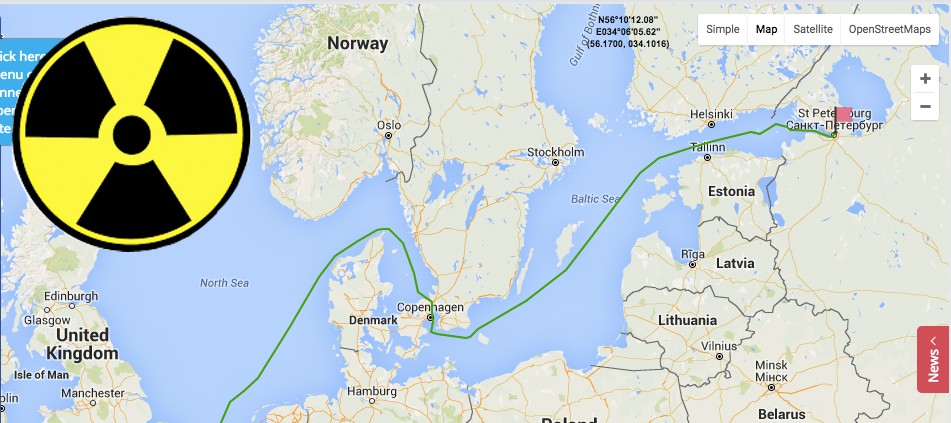
Voyage route across Scandinavian waters confirmed

Director of Norway’s Radiation Protection Authorities, Ole Harbitz, confirms in an SMS to the Independent Barents Observer that the cargo is en route to St. Petersburg.

It was U.S. Secretary of State, John Kerry, who in a statement on December 28 confirmed that the shipment takes place on board the vessel “Mikhail Dudin”, The New York Times reported.

Kerry said the cargo includes the uranium that is closest to bomb-grade quality, enriched to 20 percent purity.

The agreement, where Norway played a key role, can in the longer run indirectly open for increased transport of highly radioactive spent nuclear fuel along the coast of Norway to the Arctic.

With the deal ensuring no nuclear weapons projects can continue, Iran can again continue to expand its civilian nuclear energy program.

More spent nuclear fuel to sail outside Norway

Simultaneously as Norway in secret assisted with the transportation of natural uranium to Iran, Russia started to construct two more civilian nuclear reactors at existing Russian built Bushehr nuclear power plant. The plant will get uranium fuel from Russia.

That fuel will later have to be shipped back to Russia.

Currently, Murmansk on Russia’s Arctic Barents Sea coast is the port used to take back spent nuclear fuel arriving from other countries. Over the last three years, several shipments of spent nuclear fuel from Soviet built research reactors in Europe have been sailed back to Russia along the coast of Norway to Murmansk. Like in September 2014, when “Mikhail Dudin” secretly transported a load of highly enriched uranium from Poland to the Atomflot base north of Murmansk.

St. Petersburg is the port used when other kinds of radioactive material, like the enriched uranium from Iran, are imported back to Russia.

Back to Russia for reprocessing

Iran is not the only country where Russia’s state nuclear corporation Rosatom will built new nuclear reactors. Deals are signed or under negotiations with China, India and Vietnam. From China, spent nuclear fuel in return to Russia can be sent by railway, but all shipments from Iran, India and Vietnam will have to go by sea.

Rosatom is currently building 19 reactors abroad and has increased its foreign contracts by 60 percent over the last two years to $66,5 billion.

Uranium fuel is normally in the reactors for 3-4 years before being replaced. Then, the fuel will have to be cooled for some years in an on-site pool before it can be transported back to Russia for reprocessing.

The reason why Murmansk is used as import harbor for spent nuclear fuel is because of its suitable infrastructure for loading the special designed containers directly from vessels to railway wagons at Atomflot, the repair base for Russia’s fleet of civilian nuclear icebreakers. From Murmansk, the wagons take the uranium fuel to the Mayak plant north of Chelyabinsk in the South Urals where Russia has its reprocessing plant.

Anyone still trusting all of this years later? Anyone?


High-End Russian Frigate in Cuba, Why?

This advanced warship is using docking space formerly used by the U.S. cruise lines of Carnival and Norwegian.  The Russian frigate has an arctic port of Severomorsk and is part of the Northern fleet. Cuba gave a 21 gun salute greeting to the arrival. Remember too, that several weeks ago, Russia dispatched a pair of Tu-160 strategic bombers to Venezuela. Gotta wonder if this Russian frigate will make the next stop in Venezuela…

Military and Commercial Technology: "Admiral Gorshkov" project 22350 undergoing a final testing ...

A U.S. destroyer is off the coast of Havana, Cuba, shadowing a detachment of Russian naval ships that includes one of the country’s most advanced surface ships, USNI News has verified.

As of Tuesday morning, Arleigh Burke-class guided-missile destroyer USS Jason Dunham (DDG-109) was roughly 50 nautical miles north of Havana and about 72 miles from Key West, Fla., operating in the Straits of Florida, according to publicly available ship location data reviewed by USNI News.

A day earlier, Russia’s first-in-class frigate Admiral Gorshkov arrived in Havana. Admiral Gorshkov was joined by support vessel Elbrus and salvage tug Nikolay Chiker, according to several media reports.

Navy officials told USNI News they were aware of the Russian detachment’s arrival in Cuba and were monitoring its activities. The same officials referred USNI News to U.S. Northern Command for more information on Dunham.

In a statement provided to USNI News on Wednesday morning, NORTHCOM said, “We are aware of the deployment of the Russian ship Gorshkov and are taking steps to actively track it. We won’t discuss all measures being taken, but NORAD is conducting air operations in defense of the U.S. and Canada and USNORTHCOM has deployed maritime assets to track Gorshkov.”

The first-in-class Admiral Gorshkov departed its homeport of Severomorsk, on the Barents Sea, on Feb. 26. This around-the-world cruise is the ship’s first significant deployment, according to a Russian Navy statement. Admiral Gorshkov made port calls to Djibouti, Sri Lanka and China. The frigate also visited Ecuador before passing through the Panama Canal, according to the Russian Navy.

The Russian Navy did not release information about Admiral Gorshkov’s visit to Cuba, only stating that “the Russian ships will continue to perform tasks in accordance with the long-range cruise plan and make business calls to the ports of some island states in the region.”

During the past decade, Russian naval ships have periodically visited Cuba, according to several media accounts, including a post from PBS News Hour

In the last several years, the Russian signals intelligence ship Viktor Leonov also has visited Cuba.

The Admiral Gorshkov class of frigates has a displacement of 4,500 tons, a top speed of 29 knots and a crew of about 210, according to an account posted on English-language Russian news site RT Sputnik. The ship features a modern Russian vertical launch system and a variety of anti-ship and land-attack missiles that parallel capabilities of modern U.S. and allied surface combatants.

The ship is the first of a new generation of Russian Navy surface ships that have been developed since the end of the Cold War. Russian surface forces have lagged behind their submarine counterparts, with limited deployments of surface action groups relative to submarines.

***

The ship is the first in class of new blue water frigates for the VMF, according to Vice Admiral Viktor Bursuk, deputy chief of naval armaments. “We will operate four Gorshkov-class surface combatants,” he said.

The Admiral Gorshkov has a full displacement of 5,400 tonnes, a length of 135 m, a beam of 16 m, and a draft of 4.5 m. Its armament suite comprises 16 3M55 Oniks anti-ship missiles (ASMs) or 3M54/3M14 Kalibr ASMs/land attack missiles, a 9K96 Poliment-Redut naval air defence system, an RPK-9 anti-submarine rocket launcher, two 3M89 Palash close-in weapon systems, and an A-192 130 mm naval gun. The frigate also carries a Ka-27PL anti-submarine helicopter. The Admiral Gorshkov is powered by a combined diesel and gas turbine engine, producing a maximum speed of 30 kt. The ship has a range of 4,500 n miles and an endurance of 30 days. It has a crew of 180-210.

A military source told Jane’s the Admiral Gorshkov has already been assigned to the Northern Fleet’s 43rd Missile Ship Division.

Jane’s has also learned that sea trials of the second Project 22350 frigate, Admiral Kasatonov , are scheduled for late 2018.

The source also reported that the Severnoye Design Bureau (SPKB) started design work on the upgraded Project 22350M frigate in 2018. “The navy is planning to build a larger series of modernised [Project 22350] ships and to receive the first upgraded frigate in 2026,” the source said.

Could there be a Real Uprising Against Putin in the Making?

Several events going on regarding Russia. The Russia Desk at CIA and the U.S. State Department must be real busy about now. Why? Could the United States and international friends be encouraging some of these items? One cannot overlook the fact that Russia continues to bomb Syria and then well, we have Russia still embedding itself in Venezuela….but read on…some interesting items below.

  1. Jon Huntsman is expected to leave his role as U.S. ambassador to Russia this year ahead of a potential bid to be Utah’s next governor, The Atlantic reported Monday.Four sources familiar with the situation told the magazine that Huntsman is more seriously considering the job, which he already held from 2004 to 2009, than he previously had been.

    “It’s not idle chatter,” Chuck Warren, a Republican consultant who served as Huntsman’s campaign manager during his first bid for governor, told The Atlantic. “He’s seriously considering it.”

  2. Yet another mock gravestone bearing the name and image of President Vladimir Putin has appeared in Russia — this time in the southwestern city of Voronezh.”Incredible thief and liar. Political corpse,” read the accompanying text featuring Putin’s surname, initials, and birth year, and listing 2019 as the year of death.

    Soon after that a mock gravestone emerged in Moscow, and a third in Berlin. On April 3, activists placed one opposite the famed St. Isaac’s Cathedral in St. Petersburg, garnering widespread attention.

    Agit Rossia has taken responsibility for at least some of the gravestones. In an interview with Meduza in April, spokesman Grigory Kudryavtsev said the group was created to “fill a niche” left behind by the lack of street protests in Russia.

    photo 

  3. Vladimir Putin’s decision to offer Russian citizenship to those living in Russian-occupied portions of Ukraine and possibly others as well may be intended not only to extend Russian power over that country further but also to help solve Russia’s demographic collapse, according to a Russian blogger who writes under the screen name “Ded Moroz” [Grandfather Frost].He suggests that the extremely negative demographic figures of recent months mean that “the massive distribution of passports may be the only way to save [Russia] from withering away altogether” (cont.ws/@Ded-Moroz/1310165 reposted at newizv.ru).

    If Russian government claims that 86 percent of the population in Russian-occupied portions of the Donbas are correct, this policy would immediately produce some two million new Russian citizens and be a boost to the country’s total population.

    Many analysts had concluded that the declining number of women in the prime child-bearing ages and declining birthrates present Russia with an almost intractable problem especially given that the number of immigrants has fallen sharply, Grandfather Frost says. But it turns out that this all can be solved not just by falsification of demographic data but by “the stroke of a pen.” Complete summary here.

  4. Ukraine is still under military attack by Russia.

    Russia’s hybrid military forces on June 9 mounted 26 attacks on Ukrainian army positions in Donbas, eastern Ukraine. “In eight instances, they used the weapons banned by the Minsk agreements – 122mm artillery systems, 120mm and 82mm mortars,” the press center of Ukraine’s Joint Forces Operation said on Facebook in an update as of 07:00 Kyiv time on June 10, 2019.

    Russia-led forces also used weapons installed on infantry fighting vehicles, anti-tank missile systems, grenade launchers of various types, heavy machine guns, and small arms. Under attack were Ukrainian positions near the town of Avdiyivka, as well as near the villages of Vodiane, Talakivka, Pavlopil, Hnutove, Verkhniotoretske, Pisky, Berezove, Nevelske, Novo-Oleksandrivka, Zaitseve, and Novoluhanske.

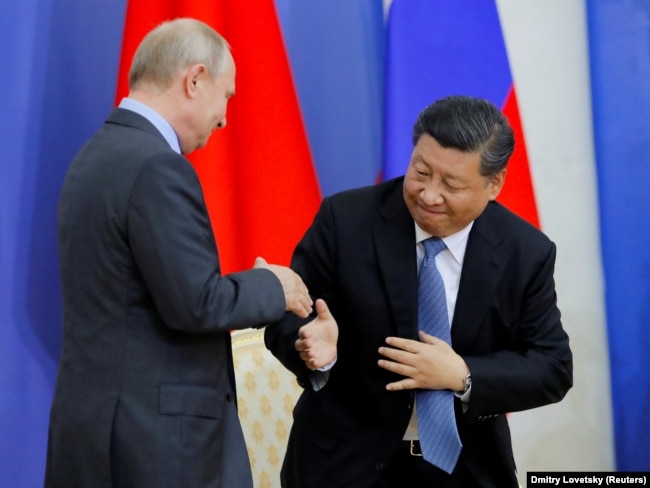
    *** There is more but now it stands to reason that since Europe has joined the United States by pushing back on countless items of Russian aggression, it is no wonder Putin is looking for a deeper relationship with China, both for sure rogue nations that are in a hybrid war against the United States. Putin was not invited to any of the D-Day events so he met with Xi Jinping and they declared the best of friendships.Putin’s message got a boost, if a superficial one, from Xi, who called him “my best friend” and presented a pair of pandas – Ru Yi and Ding Ding – that China is loaning Russia for 15 years for what was described as a joint research project.

    In what seems like some sort of metaphor for Russia’s lopsided relationship with China, whose economy is nearly 10 times the size of Russia’s, state news agency TASS reported that the pandas will remain the property of the Chinese government “and their offspring, if any, will also belong to China.”

    And Putin’s message at the forum was undermined by a warning from longtime former Finance Minister Aleksei Kudrin, who suggested that Calvey’s arrest in February was behind a doubling of capital flight from Russia, which he said reached $40 billion so far this year. Chinese President Xi Jinping (right) and Russian President Vladimir Putin at the St. Petersburg International Economic Forum in St. Petersburg on June 6.


  5. Meanwhile, there has been almost no reporting of the near purposeful collision of a Russian destroyer with a U.S. Navy cruiser.USS Chancellorsville (CG-62) was attempting to recover a helicopter when it was approached by a Udaloy-class destroyer at about 11:45 a.m. local time, according to a Friday statement from 7th Fleet.“While Chancellorsville was recovering its helicopter on a steady course and speed when the Russian ship DD572 maneuvered from behind and to the right of Chancellorsville accelerated and closed to an unsafe distance of ~50-100 feet. This unsafe action forced Chancellorsville to execute all engines back full and to maneuver to avoid collision,” read the statement.

The Friday incident in the Pacific follows an unsafe aircraft interaction between a U.S. Navy P-8A Poseidon and a Russian Sukhoi Su-35 fighter. By the way, notice towards the end of the video where the Russian sailors are on the stern sunbathing… More here.

Hey Social Media, Here Comes Anti-Trust Scrutiny

It has started with Google and this site has warned users of the Internet to stop using Google for years for various reasons. Now there are more. Oh, the Department of Justice may not stop with Google, so watch out Facebook, Yahoo News, Apple, Amazon and Twitter. Why?

Have you noticed how twisted news stories are? Have you noticed selective search engine results? Have you noticed search intrusions? Have you noticed censorship that may affect politics, truths or even voting habits?

How to Become a Social Media Marketing Pro for Less Than ...

Well, it begins with these social media/tech companies stopping competition, free speech and lying by omission. Reliance on these investigative activities begin with the Sherman Anti-Trust Act. This is a law where the Federal government opposes monopolies when it comes to contracts, trade and commerce. Add in the Federal Trade Commission Act and consider the timing as we move towards the 2020 General Election(s).

A short definition of the Antitrust Laws is found here.

In part from C-Net:

The move by the Justice Department comes as Google and other Silicon Valley giants face renewed antitrust scrutiny in the United States. Sen. Elizabeth Warren, a Democratic 2020 presidential candidate, has made it a key part of her platform to break up the big tech companies, including Google, Facebook and Amazon. Earlier this month, Chris Hughes, a Facebook co-founder, also called for the breakup of the company he helped create.

In February 2018, President Donald Trump had signaled via his Federal Trade Commission leadership choice that he was open to investigating big tech companies.

Former US Attorney General Jeff Sessions last September reportedly met with state attorneys general to discuss whether Google and Facebook could be suppressing conservative views, after forming a task force to look into problems in the tech industry. However, once Sessions stepped down in November, the plan to follow up with the Justice Department was shelved.

The Journal report follows reports in March that Google could be facing an investigation over violations of antitrust or consumer protection regulations.

Google has also faced antitrust pressures from regulators in Europe. In March, the search giant was hit with a $1.7 billion fine from the European Commission for “abusive” online ad practices. The Commission said Google exploited its dominance by restricting its rivals from placing their search ads on third-party websites.

Last year, the EU’s executive arm fined Google a record $5 billion for unfair business practices around Android, its mobile operating system. The investigation focused on Google’s deals with phone manufacturers, requiring them to preload specific Google apps and services onto Android phones. After the EU announced the fine, Trump tweeted, “I told you so.”

***

Earlier Monday, the Wall Street Journal reported that the Federal Trade Commission will examine how Facebook’s practices affect digital competition. The Washington Post reported over the weekend that Amazon has come under heightened scrutiny by U.S. regulators. And on Friday, the Journal reported that the Justice Department is preparing a probe of Google, sending shares of parent company Alphabet down more than 7% Monday.

The possible Apple probe is linked to the Google probe, Reuters reported, and stems from meetings between the DOJ and the FTC.

The headlines together paint a daunting picture for Silicon Valley and the stock market’s most valuable companies. Big tech has long faced scrutiny from European regulators, but has so far shrugged off calls for government regulation in the U.S.

Apple has drawn increased criticism in recent months for what some — including streaming giant Spotify — see as anti-competitive behavior in the App Store. Apple owns and operates the online marketplace, collecting subscription fees from developers.

The so-called “Apple tax” accounts for a sizable percentage of Apple’s burgeoning services revenue segment, but draws the ire of developers who, in some cases, compete with Apple’s own apps in the store.

Spotify’s EU complaint against Apple, filed in March, is pending investigation by European authorities. More here.