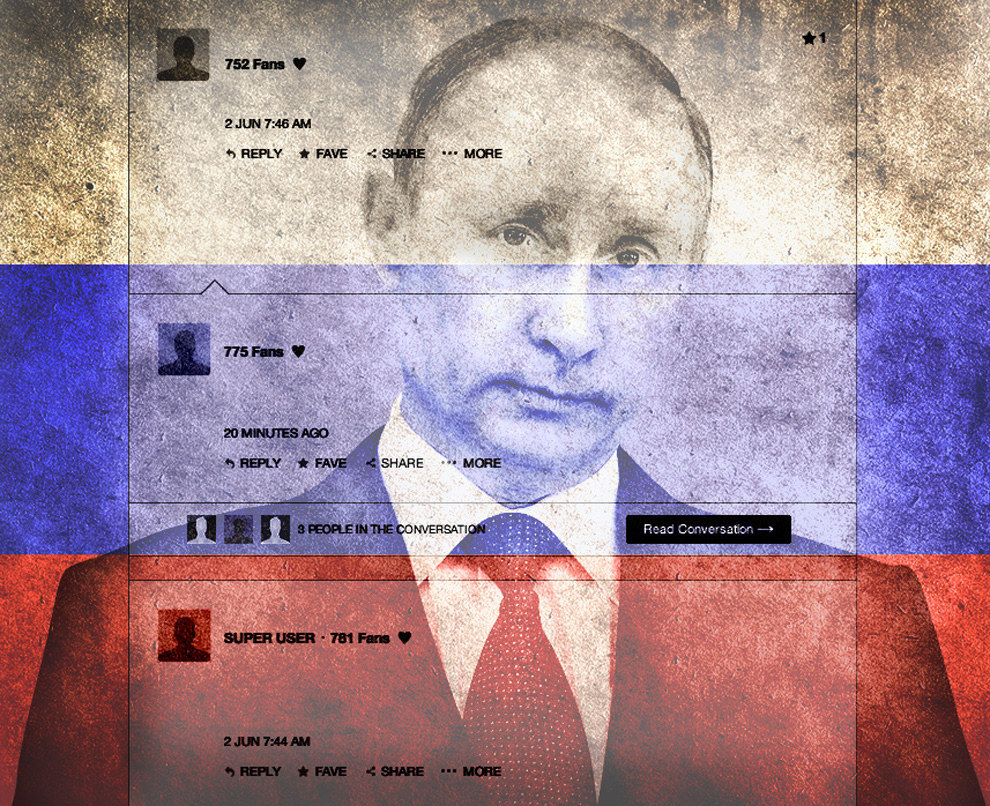
Russian Troll Operations Continue, What are You Reading?

This website wrote about the Russian KGB propaganda model almost a year ago. Even with some sunlight on the topic and exposure to the Kremlim troll operations, it continues and it reaches to some of the most popular websites in America. What is worse, the postings and comments often found on Facebook (Fakebook) come from readers thinking they ‘get-it’ when in fact, those trolls check a box designed as effective propaganda as truth.

C’mon America, not everything you read on websites across the internet is true or well researched. Even that ever popular news aggregator Drudge has fallen victim to advancing falsehoods and baseless opinions.

Documents Show How Russia’s Troll Army Hit America

The adventures of Russian agents like The Ghost of Marius the Giraffe, Gay Turtle, and Ass — exposed for the first time.

by:  

 Justine Zwiebel / BuzzFeed ID: 3053356

Russia’s campaign to shape international opinion around its invasion of Ukraine has extended to recruiting and training a new cadre of online trolls that have been deployed to spread the Kremlin’s message on the comments section of top American websites.

Plans attached to emails leaked by a mysterious Russian hacker collective show IT managers reporting on a new ideological front against the West in the comments sections of Fox News, Huffington Post, The Blaze, Politico, and WorldNetDaily.

The bizarre hive of social media activity appears to be part of a two-pronged Kremlin campaign to claim control over the internet, launching a million-dollar army of trolls to mold American public opinion as it cracks down on internet freedom at home.

“Foreign media are currently actively forming a negative image of the Russian Federation in the eyes of the global community,” one of the project’s team members, Svetlana Boiko, wrote in a strategy document. “Additionally, the discussions formed by comments to those articles are also negative in tone.

“Like any brand formed by popular opinion, Russia has its supporters (‘brand advocates’) and its opponents. The main problem is that in the foreign internet community, the ratio of supporters and opponents of Russia is about 20/80 respectively.”

The documents show instructions provided to the commenters that detail the workload expected of them. On an average working day, the Russians are to post on news articles 50 times. Each blogger is to maintain six Facebook accounts publishing at least three posts a day and discussing the news in groups at least twice a day. By the end of the first month, they are expected to have won 500 subscribers and get at least five posts on each item a day. On Twitter, the bloggers are expected to manage 10 accounts with up to 2,000 followers and tweet 50 times a day.

They are to post messages along themes called “American Dream” and “I Love Russia.” The archetypes for the accounts are called Handkerchief, Gay Turtle, The Ghost of Marius the Giraffe, Left Breast, Black Breast, and Ass, for reasons that are not immediately clear.

According to the documents, which are attached to several hundred emails sent to the project’s leader, Igor Osadchy, the effort was launched in April and is led by a firm called the Internet Research Agency. It’s based in a Saint Petersburg suburb, and the documents say it employs hundreds of people across Russia who promote Putin in comments on Russian blogs.

Osadchy told BuzzFeed he had never worked for the Internet Research Agency and that the extensive documents — including apparent budgeting for his $35,000 salary — were an “unsuccessful provocation.” He declined to comment on the content of the leaks. The Kremlin declined to comment. The Internet Research Agency has not commented on the leak.

Definitively proving the authenticity of the documents and their authors’ ties to the Kremlin is, by the nature of the subject, not easy. The project’s cost, scale, and awkward implementation have led many observers in Russia to doubt, however, that it could have come about in any other way.

“What, you think crazy Russians all learned English en masse and went off to comment on articles?” said Leonid Bershidsky, a media executive and Bloomberg View columnist. “If it looks like Kremlin shit, smells like Kremlin shit, and tastes like Kremlin shit too — then it’s Kremlin shit.”

Despite efforts to hire English teachers for the trolls, most of the comments are written in barely coherent English. “I think the whole world is realizing what will be with Ukraine, and only U.S. keep on fuck around because of their great plans are doomed to failure,” reads one post from an unnamed forum, used as an example in the leaked documents.

The trolls appear to have taken pains to learn the sites’ different commenting systems. A report on initial efforts to post comments discusses the types of profanity and abuse that are allowed on some sites, but not others. “Direct offense of Americans as a race are not published (‘Your nation is a nation of complete idiots’),” the author wrote of fringe conspiracy site WorldNetDaily, “nor are vulgar reactions to the political work of Barack Obama (‘Obama did shit his pants while talking about foreign affairs, how you can feel yourself psychologically comfortable with pants full of shit?’).” Another suggested creating “up to 100” fake accounts on the Huffington Post to master the site’s complicated commenting system.

WorldNetDaily told BuzzFeed it had no ability to monitor whether it had been besieged by an army of Russian trolls in recent weeks. The other outlets did not respond to BuzzFeed’s queries.

Some of the leaked documents also detail what appear to be extensive efforts led by hundreds of freelance bloggers to comment on Russian-language sites. The bloggers hail from cities throughout Russia; their managers give them ratings based on the efficiency and “authenticity,” as well as the number of domains they post from. Novaya Gazeta, Russia’s only independent investigative newspaper, infiltrated its “troll farm” of commenters on Russian blogs last September.

Russia’s “troll army” is just one part of a massive propaganda campaign the Kremlin has unleashed since the Ukrainian crisis exploded in February. Russian state TV endlessly asserts that Kiev’s interim government is under the thumb of “fascists” and “neo-Nazis” intent on oppressing Russian-speaking Ukrainians and exerts a mesmerizing hold on many in the country’s southeast, where the channels are popular. Ukraine has responded by banning all Russian state channels, barring entry to most Russian journalists, and treats some of the more obviously pro-rebel Russian reporters as enemy combatants.

The trolling project’s finances are appropriately lavish for its considerable scale. A budget for April 2014, its first month, lists costs for 25 employees and expenses that together total over $75,000. The Internet Research Agency itself, founded last summer, now employs over 600 people and, if spending levels from December 2013 to April continue, is set to budget for over $10 million in 2014, according to the documents. Half of its budget is earmarked to be paid in cash.

Two Russian media reports partly based on other selections from the documents attest that the campaign is directly orchestrated by the Kremlin. Business newspaper Vedomosti, citing sources close to Putin’s presidential administration, said last week that the campaign was directly orchestrated by the government and included expatriate Russian bloggers in Germany, India, and Thailand. Novaya Gazeta claimed this week that the campaign is run by Evgeny Prigozhin, a restaurateur who catered Putin’s re-inauguration in 2012. Prigozhin has reportedly orchestrated several other elaborate Kremlin-funded campaigns against opposition members and the independent media. Emails from the hacked trove show an accountant for the Internet Research Agency approving numerous payments with an accountant from Prigozhin’s catering holding, Concord.

Several people who follow the Russian internet closely told BuzzFeed the Internet Research Energy is only one of several firms believed to be employing pro-Kremlin comment trolls. That has long been suspected based on the comments under articles about Russia on many other sites, such as Kremlin propaganda network RT’s wildly successful YouTube channel. The editor of The Guardian’s opinion page recently claimed that the site was the victim of an “orchestrated campaign.”

Russian-language social networks are awash with accounts that lack the signs of real users, such as pictures, regular posting, or personal statements. These “dead souls,” as Vasily Gatov, a prominent Russian media analyst who blogs at Postjournalist, calls them, often surface to attack opposition figures or journalists who write articles critical of Putin’s government.

The puerility of many of the comments recalls the pioneering trolling of now-defunct Kremlin youth group Nashi, whose leaders extensively discussed commenting on Russian opposition websites in emails leaked by hackers in 2012. Analysts say Timur Prokopenko, former head of rival pro-Putin youth group Young Guard, now runs internet projects in the presidential administration.

“These docs are written in the same style and keep the same quality level,” said Alexei Sidorenko, a Poland-based Russian developer and net freedom activist. “They’re sketchy, incomplete, done really fast, have tables, copy-pastes — it’s the standard of a regular student’s work from Russian university.”

The group that hacked the emails, which were shared with BuzzFeed last week and later uploaded online, is a new collective that calls itself the Anonymous International, apparently unrelated to the global Anonymous hacker movement. In the last few months, the group has shot to notoriety after posting internal Kremlin files such as plans for the Crimean independence referendum, the list of pro-Kremlin journalists whom Putin gave awards for their Crimea coverage, and the personal email of eastern Ukrainian rebel commander Igor Strelkov. None of the group’s leaks have been proven false.
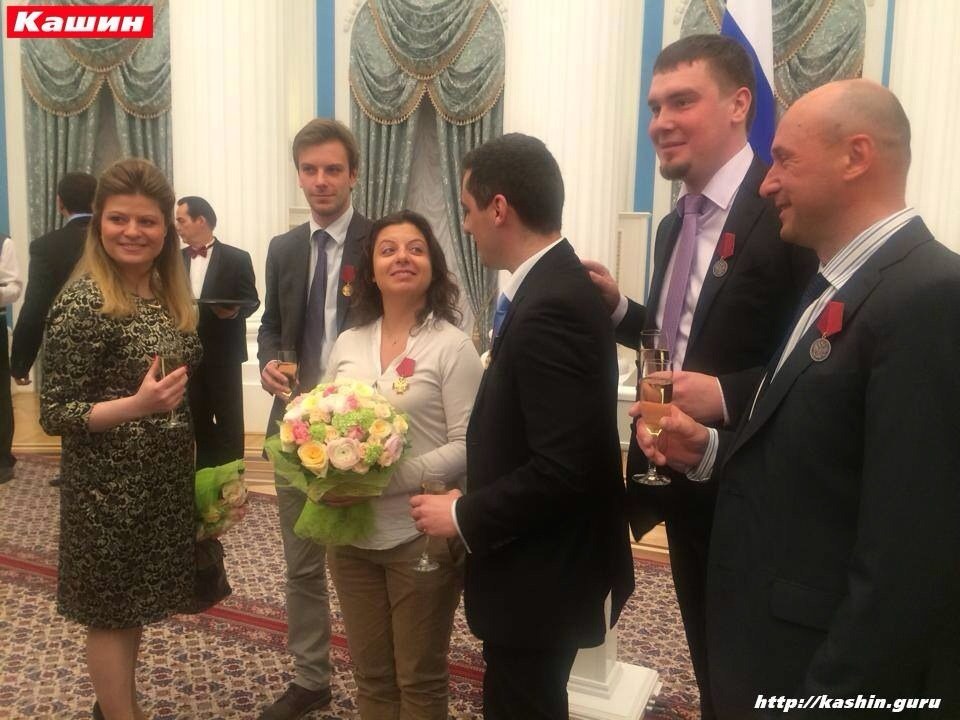
 Russia Today editor Margarita Simonyan was among the journalists whom Putin gave awards for their favorable coverage of the Crimean crisis. Via kashin.guru ID: 3053393

In email correspondence with BuzzFeed, a representative of the group claimed they were “not hackers in the classical sense.”

“We are trying to change reality. Reality has indeed begun to change as a result of the appearance of our information in public,” wrote the representative, whose email account is named Shaltai Boltai, which is the Russian for tragic nursery rhyme hero Humpty Dumpty.

The leak from the Internet Research Agency is the first time specific comments under news articles can be directly traced to a Russian campaign.

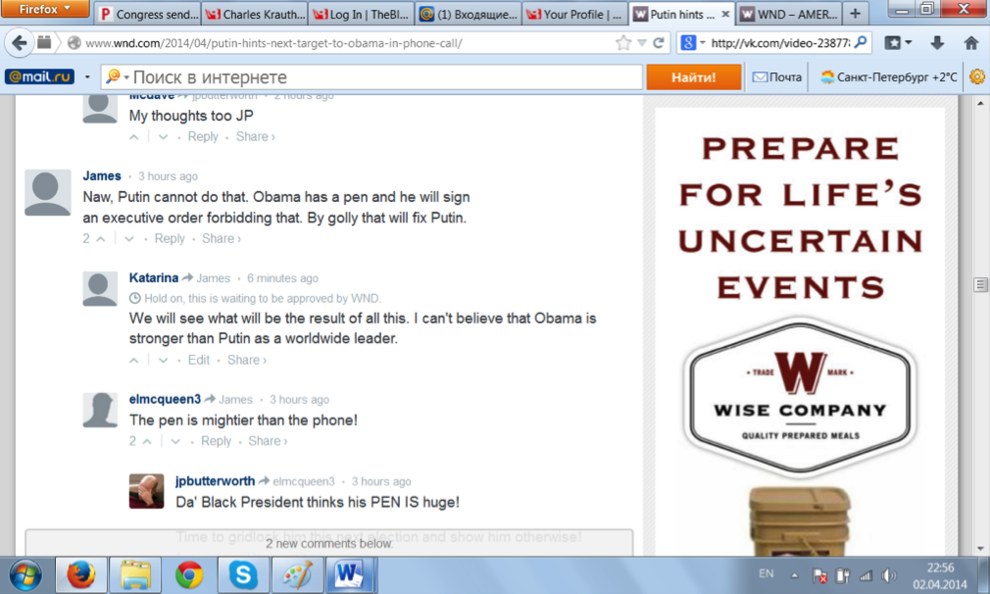
Katarina Aistova, a 21-year-old former hotel receptionist, posted these comments on a WorldNetDaily article.
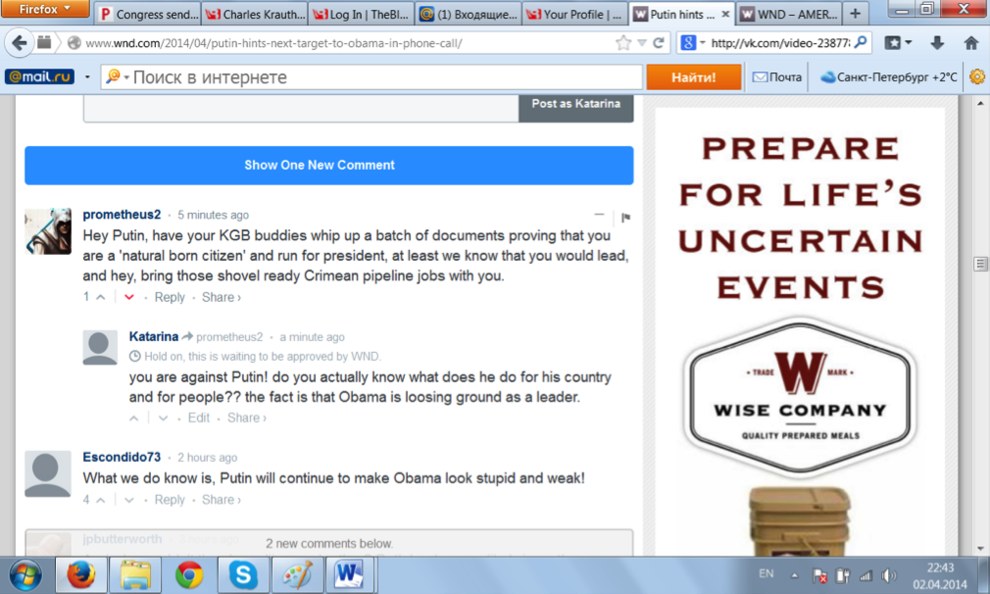
ID: 3048806

Kremlin supporters’ increased activity online over the Ukraine crisis suggests Russia wants to encourage dissent in America at the same time as stifling it at home. The online offensive comes on the heels of a series of official laws and signals clearly suggesting Russia wants to tighten the screws on its vibrant independent web. In the last 30 days alone, Putin claimed the internet was and always had been a “CIA project” and then signed a law that imposes such cumbersome restrictions on blogs and social media as to make free speech impossible.

“There’s no paradox here. It’s two sides of the same coin,” Igor Ashmanov, a Russian internet entrepreneur known for his pro-government views, told BuzzFeed. “The Kremlin is weeding out the informational field and sowing it with cultured plants. You can see what will happen if they don’t clear it out from the gruesome example of Ukraine.”

Gatov, who is the former head of Russia’s state newswire’s media analytics laboratory, told BuzzFeed the documents were part of long-term Kremlin plans to swamp the internet with comments. “Armies of bots were ready to participate in media wars, and the question was only how to think their work through,” he said. “Someone sold the thought that Western media, which specifically have to align their interests with their audience, won’t be able to ignore saturated pro-Russian campaigns and will have to change the tone of their Russia coverage to placate their angry readers.”

Pro-Russian accounts have been increasingly visible on social networks since Ukraine’s political crisis hit fever pitch in late February. One campaign, “Polite People,” promoted the invasion of Crimea with pictures of Russian troops posing alongside girls, the elderly, and cats. Russia’s famously internet-shy Foreign Ministry began to viciously mock the State Department’s digital diplomacy efforts. “Joking’s over,” its Facebook page read on April 1.

Other accounts make clear attempts to influence Russian-speaking Ukrainians in the country’s restive southeast. Western officials believe many of the Twitter accounts are operated by Russian secret services. One was removed after calling for and celebrating violent attacks on a bank owned by a virulently anti-Putin Ukrainian oligarch.

“This is similar to media dynamics we observed in the Syrian civil war,” said Matt Kodama, an analyst at the web intelligence firm Recorded Future. “Russian news channels broke stories that seemed tailored-made to reinforce pro-Assad narratives, and then Syrian social media authors pushed them.”

Other documents discuss the issues the Russian commenters run into when arguing with the regular audience on the American news sites, particularly the conservative ones. “Upon examining the tone of the comments on major articles on The Blaze that directly or indirectly cover Russia, we can take note of its negative direction,” the author wrote. “It is notable that the audience of the Blaze responds to the article ‘Hear Alan Grayson Actually Defend Russia’s Invasion of Crimea as a Good Thing,’ which generally gives a positive assessment of Russian actions in Ukraine, extremely negatively.”

But praise can be as problematic as scorn. “While studying America’s main media, comments that were pro-Russian in content were noticed,” the author wrote. “After detailed study of the discussions they contained, it becomes obvious: the audience interprets those comments extremely negatively. Moreover, users of internet resources assume that the comments in questions were either written for ideological reasons, or paid for.”

The documents align with the Kremlin’s new attention to the internet. Putin, who swiftly monopolized control over television after coming to power in 1999 and marginalized dissent to a few low-circulation newspapers, largely left the “Runet” alone during his first two terms in power, allowing it to flourish as a parallel world free of censorship and skewed toward the educated urban middle class. Dmitry Medvedev, Putin’s protégé who was president from 2008–12, made a show of embracing social media, but it never sat well with officials and Putin supporters. The gulf between Medvedev’s transparency drive and Russia’s Byzantine bureaucracy’s reluctance to change only highlighted his impotence, earning him the nickname “Microblogger” for his small stature.
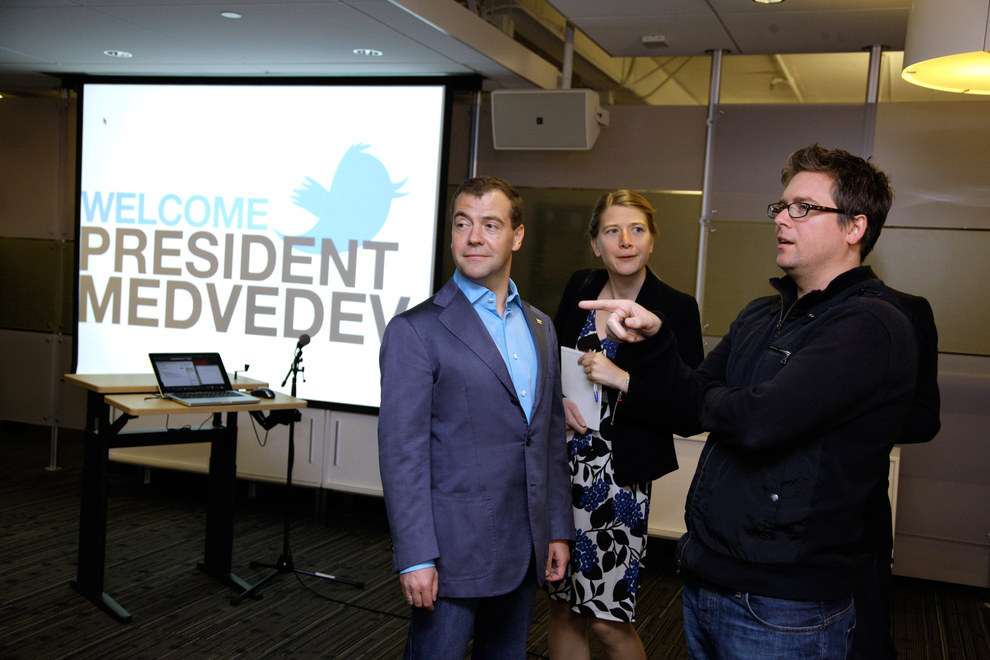
While president, Dmitry Medvedev visited Twitter’s headquarters in Silicon Valley. Dmitry Astakhov / AFP / Getty Images ID: 3053598

“In the best case they looked funny, in the worst, their actions exposed their real motives,” said Katya Romanovskaya, co-author of KermlinRussia, a popular parody account mocking Medvedev’s clumsy efforts. “Twitter is an environment where you can instantly connect with your audience, answer direct questions, and give explanations — which Russian officials are completely incapable of. It goes against their bureaucratic and corrupt nature.”

The current internet crackdown comes after protests by middle-class Muscovites against Putin’s return to the presidency in early 2012, which were largely organized on Facebook and Twitter. All but a few officials have since abandoned the medium and many did so en masse last fall, raising suspicions they did so on Kremlin orders.

“Putin was never very fond of the internet even in the early 2000s,” said Andrei Soldatov, a Russian investigative journalist who specializes in security services and cyber issues. “When he was forced to think about the internet during the protests, he became very suspicious, especially about social networks. He thinks there’s a plot, a Western conspiracy against him. He believes there is a very dangerous thing for him and he needs to put this thing under control.”

Last month, the deputy head of the Kremlin’s telecommunications watchdog said Twitter was a U.S. government tool and threatened to block it “in a few minutes” if the service did not block sites on Moscow’s request. Though the official received a reprimand (as well as a tongue-lashing on Facebook from Medvedev), the statement was widely seen as a trial balloon for expanding censorship. Twitter complied with a Russian request for the first time the following Monday and took down a Ukrainian nationalist account.

A new law that comes into effect in August also forces bloggers with more than 3,000 followers to register with the government. The move entails significant and cumbersome restrictions for bloggers, who previously wrote free of Russia’s complicated media law bureaucracy, while denying them anonymity and opening them up to political pressure.

“The internet has become the main threat — a sphere that isn’t controlled by the Kremlin,” said Pavel Chikov, a member of Russia’s presidential human rights council. “That’s why they’re going after it. Its very existence as we know it is being undermined by these measures.”
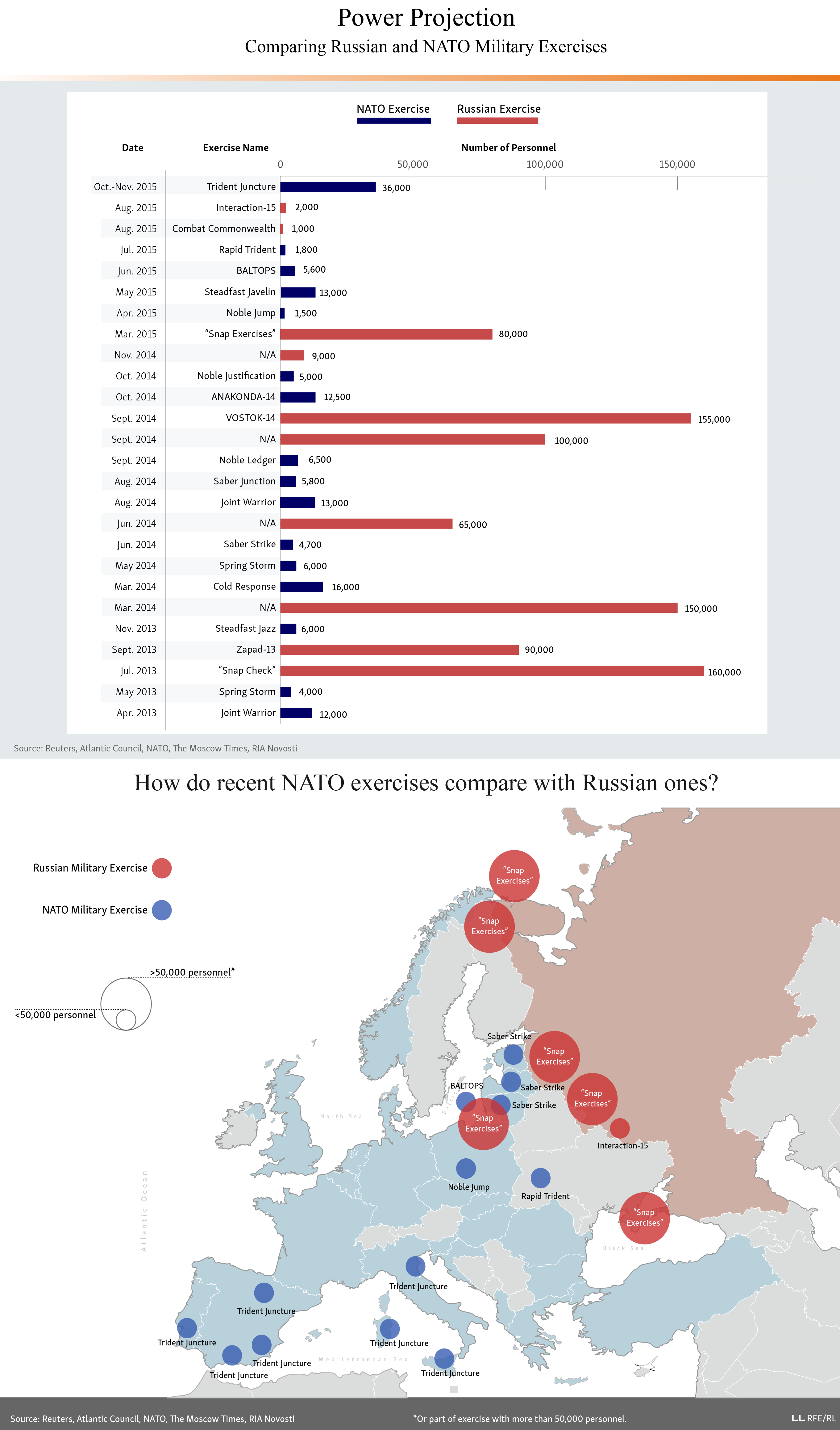
Response to a Russian Attack on Poland and the Baltic States

 Citation: RFEL

*****

Huge NATO Exercise Is a Rehearsal for a Russian Invasion

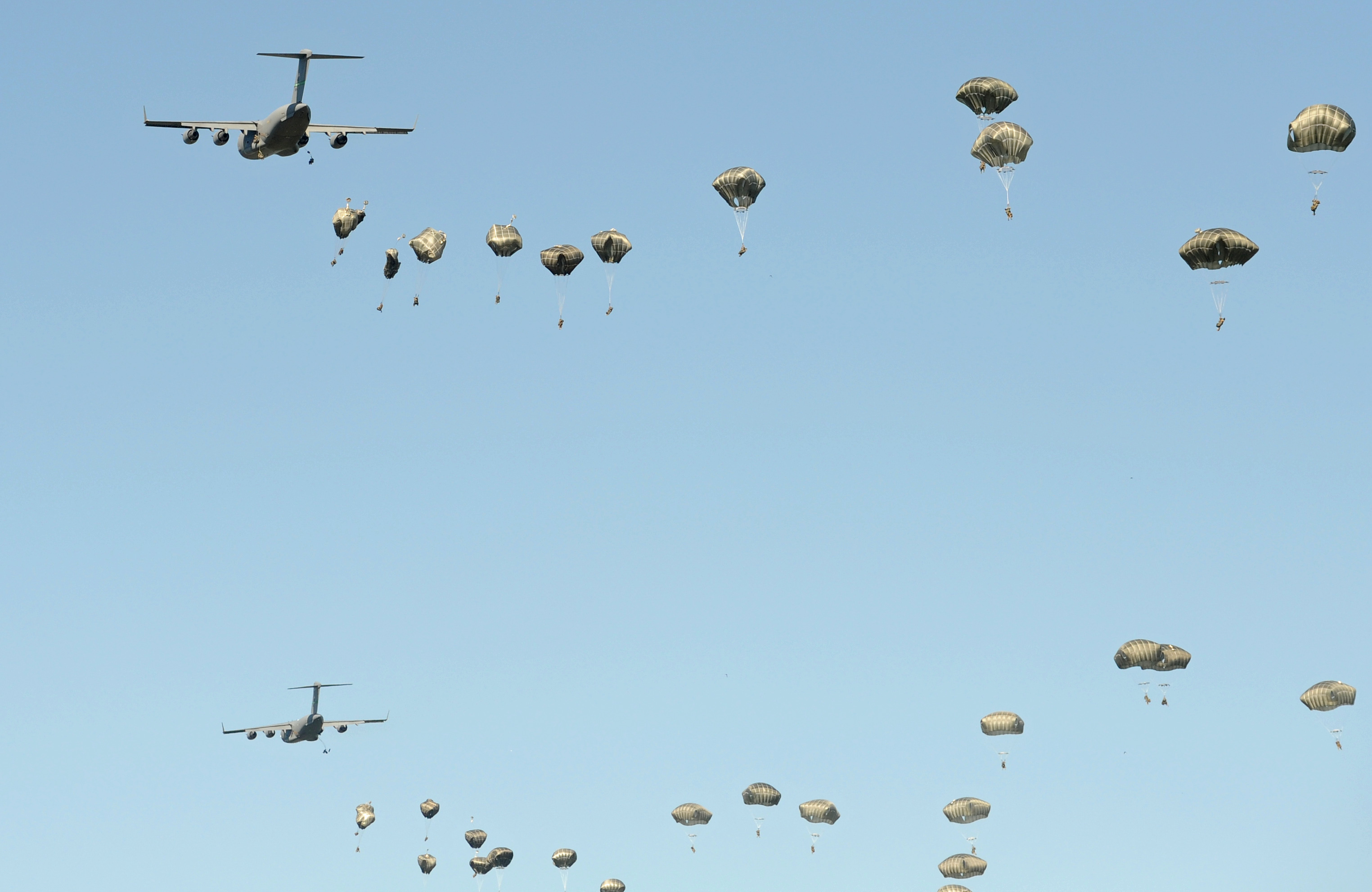
U.S. C-17 planes from the 82nd Airborne Division drop paratroopers during a multi-national jump with soldiers and equipment from the U.S., Great Britain and Poland on to a designated drop zone near Torun, Poland, Tuesday, June 7, 2016. The exercise, Swift Response-16, sets the stage in Poland for the multi-national land force training event Anakonda-16. (AP Photo/Alik Keplicz)

U.S. C-17 planes from the 82nd Airborne Division drop paratroopers during a multinational jump with soldiers and equipment from the U.S., Great Britain and Poland on to a designated drop zone near Torun, Poland, on June 7, 2016. The exercise, Swift Response-16, sets the stage in Poland for the multinational land force training event Anaconda-16. AP

TORUN, Poland — US, British and Polish soldiers parachuted to the ground in Poland on Tuesday in a mass show of force as NATO launched its biggest war games in eastern Europe since the Cold War.

The exercises — staged against the backdrop of a military and diplomatic standoff between Russia and the West — have rattled the Kremlin.

NATO says the 10-day Anaconda maneuvers involving 31,000 troops are intended to shore up security on the alliance’s eastern flank, where member states have been spooked by Russia’s increasingly assertive actions.

“There’s no reason to be nervous,” Ben Hodges, Commanding General, US Army Europe, told reporters, insisting the exercises were purely “defensive”.

They are being held a month ahead of a NATO summit in Warsaw set to seal its largest revamp since the Cold War by deploying more troop rotations to eastern European members deeply wary of Russia after its 2014 annexation of Crimea from Ukraine.

Moscow fiercely opposes the NATO moves, billed by the US-led alliance as part of its “deterrence and dialogue” strategy.

‘Trust deficit’

And the Kremlin reacted angrily to the start of the maneuvers, NATO’s biggest since the Trident drills last year involving 36,000 troops in Italy, Spain and Portugal.

“The exercises… do not contribute to an atmosphere of trust and security,” said spokesman Dmitry Peskov.

“Unfortunately we are still witnessing a deficit in mutual trust.”

Anaconda involves troops from 24 states, including 14,000 from the US, as well as ex-Soviet “Partnership for Peace” states like Ukraine.

US generals in Torun, central Poland, said it took just 24 hours for 500 rapid “Global Response” paratroopers to deploy 4,500 miles (7,200 kilometers) from the world’s largest military base in Fort Bragg, North Carolina.

Russia has long protested at NATO’s expansion in its Soviet-era backyard and in 1997 NATO formally agreed not to install permanent bases in former Warsaw Pact states.

Since the Ukraine conflict erupted in 2014 however, NATO has established a high-speed “spearhead” response force, complete with forward command and logistic centers in eastern states.

The Pentagon said in March it would deploy an additional armored brigade of about 4,200 troops in eastern Europe from early 2017 on a rotational basis.

While NATO cut all practical cooperation with Moscow over the Ukraine crisis, the alliance plans formal talks with the Russians before the July 8-9 summit.

“The Cold War is history and we want it to stay that way,” NATO chief Jens Stoltenberg said last week.

But last month Moscow and Washington accused each other of mounting an aggressive military presence in Europe as the US broke ground on a missile shield in Poland and Romania.

Russia has vowed to “end threats” posed

by the missile system, despite US assurances it is intended to ward of potential attacks by “rogue” states in the Middle East.

Moscow has significantly stepped up its presence in the Baltic Sea area and its jets regularly violate the airspace of smaller ex-Soviet NATO allies like Estonia. In April, they even buzzed a US naval destroyer.

‘Test of wills’

Some analysts question whether NATO’s current strategy — using rotational rather than permanent forces — can secure its eastern flank.

“When push comes to shove, how long will it really take to mobilize at break-neck speed troops in the possibility of a threat of an attack?” Carnegie Europe analyst Judy Dempsey said in an interview with AFP.

“Russian exercises are sophisticated, they’re big, they’re intimidating and look what they’re doing in Kaliningrad,” she said, referring to Moscow’s maneuvers in the Russian enclave sandwiched between Poland and Lithuania.

“It’s like a warning to NATO: ‘don’t forget, we’re right inside NATO territory’.”

The Kremlin has said it would set up three new divisions in the west and south of Russia by the end of the year to counter NATO forces near its border.

Describing the confrontation as “a test of wills”, Dempsey said she believes Moscow’s saber-rattling is ultimately aimed at stopping NATO from encroaching even further into its backyard, with ex-Soviet republics Georgia and Ukraine keen to join the Western alliance.


Mystery Navy Flights to Jam GPS for 1 Month

ZH: Starting today, and continuing for the next month, the FAA has warned airplane pilots that GPS signals on on the West Coast, and especially over California and Nevada, may be impacted.

The reason why is not exactly clear, but as Gizmodo notes, the US military will be testing a device or devices that will potentially jam GPS signals for six hours each day. Officially the tests were announced by the FAA but are centered near the US Navy’s largest installation in the Mojave Desert, China Lake, located “just down the road” from Area 51. The Navy has kept silent about the nature of the tests.

An aerial view of the Naval Air Weapons Station China Lake

As Gizmodo adds, the FAA issued an advisory warning pilots on Saturday that global positioning systems (GPS) could be unreliable during six different days this month, primarily in the Southwestern United States. On June 7, 9, 21, 23, 28, and 30th the GPS interference testing will be taking place between 9:30am and 3:30pm Pacific time. But if you’re on the ground, you probably won’t notice interference.

The dates and times of potential GPS outages per the FAA are shown below:

  • 7 JUN 16 1630Z – 2230Z
  • 9 JUN 16 1630Z – 2230Z
  • 21 JUN 16 1630Z – 2230Z
  • 23 JUN 16 1630Z – 2230Z
  • 28 JUN 16 1630Z – 2230Z
  • 30 JUN 16 1630Z – 2230Z

The testing will be centered on China Lake, California—home to the Navy’s 1.1 million acre Naval Air Weapons Center in the Mojave Desert. The potentially lost signals will stretch hundreds of miles in each direction and will affect various types of GPS, reaching the furthest at higher altitudes. But the jamming will only affect aircraft above 50 feet. As shown in the FAA map below, the jamming will almost reach the California-Oregon border at 4o,000 feet above sea level and 505 nautical miles at its greatest range.

The FAA map showing the GPS jamming that will occur at different altitudes this month

“We’re aware of the flight advisory,” Deidre Patin, Public Affairs specialist for Naval Air Warfare Center Weapons Division told Gizmodo but she couldn’t give any further details about whether there was indeed GPS “jamming,” nor whether it had happened before. Patin added, “I can’t go into the details of the testing, it’s general testing for our ranges.

Embraer Phenom 300 business jets are specifically being told to avoid the area completely during the tests.

THIS NOTAM APPLIES TO ALL AIRCRAFT RELYING ON GPS. ADDITIONALLY, DUE TO GPS INTERFERENCE IMPACTS POTENTIALLY AFFECTING EMBRAER PHENOM 300 AIRCRAFT FLIGHT STABILITY CONTROLS, FAA RECOMMENDS EMB PHENOM PILOTS AVOID THE ABOVE TESTING AREA AND CLOSELY MONITOR FLIGHT CONTROL SYSTEMS DUE TO POTENTIAL LOSS OF GPS SIGNAL.

This means that billionaires flying into Santa Monica will have to find alternative routes in the affected intervals, due to the FAA’s warning that the jamming test could interfere with the business jet’s “aircraft flight stability controls.”

As Gizmodo’s Matt Novak writes, “GPS technology has become so ubiquitous that cheap jamming technology has become a real concern for both military and civilian aircraft. And if we had to speculate we’d say that these tests are probably pulling double duty for both offensive and defensive military capabilities. But honestly, that’s just a guess.”

Readers who have more information on the nature of these tests are welcome to write in or comment. The full FAA Advisory is attached below.

CHLK 16-08 GPS Flight Advisory by zerohedge

SITREP Afghanistan: Taliban, Contractors, Troop Levels

Two members of an NPR news crew, David Gilkey and Zabihullah Tamanna, were killed on Sunday while traveling in southern Afghanistan.

CNN: “They were traveling with an Afghan army unit when the convoy came under fire. Their vehicle was struck by shell fire,” according to a statement by NPR.

Two other NPR crew members, correspondent Tom Bowman and producer Monika Evstatieva, “were in a following vehicle,” NPR head of news Michael Oreskes told CNN. “Tom and Monika were not hurt.”

david gilkey npr

Sunday’s attack marks the first time in the 46-year history of NPR that one of its journalists has been killed on assignment.

Gilkey, 50, was an award-winning staff photographer and video editor for NPR. In the 15 years since the 9/11 attacks, he returned time and time again to Afghanistan and other conflict zones.

“David was profoundly committed to coverage of both Afghanistan and Iraq,” Oreskes said. “He wanted to know what was happening to the people there. I think that’s why he kept going back — because he wanted to understand what was happening to the soldiers and civilians.”

Watchdog: Afghanistan’s lapis lazuli is a ‘conflict mineral’

An international anti-corruption watchdog says Afghanistan’s war is being fueled by the country’s mining sector, with armed groups — including the Taliban — earning $20 million from illegal mining of lapis lazuli.

A report by Global Witness released on Monday says that lapis lazuli, a blue stone almost unique to Afghanistan, should be classified as a “conflict mineral.”


It says the northern Badakhshan province where lapis lazuli is concentrated has been “deeply destabilized” by violent competition for control of the mines between local strongmen, law makers and the Taliban.

Badakhshan is a microcosm of what is happening across Afghanistan, with mining being the Taliban’s second biggest source of income, after drugs.

The Taliban insurgency is in its 15th year.

Afghanistan’s mineral assets are believed to be worth billions of dollars.

How Obama’s Afghanistan plan is forcing the Army to replace soldiers with contractors

WaPo: Current restrictions on U.S. troop levels in Afghanistan and a heavy reliance on civilian contractors are eroding the skills and cohesion of units deployed to the country, according to information from the Army given to the House Armed Services Committee and provided to The Washington Post.

According to an Army document, the use of civilian labor in one of the Army’s combat aviation brigades, or CABs, in Afghanistan has had negative side effects because the contractors are being used in lieu of the brigade’s maintenance soldiers. Those soldiers should be deploying with their units, but are not because of the “constrained troop level environment” in Afghanistan, the document says.

“Aviation maintainers not deploying with their [brigades] results in an erosion of skill and experience essential to soldier and leader development,” Army officials said in the document. “The atrophy of these critical skills erodes the brigade’s ability to deploy in the future and sustain itself in an expeditionary manner to locations that may not permit the deployment of contractors.”

According to the Army document, three CABs have deployed to Afghanistan since 2013 with reduced maintenance staffs. A typical CAB usually deploys with 1,500 soldiers but can swell above 2,500 depending on the mission. In 2013, a brigade deployed with 1,900 troops, but as U.S. forces were reduced in Afghanistan, a brigade of only 800 deployed in 2015. Despite the reduction in troop levels, the brigade was still expected to maintain and fly its roughly 100 aircraft.

Currently, the 4th Infantry Division’s CAB is deployed to Afghanistan and provides “country-wide aviation support,” according to a breakdown of U.S. forces in Afghanistan that was compiled by the Institute for the Study of War. It primarily provides rotor-wing support in the form of helicopter gunships and transports.

According to the Army document, only 6 percent of the 4th’s CAB is dedicated to maintaining aircraft. That small number is specifically for recovering aircraft that land or crash in a hostile environment. Instead, 427 civilian personnel — at a cost of $101 million annually — are maintaining the CAB’s fleet of helicopters. Through 2014 and 2015, 390 contractors maintained both the 101st and 82nd Airborne Divisions’ aircraft for $86 million when their CABs were deployed to Afghanistan.

While U.S.-led combat operations in Afghanistan officially ended in 2014, last fall, as the Taliban gained momentum throughout the country, President Obama agreed to keep about 9,800 U.S. troops in Afghanistan through 2016, and 5,500 into 2017.

Although the troop levels are low compared to the 45,000 deployed at the start of 2014, the number of uniformed service members in Afghanistan is only part of the U.S. war effort there. As of April, 26,000 Pentagon contractors are in Afghanistan, about half of whom are assigned to logistics and maintenance duties, according to publicly available reports.

Although the number of contractors has almost always exceeded the number of uniformed troops in Afghanistan, the ratio of civilian employees compared to U.S. military personnel has more than doubled in the past two years, from 1.34 to 2.92.

“I am not at all convinced that the only units affected are the combat aviation brigades,” Rep. Mac Thornberry (R-Tex.), chairman of the House Armed Services Committee, said in a recent interview. “Aside from financially … is there a potential that it increases the risk that our folks face just because of these political limits? Those questions are certainly worthy of a significant deep dive on the part of the committee.”

***** Obama being asked about force levels:

Washington, DC- Senator Tom Cotton (R-Arkansas) and nine members of the Senate Armed Services Committee sent a letter to President Obama regarding U.S. troop levels in Afghanistan. “A timely decision on U.S. force levels is necessary so that our allies and partners can generate forces and make appropriate pledged for the Resolute Support Mission beginning in January 2017,” the bipartisan group of senators wrote. “We urge you to announce any changes to our current planned force levels ahead of the relevant NATO conferences, giving the strong consideration to the assessment of your military commanders and to conditions on the ground.”

The letter was signed by Senator Tom Cotton (R-AR), Senator John McCain (R-AZ), Chairman of the Armed Services Committee, Senator Joe Manchin (D-WV), Senator Kelly Ayotte (R-NH), Senator Jeanne Shaheen (D-NH), Senator Deb Fischer (R-NE), Senator Joe Donnelly (D-IN), Senator Tim Kaine (D-VA), Senator Lindsey Graham (R-SC), and Senator Angus King (I-ME).

The text of the letter can be found below. Additionally, click here to read the letter.

Dear President Obama:

We appreciate your continued willingness to consider adjustments based on the security situation in Afghanistan to preserve and build upon the hard fought gains achieved over the past 14 years. In recent months, the Senate Armed Services Committee has heard from General Nicholson, General Campbell, and General Votel – the senior military commanders closest to the fight – that the security situation in Afghanistan is deteriorating, which challenges the ability of the Afghan government to provide stability and security for its people.


We understand that General John Nicholson is in the process of completing his assessment of the capabilities and associated troop levels he believes will be necessary in Afghanistan to confront a resurgent Taliban, a reviving Al Qaida, and a rising Islamic State in Iraq and the Levant, and will make recommendations in the near future. As the Commander on the ground, we believe that his recommendations should be given extraordinary weight. We also believe that the withdrawal of U.S. forces from Afghanistan should be based on conditions on the ground and that considerations on troop levels should be driven first by what capabilities are needed to protect our national security interests in Afghanistan, and second by the number of troops it takes to enable those capabilities.

Furthermore, the North Atlantic Treaty Organization (NATO) will hold its Force Generation Conference beginning on June 8th and the NATO Summit in Warsaw will begin on July 8th. It is important that our allies and partners understand any changes to our planned force levels for Afghanistan before those key events to determine and plan for the number of troops they will commit to operations in Afghanistan in 2017. As has long been the case, we believe our NATO Allies and partners will follow our lead in Afghanistan. In February, General Campbell testified to Congress that “If our number continues to go down, NATO will absolutely reduce their commitment to Afghanistan.” Additionally, we do not think we are going to learn anything in the next several months that we do not know now. Should you decide to revise the planned number of U.S. troops in Afghanistan for 2017, we urge you to announce such a decision before the relevant NATO conferences convene and inform our partners and allies of that decision so they can plan accordingly.

In summary, a timely decision on U.S. force levels is necessary so that our allies and partners can generate forces and make appropriate pledges for the Resolute Support Mission beginning in January 2017. We urge you to announce any changes to our current planned force levels ahead of the relevant NATO conferences, giving the strongest consideration to the assessment of your military commanders and to conditions on the ground.

Sincerely,

Senator John McCain

Senator Joe Manchin

Senator Kelly Ayotte

Senator Jeanne Shaheen

Senator Deb Fischer

Senator Joe Donnelly

Senator Tom Cotton

Senator Tim Kaine

Senator Lindsey Graham

Senator Angus King

Does the Kremlin Really Have Hillary’s Emails?

Wouldn’t you love to read the most recent and current emails between Sidney and Hillary right now?

Putin’s Army Of Internet Trolls Is Influencing The Hillary Clinton Email Scandal

The Hillary Clinton email scandal broke more than three years ago—on March 19, 2013—with the Russian news service RT’s publication of Sidney Blumenthal’s emails to the then-Secretary of State. What most American journalists don’t realize is that Putin’s internet army continues to influence the evolution of the story.


My article on the Blumenthal emails, published on the same day, attracted 361,000 viewers, meaning the story was not a secret. The mainstream press ignored the story, only to see it burst upon the 2016 election scene where it occupies daily headlines. As I pointed out in my more recent piece entitled “What if Vladimir Putin Has Hillary’s Emails,” the Clinton campaign and the country could be sorely damaged if Hillary’s emails (including those she deemed “personal”) are in Kremlin hands. Even if they are not, Putin can gain leverage simply from the suspicion that he has them.

Despite the New York Times’ weak assurances that there is “no evidence of hacking,” experts agree, including a former defense secretary and head of the CIA, that Kremlin cyber forces most likely hacked Hillary’s emails, which we now know include a number of top secret documents.

I have been following the Russian and English language blogosphere using Google searches like “Does Putin/the Kremlin have Hillary’s emails?” Included are rumor-mills such as Sovershenno sekretno.ru (“Completely secret”) and kompromat.ru (“Compromising material”). In a country that thrives on gossip and rumors, even on delicate matters such as the murder of Boris Nemtsov, the Russian search yields absolute silence. The Kremlin is holding information about any possession of Hillary’s emails as close to the vest as possible.

Not that the Kremlin is not enjoying Hillary’s discomfort. The FBI investigation, the testimony of the hacker Guccifer, and the release of the state-department Inspector General report are covered daily and with glee. My own Forbes articles are prominently featured. Russia’s information technologists have elevated me from a moronic paid Forbes hack to a distinguished scholar writing for a respected publication. My words seem to count when I suggest that Putin has outsmarted Hillary Clinton.

Contrary to the Russian media silence, the U.S. media began buzzing with the May 6 publication on an obscure conspiracy-oriented website (whatdoesitmean.com) entitled “Kremlin War Erupts over Release of Top Secret Hillary Clinton Emails.” The article, written under the exotic pseudonym of Sorcha Faal, claims that a faction within the Kremlin wants Hillary’s email cache released. Fox News pundits (Sean Hannity and Judge Anthony Napolitano) cited the article as evidence that Putin has the Clinton emails. Their comments were triumphantly and derisively panned by Media Matters, who pointed out that the same website published articles on British jets fighting UFOs and a new planet threatening existence on earth.

Both Fox News and Media Matters, in my view, are both unwitting victims of a classic Putin troll attack. Whereas Washington works on the basis of leaks, Kremlin information technologists first plant their narrative in an obscure blog (like whatdoesitmean.com) and then use its blogosphere network to cascade the story until it reaches more mainstream outlets. In this case, they struck gold with references by major figures on Fox News. With the Kremlin’s psychological operations, no one knows fact from fiction (Is this just some crackpot or the Kremlin?) and first impressions tend to stick, even if the story is proven false.

There are good reasons to believe that a Putin troll attack is at work here.

First, it spins an alternate-world narrative that serves Kremlin interests in a number of ways. The Sorcha Faal article explains to the world that, yes, the Kremlin does have Hillary’s emails, thanks to Russia’s vigilant cyber forces, who obtained them in a perfectly legitimate way. After they detected hacker Guccifer’s attempted hacking of their own RT, they claim to have followed him as he attacked Hillary’s server and ended up coincidently with the cache of Hillary’s emails. The lesson: Russia has good cyber security; the incompetent U.S. does not.

The even more important message is that the CIA, knowing that the Kremlin has damaging secrets (such as the truth of Benghazi), launched a false Panama Papers operation to discredit Putin’s inner circle. The Panama Papers gambit was fabricated as a threat to prevent Russia from revealing the contents of Hillary’s emails. Thus, revelations about financial misdeeds of Putin’s inner circle can be written off as a CIA disinformation counter attack.

The story’s lightning-fast spread through the blogosphere is a second reason for believing in an organized troll attack. Faal’s crazy headline stories that Media Matters derides do not spread through the blogosphere.  Granted that the Clinton email story is hot, its cascading through the internet smells of a planned operation by Putin’s troll army.

In the case of the Clinton emails, the Kremlin appears to be using its classic “Madeline Albright declaration” approach. In the Albright case, an obscure and unidentified blogger, “Natalia 1001,” made the unsubstantiated claim that then Secretary of State, Madeline Albright, had declared that Siberia, with its rich resources, should belong to the United States, not to Russia. This false claim was repeated by multiple sources (including an FSB mind reader) until it has become an integral part of the Putin doctrine that the U.S. is an aggressive power intent on Russia’s demise.

We are no closer to proof of whether Putin has Hillary’s emails or not. What we have is a troll attack that lays out a Kremlin narrative linking the Clinton emails to the Panama Papers. We expect the Kremlin to build on this narrative as time passes. In either case, Putin is sitting in the catbird seat. The mere suspicion that he has the email cache gives him leverage over the U.S. election. Those who argue that Clinton’s use of an insecure private server is a minor dereliction do not understand the consequences of having the Secretary of State’s correspondence in the hands of a hostile nation.

We can expect the Kremlin to use Hillary’s email scandal to its advantage. It is up to Putin to determine the timing, which will be most likely related to the U.S. election cycle. Let’s hope that Donald Trump uses this lesson to retract his favorable comments about Vladimir Putin.