Is the Trump Campaign/GOP Going to Be Hurt By This?

Could this keep the Donald from obtaining security clearance? Will there be some extortion cases as he is the nominee?

This site has published previous articles on Felix Sater knowing there was a potential for some yet unknown Trump history. What is also concerning is the Washington Post has a team looking into Trump’s entire background and they are doing the same with Hillary. The item below was performed by Politico. Further, both Hillary and Donald have huge unfavorable and are beginning to have some parallel dark histories. This is looking bad for the future of who the next president will be but will the electorate on both sides just look the other way, justify their candidate(s) and push them into the Oval Office?

How did we get here?

Just What Were Donald Trump’s Ties to the Mob?

I’ve spent years investigating, and here’s what’s known.

Politico: In his signature book, The Art of the Deal, Donald Trump boasted that when he wanted to build a casino in Atlantic City, he persuaded the state attorney general to limit the investigation of his background to six months. Most potential owners were scrutinized for more than a year. Trump argued that he was “clean as a whistle”—young enough that he hadn’t had time to get into any sort of trouble. He got the sped-up background check, and eventually got the casino license.

Donald Trump, Mayor Ed Koch, and Roy Cohn attend the Trump Tower opening in October 1983.

But Trump was not clean as a whistle. Beginning three years earlier, he’d hired mobbed-up firms to erect Trump Tower and his Trump Plaza apartment building in Manhattan, including buying ostensibly overpriced concrete from a company controlled by mafia chieftains Anthony “Fat Tony” Salerno and Paul Castellano. That story eventually came out in a federal investigation, which also concluded that in a construction industry saturated with mob influence, the Trump Plaza apartment building most likely benefited from connections to racketeering. Trump also failed to disclose that he was under investigation by a grand jury directed by the U.S. attorney in Brooklyn, who wanted to learn how Trump obtained an option to buy the Penn Central railroad yards on the West Side of Manhattan.

Why did Trump get his casino license anyway? Why didn’t investigators look any harder? And how deep did his connections to criminals really go?

These questions ate at me as I wrote about Atlantic City for The Philadelphia Inquirer, and then went more deeply into the issues in a book, Temples of Chance: How America Inc. Bought Out Murder Inc. to Win Control of the Casino Business. In all, I’ve covered Donald Trump off and on for 27 years, and in that time I’ve encountered multiple threads linking Trump to organized crime. Some of Trump’s unsavory connections have been followed by investigators and substantiated in court; some haven’t. And some of those links have continued until recent years, though when confronted with evidence of such associations, Trump has often claimed a faulty memory. In an April 27 phone call to respond to my questions for this story, Trump told me he did not recall many of the events recounted in this article and they “were a long time ago.” He also said that I had “sometimes been fair, sometimes not” in writing about him, adding “if I don’t like what you write, I’ll sue you.”

I’m not the only one who has picked up signals over the years. Wayne Barrett, author of a 1992 investigative biography of Trump’s real-estate dealings, has tied Trump to mob and mob-connected men.

No other candidate for the White House this year has anything close to Trump’s record of repeated social and business dealings with mobsters, swindlers, and other crooks. Professor Douglas Brinkley, a presidential historian, said the closest historical example would be President Warren G. Harding and Teapot Dome, a bribery and bid-rigging scandal in which the interior secretary went to prison. But even that has a key difference: Harding’s associates were corrupt but otherwise legitimate businessmen, not mobsters and drug dealers.

This is part of the Donald Trump story that few know. As Barrett wrote in his book, Trump didn’t just do business with mobbed-up concrete companies: he also probably met personally with Salerno at the townhouse of notorious New York fixer Roy Cohn, in a meeting recounted by a Cohn staffer who told Barrett she was present. This came at a time when other developers in New York were pleading with the FBI to free them of mob control of the concrete business.

From the public record and published accounts like that one, it’s possible to assemble a clear picture of what we do know. The picture shows that Trump’s career has benefited from a decades-long and largely successful effort to limit and deflect law enforcement investigations into his dealings with top mobsters, organized crime associates, labor fixers, corrupt union leaders, con artists and even a one-time drug trafficker whom Trump retained as the head of his personal helicopter service.

Now that he’s running for president, I pulled together what’s known – piecing together the long history of federal filings, court records, biographical anecdotes, and research from my and Barrett’s files. What emerges is a pattern of business dealings with mob figuresnot only local figures, but even the son of a reputed Russian mob boss whom Trump had at his side at a gala Trump hotel opening, but has since claimed under oath he barely knows.

Neither Trump’s campaign spokesperson, Hope Hicks, nor Jason Greenblatt, the executive vice president and chief legal officer at the Trump Organization, responded to several emailed requests for comment on the issues raised in this article.

Here, as close as we can get to the truth, is what really happened.

Anthony 'Fat Tony' Salerno, boss of the Genovese Crime Family, is photographed leaving the U.S. federal courthouse in Manhattan, New York, on February 28, 1985 after his arraignment for two counts of racketeering. | Getty

***

After graduating in 1968 from the University of Pennsylvania, a rich young man from the outer boroughs of New York City sought his fortune on the island of Manhattan. Within a few years Donald J. Trump had made friends with the city’s most notorious fixer, lawyer Roy Cohn, who had become famous as lead counsel to Senator Joseph McCarthy. Among other things Cohn was now a mob consigliere, with clients including “Fat Tony” Salerno, boss of the Genovese crime family, the most powerful Mafia group in New York, and Paul Castellano, head of what was said to be the second largest family, the Gambinos.

This business connection proved useful when Trump began work on what would become Trump Tower, the 58-story high-rise where he still lives when he’s not at his Florida estate.

There was something a little peculiar about the construction of Trump Tower, and subsequent Trump projects in New York. Most skyscrapers are steel girder construction, and that was especially true in the 1980s, says John Cross of the American Iron & Steel Institute. Some use pre-cast concrete. Trump chose a costlier and in many ways riskier method: ready-mix concrete. Ready-mix has some advantages: it can speed up construction, and doesn’t require costly fireproofing. But it must be poured quickly or it will harden in the delivery truck drums, ruining them as well as creating costly problems with the building itself. That leaves developers vulnerable to the unions: the worksite gate is union controlled, so even a brief labor slowdown can turn into an expensive disaster.

Salerno, Castellano and other organized crime figures controlled the ready-mix business in New York, and everyone in construction at the time knew it. So did government investigators trying to break up the mob, urged on by major developers such as the LeFrak and Resnick families. Trump ended up not only using ready-mix concrete, but also paying what a federal indictment of Salerno later concluded were inflated prices for it – repeatedly – to S & A Concrete, a firm Salerno and Castellano owned through fronts, and possibly to other mob-controlled firms. As Barrett noted, by choosing to build with ready-mix concrete rather than other materials, Trump put himself “at the mercy of a legion of concrete racketeers.”

Paul Castellano, boss of the Gambino Crime Family, is photographed arriving for the trial on February 27, 1985 at the U.S. Federal Courthouse in Manhattan, New York City. | Getty

Salerno and Castellano and other mob families controlled both the concrete business and the unions involved in delivering and pouring it. The risks this created became clear from testimony later by Irving Fischer, the general contractor who built Trump Tower. Fischer said concrete union “goons” once stormed his offices, holding a knife to throat of his switchboard operator to drive home the seriousness of their demands, which included no-show jobs during construction of Trump Tower.

But with Cohn as his lawyer, Trump apparently had no reason to personally fear Salerno or Castellanoat least, not once he agreed to pay inflated concrete prices. What Trump appeared to receive in return was union peace. That meant the project would never face costly construction or delivery delays.

The indictment on which Salerno was convicted in 1988 and sent to prison, where he died, listed the nearly $8 million contract for concrete at Trump Plaza, an East Side high-rise apartment building, as one of the acts establishing that S &A was part of a racketeering enterprise. (While the concrete business was central to the case, the trial also proved extortion, narcotics, rigged union elections and murders by the Genovese and Gambino crime families in what Michael Chertoff, the chief prosecutor, called “the largest and most vicious criminal business in the history of the United States.”)

FBI agents subpoenaed Trump in 1980 to ask about his dealing with John Cody, a Teamsters official described by law enforcement as a very close associate of the Gambino crime family. The FBI believed that Cody previously had obtained free apartments from other developers. FBI agents suspected that Cody, who controlled the flow of concrete trucks, might get a free Trump Tower apartment. Trump denied it. But a female friend of Cody’s, a woman with no job who attributed her lavish lifestyle to the kindness of friends, bought three Trump Tower apartments right beneath the triplex where Donald lived with his wife Ivana. Cody stayed there on occasion and invested $500,000 in the units. Trump, Barrett reported, helped the woman get a $3 million mortgage without filling out a loan application or showing financials.

In the summer of 1982 Cody, then under indictment, ordered a citywide strike—but the concrete work continued at Trump Tower. After Cody was convicted of racketeering, imprisoned and lost control of the union, Trump sued the woman for $250,000 for alteration work. She countersued for $20 million and in court papers accused Trump of taking kickbacks from contractors, asserting this could “be the basis of a criminal proceeding requiring an attorney general’s investigation” into Trump. Trump then quickly settled, paying the woman a half-million dollars. Trump said at the time and since then that he hardly knew those involved and there was nothing improper his dealings with Cody or the woman.

***

There were other irregularities in Trump’s first big construction project. In 1979, when Trump hired a demolition contractor to take down the Bonwit Teller department store to make way for Trump Tower, he hired as many as 200 non-union men to work alongside about 15 members of the House Wreckers Union Local 95. The non-union workers were mostly illegal Polish immigrants paid $4 to $6 per hour with no benefits, far below the union contract. At least some of them did not use power tools but sledgehammers, working 12 hours a day or more and often seven days a week. Known as the “Polish brigade,” many didn’t wear hard hats. Many slept on the construction site.

Normally the use of nonunion workers at a union job site would have guaranteed a picket line. Not at this site, however. Work proceeded because the Genovese family principally controlled the union; this was demonstrated by extensive testimony, documents and convictions in federal trials, as well as a later report by the New York State Organized Crime Task Force.

When the Polish workers and a union dissident sued for their pay and benefits, Trump denied any knowledge that illegal workers without hard hats were taking down Bonwit with sledgehammers. The trial, however, demonstrated otherwise: Testimony showed that Trump panicked when the nonunion Polish men threatened a work stoppage because they had not been paid. Trump turned to Daniel Sullivan, a labor fixer and FBI informant, who told him to fire the Polish workers.

Trump knew the Polish brigade was composed of underpaid illegal immigrants and that S&A was a mob-owned firm, according to Sullivan and others. “Donald told me that he was having his difficulties and he admitted to me that — seeking my advice — that he had some illegal Polish employees on the job. I reacted by saying to Donald that ‘I think you are nuts,'” Sullivan testified at the time. “I told him to fire them promptly if he had any brains.” In an interview later, Sullivan told me the same thing.

In 1991, a federal judge, Charles E. Stewart Jr., ruled that Trump had engaged in a conspiracy to violate a fiduciary duty, or duty of loyalty, to the workers and their union and that the “breach involved fraud and the Trump defendants knowingly participated in his breach.” The judge did not find Trump’s testimony to be sufficiently credible and set damages at $325,000. The case was later settled by negotiation, and the agreement was sealed.

While Trump’s buildings were going up in Manhattan, he was entering a highly regulated industry in New Jersey – one that had the responsibility, and the means, to investigate him and bring the facts to light.

From the beginning, Trump tried to have it both ways. While he leveraged Roy Cohn’s mob contacts in New York, he was telling the FBI he wanted nothing to do with organized crime in Atlantic City, and even proposed putting an undercover FBI agent in his casinos. In April of 1981, when he was considering building a New Jersey casino, he expressed concern about his reputation in a meeting with the FBI, according to an FBI document in my possession and which the site Smoking Gun also posted. “Trump advised Agents that he had read in the press media and had heard from various acquaintances that Organized Crime elements were known to operate in Atlantic City,” the FBI recorded. “Trump also expressed at this meeting the reservation that his life and those around him would be subject to microscopic examination. Trump advised that he wanted to build a casino in Atlantic City but he did not wish to tarnish his family’s name.”

Part of the licensing process was supposed to be a deep investigation into his background, taking more than a year for would-be casino owners, but Trump managed to cut that short. As he told the story in The Art of the Deal, in 1981 he threatened to not build in Atlantic City unless New Jersey’s attorney general, John Degnan, limited the investigation to six months. Degnan was worried that Trump might someday get approval for a casino at the Grand Hyatt Hotel in Manhattan, which could have crushed Atlantic City’s lucrative gaming industry, so Degnan agreed to Trump’s terms. Trump seemingly paid Degnan back by becoming an ardent foe of gambling anywhere in the East except Atlantic City—a position that obviously protected his newfound business investment as well, of course.

Trump was required to disclose any investigations in which he might have been involved in the past, even if they never resulted in charges. Trump didn’t disclose a federal grand jury inquiry into how he obtained an option to buy the Penn Central railroad yards on the West Side of Manhattan. The failure to disclose either that inquiry or the Cody inquiry probably should have disqualified Trump from receiving a license under the standards set by the gaming authorities.

Once Trump was licensed in 1982, critical facts that should have resulted in license denial began emerging in Trump’s own books and in reports by Barrett—an embarrassment for the licensing commission and state investigators, who were supposed to have turned these stones over. Forced after the fact to look into Trump’s connections, the two federal investigations he failed to reveal and other matters, the New Jersey Division of Gaming Enforcement investigators circled the wagons to defend their work. First they dismissed as unreliable what mobsters, corrupt union bosses and Trump’s biggest customer, among others, had said to Barrett, to me and other journalists and filmmakers about their dealings with Trump. The investigators’ reports showed that they then put Trump under oath. Trump denied any misconduct or testified that he could not remember. They took him at his word. That meant his casino license was secure even though others in the gambling industry, including low-level licensees

like card dealers, had been thrown out for far less.

This lapse illustrated a fundamental truth about casino regulation at the time: Once the state licensed an owner, the Division of Gaming Enforcement had a powerful incentive not to overturn its initial judgment. State officials recited like a mantra their promise that New Jersey casinos were the most highly regulated business in American history, more tightly regulated than nuclear power plants. In Temples of 

Chance I showed that this reputation often owed less to careful enforcement than to their willingness to look the other way when problems arose.

***

In 1986, three years after Trump Tower opened, Roy Cohn was disbarred for attempting to steal from a client, lying and other conduct that an appellate court found “particularly reprehensible.”

Trump testified that Cohn, who was dying from AIDS, was a man of good character who should keep his license to practice law.

This was not the only time Trump went to bat publicly for a criminal. He has also spoken up for Shapiro and Sullivan. And then there was the case of Joseph Weichselbaum, an embezzler who ran Trump’s personal helicopter service and ferried his most valued clientele.

Trump and Weichselbaum were so close, Barrett reported in his book, that Weichselbaum told his parole officer about how he knew Trump was hiding his mistress, Marla Maples, from his first wife, Ivana, and tried to persuade Trump to end their years-long affair.

Trump’s casinos retained Weichselbaum’s firm to fly high rollers to Atlantic City. Weichselbaum was indicted in Ohio on charges of trafficking in marijuana and cocaine. The head of one of Trump’s casinos was notified of the indictment in October 1985, but Trump continued using Weichselbaum—conduct that again could have cost Trump his casino license had state regulators pressed the matter, because casino owners were required to distance themselves from any hint of crime. Just two months later Trump rented an apartment he owned in the Trump Plaza apartment building in Manhattan to the pilot and his brother for $7,000 a month in cash and flight services. Trump also continued paying Weichselbaum’s firm even after it went bankrupt.

Weichselbaum, who in 1979 had been caught embezzling and had to repay the stolen money, pleaded guilty to two felonies.

Donald Trump vouched for Weichselbaum before his sentencing, writing that the drug trafficker is “a credit to the community” who was “conscientious, forthright, and diligent.” And while Weichselbaum’s confederates got as many as 20 years, Weichselbaum himself got only three, serving 18 months before he was released from the urban prison that the Bureau of Prisons maintains in New York City. In seeking early release, Weichselbaum said Trump had a job waiting for him.

Weichselbaum then moved into Trump Tower, his girlfriend having recently bought two adjoining apartments there for $2.4 million. The cash purchase left no public record of whether any money actually changed hands or, if it did, where it came from. I asked Trump at the time for documents relating to the sale; he did not respond.

As a casino owner, Trump could have lost his license for associating with Weichselbaum. Trump has never been known to use drugs or even drink. What motivated him to risk his valuable license by standing up for a drug trafficker remains unclear to this day.

Trump, in his phone call to me, said he “hardly knew” Weichselbaum.

***

The facts above come from court records, interviews and other documents in my own files and those generously made available by Barrett, who was the first journalist to take a serious investigative look at Trump. Our files show Trump connected in various deals to many other mobsters and wise guys.

There was, for example, Felix Sater, a senior Trump advisor and son of a reputed Russian mobster, whom Trump kept on long after he was convicted in a mob-connected stock swindle. And there was Bob Libutti, a racehorse swindler who was quite possibly Trump’s biggest customer at the casino tables at the time. Libutti told me and others about arrangements that went beyond the “comps”—free hotel rooms and services, for example—that casinos can legally give to high-rollers. Among these was a deal to sell Trump a less-than-fit horse at the inflated price of $500,000, though Trump backed out at the last minute. Libutti accused Trump of making an improper $250,000 payment to him, which would have cost Trump his license. The DGE dismissed Libutti as unreliable and took Trump at his word when he denied the allegations. (Libutti was a major figure in my 1992 book Temples of Chance.)

Some of the dealings came at a remove. In Atlantic City, Trump built on property where mobsters controlled parts of the adjoining land needed for parking. He paid $1.1 million for about a 5,000-square-foot lot that had been bought five years earlier for just $195,000. The sellers were Salvy Testa and Frank Narducci Jr., a pair of hitmen for Atlantic City mob boss Nicky Scarfo who were known as the Young Executioners. For several adjoining acres, Trump ignored the principal owner of record and instead negotiated directly in a deal that also likely ended up benefiting the Scarfo mob. Trump arranged a 98-year lease deal with Sullivan, the FBI informant and labor fixer, and Ken Shapiro, described in government reports as Scarfo’s “investment banker.” Eventually the lease was converted into a sale after the Division of Gaming Enforcement

objected to Sullivan and Shapiro being Trump’s landlords.

Trump later boasted in a sworn affidavit in a civil case that he made the deals himself, his “unique contribution” making the land deals possible. In formal hearings Trump later defended Sullivan and Shapiro as “well thought of.” Casino regulators thought otherwise, and banned Sullivan and Shapiro from the casino industry. But the Casino Control Commission was never asked to look into FBI reports that Trump was involved, via Shapiro, in the payoffs at the time of the land deals that resulted in Mayor Michael Mathews going to prison.

Thanks in part to the laxity of New Jersey gaming investigators, Trump has never had to address his dealings with mobsters and swindlers head-on. For instance, Barrett reported in his book that Trump was believed to have met personally with Salerno at Roy Cohn’s townhouse; he found that there were witnesses to the meeting, one of whom kept detailed notes on all of Cohn’s contacts. But instead of looking for the witnesses (one of whom had died) and the office diary one kept, the New Jersey Division of Gaming Enforcement (DGE) took an easier path. They put Trump under oath and asked if he had ever attended such a meeting. Trump denied it. The inquiry ended.

Taking Trump at his word that he never met with the mobsters in Cohn’s townhouse saved the casino investigators from having to acknowledge their earlier failure—that from the start, they had never properly investigated Trump and his connections to criminals. They certainly had the leverage to push harder if they chose. Indeed, two of the five Casino Control commissioners in 1991 declared that the DGE showed official favoritism to Trump. Commissioner David Waters complained that DGE did not go nearly far enough in seeking a $30,000 fine against Trump for taking an illegal loan from his father, which could be grounds to revoke Trump’s casino licenses. Waters called it “an outrage that the Division of Gaming Enforcement would take this position and fail to carry out what I understand to be its responsibility to enforce the provisions of the Casino Control Act.”

***

Even after he got his license, Trump continued to have relationships that should have prompted inquiries. For example, he made a deal to have Cadillacs dolled up with fancy interiors and exteriors beginning in 1988, marketing them as Trump Golden Series and Trump Executive Series limousines. The modifications were made at the Dillinger Coach Works, which was owned by a pair of convicted felons, convicted extortionist Jack Schwartz and convicted thief John Staluppi, who was so close to mobsters that he was invited to the wedding of a mob capo’s daughter. New York liquor regulators proved tougher than those in New Jersey, denying Staluppi, a rich car dealer, a license because of his rap sheet and his extensive dealings with mobsters, as Barrett’s former reporting partner Bill Bastone found in public records. So why did Trump repeatedly do business with mob owned businesses and mob-controlled unions? Why go down the aisle with an expensive mobbed-up concrete firm when other options were available?

“Why’d Donald do it?” Barrett said when I put the question to him. “Because he saw these mob guys as pathways to money, and Donald is all about money.”

From a $400 million tax giveaway on his first big project, to getting a casino license, to collecting fees for putting his name on everything from bottled water and buildings to neckties and steaks, Trump’s life has been dedicated to the next big score. Through Cohn, Trump made choices that—gratuitously, it appears—resulted in his first known business dealings with mob-controlled companies and unions, a pattern that continued long after Cohn died.

What Trump has to say about the reasons for his long, close and wide-ranging dealings with organized crime figures, with the role of mobsters in cheating Trump Tower workers, his dealings with Felix Sater and Trump’s seeming leniency for Weichselbaum, are questions that voters deserve full answers about before casting their ballots.



Confused About the Middle East That Costs Us Billions?

You are not alone if foreign policy is either boring, confusing or just over there. Foreign policy is domestic policy given what we are forced to spend in money and human treasure to maintain some kind of equilibrium in the region. Under the Obama regime, the United States has backed off substantially and the reasons were explained in the Jeffrey Goldberg Atlantic article which was a VERY long read. However, it is important because war and political conflict began in the 70’s for the United States and has no end in sight as told by the intelligence experts due to militant Islam.

Fighting against Islam has been a centuries old condition and there is no forecast for any sort of resolution while treaties, accords and agreements have populated presidential administrations for decades.

We, in the West just cannot bail out and leave it to those ‘over there’ to deal with it all, as there are countless ramifications to that notion, and we are war weary. We are out of money and out of solutions. Do we stay the course in some form?

Below are some maps to help you understand better the entire region, the history and the dynamic of where the world is today. Maps are of great help and this should be a useful tool.

40 maps that explain the Middle East

by Max Fisher on March 26, 2015

Vox: Maps can be a powerful tool for understanding the world, particularly the Middle East, a place in many ways shaped by changing political borders and demographics. Here are 40 maps crucial for understanding the Middle East — its history, its present, and some of the most important stories in the region today.

Middle East History

  1. The fertile crescent, the cradle of civilization

    The fertile crescent, the cradle of civilization

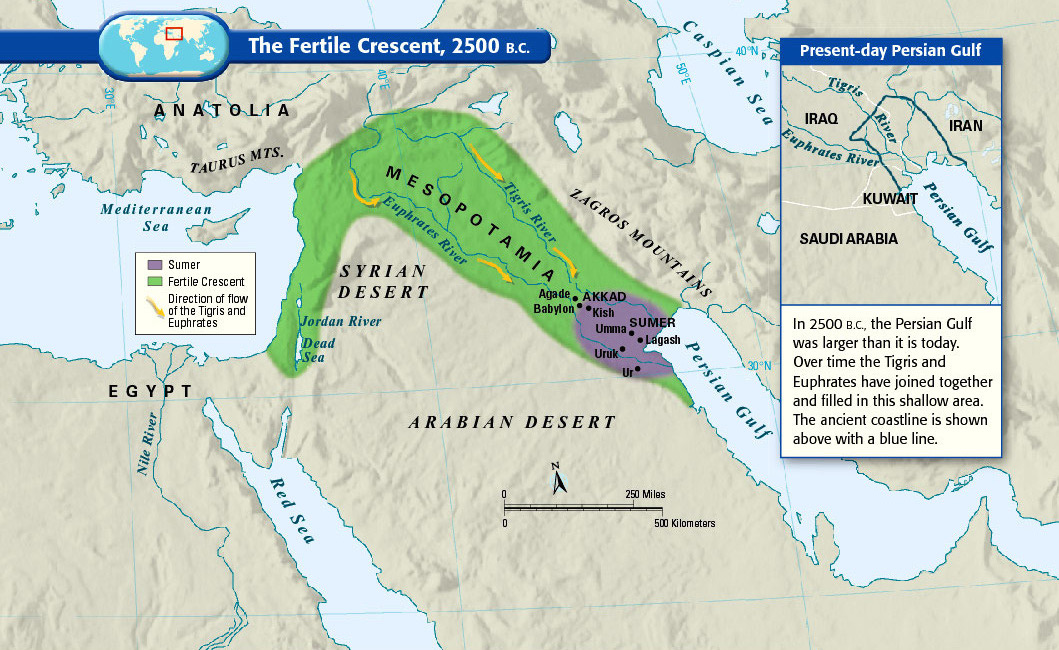
    If this area wasn’t the birthplace of human civilization, it was at least a birthplace of human civilization. Called “the fertile crescent” because of its lush soil, the “crescent” of land mostly includes modern-day Iraq, Syria, Jordan, and Israel-Palestine. (Some definitions also include the Nile River valley in Egypt.) People started farming here in 9000 BC, and by around 2500 BC the Sumerians formed the first complex society that resembles what we’d now call a “country,” complete with written laws and a political system. Put differently, there are more years between Sumerians and ancient Romans than there are between ancient Romans and us.

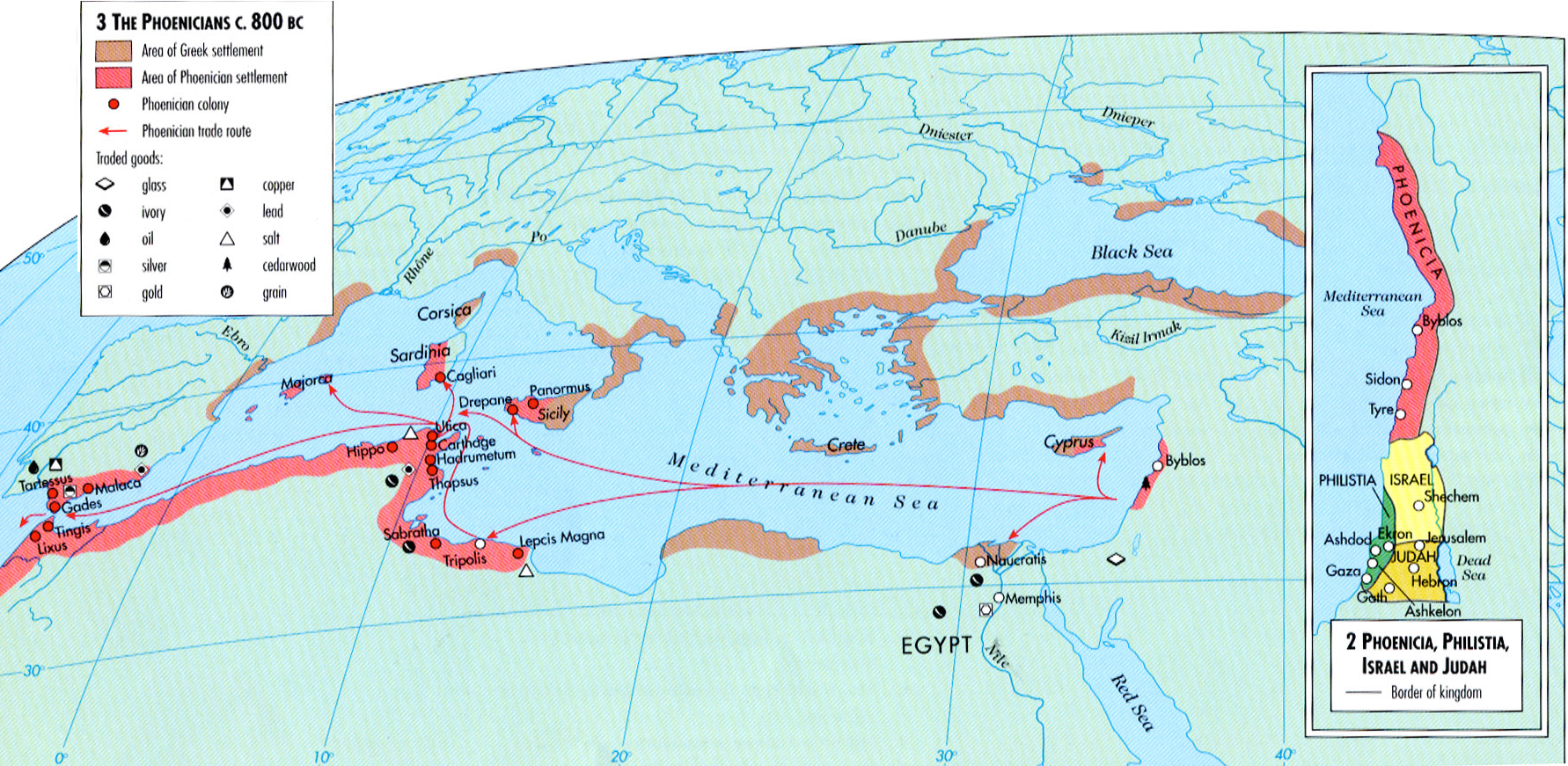
  2. How ancient Phoenicians spread from Lebanon across the Mediterranean

    How ancient Phoenicians spread from Lebanon across the Mediterranean

    The Phoenicians, who lived in present-day Lebanon and coastal Syria, were pretty awesome. From about 1500 to 300 BC, they ran some of the Mediterranean’s first big trading networks, shown in red, and dominated the sea along with the Greeks, who are shown in brown. Some sailed as far as the British Isles, and many of them set up colonies in North Africa, Spain, Sicily, and Sardinia. This was one of the first of many close cultural links between the Middle East and North Africa – and why Libya’s capital, Tripoli, still bears the name of the ancient Phoenician colony that established it.

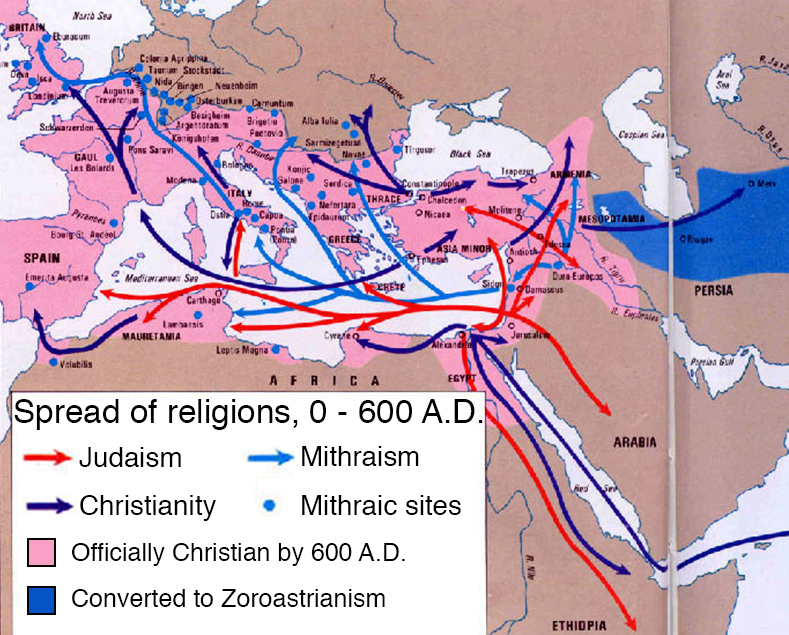
  3. How the Middle East gave Europe religion, three times

    How the Middle East gave Europe religion, three times

    The Middle East actually gave Europe religion four times, including Islam, but this map shows the first three. First was Judaism, which spread through natural immigration and when Romans forcibly dispersed the rebelling Israelites in the first and second century AD. In the first through third centuries A.D., a religion called Mithraism — sometimes called a “mystery religion” for its emphasis on secret rites and clandestine worship — spread from present-day Turkey or Armenia throughout the Roman Empire (at the time, most adherents believed it was from Persians in modern-day Iran, but this is probably wrong). Mithraism was completely replaced with Christianity, which became the Roman Empire’s official religion, after a few centuries. It’s easy to forget that, for centuries, Christianity was predominantly a religion of Middle Easterners, who in turn converted Europeans.

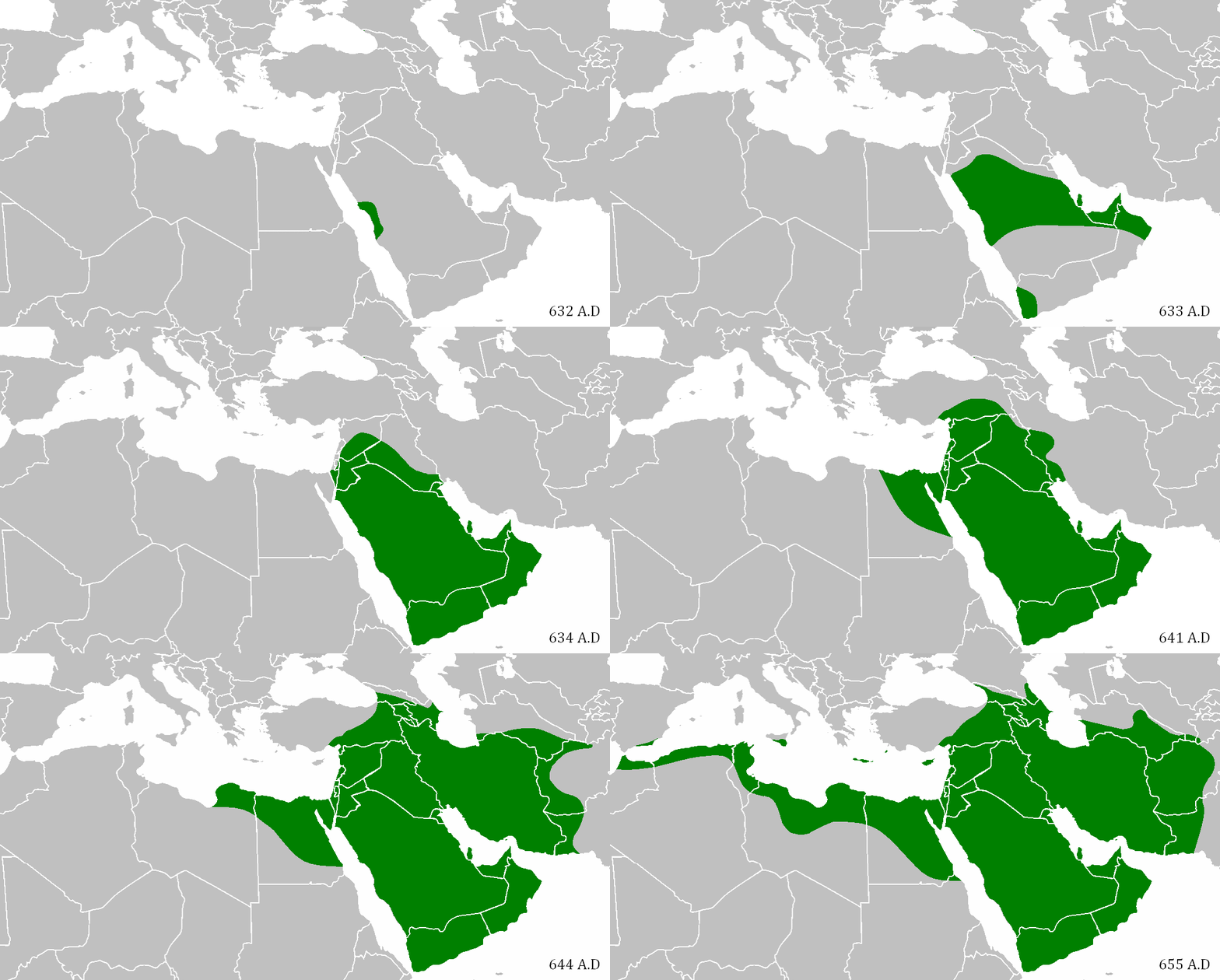
  4. When Mohammed’s Caliphate conquered the Middle East

    When Mohammed’s Caliphate conquered the Middle East

    In the early 7th century AD in present-day Saudi Arabia, the Prophet Mohammed founded Islam, which his followers considered a community as well as a religion. As they spread across the Arabian peninsula, they became an empire, which expanded just as the neighboring Persian and Byzantine Empires were ready to collapse. In an astonishingly short time — from Mohammed’s death in 632 to 652 AD — they managed to conquer the entire Middle East, North Africa, Persia, and parts of southern Europe. They spread Islam, the Arabic language, and the idea of a shared Middle Eastern identity — all of which still define the region today. It would be as if everyone in Europe still spoke Roman Latin and considered themselves ethnically Roman.

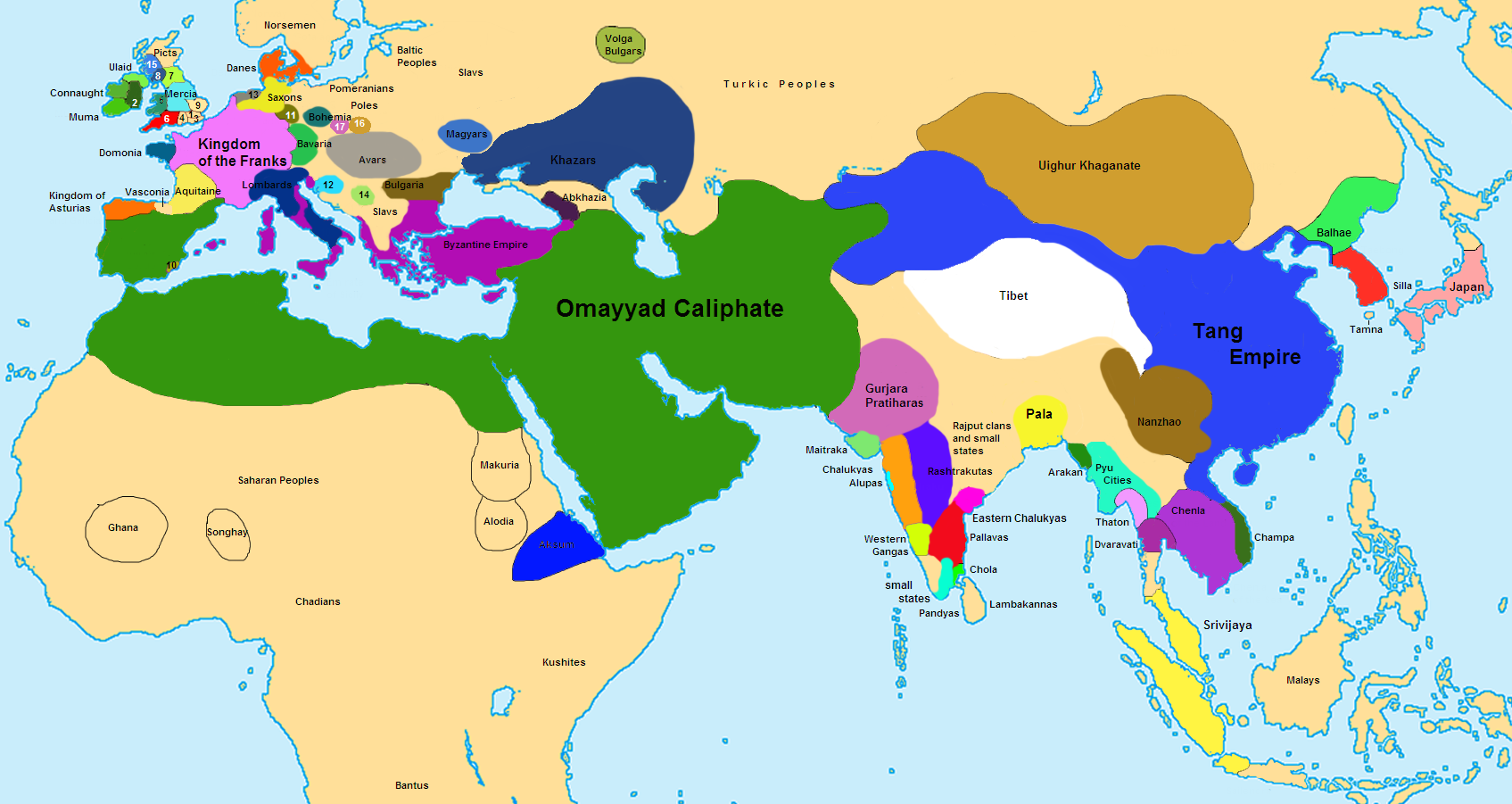
  5. A map of the world at the Caliphate’s height

    A map of the world at the Caliphate’s height

    This is a rough political map of the world in 750 AD, at the height of the Omayyad Caliphate (“caliph” means the ruler of the global Islamic community). This is to give you a sense of how vast and powerful the Muslim empire had become, barely one century after the founding of the religion that propelled its expansion. It was a center of wealth, arts, and learning at a time when only China was so rich and powerful. This was the height of Arab power.

  6. The six-century rise and fall of the Ottoman Empire

    The six-century rise and fall of the Ottoman Empire

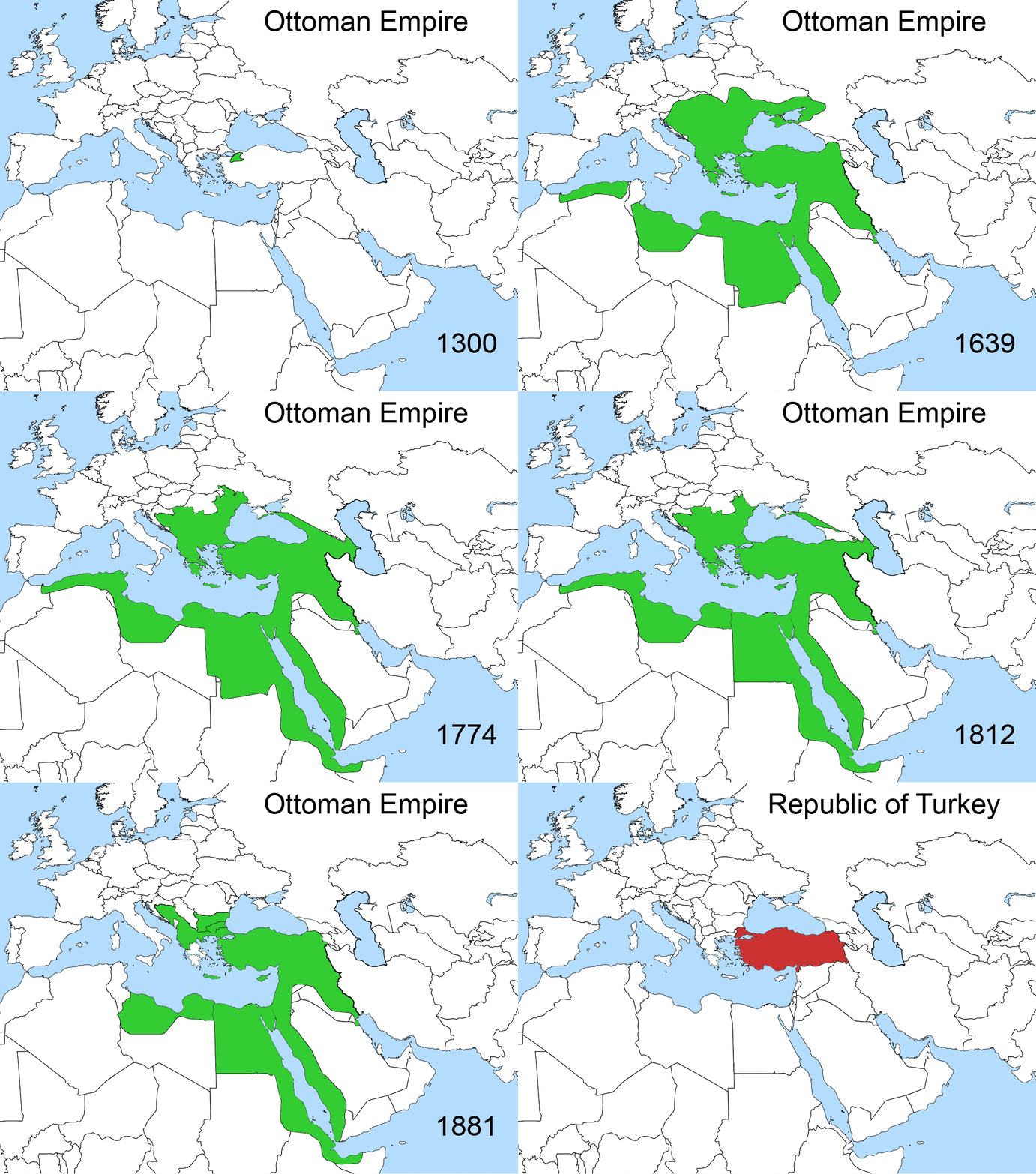
    The Ottoman Empire is named for Osman, its first ruler, who in the early 1300s expanded it from a tiny part of northwest Turkey to a slightly less tiny part. It continued expanding for about 500 years — longer than the entire history of the Roman Empire — ruling over most of the Middle East, North Africa, and southeastern Europe for centuries. The empire, officially an Islamic state, spread the religion in southeast Europe but was generally tolerant of other religious groups. It was probably the last great non-European empire until it began declining in the mid-1800s, collapsed after World War I, and had its former territory in the Middle East divided up by Western Europe.

  7. What the Middle East looked like in 1914

    What the Middle East looked like in 1914

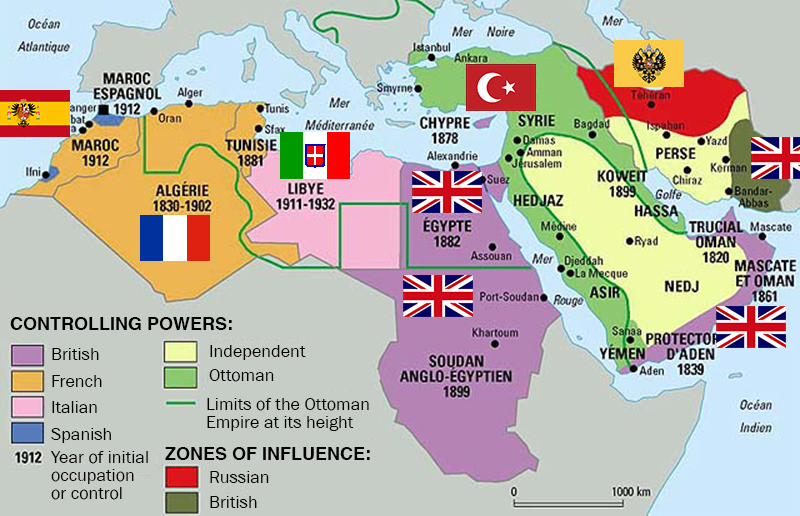
    This is a pivotal year, during the Middle East’s gradual transfer from 500 years of Ottoman rule to 50 to 100 years of European rule. Western Europe was getting richer and more powerful as it carved up Africa, including the Arab states of North Africa, into colonial possessions. Virtually the entire region was ruled outright by Europeans or Ottomans, save some parts of Iran and the Arabian peninsula divided into European “zones of influence.” When World War I ended a few years later, the rest of the defeated Ottoman Empire would be carved up among the Europeans. The lines between French, Italian, Spanish, and British rule are crucial for understanding the region today – not just because they ruled differently and imposed different policies, but because the boundaries between European empires later became the official borders of independence, whether they made sense or not.

  8. The Sykes-Picot treaty that carved up the Middle East

    The Sykes-Picot treaty that carved up the Middle East

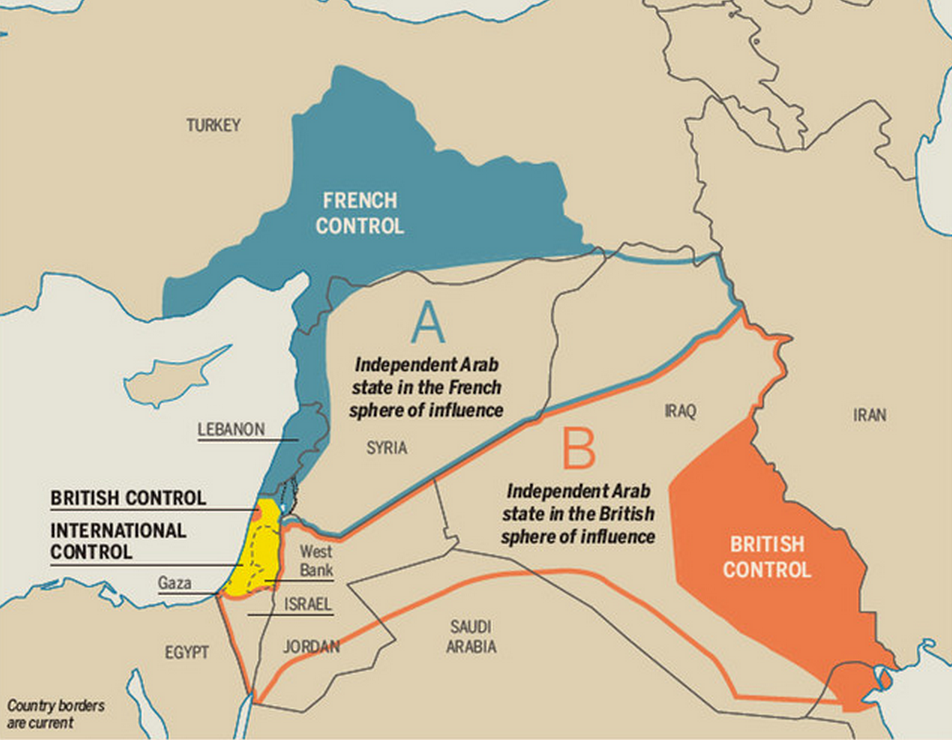
    You hear a lot today about this treaty, in which the UK and French (and Russian) Empires secretly agreed to divide up the Ottoman Empire’s last MidEastern regions among themselves. Crucially, the borders between the French and British “zones” later became the borders between Iraq, Syria, and Jordan. Because those later-independent states had largely arbitrary borders that forced disparate ethnic and religious groups together, and because those groups are still in terrible conflict with one another, Sykes-Picot is often cited as a cause of warfare and violence and extremism in the Middle East. But scholars are still debating this theory, which may be too simple to be true.

  9. An animated history of great empires in the Middle East

    An animated history of great empires in the Middle East

    You may have noticed a theme of the last eight maps: empires, mostly from outside the Middle East but sometimes of it, conquering the region in ways that dramatically changed it. This animation shows you every major empire in the Middle East over the last 5,000 years. To be clear, it is not exhaustive, and in case it wasn’t obvious, the expanding-circle animations do not actually reflect the speed or progression of imperial expansions. But it’s a nice primer.

  10. The complete history of Islamic states

    The complete history of Islamic states

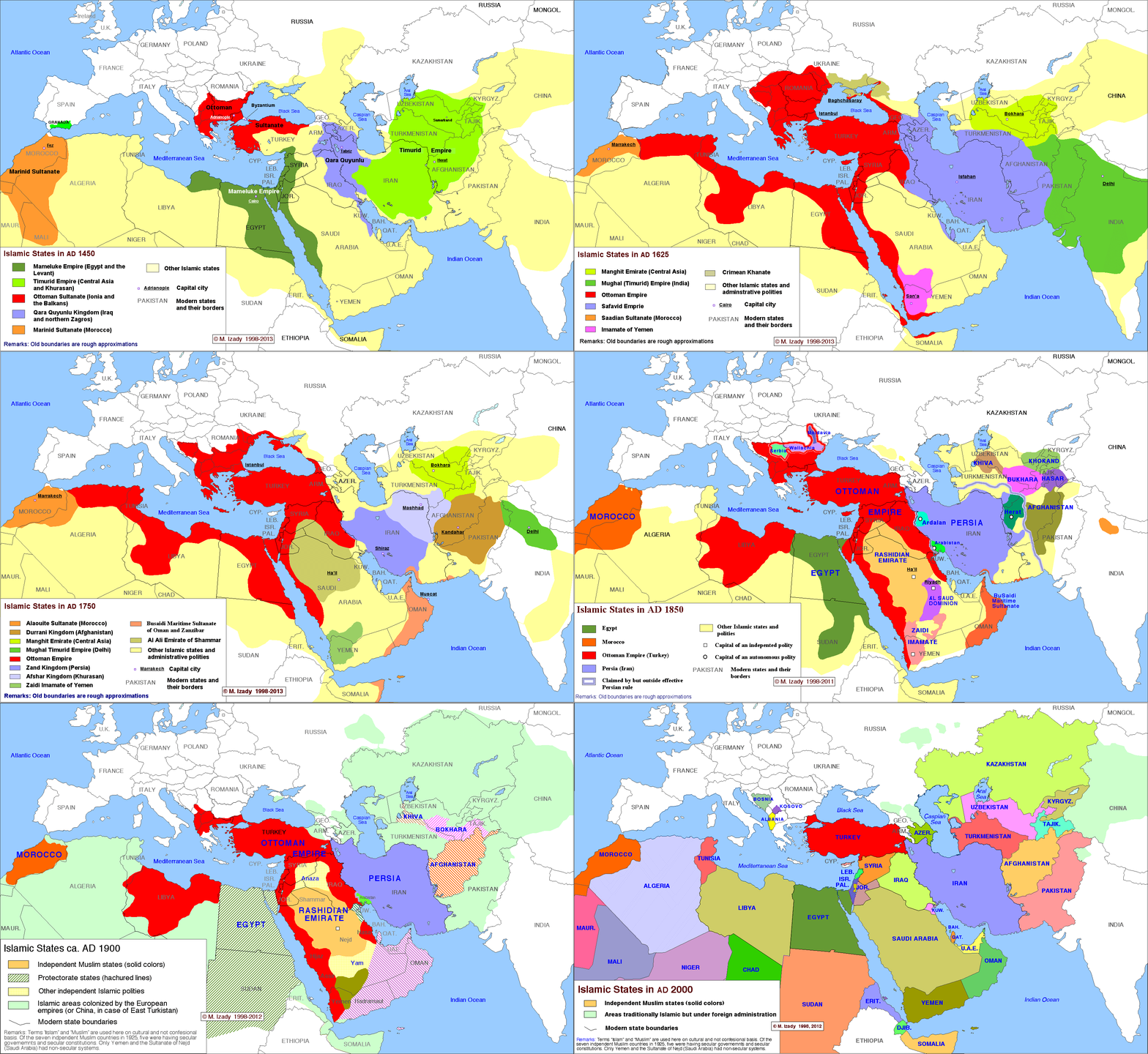
    This time-lapse map by Michael Izady — a wonderful historian and cartographer at Columbia University, whose full collection can be found here — shows the political boundaries of the greater Middle East from 1450 through today. You’ll notice that, for much of the last 500 years, most or all of the region has been under some combination of Turkish, Persian, and European control. For so much of the Arab Middle East to be under self-rule is relatively new. Two big exceptions that you can see on this map are Morocco and Egypt, which have spent more of the last 500 years as self-ruling empires than other Arab states. That’s part of why these two countries have sometimes seen themselves as a degree apart from the rest of the Arab world.

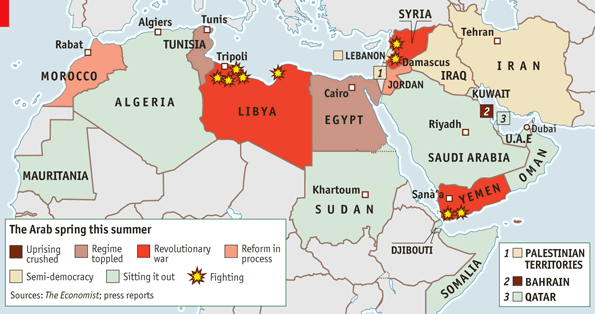
  11. The 2011 Arab Spring

    The 2011 Arab Spring

    It is still amazing, looking back at early and mid-2011, how dramatically and quickly the Arab Spring uprisings challenged and in many cases toppled the brittle old dictatorships of the Middle East. What’s depressing is how little the movements have advanced beyond those first months. Syria’s civil war is still going. Egypt’s fling with democracy appeared to end with a military coup in mid-2013. Yemen is still mired in slow-boil violence and political instability. The war in Libya toppled Moammar Qaddafi, with US and European support, but left the country without basic security or a functioning government. Only Tunisia seems to have come out even tenuously in the direction of democracy.


The Middle East today

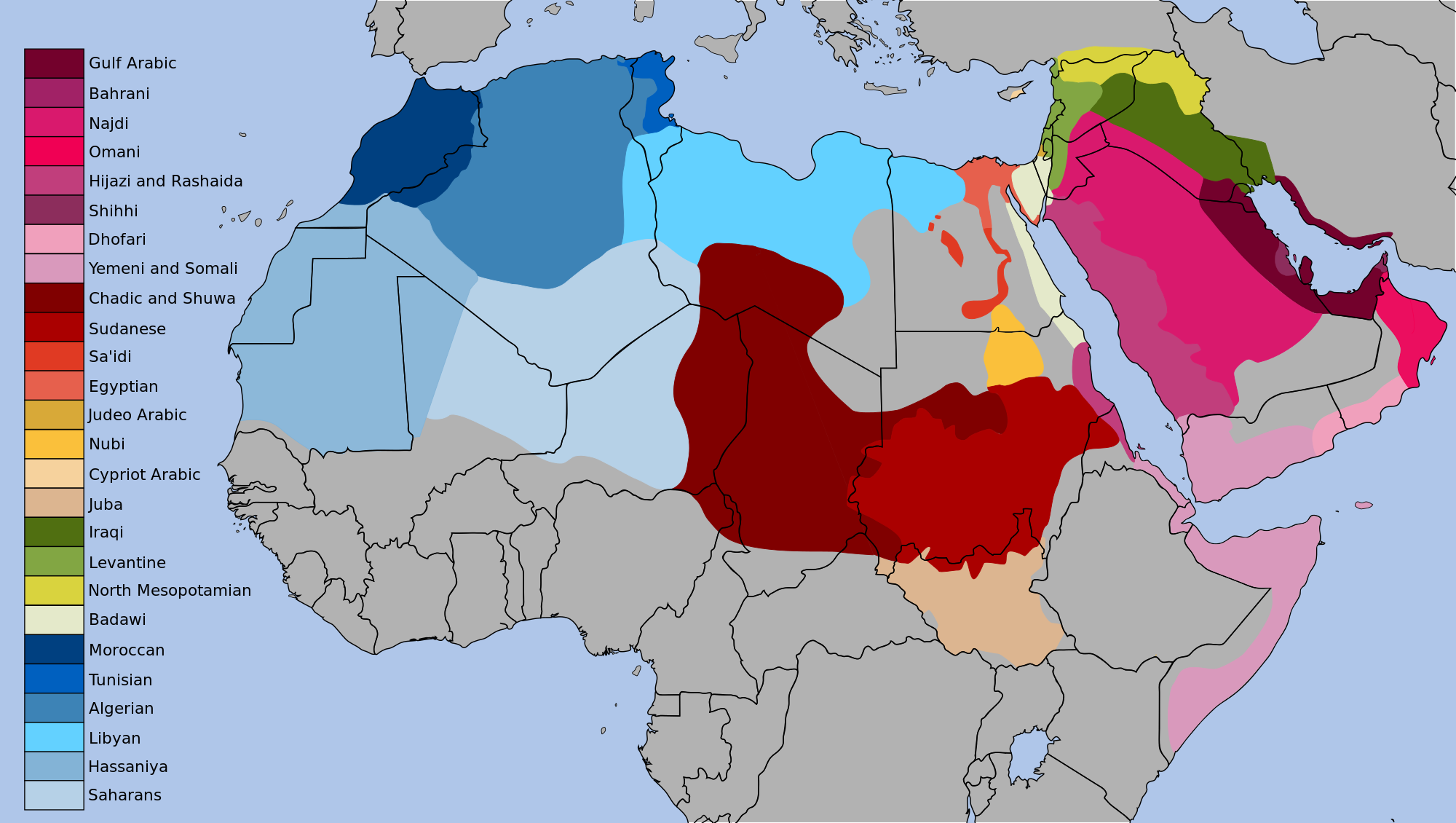
  1. The dialects of Arabic today

    The dialects of Arabic today

    This map shows the vast extent of the Arabic-speaking world and the linguistic diversity within it. Both go back to the Caliphates of the sixth and seventh century, which spread Arabic from its birthplace on the Arabian Peninsula across Africa and the Middle East. Over the last 1,300 years the language’s many speakers have diverged into distinct, sometimes very different, dialects. Something to look at here: where the dialects do and do not line up with present-day political borders. In places where they don’t line up, you’re seeing national borders that are less likely to line up with actual communities, and in some cases more likely to create problems.
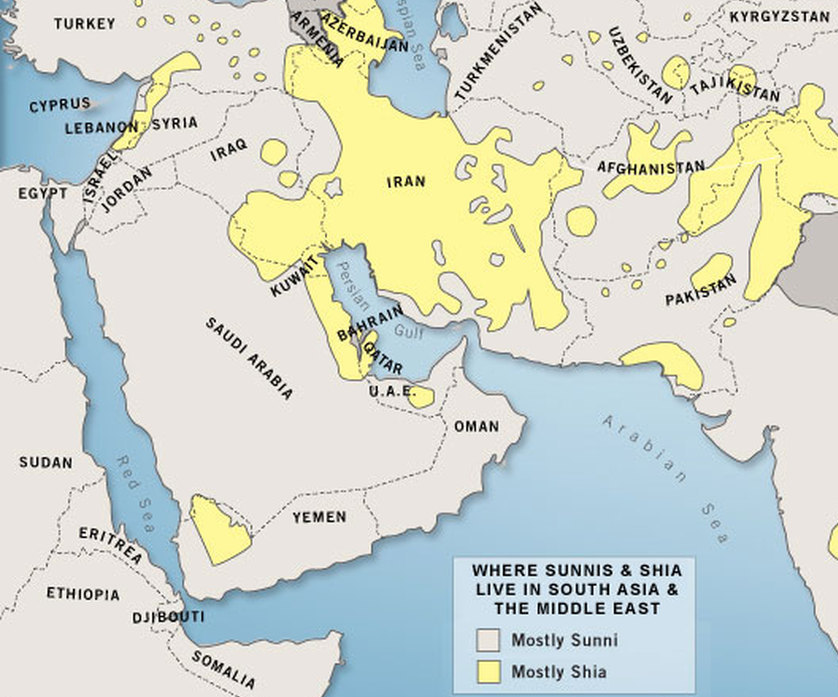
  2. The Sunni-Shia divide

    The Sunni-Shia divide

    The story of Islam’s division between Sunni and Shia started with the Prophet Mohammed’s death in 632. There was a power struggle over who would succeed him in ruling the Islamic Caliphate, with most Muslims wanting to elect the next leader but some arguing that power should go by divine birthright to Mohammed’s son-in-law, Ali. That pro-Ali faction was known as the “Partisans of Ali,” or “Shi’atu Ali” in Arabic, hence “Shia.” Ali’s eventual ascension to the throne sparked a civil war, which he and his partisans lost. The Shia held on to the idea that Ali was the rightful successor, and grew into an entirely separate branch of Islam. Today about 10 to 15 percent of Muslims worldwide are Shia — they are the majority group in Iran and Iraq only — while most Muslims are Sunni. “Sunni” roughly means “tradition.” Today, that religious division is again a political one as well: it’s a struggle for regional influence between Shia political powers, led by Iran, versus Sunni political powers, led by Saudi Arabia. This struggle looks an awful lot like a regional cold war, with proxy battles in Syria and elsewhere.

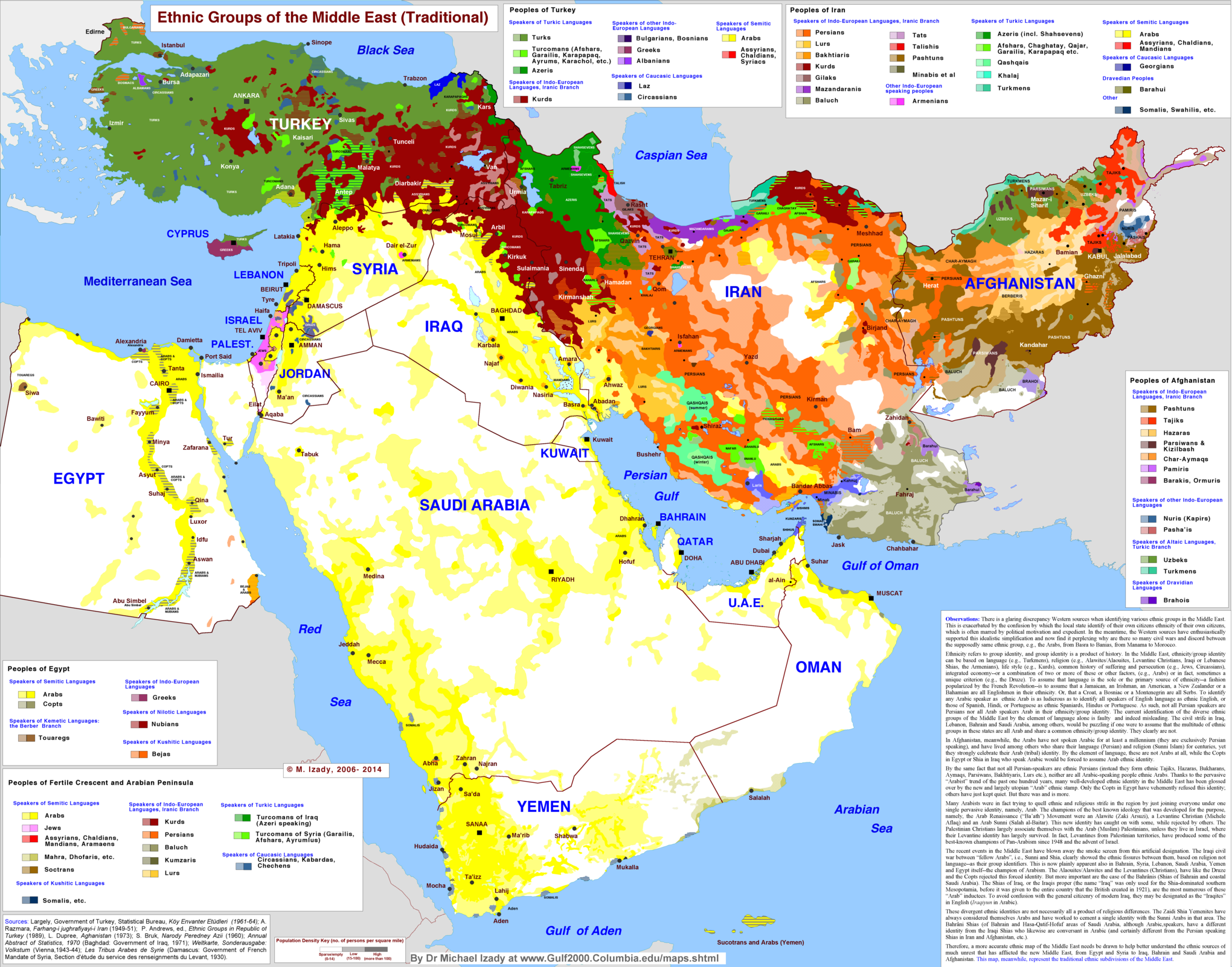
  3. The ethnic groups of the Middle East

    The ethnic groups of the Middle East

    The most important color on this map of Middle Eastern ethnic groups is yellow: Arabs, who are the majority group in almost every MidEast country, including the North African countries not shown here. The exceptions are mostly-Jewish Israel in pink, mostly-Turkish Turkey in green, mostly-Persian Iran in orange, and heavily diverse Afghanistan. (More on the rich diversity of Iran and Afghanistan below.) That splash of red in the middle is really important: ethnic Kurds, who have no country of their own but big communities in Iran, Iraq, Syria, and Turkey. But the big lesson of this map is that there is a belt of remarkable ethnic diversity from Turkey to Afghanistan, but that much of the rest of the region is dominated by ethnic Arabs.

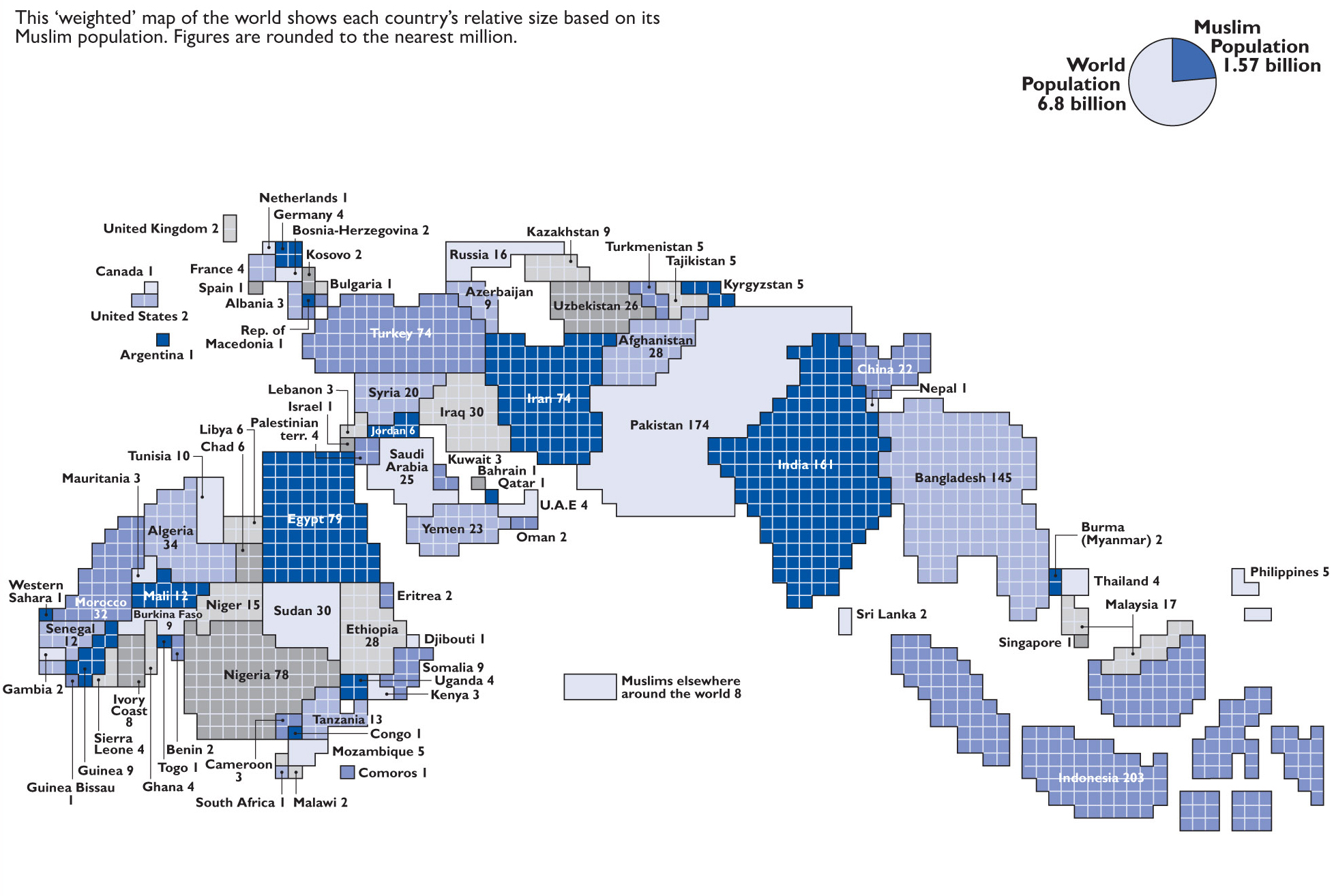
  4. Weighted Muslim populations around the world

    Weighted Muslim populations around the world

    This map makes a point about what the Middle East is not: it is not synonymous with the Islamic world. This weighted population map shows every country in the world by the size of its Muslim population. Countries with more Muslim citizens are larger; countries with fewer Muslim citizens are smaller. You’ll notice right away that the Middle East makes up just a fraction of the world’s total Muslim population. There are far more Muslims, in fact, in the South Asian countries of India, Pakistan, and Bangladesh. The biggest Muslim population by far is Indonesia’s, in southeast Asia. And there are millions in sub-Saharan Africa as well. The Islamic world may have begun in the Middle East, but it’s now much, much larger than that.


Israel-Palestine

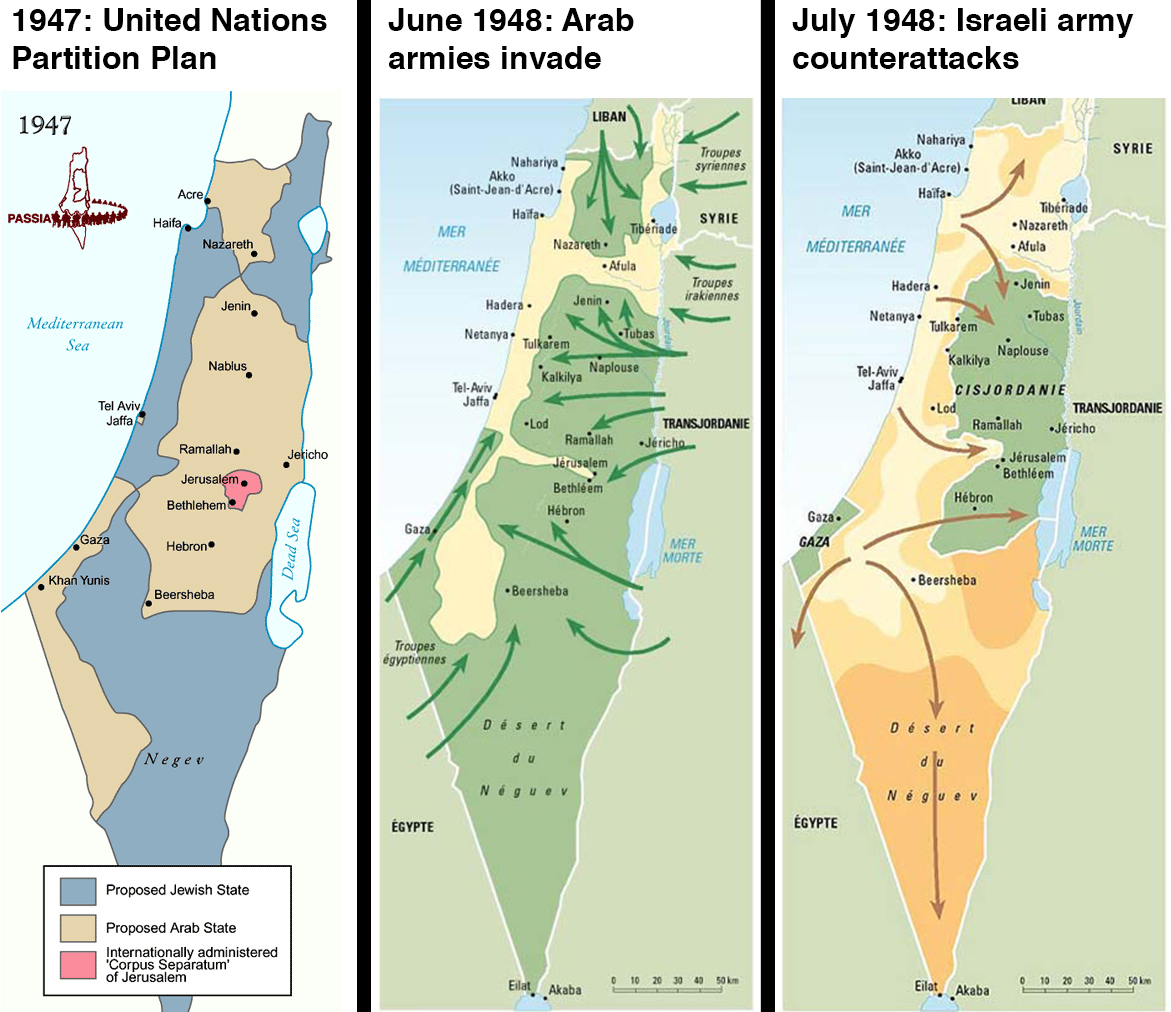
  1. Israel’s 1947 founding and the 1948 Israeli-Arab War

    Israel's 1947 founding and the 1948 Israeli-Arab War

    Left map: Passia; center and right maps: Philippe Rekacewicz / Le Monde Diplomatique

    Israel’s 1947 founding and the 1948 Israeli-Arab War

    These three maps show how Israel went from not existing to, in 1947 and 1948, establishing its national borders. It’s hard to identify a single clearest start point to the Israel-Palestine conflict, but the map on the left might be it: these are the borders that the United Nations demarcated in 1947 for a Jewish state and an Arab state, in what had been British-controlled territory. The Palestinians fought the deal, and in 1948 the Arab states of Egypt, Jordan, Iraq, and Syria invaded. The middle map shows, in green, how far they pushed back the Jewish armies. The right-hand map shows how the war ended: with an Israeli counterattack that pushed into the orange territory, and with Israel claiming that as its new national borders. The green is what was left for Palestinians.

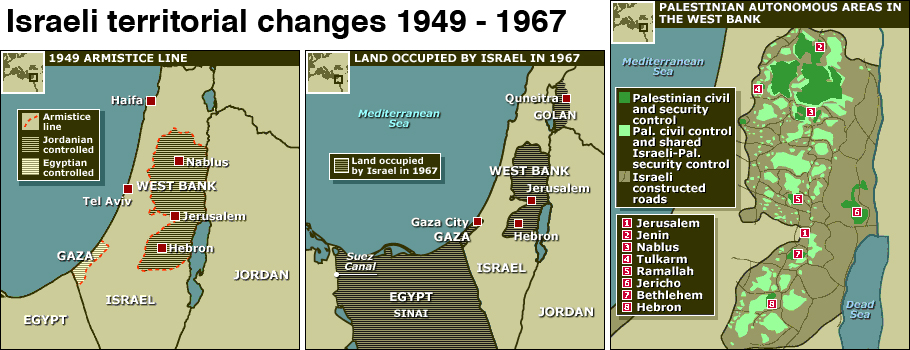
  2. The 1967 Israeli-Arab War that set today’s borders

    The 1967 Israeli-Arab War that set today's borders

    BBC

    The 1967 Israeli-Arab War that set today’s borders

    These three maps (click the expand icon to see the third) show how those 1948 borders became what they are today. The map on left shows the Palestinian territories of Gaza, which was under Egyptian control, and the West Bank, under Jordanian control. In 1967, Israel fought a war with Egypt, Jordan, and Syria. The war ended with Israel occupying both of the Palestinian territories, plus the Golan Heights in Syria and Egypt’s Sinai peninsula: that’s shown in the right map. Israel gave Sinai back as part of a 1979 peace deal, but it still occupies those other territories. Gaza is today under Israeli blockade, while the West Bank is increasingly filling with Israeli settlers. The third map shows how the West Bank has been divided into areas of full Palestinian control (green), joint Israeli-Palestinian control (light green), and full Israeli control (dark green).

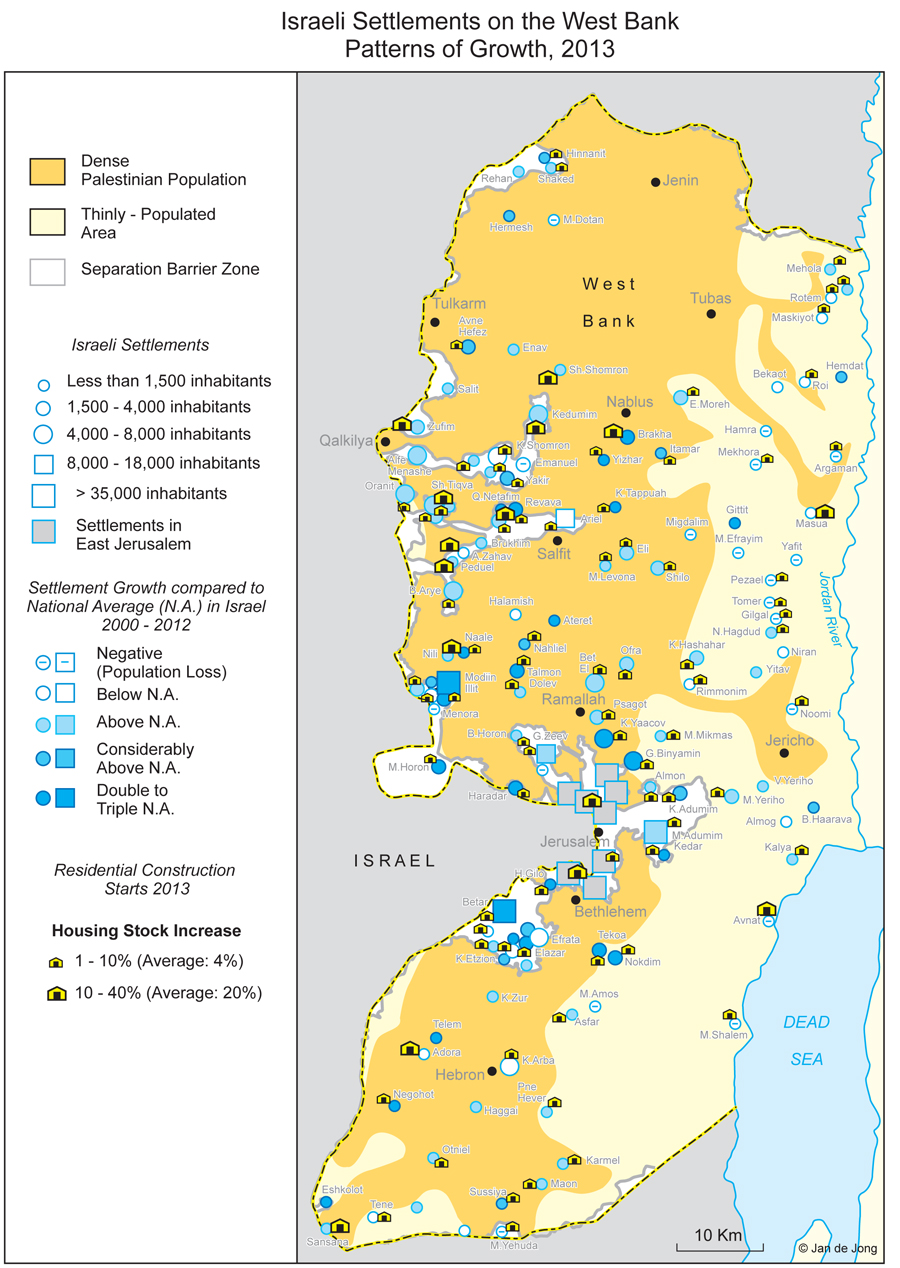
  3. Israeli settlements in the Palestinian West Bank

    Israeli settlements in the Palestinian West Bank

    Since 1967, Israelis have been moving into settlements in the West Bank. Some go for religious reasons, some because they want to claim Palestinian land for Israel, and some just because they get cheap housing from subsidies. There about 500,000 settlers in 130 communities, which you can see in this map. The settlements make peace harder, which is sometimes the point: for Palestinians to have a state, the settlers will either to have to be removed en masse, or Palestinians would have to give up some of their land. The settlements also make life harder for Palestinians today, dividing communities and imposing onerous Israeli security. This is why the US and the rest of the world opposes Israeli settlements. But Israel is continuing to expand them anyway.

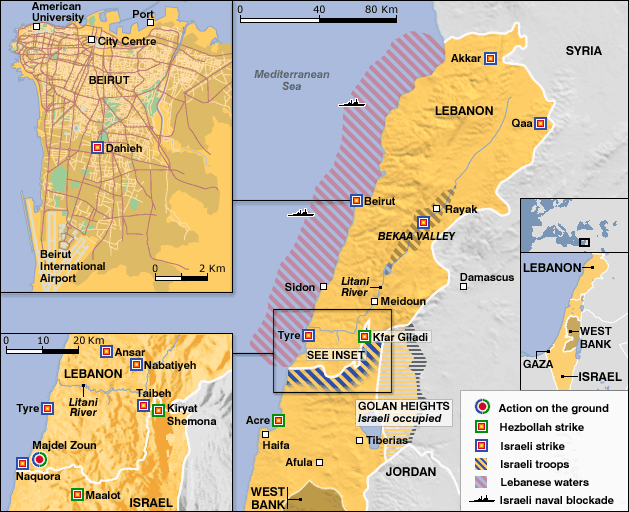
  4. Israeli and Hezbollah strikes in the 2006 Lebanon War

    Israeli and Hezbollah strikes in the 2006 Lebanon War

    BBC

    Israeli and Hezbollah strikes in the 2006 Lebanon War

    This map shows a moment in the 2006 war between Israel and Lebanon. It also shows the way that war between Israel and its enemies has changed: Israel now has the dominant military, but the fights are asymmetrical. Israel wasn’t fighting a state, but the Lebanese militant group Hezbollah. It launched many air and artillery strikes in Lebanon (shown in blue) to weaken Hezbollah, destroying much of the country’s infrastructure in the process. Israel also blockaded Lebanese waters. Hezbollah fought a guerrilla campaign against the Israeli invasion force and launched many missiles into Israeli communities. The people most hurt were regular Lebanese and Israelis, hundreds of thousands of whom were displaced by the fighting.

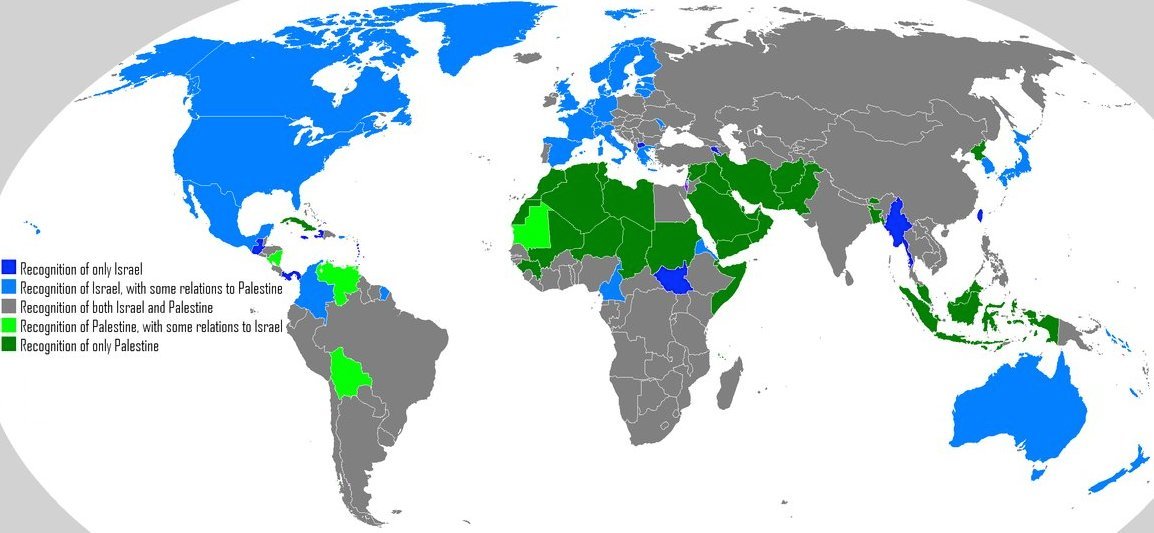
  5. Which countries recognize Israel, Palestine, or both

    Which countries recognize Israel, Palestine, or both

    The Israel-Palestine conflict is a global issue, and as this map shows it’s got a global divide. Many countries, shown in green, still do not recognize Israel as a legitimate state. Those countries are typically Muslim-majority (that includes Malaysia and Indonesia, way over in southeast Asia). Meanwhile, the blue countries of the West (plus a few others) do not recognize Palestine as a country. They still have diplomatic relations with Palestine, but in their view it will not achieve the status of a country until the conflict is formally resolved. It is not a coincidence that there has historically been some conflict between the blue and green countries.


Syria

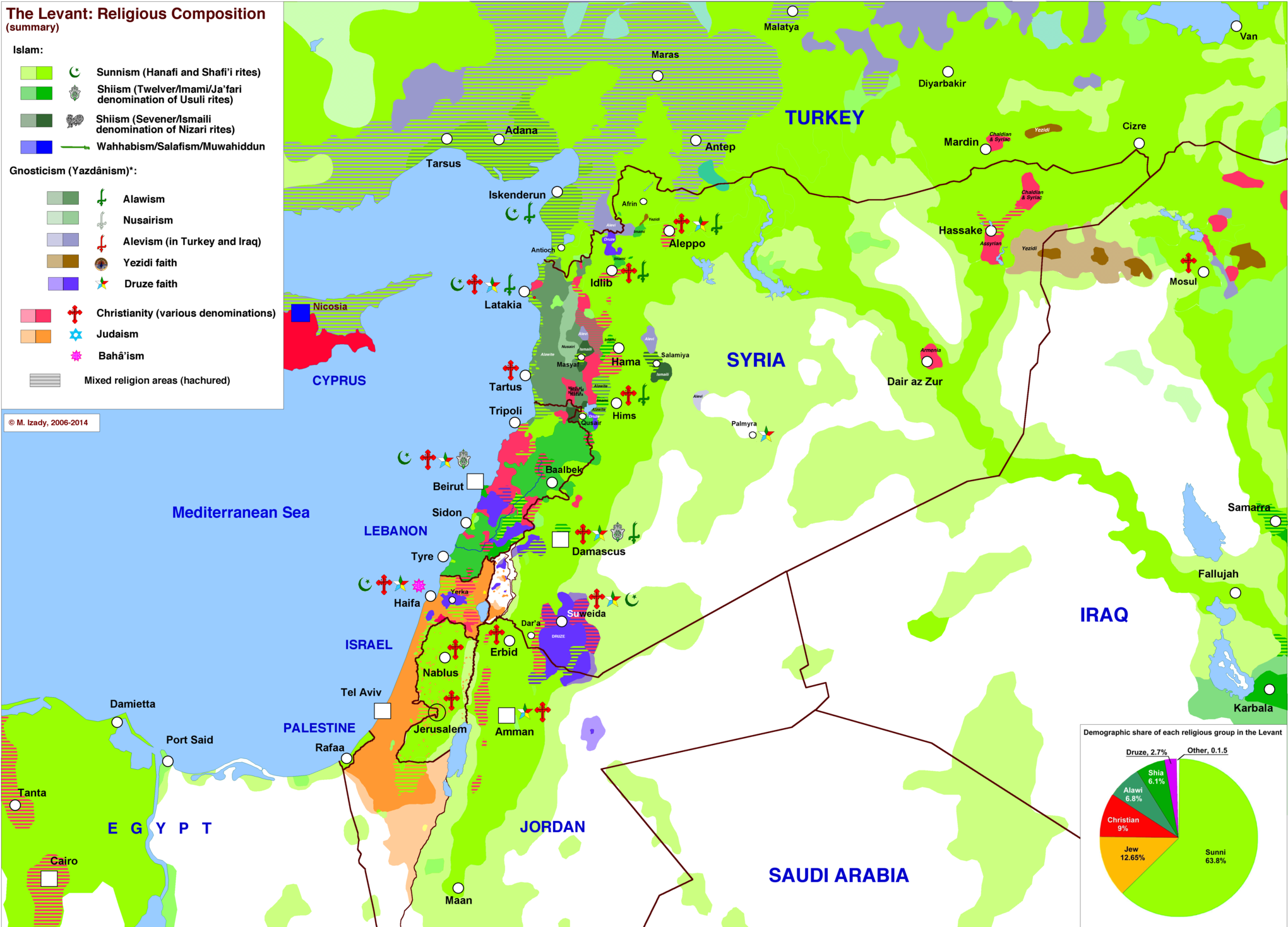
  1. Syria’s religious and ethnic diversity

    Syria’s religious and ethnic diversity

    Each color here shows a different religious group in the part of the eastern Mediterranean called the Levant. It should probably not be surprising that the birthplace of Judaism and Christianity is religiously diverse, but this map drives home just how diverse. Israel stands out for its Jewish majority, of course, but this is also a reminder of its Muslim and other minorities, as well as of the Christian communities in Israel and the West Bank. Lebanon is divided among large communities of Sunnis, Shias, Christians, and a faith known as Druze — they’re at peace now, but the country’s horrific civil war from 1975 to 1990 divided them. There may be a similar effect happening in Syria, which is majority Sunni Muslim but has large minorities of Christians, Druze, Shia, and a Shia sect known as Alawites whose members include Syrian leader Bashar al-Assad and much of his government.

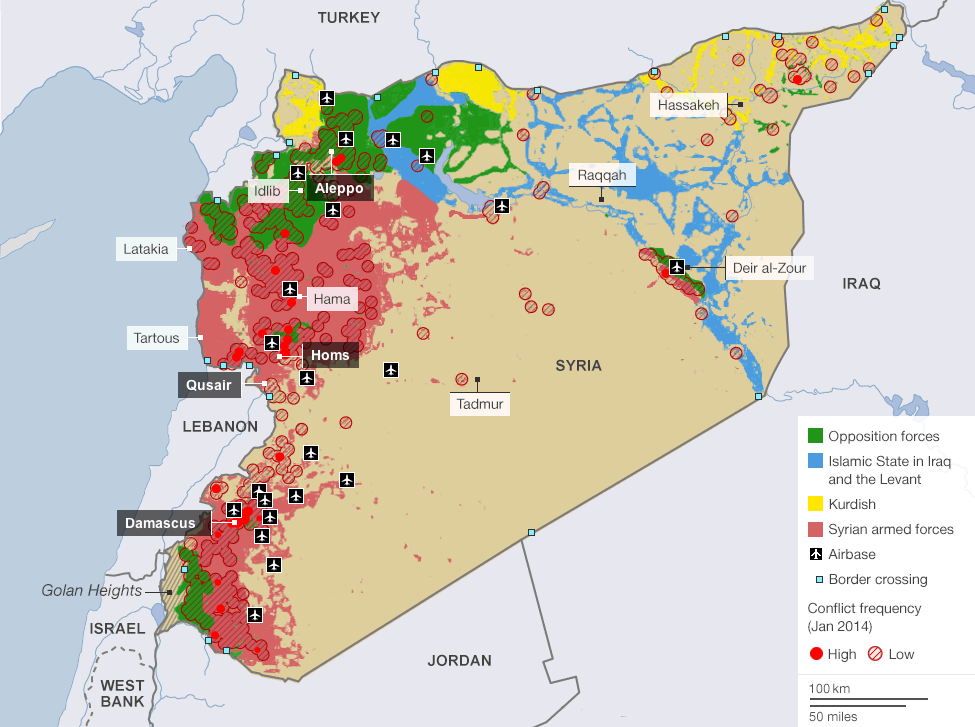
  2. Current areas of control in the Syrian Civil War

    Current areas of control in the Syrian Civil War

    This map shows the state of play in Syria’s civil war, which after three years of fighting has divided between government forces, the anti-government rebels who began as pro-democracy protestors, and the Islamist extremist fighters who have been moving in over the last two years. You may notice some overlap between this map and the previous: the areas under government control (in red) tend to overlap with where the minorities live. The minorities tend to be linked to the regime, whereas the rebels are mostly from the Sunni Muslim majority. But the anti-government Syrian rebels (in green) have been taking lots of territory. Syria’s ethnic Kurdish minority also has militias that have taken over territory where the Kurds live. Over the past year, though, there’s been a fourth rising faction: Islamic State of Iraq and the Levant (sometimes called ISIS, shown in blue), an extremist group based in Iraq that swears allegiance to al-Qaeda. They’re fighting both the rebels and the government. So it’s a three-way war now, as if it weren’t already intractable enough.

  3. Syria’s refugee crisis

    Syria’s refugee crisis

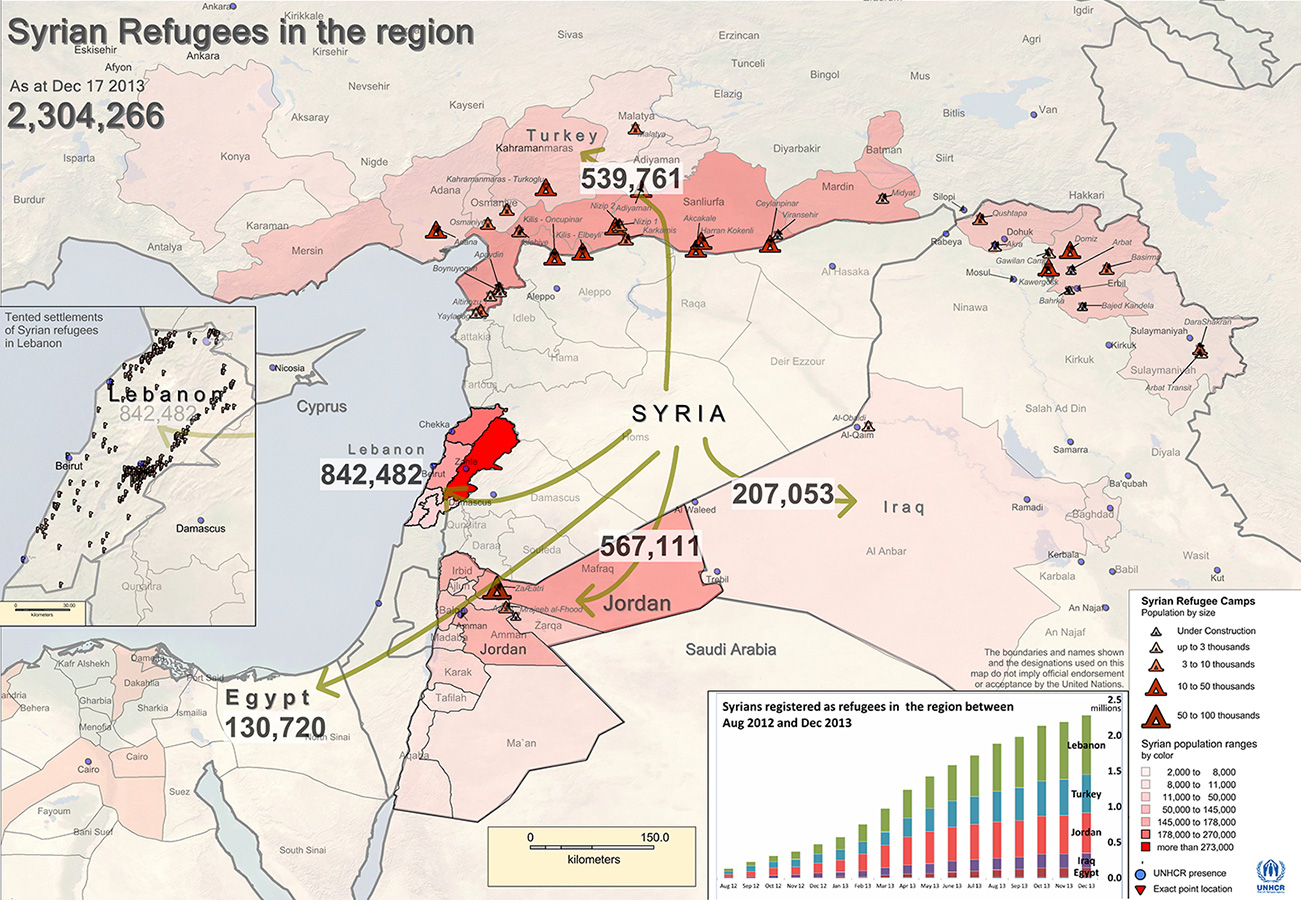
    Syria’s civil war hasn’t just been a national catastrophe for Syria, but for neighboring countries as well. The war has displaced millions of Syrians into the rest of the Middle East and into parts of Europe, where they live in vast refugee camps that are major drains on already-scarce national resources. This map shows the refugees; it does not show the additional 6.5 million Syrians displaced within Syria. Their impact is especially felt in Jordan and Lebanon, which already have large Palestinian refugee populations; as many as one in five people in those countries is a refugee. While the US and other countries have committed some aid for refugees, the United Nations says it’s not nearly enough to provide them with basic essentials.


Iran

  1. How Iran’s borders changed in the early 1900s

    How Iran’s borders changed in the early 1900s

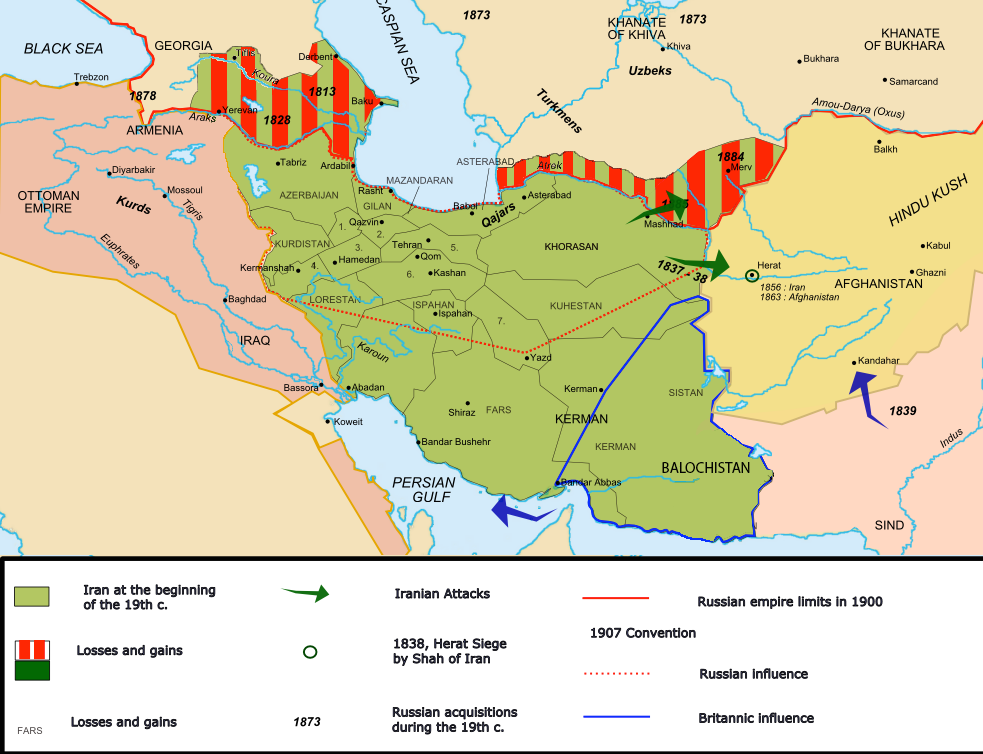
    Iran is the only Middle Eastern country was never conquered by a European power, but it came pretty close in the 1900s. It lost a lot of territory to Russia (the red stripey part). After that, the Russian Empire and British Empire (the British Indian Raj was just next door) divided Iran’s north and south into “zones of influence.” They weren’t under direct control, but the Iranian government was bullied and its economy and resources exploited. This remains a point of major national resentment in Iran today.

  2. Iran’s religious and ethnic diversity

    Iran’s religious and ethnic diversity

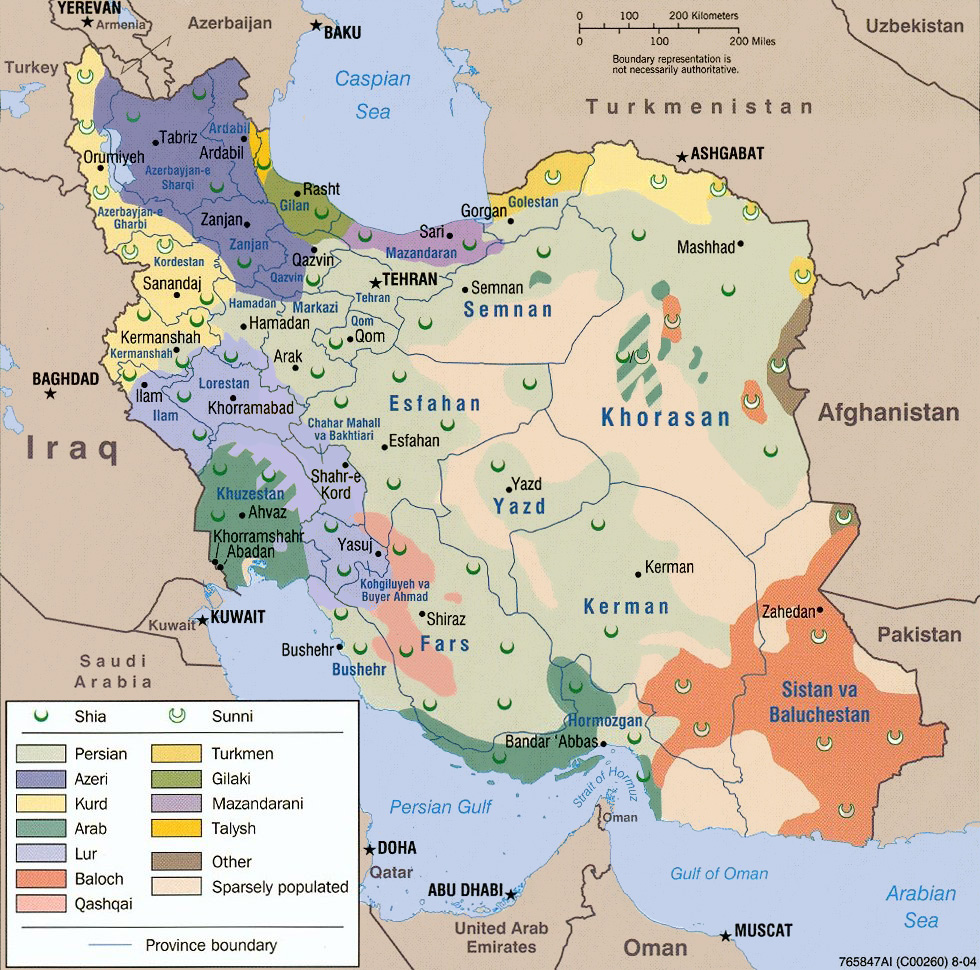
    Iran is most associated with the Persians — the largest ethnic group and the progenitors of the ancient Persian empires — but it’s much more diverse than that. This map shows the larger minorities, which includes Arabs in the south, Kurds in the west, and Azeris in the north (Iran used to control all Azeri territory, but much of now belongs to the Azeri-majority country Azerbaijan). The Baloch, in the southeast, are also a large minority group in Pakistan. There is significant unrest and government oppression in the “Baluchistan” region of both countries.

  3. Iran’s nuclear sites and possible Israeli strike plans

    Iran's nuclear sites and possible Israeli strike plans

    BBC

    Iran’s nuclear sites and possible Israeli strike plans

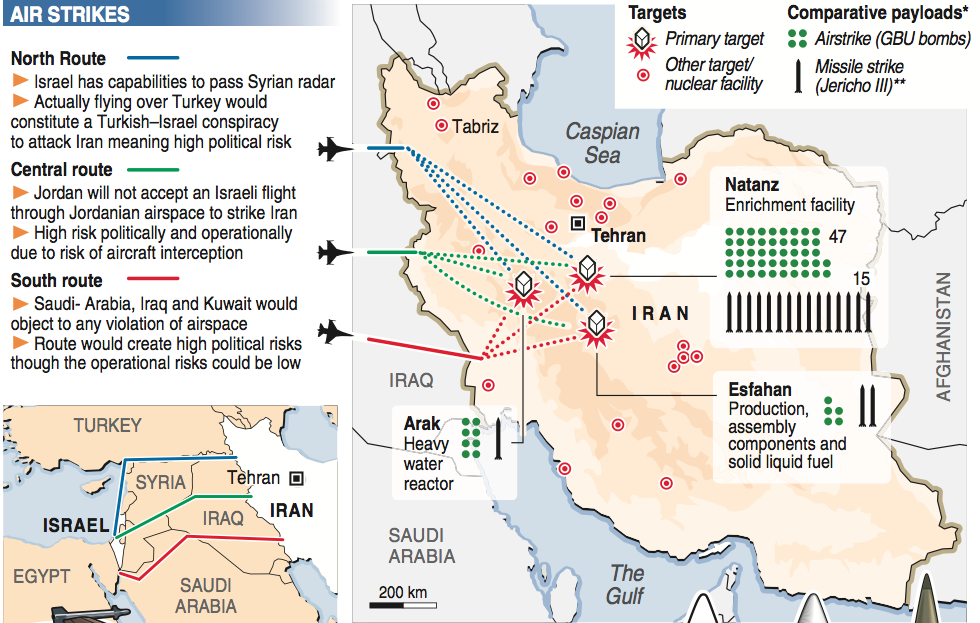
    This is a glimpse at two of the big, overlapping geopolitical issues in which Iran is currently embroiled. The first is Iran’s nuclear program: the country’s leaders say the program is peaceful, but basically no one believes them, and the world is heavily sanctioning Iran’s economy to try to convince them to halt the nuclear development that sure looks like it’s heading for an illegal weapons program. You can see the nuclear development sites on here: some are deep underground, while others were kept secret for years. That gets to the other thing on this map, which was originally built to show how Israel could hypothetically launch strikes against Iran’s nuclear program. Israel-Iran tensions, which have edged near war in recent years, are one of the biggest and most potentially dangerous things happening right now in a part of the world that has plenty of danger already. Israel is worried that Iran could build nukes to use against it; Iran may be worried that it will forever be under threat of Israeli strike until it has a nuclear deterrent. That’s called a security dilemma and it can get bad.


Afghanistan

  1. How the colonial “Durand Line” set up Afghanistan’s conflict

    How the colonial “Durand Line” set up Afghanistan’s conflict

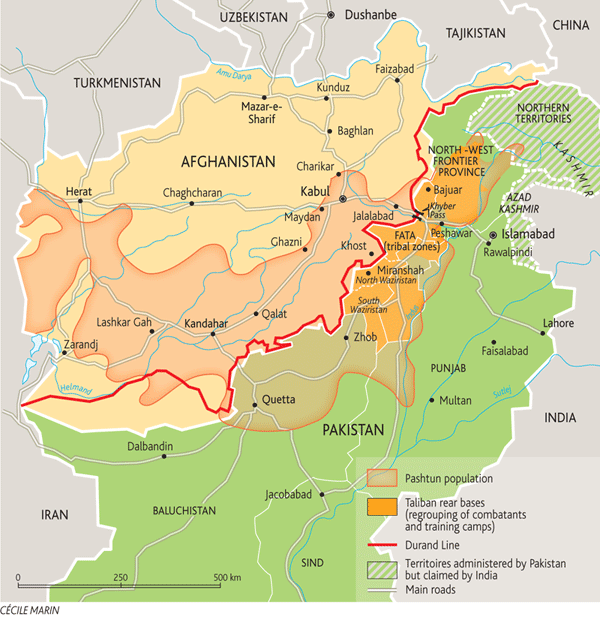
    So, first ignore everything on this map except for the light-orange overlay. That shows the area where an ethnic group called the Pashtun lives. Now pretend it’s the 1800s and you are a British colonial officer named Mortimer Durand, and it’s your job to negotiate the border between the British Indian Raj and the quasi-independent nation of Afghanistan. Do you draw the border right smack across the middle of the Pashtun areas, thus guaranteeing decades of conflict by forcing Pashtuns to be minorities in both states? If you answered “yes,” then you would have made a great British colonial officer, because that’s what happened. The “Durand Line,” marked in red, became most of the border between modern Afghanistan and Pakistan. Many Pashtun now belong to or support a mostly-Pashtun extremist group called the Taliban, which wreaks havoc in both countries and has major operating bases (shown in dark orange) in the Pakistani side of the border. Thanks, Mortimer!

  2. The 1989 war that tore up Afghanistan

    The 1989 war that tore up Afghanistan

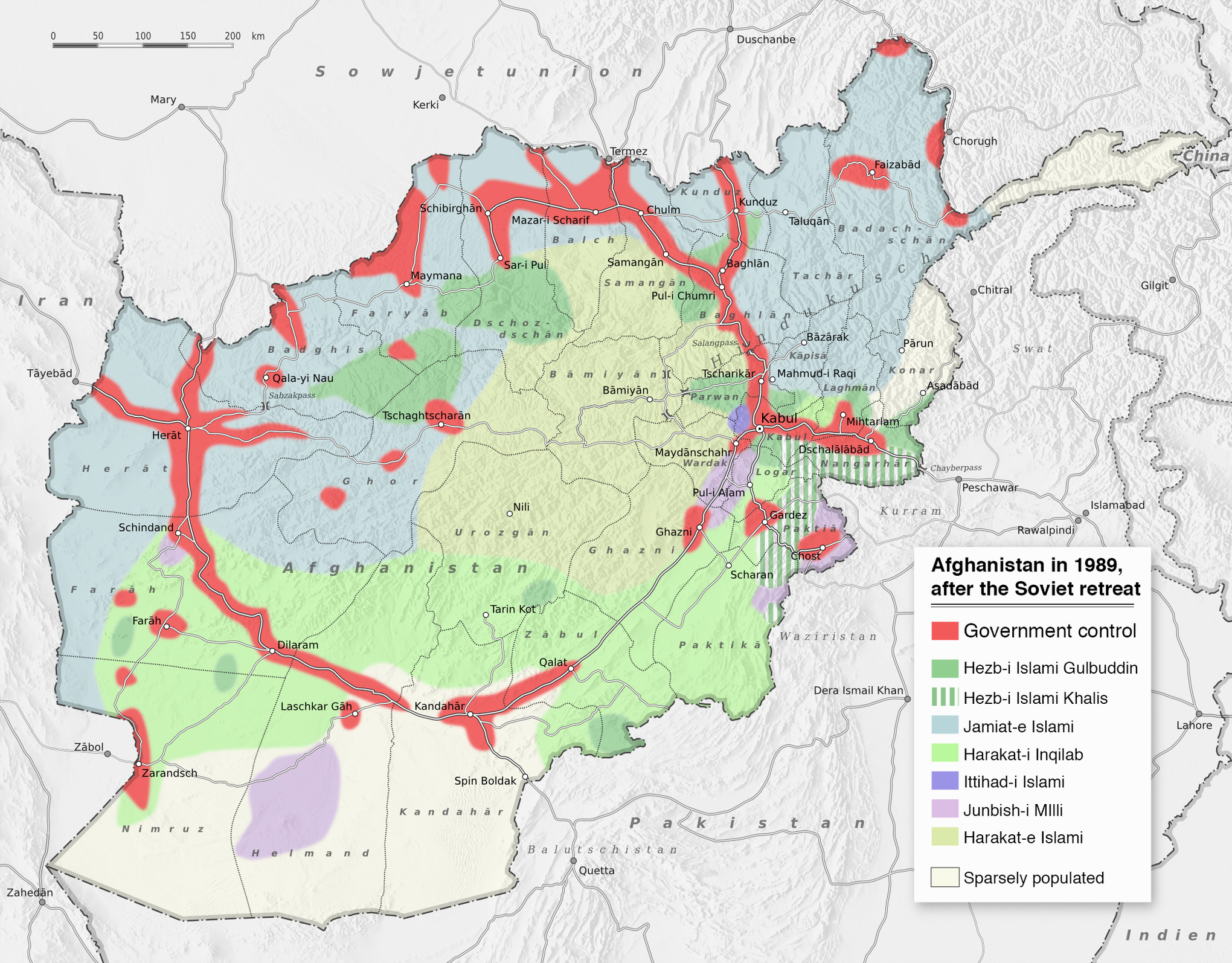
    In 1979, the Soviet Union invaded Afghanistan to defend the pro-Moscow communist government from growing rebellions. The US (along with Saudi Arabia and Pakistan) funded and armed the rebels. The CIA deliberately chose to fund extremists, seeing them as better fighters. When the Soviets retreated in 1989, those rebel groups turned against one another, fighting a horrific civil war that you can see on this map: the red areas were, as of 1989, under government control. Every other color shows a rebel group’s area of control. Some of these rebels, like the Hezb-i Islami Gulbuddin, are still fighting, though most of them were defeated when the Taliban rose up and conquered the country in the 1990s.

  3. How the Taliban overlaps with ethnicity

    How the Taliban overlaps with ethnicity

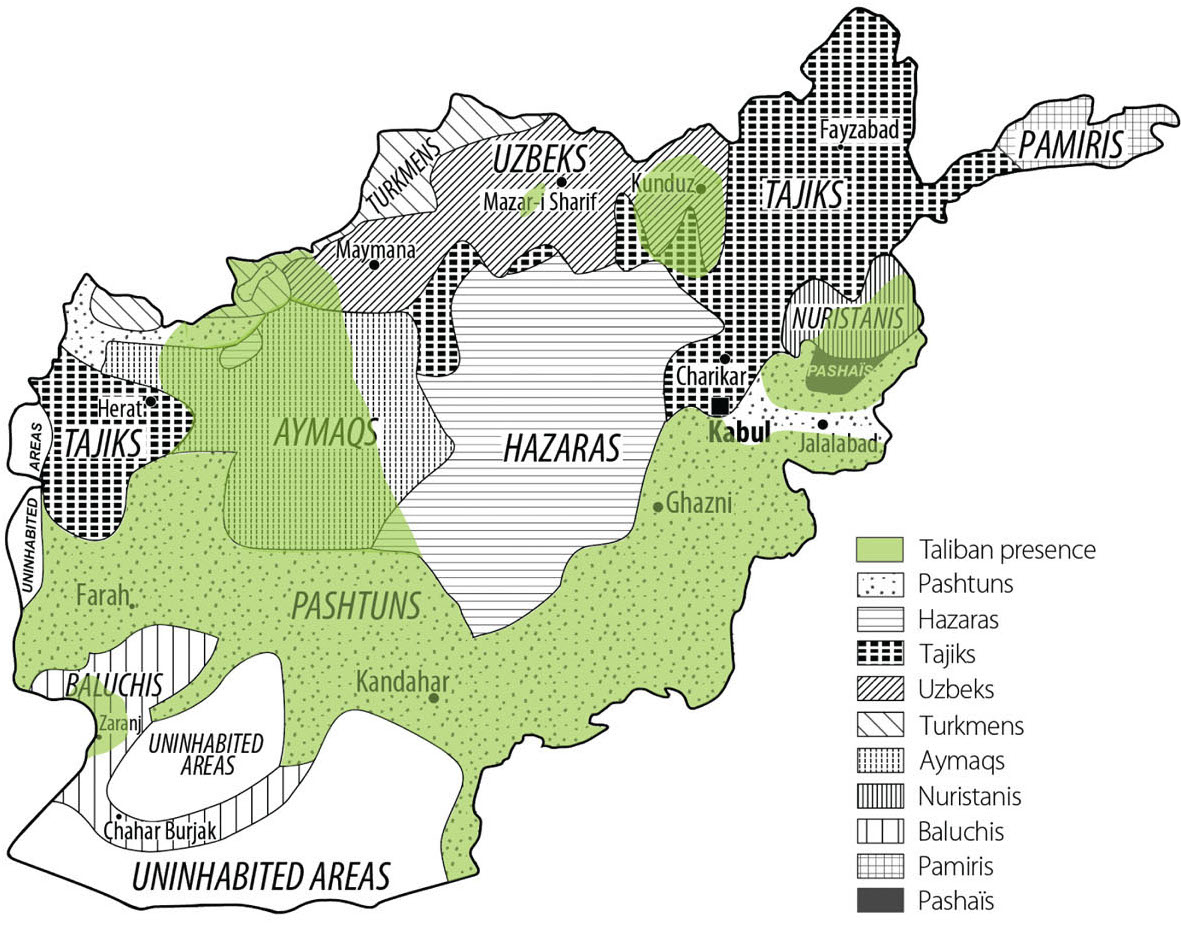
    This is to underscore the degree to which Afghanistan’s current war (the war that began when the US and allies invaded in 2001, not the 1979 to 1989 war against the Soviets or the civil wars from 1989 to 2001) is and is not about ethnicity. The Taliban does very broadly, but not exclusively, overlap with the Pashtuns in the south and east. That’s especially important since there are so many Pashtuns just across the border in Pakistan, where the Taliban have major bases of operation. But there are rebel groups besides the Taliban, not all of which are Pashtun. Generally, though, the north of the country is stabler and less violent than the south or east.

  4. The most important parts of the Afghan War, in one map

    The most important parts of the Afghan War, in one map

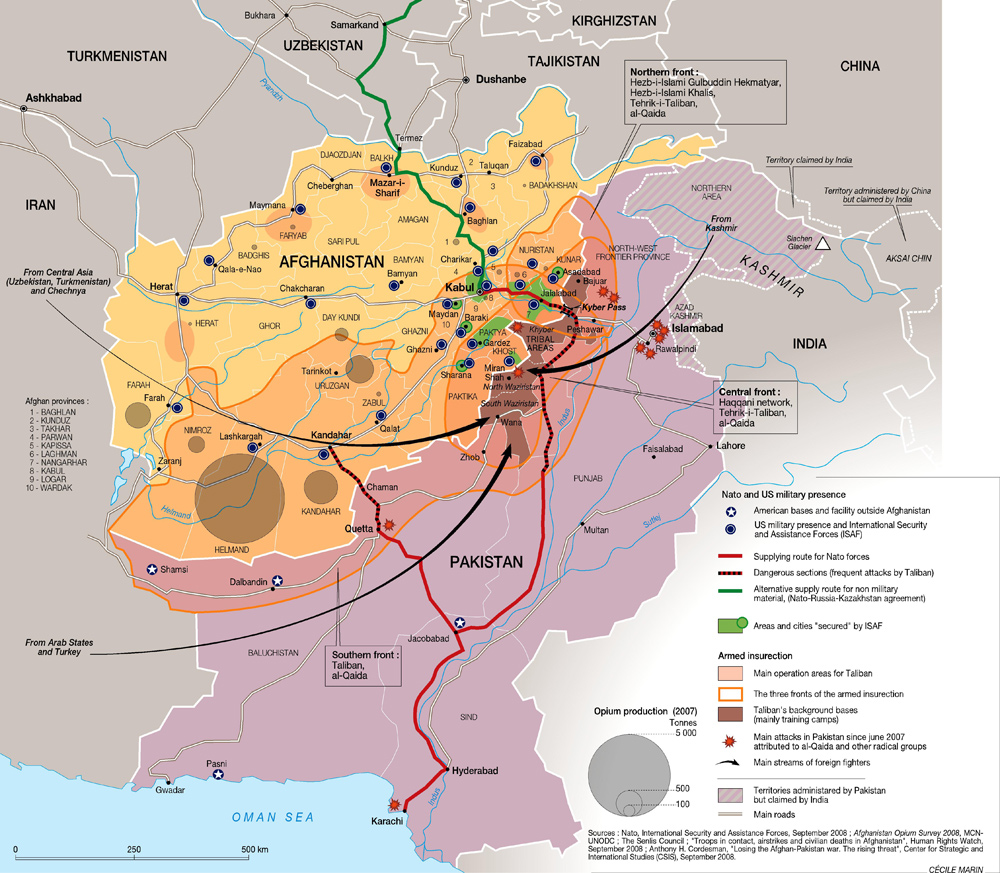
    The Afghanistan War is extremely complicated, but this map does a remarkable job of capturing the most important components: 1) the Taliban areas, in orange overlay; 2) the areas controlled by the US and allies, in depressingly tiny spots of green; 3) the major Western military bases, marked with blue dots; 4) the areas of opium production, which are a big source of Taliban funding, in brown circles, with larger circles meaning more opium; 5) the supply lines through Pakistan, in red, which Pakistan has occasionally shut down and come under frequent Taliban attack; 6) the supply line through Russia, which requires Russian approval. If this map does not depress you about the prospects of the Afghan War, not much will.


Saudi Arabia and Oil

  1. What Saudi Arabia and its neighbors looked like 100 years ago

    What Saudi Arabia and its neighbors looked like 100 years ago

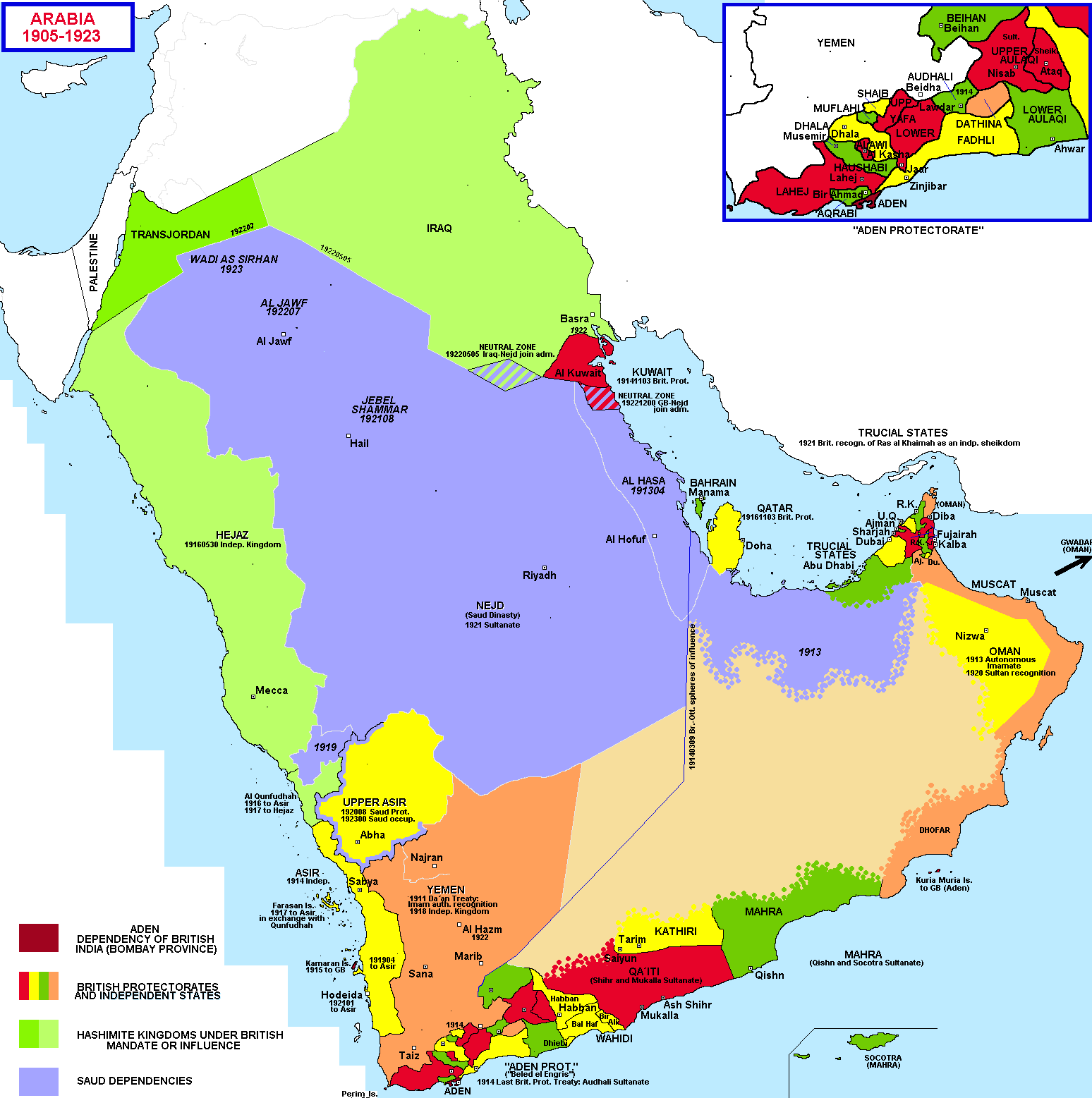
    The Arabian peninsula has a very, very long history, and the Saudi family has controlled much of it since the 1700s. But to understand how the peninsula got to be what it is today, go back about a 100 years to 1905. The Saudis at that point controlled very little, having lost their territory in a series of wars. The peninsula was divided into lots of little kingdoms and emirates. The Ottoman Empire controlled most of them, with the British Empire controlling the southernmost third or so of the peninsula — that line across the middle shows how it was divided. After World War I collapsed the Ottoman Empire, the Saudis expanded to all of the purple area marked here, as the British had promised for helping to fight the Ottomans. (This deal is dramatized in the film Lawrence of Arabia). By the early 1920s, the British effectively controlled almost all of the peninsula, which was divided into many dependencies, protectorates, and mandates. But the Saudis persisted.

  2. Oil and Gas in the Middle East

    Oil and Gas in the Middle East

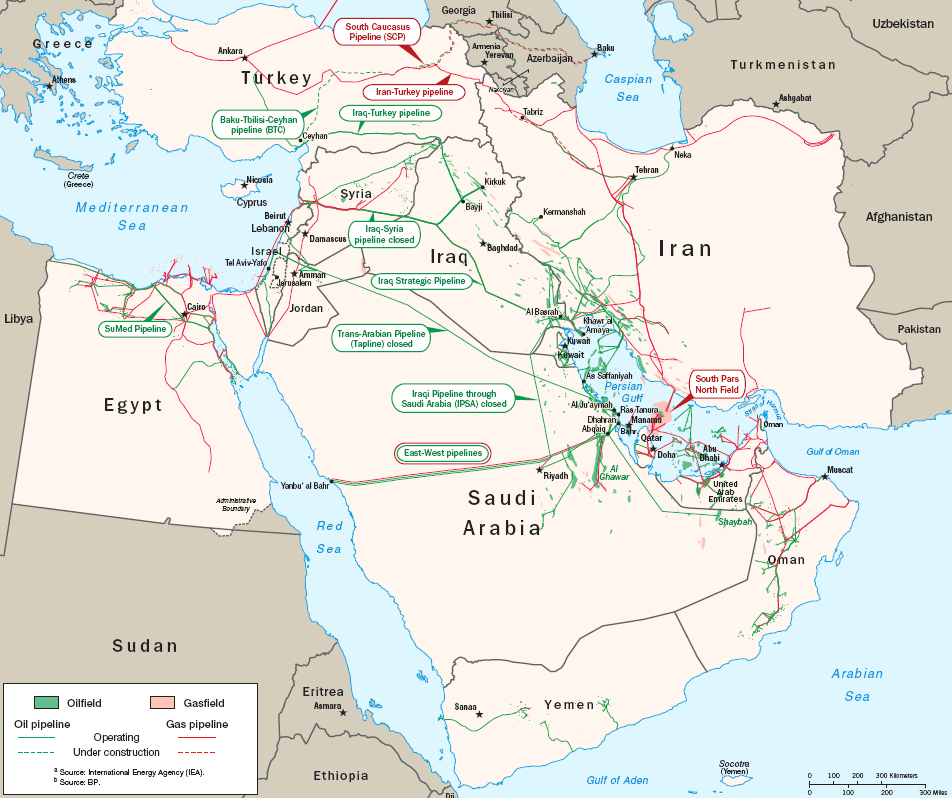
    The Middle East produces about a third of the world’s oil and a tenth of its natural gas. (It has a third of all natural gas reserves, but they’re tougher to transport.) Much of that is exported. That makes the entire world economy pretty reliant on the continued flow of that gas and oil, which just happens to go through a region that has seen an awful lot of conflict in the last few decades. This map shows where the reserves are and how they’re transported overland; much of it also goes by sea through the Persian Gulf, a body of water that is also home to some of the largest reserves in the region and the world. The energy resources are heavily clustered in three neighboring countries that have historically hated one another: Iran, Iraq, and Saudi Arabia. The tension between those three is something that the United States, as a huge energy importer, has been deeply interested in for years: it sided against Iran during the Iran-Iraq war of the 1980s, against Iraq when it invaded Kuwait and threatened Saudi Arabia in the 1990s, again against Iraq with the 2003 invasion, and now is supporting Saudi Arabia in its rapidly worsening proxy war against Iran.

  3. Oil, trade, and militarism in the Strait of Hormuz

    Oil, trade, and militarism in the Strait of Hormuz

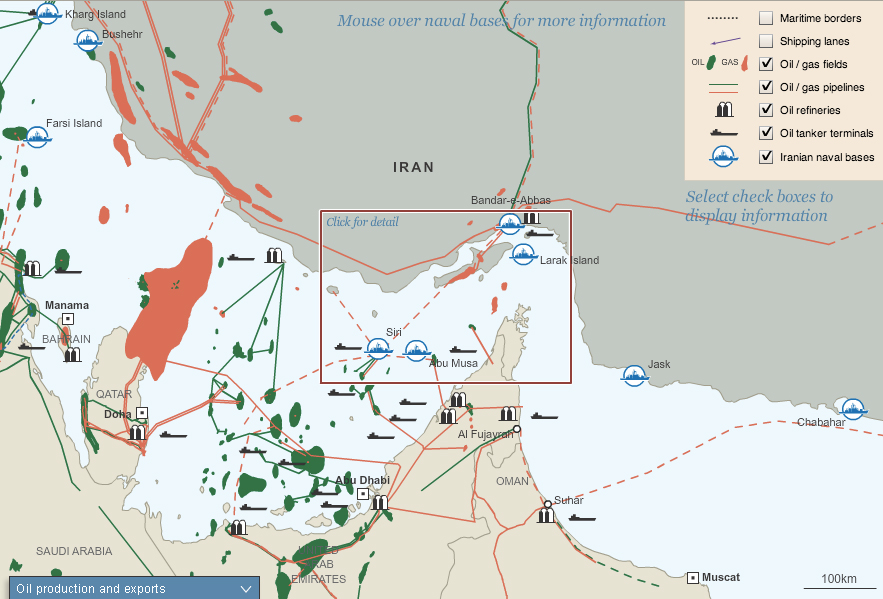
    The global economy depends on this narrow waterway between Iran and the Arabian Peninsula. Ever since President Jimmy Carter issued the 1980 “Carter Doctrine,” which declared that the US would use military force to defend its access to Persian Gulf oil, the little Strait of Hormuz at the Gulf’s exit has been some of the most heavily militarized water on earth. The US installed a large naval force, first to protect oil exports from the brutal Iran-Iraq War of the 1980s, then to protect them from Saddam Hussein in the 1990s Gulf Wars, and now to protect them again from Iran, which has gestured toward shutting down oil should war break out against Israel or the US. As long as the world runs on fossil fuels and there is tension in the Middle East, there will be military forces in the Strait of Hormuz.

  4. Why Egypt’s Suez Canal is so important for the world economy

    Why Egypt’s Suez Canal is so important for the world economy

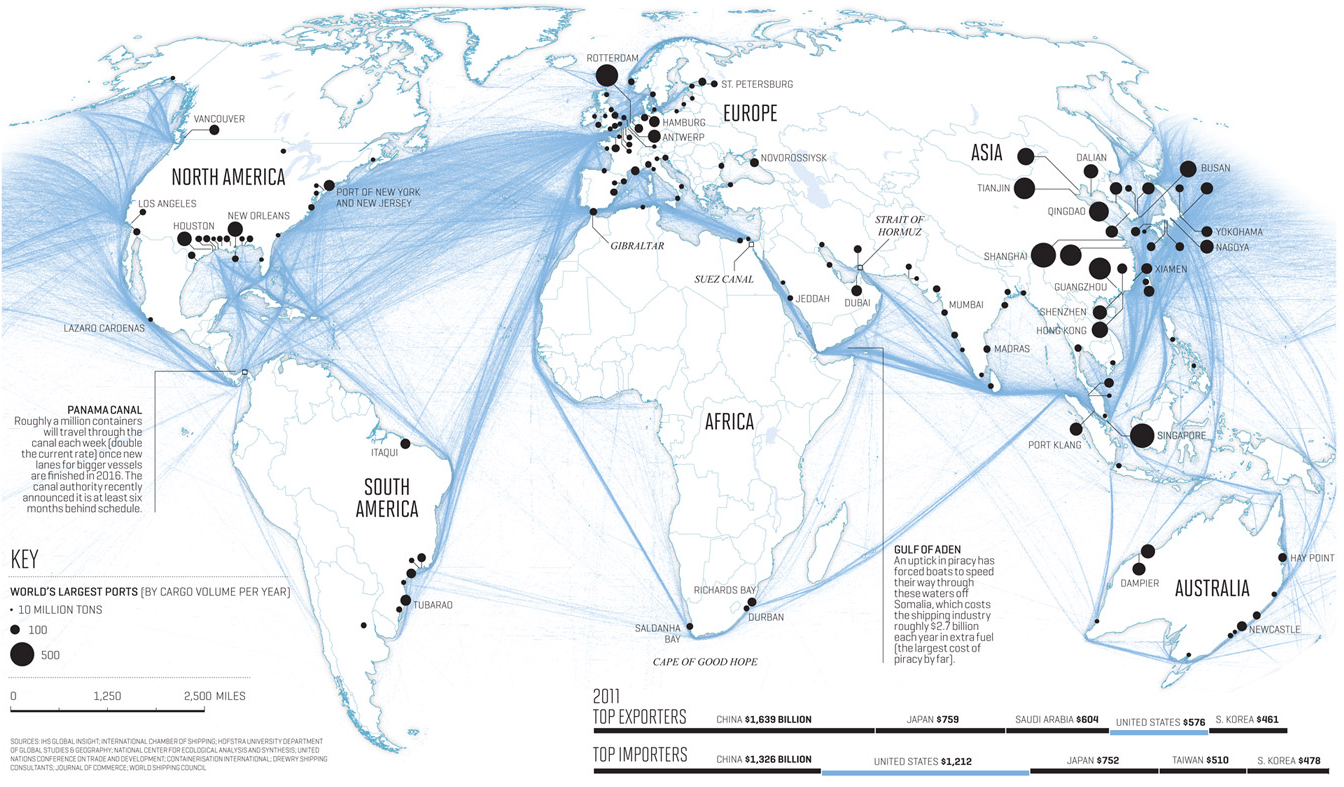
    The Suez Canal changed everything. When Egypt opened it in 1868, after ten years of work, the 100-mile, man-made waterway brought Europe and Asia dramatically and permanently closer. The canal’s significance to the global order was so immediately obvious that, shortly after the British conquered Egypt in the 1880s, the major world powers signed a treaty, which is still in force, declaring that the canal would forever be open to trade and warships of every nation, no matter what. Today, about eight percent of all global trade and three percent of global energy supply goes through the canal.


Iraq and Libya

  1. The ethnic cleansing of Baghdad during the Iraq War

    The ethnic cleansing of Baghdad during the Iraq War

    BBC

    The ethnic cleansing of Baghdad during the Iraq War

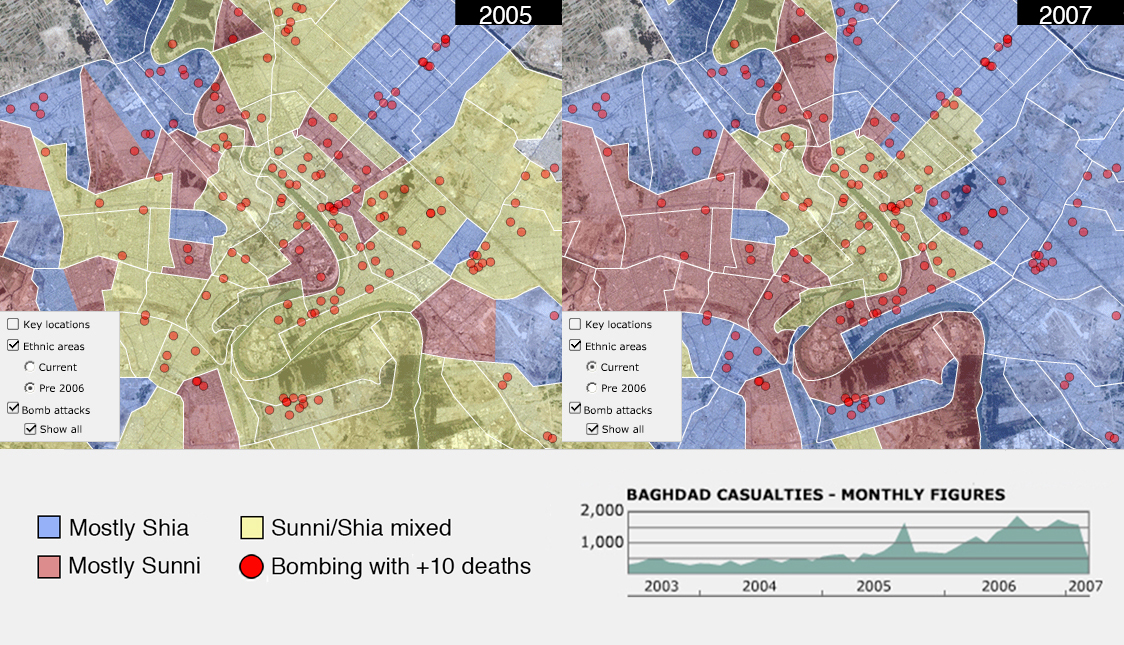
    There are few grimmer symbols for the devastation of the Iraq War than what it did to Baghdad’s once-diverse neighborhoods. The map on the left shows the city’s religious make-up in 2005. Mixed neighborhoods, then the norm, are in yellow. The map on right shows what it looked like by 2007, after two awful years of Sunni-Shia killing: bombings (shown with red dots), death squads, and militias. Coerced evictions and thousands of deaths effectively cleansed neighborhoods, to be mostly Shia (blue) or mostly Sunni (red). Since late 2012, the sectarian civil war has ramped back up, in Baghdad and nationwide.

  2. Where the Kurds are and what Kurdistan might look like

    Where the Kurds are and what Kurdistan might look like

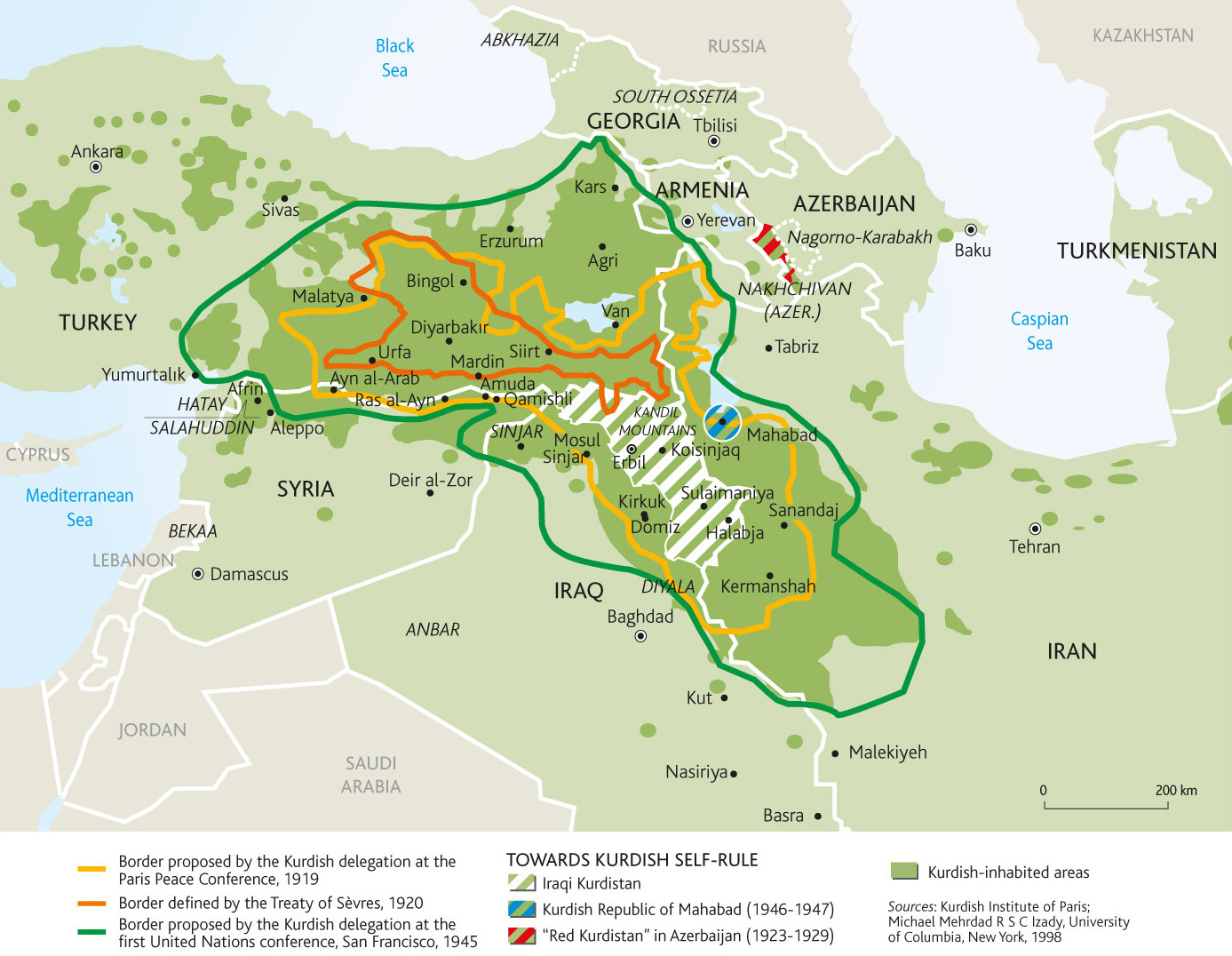
    The ethnic group known as Kurds, who have long lived as a disadvantaged minority in several Middle Eastern countries, have been fighting for a nation of their own for a long time. This map shows where they live in green overlay, and the national borders that they have proposed on three separate occasions, all of them failed. The Kurds have fought many armed rebellions, including ongoing campaigns in Syria and Turkey, and suffered many abuses, from attempted genocides to official bans on their language and culture. Their one major victory in the last century has been in Iraq: as a result of the US-led invasion that toppled Saddam Hussein, Iraqi Kurds have autonomous self-rule in Iraq’s north.

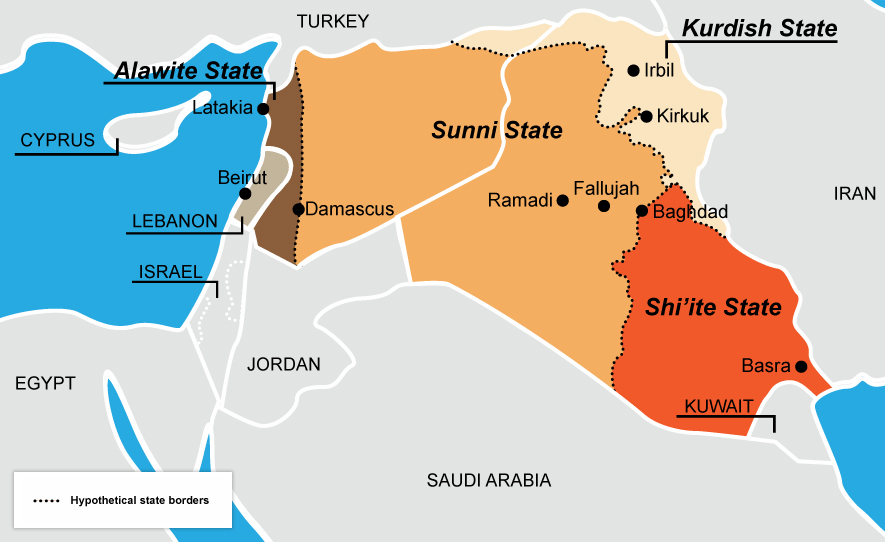
  3. A hypothetical re-drawing of Syria and Iraq

    A hypothetical re-drawing of Syria and Iraq

    This is an old idea that gets new attention every few years, when violence between Sunnis and Shias reignites: should the arbitrary borders imposed by European powers be replaced with new borders along the region’s ever-fractious religious divide? The idea is unworkable in reality and would probably just create new problems. But, in a sense, this is already what the region looks like. The Iraqi government controls the country’s Shia-majority east, but Sunni Islamist extremists have seized much of western Iraq and eastern Syria. The Shia-dominated Syrian government, meanwhile, mostly only controls the country’s Shia- and Christian-heavy west. The Kurds, meanwhile, are legally autonomous in Iraq and functionally so in Syria. This map, then, is not so much just idle speculation anymore; it’s something that Iraqis and Syrians are creating themselves.

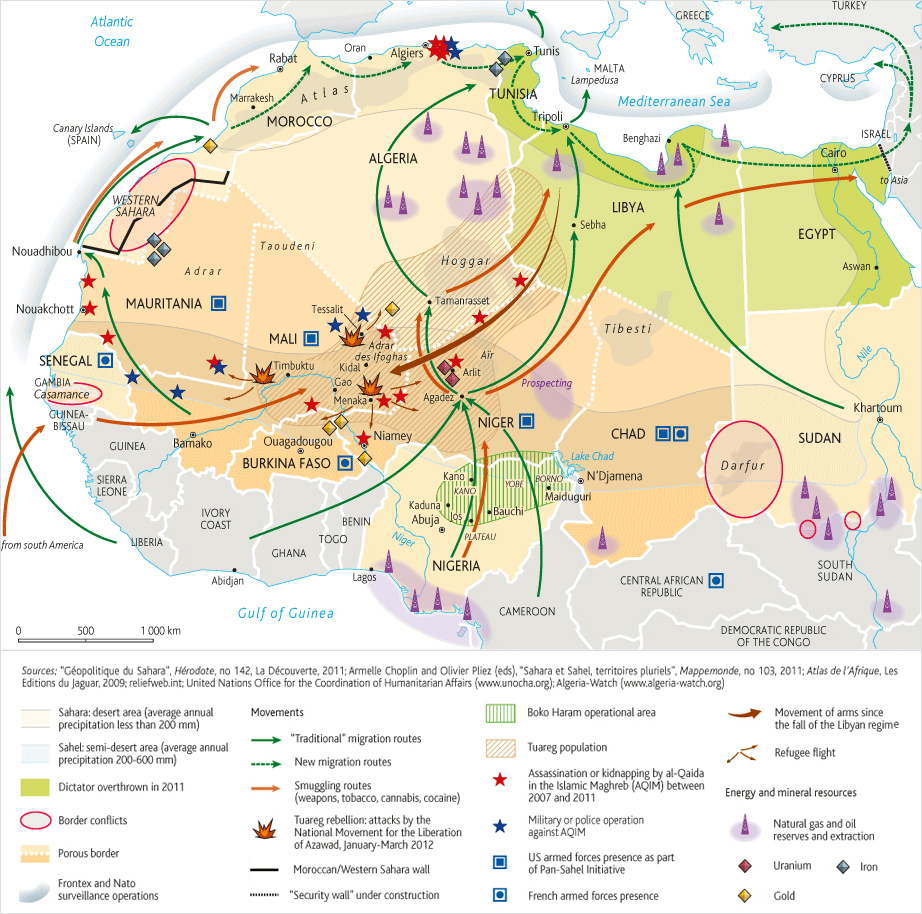
  4. How Libya’s 2011 War changed Africa

    How Libya’s 2011 War changed Africa

    Noble as the cause was, the destruction of Moammar Qaddafi’s dictatorship by a spontaneous uprising and a Western intervention has just wreaked havoc in Africa’s northern half. This map attempts to show all that came after Qaddafi’s fall; that it is so overwhelmingly complex is precisely the point. The place to center your gaze is the patterned orange overlay across Libya, Algeria, Mali, and Niger: this shows where the Tuaregs, a semi-nomadic ethnic minority group, lives. Qaddafi used Libya’s oil wealth to train, arm, and fund large numbers of Tuaregs to fight the armed uprising in 2011. When he fell, the Tuaregs took the guns back out with them to Algeria and Mali, where they took control of territory. In Mali, they led a full-fledged rebellion that, for a time, seized the country’s northern half. Al-Qaeda moved into the vacuum they left, conquering entire towns in Mali and seizing fossil fuel facilities in Algeria. Criminal enterprises have flourished in this semi-arid belt of land known as the Sahel. So have vast migration routes, of Africans looking to find work and a better life in Europe. At the same time, armed conflict is getting worse in Nigeria and Sudan, both major oil producers. Qaddafi’s fall was far from the sole cause of all of this, but it brought just the right combination of disorder, guns, and militias to make everything a lot worse.


Points of Light

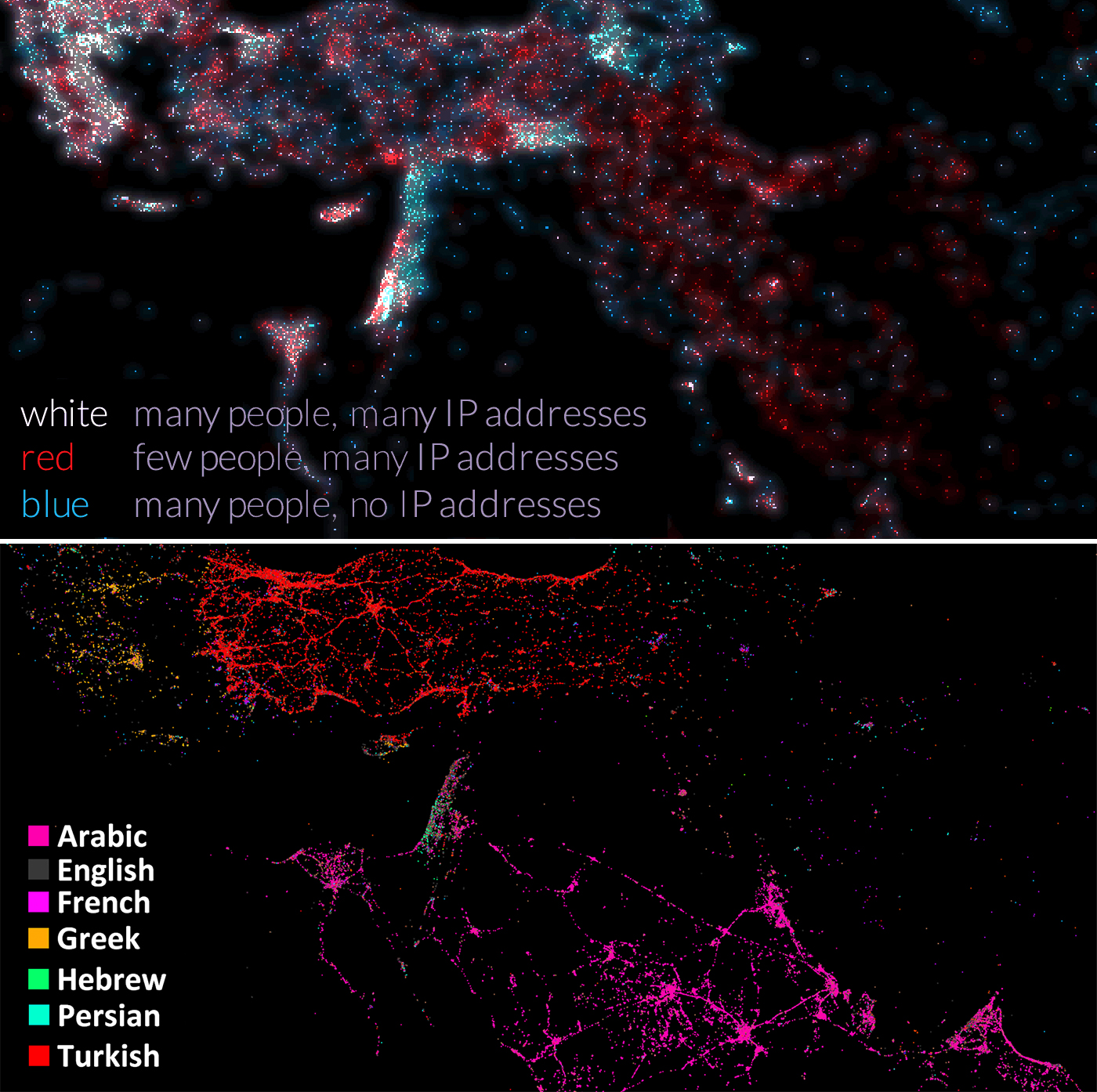
  1. Mapped by Internet connections (top) and by tweets (bottom)

    Mapped by Internet connections (top) and by tweets (bottom)

    Top map: Gregor Aisch; bottom map: Eric Fischer

    Mapped by Internet connections (top) and by tweets (bottom)

    These maps are two ways of looking at a similar thing: the digitalization of the Middle East. The map on top is actually a population map: the dots represent clusters of people, but the dots are colored to show how many IP addresses there are, which basically means how many internet connections. The blue areas have lots of people but few connections: these are the poorer areas, such as Yemen, Pakistan, and Syria. White and red show where there are lots of connections: rich countries like Israel and the United Arab Emirates, but also parts of Egypt and Iran and Turkey, the populations of which are increasingly wired, to tremendous political consequence. The map on the bottom shows tweets: lots of dots mean lots of tweets from that area. They’re colored by language. Notice where these two maps are different: Iran has lots of internet connections but almost no tweets; like Facebook, Twitter has been banned since the 2009 anti-government protests. Saudi Arabia, on the other hand, lights right up: its modestly sized population is remarkably wired. The significance of that became clear, for example, with the 2012 and 2013 social media-led campaigns by Saudi women to drive en masse, in protest of the country’s ban on female drivers. The consequences of internet access and lack of access will surely continue to be important, and perhaps hard to predict, for the region.

  2. The Middle East at night from space

    The Middle East at night from space

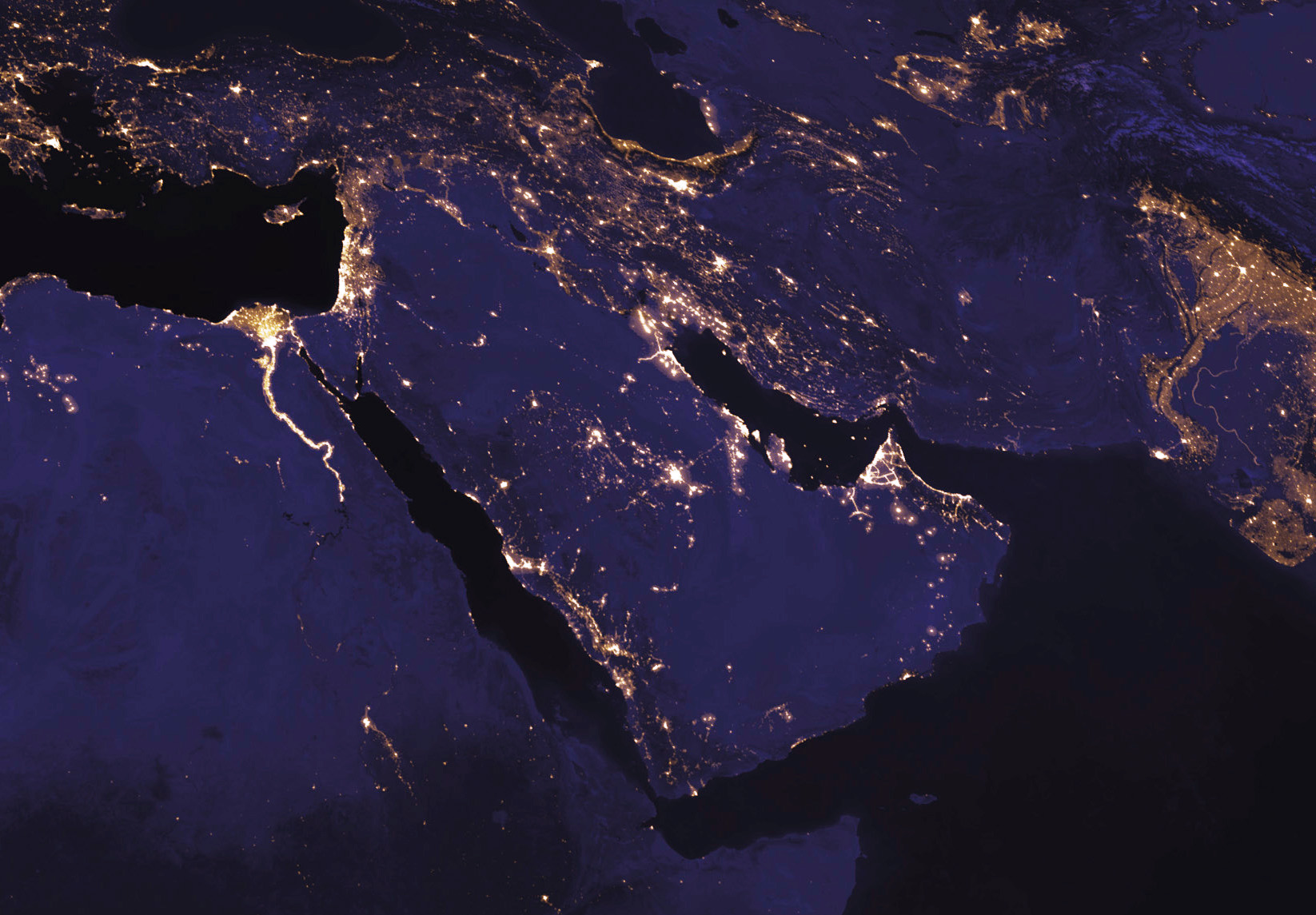
    I’m concluding with this map to look at the region without political borders, without demographic demarcations of religion or ethnicity, without markers of conflict or oil. Looking at the region at night, from space, lets those distinctions fall away, to see it purely by its geography and illuminated by the people who call it home. The lights trace the rivers that have been so important to the Middle East’s history, and the world’s: the Nile in Egypt, the Tigris and Euphrates that run through Iraq and Syria, the Indus in Pakistan. They also show the large, and in many cases growing, communities along the shores of the Persian Gulf, the eastern Mediterranean, and the southern end of the Caspian. It’s a beautiful view of a really beautiful part of the world.

Patton’s Tank Wars Re-Do VS. Russia

How the Pentagon is Preparing for a Tank War With Russia

When Lt. Gen. H.R. McMaster briefs, it’s like Gen. Patton giving a TED talk — a domineering physical presence with bristling intellectual intensity.


DefenseOne: These days, the charismatic commander of the U.S. Army’s Training and Doctrine Command is knee-deep in a project called The Russia New Generation Warfare study, an analysis of how Russia is re-inventing land warfare in the mud of Eastern Ukraine. Speaking recently at the Center for Strategic and International Studies in Washington, D.C., McMaster said that the two-year-old conflict had revealed that the Russians have superior artillery firepower, better combat vehicles, and have learned sophisticated use of UAVs for tactical effect. Should U.S. forces find themselves in a  land war with Russia, he said, they would be in for a rude, cold awakening.

“We spend a long time talking about winning long-range missile duels,” said McMaster. But long-range missiles only get you through the front door. The question then becomes what will you do when you get there.

“Look at the enemy countermeasures,” he said, noting Russia’s use of nominally semi-professional forces who are capable of “dispersion, concealment, intermingling with civilian populations…the ability to disrupt our network strike capability, precision navigation and timing capabilities.” All of that means “you’re probably going to have a close fight… Increasingly, close combat overmatch is an area we’ve neglected, because we’ve taken it for granted.”

So how do you restore overmatch? The recipe that’s emerging from the battlefield of Ukraine, says McMaster, is more artillery and better artillery, a mix of old and new.

Cross-Domain Fires

“We’re out-ranged by a lot of these systems and they employ improved conventional munitions, which we are going away from. There will be a 40- to 60-percent reduction in lethality in the systems that we have,” he said. “Remember that we already have fewer artillery systems. Now those fewer artillery systems will be less effective relative to the enemy. So we need to do something on that now.”

To remedy that, McMaster is looking into a new area called “cross domain fires,” which would outfit ground units to hit a much wider array of targets. “When an Army fires unit arrives somewhere, it should be able to do surface-to-air, surface-to-surface, and shore-to-ship capabilities. We are developing that now and there are some really promising capabilities,” he said.

While the full report has not been made public, “a lot of this is available open source” said McMaster, “in the work that Phil Karber has done, for example.”

Seven platoons from 6 NATO nations (Denmark, Germany, Italy, Poland, Slovenia and the United States) are participating in the Strong Europe Tank Challenge at Grafenwoehr Training Area, Germany May 10-13, 2016.

Karber, the president of the Potomac Foundation, went on a fact-finding mission to Ukraine last year, and returned with the conclusion that the United States had long overemphasized precision artillery on the battlefield at the expense of mass fires. Since the 1980s, he said last October, at an Association for the United States Army event, the U.S. has given up its qualitative edge, mostly by getting rid of cluster munitions.

Munitions have advanced incredibly since then. One of the most terrifying weapons that the Russians are using on the battlefield are thermobaric warheads, weapons that are composed almost entirely of fuel and burn longer and with more intensity than other types of munitions.

“In a 3-minute period…a Russian fire strike wiped out two mechanized battalions [with] a combination of top-attack munitions and thermobaric warheads,” said Karber. “If you have not experienced or seen the effects of thermobaric warheads, start taking a hard look. They might soon be coming to a theater near you.”

Karber also noted that Russian forces made heavy and integrated use of electronic warfare. It’s used to identify fire sources and command posts and to shut down voice and data communications. In the northern section, he said, “every single tactical radio [the Ukrainian forces] had was taken out by heavy Russian sector-wide EW.” Other EW efforts had taken down Ukrainian quadcopters. Another system was being used to mess with the electrical fuses on Ukrainian artillery shells, ”so when they hit, they’re duds,” he said.

Karber also said the pro-Russian troops in Donbas were using an overlapping mobile radar as well as a new man-portable air defense that’s “integrated into their network and can’t be spoofed by [infrared] decoys” or flares.

Combat Vehicles and Defenses

The problems aren’t just with rockets and shells, McMaster said. Even American combat vehicles have lost their edge.

“The Bradley [Fighting Vehicle] is great,” he said, but “what we see now is that our enemies have caught up to us. They’ve invested in combat vehicles. They’ve invested in advanced protective systems and active protective systems. We’ve got to get back ahead on combat vehicle development.”

If the war in Eastern Ukraine were a real-world test, the Russian T-90 tank passed with flying colors. The tank had seen action in Dagestan and Syria, but has been particularly decisive in Ukraine. The Ukrainians, Karber said, “have not been able to record one single kill on a T-90. They have the new French optics on them. The Russians actually designed them to take advantage of low light, foggy, winter conditions.”

What makes the T-90 so tough? For starters, explosive reactive armor. When you fire a missile at the tank, its skin of metal plates and explosives reacts. The explosive charge clamps the plates together so the rocket can’t pierce the hull.

But that’s only if the missile gets close enough. The latest thing in vehicle defense is active protection systems, or APS, which automatically spot incoming shells and target them with electronic jammers or just shoot them down. “It might use electronics to ‘confuse’ an incoming round, or it might use mass (outgoing bullets, rockets) to destroy the incoming round before it gets too close,” Army director for basic research Jeff Singleton told Defense One in an email.

The T-90’s active protective system is the Shtora-1 countermeasures suite. “I’ve interviewed Ukrainian tank gunners,” said Karber. “They’ll say ‘I had my [anti-tank weapon] right on it, it got right up to it and then they had this miraculous shield. An invisible shield. Suddenly, my anti-tank missile just went up to the sky.’”

The Pentagon is well behind some other militaries on this research. Israeli forces declared its Trophy APS operational in 2009, integrated it onto tanks since 2010, and has been using it to protect Israeli tank soldiers from Hamas rockets ever since.

Singleton said the United States is looking to give its Abrams tank the Trophy, which uses buckshot-like guns to down incoming fire without harming nearby troops.

The Army is also experimenting with the Israeli-made Iron Curtain APS for the Stryker, which works similarly, and one for the Bradley that has yet to be named. Raytheon has a system called the Quick Kill that uses a scanned array radar and a small missile to shoot down incoming projectiles.

Anti-Drone Defenses

One of the defining features of the war in Eastern Ukraine is the use of drones by both sides, not to target high-value terrorists but to direct fire in the same way forces used the first combat aircraft in World War I.

The past has a funny way of re-inventing itself, says McMaster.

“I never had to look up in my whole career and say, ‘Is it friendly or enemy?’ because of the U.S. Air Force. We have to do that now,” said McMaster. “Our Air Force gave us an unprecedented period of air supremacy…that changed the dynamics of ground combat. Now, you can’t bank on that.”

Pro-Russian forces use as many as 16 types of UAVs for targeting.

Russian forces are known to have “a 90-kilometer [Multiple Launch Rocket System] round, that goes out, parachute comes up, a UAV pops out, wings unfold, and they fly it around, it can strike a mobile target” said Karber, who said he wasn’t sure it had yet been used in Ukraine.

Karber’s track record for accuracy is less than perfect, as writer Jeffrey Lewis has pointed out in Foreign Policy. At various points, he has inflated estimates of China’s nuclear arsenal from some 300 weapons (based on declassified estimates) to 3,000 squirreled away in mysterious tunnels, a claim that many were able to quickly debunk. In 2014, he helped pass photos to Sen. James Inhofe of the Senate Armed Services Committee that purported to be recent images of Russian forces inside Ukraine. It turned out they were AP photographs from 2008.

“In the haste of running for the airport and trying to respond to a last-minute request with short time fuse,” Karber said by way of explanation, “I made the mistake of believing we were talking about the same photos … and it never occurred to me that the three photos of Russian armor were part of that package or being considered.”

No Foolproof Technological Solution

All of these technologies could shape the future battlefield, but none of them are silver bullets, nor do they, in McMaster’s view, offset the importance of human beings in gaining territory, holding territory, and changing facts on the ground to align with mission objectives.

As the current debate about the authorization for the use of force in Iraq shows, the commitment of large numbers of U.S. ground troops to conflict has become a political nonstarter for both parties. In lieu of a political willingness to put troops in the fight, multi-sectarian, multi-ethnic forces will take the lead, just as they are doing now in Iraq and Syria.

“What’s necessary is political accommodation, is what needs to happen, if we don’t conduct operations and plan campaigns in a way that gets to the political accommodation,” he said. “The most important activity will be to broker political ceasefires and understandings.”

Sometimes that happens at the end of a tank gun.

How Many Times did Russia Buzz the U.S.?

Navy releases nearly two dozen videos of Russian jets, helicopter buzzing USS Donald Cook

PilotonLine:The Navy has released new video of two Russian jets buzzing the USS Donald Cook in the Baltic Sea last month, as well as video of a Russian helicopter circling the destroyer.

Russia 1

Russia 2

Russia 3

The Navy released nearly two dozen videos of the incident in response to a Freedom of Information Act request from The Virginian-Pilot. The Navy had previously uploaded four videos to YouTube of two Russian Su-24 jets making close-range, low-altitude passes near the ship on April 11 and 12.

The newly released videos show additional angles and commentary from sailors. At one point, a sailor is heard saying “Oh my God” as the jets pass close by. The Russian jets repeatedly flew next to and over the Donald Cook in what the Navy says was a simulated attack profile and didn’t respond to repeated safety advisories issued in English and Russian.

The Navy criticized the passes by the jets and the KA-27 Helix helicopter. The Russian jets appeared unarmed and the helicopter’s crew was seen photographing the Donald Cook.

“We have deep concerns about the unsafe and unprofessional Russian flight maneuvers,” the Navy said in an April 13 statement about the incident. “These actions have the potential to unnecessarily escalate tensions between countries and could result in a miscalculation or accident that could cause serious injury or death.”

Russia’s Defense Ministry in April said the Navy’s criticism was “not consistent with reality” and that the Russian aircraft had “performed strictly in accordance with the international regulations on the use of airspace.”

The Donald Cook was based in Norfolk until 2014, when it moved to Rota, Spain. A Russian Su-24 Fencer attack aircraft repeatedly flew near the Donald Cook in the Black Sea that year.

The U.S. Navy has released more photographs, taken from aboard USS Donald Cook, an Arleigh Burke-class guided-missile destroyer that was buzzed by Russian Su-24M attack aircraft on Apr. 12.

Although quite provocative, the low passes that the Russian Sukhois performed near the ship (within 1,000 feet once coming as close as 30 feet to the destroyer) had little to be worried about: the aircraft depicted in the photographs are unarmed Sukhoi Su-24M bombers, most probably conducting “simulated attacks” on the American warship at sea.

According to the Russian MoD the Fencers skirted the Donald Cook in international waters some 70 km from a Russian Navy base.

Aviationist: For sure, close encounters at sea occur: in April 2014, when a Russian Su-24MR, flew within 1,000 yards of the USS Donald Cook, that was operating in the Black Sea following the crisis in Ukraine: a show of force considered  “provocative and inconsistent with international agreements.”

On Mar. 3, 2015, Russian Su-30s and Su-24s aircraft from Russia’s Black Sea Fleet based in Crimea conducted attack runs on NATO warships operating in the Black Sea “to practice penetrating anti-air systems.”

On Oct. 27, 2015, USS Ronald Regan, sailing in international waters east of the Korean peninsula, had to scramble four Hornets after two Russian Navy Tu-142 Bear aircraft flew within a nautical mile of the U.S. Navy nuclear-powered aircraft carrier.

In 2008, USS Nimitz operating in the Pacific had to launch some Hornets to intercept and escort two Tu-95s approaching the carrier.

So, such close encounters have occurred since the Cold War and they have never really escalated even though there are rumors of U.S. Navy officers facing active jamming activities by some Russian planes in the past.

Nothing special then. At least, until something more happens…

Image credit: U.S. Navy

Russia’s Other War, Cyber


Finding weakness and exploiting it in the cyber realm is hidden warfare, few speak about. For the West, Russia tops the list. China, Iran and North Korea are also on the short list. For Russia’s other targets, the Baltic States are in the Russian target list.

CBS: The U.S. has elevated its appraisal of the cyber threat from Russia, the U.S. intelligence chief said Thursday, as he delivered the annual assessment by intelligence agencies of the top dangers facing the country.

“While I can’t go into detail here, the Russian cyber threat is more severe than we had previously assessed,” James Clapper, the director of national intelligence, told the Senate Armed Services Committee, as he presented the annual worldwide threats assessment.

As they have in recent years, U.S. intelligence agencies once again listed cyber attacks as the top danger to U.S. national security, ahead of terrorism. Saboteurs, spies and thieves are expanding their computer attacks against a vulnerable American internet infrastructure, chipping away at U.S. wealth and security over time, Clapper said.

Russia ‘was behind German parliament hack’

BBC: Germany’s domestic intelligence agency has accused Russia of being behind a series of cyber attacks on German state computer systems.

The BfV said a hacker group thought to work for the Russian state had attacked Germany’s parliament in 2015.

This week it emerged that hackers linked to the same group had also targeted the Christian Democratic Union party of Chancellor Angela Merkel.

Russia has yet to respond publicly to the accusations made by the BfV.

Sabotage threat

BfV head Hans-Georg Maassen said Germany was a perennial target of a hacker gang known as Sofacy/APT 28 that some other experts also believe has close links with the Russian state. This group is believed by security experts to be affiliated with the Pawn Storm group that has been accused of targeting the CDU party.

The Russian Cyber Threat: Views from Estonia

Tensions between Russia and its adversaries in the West are escalating. In recent years, Russia has undermined the security of its neighbors by violating their land borders, crossing into their airspace unannounced and harassing them above and below sea level. Less noticed or understood, however, are Moscow’s aggressive actions in cyberspace. The small Baltic country of Estonia—a global leader in digital affairs—is well-placed to shed light on the tactical and strategic aspects of Russia’s offensive computer network operations.

In fact, three civilian and intelligence agencies responsible for cyber security—the Estonian Information System Authority, Internal Security Service and Information Board—recently issued reports that help put together different pieces of the puzzle. The conclusion is that “in cyberspace, Russia is the source of the greatest threat to Estonia, the European Union and NATO.” Now policymakers on both sides of the Atlantic must decide what to do about it.

Russia has been developing and employing offensive cyber capabilities for years. Russian cyber threat groups consist of professional, highly skilled practitioners whose daily jobs are to prepare and carry out attacks. And they don’t go after low-hanging fruit; instead, they receive specific orders on which institutions to target and what kind of information is needed. Criminals, hacktivists, spies and others linked to Russian strategic interests are usually well-financed, persistent and technologically advanced. They have a wide range of tools and resources, including the ability to carry out denial-of-service attacks, develop sophisticated malware and exploit previously unknown software vulnerabilities. Russian threat actors cloak their identities by using remote servers and anonymizing services. They target everything from the mobile devices of individuals to the IT infrastructure of entire government agencies.

Often, Russian threat actors map target networks for vulnerabilities and conduct test attacks on those systems. After carrying out reconnaissance, they conduct denial-of-service attacks or try to gain user access. Common techniques include sending emails with malicious attachments, modifying websites to infect visitors with malware and spreading malware via removable media devices like USB drives. Once inside, they continue to remotely map networks, attempt to gain administrator-level access to the entire network and extract as much sensitive data as possible. Such access also lets them change or delete data if that’s what the mission requires. They’ll often go after the same targets for years to get what they need. They have the confidence that comes from perceived anonymity and impunity; if they make a mistake or fail, they’ll simply try again.

These tactical activities are carried out in pursuit of strategic objectives. In the long term, this includes undermining and, if possible, helping to dissolve the EU and NATO. Moscow also aims to foster politically divided, strategically vulnerable and economically weak societies on its periphery in order to boost its own ability to project power and influence on those countries’ decisions. Russian cyber threat actors help by stealing military, political or economic data that gives Russia advantages in what it sees as the zero-sum game of foreign relations. The exfiltrated data can be used to recruit intelligence agents or provide economic benefits to its companies. Cyber capabilities can also be used to carry out influence operations that undermine trust between the citizens and the state. Telling examples of that strategy include its multi-week distributed-denial-of-service (DDoS) attacks against Estonia in 2007, its coordinated attacks against Ukraine’s 2014 presidential elections and the false-flag operation against a French telecommunication provider in 2015.

Most worryingly, today’s intelligence operations can enable tomorrow’s military actions. Influence operations, including the use of propaganda and social media, can create confusion and dissatisfaction among the population. Denial-of-service attacks can inhibit domestic and international communication. Coordinated, plausibly deniable attacks on multiple critical national infrastructure sectors can disrupt the provision of vital services such as energy, water, or transportation. This can provide a context for the emergence of “little green men”. Malicious code can be weaponized to hinder military and law enforcement responses. Clearly, cyber capabilities have the potential to be a powerful new tool in the Kremlin’s not-so-new “hybrid warfare” toolbox. With enough resources and preparation, they can be used in attempts to cause physical destruction, loss of life and even to destabilize entire countries and alliances. Such operations could be but a decision or two away in terms of planning, and perhaps several months or years before implementation. What can be done about it?

Preventive and countermeasures exist at the personal, organizational, national and international levels. Individuals should take “cyber hygiene” seriously, since Russian threat actors target both personal and work devices. This includes employing basic security technologies, backing up data, not visiting dubious websites and not opening suspicious emails. Organizations that handle sensitive information should adopt stricter security policies, including for handling of work-related data on personal devices. Information systems managers must be especially vigilant since they are primary targets, and weak personal security on their part may compromise national security. For their part, governments must enact the basics: computer security laws, national cyber strategies, a police focus on cybercrime, national CERTs, public-private partnerships and capable intelligence agencies. They also need continuous training and exercises to keep relevant agencies prepared for their missions. Finally, global cooperation and expeditious exchange of information among cyber security firms, national computer security incident response teams (CSIRTs) and security services are key to identifying Russian attack campaigns and taking defensive countermeasures.

All such countermeasures comprise elements of a deterrence-by-denial strategy that aims to raise the cost of carrying out malicious operations. States have also undertaken diplomatic initiatives to manage the potential instability that could result from the use of weaponized code—namely confidence-building measures, norms of responsible state behavior and attempts to agree on international law. While laudable, none of these have curbed Russian cyber aggression in the short term. For example, Russia’s coordinated December 2015 attack on the Ukrainian electrical grid—highlighted in all three agencies’ reports—was clearly an attack on critical national infrastructure that violated tentative international norms signed by Russia, possibly even while the campaign was being prepared. Defensive and diplomatic countermeasures must be complemented by a cohesive strategy of deterrence-by-punishment by individual countries as well as like-minded allies.

Cyber threat actors with links to Russia (APT28/Sofacy/Pawn Storm, the Dukes/APT29, Red October/Cloud Atlas, Snake/Turla/Uroburos, Energetic Bear/DragonFly, Sandworm Team and others) target NATO members on a daily basis—mainly for espionage and influence operations. But a recent SCMagazineUK article claims that the FSB plans to spend up to $250 million per year on offensive cyber capabilities. “Particular attention is to be paid to the development and delivery of malicious programs which have the ability to destroy the command and control systems of enemy armed forces, as well as elements of critical infrastructure, including the banking system, power supply and airports of an opponent.” Clearly, we had better be prepared.