
Hillary, Emails, Russia, Foundation, Crisis, ALERT

Russia Is Reportedly Set To Release Clinton’s Intercepted Emails

Reliable intelligence sources in the West have indicated that warnings had been received that the Russian Government could in the near future release the text of email messages intercepted from U.S. Presidential candidate Hillary Clinton’s private e-mail server from the time she was U.S. Secretary of State. The release would, the messaging indicated, prove that Secretary Clinton had, in fact, laid open U.S. secrets to foreign interception by putting highly-classified Government reports onto a private server in violation of U.S. law, and that, as suspected, the server had been targeted and hacked by foreign intelligence services.

The reports indicated that the decision as to whether to reveal the intercepts would be made by Russian Federation President Vladimir Putin, and it was possible that the release would, if made, be through a third party, such as Wikileaks. The apparent message from Moscow, through the intelligence community, seemed to indicate frustration with the pace of the official U.S. Department of Justice investigation into the so-called server scandal, which seemed to offer prima facie evidence that U.S. law had been violated by Mrs Clinton’s decision to use a private server through which to conduct official and often highly-secret communications during her time as Secretary of State. U.S. sources indicated that the extensive Deptartment of Justice probe was more focused on the possibility that the private server was used to protect messaging in which Secretary Clinton allegedly discussed quid pro quo transactions with private donors to the Clinton Foundation in exchange for influence on U.S. policy.

The Russian possession of the intercepts, however, was designed also to show that, apart from violating U.S. law in the fundamental handling of classified documents (which Sec. Clinton had alleged was no worse than the mishandling of a few documents by CIA Director David Petraeus or Clinton’s National Security Advisor Sandy Berger), the traffic included highly-classified materials which had their classification headers stripped. Russian (and other) sources had indicated frustration with the pace of the Justice Dept. probe, and its avoidance of the national security aspects of intelligence handling. This meant that the topic would be suppressed by the U.S. Barack Obama Administration so that it would not be a factor in the current U.S. Presidential election campaign, in which President Obama had endorsed Mrs Clinton.

Moscow’s discreet messaging about a possible leak of the traffic, in time to impact the U.S. elections, was designed to pressure faster U.S. legal action on the matter, but was largely due to Russian concerns about possible U.S. strategic policy in the event of a Hillary Clinton presidency.

Apart from the breach of U.S. Federal law in the handling of classified material, the Clinton private server was, according to GIS/Defense & Foreign Affairs analysts, always likely to have been a primary target for foreign cyber warfare interception operations, particularly those of the People’s Republic of China (PRC), Russia, and North Korea (DPRK), but probably also by others, including Iran.


EXCLUSIVE: Cryptic NY Filing Reveals Clinton Foundation’s Millions In Foreign Donations

DCCallerNewsFoundation: Clinton Foundation officials used an obscure New York state charity board filing amendment to disclose that the non-profit received $17.7 million in donations from foreign governments while Hillary Clinton was Secretary of State, the Daily Caller News Foundation has learned.

The specific foreign governments involved and the particular amounts they each gave were not disclosed on the document, entitled “Exhibit A” and filed to the public charity division operated by New York Attorney General Eric Schneidermann, a Democrat. The money was given between 2010 and 2013 when Clinton was America’s chief diplomat.

The amended document included a line that was present in November 2015 when the foundation announced revised federal tax filings for the four years. The line added in January 2016 said: “All other government grants came from foreign governments” with a total figure for each of the four years that equalled $17.7 million.

The foreign donations are still not listed on the financial portion of the foundation’s web site despite a claim in November by the non-profit’s president, Donna Shalala, that “there is nothing to suggest that the foundation intended to conceal the receipt of government grants, which we report on our website.”

Criticism of the the latest revelation concerning Clinton Foundation tax returns came from across the ideological spectrum.

Leslie Lenkowski, an expert on philanthropy who was appointed by former President Bill Clinton in 1993 as a founding director of the Corporation for National and Community Service, a government-operated volunteer organization, told TheDCNF that the Clinton Foundation was “an appearance of a conflict of interest waiting to happen.”

President George W. Bush later appointed Lenkowski to also serve as CEO of the corporation in 2001.

Similarly Sandra Miniutti, vice president of Charity Navigator, which grades and ranks the financial disclosures of charities, said her group expects more transparency, not less from non-profits.

“I think more transparency is better than less and this is an issue that the public is questioning.  Yeah, they should make it a point to be more transparent about it and share that information,” she told TheDCNF.

Former U.S. Attorney Joseph DiGenova told TheDCNF that the foundation’s failure to break out foreign government donations specifically was part of an effort to “protect” Clinton while she headed the Department of State.

“There is no doubt that the foundation purposely refused to make public certain things as a way of protecting the Secretary of State during her tenure,” DiGenova charged. “The entire process to hide information from the public is completely inconsistent with a public charity.”

DiGenova predicted that “the new revelations will up the ante for the FBI.  This will just add fodder to the ongoing investigation.” The former federal prosecutor also doubted that the $18 million figure was accurate.

“There is no reason to believe that the $18 million figure is complete,” he said, citing the “unreliability” of past foundation accountings. “It may very well be much, much more.”

Cleta Mitchell, a partner in the Washington, D.C. law office of Foley & Lardner LLP who frequently represents conservative nonprofits, slammed the Clintons for “their determination to disguise what they are doing.”

The New York filings also were unusual in that the latest foundation submission constituted a third “official” revised version of the Clinton Foundation’s financial statements for those years.

Clinton officials last November publicly issued a second revision to their Internal Revenue Service form 990 filings that covered the same four years.

At the time, foundation officials revealed at least 29 separate “amendments,” including new revenue numbers and income from Clinton speaking engagements.  But foundation officials did not list dollar amounts from foreign government donations.

During Clinton’s tenure at State, the foundation operated in at least 29 countries, including places that contained rampant corruption such as Nigeria, Uganda, Ukraine, Haiti, Mozambique, China and South Africa.

The amended Exhibit A also revealed how foreign government gifts vastly overshadowed domestic government contributions during her State Department tenure.

In the foundation’s revised 2010 filing, $7.8 million of $8.8 million in all government grants originated from foreign governments, according to the exhibit. In 2011, $2 million of the $3 million were foreign donations.

In 2012, $3.5 million came from foreign governments while only $300,000 came from domestic government sources.  And in 2013, nearly 100 percent of the $4.4 million of the government donations came from overseas governments. Only $23,000 came from U.S. government entities, according to the exhibit.

The disclosures likely will fuel charges by presumptive Republican presidential candidate Donald Trump, who claims Clinton turned her secretaryship into a huge “hedge fund” where “the Russians, the Saudis and the Chinese all gave money to Bill and Hillary and got favorable treatment in return.” Trump demanded that the foundation return $25 million from the Saudis.

Clinton defended the foundation but admitted last week in a Politico interview that in “one or two instances” some foreign donations aiming to influence her office may have “slipped through the cracks.”

A 2008 Memorandum of Understanding between the Clinton Foundation and Valerie Jarrett, then-vice-chairwoman of President-elect Barack Obama’s transition team attempted to limit and in some instances to ban foreign government to the Clinton Foundation and its many projects.

The FBI currently has two criminal investigations involving Clinton and the foundation, with one focused on her use of a private email server located in her New York home to conduct official diplomatic business instead of a secure government communication channel.

The second investigation is focused on allegations of “pay-to-play” efforts in which Clinton traded policy or other official actions in return for contributions by foreign donors to the foundation.

DiGenova and Mitchell were also critical of Schneidermann for his inaction on the foundation’s filing.

“One has to wonder what the New York State Attorney General is doing,” DiGenova said. “He’s a very partisan Democrat.  And it is readily apparent that he intends to do nothing about the Clinton Foundation.”

Mitchell agreed, saying “the Attorney General of New York has a statutory and fiduciary responsibility to conduct an investigation into the Clinton Foundation to determine whether this entity is engaged in fulfilling its charitable mission.”

Neither the Clinton Foundation nor Schneidermann responded to TheDCNF’s request for comment.
NATO Launches CyberSpace Mission

NATO to Recognize Cyberspace as New Frontier in Defense


Nasdaq: BRUSSELS—Allied defense ministers formally recognized cyberspace as a domain of warfare on Tuesday, an acknowledgment that modern battles are waged not only in air, sea and land, but also on computer networks.

The move comes the same day as the Democratic National Committee announced its computers had been hacked by the Russian government. DNC officials said the hackers made off with its opposition research related to Donald Trump, the presumptive Republican nominee for President.

The effort is designed to bolster allies’ cyberdefenses, but also will begin a debate over whether NATO should eventually use cyberweapons that can shut down enemy missiles and air defenses or destroy adversaries’ computer networks.

“This is important to all possible conflicts we can foresee,” he said.

Mr. Stoltenberg declined to address the suspected cyberhack on the Democratic National Committee by the Russian government, and wouldn’t name any potential cyber adversaries, noting that NATO’s cyberdefenses weren’t aimed at any one country. U.S. and allied officials have previously said Russia remains the greatest cyberthreat to the alliance.

Developing capabilities to more quickly attribute responsibility for cyberintrusions and cyberattacks is a priority for the alliance, Mr. Stoltenberg said.

“One of the challenge when it comes to cyber is it is not easy to tell who is attacking you,” he said.

The decision by the ministers will allow the alliance to better coordinate its cyberspace efforts and defenses, Mr. Stoltenberg said.

“This is about developing our abilities and capabilities to protect NATO cyber networks but also to help and assist nations in defending their cyber networks,” he said.

For now, the alliance is focused on defending its own secure networks and helping allies build their cyberdefenses.

Tuesday’s announcement to recognize cyberspace as new sphere of conflict or battleground constitutes a bit of catch- up by the alliance. The U.S. military, for example, has expanded its cyber command, improved its training and developed weaponry and defenses to deploy in cyberspace.

The change comes as the number of cyberattacks against the alliance and member states has been increasing, a senior NATO official said.

By making cyber a warfare domain, NATO will open the door to stepped up military planning, dedicate more officers to cyber operations and better integrate electronic warfare into its military exercises.

Two years ago, at the previous summit in Wales, NATO leaders announced a cyberattack on one ally could trigger the alliance’s collective defense provisions.

Under NATO’s founding treaty, each ally primarily has responsibility for its own defense. But NATO officials acknowledge that the alliance is only as strong as its weakest link, which makes helping nations improve their cyber capabilities a priority.

As part of efforts to counter so-called hybrid warfare threats, the use of covert forces to stir unrest or make military gains, NATO has been pushing member countries to improve their cyberdefenses.

Russia has made cyber and electronic warfare a key part of its military operations. U.S. and allied officials said that Russia has demonstrated its willingness to use such techniques to interfere with the military capabilities of its opponents in Ukraine. Russia denies it is involved militarily in Ukraine.

U.S. officials have said countering Russia’s improving militarily capabilities—such as its advanced missiles and air defenses in the Kaliningrad exclave on the border of Poland and Lithuania—could require cyber capabilities.

“Russia has sophisticated cyber capabilities,” said Vaidotas Urbelis, the defense policy director for the Lithuania ministry of defense. “But, come on, NATO nations have invested a lot in cyber and we have the capacity to defend ourselves.”

On Monday, Douglas Lute, the U.S. ambassador to NATO said cyber operations could be a key part of the alliance’s defense against stepped up Russian advances in anti-access weaponry.

“A networked air defense system can be jammed. It can be disrupted by way of cyber techniques,” Mr. Lute said.

A discussion of additional NATO cyber capabilities—or offensive capabilities—is likely to wait until after the conclusion of the alliance summit in Warsaw next month.

The alliance lags well behind its most militarily advanced members, including the U.S. and Britain, in developing its cyber capabilities. In any potential conflict, the alliance would need to rely on the U.S. and its use of cyber weaponry.

“We welcome the decision to recognize cyber as a domain,” said British Defense Secretary Michael Fallon, adding the U.K. has committed some $2 billion for its own cyberdefenses and capabilities.

The U.S. Army has been increasing its cyberdefense training at its training centers in the U.S. and Europe. A pilot program begun last year has aimed embedding “cyber elements” with tactical units.

“We know a variety of countries have increasing cyber capabilities that can interfere with your communications, your global position and navigating systems, your targeting systems,” said a U.S. defense official.
*****

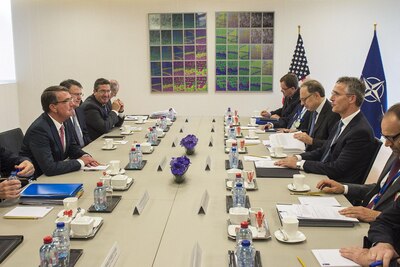
Defense Secretary Ash Carter, left, talks with NATO Secretary General Jens Stoltenberg, right, at NATO headquarters in Brussels, June 14, 2016, during a meeting of NATO defense minister. The two leaders met to discuss matters of mutual importance. DoD photo by Air Force Senior Master Sgt. Adrian Cadiz

Last year saw was a small uptick in defense spending across Europe and Canada, Stoltenberg said. “Our estimates for 2016 show a further increase across NATO’s European allies and Canada,” said he added. “These are only estimates. But they are encouraging.”

The annual real change in NATO defense spending, he said, currently stands at around 1.5 percent, which represents an increase of more than $3 billion.

Plans to Boost Defense Spending

Some 20 NATO allies plan to spend more in real terms on defense this year, Stoltenberg said.

“So, this is real progress,” he said. “After many years of going in the wrong direction, we are starting to go into the right direction.”

With more money comes increased capabilities, Stoltenberg said, noting that NATO has agreed to place four battalions in the eastern nations of the alliance.

“Based on the advice of our military planners, we will agree to deploy by rotation four robust multinational battalions in the Baltic states and in Poland,” he said. “This will send a clear signal that NATO stands ready to defend any ally. More from the Department of Defense.


Europe has an Unaccompanied Children Crisis Too

New World Dis-Order

Unaccompanied child refugees: ‘These children aren’t seen as children’

A network of 30 European NGOs supporting missing and exploited children have come together to tackle the rising problem of missing refugee children

Guardian: Human smugglers increasingly combine smuggling with exploitation and their victims are often children,” says Federica Toscano. “At chaotic border situations, it happens that smugglers deliberately separate refugee children from their parents to exploit them.’’

“We also hear that families at the border between Greece and Macedonia have been forced to ‘pay’ smugglers with one of their children,” continues Toscano. “Smugglers have come to realise they can make much more profit by taking advantage of vulnerable people. And the most vulnerable people are children.”

Toscano is well-placed to know. She works for Missing Children Europe, a network of thirty European NGOs that are active in the field of missing and sexually exploited children. Since its foundation in 2001, MCE has focussed on different groups of missing children (pdf). Half of the cases of children that disappear in Europe are runaways: those who run away from home or institutions after a history of violence or abuse. More than a third are abducted by parents.

Related reading: Invisible refugees: ‘You are the only organisation that has ever visited us’ 

But the most recent category is unaccompanied child refugees. “This group only makes up 2% of cases, which is a low percentage,” says Delphine Moralis, the secretary general of MCE, “but that doesn’t say anything about the magnitude of the problem. These children are seldom reported as missing. That’s why we find it so important to focus on this problem too.’’

Earlier this year Europol stated that at least 10,000 unaccompanied child refugees have gone missing in Europe. A recent EU report warned that these children have become targets for criminal gangs, who exploit them in the sex industry or force them to beg, steal or smuggle drugs.

But MCE believe the true number to be far higher than 10,000. Toscano says that “in Italy alone 5,000 refugee children have gone missing. And Germany reported that in 2015 almost 6,000 of these children have disappeared.’’

The organisation has been aware of the problem for some time. “As far back as 2005 a Belgian study showed that one fourth of unaccompanied children seeking asylum went missing within the first 48 hours upon arrival. So it’s no news to us.”

But for a whole range of reasons, many of these disappearances go unreported. “First of all, there’s no sense of urgency,” explains Toscano. “When a child refugee goes missing, the general assumption is that he or she has a plan, and that the child is resilient. The police and social services don’t feel the same sense of urgency as when the child is from their own country. They are not aware of the risks these children run, that they might fall victim to exploitation. So nothing is really done.’’

The lack of formal procedures when these children disappear is another problem. “Much depends on the goodwill of the single professional involved,” says Toscano. “There is no common system to collect information about missing children in Europe. There are good practices, but they’re very local. So the traffickers just go to another area.’’

MCE was founded fifteen years ago in 2001, when it became clear that European cooperation on this issue was seriously lacking. “I was working for a Belgian NGO at the time when two Belgian girls went missing,” says Moralis. “On the third day of their disappearance a judge called us and said: ‘We have no idea where these children are, they could be anywhere in Europe, we really need your help now.’ There was no other way to tackle the problem but by contacting one by one all the 309 European organisations working in this field. That’s when we realised it was necessary to create a network of contact points for missing children.”

The organisation facilitates training of professionals to respond better to the disappearance of child refugees. It also exerts pressure on European institutions to provide clear rules and legislation to protect these children. This year, MCE has published a handbook (pdf) on good practises to help prevent and respond to unaccompanied children going missing.

“We try to be as practical as possible,” says Toscano. “You can do so much to prevent a child from disappearing. Just a simple example: when a child arrives in a shelter and is given food, he may think he has to pay for it. When he has no money, he will try to escape as soon as possible. Workers should take time to explain everything to the child … Sometimes these children don’t even realise it when they are exploited. Their traffickers tell them all kinds of lies to make them extra vulnerable. They say: watch out for authorities, they will lock you up.’’

They also closely monitor development throughout Europe. Toscano has been collecting information on missing children in Europe through the EU co-funded SUMMIT project (pdf). This included a study into interagency cooperation around unaccompanied migrant children done through surveys and interviews with hotlines for missing children, professionals at refugee reception centres, guardians and law enforcement in the UK, Italy, Greece, Cyprus, Spain, Belgium and Ireland.

As a result they are hearing from the frontlines. “We know that there are networks of child traffickers that operate in different countries,” says Toscano. “For example, when a refugee child has been exploited in Eritrea and claims asylum in the Netherlands, there will be another criminal gang waiting to exploit him there. Traffickers have excellent lines of communication. When a child has a history of trafficking, the risk that he will be trafficked again is very high.”

According to Moralis, the closing of borders means that lots of refugees are stuck in bad conditions: “This makes them more vulnerable and creates more opportunities for criminals. How is it possible that all this is going on in Europe and nobody seems to know where these children are?”

“Our main aim is to raise awareness that these children are children,” says Toscano. “It’s very simple. You’d think that everyone would be aware of this, but it is certainly not the case. Not for authorities, not for members of the civil society, nor for the general public. These children usually aren’t seen as children, but as people who just come here and use resources that we want to use for something else.’’

Russian Govt Hackers broke into DNC, Stole Trump Oppo

They have been inside for a year.

Last month May, ODNI James Clapper already testified to this.

The director of national intelligence on Wednesday said officials had seen signs of attempted cyberattacks on 2016 presidential campaigns.

“We’ve already had some indications of that,” James R. Clapper Jr. said at a cyber-event at the Bipartisan Policy Center in Washington.

He did not indicate whether the attempted intrusions were successful or whether they were by foreign or domestic hackers. Nor did he specify whether the websites or campaign networks of Democratic candidates Hillary Clinton and Bernie Sanders or Republican presumptive nominee Donald Trump were targeted.

“We’re aware that campaigns and related organizations and individuals are targeted by actors with a variety of motivations — from philosophical differences to espionage — and capabilities — from defacements to intrusions,” said Brian P. Hale, director of public affairs for the Office of the Director of National Intelligence. “We defer to FBI for specific incidents.” More here from WaPo.


Russian government hackers broke into DNC servers, stole Trump oppo

The hackers had access to the information for approximately one year.

Politico: Russian government hackers broke into the computer systems of the Democratic National Committee and accessed information about Democratic candidates as well as a database on opposition research against Donald Trump, POLITICO has confirmed.

The Washington Post first reported on Tuesday that the DNC was aware of suspicious activity in April; within 24 hours of the first signals that something was amiss, cyber firm CrowdStrike was brought in to install monitoring software to analyze the details of who was responsible.

The hackers had access to the information for approximately one year but were all cleared out over the last weekend, the Post reported, noting that the DNC said that no personal, financial or donor information had been accessed or taken.

“The security of our system is critical to our operation and to the confidence of the campaigns and state parties we work with,” said Rep. Debbie Wasserman Schultz (D-Fla.), the DNC chairwoman, in a statement. “When we discovered the intrusion, we treated this like the serious incident it is and reached out to CrowdStrike immediately. Our team moved as quickly as possible to kick out the intruders and secure our network.”

A spokesman for the Russian Embassy told the Post that he had no knowledge of the hacking.

Shawn Henry, the president of CrowdStrike, told MSNBC moments after the story broke that the DNC was “very responsive” to the hack.

“They immediately recognized and had a high degree of urgency that this was important by calling us in,” Henry said. “The key piece is moving towards remediation. How are we able to quickly kind of stop the flow of intelligence that’s leaving that network and move the attackers off the network and provide the organization, allow them to build a network that is free from this type of tools that the Russians had put on to the network.”

Henry, former executive assistant director at the FBI, said the DNC contacted his organization through their legal counsel.

“We deployed certain pieces of technology that we use to try to get some visibility into the extent, the depth and breadth of this particular breach. In the course of this, working very closely with the I.T. staff of the DNC, we were able to identify with a very high degree of confidence a group that we have attributed back to the Russian government targeting that DNC network,” Henry said. “We know with certainty my time in the bureau and now at Crowd Strike that foreign intelligence services are constantly interested in political processes. They’re interested in strategies. They’re interested in foreign policy, et cetera. And the DNC and other NGOs that have been targeted over the years by this very, very sophisticated group with a high degree of capability and some very, very sophisticated technology.”


Militant Islam, Obama Admin Forbidden Terms

A distinction needs to be made. Radical extremists are for the force multipliers, those like Anwar al Awlaki. The militants like Mohammed Emwazi are born from the radicals and they are the deadly enforcers of the Islamic doctrine and Sharia.

Don’t blame the FBI for failures, with particular regard to the worst terror attack in American by a gunman, Orlando. Blame the White House. All the Q&A sessions, congressional testimony and press briefings by FBI Director James Comey have had an underlying message, a cry for help, attention and support.

Don’t blame the intelligence community including CENTCOM and the Pentagon for battlefield or rules of engagement failures. That belongs to the entire White House national security team. The Office of National Intelligence has also been affected.

This is not political correctness at all, it is a Barak Obama edict, sensitivity to Islam across our homeland and across the globe. Obama has had a strident mission since he assumed the Oval Office to create a Muslim protective shield. This is beyond dispute.

While not in any chronological order, there are some very key decisions that were made and continue to be made by the Obama administration that affect our national security and this generational war titled the Overseas Contingency Operation.

In April of 2009, Barak Obama delivered ‘The New Beginnings’ speech. In this presentation he spelled out his full agenda in what was to become the long-term mission to elevate Muslims and their organizations at home and globally. The White House objectives have been successful and consequential.

With the new beginning announced, Obama extended his same purpose throughout government agencies, law enforcement and policies as a mandatory doctrine.

‘Just before that Christmas Day attack, in early November 2009, I was ordered by my superiors at the Department of Homeland Security to delete or modify several hundred records of individuals tied to designated Islamist terror groups like Hamas from the important federal database, the Treasury Enforcement Communications System (TECS). These types of records are the basis for any ability to “connect dots.”  Every day, DHS Customs and Border Protection officers watch entering and exiting many individuals associated with known terrorist affiliations, then look for patterns. Enforcing a political scrubbing of records of Muslims greatly affected our ability to do that. Even worse, going forward, my colleagues and I were prohibited from entering pertinent information into the database.’ Philip Haney, The Hill.

Directly after the 9/11 attack, the Bush administration did reach out to the Muslim communities to determine who was with peace and national security and who perhaps gave clues of a larger and hidden condition that could be festering that would prove clues to more domestic security challenges.

Then came the Holyland Foundation trial in 2007/2008. The material facts and conditions of the domestic threat, people, money, collaboration and global consequence all converged in a courtroom in Texas.

During the Holy Land trial, FBI Agent Lara Burns testified in court that CAIR was a front for HAMAS. One trial exhibit submitted by federal prosecutors – and stipulated to by the defense in the case – explained that these organizations were dedicated to a “civilizational-jihadist process” to destroy America from within and replace the Constitution with sharia (Islamic law):

The Ikhwah [Muslim Brotherhood] must understand that their work in America is a kind of grand Jihad in eliminating and destroying the Western civilization from within and “sabotaging” its miserable house by their hands and the hands of the believers so that it is eliminated and God’s religion [Islam] is made victorious over all other religions. (p. 21)

Federal prosecutors specifically cited this internal Muslim Brotherhood planning document as the strategic goal of these U.S.-based Islamic groups – the very same group advising the Obama Administration. The federal judge in the Holy Foundation case agreed with the case presented by the federal prosecutors had made regarding these organizations, stating in one ruling that “the Government has produced ample evidence to establish the associations with CAIR, ISNA and NAIT with HLF…and with HAMAS.” (p. 14-15) More important details here from the CounterjihadReport.

The Department of Justice under Eric Holder was included in the full protection of the terror networks and associated people. Congressman Gohmert of Texas challenged AG Holder to no avail in a chilling exchange.

Here is where the ‘words matter’ material documentation began. The Obama administration took this agenda to new standard.

In 2009, DHS published via the Office of Intelligence and Analysis Assessment a ‘Rightwing Extremism’ document, pinpointing those that may challenge the Obama Muslim doctrine. Additionally, DHS posted The Department of Homeland Security launched a ‘Do’s and Dont’s bulletin.

The entire complexion of the Department of Homeland Security began to change with new personnel and outreach under Secretary Janet Napolitano. The outreach extended to law enforcement agencies of which LAPD demonstrates.

The order to purge documents, training materials and database was made. The proof is here.

Barak Obama was not finished. In 2015, the White House introduced a strategy for CVE, Counter Violent Extremism.

Then comes the foreign policy of Obama. All deference to Iran began before Obama assumed the White House in 2009 and continues today. Secret back channels to Iran using Ambassador Burns began in 2008. Further, there is Iraq and Syria with Islamic State. Documents here on ISIS prove the intelligence and forecasts were known, available and delivered.

This would not be complete without mentioning China, Russia or North Korea where policies are non-existent.

The Paris attack was a slaughter and Obama found it wise to snub the solidarity march with other world leaders.

Obama touted Yemen as one of his successes but the country collapsed. Finally, the Obama policy doctrine crumbled and the cause was fully explained here. Obama wilfully recoiled as he and Hillary did on Benghazi.

It really no longer matters that Barak Obama, Hillary Clinton or John Kerry refuse to use key terms to describe militant Islam, the entire well verse and informed world have defined it for them. What does matter beyond the words are the policies and refusals of missions, strategies and conditions to keep America, her interests and allies safe.

It is no wonder there is no global respect for the Obama administration and there is much less to fear from her.

In summary, Obama owns this terror, owns this jihad and owns the death as well as the genocide. This is his legacy, he owns it as his own scarlet letter.