Iran Buying War Torn Syria Real Estate, Pipelines Abound

Damascus, Syria is known as the city of Jasmine. It is rich in religious history including Christians, Jews and Muslims. If there is any question about how Iran is advancing their power in the region to include Syria and eventually erasing history, then read on.

Now?  AFP

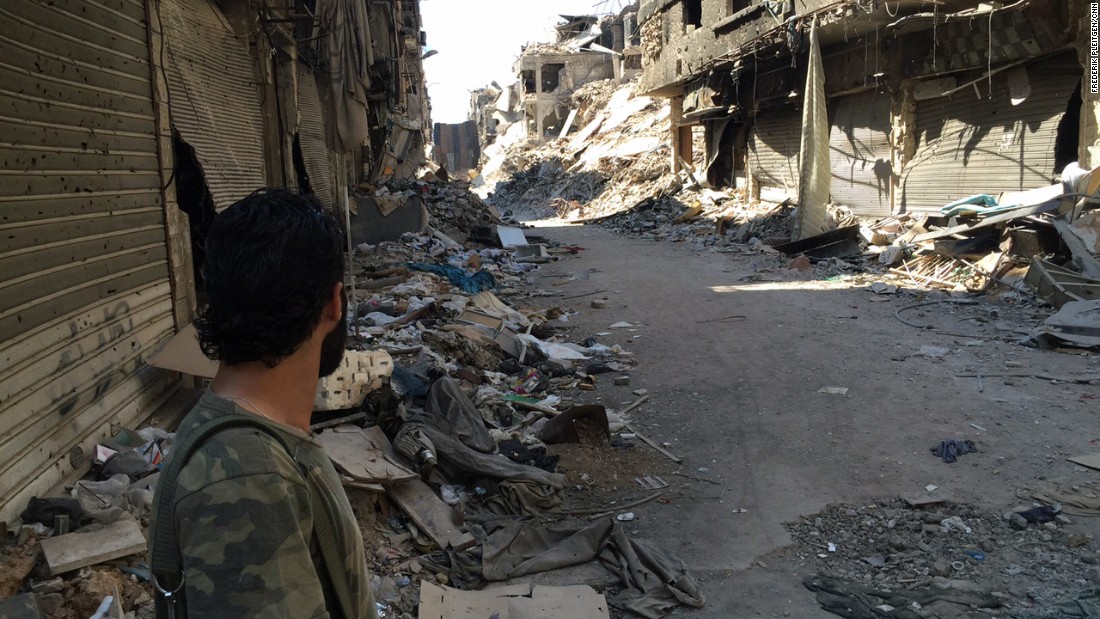
BEIRUT: Syrian government forces fired rockets at a rebel-held area on Damascus’s outskirts on Sunday, pressing an attack that began the day before and has killed up to 16 people, a medical worker and war monitors said.
The medical worker and the Syrian Observatory for Human Rights said it was the biggest attack on the Qaboun area, to the city’s northeast, in at least two years.
At least three shells hit government-held areas closer to the center of Damascus and near Qaboun on Sunday, but there were no reports of casualties, a Hezbollah-run military media unit and a Reuters witness said.
On Saturday, a government sniper killed one person in the area and rockets hit a cemetery on Qaboun’s outskirts, the medical worker, who asked not to be named, told Reuters.
The British-based Observatory also reported attacks on a cemetery.
Reuters could not independently verify the accounts.
There was no immediate government comment on the Damascus fighting.
The Observatory said 16 people had died in the violence around Qaboun since Saturday, the highest death toll from fighting there for more than two years.
The medical worker in nearby Eastern Ghouta, just outside Damascus, said at least 13 people had died. He said he could hear explosions coming from Qaboun early on Sunday.
Violence in western Syria has increasingly tarnished a shaky cease-fire which took effect on Dec. 30, backed by Damascus ally Russia and Turkey, which supports rebels.

*** Related image
The Syrian Commission for Media has issued a report regarding purchases and long-term renting carried out by figures with close ties to the Syrian regime, including Abdullah Nazzam, Iran’s man in Syria. Real estate offices in Damascus have confirmed Nazzam’s unprecedented activity in buying property in capital.

Reports from Damascus and Tehran said that Iran’s men have expanded their purchase activities to include a number of properties in the capital since last June.

The activities of pro-regime businessmen in the purchase of real estate were largely limited to areas of eastern Damascus, namely the Old City, but after June, Abdullah Nazzam expanded his sights on the entire capital.

In addition, the Iranians have also increased their purchasing activities in Eastern Ghouta, largely in Maliha, which is owned by the state, making it easier for the Iranians to circumvent local Syrian laws, especially after the decline of Eastern Ghouta’s battalions after fierce fighting rocked the region last year.

Syrian opposition sources confirmed earlier that many hotels – including Caldah, Iwan, Asia, Damascus International, Venice and Petra – are now owned by the Iranian Embassy in Damascus, ​​in addition to holding shares in the Samiramis Hotel. The Iranian Embassy also sought to buy huge portions of real estate in the Old City of Damascus, specifically in the area extending from behind the Umayyad Mosque to the Bab Touma area, and in the western region of al-Maryamiyah neighborhood.

Image result for iran buying real estate in syria VOA

*** Iranians Buying Up Land in War-Torn Syria

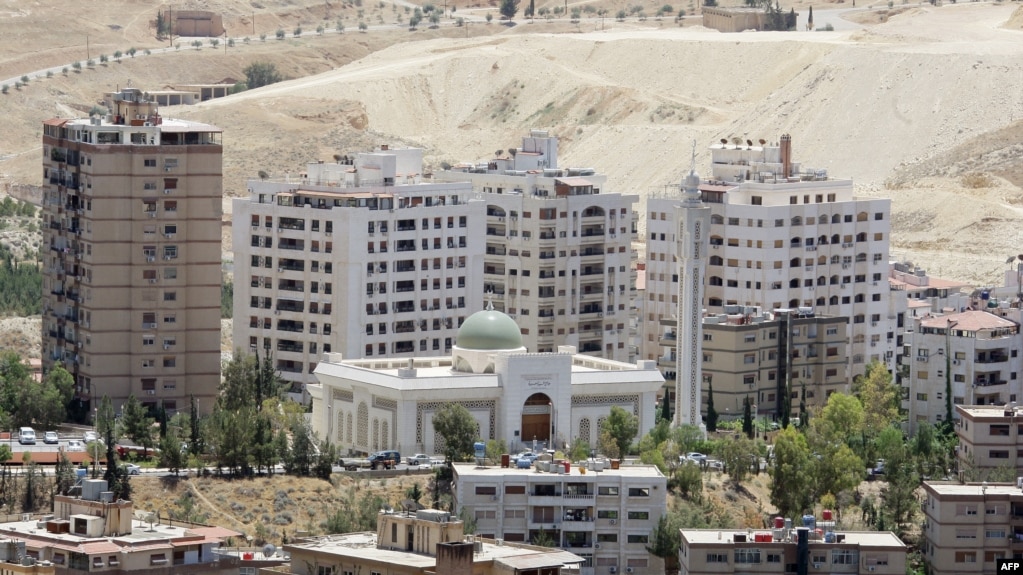
New buildings are seen in Damascus, Syria, in this file photo. Iranians are investing in and providing labor for some of the construction in the war-torn country. AFP PHOTO/ LOUAI BESHARA

New buildings are seen in Damascus, Syria, in this file photo. Iranians are investing in and providing labor for some of the construction in the war-torn country. AFP PHOTO/ LOUAI BESHARA

VOA: Iran’s government wants its builders to buy up property in Shi-ite majority neighborhoods of Syria’s capital, Damascus.

It is also asking construction workers to go to Syria.

This information comes from construction industry officials in Tehran and Iranian experts.

Iranian analyst Fariborz Saremi said owning real estate gives Iran more control over Syria and other parts of the Middle East.

Rich and conservative Iranian business people with ties to the government are buying expensive homes in Damascus, according to news reports. This is influencing price increases in Syria’s real estate markets.

“Five million houses have been destroyed in the civil war,” said Syrian economist Khorshid Alika told Voice of America. “The increased Iranian demand to buy land and properties has naturally led to more inflation in the market.”

Iran’s interest in Syrian real estate is not new. But it increased after the rebel uprising began in 2011.

Government-run media have been reporting recently about how Iran joined Russia to support Syrian President Bashar al-Assad. Assad’s government has been fighting against rebels and the Islamic State terror group.

Iran is not only asking people to buy homes and property in Syria. The country is also asking construction workers and contractors to take jobs there.

One contractor said a fellow contractor with close ties to the Iranian government told him he had a chance to make money in Damascus.

“When we asked about the security, he said that the zone is even more secure than Tehran,” Iranian contractor Amir Maghsoudloo told VOA.

Iran is home to about 3 million people from Afghanistan. Many fled the war-torn country. Most earn low wages in Iran. They are being offered better paying construction jobs in Syria.

Some Damascus construction projects are run by Afghan nationals from Iran, said Tahi Esmali. He is an Afghan national who works as a bricklayer. He had worked in Iran before moving to Syria in 2015.

Iranian interests are not limited to Damascus. Iranian business people and companies are looking to invest in projects in the central Syrian city of Homs. The Syrian military and its Lebanese Hezbollah allies recaptured Homs in late 2015.

The Iranian government has supported Syrian President Assad. Recent reports in state-run media say that Iran increased the size of its Revolutionary Guard Corps in Syria.
*** What more is causing all the interest in Syria by Iran and Russia? Well there are other countries with interests as well….pipelines.

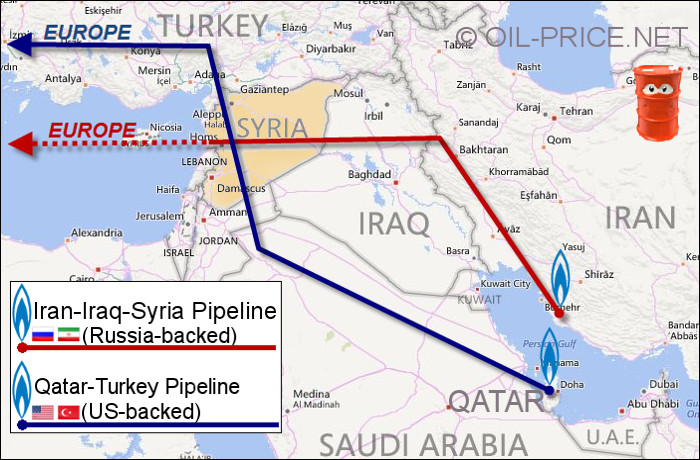
As noted in late 2015: The Syrian Civil War stems from a disagreement between the Saudis and Russia over the route for a new gas pipeline ducting Gulf gas to the lucrative European markets. Russia, whose only Mediterranean base is located in Tartus, Syria, supports Assad’s initiative of a gas pipeline from Iran through Iraq and Syria (the Iran-Iraq-Syria pipeline). But Saudi Arabia’s hardline Sunni Muslims wants to overthrow Syria’s Assad, who is a Shia Muslim, for religious reasons. They want to run a 100 per cent Sunni-controlled pipeline from Qatar through Syria and Turkey (the Qatar-Turkey pipeline), into Europe. As a result of this disagreement a proxy war is taking place in Syria between the aforementioned powers. Meanwhile displaced Syrian refugees are flooding into Europe with jihadis in their midst.

Map of proposed Iran-Iraq-Syria pipeline and Qatar-Turkey pipeline

Originally, Europeans were strongly in favor of deposing Assad for so-called “humanitarian reasons”. Their humanitarian concerns for Assad’s repressive regime veil the truth – Europe resents depending on Russia for 40 per cent of its gas. Russian President Putin annexed Crimea and maintained a belligerent stance, pushing Europe to favor the pipeline proposal of Qatar and Saudi Arabia. The Saudi plan to duct natural gas all the way to Europe through Syria and Turkey came with a catch – Assad would have to be toppled. The US supported the initiative as Russia’s only Mediterranean naval base would disappear with Assad. Thus, the Western world had itself a new plan that would bring peace and prosperity to the region. That is after the “initial shakeout” necessary to oust Assad.

The “initial shakeout” didn’t go as planned. Russia-backed Assad proved far more resilient than anticipated. But more importantly, western-backed Islamic militias committed such barbaric acts of terror they even made Assad, and Russia, look good in comparison. An emboldened ISIS gradually took over several of the region’s oil fields to fund its operations to the tune of $50 million per month by smuggling oil into Turkey. The routes and means were well established during the previous oil embargo on Iraq and so are the financial networks that profit from it in Turkey. Today, crude oil illegally smuggled by ISIS into Turkey accounts for a fairly significant 3.5 per cent of Turkey’s total oil imports. More here.
The JPOA, Billions Given by Obama to Iran Results in Huge Profits

Remember, Barack Obama and John Kerry gave billions to Iran, which is to say to the Supreme Leader Ali Khamenei. Two companies owned and controlled by the Supreme leader are Setad and Bonyad Mostazafan.

  For the full summary investigation performed by Reuters, go here.

Image result for iran supreme leader wealth

Iran Irony: IRGC And State Firms Are Benefiting From JCPOA

Mr. Alavi is an Iranian activist focusing on human rights, social crackdown, the regime’s support for terrorism, and its nuclear program.

Forbes: Those who raised the Iran deal flag, mainly in the United States and Europe, claimed the Joint Comprehensive Plan of Action (JCPOA) would boost trade and encourage foreign investment, enhancing Iran’s private sector and eventually downgrading the regime’s tight grip on the economy.

This was back in 2015 when the P5+1 agreed to lift sanctions in return for having Iran’s nuclear program curbed. Now in early 2017, however, signs indicate the main winners in Iran are none other than state-owned companies. This means Iranian Supreme Leader Ali Khamenei and the terrorist-supporting Revolutionary Guards are enjoying JCPOA benefits.

At least 90 of the nearly 110 agreements, totaling nearly $80 billion, involve such state-controlled companies. This includes the National Iranian Oil Company, parallel to others run by regime pension funds and massive conglomerates of semi-public nature.

Despite a long slate of harsh remarks made by Iran’s hardliners against the JCPOA, a recent Reuters study shows those businesses answering directly to Khamenei are benefiting most from the JCPOA.

Many deals, spanning the energy, infrastructure, pharmaceuticals and other sectors, remain in the preliminary stage. Iran’s foreign partners mainly include France, Germany, Italy, Russia and South Korea.

Iran’s “Setad Ejraiye Farman-e Hazrat-e Emam,” also known as the Headquarters for Executing the Order of the Imam and best known as Khamenei’s personal empire, has been the main benefactor of the highly flawed nuclear pact. This entity has stakes in and control over nearly all of Iran’s economy and benefits significantly through the JCPOA.

A 2013 Reuters probe shed light on Setad’s $95 billion empire, established through illegally seizing thousands of properties owned by business people, Iranians living abroad and religious minorities.

“A major network of front companies controlled by Iran’s leadership” is how the U.S. Treasury Department described Setad as it sanctioned the massive entity. Through the JCPOA, however, this conglomerate has enjoyed doing business with foreign companies.

One of the three such deals signed with foreign companies involves a $10 billion oil refinery construction plan. While Khamenei may not personally own these companies, his shadow—described as supervision—is essentially routing all invested finances.

In the past 18 months Khamenei-controlled companies, including the IRGC conglomerate, have sealed deals with foreign companies valued at over $11 billion.

It is a known fact that Tehran maintains a heavy hand over the economy, providing circumstances allowing state-controlled firms to acquire most business deals made possible after sanctions were lifted. The private sector makes up a mere 20% of Iran’s economy, according to official estimates.

To this end, private companies have received a dismal 17 deals, including a hotel management contract sealed most probably because of the French partner’s chief executive being the brother of Eshaq Jahangiri, Iran’s vice president.

The first slate of investments inked for Iran is most likely to strengthen state power, meaning Khamenei, counter to any hopes raised prematurely by JCPOA supporters. The supreme leader enjoys vast control, especially in the IRGC, through which he pursues his Syria, Iraq, Yemen, Bahrain and Lebanon policies.

Conglomerates, or foundations, whose chiefs are appointed directly by Khamenei, were the recipients of five of the 90 deals. Several of these entities enjoy widespread business transactions and not being obligated to pay full taxes. This includes Astan Qods Razavi, a vast religious institution controlling at least 36 subsidiary companies and entities.

One such firm is the Razavi Oil & Gas Development Company that sealed a preliminary agreement with Italy’s Saipem, also an oil and gas company.

The IRGC, known for its domestic crackdown and dispatching tens of thousands of Shiite militia members and arms throughout the region, is also considered a major destination point of JCPOA benefits.

The IRGC controls or has large stakes in four of the 90 deals sealed with the Iranian regime. And of course, Khamenei enjoys full hegemony over the IRGC. Despite remaining U.S. sanctions banning any “significant” business transactions with the IRGC, many of its front companies are free of any blacklisting.

Three of the four mentioned deals are signed with companies with strong ties to the IRGC and yet are not sanctioned. And to add insult to injury, the fourth company is on sanctions and yet enjoys involvement in a foreign deal through indirect routes.

Loopholes remain in the sanction regime imposed against Iran, all resulting from an appeasement/engagement approach adopted by former president Barack Obama. This is a gap in need of closing at a policy level.

“Despite a decline in sanctions… the Iranian economy is suffering from recession. The Iranian economy is under the control of the regime’s supreme leader Ali Khamenei and the IRGC. They are the only one who will benefit from trade with Iran and not the Iranian people,” said Iranian opposition leader Maryam Rajavi in a conference. Rajavi is president of the National Council of Resistance of Iran, an umbrella group of Iranian dissident entities, including the People’s Mojahedin Organization of Iran (PMOI/MEK).

Debate over the JCPOA’s future remains a major issue. If kept intact despite all its flaws, the U.S. should fully implement all articles and have each and every loophole sealed. This initiative can be coupled with further sanctions punishing Iran’s lethal meddling across the Middle East, pursuing a dangerous ballistic missile program and atrocious human rights violations.

Does DHS Secretary Kelly Know RAPS?

My friend Tom Del Beccaro explains in his summary at Forbes how the Federal government maintains primacy over the states for immigration law and item 8 U.S. Code Section 1182, which the liberal court chose never to previously challenge.

In spite of the 9th Circuit 3 judge panel ruling maintaining the stay on the Trump Executive Order for the travel restraining order, there is much work to do administratively as this continues to be challenged.

The data is private and protected:

Once the information is entered into the system, RAPS generates an appointment notice for the collection of fingerprints used to complete criminal and background checks and to create Employment Authorization Documents (EADs), as appropriate. The applicant will appear at a USCIS service center to provide fingerprints and confirm application information.

RAPS then automatically initiates several background security check processes: Federal Bureau of Investigation (FBI) Name Check, United States Visitor and Immigrant Status Indicator Technology (US-VISIT) and DHS’ Automated Biometric Identification System (IDENT), Customs and Border Protection (CBP) TECS, FBI Fingerprint, and the ENFORCE Alien Removal Module (EARM) (for a full discussion of the background check process, see Section 5.1). RAPS also stores the results of security checks.

Image result for USCIS Asylum Office Image result for USCIS Asylum Office

When a new application is entered into RAPS, it is forwarded to a USCIS Asylum Office for interview and adjudication.  Asylum Offices use RAPS to schedule an asylum interview to evaluate the claim of asylum status and to conduct various aspects of case maintenance such as address changes, updates of information pertaining to dependent claimants, to record preliminary and final decisions, and to generate decision documents. An individual who files for asylum may include in his or her application any spouse or child who is within the United States and appears for the asylum interview. This is because a grant received by the principal asylum applicant is conveyed to the spouse and children included in the family group if the spouse/child is in the U.S. and not otherwise barred from a grant of asylum.

RAPS is a comprehensive case management tool that enables USCIS to handle and process applications for asylum pursuant to Section 208 of the Immigration and Naturalization Act (INA) and applications for suspension of deportation or special rule cancellation of removal pursuant to NACARA § 203. DHS offices worldwide can access RAPS as a resource of current and historic immigration status information on more than one million applicants. DHS officials can use RAPS to verify the status of asylum applicants, asylees, and their dependents to assist with the verification of an individual’s immigration history in the course of a review of visa petitions and other benefit applications as well.

RAPS Typical Transaction

A typical transaction begins when an individual initiates the process to apply for asylum by completing and filing Form I-589, Application for Asylum and for Withholding of Removal, with a USCIS Service Center, or in certain circumstances directly with an asylum office. Service Center personnel receive the application in person or via mail and manually enter, most, but not all, of the information from a new application into RAPS.

As set forth in Section 451(b) of the Homeland Security Act of 2002, Public Law 107-296, Congress charged USCIS with the administration of the asylum program, which provides protection to qualified individuals in the United States who have suffered past persecution or have a well-founded fear of future persecution in their country of origin as outlined under INA § 208 and 8 CFR § 208. USCIS is also responsible for the adjudication of the benefit program established by Section 203 of the Nicaraguan Adjustment and Central American Relief Act (NACARA § 203) (discussed in more detail in Section B below), in accordance with 8 CFR § 240.60 and the maintenance and administration of the credible fear and reasonable fear screening processes, in accordance with 8 CFR §§ 208.30 and 208.31. USCIS developed RAPS and APSS in order to carry out its obligations in administering these benefit programs.

Functions

RAPS and APSS track case status and facilitate the scheduling of appointments and interviews and the issuance of notices (including receipt notices, appointment notices, and decision letters) at several stages of the adjudication process. USCIS Asylum Offices use RAPS and APSS to:

  • record decisions and to generate decision documents such as approval, dismissal, or rescission of an asylum or NACARA § 203 application,
  • denial of an asylum application,
  • administrative closure of an asylum application, or
  • referral of an asylum or NACARA § 203 application to Executive Office of Immigration Review (EOIR).

The systems also initiate, receive, and record responses for national security and background check screening and prevent the approval of any benefit prior to the review and completion of all security checks. Finally, the systems provide fully developed and flexible means for analyzing and managing program workflows and provide the Asylum Program with statistical reports to assist with oversight of production and processing goals.

Read more from the two DHS documents here and here.

Image result for DHS Secretary

***

GAO Raps DHS for Failure to Get Security Data from Visa Waiver Countries

One of the requirements for allowing visa-free entry of tourists from countries in the Visa Waiver Program (VWP) is that those governments share with us information on nationals with terrorism links and/or criminal histories. According to a report of the Government Accountability Office (GAO) issued in May 2016, the Department of Homeland Security (DHS) has obtained those agreements with most of the countries, but more than a third of  the agreements have not been implemented, and no data have been received from them.

In addition, Congress has required reports from DHS on implementation of the VWP with each of the participating countries, but GAO found that DHS has failed to provide many of those reports when due.

The recommendation of agency (GAO-16-498) is that, “DHS should (1) specify time frames for working with VWP countries on the requirement to implement information-sharing agreements and (2) take steps to improve its timeliness in reporting to Congress on whether VWP countries should continue in the program.”

FAIR has consistently pointed to the VWP as a national security threat and called for its termination. This GAO report underscores the security flaw and finds that it is exacerbated by cavalier implementation by DHS


Venezuela Gave Passports to Terrorists, Syria and Iraq?

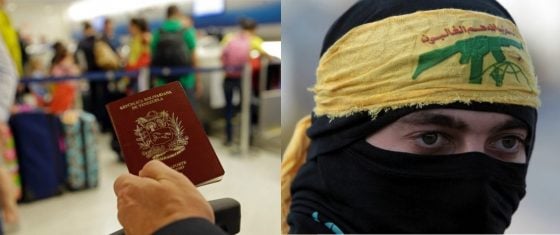
Image result for venezuelan passport

Venezuela may have given passports to people with ties to terrorism

Toledo, Spain (CNN): The stunning postcard-perfect vista surrounding Misael Lopez in this town about one hour from Madrid belies his constant anxiety, even fear.

That’s because the former legal adviser to the Venezuelan Embassy in Iraq is revealing secrets he says his government doesn’t want disclosed.
“I’m concerned about my safety and my family’s safety everywhere I go,” Lopez said as he walked the cobble-stoned streets of Toledo.
Lopez, 41, says he reported what he says was a scheme to sell passports and visas for thousands of dollars out of the embassy and repeatedly turned down offers to get a cut of the money. But it was the response from his government — which has denied his allegations — that surprised him the most.
CNN and CNN en Español teamed up in a year-long joint investigation that uncovered serious irregularities in the issuing of Venezuelan passports and visas, including allegations that passports were given to people with ties to terrorism. The investigation involved reviewing thousands of documents, and conducting interviews in the U.S., Spain, Venezuela and the United Kingdom.
One confidential intelligence document obtained by CNN links Venezuela’s new Vice President Tareck El Aissami to 173 Venezuelan passports and ID’s that were issued to individuals from the Middle East, including people connected to the terrorist group Hezbollah.
The accusation that the country was issuing passports to people who are not Venezuelan first surfaced in the early 2000s when Hugo Chavez was the country’s president, interviews and records show.
A Venezuelan passport permits entry into more than 130 countries without a visa, including 26 countries in the European Union, according to a ranking by Henley and Partners. A visa is required to enter the United States.
Over the course of the CNN investigation, Lopez provided documents that show he repeatedly told Venezuelan officials about what he discovered. But he said instead of investigating his allegations, the government targeted him for disclosing confidential information. U.S. officials were also made aware of his findings.
“You cannot be a cop, and a thief at the same time,” Lopez said. “I decide to be a cop and do the right thing.”
Doing the right thing has cost him.

Unwelcome surprise

It didn’t start out that way.
Lopez, a lawyer who worked as a police officer in Venezuela, said he thought becoming a diplomat was a great career opportunity, which would also allow him to serve his country. With that in mind, he moved to Baghdad to start his new life at the Venezuelan Embassy.
But, he recalled, he got an unwelcome surprise on his first day in July 2013.
His new boss, Venezuelan Ambassador Jonathan Velasco, gave him a special envelope, he said.
“He gave me an envelope full of visas and passports,” Lopez recalled. “He told me, ‘Get this, this is one million U.S. dollars.’ I thought it was like a joke. Then he told me here people pay a lot of money to get a visa or a passport to leave this country.”
About one month later, Lopez said he realized it was no joke.
An Iraqi employee of the embassy, who was hired to be an interpreter, told him she had made thousands of dollars selling Venezuelan passports and visas, he said. And he could make a lot of money, too.
But Lopez said he told her it was wrong and he refused.
The employee pressed the issue, telling him there were thousands of dollars to be made, he said, even discussing an offer to sell visas to 13 Syrians for $10,000 each.
And, Lopez, said, she told him he could get a cut of the money, too.
Again, he said he refused.
“I suspect it might be terrorists; that’s why I reject, of course, immediately,” Lopez said.
And he said it just got worse.

Lists of names

Lopez said he was stunned when he found a document inside the embassy. It was a list of 21 Arabic names with corresponding Venezuelan passport numbers and Venezuelan identification numbers. A Venezuelan immigration official told CNN that a cross-check of the passport numbers indicated that the passports are valid and match the names on the list Lopez found — meaning the people on the list could be able to travel using those passports.
But incredibly, a publicly available database in Venezuela examined by CNN shows 20 of the 21 identification numbers are registered to people with Hispanic names — not the Arabic names listed on the passports.
Lopez kept investigating what was going on inside the embassy. He said he even found the case of a convicted drug dealer with an Iraqi identification certificate that appears to show he was born in Iraq. But the man had a Venezuelan passport that said he was born in Venezuela.
He kept evidence and notes of what he found.
Concerned that the passport and visa scheme was continuing without his knowledge, Lopez investigated the embassy employee who he said had offered to sell passports. He took photos of her desk where he says he found the embassy’s official stamp, used to authenticate visas, as well as sheets of papers printed with the Venezuelan government seal.
He eventually fired the employee. Lopez did not have any other documents that would confirm the allegations against her.
The employee did not respond to repeated requests from CNN for comment.
In April 2014, only nine months after he started the job, he emailed a report to Ambassador Velasco about the alleged selling of passports and visas. By then, he said he was convinced that Velasco knew about what was going on inside the embassy.
“He’s been there since 2008,” Lopez said. “How could he (have) been there so long, couldn’t notice that?”
He said Velasco did nothing and even threatened to fire him.
By 2015, frustrated that no one would investigate, he took what he found to Delcy Rodriguez, Venezuela’s foreign minister. His emailed report said there was “fraudulent issuing of visas, birth certificates and Venezuelan documents.”
He said nothing happened.

Going to the FBI

Eventually, with nowhere else to turn, Lopez contacted an FBI official at the U.S. Embassy in Madrid. The two met at a restaurant across the street from the embassy, and the official sent Lopez’s information to FBI headquarters in Washington, D.C., a law enforcement source said. The FBI would not comment about what happened with the information.
For Lopez, it was his final attempt to get something done.
But it was too late.
By the end of 2015, the Venezuelan government accused Lopez of “abandoning his post” and removed him. A police official showed up at his home in Venezuela with a document that said he was under investigation for revealing “confidential documents or secrets.”

Looking for answers

In an email, Velasco strongly denied Lopez’s allegations.
“This embassy is ready open to be audit [sic] and investigated for any international organization and intelligent [sic] Services as well, I don’t have nothing to hide or fear. I be sure [sic] that under my duties this embassy don’t never [sic] and ever sell Venezuelan nationalities, this will be a joke for all the international security organization [sic] and we already cooperate with the (Iraqi) government and international intelligent [sic] service,” the email read in English.
In an attempt to get answers, a team from CNN en Español traveled to Caracas last June. In a letter, the government restricted CNN’s coverage to stories related to tourism, weather, alternative energy sources and relations among the different government institutions in Venezuela.
Rodriguez, the foreign minister, ignored reporter Rafael Romo when he tried to question her at a press event.
A government official told the CNN en Español team that any questions about the passport allegations would be grounds for expulsion from the country.
On a second visit to Caracas last August, a CNN en Español producer and videographer were forced to leave the country after Venezuelan authorities impounded CNN camera equipment at the airport.
Last September, Rodriguez represented Venezuela at the United Nations General Assembly. Inside the UN, she again ignored CNN’s attempt to ask her questions.
Finally, CNN was able to speak with her as she was walking with a small group on the sidewalk across from the UN. As she walked away from the crews, she said, “You’re going to hurt yourself for following the lies of a person who doesn’t know what he’s talking about.” She said allegations of selling passports and visas were “totally” false.
But it’s not the first time allegations about Venezuelan passports have been made public.

Links to terror

U.S. lawmakers heard reports about Venezuelan passport fraud during congressional hearings as far back as 2006. In fact, a congressional report warned, “Venezuela is providing support, including identity documents that could prove useful to radical Islamic groups.”
And a state department report at the time also concluded that “Venezuelan travel and identification documents are extremely easy to obtain by persons not entitled to them.”
Roger Noriega, the former US ambassador to the Organization of American States and former assistant secretary of state for Western Hemisphere affairs, said in prepared remarks before a congressional in 2012 that “Venezuela has provided thousands of phony IDs, passports and visas to persons of Middle Eastern origin.”
Noreiga, who is now managing director of Vision Americas and works for a conservative think tank, told CNN that evidence began to emerge in 2003 in Venezuela that passports were being issued to non-Venezuelans.
“I absolutely believe, and I state it so publicly, that if we do not get our arms around this problem, people are going to die, either our allies or our own personnel or facilities are going to be attacked by networks abetted by the Venezuelans,” Noriega said.
The U.S. State Department declined CNN’s request late last year for an interview, instead emailing a link to its 2015 country terrorism overview. That report concluded, “There were credible reports that Venezuela maintained a permissive environment that allowed for support of activities that benefited known terrorist groups.”
A 2013 confidential intelligence report from a group of Latin American countries obtained by CNN says that from 2008 to 2012, 173 individuals from the Middle East were issued Venezuelan passports and IDs. Among them were people connected to the terrorist group Hezbollah.
The official who ordered the issuing of the passports, the report said, is Tareck El Aissami, who was appointed vice president of Venezuela in January. He is the former minister in charge of immigration as well as a governor.
El Aissami “took charge of issuing, granting visas and nationalizing citizens from different countries, especially Syrians, Lebanese, Jordanians, Iranians and Iraqis,” the report said.
He did not respond to multiple requests for comment.
Ghazi Nasr Al-Din

Another high-profile Venezuelan linked to terrorism is Ghazi Nasr Al-Din, a former Venezuelan diplomat who worked in the country’s embassy in Syria. He is “wanted for questioning” by the FBI for “his fundraising efforts” with Hezbollah contributors, according to a notice on the FBI website. The bureau confirmed that the information was still active, but would not comment further.
U.S. officials say he has “facilitated the travel” of Hezbollah members to and from Venezuela, according to a 2008 press release from the U.S. Treasury Department.

Leaks in the process

What allegedly happened in Iraq is no surprise to General Marco Ferreira, who was in charge of Venezuela’s immigration office in 2002.
Today, Ferreira is living in Miami after being granted political asylum after he supported a 2002 failed coup against Venezuela’s then-President Hugo Chavez. He told CNN that he personally witnessed corrupt senior officials ordering passports for people who were not citizens when he was running the department. He added anyone could get a passport at a local office because each worked independently.
He said it was “very easy” to assume someone else’s identity.
“One of the problems was the corrupted people that was working in that place,” Ferreira said. “The second one was the fragility of the system because everything was very old and they have a lot of leaks in the process.”
He said it was “very, very easy to go and be Venezuelan, or pretend being born in Venezuela.”
Asked about what Misael Lopez described as the alleged passport and visa-selling operation at the Venezuelan Embassy in Iraq, he said he was not surprised.
As for Misael Lopez, he’s living modestly in Spain, where he also has citizenship; he knows he can’t go back to Venezuela.
With his safety always an issue, he still says he had to tell his story. And going public, he hopes, will help protect him and his family.
“I did the right thing and I’m proud it,” he said. “No regrets at all.”

20 Step Refugee Vetting Process, Nuts…

So, that is the process, allegedly done with extreme scrutiny…ahem. But what about those that come into the United States by other nefarious methods such as sneaking across our borders? They get a pass?

It is the exact time in our country to have this debate and the arguments must include the safety and financial consequences, both of which never are part of the wider discussion.

California is working to become a sanctuary state, putting all other CONUS states at extreme risk as people can travel freely. (CONUS = Continental United States).

Related reading: FBI: 7,700 Terrorist Encounters in USA in 2015

Related reading: Corruption, Shell Companies, Cartels and the Mexican President

San Francisco is at the hub of the issue, how so? The mayor via the police force refuse any collaboration as noted below:

SFPD Cuts Ties With FBI’s Joint Terrorism Task Force

San Francisco Police Department officials announced Wednesday that they have suspended participation with the FBI’s controversial Joint Terrorism Task Force.

According to San Francisco Police Commission protocol, all contracts require approval by the Board of Supervisors after 10 years.

The JTTF Memoranda of Understanding was signed in 2007, so that time has come, according to department officials.

The department will update its guideline for First Amendment activities and will “seek clarification” from the Police Commission as to this guideline’s application to JTTF investigations.

Once that new guideline is adopted, the department may consider renegotiating the JTTF memoranda with the FBI with guidance from the police commission.

Last month, the Asian Law Caucus, the Council on American-Islamic Relations’ San Francisco Bay Area office and the American Civil Liberties Union of Northern California sent a letter to San Francisco Police commissioners urging them to cease the department’s participation in the JTTF.

In the Jan. 5 letter, the groups speculate that, following President Donald Trump’s inauguration, the JTTF would likely increase surveillance of Muslim communities like the New York City police did after Sept. 11, 2001.

According to the FBI, 71 JTTF field offices have been established since 2001. The first was established in New York City in 1980.

“The SFPD is committed to public safety and will continue to work diligently to keep San Francisco safe for everyone,” San Francisco police Sgt. Michael Andraychak said in a statement.

(That last statement gets a BIG REALLY DUDE?)

*** Back in 2008:

Refugee Program Halted As DNA Tests Show Fraud

Thousands in Africa Lied about Families To Gain U.S. Entry

The State Department has suspended a humanitarian program to reunite thousands of African refugees with relatives in the U.S. after unprecedented DNA testing by the government revealed widespread fraud.

The freeze affects refugees in Kenya, Ethiopia, Uganda, Guinea and Ghana, many of whom have been waiting years to emigrate. More here from the WSJ. Lying and making up ghost people to get other permits? Hah….

*** Back in 2004, as a result of the 9/11 Commission Report on the issue of immigration, many robust recommendations were made of which all members of Congress at the time signed off on. They need to be reminded of that, as does the California legislature at a minimum. But going deeper in factual history, others need to be reminded of the following: (In part from Migration Policy dot org.)

Kerry Outlines Ideas on Immigration Reform

Democratic presidential candidate John Kerry on June 30 announced his platform on immigration reform. In a speech to the National Council of La Raza’s national conference, Kerry said that within 100 days of taking office, he would propose a four-part plan that would give “good people who are undocumented but living here, working here, paying taxes, [and] staying out of trouble . . . a path to equal citizenship.” In addition, he said that immigrants would be required to take civics and English classes. Kerry also promised to sign two bills currently pending in Congress: the AgJobs agricultural worker program, and the DREAM Act, which would allow young, out-of-status immigrants to pay in-state tuition rates while attending college. Both bills create a path for immigrants to eventually receive legal resident status.

In an interview with the Spanish-language network Telemundo on June 29, Kerry took stances on other immigration-related issues. He stated that granting driver’s licenses to undocumented immigrants violated the spirit of the law, and that immigration authorities had the right to perform raids to capture unauthorized immigrants who had broken other laws. Some analysts believe that Kerry’s comments regarding driver’s licenses could hurt his standing with Latino voters in the election. Nevertheless, the Washington Post reported on July 22 that Kerry currently has a 2 to 1 advantage over his opponent, President George W. Bush, among registered Latino voters.

Hmong Refugees Resettled to the United States

Around 15,000 Hmong refugees are expected to arrive in the United States this year. The first members of the group have already reached the U.S., and up to 3,000 more are expected by the end of August, with the remainder arriving by the end of 2004. The new arrivals fled their native country because of persecution they suffered due to their alliance with the U.S. during the Vietnam War. One third of the refugees will be resettled to Minnesota, a third will be sent to California, and the rest will be distributed among more than a dozen other states. Many of the refugees have been living illegally in a makeshift camp in Thailand, having passed up the opportunity for resettlement to the United States in the 1980s and 1990s as they clung to the hope of returning to Laos. Because the Thai military plans to close the camp by the end of 2004, most residents plan to accept the resettlement opportunity offered by the U.S. Department of State.

The refugees will receive initial assistance from U.S. resettlement agencies, which will help meet basic needs such as housing, school, language, employment, and health services. To fund these services, the U.S. Department of Health and Human Services on June 24 announced an additional $3.3 million allocation for Hmong resettlement costs. After one year of living in the U.S., refugees can apply to adjust their status to permanent residency and acquire a “green card.” They eventually become eligible for citizenship. In addition, unlike other immigrants, refugees are not barred from receiving welfare benefits in their first seven years of residence in the United States. The next group of Hmong refugees, approximately 2,000 individuals, is expected to arrive by the end of August.

U.S and Mexico Sign Pact on Social Security

The United States and Mexico on June 29 signed a pact enabling Mexican workers in the U.S. and American workers in Mexico to transfer social security benefits across national borders. The pact is similar to international Social Security agreements the U.S. has with Britain and Canada, and allows workers to contribute to only one benefits system at a time. According to estimates by U.S. Social Security officials, only 7,500 U.S. citizens working in Mexico will qualify for retirement benefits, as compared to 41,000 Mexican employees likely to qualify for Social Security in the United States. Even so, the plan will have an initially limited effect because it excludes, unless or until they are legalized, an estimated six to eight million undocumented Mexican workers currently employed in the United States. While the pact will not become law without legislative approval, the United States Congress and the Mexican Senate are expected to pass the measure; U.S. lawmakers have routinely approved similar agreements with 20 other nations. (For more information on International Agreements of the Social Security Administration, see this January 2004 Migration Policy Institute Immigration Fact Sheet)

State Department Halts Mail Renewal of Visas

The Department of State on July 16 stopped accepting applications for mail renewals of visas. Under the new policy, announced on June 23, foreigners who work in the United States must return to U.S. embassies abroad to be interviewed and fingerprinted for visa renewal. The policy, which does not apply to foreign diplomats or employees of international organizations, is part of the U.S. effort to improve border controls after the September 11, 2001 attacks. State Department spokesman Richard Boucher stated that the switch was made to overseas processing because of the better capacity of U.S. embassies abroad to interview and fingerprint visa applicants. More than 50,000 people from more than 60 countries were processed in 2003.