Hey Donald Trump, Day 2, Please Handle this

Obama’s Parting Gift? Lots more Money to Iran

 Business Insider

Meanwhile,

CBS: WASHINGTON — A U.S. Navy destroyer fired multiple warning shots at Iranian patrol boats as they sped toward the destroyer at the entrance to the Persian Gulf “with their weapons manned,” U.S. defense officials said.

The crew of the USS Mahan fired the warning shots after attempting to establish contact with the Iranians and after dropping smoke flares, the officials said. The official was not authorized to discuss the matter publicly as so spoke on condition of anonymity.

The U.S. Navy occasionally has confrontations with Iranian naval forces in the Persian Gulf but they do not usually reach the point of prompting warning shots by the U.S.

A U.S. Navy official told CBS News the Mahan was transiting the Strait of Hormuz on Sunday when the Iranian boats sped toward it and failed to halt despite U.S. cautionary moves.

S0….  

Iran: U.S. Surrendered More Than $10 Billion in Gold, Cash, Assets

Obama admin lowballs cost of dealing with Iran

FreeBeacon: The Obama administration has paid Iran more than $10 billion in gold, cash, and other assets since 2013, according to Iranian officials, who disclosed that the White House has been intentionally deflating the total amount paid to the Islamic Republic.

Senior Iranian officials late last week confirmed reports that the total amount of money paid to Iran over the past four years is in excess of $10 billion, a figure that runs counter to official estimates provided by the White House.

The latest disclosure by Iran, which comports with previous claims about the Obama administration obfuscating details about its cash transfers to Iran—including a $1.7 billion cash payment included in a ransom to free Americans—sheds further light on the White House’s back room dealings to bolster Iran’s economy and preserve the Iran nuclear agreement.

Iranian Foreign Ministry spokesman Bahram Ghasemi confirmed last week a recent report in the Wall Street Journal detailing some $10 billion in cash and assets provided to Iran since 2013, when the administration was engaging in sensitive diplomacy with Tehran aimed at securing the nuclear deal.

Ghasemi disclosed that the $10 billion figure just scratches the surface of the total amount given to Iran by the United States over the past several years.

“I will not speak about the precise amount,” Ghasemi was quoted as saying in Persian language reports independently translated for the Washington Free Beacon.

The $10 billion figure is actually a “stingy” estimate, Ghasemi claimed, adding that a combination of cash, gold, and other assets was sent by Washington to Iran’s Central Bank and subsequently “spent.”

“This report is true but the value was higher,” Ghassemi was quoted as saying.

“After the Geneva conference and the resulting agreement, it was decided that $700 million dollars were to be dispensed per month” by the U.S., according to Ghassemi. “In addition to the cash funds which we received, we [also] received our deliveries in gold, bullion, and other things.”

Regional experts who spoke to the Free Beacon about these disclosures said that the $10 billion figure offered by the Obama administration should be viewed “as a conservative estimate for what Iran was paid to stay at the table and negotiate.”

“Iran does have incentives to overstate this figure,” Behnam Ben Taleblu, a research analyst at the Foundation for Defense of Democracies, told the Free Beacon. “But given the recent state-sponsored narrative in Iran about a Western and particularly American failing to offer sanctions relief, this reads much more as fact rather than another instance of disinformation from Tehran.”

It is likely Iran spent a portion of this money to fund its regional terror operations and military enterprise to bolster embattled Syrian President Bashar al Assad, Ben Taleblu said.

“Given the nature of some of this sanctions relief (through the provision of gold and unfrozen assets), this money likely underwrote some of the Islamic Republic’s more destabilizing regional activities,” he explained. “At the macro level, all of this continues to prove one larger point: The way the Iran deal was handled and the provision of sanctions relief during and after the talks that led to the nuclear accord continues to create problems for those interested in defending the integrity of the international financial system.”

One veteran foreign policy insider familiar with the administration’s outreach to Iran told the Free Beacon that the White House has a history of deflating these figures in order to obfuscate details about its contested diplomacy with the Islamic Republic.

“This is how it always happens when the Obama administration secretly sends money to Iran,” said the source, who would only speak on background when discussing the outgoing administration’s strategy. “They deny it until they’re caught, then they lowball it until they’re caught again, then they say it’s old news. In every single case where Iranian officials confirms these transfers while Obama officials denied them, it later turned out the Iranian officials were the ones telling the truth.”

U.N. chief concerned Iran may have violated arms embargo: report

The United Nations chief expressed concern to the Security Council that Iran may have violated an arms embargo by supplying weapons and missiles to Lebanese Shi’ite group Hezbollah, according to a confidential report, seen by Reuters on Sunday.

The second bi-annual report, due to be discussed by the 15-member council on Jan. 18, also cites an accusation by France that an arms shipment seized in the northern Indian Ocean in March was from Iran and likely bound for Somalia or Yemen.

Most U.N. sanctions were lifted a year ago under a deal Iran made with Britain, France, Germany, China, Russia, the United States and the European Union to curb its nuclear program. But Iran is still subject to an arms embargo and other restrictions, which are not technically part of the nuclear agreement.

The report was submitted to the Security Council on Dec. 30 by U.N. Secretary-General Ban Ki-moon before he was succeeded by Antonio Guterres on Jan. 1. It comes just weeks before U.S. President-elect Donald Trump, who has threatened to either scrap the nuclear agreement or seek a better deal, takes office.

“In a televised speech broadcast by Al Manar TV on 24 June 2016, Hassan Nasrallah, the Secretary-General of Hezbollah, stated that the budget of Hezbollah, its salaries, expenses, weapons and missiles all came from the Islamic Republic of Iran,” Ban wrote in the report.

“I am very concerned by this statement, which suggests that transfers of arms and related materiel from the Islamic Republic of Iran to Hezbollah may have been undertaken contrary (to a Security Council resolution),” Ban said.

When asked by the United Nations to clarify the issue, Iran’s mission to the United Nations said “measures undertaken by the Islamic Republic of Iran in combating terrorism and violent extremism in the region have been consistent with its national security interests and international commitments.”

Under a Security Council resolution enshrining the deal, which came into effect a year ago, the U.N. secretary-general is required to report every six months to the council on any violations of sanctions still in place. More here from Reuters.

Palestinian Truck Attack Kills 4 in Israel

Prime Minister Benjamin Netanyahu and Defense Minister Avigdor Liberman, this afternoon (Sunday, 8 January 2017), visited the site of the terrorist attack in the Jerusalem neighborhood of Armon Hanatziv and were briefed by Jerusalem District Police Commander Yoram Halevy.  

Prime Minister Netanyahu:  

“We in Jerusalem have just experience an unprovoked terrorist attack, a murderous attack that claimed the lives of four young Israelis and wounded others. This is part of the same pattern inspired by Islamic State, by ISIS, that we saw first in France, then in Germany and now in Jerusalem. This is part of the same ongoing battle against this global scourge of the new terrorism. We can only fight it together, but we have to fight it, and we will.”

In part from Reuters: A Palestinian rammed his truck into a group of Israeli soldiers on a popular promenade in Jerusalem on Sunday, killing four of them in an attack which Prime Minister Benjamin Netanyahu said had likely been inspired by Islamic State.

It was the deadliest Palestinian attack in Jerusalem in months and targeted officer cadets as they disembarked from a bus that brought them to the Armon Hanatziv promenade which has a panoramic view of the walled Old City.

The military said an officer and three officer cadets were killed and that 17 others were injured. Police said three of the dead were women.

Police identified the truck driver as a Palestinian from Israeli-annexed East Jerusalem and said he was shot dead. His uncle, Abu Ali, named him as Fadi Ahmad Hamdan Qunbor, 28, a father of four from the Jabel Mukabar neighborhood.

The Israeli military regularly takes soldiers on educational tours of Jerusalem, including the Armon Hanatziv vantage point.

Netanyahu visited the scene and said he convened a forum of senior ministers to discuss Israel’s response.

“We know the identity of the attacker. According to all the signs he is a supporter of Islamic State,” the prime minister said.

Roni Alsheich, the national police chief, told reporters he could not rule out that the driver had been motivated by a truck ramming attack in a Berlin Christmas market that killed 12 people last month.

In another attack claimed by Islamic State in which a truck was used to ram into crowds, nearly 90 people were killed in the French city of Nice in July.

Actions inspired by Islamic State in Israel, the occupied West Bank and Jerusalem have been rare and only a few dozen Arab Israelis and Palestinians are known to have declared their sympathy with the group.

A wave of Palestinian street attacks, including vehicle rammings, has largely slowed but not stopped completely since it began in October 2015 and 37 Israelis and two visiting Americans have been killed in these assaults. More here from Reuters.

****

REUTERS/Ronen Zvulun

AP: The attacker came from the east Jerusalem Palestinian neighborhood of Jabel Mukaber, near the attack site. Police barred publication of his name.

Neighbors said he espoused an ultra-conservative version of Islam, known as Salafism, but that he did not have a known affiliation with any Palestinian political faction. Salafism is split into peaceful and violent streams, with the latter promoting ideas that are close to those of IS.

Netanyahu said Israel had blockaded Jabel Mukaber and was planning other steps, but did not elaborate. He said the dead were all soldiers — three women and a man. The Israeli military said three were cadets and one was an officer.

Israel’s national rescue service said one of the wounded was in serious condition. More here from Associated Press.


Netanyahu will not Attend Paris Peace Summit

Did any of those votes at the UN for the recent resolution endorsed by John Kerry, Samantha Power and the Obama White House remember this?

Now would be a good time to refer to an earlier post on this site:

Documents: Mahmoud Abbas Former KGB, Syria


The documents reveal an extensive relationship between the Soviet Union and the nascent Palestinian nationalist movement that began in the late 1960s. At the time, the Soviets established a covert channel with Yasser Arafat’s terror-inclined guerilla group, the Palestinian Liberation Organization, or PLO. Abbas held an integral role in these backdoor communications, functioning as liaison. Accordingly, the PLO closely collaborated with the KGB, receiving Soviet arms to launch asymmetrical warfare against the State of Israel. More from DailyWire.

January 15, there is a Peace Summit in Paris, Prime Minister Netanyahu will not attend. Below could be the reason for that decision.

TEL AVIV, January 2. /TASS/. A meeting of Palestine’s major forces Fatah and Hamas alongside representatives of other factions seeking to restore unity among the Palestinians will be held in Moscow on January 15, Wasel Abu Yousef, a PLO (Palestine Liberation Organization) Executive Committee member, said cited by Israel’s The Jerusalem Post daily on Monday.  

“The Russians will host a meeting of Fatah, Hamas and other Palestinian officials in Moscow in the middle of January to discuss reconciliation,” Yousef said.  

The PLO official added that the talks in Russia would be held simultaneously with an international peace conference in Paris scheduled for the same day, January 15.  

“The Palestinian leadership wants to demonstrate that it is working on both the peace process through the Paris conference and reconciliation by way of the Moscow meeting,” he said.  

On June 3, 2016 Deputy Foreign Minister Mikhail Bogdanov, the special presidential envoy for the Middle East and Africa, at the first international conference on the Israeli-Palestine settlement in Paris called “the split among Palestinians” as “another negative factor hampering the peace progress.”  

“This issue should be resolved as the priority task so that the Palestinians present a single and united delegation at the talks on the final status,”  Bogdanov said at the time.  

“Russia fully supports efforts on soonest restoration of inter-Palestinian unity on the basis of PLO (Palestine Liberation Organization) and Arab Peace Initiative, holds dialogue with representatives of the whole range of Palestinian forces, first of all Fatah and Hamas, in the interests of achieving appropriate agreements. We hope that such approach is shared by other members of the international community,” the diplomat concluded.  

In May 2011, a first meeting behind closed doors took place at a health resort near Moscow in an attempt to reconcile major Palestinian groups, including Fatah and Hamas. High-ranking officials of key Palestinian movements arrived in Russia after Fatah and Hamas had sealed a deal in Cairo to form a Palestinian government of “professionals.”  

A split between Palestine’s two major forces, Fatah and Hamas, occurred after the parliamentary elections in Palestine in 2006 when Hamas won. In June 2007, its militants seized power in Gaza Strip. Since then, Palestine has been divided into two parts: Fatah controls West Bank and Hamas controls the Gaza Strip.


John Kerry to PA: ‘This Meeting is Classified’

Ah well not so much. The planning for the UN resolution against Israel was several weeks in the making and had a lot of Washington DC players and coordination.

There is much talk about defunding the United Nations, yet a good start would be to defund UNRWA.(United Nations Relief and Works Agency for Palestinian Refugees) With a total of $644,701,999 in contributions, the US, EU, UK, Sweden, Norway, Germany, The Netherlands and Japan pay 71% of the annual UNRWA budget. The personal wealth of Palestinian Authority President Mahmoud Abbas is estimated at $100 million. Read more here.


Understanding the UNRWA Funding Structure

UNRWA is mandated by the General Assembly under resolution 302(IV) to respond to the needs of more than 5 million refugees (compared to 750,000 in 1950) in its five fields of operation until a just and durable solution is found to the refugee issue. Based on this mandate, UNRWA delivers essential services in the areas of education, health, protection, relief and social services, microfinance and camp improvement with the support of more than 28,000 national Palestinian staff members.

The UNRWA Programme Budget (General Fund), approved by the General Assembly for the 2016-2017 biennium, comprises recurrent staff and non-staff costs.

In budgeting, UNRWA is guided by the strategic objectives and priorities outlined in its Medium Term Strategy 2016-21 (MTS). This strategic vision is further refined by strategic plans for each UNRWA field of operation, based on programme cycle management.

The MTS identifies five strategic outcomes:

  • Refugees’ rights under international law are protected and promoted
  • Refugees’ health is protected and the disease burden is reduced
  • School-aged children complete quality, equitable and inclusive basic education
  • Refugee capabilities are strengthened for increased livelihoods opportunities
  • Refugees are able to meet their basic human needs of food, shelter and environmental health

To link financial resources directly to the achievement of results consistent with the Agency’s strategy, the budget includes a breakdown based on these goals and strategic objectives.

***

Memri: Egyptian Daily Close To Egyptian Intelligence Reveals Minutes Of Secret Palestinian Authority Meeting With John Kerry, Susan Rice; U.S.-Palestinian Coordination On UNSC 2334; Rice Says Trump Administration’s Policy Will Be ‘Dangerous’

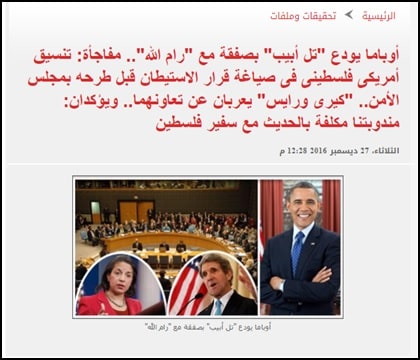
In mid-December 2016, a Palestinian Authority (PA) delegation met in Washington with officials from the outgoing Obama administration for secret talks. On December 27, the Egyptian daily Al-Youm Al-Sabi’, which is close to Egyptian intelligence services, published an exposé of the minutes of the secret talks. According to the report, by Ahmed Gomaa, the Palestinian delegation included PLO Executive Committee secretary and negotiating team leader Saeb Erekat; Palestinian general intelligence chief Majid Faraj; Husam Zomlot, strategic affairs advisor to Palestinian Authority president Mahmoud ‘Abbas; Palestinian Foreign Ministry official Dr. Majed Bamya; Palestinian negotiations department official Azem Bishara; Palestinian intelligence international relations department chief Nasser ‘Adwa; and head of the PLO delegation to Washington Ma’an Erekat.

The report gave the details of the Palestinian delegation’s schedule during the visit, noting that “the Palestinian side began its meetings on December 12, when Saeb Erekat and Majid Faraj met with U.S. Secretary of State John Kerry. The next day, the two met with National Security Advisor Susan Rice. The entire delegation met with an American team that included four representatives of the Secretaries of State and Homeland Security, for a six-hour political-strategic meeting. Majid Faraj concluded his visit with a lengthy meeting with the CIA chief.”

According to the report, the minutes of the “top secret” meeting of Kerry, Rice, Erekat, and Faraj reveals U.S.-Palestinian coordination leading up to the UN Security Council vote on Resolution 2334 regarding Israel’s settlements, which was adopted December 23. It states that the sides “agreed to cooperate in drafting a resolution on the settlements” and that the U.S. representative in the Security Council was “empowered” to coordinate with the Palestinian UN representative on the resolution.

The meeting also, according to the report, was aimed at coordinating Kerry’s attendance at the upcoming international Paris Conference set for January 15, 2017, in order to promote a further international move regarding the Israeli-Palestinian conflict. Kerry, it said, offered to propose his ideas for a permanent arrangement “provided that they are supported by the Palestinian side.”

At the meeting, Rice pointed out the “danger” of the incoming Trump administration’s policies, the report stated, adding that both she and Kerry had advised President ‘Abbas to make no preliminary moves that might provoke the new administration. Rice even offered to help arrange a meeting between the Palestinian delegation and a representative from the Trump team, by enlisting the help of World Jewish Congress president Ronald Lauder.

Also at the meeting, Erekat warned that if the U.S. Embassy was moved to Jerusalem, the Palestinians would call to expel U.S. Embassies from Arab and Muslim capitals, the report said.

The report added that Kerry and Rice had fulsomely praised ‘Abbas’s policies and how he handled matters, and harshly criticized Israeli Prime Minister Benjamin Netanyahu, saying that he “aims to destroy the two-state solution.”

It should be mentioned that both Kerry and Erekat have denied that there was any U.S.-Palestinian coordination in drafting the Security Council resolution.[1]

Following are excerpts from the Al-Youm Al-Sabi’ report:[2]

The report in Al-Yawm Al-Sabi’

U.S. Representative To The Security Council Coordinated With Palestinian UN Representative On The Issue Of The Resolution Condemning The Settlements

According to the Al-Youm Al-Sabi’ report, “the minutes of the meeting – which was attended by U.S. Secretary of State John Kerry and National Security Advisor Susan Rice, and on the Palestinian side by PLO Executive Committee Secretary and negotiations team leader Saeb Erekat, and head of Palestinian general intelligence Maj,-Gen. Majid Faraj – reveals that the sides agreed to collaborate regarding a resolution on the settlements.” According to the report, “during the meeting, the American side focused on coordination of positions between Washington and Ramallah regarding the resolution on the settlements, which was brought to a vote in the Security Council and adopted several days ago…”

The report stated that “the minutes of the meeting reveal American-Palestinian coordination regarding the resolution on the settlements” and that Kerry and Rice stressed that “they were willing to cooperate with a balanced resolution, and that Washington’s UN mission was authorized to discuss this matter with the Palestinian representative to the UN, Ambassador Riyad Mansour.” It continued: “The U.S.’s representative to the Security Council coordinated with the Palestinian ambassador on the issue of the resolution condemning the settlements.”

Coordinating Kerry’s Attendance At International Conference In France

The delegation also attempted to coordinate Kerry’s attendance at the Paris Conference, which will take place January 15, 2017, to promote a further international move for the Israeli-Palestinian conflict, according to the report. “As for the French initiative, U.S. Secretary of State John Kerry said that he could not attend [the conference if it were to be held] December 21-22, but stressed that he could [attend it if it were to be held] after January 9. The Palestinian delegation stressed that ‘Abbas had contacted the French side, and that it had expressed its willingness to postpone the international conference [in Paris] so that the American secretary of state could attend.”

Possibility Of Kerry Presenting His Ideas For Permanent Solution

According to the report, “Kerry raised the possibility of presenting ideas for a permanent solution, provided that they are supported by the Palestinian side… and this refers to principles that have already been raised as part of the Framework Agreement.[3] He also proposed that the Palestinian delegation travel to Saudi Arabia to discuss these points, but according to the minutes, he did not contact the Saudis on this matter. [Additionally,] according to the minutes of the meeting, National Security Advisor Susan Rice rejected, and ridiculed, the offer to propose ideas, arguing that the [incoming] administration of Republican President Donald Trump will completely oppose them.”

Rice “Stressed The Danger Posed By The Trump Administration”

Rice, the report stated, “stressed the danger posed by the Trump administration, which could take a position different from that of all American administrations since 1967 on the issue of Palestine and Israel. She emphasized that she took seriously statements about moving the U.S. Embassy to Jerusalem and the Trump administration’s view of the settlements.”

Kerry and Rice “advised Palestinian President Mahmoud ‘Abbas to not take any preliminary steps that could provoke the Trump administration, such as dismantling the PA, turning to the International Criminal Court, or ending security coordination with Israel,” said the report, adding: “They [also] stressed the need to avoid military action or martyrdom [attacks], as these would greatly jeopardize the Palestinian position.

“They praised the substantial efforts of the Palestinian security apparatuses, specifically Palestinian [general] intelligence, led by Majid Faraj, as part of what they called ‘the struggle against terrorism.’ [The two] maintained that Palestinian-American collaboration in this area is among the closest of all the coordination between American apparatuses and security forces in the region.”

Rice Offered To Organize Meeting Between Ronald Lauder And Palestinian Delegation

“According to the minutes of the meeting, Susan Rice asked whether the Palestinian delegation could meet with a representative from Donald Trump’s team. She clarified that she could request intervention and could organize this by means of World Jewish Congress President Ronald Lauder. Saeb Erekat responded that he had already asked but that Lauder could not. He added: ‘We were told that they were still organizing the new administration, and that once they were done, they would officially meet with the Palestinian side.'”

Erekat: If U.S. Embassy Is Moved To Jerusalem, We Will Call To Expel U.S. Embassies From Arab And Muslim Countries

“When Susan Rice asked what the Palestinian response would be if the U.S. Embassy was moved to Jerusalem, or if a new settlement bloc was annexed, Erekat responded: ‘We will directly and immediately join 16 international organizations, withdraw the PLO’s recognition of Israel, and cut back our security, political, and economic ties with the Israeli occupation regime, and we will hold it fully responsible for the PA’s collapse. Furthermore, we will [call] on the Arab and Islamic peoples to expel U.S. Embassies from their capitals.’ Rice answered Erekat by saying: ‘It seems that future matters could be very complicated, and we are all apprehensive about sitting down with Erekat because of his absolute knowledge of these matters, and because of his memory and his sincerity.’ She expressed the American side’s respect and friendship for Erekat, and apologized for yelling at him in March 2014.”

“The Palestinian Delegation Officially Demanded That The Law… Designating The PLO A Terrorist Organization Be Rescinded”

According to the report, “the Palestinian side officially demanded that the 1987 U.S. law designating the PLO a terrorist organization be rescinded.[4] Furthermore, both sides agreed to establish a bilateral commission to examine visa requests from Palestinians and entry and movement visas for Palestinian leadership in the U.S.”

Part of the minutes published in the report

Kerry, Rice Congratulate ‘Abbas “For His Stunning Success At Fatah’s Seventh General Conference”

“The Palestinian delegation thanked Kerry and Rice, and expressed Palestinian President Mahmoud ‘Abbas’s esteem for the views of U.S. President Barack Obama, Advisor Rice, and Secretary Kerry, and particularly for Kerry’s speech at the Saban Forum in early December,” the report stated, and added that the two U.S. officials had congratulated ‘Abbas “for his stunning success at Fatah’s Seventh General Conference and for his long and courageous speech (like those given by the late Cuban ruler Fidel Castro), during which he reiterated his positions and founding principles regarding his adherence to the peace process and his opposition to violence and terrorism in all forms.”

Also according to the report, Erekat and Faraj asked Kerry and Rice “to stress in the reports of the transition to the new administration that Palestinian President Mahmoud ‘Abbas, the PLO, and the PA are partners in the peace process, and that the Palestinian president and security apparatuses are strategic partners in the struggle against terrorism on the regional and international [levels].

“[They asked] that it be emphasized that there would be bilateral Palestinian-American committees in all areas (healthcare, education, agriculture, tourism, sports, trade, security, women, youth, and more) and that the new administration would oversee them together with Palestinian Prime Minister Dr. Rami Hamdallah.” Additionally, the possibility of “establishing a joint database together with the Palestinian ambassador to Washington and a representative from Palestinian general intelligence” was raised.

Kerry and Rice said, according to the report, that “all the above matters will head the transitional report now being prepared by the team of the outgoing president, Barack Obama, for the new American administration.” They also “praised ‘Abbas’s courage, positions, leadership, and adherence to the culture of peace and to peace as a strategic option, in addition to his opposition to violence and terrorism, to the ongoing security coordination, and to his being considered a uniquely strategic and courageous leader in the Middle East. The success of [Fatah’s] Seventh General Conference. they [said], had effectively ended attempts by Muhammad Dahlan and others to weaken President ‘Abbas, who must now act to tighten his relationship with Saudi Arabia, Jordan, and Egypt.”[5]

It continued: “Rice asked the Palestinian delegation to convey U.S. President Barack Obama’s gratitude to Palestinian President Mahmoud ‘Abbas for honoring all his commitments to him, and added: ‘Abbas was open and honest regarding all his commitments, especially regarding [Palestine] refraining from joining the 16 international organizations [as a member state].'”

Kerry and Rice also said that it was necessary “to continue American-Palestinian, Israeli-Palestinian, and American-Israeli-Palestinian security cooperation in all fields.” In this context, said the report, Faraj stressed that “the cooperation between Palestinian security apparatuses [and Israel] is carried out according to the clear and direct order of Palestinian President Mahmoud ‘Abbas.”

Kerry And Rice: Netanyahu “Aims To Destroy The Two-State Solution”

Kerry and Rice stressed that “Israeli Prime Minister Benjamin Netanyahu aims to destroy the two-state solution, and Dr. Saeb Erekat foresaw Netanyahu’s plan to create one state with two systems four years ago. The two said that Erekat’s prediction was highly accurate, and that all Netanyahu has to offer is maintaining the status quo, in addition to guarantees to improve [Palestinian] living conditions,” the report stated.

“John Kerry And Susan Rice Asked That The Meetings Be Classified ‘Top Secret'”

Finally, the report stated: “John Kerry and Susan Rice asked that the meetings be classified ‘Top Secret’ and that what went on in them not be leaked, in light of the sensitivity of the transition between the two U.S. administrations.”

“The Palestinian delegation,” it said, “asked Kerry and Rice to reexamine the financial aid to the PA and not to reduce it, as they did when they cut it from $150 million in 2011 to $100 million in 2012, with the current aid proposal being only $39 million. According to the meeting’s minutes, the Palestinian side revealed that [U.S.]  financial aid to the PA was $400-$500 million between 2008 and 2013, and was cut to $370 million in 2014 and 2015, and then cut again to $290 million in 2016.[6]

“The Palestinian side praised the American administration’s aid to UNRWA, which averaged $277 million per year between 2009 and 2016, and asked for it to be increased in order to cover UNRWA’s $101 million deficit in 2016.”


[1] Wafa.ps, December 28, 2016.

[2] Al-Yawm Al-Sabi’ (Egypt), December 27, 2016.

[3] The Framework Agreement was proposed by Kerry in February 2014. According to Thomas Friedman of the New York Times, this agreement included: Gradual Israeli withdrawal from the West Bank; Israel retaining some West Bank settlements in return for Israeli land given over to Palestinian control; security arrangements in the Jordan Valley for Israel’s defense; Palestinian recognition of Israel as a Jewish state within the 1948 borders; a right of return to the 1967, rather than the 1948, borders; and a Palestinian capital in East Jerusalem.

[4] 22 USC Ch. 61 designates the PLO as a terrorist organization, banning it from operating in the U.S. See Uscode.house.gov/view.xhtml?path=/prelim@title22/chapter61&edition=prelim

[5] See MEMRI Inquiry & Analysis No. 1283, Fatah’s Seventh General Conference Will Convene Under The Shadow Of The ‘Abbas-Dahlan Struggle, November 28, 2016; Inquiry & Analysis No. 1282, The ‘Abbas-Dahlan Power Struggle Over The Palestinian Presidential Succession, November 28, 2016; Special Dispatch No. 6684, Reports In Arab Press: ‘Abbas Resisted Arab League Pressure To Appoint Successor – Despite Threats Of Sanctions Against Him, November 18, 2016; Inquiry & Analysis No. 1270, Tension Between Mahmoud ‘Abbas, Arab Quartet Over Initiative For Internal Reconciliation In Fatah, September 27, 2016; and Inquiry & Analysis No. 1290, Fatah’s Seventh General Conference Bolsters ‘Abbas’s Standing; Contradictory Messages In ‘Abbas Statements On Terror, Negotiations With Israel, December 21, 2016.

[6] All conflicting numbers mentioned above appear as is in the report.