The Untold Holocaust in Russia on Remembrance Day

The Forgotten Holocaust: The Films of Boris Maftsir

An Israeli filmmaker works to revive the neglected, terrible history of Shoah victims in the Soviet Union

Tablet: In a series of spellbinding documentaries, Boris Maftsir, an Israeli filmmaker, has been racing to prevent the last traces of the Holocaust in the USSR from vanishing for good. He went deep into the forests of Belarus to film the remnants of Tuvie Bielski’s partisans’ camp and document instances of Jewish resistance that have not been widely known until now. While it is hard to imagine anything remains to be said about the Shoah, that, says Maftsir, is because we keep retelling half the story—the story of the destruction of the Western European Jewry, from ghettos to gas chambers and everything those stand for: the merciless, mechanized, industrial-scale killing machine that organized the murder of millions into a precise, assembly-line-like operation.

While half of all the Shoah victims died in the Soviet Union, they died very different deaths. Here, people died in mass executions in ravines, forests, and village streets, at the hands of Germans or local collaborators. They perished right where they lived, in front of people who had been their neighbors.

Because the Nazis put Soviet Jews, whom they called Judeo-Bolsheviks, in a separate category and viewed them as particularly dangerous (and because they expected a quick victory here) with a few notable exceptions, they almost never bothered with organizing the Jews into long-term ghettos or transporting them to faraway places. Jews began dying the moment Germans invaded the Soviet Union on June 22, 1941.

“By the end of 1941,” writes Timothy Snyder in Holocaust: The Ignored Reality, “the Germans (along with local auxiliaries and Romanian troops) had killed a million Jews in the Soviet Union and the Baltics. That is the equivalent of the total number of Jews killed at Auschwitz during the entire war. By the end of 1942, the Germans (again, with a great deal of local assistance) had shot another 700,000 Jews, and the Soviet Jewish populations under their control had ceased to exist. … By 1943 and 1944, when most of the killing of West European Jews took place, the Holocaust was in considerable measure complete.”

A different set of numbers throws this into even sharper relief. An estimated 25 to 27 percent of Amsterdam Jews who found themselves under occupation survived—the lowest rate in Western Europe. In France, 75 percent of Jews survived the Nazi occupation. By contrast, of the conservatively estimated 2.61 to 2.75 million Soviet Jews who found themselves living under Nazi occupation, an estimated 103,000 to 119,000 survived, for a survival rate of between 2.7 percent and 4 percent. (Estimates of victims include only those who died as a result of direct anti-Jewish actions by the Nazis; they do not include hundreds of thousands of Jews who fell in battle while serving in the Red Army or died during sieges of Leningrad and Odessa from bombings, hunger, illness, and other causes. These are estimated to constitute several hundred thousand.)

Maftsir doesn’t mince words when he talks about the near-erasure of the eastern half of the Holocaust. “The place of memory of the Holocaust is already taken up,” he says. “There is the Victim—Anne Frank. There is the Saint—Janusz Korczak. There is the Villain—Adolf Eichman. There is Hell, it’s Auschwitz. There is heroism—the Warsaw Ghetto Uprising. And that’s it.”

***

I met Maftsir in September 2016 in Kyiv, where I was attending a series of events commemorating the 75th anniversary of the Babi Yar massacre. At one of the events, Maftsir showed the first film of his Holocaust in the USSR project, Guardians of Remembrance. It was the first time in my life that I, who grew up in the Soviet Union, saw people I could recognize and relate to—survivors from Belarus, Russia, Ukraine—speaking to me from the screen, in Russian, about the horrors of the Holocaust. They told the story of a Holocaust that happened in places where my family had lived.

Maftsir has been working on his project since 2013, but its roots go back to his time at Yad Vashem, Israel’s memorial to the victims of the Holocaust, where for seven years he headed up the effort to recover the names of the Soviet victims of the Shoah. When he took the job in 2006, he was shocked to discover how many were still missing.

“I knew that in Soviet times, for ideological and political reasons, there was neither documentation, nor memorialization, nor the study of the Holocaust,” he told me. “But I couldn’t imagine that out of the 1.5 million Jews we believe died in Ukraine, we had only 10 to 15 percent of the names.” This figure stood in contrast to the names of Western European Jews who died in the Holocaust, 90 percent of which were known at the time.

Maftsir spent the next several years traveling to some 160 Shoah sites in the former Soviet Union, a mind-boggling number that is nevertheless only a fraction of the total of 2,000 sites connected to the Holocaust. Today, these sites are spread out across several post-Soviet states. Step by step, he built a network of local volunteers who sought out Holocaust survivors, non-Jewish witnesses, and local memory activists—the so-called guardians of remembrance. “We did not work with archives,” Maftsir emphasized. “We were looking for living memory.”

His team collected hundreds of thousands of names. And at the end of his seventh year on the project, Maftsir realized that he needed to bring this story before a larger audience. As a professional filmmaker, he chose film as his medium. In 2012 he resigned from the project at Yad Vashem to make Guardians of Remembrance.

“What does it mean to shoot almost everyone or to destroy nearly 3 million people across a span of a given territory?” asks Maftsir. The question is only partly rhetorical. In the USSR, it meant there were virtually no survivors left to tell their stories. Those who had managed to evacuate before the German invasion or who had served in the Red Army came back to find empty homes and mass graves. Their grief was suppressed under the blanket Soviet policy of silence and denial of the specificity of the Jewish nature of the Holocaust.

The Soviets, of course, knew exactly what had happened to the Jews in their territory. Even before the war ended, a special state commission began investigating German crimes, including those against the Jews. A group of Soviet Jewish writers began collecting witness testimony and preparing it for publication in a work that became known as the Black Book of Soviet Jewry. Some of these materials became evidence in the Nuremberg trials.

But the findings of the commission were never published in the USSR. Many of those who worked on the Black Book were executed a few years later, charged with disloyalty, as the campaign against “rootless cosmopolitanism” unfolded. It would have been ideologically uncomfortable for Stalin to emphasize Jews as a particular target, for doing so could have detracted from the special status of the USSR as a whole as a target of Hitler’s aggression. It could also have given credence to Hitler’s propaganda about the Judeo-Commune and reinflamed anti-Semitic tendencies among the local populations that needed to be reintegrated—and reindoctrinated—after prolonged periods of living under the German occupation.

In the vast majority of cases, there were no monuments or other works commemorating the execution sites. In the few cases with some sort of memorial, the inscriptions referred to the victims as “peaceful Soviet citizens.” Relatives were not permitted to gather at the memorial sites. Those who did were often arrested. Western scholars were denied access to the archives to conduct research.

“What do deniers of the Holocaust say?” asks Maftsir. “They say: Look at the USSR. Show us the corpses. But everything there is burned down, everything is ground down, everything is destroyed. The forgetting by the Soviet power for 40-50 years has led to the fact that there is no direct connection anymore. And that is how memory goes away.”

***

As Dr. Inna Gerasimova, the founder of the Museum of Jewish History and Culture of Belarus, tells her story in one of the opening scenes of Guardians of Remembrance, the camera pans across a square garden in the center of Minsk, where she and Maftsir are discussing the events of November 1941.

“This is where the gallows stood,” she tells him, motioning with her hand. Around them is a street scene that is unremarkable in its normalcy. Passers-by are going about their business, some with the habitual urgency of a city-dweller, some just strolling. Most are oblivious to the cameras. It’s a gray, rainy afternoon in late November, and pedestrians are studiously avoiding the puddles. You can almost feel the chill in the air.

“It is precisely here that once in a while they hanged people,” Gerasimova continues, and the growing dissonance between her words and the humdrum, quotidian reality on the screen sets off a barely detectable alarm bell of internal discomfort in the viewer.

“The people began to panic from the very beginning. They felt frightened because right away they realized the most scary thing—the complete permissiveness that was indulged in by those who kept them here. They raped women, they raped girls, and they did it openly.” As she speaks, the camera cuts over to a well-dressed young woman with two school-age sons. The boys look back at the camera, giggling the way preteen boys anywhere might do. Gerasimova’s narrative of the horror that took place in these very streets clashes with the visual of the weirdly normal, peaceful scene playing out on-screen.

And suddenly it hits you. It was people just like these—regular, ordinary residents whom any one of us could identify with—who became swept up in the horrible events she is describing. Suddenly you can visualize and feel in your gut the shock and horror of seeing the gallows erected in the heart of your city. It could have been anyone who happened to be a Jew. It could have been you.

It is Maftsir’s ability to create this presence that makes his films so powerful. To achieve this, he films on location, at the same time of year when the events his informants describe took place. This means that he’s had to film in 1 degree F in Sukhari in Belarus, 104 degrees F in Zmievskaya Balka in the south of Russia, and in the pouring rain in Minsk. His films are based entirely on witness and survivor testimony, and he takes his witnesses to the places where they experienced the events. He asks them to tell their stories in the language they spoke in their childhood, whether it be Russian, Yiddish, Ukrainian, or Romanian.

This produces a lot of difficulties. “Physically, it’s very hard,” he told me. “You come to Berezhany in Western Ukraine with a witness. He is over 80, he is afraid of getting sick. And the rain starts, and he thinks, naturally—what will happen to me? And you have to work with people so they don’t cry, so they can tell the story.”

And they do tell their stories. They tell their stories all over the Holocaust country of the former Soviet Union, from Nalchik to Khatyn to Lubavichi, the birthplace of Chabad. The relentless narrative of Maftsir’s films, in which each episode of annihilation unfolds chronologically as one story builds on another, paints a picture of what he refers to as “the organized chaos” of the Holocaust in the USSR. In many ways, it can be said that it was here that the Nazis invented, practiced, and perfected techniques of mass executions; learned to manipulate and control crowds of future victims to prevent panic from setting in too early; learned what incentives worked to supply them with streams of local collaborators. It was out of the chaos of these early months of the Holocaust that the well-oiled extermination machine of later years arose.

To be sure, Germans had their orders to annihilate Soviet Jews, but, in Maftsir’s view, there wasn’t an organized plan.

“Take the example of the Romanians,” he says. “Why is it that in Zhmerinka you have an ‘exemplary’ ghetto, and in Bershad hundreds are dying each day? That one is run by Romanians and this one is run by Romanians. In Bogdanovka there are executions taking place locally, but in the northern part of Vinnytsa region people are basically told to live or die any way they wish.”

This lack of organization and preplanning, in his view and that of many historians, extended even to such massive events as Babi Yar.

“Babi Yar was a horrible tragedy,” says Maftsir. “But it wasn’t the first. And it wasn’t even unique in its scale.” He rattles off several notorious mass execution sites. Kamenets-Podolsk: two days, 23,600 people, a full month before Babi Yar. The Rumbula massacre in Riga: 25,000 Jews over two nonconsecutive days in late November and early December 1941. By then, he says, “they already knew how to do it.”

***

So far, Maftsir has completed four of the nine films he has planned. All four—Guardians of RemembranceHolocaust: The Eastern Front, Beyond the Nistru (parts 1-3 and 4-5), and Until the Last Step—are available online. Of particular interest in Until the Last Step, which is shot in Belarus, are stories of little-known instances of Jewish resistance.

How reliable are the accounts he presents? Witness testimony is a contentious issue among historians. One problem is that people’s memories can be unreliable, especially many decades later. Bystander testimony can be particularly problematic, Dr. Kathleen Smith, a professor at Georgetown University focusing on issues of memory and historical politics, told me: “Bystanders are people who perhaps weren’t specifically targets of repression. They were there, and one might ask, well, what were you doing? Were you a collaborator or were you just someone who was scared? Were you someone who tried to help the victims? It’s much more messy when you try to pull information out of people who were bystanders.” In fact, it is well known that neighbors often benefited from the Jews’ misfortune.

When I put these questions to Maftsir, he is careful to emphasize that his witnesses were children or teenagers when the events took place. “Each of them talks about what they saw. And they do it sometimes very honestly,” he says. “It was a terrible time. It was occupation. I don’t know how people lived and how they survived. Even the righteous who saved people did not do it for free: they had to get food for the people. Those who saved themselves had to pay for it.”

Not a single historian who has viewed his films has ever raised objections about the veracity of testimonies, says Maftsir. “I don’t make things up and I don’t uncover anything new,” he stresses. “All the events that are described are well documented. I simply recreate these events. Each witness talks only about what she saw.”

In fact, a number of organizations in Israel use his films in their Holocaust education programs, including the Ghetto Fighters’ House museum.

“To what extent are these testimonies history? I don’t know,” he says. “It’s memory. And my entire project is about the restoration of memory about the Holocaust in the USSR. I collect imagery to convey the scale, the prevalence, the uniqueness, the systematic nature of what happened through personal stories.”

In a strange way, Maftsir’s films give one a sense of hope. After all, these are the stories of survival and resurrection of memory; stories that defied the intended triple annihilation of death, burial in mass graves, and forgetting.

One of the most emblematic scenes in the film is one of a Soviet World War II veteran, Emil Ziegel, who now lives in Israel, coming back to Mineralny Vody, Russia, with his Israeli grandson to show him where he came from and tell him the story of losing his family in the Shoah. “By the time you have children, I probably won’t be alive,” he says to him. “You bring them here, tell them what I told you today.”

***

To read J. Hoberman’s Tablet magazine review of a series of Holocaust movies made in Communist countries, click here.

PM Theresa May Tells Trump Don’t Trust Russia

The British Prime Minister often turned to the example of President Ronald Reagan and former Prime Minister Margaret Thatcher who worked together through the end of the Cold War. Their actions, she said, would be helpful when considering a relationship with Russia.

“When it comes to Russia, as so often it is wise to turn to the example of President Reagan who — during his negotiations with his opposite number Mikhail Gorbachev — used to abide by the adage ‘trust but verify.’ With President Putin, my advice is to ‘engage but beware,'” May said.

This comes down to the scheduled phone call between President Trump and Vladimir Putin on Saturday. Due to the take over of Crimea, the hostilities of Russia towards Ukraine and the failed peace talks regarding Syria coupled with supplying Iran with missile systems, Trump cannot lift the Russian sanctions.

When it comes to the Russian encroachment in the Arctic, it is completely under reported, that is a mistake and President Trump will soon need to address with Secretary of Defense Mattis.

Screen Shot 2015-08-10 at 11.44.56 AM

The numbers don’t lie. In recent years, Russia unveiled a new Arctic command, four new Arctic brigade combat teams, 14 new operational airfields, 16 deepwater ports, and 40 icebreakers with an additional 11 in development. (The United States has one working icebreaker for the Arctic — it’s only other one is broken.) More here from Foreign Policy magazine.

Further there is the Russian military expansion in Syria.

The Russian armed forces have signed a 49 year lease with Syria for use of the port of Tartus for the Russian Navy and the air base at Hmeymim for the air force. The lease will have a 25 year automatic renewal feature if neither side objects. The agreements will ensure a permanent Russian presence in the Middle East for decades to come.

*** Further, with the genocide of innocent people in Aleppo at the hands of Bashir al Assad and Vladimir Putin, Russia has deployed Chechens to Aleppo for local policing.

Why Are Chechen Military Police Patrolling Aleppo?

Why Are Chechen Military Police Patrolling Aleppo? Ain al-Medina explains the reason Moscow sent non-Russian special forces to a foreign country as part of a special mission for the first time since the breakup of the Soviet Union. The Chechen police forces, which include about 400 soldiers, have deployed in some Aleppo districts, especially those with mixed demographics — Al-Midan, Bustan al-Pasha, Al-Hallak, Sheikh Khodr, Sheikh Maqsood, and in the area of the international Aleppo airport. More here.

There is no behavior by the current Moscow leadership that has altered any course of history going back to Truman or Reagan.

***

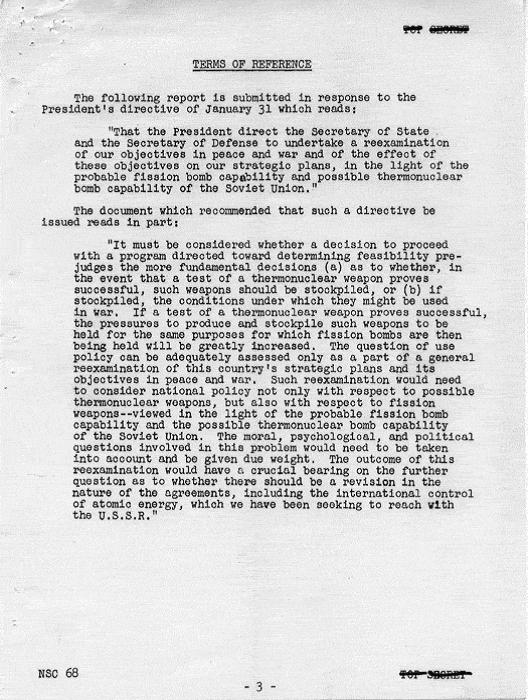
April 7, 1950, Cold War document crafted by President Truman as a presidential directive:

The page to the left is but one page of 72 page directive, of which the full document is found here.


If after reading in full context that is not enough for not lifting sanctions on Russia due to history versus contemporary actions….we can move on to the Reagan era. The text of President Reagan’s ‘Evil Empire’ speech.

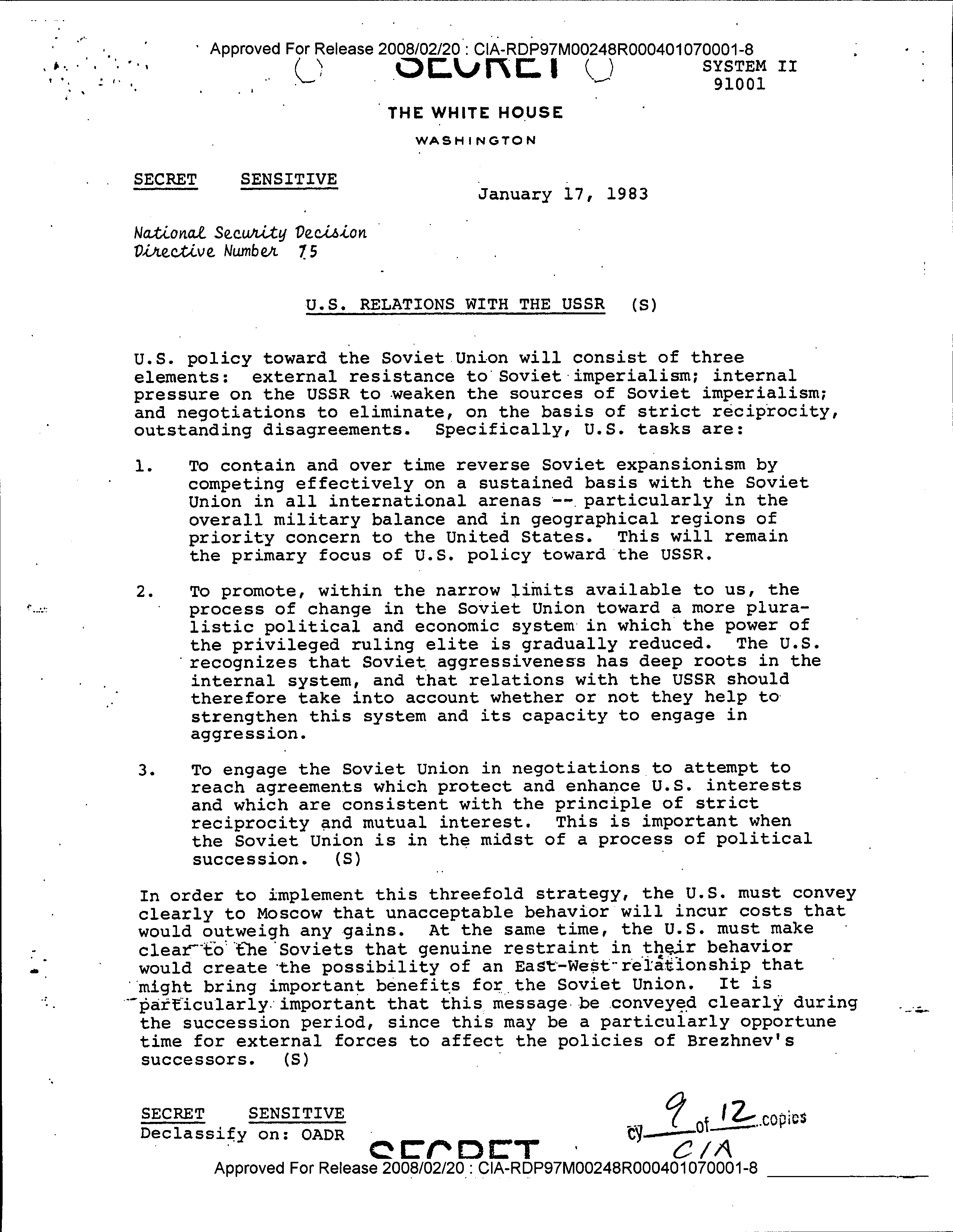
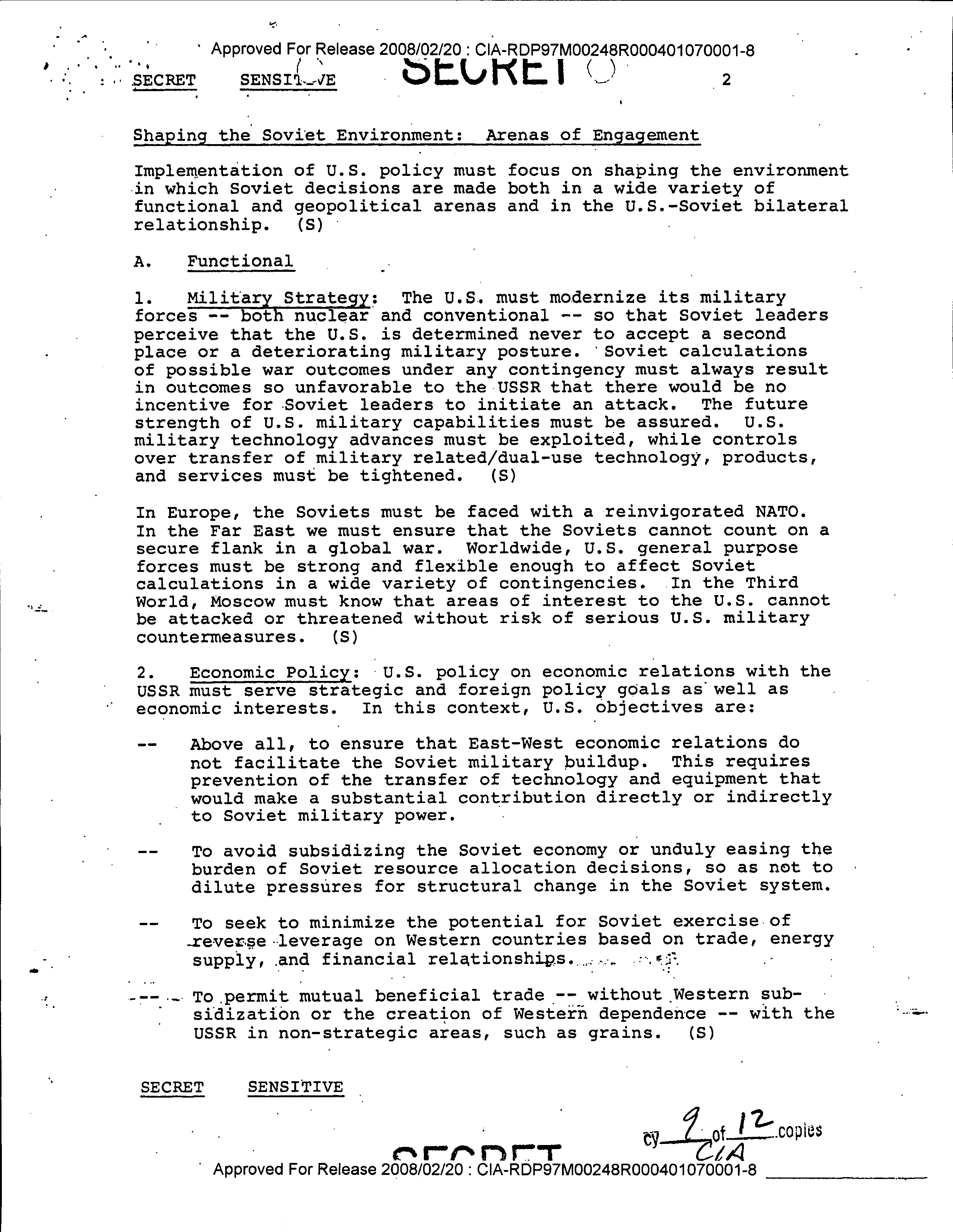
January 17, 1983, President Reagan issued Directive #75.


You can read the full document here.

Anymore questions on why President Trump needs to stand stern on Russia? History does meet today.

Russia Arrests Kaspersky ‘Treason Probe’

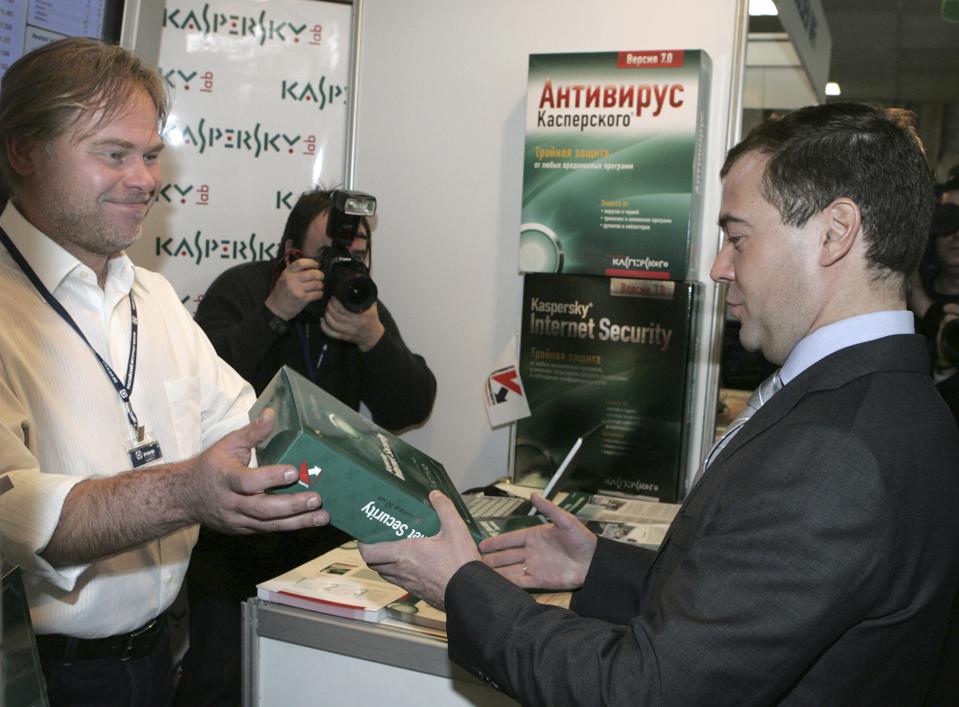
Russian President-elect Dmitry Medvedev, right, speaks with Yevgeny Kaspersky, head of the Kaspersky Lab company, at the 2008 Internet Forum outside Moscow, Thursday, April 3, 2008. (AP Photo/RIA-Novosti, Mikhail Klimentyev, Pool)

Forbes: One of Russia’s most successful cybercrime investigators and hacker hunter at one of the world’s biggest security companies, Kaspersky Lab, has been arrested by Russian law enforcement as part of a probe into possible treason, according to reports. Kaspersky has confirmed that its incident response chief Ruslan Stoyanov was at the center of an investigation, but could not offer more details.

“This case is not related to Kaspersky Lab. Ruslan Stoyanov is under investigation for a period predating his employment at Kaspersky Lab,” a Kaspersky spokesperson said in an emailed statement. “We do not possess details of the investigation. The work of Kaspersky Lab’s Computer Incidents Investigation Team is unaffected by these developments.”

Reports of the arrest landed today from national paper Kommersant, which said Stoyanov’s arrest may be tied to an investigation into Sergei Mikhailov, deputy head of the information security department of the FSB, Russia’s national security service. Both men were said to have been arrested in December. Kommersant cited sources who claimed the investigation was exploring the receipt of money from foreign companies by Stoyanov and his links to Mikhailov.

The FBI consistently investigates Russian cybercrime operations, the best-known case being the alleged 2016 hacks of the U.S. election, following a breach at the Democratic National Committee.

Major player in fighting Russian cybercrime

In his role at Kaspersky, Stoyanov was in charge of incident response, the group that helped organizations investigate and recover from breaches or other security events. According to his LinkedIn profile, prior to his 2012 move to Kaspersky, he spent six years as a major in the Ministry of Interior’s cybercrime unit between 2000 and 2006 before moving into the private sector.

A source familiar with Stoyanov’s past work told FORBES that during his time chasing cybercriminals for the Russian government, he was the lead investigator into a hacker crew that was launching denial of service attacks on U.K. betting shops, extorting them for a total of $4 million. Three individuals were arrested and each sentenced in 2006 to eight years in prison.

In recent years, Stoyanov has assisted Russian authorities in some major investigations into cybercrime, including one that led to arrests of 50 individuals involved in the Lurk gang, which stole as much as $45 million from local banks.

“Stoyanov was involved in every big arrest of cybercriminals in Russia in past years,” the source added.

Kaspersky has repeatedly aroused suspicion in the U.S. for its ties to the Kremlin, thanks to articles alleging CEO Eugene Kaspersky’s ties with the state. The firm has denied any collusion with the government, however. The charismatic chief wrote in FORBES in 2015 that he had never worked for the FSB and his companies had no ties to Russia or any other government. He wrote: “A few reporters who seem to be openly hostile to Kaspersky Lab will no doubt be planning their next fictional installment.”

**** Was this because Kaspersky blew the whistle on the hack of the NSA which maybe had Russian fingerprints? Let’s see…

In part from Motherboard: A mysterious hacker or hackers going by the name “The Shadow Brokers” claims to have hacked a group linked to the NSA and dumped a bunch of its hacking tools. In a bizarre twist, the hackers are also asking for 1 million bitcoin (around $568 million) in an auction to release more files.

“Attention government sponsors of cyber warfare and those who profit from it!!!!” the hackers wrote in a manifesto posted on Pastebin, on GitHub, and on a dedicated Tumblr. “How much you pay for enemies cyber weapons? […] We find cyber weapons made by creators of stuxnet, duqu, flame.”

The hackers referred to their victims as the Equation Group, a codename for a government hacking group widely believed to be the NSA.

”We find cyber weapons made by creators of stuxnet, duqu, flame.”

The security firm Kaspersky Lab unmasked Equation Group in 2015, billing it as the most advanced hacking group Kaspersky researchers had ever seen. While Kaspersky Lab stopped short of saying it’s the NSA, its researchers laid out extensive evidence pointing to the American spy agency, including a long series of codenames used by the Equation Group and found in top secret NSA documents released by Edward Snowden. The Equation Group, according to Kaspersky Lab, targeted the same victims as the group behind Stuxnet, which is widely believed to have been a joint US-Israeli operation targeting Iran’s nuclear program, and also used two of the same zero-day exploits.

The Shadow Brokers claimed to have hacked the Equation Group and stolen some of its hacking tools. They publicized the dump on Saturday, tweeting a link to the manifesto to a series of media companies.

The dumped files mostly contain installation scripts, configurations for command and control servers, and exploits targeted to specific routers and firewalls. The names of some of the tools correspond with names used in Snowden documents, such as “BANANAGLEE” or “EPICBANANA.” Read more here from Motherboard.

Top Policy People, Mass Exodus at State Dept.

 Rex Tillerson was there at Foggy Bottom getting a lay of the landscape, when the resignations turned in last week became effective today as there was a walk out. And YES, the most corrupt official at the State Department remaining after John Kerry left is Patrick Kennedy, and he is gone too…YIPPEE.


It is real awesome that Victoria Nuland has left too.

CBS: State Department posts occupied by other career diplomats have also been left vacant. Victoria Nuland is one of the people leaving. Nuland was the Assistant Secretary of State responsible for Russia and Eurasia Policy at the State Department, and is known for her hardline view on Russia. Linda Etim, a political appointee handling USAID and African affairs, has also left the State Department.

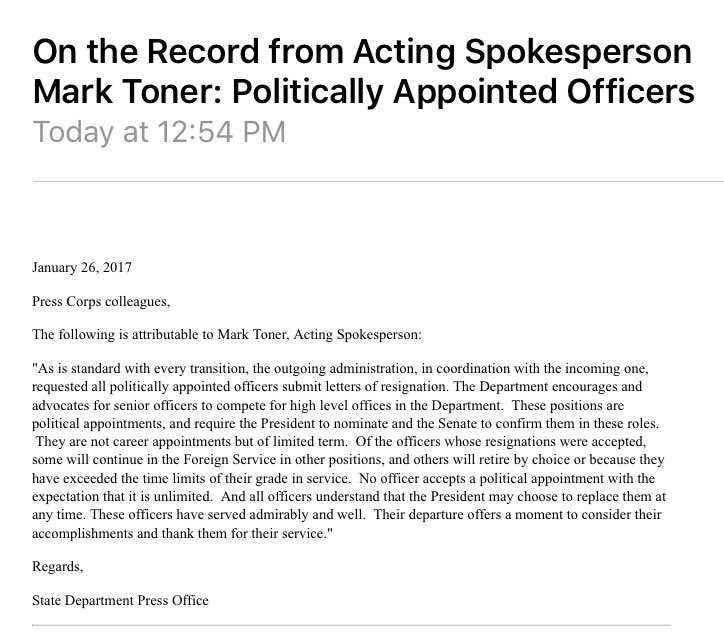
The State Department’s entire senior management team just resigned

WaPo: Secretary of State Rex Tillerson’s job running the State Department just got considerably more difficult. The entire senior level of management officials resigned Wednesday, part of an ongoing mass exodus of senior foreign service officers who don’t want to stick around for the Trump era.

Tillerson was actually inside the State Department’s headquarters in Foggy Bottom on Wednesday, taking meetings and getting the lay of the land. I reported Wednesday morning that the Trump team was narrowing its search for his No. 2, and that it was looking to replace the State Department’s long-serving undersecretary for management, Patrick Kennedy. Kennedy, who has been in that job for nine years, was actively involved in the transition and was angling to keep that job under Tillerson, three State Department officials told me.

Then suddenly on Wednesday afternoon, Kennedy and three of his top officials resigned unexpectedly, four State Department officials confirmed. Assistant Secretary of State for Administration Joyce Anne Barr, Assistant Secretary of State for Consular Affairs Michele Bond and Ambassador Gentry O. Smith, director of the Office of Foreign Missions, followed him out the door. All are career foreign service officers who have served under both Republican and Democratic administrations.

Kennedy will retire from the foreign service at the end of the month, officials said. The other officials could be given assignments elsewhere in the foreign service.

In addition, Assistant Secretary of State for Diplomatic Security Gregory Starr retired Jan. 20, and the director of the Bureau of Overseas Building Operations, Lydia Muniz, departed the same day. That amounts to a near-complete housecleaning of all the senior officials that deal with managing the State Department, its overseas posts and its people.

“It’s the single biggest simultaneous departure of institutional memory that anyone can remember, and that’s incredibly difficult to replicate,” said David Wade, who served as State Department chief of staff under Secretary of State John Kerry. “Department expertise in security, management, administrative and consular positions in particular are very difficult to replicate and particularly difficult to find in the private sector.”

Several senior foreign service officers in the State Department’s regional bureaus have also left their posts or resigned since the election. But the emptying of leadership in the management bureaus is more disruptive because those offices need to be led by people who know the department and have experience running its complicated bureaucracies. There’s no easy way to replace that via the private sector, said Wade.

“Diplomatic security, consular affairs, there’s just not a corollary that exists outside the department, and you can least afford a learning curve in these areas where issues can quickly become matters of life and death,” he said. “The muscle memory is critical. These retirements are a big loss. They leave a void. These are very difficult people to replace.”

Whether Kennedy left on his own volition or was pushed out by the incoming Trump team is a matter of dispute inside the department. Just days before he resigned, Kennedy was taking on more responsibility inside the department and working closely with the transition. His departure was a surprise to other State Department officials who were working with him.

One senior State Department official who responded to my requests for comment said that all the officials had previously submitted their letters of resignation, as was required for all positions that are appointed by the president and that require confirmation by the Senate, known as PAS positions.

“No officer accepts a PAS position with the expectation that it is unlimited. And all officers understand that the President may choose to replace them at any time,” this official said. “These officers have served admirably and well. Their departure offers a moment to consider their accomplishments and thank them for their service. These are the patterns and rhythms of the career service.”

Ambassador Richard Boucher, who served as State Department spokesman for Colin Powell and Condoleezza Rice, said that while there’s always a lot of turnover around the time a new administration takes office, traditionally senior officials work with the new team to see who should stay on in their roles and what other jobs might be available. But that’s not what happened this time.

The officials who manage the building and thousands of overseas diplomatic posts are charged with taking care of Americans overseas and protecting U.S. diplomats risking their lives abroad. The career foreign service officers are crucial to those functions as well as to implementing the new president’s agenda, whatever it may be, Boucher said.

“You don’t run foreign policy by making statements, you run it with thousands of people working to implement programs every day,” Boucher said. “To undercut that is to undercut the institution.”

By itself, the sudden departure of the State Department’s entire senior management team is disruptive enough. But in the context of a president who railed against the U.S. foreign policy establishment during his campaign and secretary of state with no government experience, the vacancies are much more concerning.

Tillerson’s job No. 1 must be to find qualified and experienced career officials to manage the State Department’s vital offices. His second job should be to reach out to and reassure a State Department workforce that is panicked about what the Trump administration means for them.

Mattis Encountering Russian Aggression Already?

Secretary of Defense James Mattis will embark on his first trip as secretary Feb. 1-4 to meet with his counterparts from two critical allies, Japan and the Republic of Korea. The four day trip will include stops in Seoul and Tokyo.   Departing on Feb. 1, Secretary Mattis will begin his trip in the Republic of Korea, where he will meet Minister of National Defense Han Min Koo and other senior Korean officials.  On Feb. 3, Secretary Mattis will travel to Tokyo for meetings with Minister of Defense Tomomi Inada and other senior Japanese officials.   The trip will underscore the commitment of the United States to our enduring alliances with Japan and the Republic of Korea, and further strengthen U.S.-Japan-Republic of Korea security cooperation.

***

NORAD responds after Russian bombers zoom around Japan

A pair of Russian Tu-95 Bear nuclear-capable bombers flew around Japan on Tuesday, prompting the Japanese military to scramble fighter jets as the North American Aerospace Defense Command (NORAD) increased its threat posture, two U.S. defense officials revealed to Fox News.

The Russian bombers stayed in international airspace, the officials said. News of this latest Russian provocation came shortly after the Pentagon announced that new Defense Secretary James Mattis would make his first visit overseas to Japan and South Korea early next month.

A third Russian Tu-95 bomber took off from a base in eastern Russia near the Pacific Ocean but it did not fly around Japan. Instead, it acted as a “communications relay” to pass radio traffic between the bombers flying around Japan, the officials said.

NORAD did not immediately respond for comment when reached by Fox News.

All three Russian strategic bombers took off outside the Pacific coastal city of Anadyr in eastern Russia. They returned to the eastern Russian airbase Ukrainka, roughly 1,000 miles from Japan.


Three Russian refueling tankers (IL-78) were also part of the flight. Two airborne radar and communications planes known as Beriev A-50 AWACs were also part of the Russian flying armada.

Only two Russian bombers made the flight around Japan’s major islands, according to officials.

The increase in threat posture from 5 to 4 meant the U.S. Air Force would place an extra tanker crew on standby ready to refuel the Japanese jets if necessary, according to officials.

It was the first time Russian bombers had circumnavigated Japan’s major islands in a year, the officials said.

***

The last time JASDF had to scramble fighter jets in response to Russian bomber incursions occurred a year ago, in January 2016, when two Russian Tu-95 bombers circled Japan’s major islands on a similar flight path to yesterday’s patrol. In March 2015, Russian strategic bombers also patrolled the skies in close vicinity to the Ryukyu Islands.

Russia stopped conducting regular bomber patrols in the 1990s and early 2000s, but has increased its patrol activities in the Pacific Ocean following the Ukraine crisis in 2014 amid the resulting isolation from the West. As I reported in October 2016 (See: “Russia to Set up Heavy Bomber Division to Patrol Japan, Hawaii, and Guam”), the Russian Aerospace Forces are in the process of setting up a new long-range heavy bomber division in Russia’s Far East to patrol the Pacific Ocean inside the Japan-Hawaii-Guam triangle.

The new unit will eventually consist of several dozen Tu-95MS strategic missile bombers and Tu-22M3 long-range bombers. “The Tupolev Tu-95MS, an improved variant of the older Tu-95, is a four-engine, long-range, turboprop, strategic bomber that can be armed with a wide range of weapons including stand-off cruise missiles. Russia intends to operate 20 Tu-95MS by the end of 2016,” I explained. The new division is based on the 6953rd Guards’ Red Banner, Pacific Air Group, which conducted patrols within the Japan-Hawaii-Guam triangle during the Cold War. More here.