Russian Ambo Kislyak also Met with WH’s John Holdren

Who is this Russian ambassador anyway? It is likely no coincidence that the Russian spy ship is presently off the coast of Florida as this post is about to be published either. We are watching this vessel as they are watching us. Moving on…

Ambassador Sergey Kislyak is a long time English speaking operative from the Kremlin who is called back to Moscow at any moment’s notice to confer with the Russian intelligentsia. Meanwhile, Ambassador Kislyak has been cultivating a network in Washington DC for many years and he makes the social government scene with regularity. In fact, Kislyak often made visits to the Obama White House where most recently he met with the former czar and still Obama advisor, John Holdren.

Image result for sergey kislyak on the sofa bu.edu

The logs include which White House official hosted Kislyak each time he was cleared to visit. The hosts included are: Gary Samore, who was the senior National Security Council official on weapons of mass destruction during Obama’s first term (four visits); Robert Malley, who was Obama’s senior adviser on defeating the Islamic State (three visits); Lawrence Summers, who was Obama’s economic adviser (one visit); Michael Froman, Obama’s trade representative; Holdren (two visits); and the visitor’s office (four visits).

Kislyak was also listed in the logs an additional 12 times, but that was when there were between 180 and 3,000 other visitors also listed, such as for an event like a “holiday open house” or the “diplomatic corps reception.” More here.

***

Kislyak is an expert on arms control negotiations with a degree from the Moscow Engineering Physics Institute, Mr. Kislyak first served in the Washington embassy from 1985 to 1989 during the late Soviet period. He became the first Russian representative to NATO and was ambassador to Belgium from 1998 to 2003. He returned to Moscow, where he spent five years as a deputy foreign minister. He has told associates that he will leave Washington soon, likely to be replaced by a hard-line general. His name recently surfaced at the United Nations as a candidate for a new post responsible for counterterrorism, diplomats there said. Vitaly I. Churkin, the Russian ambassador to the United Nations, died last month and that post remains vacant. More here.

While we are in somewhat of a scandal due to several within the Trump team and later his administration as having meetings with Russian officials, there is quite a lot of hypocrisy in the matter as noted by the countless democrats who too have been in the frequent company of the ambassador. But to several wrongs go right when the republicans do the same? Actually, there should be more vetting and control along with messaging for the republicans as they are in full power of government. Why you ask?

Image result for sergey kislyak trump speech democrats

It is said that Sergey Kislyak is not just the ambassador of record, but he is also the top boss and manager of the Russian diplomatic architecture in the United States as well as the marshal of the intelligence wing and espionage operations across our homeland as well. It is questionable as to why he too was not expelled last December by Obama or perhaps that would have caused even more relational strain between the two countries. Kislyak was born in Ukraine and he declares he is not Ukrainian but rather a Russian. Could he have been quite busy with passing intelligence during the time Russia annexed Crimea and is presently continuing military aggressions against Ukraine? Yes. There is a war in Ukraine.

Image result for sergey kislyak

Most places in eastern Ukraine are still overwhelmed with Russian propaganda, which is as much of a threat to Ukraine’s overall war effort as the tanks and artillery. In some places, there is still not a single Ukrainian broadcast TV channel available—they’re all beamed in from Russia and the two separatist territories.

The diffuse Russian propaganda taps into attitudes leftover from the Soviet era, including deeply held, latent fears about fascism, and distrust for the central government in Kyiv. Conspiracy theories about the intentions of the U.S., NATO, and western Ukrainians are also pervasive. More here.

Some within the CIA say that Kislyak is both a diplomat and a spy. It is important to add the fact that diplomats have immunity and it is great cover when the FBI is tasked with tracking communications and movement. This is for sure the reason that Barack Obama did not expel him last December. Russia has issued a complete denial he is a spy. Uh huh…

He is in fact a hardliner but has any government official outside of CIA paid attention?

Kislyak: Why do we need to provide assurances to the U.S. Congress? We provide assurances to the Russian parliament. So if the United States is interested in working with us in nuclear energy cooperation, that is fine. It is for the United States to decide what it is that it wants. If it wants to cooperate with us, the doors [for cooperation] are open. If we are asked to make our actions, our policies, reportable to the [U.S.] Congress in order for the U.S. to make decisions on cooperating with us, we are not interested in that kind of scheme. We are fully in compliance with our obligations, with our commitments. We have not violated any agreement with the United States or anybody else. Our cooperation with Iran is limited in the nuclear field to Bushehr. By the way, your president has welcomed the way we cooperate on Bushehr because a scheme for the project that was developed with the Iranians that is very reliable and provides an alternative, a visible alternative, to the need to develop an indigenous enrichment capability. Because we build the reactor, we provide the fuel, and we take it back.[18] This is the best way to provide access to nuclear energy and electricity derived from nuclear energy. It was also supported by Europe.

When it comes to the defense supplies you seem to be referring to, there are no inconsistencies with our obligations or the resolutions of the Security Council, because we do show restraint, and whatever we do is purely defensive and for deterrence. It is our policy, and it is reportable the Russian parliament and Russian people and not anybody else. If the United States is interested in working with us [in the field of nuclear energy], we will be more than ready to work together, but it needs to be based on mutual respect and the mutual respect of interests. I think there are all sorts of reasons why we could and should cooperate in this field because both of us can do a lot in order to promote nuclear energy. That is something that most probably for the coming 20-30 years will be the alternative of choice to fossil fuel, and I do not know of any other [alternative] source of energy that can be employable in the foreseeable future but nuclear energy. All other renewable energies are either in scarce supply or the technology has yet to be developed to the point where it becomes competitive.

So we will see, all of us, significant development of nuclear energy in a lot of countries, in yours as well. We also embarked on an ambitious program to expand nuclear energy production. Currently we have, I think, 16 or 17 percent of electricity produced in my country from nuclear energy sources, and we will expand it to 25 [percent] within maybe 15 or more years. It is an ambitious program. We are going to make it. At the same time, we have a lot of things that are of interest to your industries.

You might be interested in [our]technologies, so we are very much mutually complementary. But unless we have a bigger [legal] framework for that, there can be no reliable interaction between our respective businesses. If the United States wants to work with us, we would be more than willing to do so.

There is another initiative by the two presidents, and that is to develop alternative sources of nuclear energy for the rest of the world that are less prone to proliferation. We are offering the multilateral enrichment center and your president has launched the idea of the GNEP [Global Nuclear Energy Partnership].[19]  

The full interview is here.


Radioactivity in Europe Due to Russian Nuclear Test?

U.S. Air Force deploys WC-135 nuclear sniffer aircraft to UK as spike of radioactive Iodine levels is detected in Europe

The USAF WC-135C Constant Phoenix might be investigating a spike in radioactive levels in Norway. Someone speculates the release of this radionuclide could be the effect of a Russian nuclear test.

On Feb. 17, 2017, U.S. Air Force WC-135C Constant Phoenix Nuclear explosion “sniffer,” serial number 62-3582, using radio callsign “Cobra 55” deployed to RAF Mildenhall, UK.

As we have already reported the WC-135 is a derivative of the Boeing C-135 transport and support plane. Two of these aircraft are in service today out of the ten examples operated since 1963. The aircraft are flown by flight crews from the 45th Reconnaissance Squadron from Offutt Air Force Base while mission crews are staffed by Detachment 1 from the Air Force Technical Applications Center.

The WC-135, known as the “sniffer” or “weather bird” by its crews, can carry up to 33 personnel. However, crew compliments are kept to a minimum during mission flights in order to lessen levels of radioactive exposure.

Effluent gasses are gathered by two scoops on the sides of the fuselage, which in turn trap fallout particles on filters. The mission crews have the ability to analyze the fallout residue in real-time, helping to confirm the presence of nuclear fallout and possibly determine the characteristics of the warhead involved: that’s why the aircraft is important to confirm the type of explosion of today’s test.


Along with monitoring nuke testing, the WC-135 is used to track radioactive activity as happened after the Chernobyl nuclear plant disaster in the Soviet Union in 1986 and Fukushima incident back in 2011.

One of these aircraft was deployed near North Korea in anticipation of Kim Jong Un rocket launches then was spotted transiting the UK airspace in August 2013 raising speculations it was used in Syria thanks to the ability to detect chemical substances down wind from the attack area days, or weeks after they were dispersed.

Although they cross the European airspace every now and then, their deployment in the Old Continent is somehow rare. As of yet, there has been no official statement from the U.S. military about the reasons why such nuclear research aircraft was deployed there. However, many sources suggest the aircraft was tasked with investigating the spike in Iodine levels detected in northern Europe since the beginning of January.

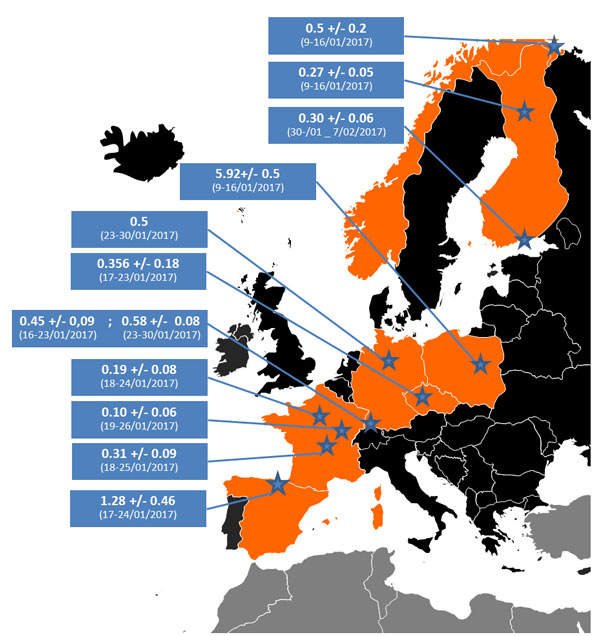
Iodine-131 (131I), a radionuclide of anthropogenic origin, has recently been detected in tiny amounts in the ground-level atmosphere in Europe. The preliminary report states it was first found during week 2 of January 2017 in northern Norway. Iodine-131 was also detected in Finland, Poland, Czech Republic, Germany, France and Spain, until the end of January.

However, no one seems to know the reason behind the released Iodine-131. Along with nuclear power plants, the isotope is also widely used in medicine and its presence in the air could be the effect of several different incidents.

Or, as someone speculates, it could have been the side effect of a test of a new nuclear warhead in Russia: an unlikely (considered the ability to detect nuke tests through satellites and seismic detectors) violation of Nuclear Test Ban Treaty.

Maybe the WC-135 will help authorities find out the origin of the Iodine-131.

Detection of radioactive iodine at trace levels in Europe in January 2017

Iodine-131 (131I), a radionuclide of anthropogenic origin, has recently been detected in tiny amounts in the ground-level atmosphere in Europe. The preliminary report states it was first found during week 2 of January 2017 in northern Norway. Iodine-131 was also detected in Finland, Poland, Czech Republic, Germany, France and Spain, until the end of January.

Iodine-131 is a radionuclide with a short half-life (T1/2 = 8.04 day). The detection of this radionuclide is proof of a rather recent release.

Besides the iodine release, the origin of which is still unknown, the poor dispersion conditions due to the thermal stratification [1] of the atmosphere also affected the observed concentration levels, including those of naturally occurring radionuclides such as Lead-210 (210Pb) [2], or fine particles (PM2.5 and PM10) leading to pollution episodes, particularly in the Western part of Europe during week 4 of January.

It must be pointed out that only particulate iodine was reported. When detectable, gaseous iodine is usually dominant and can be estimated to be 3 to 5 times higher than the fraction of particulate iodine.

In France, particulate 131I reached 0.31 µBq/m3 and thus the total (gaseous + particulate fractions) can be estimated at about 1.5 µBq/m3. These levels raise no health concerns.

The data has been shared between members of an informal European network called Ring of Five gathering organizations involved in the radiological surveillance of the atmosphere. In France, IRSN is responsible for monitoring the radioactivity of the atmosphere on a nation-wide scale. Its surveillance network OPERA-Air includes high-volume aerosol samplers (700 to 900 m3 of air per hour) and measurement equipment capable of detecting trace amounts of radioactivity.


Particulate Iodine-131 (value +/- uncertainty) in the atmosphere(µBq/m3) :
Particulate Iodine-131 (value +/- uncertainty) in the atmosphere(µBq/m3)

More information about the Ring of Five (Ro5) network


Notes:
1- Thermal stratification of the atmosphere that often affects the lower atmospheric layers in winter. The colder air at ground-level compare with altitude stuck or considerably limit atmospheric pollutant dispersion.
2- The 210Pb concentration detected by IRSN peaked at 1600 µBq/m3 in January, four times higher than the usual mean value.

California Secede from United States, Courtesy of Russia

The movement:

In our view, the United States of America represents so many things that conflict with Californian values, and our continued statehood means California will continue subsidizing the other states to our own detriment, and to the detriment of our children.

Although charity is part of our culture, when you consider that California’s infrastructure is falling apart, our public schools are ranked among the worst in the entire country, we have the highest number of homeless persons living without shelter and other basic necessities, poverty rates remain high, income inequality continues to expand, and we must often borrow money from the future to provide services for today, now is not the time for charity.

However, this independence referendum is about more than California subsidizing other states of this country. It is about the right to self-determination and the concept of voluntary association, both of which are supported by constitutional and international law.

It is about California taking its place in the world, standing as an equal among nations. We believe in two fundamental truths: (1) California exerts a positive influence on the rest of the world, and (2) California could do more good as an independent country than it is able to do as just a U.S. state.

In 2016, the United Kingdom voted to leave the international community with their “Brexit” vote. Our “Calexit” referendum is about California joining the international community. You have a big decision to make.

****

He’s the founder of a Californian independence movement. Just don’t ask him why he lives in Russia.

WaPo: Louis J. Marinelli is a man on a quixotic mission: to help California secede from the United States and become an independent country.

Image result for Louis J. Marinelli

Surprisingly, this quest has been going relatively well of late. Marinelli’s group, Yes California, is attempting to collect 585,000 signatures necessary to place a secessionist question on the 2018 ballot. Buoyed by California’s already tense relationship with President Trump, the campaign has received a large amount of press coverage and support over the past few months.

But for the 30-year-old Yes California president, there remains one annoying problem: People keep asking him why he lives in Russia.

In the wake of Yes California’s recently acquired momentum, a lot of people have taken note of Marinelli’s unusual home base. Numerous articles have appeared in the Californian media noting Marinelli’s choice of residence. On social media, discussions about Marinelli often take on a deeply conspiratorial tone.

“Hands off California, Putin,” a rival secessionist movement, the California National Party, tweeted in January. “We won’t take orders from your puppet Moscow Marinelli.”

Marinelli has perhaps compounded the issue by making numerous appearances on Russian state media (approximately once a week, by his own estimation), at times offering a political viewpoint that seems to line up neatly with the Kremlin’s. In late December, the Russian media gave widespread coverage to Marinelli as his group opened a “Californian Embassy” in Moscow.

Speaking via video chat from his home in Yekaterinburg earlier this month, Marinelli seemed exasperated when quizzed about his decision to live in Russia.

Image result for yekaterinburg russia

“And Barack Obama was born in Kenya, right?” he said incredulously.

“The fact that I’m an English teacher in Yekaterinburg doesn’t mean there’s some Russian government conspiracy or support for our campaign,” Marinelli said. “The fact that I studied Russian language courses at Saint Petersburg State University in 2007 or ’08 doesn’t mean that I know Vladimir Putin, who graduated from there in 1975.”

He offered an explanation for his circumstances that went into more detail than one posted in a FAQ section on the Yes California website. It presented a reasonable — though unusual — set of events that had resulted in him leading a Californian independence movement from half a world away.

It goes like this: Buffalo-born Marinelli moved to California in 2006. A year later, he upped sticks and went to Saint Petersburg State University to study Russian. He lived “on and off” in Russia between 2007 and 2011, during which time he met his wife, a Russian citizen. The pair moved back to San Diego, but Marinelli’s partner ran into problems with the U.S. immigration system.

“Her visa had expired and there was really no way for us to easily adjust her status,” Marinelli said. “If she had left the country, she’d be banned for 10 years, and so that wasn’t an option.”

Marinelli said they received a “glimmer of hope” last August that would allow his wife, who has been unable to leave the country until her legal status in the United States was secured, a chance to return home. She was desperate to visit her family, he said, so Marinelli found an apartment in Yekaterinburg and a job teaching English for a semester that provided him a visa. But then, according to his telling, “the immigration thing kind of fell through,” and his wife was unable to travel.

The end result was that Marinelli was obliged to go to Russia, he said, while his Russian wife was stuck in San Diego. “We’re still working on resolving the problem,” Marinelli said, adding that his wife was in the process of getting a green card. “Hopefully that goes well and we can end this chapter of our lives.”

It’s a strange situation — and not exactly how some of Marinelli’s partners in Yes California describe it (Marcus Ruiz Evans, the group’s vice president, told The Washington Post that Marinelli’s wife also lived in Russia).

But it is a plausible scenario.

Marinelli’s ties to Alexander Ionov are perhaps bigger conspiracy fodder. Ionov is the founder of the Anti-Globalization Movement of Russia, a group that supports various secessionist movements around the world. Last September, he put on a Kremlin-sponsored event in Moscow for Western secessionists that Marinelli and other representatives of Yes California attended.

Reached via email, Ionov said that about 30 percent of the funding for the event came from the Russian government. But he said none of that money was given to any U.S. groups, including Yes California. Marinelli also pushed back on the idea that this represents a link with the Russian government.

“We don’t have any communication with or contact with or receive any support of any kind from the Russian government or any Russian government officials,” Marinelli said.

“We’re not actively pursuing a dialogue with Vladimir Putin here in Russia even though I’m in Russia,” he added.

Would Putin want a dialogue? Some experts said that while Ionov and his group may have some limited ties to the Kremlin, they are ultimately small fry in Moscow.

Simon Saradzhyan, the founding director of the Russia Matters Project at Harvard’s Belfer Center for Science and International Affairs, said that the Russian government probably wasn’t taking the Yes California project very seriously, “if only because that chances that this movement can eventually win independence for that state are close to zero.” But Saradzhyan also noted that Russia could well be interested in getting revenge on Washington for what it saw as U.S. support for Chechen separatism in the 1990s.

Fiona Hill, a Russia expert with Brookings Institution, said in an email that historical Russian links to California added further intrigue to the situation.

“Russia had a major early-19th century colony in California and there has been quite a lot of interest in promoting this from circle’s close to the Kremlin,” Hill said, pointing to Kremlin-connected oligarch Viktor Vekselberg and his interest in Fort Ross, the former colony in what is now Sonoma County.

It sounds outlandish, but after an election in which Russian interference supposedly helped a former reality television star with no political experience gain entry to the White House — well, perhaps it doesn’t seem that outlandish. Marinelli didn’t sound like a fan of the way that election turned out. He repeatedly criticized Trump during his interview with WorldViews, noting how the U.S. president had threatened to defund California.

Marinelli also admitted that he voted for Trump — a tactical decision, he explained. “We need things that we can use to promote the cause, and I think Donald Trump is a daily advertisement for that cause,” he said, noting that his vote didn’t matter much in California, anyway.

When it comes to Marinelli’s thoughts on the other president in his life, Putin, he keeps his cards closer to his chest. He said he doesn’t have an emotional connection to Russia in the same way he does the United States, which is actually “a great thing” about living in Yekaterinburg.

Back home, he said, he was often frustrated by what he saw as America’s failings.

“I think every country has progress to make on some fronts. People say, for example, that Russia has progress to make when it comes to civil rights and human rights,” he said. “And the United States doesn’t? In Russia, police aren’t shooting people because of their skin color. There’s pros and cons.”

Read more:

‘California is a nation, not a state’: This movement wants a break from the U.S.

What did Google Know, When did The Know it?

Image result for google russian hacking Techviral

A Glimpse Into How Much Google Knows About Russian Government Hackers

A 2014 leaked private report from Google shows how much the internet giant knows about government hacking groups.

Motherboard: In October of 2014 an American security company revealed that a group of hackers affiliated with the Russian government, dubbed APT28, had targeted Georgia and other Eastern European countries in a wide-ranging espionage campaign. Two and a half years later, APT28—also known as “Fancy Bear” or “Sofacy”—is a household name not just in the cybersecurity industry, but in the mainstream too, thanks to its attack on the US Democratic party and the ensuing leaks of documents and emails.

Before that report by FireEye, APT28 was a well-kept secret within the cybersecurity industry. At the time, several companies were willing to share information about the hacking group. Even Google investigated the group, and penned a 40-page technical report on the hacking group that has never been published before.

This sort of document, which Motherboard obtained from two independent sources, may be a common sight in the threat intelligence industry, but the public rarely gets to see what such a report from Google looks like. The report draws from one of Google’s most interesting sources of data when it comes to malware and cybersecurity threats: VirusTotal, a public malware repository that the internet giant acquired in 2012.

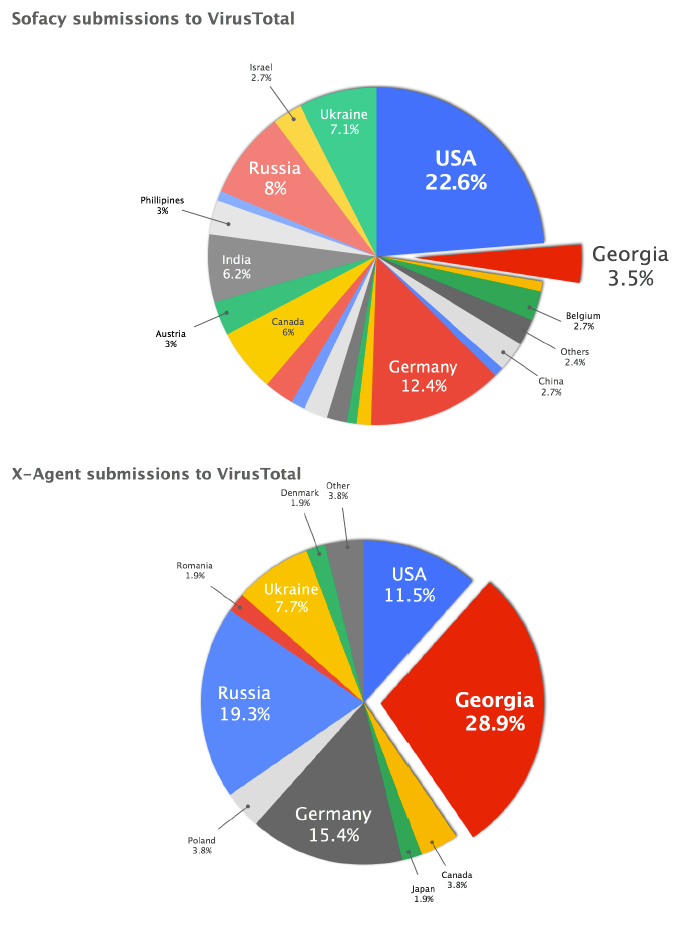
Sofacy and X-Agent, the report read, referring to the malware used by APT28, “are used by a sophisticated state-sponsored group targeting primarily former Soviet republics, NATO members, and other Western European countries.”

“It looks like Google researchers were well aware of Sofacy before it was publicly disclosed.”

While Google security researchers don’t dwell into who’s really behind these operations, they do hint that they agree with the now widespread belief that APT28 works for the Russian government in a clever, indirect, way—in the very title of the report: “Peering into the Aquarium.”

While that might seem like an obscure title, for those who follow Russian espionage activities, it’s a clear reference to the headquarters of the military intelligence agency known as GRU or Glavnoye Razvedyvatel’noye Upravleniye, which are popularly known as “The Aquarium.”

“It looks like Google researchers were well aware of Sofacy before it was publicly disclosed,” Matt Suiche, a security researcher and the founder of Comae Technologies and the OPCDE  conference, told Motherboard in an online chat after reviewing the report. “And also attributed Sofacy and X-Agent to Russia before it was publicly done by FireEye, ESET or CrowdStrike.”

In its report Google security researcher note that APT28 attacks a large number of targets with its first-stage malware Sofacy, but only uses the more tailored and sophisticated X-Agent, which was recently used against Ukraine’s military units, for “high-priority targets.”

“Sofacy was three times more common than X-Agent in the wild, with over 600 distinct samples,” Google’s report stated.

Asked for comment, a Google spokesperson said via email that the company’s “security teams are constantly monitoring potential threats to internet users, and regularly publish information to better protect them.”

The report noted that Georgia had the highest ratio of submissions of Sofacy malware, followed by Romania, Russia and Denmark.

While this report is now a bit dated, it shows that for all its sophistication, APT28 has been often caught in the act of hacking politically interesting targets, betraying the origin of the hackers behind the dry nickname. It also reveals how much a company like Google, which doesn’t have software installed on thousands of customers computers like other antivirus and security vendors that is designed to specifically detect malware, can still learn a lot about government hacking groups thanks to the other data it has access to.

*** Related reading:

State-sponsored hackers targeting prominent journalists, Google warns

Politico: Google has warned a number of prominent journalists that state-sponsored hackers are attempting to steal their passwords and break into their inboxes, the journalists tell POLITICO.

Jonathan Chait of New York Magazine said he received several messages from Google warning him about an attack from a government-backed hacker starting shortly after the election. He said the most recent warning came two to three weeks ago.

Julia Ioffe, who recently started at The Atlantic and has covered Russia for years, said she got warnings as recently as two weeks ago. (See one of the warnings: http://bit.ly/2kMUyRb)

Some journalists getting the warnings say they suspect the hackers could be Russians looking to find incriminating emails they could leak to embarrass journalists, either by revealing alleged liberal bias or to expose the sausage-making of D.C. journalism.

“The fact that all this started right after the election suggests to me that journalists are the next wave to be targeted by state-sponsored hackers in the way that Democrats were during it,” said one journalist who got the warning. “I worry that the outcome is going to be the same: Someone, somewhere, is going to get hacked, and then the contents of their gmail will be weaponized against them — and by extension all media.”

The Russian embassy did not respond to a request for comment.

Image result for russian embassy washington dc Russian embassy Washington DC

Google cautioned that the warnings did not mean the accounts had been compromised already and were sent due to “an abundance of caution.”

“Since 2012, we’ve notified users when we believe their Google accounts are being targeted by government-backed attackers,” said a Google spokesperson in a statement. “We send these warnings out of an abundance of caution — they do not indicate that a user’s account has already been compromised or that a more widespread attack is occurring when they receive the notice.”

Ezra Klein, the founder of Vox, said he had received the warning as recently as a few days back. CNN senior media reporter Brian Stelter said he has been getting the alerts for the past few months.

Other journalists who confirmed they’ve recently gotten the warnings include New York Times national security correspondent David Sanger, Times columnist Paul Krugman and Yahoo Washington bureau chief Garance Franke-Ruta.

GQ special contributor Keith Olbermann said the warnings started a few weeks after the election, and he received the most recent alert earlier this week, a “big bright red bar” across the top of his Gmail. Some of the reporters say they are tightening up their email security to try to prevent the hackers from getting in.

Chait also said he was “contacted over email by a stranger who offered to help me by giving me an encryption key to protect me from hackers. He would not give me his name, meet me or talk on the phone, despite repeated requests.”

The stranger also emailed The Atlantic’s David Frum, James Fallows and Adam Serwer, Andrew Sullivan and Ars Technica’s Dan Goodin.

Stanford professor Michael McFaul, the former U.S. ambassador to Russia, said he also received hacking warnings from Google. He added: “Given my background, one would have to guess that it’s the Russians.”

Iran Buying War Torn Syria Real Estate, Pipelines Abound

Damascus, Syria is known as the city of Jasmine. It is rich in religious history including Christians, Jews and Muslims. If there is any question about how Iran is advancing their power in the region to include Syria and eventually erasing history, then read on.

Now?  AFP

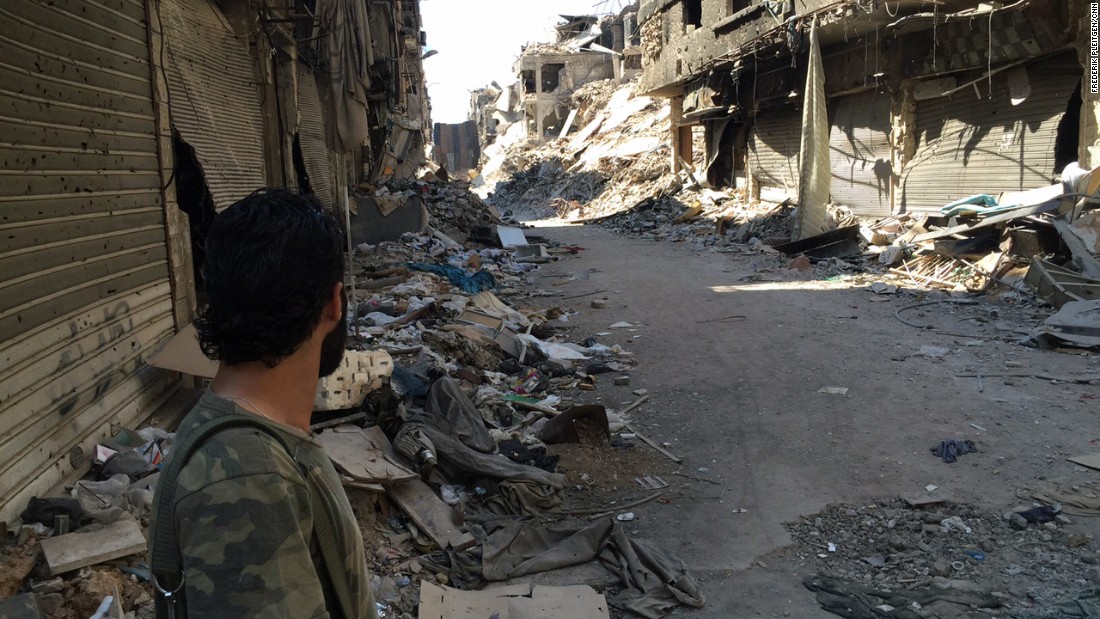
BEIRUT: Syrian government forces fired rockets at a rebel-held area on Damascus’s outskirts on Sunday, pressing an attack that began the day before and has killed up to 16 people, a medical worker and war monitors said.
The medical worker and the Syrian Observatory for Human Rights said it was the biggest attack on the Qaboun area, to the city’s northeast, in at least two years.
At least three shells hit government-held areas closer to the center of Damascus and near Qaboun on Sunday, but there were no reports of casualties, a Hezbollah-run military media unit and a Reuters witness said.
On Saturday, a government sniper killed one person in the area and rockets hit a cemetery on Qaboun’s outskirts, the medical worker, who asked not to be named, told Reuters.
The British-based Observatory also reported attacks on a cemetery.
Reuters could not independently verify the accounts.
There was no immediate government comment on the Damascus fighting.
The Observatory said 16 people had died in the violence around Qaboun since Saturday, the highest death toll from fighting there for more than two years.
The medical worker in nearby Eastern Ghouta, just outside Damascus, said at least 13 people had died. He said he could hear explosions coming from Qaboun early on Sunday.
Violence in western Syria has increasingly tarnished a shaky cease-fire which took effect on Dec. 30, backed by Damascus ally Russia and Turkey, which supports rebels.

*** Related image

The Syrian Commission for Media has issued a report regarding purchases and long-term renting carried out by figures with close ties to the Syrian regime, including Abdullah Nazzam, Iran’s man in Syria. Real estate offices in Damascus have confirmed Nazzam’s unprecedented activity in buying property in capital.

Reports from Damascus and Tehran said that Iran’s men have expanded their purchase activities to include a number of properties in the capital since last June.

The activities of pro-regime businessmen in the purchase of real estate were largely limited to areas of eastern Damascus, namely the Old City, but after June, Abdullah Nazzam expanded his sights on the entire capital.

In addition, the Iranians have also increased their purchasing activities in Eastern Ghouta, largely in Maliha, which is owned by the state, making it easier for the Iranians to circumvent local Syrian laws, especially after the decline of Eastern Ghouta’s battalions after fierce fighting rocked the region last year.

Syrian opposition sources confirmed earlier that many hotels – including Caldah, Iwan, Asia, Damascus International, Venice and Petra – are now owned by the Iranian Embassy in Damascus, ​​in addition to holding shares in the Samiramis Hotel. The Iranian Embassy also sought to buy huge portions of real estate in the Old City of Damascus, specifically in the area extending from behind the Umayyad Mosque to the Bab Touma area, and in the western region of al-Maryamiyah neighborhood.

Image result for iran buying real estate in syria VOA

*** Iranians Buying Up Land in War-Torn Syria

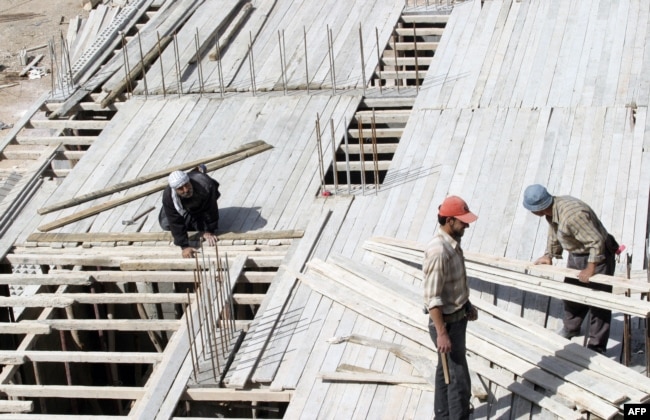
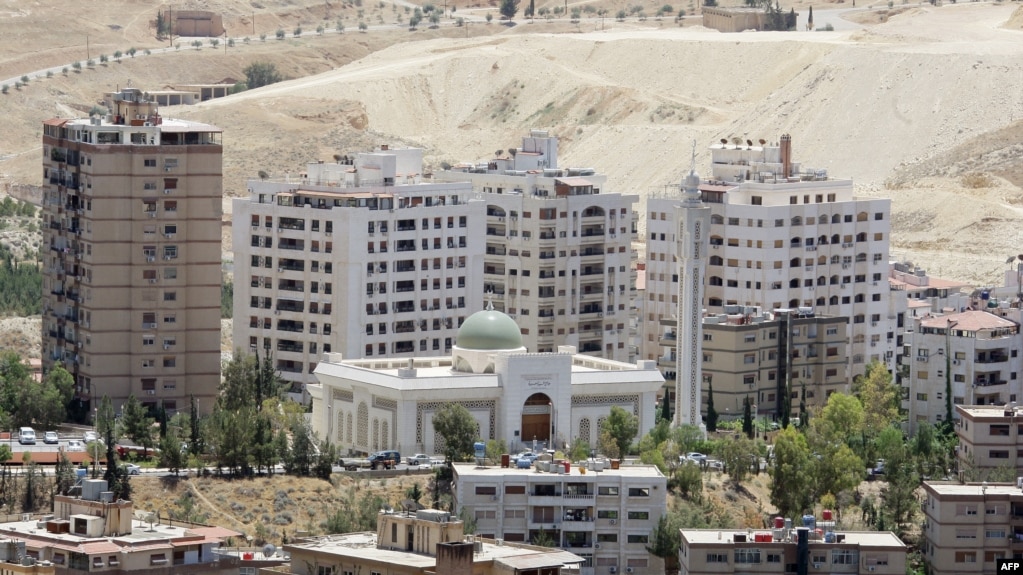
New buildings are seen in Damascus, Syria, in this file photo. Iranians are investing in and providing labor for some of the construction in the war-torn country. AFP PHOTO/ LOUAI BESHARA

New buildings are seen in Damascus, Syria, in this file photo. Iranians are investing in and providing labor for some of the construction in the war-torn country. AFP PHOTO/ LOUAI BESHARA

VOA: Iran’s government wants its builders to buy up property in Shi-ite majority neighborhoods of Syria’s capital, Damascus.

It is also asking construction workers to go to Syria.

This information comes from construction industry officials in Tehran and Iranian experts.

Iranian analyst Fariborz Saremi said owning real estate gives Iran more control over Syria and other parts of the Middle East.

Rich and conservative Iranian business people with ties to the government are buying expensive homes in Damascus, according to news reports. This is influencing price increases in Syria’s real estate markets.

“Five million houses have been destroyed in the civil war,” said Syrian economist Khorshid Alika told Voice of America. “The increased Iranian demand to buy land and properties has naturally led to more inflation in the market.”

Iran’s interest in Syrian real estate is not new. But it increased after the rebel uprising began in 2011.

Government-run media have been reporting recently about how Iran joined Russia to support Syrian President Bashar al-Assad. Assad’s government has been fighting against rebels and the Islamic State terror group.

Iran is not only asking people to buy homes and property in Syria. The country is also asking construction workers and contractors to take jobs there.

One contractor said a fellow contractor with close ties to the Iranian government told him he had a chance to make money in Damascus.

“When we asked about the security, he said that the zone is even more secure than Tehran,” Iranian contractor Amir Maghsoudloo told VOA.

Iran is home to about 3 million people from Afghanistan. Many fled the war-torn country. Most earn low wages in Iran. They are being offered better paying construction jobs in Syria.

Some Damascus construction projects are run by Afghan nationals from Iran, said Tahi Esmali. He is an Afghan national who works as a bricklayer. He had worked in Iran before moving to Syria in 2015.

Iranian interests are not limited to Damascus. Iranian business people and companies are looking to invest in projects in the central Syrian city of Homs. The Syrian military and its Lebanese Hezbollah allies recaptured Homs in late 2015.

The Iranian government has supported Syrian President Assad. Recent reports in state-run media say that Iran increased the size of its Revolutionary Guard Corps in Syria.

*** What more is causing all the interest in Syria by Iran and Russia? Well there are other countries with interests as well….pipelines.

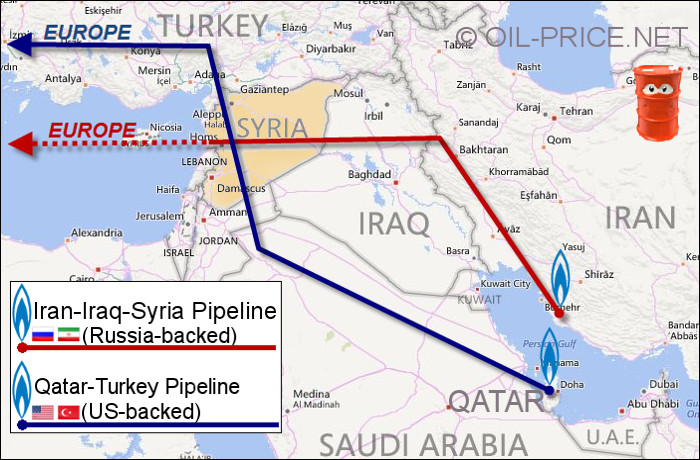
As noted in late 2015: The Syrian Civil War stems from a disagreement between the Saudis and Russia over the route for a new gas pipeline ducting Gulf gas to the lucrative European markets. Russia, whose only Mediterranean base is located in Tartus, Syria, supports Assad’s initiative of a gas pipeline from Iran through Iraq and Syria (the Iran-Iraq-Syria pipeline). But Saudi Arabia’s hardline Sunni Muslims wants to overthrow Syria’s Assad, who is a Shia Muslim, for religious reasons. They want to run a 100 per cent Sunni-controlled pipeline from Qatar through Syria and Turkey (the Qatar-Turkey pipeline), into Europe. As a result of this disagreement a proxy war is taking place in Syria between the aforementioned powers. Meanwhile displaced Syrian refugees are flooding into Europe with jihadis in their midst.

Map of proposed Iran-Iraq-Syria pipeline and Qatar-Turkey pipeline

Originally, Europeans were strongly in favor of deposing Assad for so-called “humanitarian reasons”. Their humanitarian concerns for Assad’s repressive regime veil the truth – Europe resents depending on Russia for 40 per cent of its gas. Russian President Putin annexed Crimea and maintained a belligerent stance, pushing Europe to favor the pipeline proposal of Qatar and Saudi Arabia. The Saudi plan to duct natural gas all the way to Europe through Syria and Turkey came with a catch – Assad would have to be toppled. The US supported the initiative as Russia’s only Mediterranean naval base would disappear with Assad. Thus, the Western world had itself a new plan that would bring peace and prosperity to the region. That is after the “initial shakeout” necessary to oust Assad.

The “initial shakeout” didn’t go as planned. Russia-backed Assad proved far more resilient than anticipated. But more importantly, western-backed Islamic militias committed such barbaric acts of terror they even made Assad, and Russia, look good in comparison. An emboldened ISIS gradually took over several of the region’s oil fields to fund its operations to the tune of $50 million per month by smuggling oil into Turkey. The routes and means were well established during the previous oil embargo on Iraq and so are the financial networks that profit from it in Turkey. Today, crude oil illegally smuggled by ISIS into Turkey accounts for a fairly significant 3.5 per cent of Turkey’s total oil imports. More here.